A (Black) Gat in the Hand: Hammett & The Continental Op – Volume 4 (My intro)
 “You’re the second guy I’ve met within hours who seems to think a gat in the hand means a world by the tail.” – Phillip Marlowe in Raymond Chandler’s The Big Sleep
(Gat — Prohibition Era term for a gun. Shortened version of Gatling Gun)
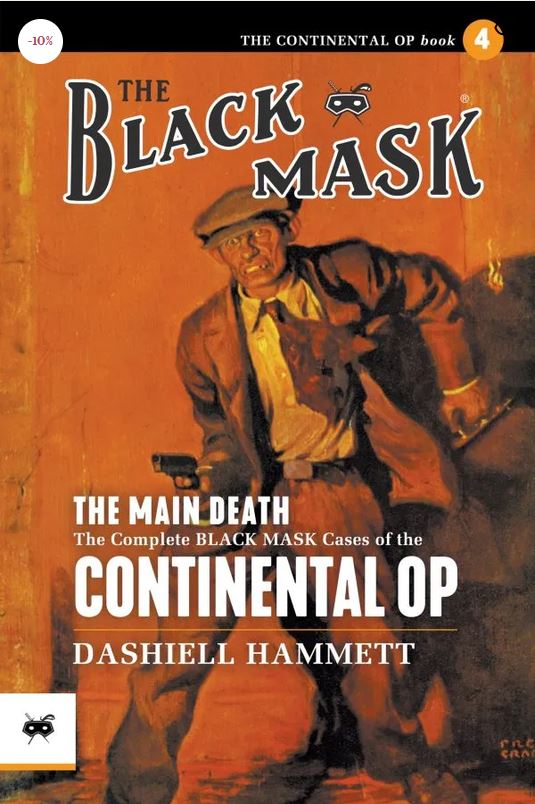
Pulp Fest takes place in Pittsburgh first week of the month. It’s a really cool event, and the Hilton Doubletree is a nice site. Steeger Books rolls out its summer line at this event. And for the fourth year in a row, there was a new Continental Op collection, with a brand new intro by yours truly. Getting to write about Dashiell Hammett remains a definite thrill. This volume contains the first great hardboiled novel, Red Harvest.
Unable to make a living writing for Phil Cody, Dashiell Hammett quit Black Mask – and the Pulps, entirely – after “The Creeping Siamese,” which appeared in the March 1926 issue. It was also the last story in Volume Three of this series.
Hammett had written some top-tier stories, such as “The Girl with the Silver Eyes,” and “The House in Turk Street.” But he was not yet THE Dashiell Hammett when he took a full-time job as advertising manager for Albert S. Samuels Co. Jewelers, in March of 1926. Hammett worked, drank, got a second apartment as a writing studio, and romanced the office secretary; all while his second child was being born. The stress was too much for his war-damaged lungs and he collapsed, coughing up blood. Unable to work full-time, he did free-lance advertising writing. He simply did not want to write fiction again. Enter Joseph ‘Cap’ Shaw.
Cody had multiple duties for Pro-Distributors Publishing, so he hired Shaw to be the editor of Black Mask. Using the ‘Cap’ nickname due to his World War I service, he had not written for the Pulps, nor was he a magazine editor. It was a strange choice by Cody: though a prescient one.
I could spend this entire introduction delving into the complexities of ‘the Shaw situation’ and how he reshaped Black Mask. Suffice to say, with Carroll John Daly, Erle Stanley Gardner, Raoul Whitfield, and Hammett, to name a few, Black Mask had set the tone for the emerging school of hardboiled Pulp. The magazine was still a mix of other genres, including Westerns, and Adventures. Shaw was determined to set a new direction. That direction would prominently feature Frederick Nebel and Horace McCoy.
After burying himself in back issues, Shaw determined that the foundation stone was to be the estranged Hammett. He wrote him a letter, offering him the princely sum of four cents a word, and encouraging him to write longer stories. He also paid Hammett the $300 which the writer insisted Cody owed him. Shaw proved himself to be a manager – not just an editor – and Hammett was writing for Black Mask again.
1927 – 1930 would establish Hammett as the greatest of Pulpsters. Two Continental Op novels, as well as quality shorts – plus The Glass Key, and Sam Spade and The Maltese Falcon – can’t be argued with. In the January 1927 issue, Shaw trumpeted the Op’s return from retirement. And February featured “The Big Knockover,” which was certainly a triumph for Hammett.
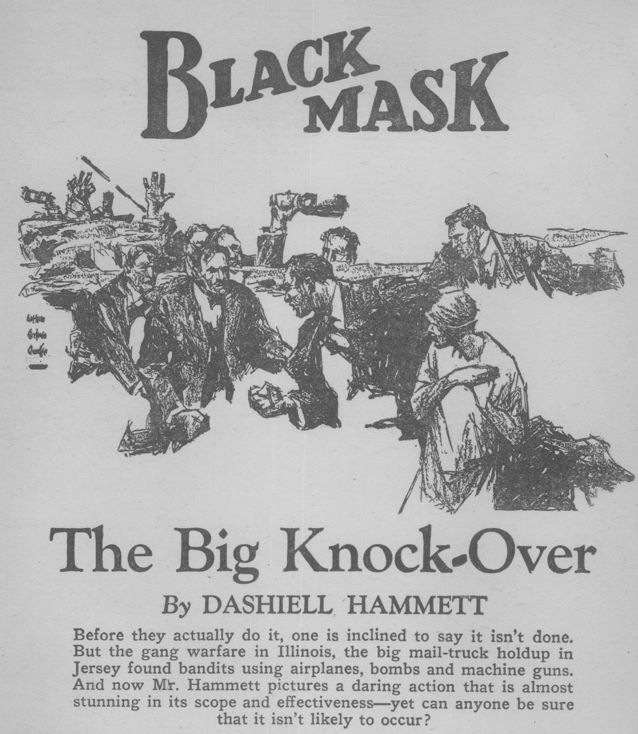 The military-like organization which Hammett had shown in “The Gutting of Couffignal” is taken to a whole new level in the heart of San Francisco. It reminds me more of the movie Heat than it does a typical PI story. There’s a trail of violence and death from start to finish. And the Op is no pacifist in this one. While Race Williams responds to every situation with violence and mayhem, the Op uses his brains first. He manipulates situations to infiltrate himself into the good graces of the bad guys. And he’ll sap somebody, or leave an ally in a precarious situation, to do so. This story requires both brains and brawn from the Op.
Hammett drops underworld names like the Dis-and-Dat Kid, L.A. Slim (from Denver), and Toby the Lugs, in an off-hand paragraph of gangsters killed in one caper. The story is full of gangland color. We meet one crook after another as the Op follows the thread of villainy from place to place. There’s a depth to this story. Details are layered, and the tale has a vibrancy that hasn’t been typical in more recent efforts.
There’s a deus ex machina (I’ll let you look that up in your Merriam Webster if you don’t know the term) in the next-to-last chapter, and it was off-putting. But I should have had faith in Hammett. We’re dealing with a master here. He pulls it off, even if the ending was a bit less satisfying than the build-up.
Though he referred to his stories as “the Black Mask junk” in a letter to his wife Josie, Hammett shook the rust off with no difficulty. “The Big Knock-over” is a big story. There’s an energy and an urgency to it that seemed to be lacking when he was battling with Cody. While it feels epic in scope, Shaw (who was a pretty good promoter) took pains to ascribe realism to it. You be the judge of that. I don’t think there’s any debate this was Hammett working at his best level so far.
Three months later in the May issue there was a sequel, “$106,000 Blood Money.” Shaw included a note that readers who missed the first story could send a request for a copy, with a dime (the cover price) and receive a copy in the mail.
Four weeks have passed since “The Big Knockover’s” conclusion, and The Continental Detective Agency is looking for a couple folks from the prior story. Hammett weaves a complex plot, with the Op working angles that keep things moving forward, while the reader tries to keep all the names straight. People are killed off-page (even before the story starts), and the Op is like a puppet master pulling the strings, though we don’t always realize it in the moment. And those strings do get tangled.
Hammett brings in some gruesome torture (within the confines of thirties detective Pulps) that hadn’t been seen before in his work.
“$106,000 Blood Money” suffers from one of mystery fiction’s biggest flaws. I mentioned in a prior introduction that even Hammett wasn’t immune to it. And that’s ‘The Big Explanation.’
Now, this is different than ‘The Big Reveal’ – where the hero gathers all the suspects together, maybe points a finger here and there while eliminating each one, and shows how brilliant they are in solving the case. That writing tool works when it’s well done. Which it often is. Rex Stout’s Nero Wolfe Big Reveals are usually a treat.
But in the last chapter of this story, the Op is having lunch with the boss. He delivers a loooong monologue (like I am right now), telling the reader everything they don’t know. It’s not like ‘The Info Dump’ readers see at the start of a story; that less-than-artfully providing of all the background information needed to get the story going.
The Op explains how and why everything happened – no spoilers here; sorry – while the Old Man just listens. Monologues are always tiresome for me, and they always have the effect of slowing down the story. The car is headed to the finish line, and now the author is pumping the brake.
The final few lines between the two men are effective, and give a satisfying conclusion to the Op’s work. Maybe, if reading the two stories consecutively as a novella, the ‘brake effect’ isn’t as pronounced, and it works better. But as a stand-alone short story, I’d knock a star off my review for this last chapter. And that’s not a great way to end a story.
In these two stories, the Op takes some questionable actions. He would never take a bribe and sell out the Agency. But he will do some things to get the job done – and to protect the Agency – that move him towards gray, and even black, on the black/white scale.
This takes a toll on him. We get a couple scenes with the Old Man, the soft-spoken leader of the Agency, whose word is law. The Old Man is a veteran of the detective business, and he is as firm and quietly ruthless as he is respected by his employees. He listens far more than he speaks, but Hammett paints him so deftly he can dominate a scene just by eating his salad.
The Op and the Old Man are weary at the end of “$106,000 Blood Money.” The Op says he needs a couple weeks off: he is ‘washed out.’ The bad guys were caught and the Agency’s reputation is still shiny; and the two men have one more burden weighing them down inside.
Blood Money was actually issued as a book (both paperback and hardback) in 1943, though it’s not considered to be one of Hammett’s novels. At roughly 38,000 words, it’s really a novella. It’s even notably shorter than “Woman in the Dark.”
The covers in these two months were for Westerns. And in the two months between, one cover was a Western, and one was an Eastern Adventure. ‘The’ was officially dropped from the mag’s title after the April issue. Shaw was shaping his version of Black Mask, but it wasn’t yet the hardoiled Pulp title revered today.
 Hammett was right back in June with a short story, “The Main Death.” This issue also included the first of Carroll John Daly’s four-part serial, The Snarl of the Beast. Daly got the cover, and Hammett’s name wasn’t on it at all.
“The Main Death” was less than half as long as each of Hammett’s first two stories since returning. Erle Stanley Gardner said in a letter to Hammett that it was not only the best story ever in Black Mask, it was the best story he had ever read, period. That seems a bit over the top.
After the two action-blockbuster stories that make up what we’ll call Blood Money, this was a return to the procedural PI story. It is a lean story, with no fat. An employee was murdered and $20,000 stolen. There are no grand heroics here. Dogged detective work does the job. The Op dislikes his employer, who is a well-off rare items merchant; not a lumber baron or a banking tycoon. It’s a different kind of rich man.
But Hammett gives us an unlikable man. He wears rouge on his cheeks, dyes his goatee, baits his wife; he’s clearly someone nobody enjoys being around. The Op’s disdain for the man steers him in this case.
This short story shows us that the Op is his own man. The job is to find the missing money. And the Op does absolutely nothing more than that for the client, who he leaves “frothing at the mouth, tearing his dyed goatee, raging…”. There’s a lot that the Op does not reveal to the client or the cops, and I don’t know that I would say justice was served. But the Op is content to return the stolen money and walk away from that household. It’s an odd little story.
Red Harvest. The first great hardboiled novel of the Pulp Era. Hammett’s chrysalis opened and the master of Pulp emerged.
The November 1927 issue of Black Mask included “The Cleansing of Poisonville.” Three more installments would follow, and Hammett redefined mystery fiction, setting the benchmark for hardboiled fiction with what would be renamed in book form, Red Harvest.
Cap Shaw wrote at the end of the second installment, “…these stories are remarkable if only for the fact that their manner of telling points the way to a new type of detective fiction, which in BLACK MASK is coming to take the place of the old, worn-out formula sort of gruesome-murder-and-clever-solution detective story.” Shaw had brought Hammett back into the fold and intentionally built his version of Black Mask on a Hammett cornerstone. He was proclaiming this in print.
And by the end of 1927, the difference between Carroll John Daly and Hammett was now a chasm. Race Williams was still popular, but Hammett was taking the new hardboiled school to an entirely different place. Daly was writing loud violence, like someone yelling at the top of their lungs. Hammett raised his voice, but in a way that you clearly heard every word and understood what he was saying. And it was far more effective that way.
The first installment has a definite ending, and it could have easily been a stand-alone story, not the first part of a serial, which then became a novel. With the initial assignment completed, the client tries to send the Op back home to San Francisco; a return to business as usual. Yeah, not so much:
“I’ve got ten thousand dollars of your money to work with and I’m going to use it to open Personville up from Adam’s apple to ankles…Now I’m going to have my fun.”
Truer words… In “The Golden Horseshoe, the Op said, “One way of finding what’s at the bottom of either a cup of coffee or a situation is to keep stirring it up until whatever is on the bottom comes to the surface.”
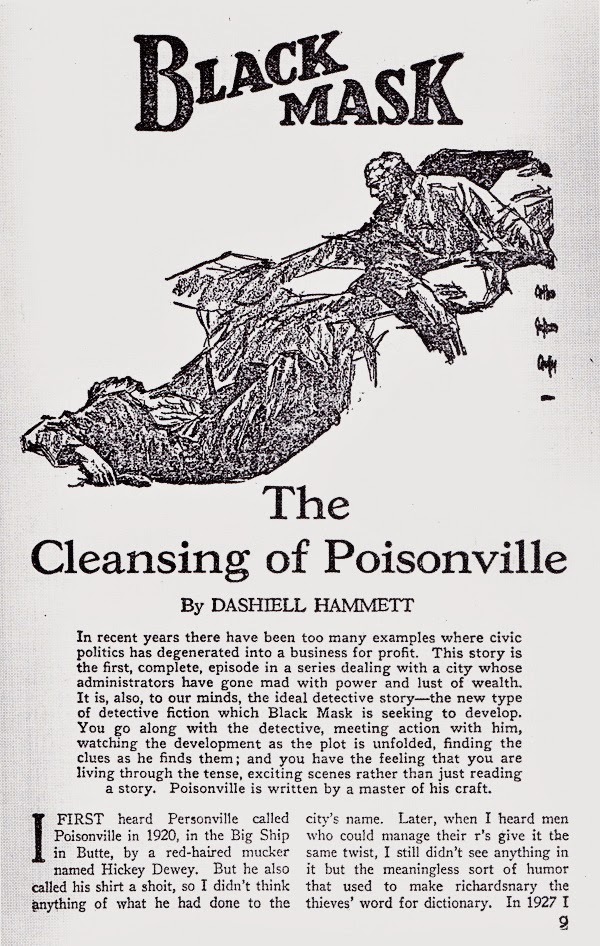 This is at the heart of his actions throughout the serial. The Op is going to stir things up in Poisonville until all hell breaks loose. And it certainly does in “Crime Wanted – Male or Female.” He plays four different sides (five if you consider his own as one) against each other, with enough fireworks for the Fourth of July. As he says at the end of installment two: “Poisonville was beginning to boil out under the lid.” He continues stirring until the very end. And the bodies do pile up.
The Old Man wasn’t some pencil-pusher running an agency. He had worked his way up from field agent to the boss. But he has an organization to manage. Hammett had been an operative for the Pinkertons. He worked in the field. And he has the Op reflect that: “It’s all right for our Continental Detective Agency to have its rules and regulations, but when you’re out on a job you do it the best way you can. The work’s got to be done. And anybody that brings any ethics to Poisonville is going to get ‘em rusty. But a report is no place for the dirty details.”
This is a mining town, run by an old-school baron who broke the union and was a despot. But it’s also populated by four different mob bosses who call some of the shots. There’s a lot of power spread around among uneasy allies. The Op isn’t looking to make sure he follows the rules as he wrecks the alliance. He’s going to clean up Poisonville, by painting it with blood.
The Old Man sends a letter near the end of part three, demanding a full explanation of the operation, the circumstances under which the Op accepted the ‘second’ commission, and daily reports to date.
The Op puts it in his pocket and acknowledges that following orders would be the same as handing in his resignation. He’s operating on his own.
The Op gives a long recap at the start of part four (and also three); an inherent flaw in a serial, I guess. But then he discourses on the morals of his job, and how he’s doing it in Poisonville. He’s drinking gin – mixing in laudanum – and he bares his soul to the female lead. He says that he’s enjoying the game, and the killing (done by others) is satisfying. Hammett peels away his insulation and we see inside the Op on a dirty job. Hammett dove deep into the Op in a way he couldn’t have done in a short story. We know the Op better than we ever have.
The action continues at a violent pace, and there’s a twist at the end worthy of O. Henry. I think that Red Harvest is one of the Top Five Novels of the Hardboiled Era. Hammett’s health did not hold him back, and Shaw believed in him. He was thriving under Shaw’s leadership.
In February of 1928 Hammett sent it off to Alfred A Knopf, and with some revisions and a name change, it was printed as a hardback novel. Blanche Knopf discarded Poisonville as a title. Hammett suggested eight alternatives, preferring Red Harvest.
Hammett was now a hardboiled novelist, and he had already started onThe Dain Curse. As he wrote to Blanche Knopf in March: “I’m one of the few people…moderately literate who take the detective tale seriously…I mean, the detective story as a form…Some day, somebody’s going to make ‘literature’ of it.’”
The novel toned down the violence from serial form, but Red Harvest did take the detective story to another level. Raymond Chandler is commonly credited for turning the genre into literature. And he heaps praise upon Hammett. But Hammett was distancing himself from his peers; and raising the expectation for what a detective story could do.
Phil Cody had driven Hammett away. Cap Shaw brought him back. Imagine a Pulp world where Hammett quit writing with “The Creeping Siamese.” And the loss of some of his impact on those to come. It’s unthinkable.
Red Harvest is hardboiled treasure.
You can find descriptions, and links, to all of my Steeger intros so far, here
Prior Posts in A (Black) Gat in the Hand – 2026 (8)
Will Murray on Lester Dent’s Lost Detective
Front Porch Pulp and Frank Kane
 After Dark, My Sweet
Ten Things I Think I Think (Gat Edition)
Rory Gallagher & The Continental Op (again)
Spider-Noir
Elliott Gould Reads Chandler
All My Steeger Books Intros
Prior Posts in A (Black) Gat in the Hand – 2025 (12)
Will Murray on Dash(iell Hammet) and (Lester) Dent
Shelfie – Dashiell Hammett
Windy City Pulp & Paper Fest – 2025
Will Murray on Who was N.V. Romero?
Conan – The Phoenix in the Sword in Weird Tales
More of Robert E. Howard’s Kirby O’Donnell
More Weird Menace from Robert E. Howard – Conrad and Kirowan
Hardboiled Gaming- LA Noire
Western Noir: Hell on Wheels
T.T. Flynn’s Mr Maddox
Dashiell Hammettt’s The Scorched Face (my intro)
Will Murray on Raymond Chandler’s Other Lost Stories?
Prior Posts in A (Black) Gat in the Hand – 2024 Series (11)
Will Murray on Other Lost Raymond Chandler Stories?
Will Murray on Dashiell Hammett’s Elusive Glass Key
Ya Gotta Ask – Reprise
Rex Stout’s “The Mother of Invention”
Dime Detective, August, 1941
John D. MacDonald’s “Ring Around the Readhead”
Harboiled Manila – Raoul Whitfield’s Jo Gar
7 Upcoming A (Black) Gat in the Hand Attractions
Paul Cain’s Fast One (my intro)
Dashiell Hammett – The Girl with the Silver Eyes (my intro)
Richard Demming’s Manville Moon
More Thrilling Adventures from REH
Prior Posts in A (Black) Gat in the Hand – 2023 Series (15)
Back Down those Mean Streets in 2023
Will Murray on Hammett Didn’t Write “The Diamond Wager”
Dashiell Hammett – ZigZags of Treachery (my intro)
Ten Pulp Things I Think I Think
Evan Lewis on Cleve Adams
T,T, Flynn’s Mike & Trixie (The ‘Lost Intro’)
John Bullard on REH’s Rough and Ready Clowns of the West – Part I (Breckenridge Elkins)
John Bullard on REH’s Rough and Ready Clowns of the West – Part II
William Patrick Murray on Supernatural Westerns, and Crossing Genres
Erle Stanley Gardner’s ‘Getting Away With Murder (And ‘A Black (Gat)’ turns 100!)
James Reasoner on Robert E. Howard’s Trail Towns of the old West
Frank Schildiner on Solomon Kane
Paul Bishop on The Fists of Robert E. Howard
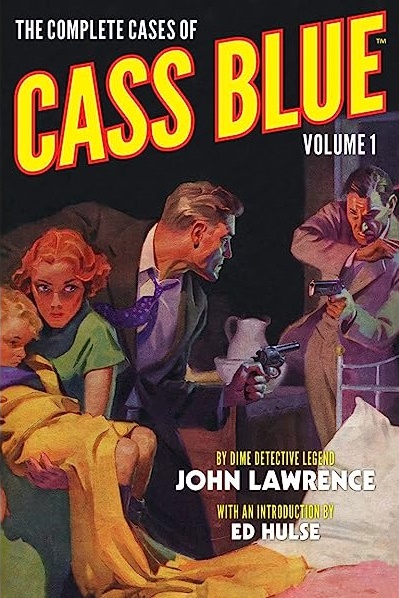
John Lawrence’s Cass Blue
Dave Hardy on REH’s El Borak
Prior posts in A (Black) Gat in the Hand – 2022 Series (16)
 Asimov – Sci Fi Meets the Police Procedural
The Adventures of Christopher London
Weird Menace from Robert E. Howard
Spicy Adventures from Robert E. Howard
Thrilling Adventures from Robert E. Howard
Norbert Davis’ “The Gin Monkey”
Tracer Bullet
Shovel’s Painful Predicament
Back Porch Pulp #1
Wally Conger on ‘The Hollywood Troubleshooter Saga’
Arsenic and Old Lace
David Dodge
Glen Cook’s Garrett, PI
John Leslie’s Key West Private Eye
Back Porch Pulp #2
Norbert Davis’ Max Latin
Prior posts in A (Black) Gat in the Hand – 2021 Series (7 )
The Forgotten Black Masker – Norbert Davis
Appaloosa
A (Black) Gat in the Hand is Back!
Black Mask – March, 1932
Three Gun Terry Mack & Carroll John Daly
Bounty Hunters & Bail Bondsmen
Norbert Davis in Black Mask – Volume 1
Prior posts in A (Black) Gat in the Hand – 2020 Series (21)
Hardboiled May on TCM
Some Hardboiled streaming options
Johnny O’Clock (Dick Powell)
Hardboiled June on TCM
Bullets or Ballots (Humphrey Bogart)
Phililp Marlowe – Private Eye (Powers Boothe)
Cool and Lam
All Through the Night (Bogart)
Dick Powell as Yours Truly, Johnny Dollar
Hardboiled July on TCM
YTJD – The Emily Braddock Matter (John Lund)
Richard Diamond – The Betty Moran Case (Dick Powell)
Bold Venture (Bogart & Bacall)
Hardboiled August on TCM
Norbert Davis – ‘Have one on the House’
with Steven H Silver: C.M. Kornbluth’s Pulp
Norbert Davis – ‘Don’t You Cry for Me’
Talking About Philip Marlowe
Steven H Silver Asks you to Name This Movie
Cajun Hardboiled – Dave Robicheaux
More Cool & Lam from Hard Case Crime
A (Black) Gat in the Hand – 2019 Series (15)
Back Deck Pulp Returns
A (Black) Gat in the Hand Returns
Will Murray on Doc Savage
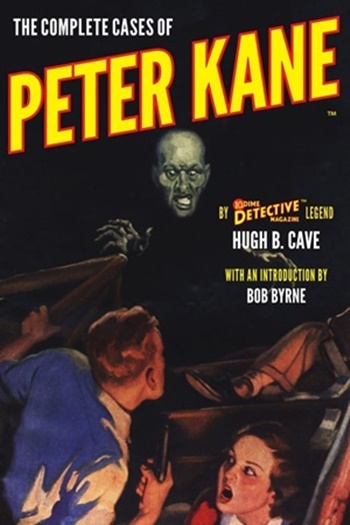
Hugh B. Cave’s Peter Kane
Paul Bishop on Lance Spearman
A Man Called Spade
 Hard Boiled Holmes
Duane Spurlock on T.T. Flynn
Andrew Salmon on Montreal Noir
Frank Schildiner on The Bad Guys of Pulp
Steve Scott on John D. MacDonald’s ‘Park Falkner’
William Patrick Murray on The Spider
John D. MacDonald & Mickey Spillane
Norbert Davis goes West(ern)
Bill Crider on The Brass Cupcake
A (Black) Gat in the Hand – 2018 Series (32)
George Harmon Coxe
Raoul Whitfield
Some Hard Boiled Anthologies
Frederick Nebel’s Donahue
Thomas Walsh
Black Mask – January, 1935
Norbert Davis’ Ben Shaley
D.L. Champion’s Rex Sackler
Dime Detective – August, 1939
Back Deck Pulp #1
W.T. Ballard’s Bill Lennox
Erle Stanley Gardner’s The Phantom Crook (Ed Jenkins)
Day Keene
Black Mask – October, 1933
Back Deck Pulp #2
Black Mask – Spring, 2017
Erle Stanley Gardner’s ‘The Shrieking Skeleton’
Frank Schildiner’s ‘Max Allen Collins & The Hard Boiled Hero’
A (Black) Gat in the Hand: William Campbell Gault
A (Black) Gat in the Hand: More Cool & Lam From Hard Case Crime
MORE Cool & Lam!!!!
Thomas Parker’s ‘They Shoot Horses, Don’t They?’
Joe Bonadonna’s ‘Hardboiled Film Noir’ (Part One)
Joe Bonadonna’s ‘Hardboiled Film Noir’ (Part Two)
William Patrick Maynard’s ‘The Yellow Peril’
Andrew P Salmon’s ‘Frederick C. Davis’
Rory Gallagher’s ‘Continental Op’
Back Deck Pulp #3
Back Deck Pulp #4
Back Deck Pulp #5
Joe ‘Cap’ Shaw on Writing
Back Deck Pulp #6
The Black Mask Dinner
 Bob Byrne’s ‘A (Black) Gat in the Hand’ made its Black Gate debut in 2018 and has returned every Summer since.
His ‘The Public Life of Sherlock Holmes’ column ran every Monday morning at Black Gate from March, 2014 through March, 2017. And he irregularly posts on Rex Stout’s gargantuan detective in ‘Nero Wolfe’s Brownstone.’ He is a member of the Praed Street Irregulars, and founded www.SolarPons.com (the only website dedicated to the ‘Sherlock Holmes of Praed Street’).
He organized Black Gate’s award-nominated ‘Discovering Robert E. Howard’ series, as well as the award-winning ‘Hither Came Conan’ series. Which is now part of THE Definitive guide to Conan. He also organized 2023’s ‘Talking Tolkien.’
He has contributed stories to The MX Book of New Sherlock Holmes Stories — Parts III, IV, V, VI, XXI, and XXXIII.
He has written introductions for Steeger Books, and appeared in several magazines, including Black Mask, Sherlock Holmes Mystery Magazine, The Strand Magazine, and Sherlock Magazine.
You can definitely ‘experience the Bobness’ at Jason Waltz’s ’24? in 42′ podcast.
Congrats on the newly published volume intro! Reads as quite comprehensive– good to know more about Shaw, alongside Hammett.
Shaw was a guy who did whatever he set out to do. Whether or not the choice was logical or likely to succeed.
After he got let go by Black Mask, he became an agent, and picked up some of his former writers, including John D. MacDonald.
He seemed to be kind of a low-key force of nature. Just moving dead ahead. And largely succeeding.
I’m lucky to navigate the grocery store weekly.