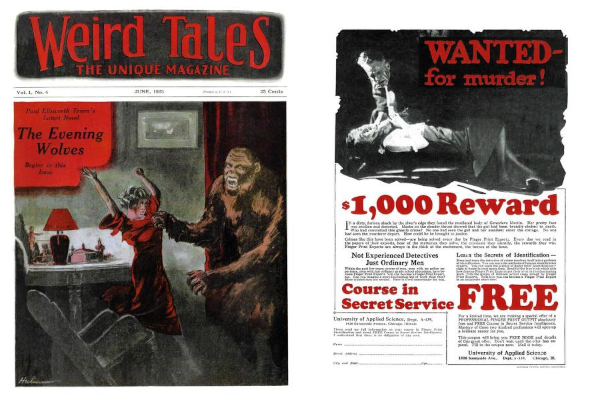
Weird Tales, June 1923, front and back coversThe fourth issue of Weird Tales, dated June 1923, keeps the same format as the issue previous — starting with the large bedsheet size, about 9 inches by 12. The trade dress of the cover is the same, with the same logo. The design of the cover, with a splash of red in which one story is advertised in black writing, is the same. Unfortunately, the actual cover art, by regular Weird Tales artist William Heitman, isn’t very good.
There’s a lady, there’s an ape, and the latter seems to have surprised the former in her room. The majority of Weird Tales readers were likely able to place the image at once as a scene from Edgar Allan Poe’s “The Murders In the Rue Morgue,” which is reprinted this issue. The problem is that it’s not a particularly evocative image, and the poses of the characters seem odd at first glance and make less sense the more you look at them.
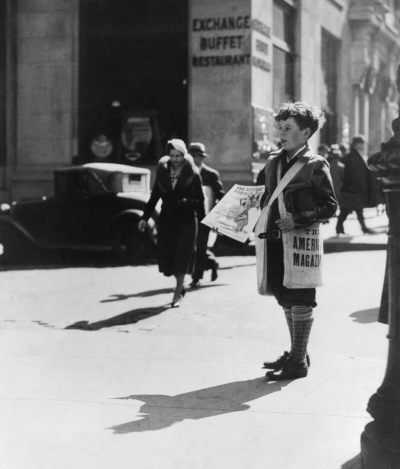
A newsboy in the 1920s.
This is the sixth post in a series reflecting on the world of the 1920s as a background to early issues of Weird Tales. Imagine that you’re an American in a big city in 1923, and you’re taking a walk to the newsstand to buy the first issue of a new pulp fiction magazine. What sort of things might you see? What do those things suggest about ways people think? What do they say about the stories they tell?
And what might you hear? Cars, of course, and maybe the buzz of conversation around you. But perhaps you’ll hear the voice of a boy on a streetcorner, holding up a newspaper and crying out a still-famous phrase: Extra! Extra! Read all about it! For this is a time when newsboys are still a feature of urban life.
The new format Weird Tales adopted for its third issue reached right into the table of contents, which dropped from two pages to one, with of necessity a more cramped layout. One extremely short story isn’t listed, but the magazine makes sure to promote “Nineteen Thrilling Short Stories” along with “Two Complete Novelettes.” That’s actually an increase over the last issue, which had sixteen short stories and two novelettes. So, having discussed the format in a previous post, let’s now look closely at this issue’s fiction.
And it is necessary with this issue to talk about race in Weird Tales, starting with the first story in the magazine (so this post will include quotations and mentions of period racism). “The Moon Terror,” by A.G. Birch, is promoted by a cover blurb; it’s 30,000 words long, 20,000 of which appear in this issue, with the conclusion in the next month’s magazine. It’s a textbook example of Yellow Peril racism, in which sinister East Asians menace white people and the Western world. In this case, the villains are a secret Chinese society who threaten the planet as a whole with increasingly powerful earthquakes.
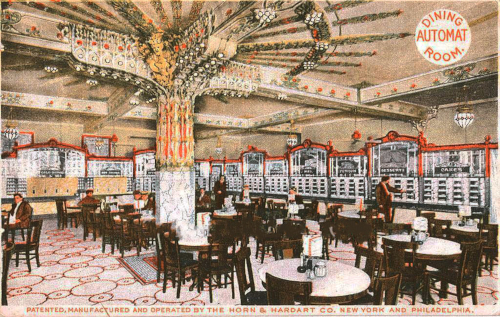
A postcard showing an early-20th century Horne & Hardart automatThis is the fifth post in a series reflecting on the world of the 1920s as a background for discussing the early issues of Weird Tales. Imagine that you’re an American in a big city in 1923, and you’re taking a walk to the newsstand to buy the first issue of a new pulp fiction magazine. What sort of things might you see? What do those things suggest about ways people think? What do they say about the stories they tell?
Let’s say you get hungry as you walk along, and think about getting some food later. Maybe you see a restaurant, and a grocery store near it. What kind of food will you be able to buy in the store? And what sort of a restaurant are you looking at? There are a lot of potential answers to that second question, but I want to focus on one admittedly unusual possibility. If you’re in the right city, especially New York or Philadelphia, maybe you have the chance to pop into an automat. And in New York, you might even spot a future Weird Tales writer drinking the hot chocolate.
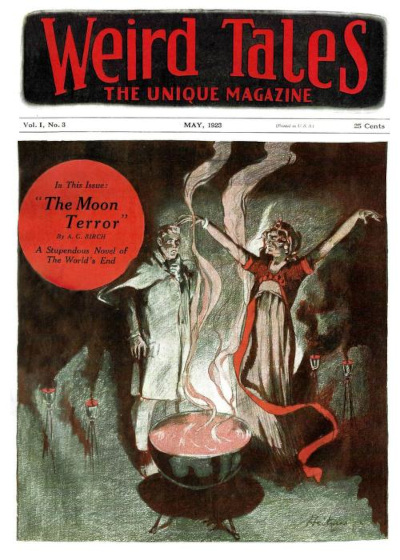
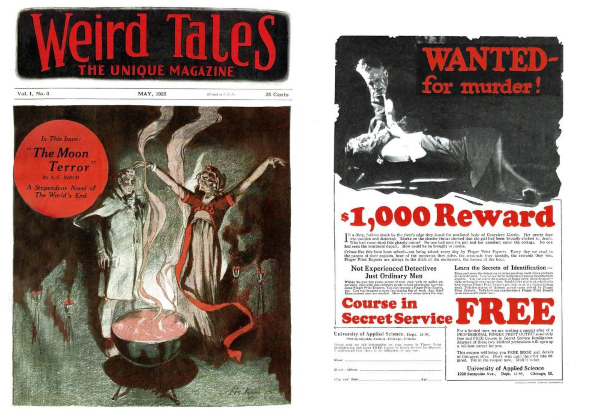
Weird Tales, May 1923, front and back coversThe third issue of Weird Tales saw the magazine experiment with a significant change in presentation. The first two issues had been a standard pulp size, about 6 inches by 9; the May 1923 issue went to the bedsheet format, a bit more than 9 inches by 12, while cutting the number of pages from 192 to 120. Open the issue, or look through a pdf file, and further changes become apparent.
The layout’s gone to three columns of text instead of two. There are two reprints in the issue, one of them printed at a reduced type size, presumably to fit the space available. And the magazine boasts interior artwork for the first time, with nine stories getting uncredited illustrations; black-and-white line drawings, usually with heavy hatching and cross-hatching.
The artist was presumably this issue’s cover artist, William Heitman, who seems to have done all the interior artwork in Weird Tales’ first year. Heitman’s two-colour cover image is simple, bordering on crude, but conveys a mood. The blurb on the cover is for A. G. Birch’s “The Moon Terror,” though there’s nothing in the story like the picture, for reasons which we’ll come to later on in this post. The colour scheme of the cover’s similar to the last issue, with solid red and black, but the logo’s the third in three issues — though the magazine’s subhead, “The Unique Magazine,” has remained consistent.
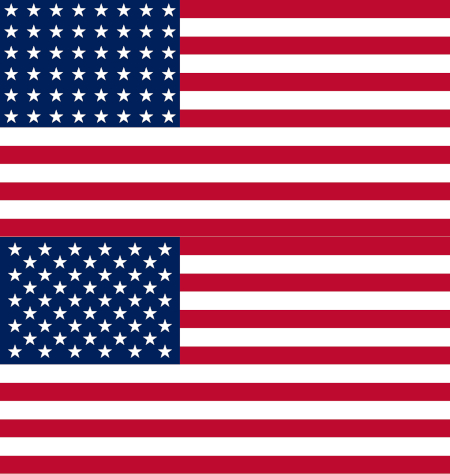
The flag of the United States of America, with 48 stars at top and with 50 at bottom.
This post is the fourth in a series reflecting on the world of 1923, and the 1920s generally, as a background to early issues of Weird Tales. Imagine that you’re an American in 1923, and you’re taking a walk to the newsstand to buy the first issue of a new pulp fiction magazine. What sort of things will you see?
You might, for example, see a flagpole with an American flag on it. It is a flag with a regular grid of stars in the corner, six rows of eight stars apiece, representing the 48 states of the Union. The United States in 1923 is a different place from what it will become a hundred years later, with a population that is distributed differently, different territories, a different self-image and different ideas about the nature of its peoples.
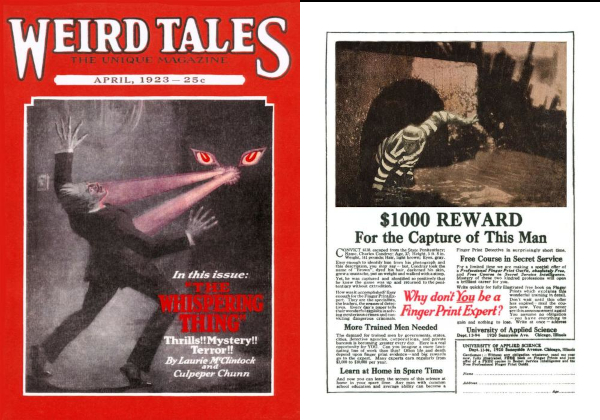
Weird Tales, April 1923
The table of contents of the second issue of Weird Tales advertises “Sixteen thrilling short stories / Two complete novelettes / Two two-part stories / Interesting, odd, and weird happenings.” More specifically, one of the two-part stories, the cover story, begins this month while the other concludes. As for the “interesting, odd, and weird happenings,” I wrote about them here, so now let’s get to the fiction. (Note that discussion of one of these stories necessitates quoting an ethnic slur, directed against the French, of all people.)
The first of the tales on offer in this issue is one of the novelettes, “The Scar,” by Carl Ramus (whose surname’s misspelled in the table of contents as ‘Rasmus’). It’s the only known published story by Ramus, though his sister Sybla was a writer whose work would later appear in Weird Tales. Carl Ramus had a day job as a doctor, and as it happens “The Scar” is a tale of a dashing young doctor pulled into a kidnapping plot. It’s not a terrible story, but it’s a surprising choice to lead off the issue as there’s little supernatural about it — the heroine claims to be able to bring on a fever by willing it and the hero believes he has a knack for hypnotism — and nothing I can see as ‘weird’ in any other sense. If the magazine’s still in the process of defining itself, then editor Edwin Baird has a different sense of where he intends it to go than we might expect from our later perspective.
This post is the third in a series reflecting on the world of 1923, and the 1920s generally, as a background to early issues of Weird Tales. Imagine that you’re an American in 1923, and you’re taking a walk to the newsstand to buy the first issue of a new pulp fiction magazine. What sort of things will you see?
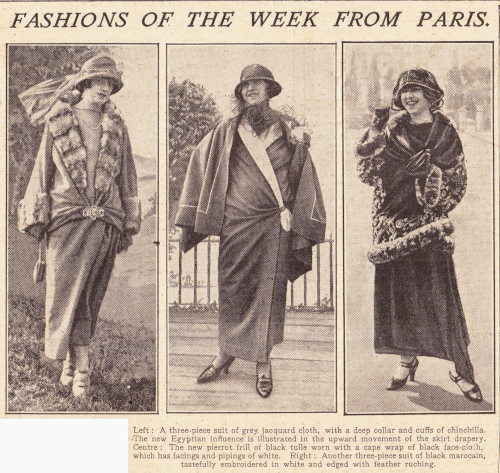
Walk down a city street and you’ll observe other people around you, meaning you’ll see the fashions of the time. Any given era has its characteristic clothes and hairstyles, and the nineteen-twenties are no exception. Interesting to me personally are the reasons behind the adoption of specific fashions, and what they have to say about the way the world is changing. I’m writing these background posts as though one aspect of the 1920s can be divided from the others, but the truth is that then as now everything’s mashed together. Fashion’s affected by technology and politics, by ideas about formality and ideas about sexuality; and it can create images that will, for later years, define its moment.
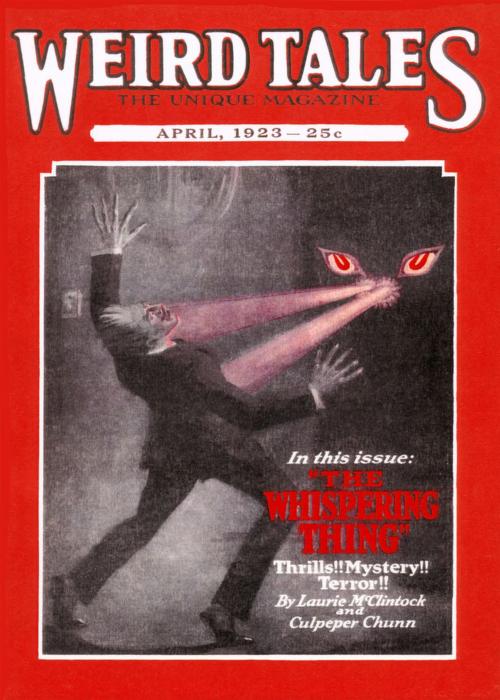
The second issue of Weird Tales, on sale from March of 1923 through to April, looked much like the first: a pulp magazine roughly 6 and a half inches by 9 and a half, with 192 pages. The April issue was .75 of an inch shorter and half an inch narrower. The black-white-and-red cover was more striking than the previous issue’s, with the main image contained in a thick red frame, and the date and price more easily visible under the title. There was a new and smoother-looking logo. Unlike the first issue, this cover didn’t share a format with that month’s issue of Weird Tales’ older sister publication Detective Tales. Although to phrase it that way may be misleading; John Locke, in The Thing’s Incredible! The Secret Origins of Weird Tales, argues that what is referred to as the April/May 1923 issue of Detective Tales was actually an issue that came out in May which the publisher retroactively dated as a bimonthly issue, and if that’s so then there was no Detective Tales issue in April for the second issue of Weird Tales to parallel.
Either way, the cover’s about all you might hope for from a magazine called Weird Tales. Mysterious gigantic eyes stare out of darkness, while from just below them pink rays shoot out to strike a man who screams and throws out his hands. It’s not terribly sophisticated — background details are nonexistent or lost in the ink wash, and you can’t help but wonder if the mysterious creature in shadows is firing rays from its nostrils. But it is an image that tells you things supernatural and horrific lurk within these pages.
This post will take a look at the physical and editorial package of the second issue of Weird Tales, with an eye to tracking the magazine’s evolution. It’ll run long, because I’ve included numerous extracts from pulp magazine editorials — mostly for the sake of making an argument about how Weird Tales was positioning itself in its marketplace, but partly, I have to admit, for historical interest and potential amusement value.
This post is the second in a series reflecting on the world of 1923 as a background to early issues of Weird Tales. Imagine that you’re an American in February of 1923, and you’re taking a walk to the newsstand to buy the first issue of a new pulp fiction magazine. What sort of things will you see?
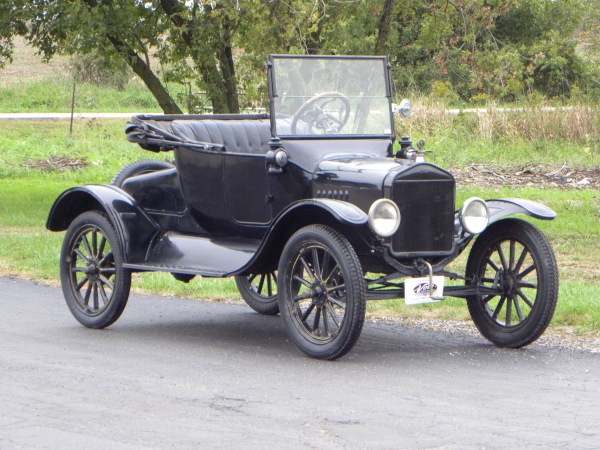
Probably the first thing you’ll notice as you set out into the street is the street itself, and its contents. The motor car has begun to change urban life. Since Ford introduced the Model T fifteen years ago the price has steadily dropped; there were almost 11 million registered passenger automobiles in the United States by the end of 1922, and will be just shy of 13.5 million by the end of 1923. Cars are registered, incidentally, and license plates have been required since 1918, but most states do not issue driver’s licenses; half the states will require licenses by 1930, and as late as 1935 only 39 states will mandate licenses and not many of those will require passing a test. In 1923 Model Ts are still the most common make of car, though competing models are about to cut into its sales. Famously, you can get a Model T in any colour, so long as it’s black; Ford used to offer a range of colours, but in 1914 streamlined production by cutting back to a particular type of black paint that was cheap and fast-drying. Model Ts do not at this time have shock absorbers, windshield wipers, rear view mirrors, bumpers, or an instrument panel for a speedometer (not a standard feature) or gas gauge.