So Much Potential: Lords of the Ultra-Realm by Doug Moench and Pat Broderick
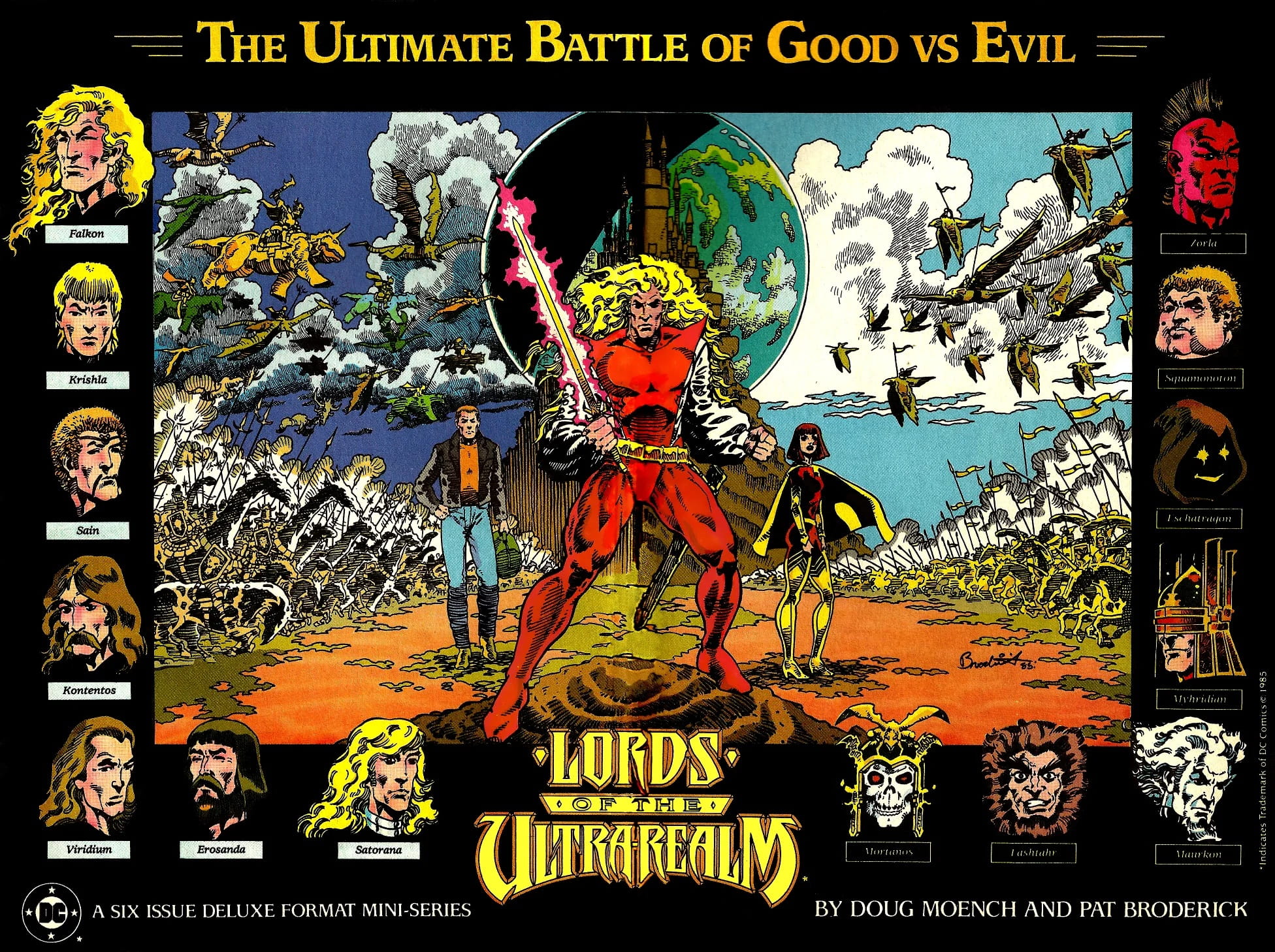
I started scouting for sword and sorcery in the spring of 1974, after stumbling upon Marvel Comics’ Conan the Barbarian #39 (March 1974). At the time, Robert E. Howard’s most famous creation was known to few beyond the then-small and -deviant subcultures of comics and fantasy.
How obscure, in my adolescence, was the Cimmerian? I mistook the cover’s loincloth-clad, axe-swinging character for a Tarzan knock-off. How wrong — how delightfully wrong — I was. More like this, please!
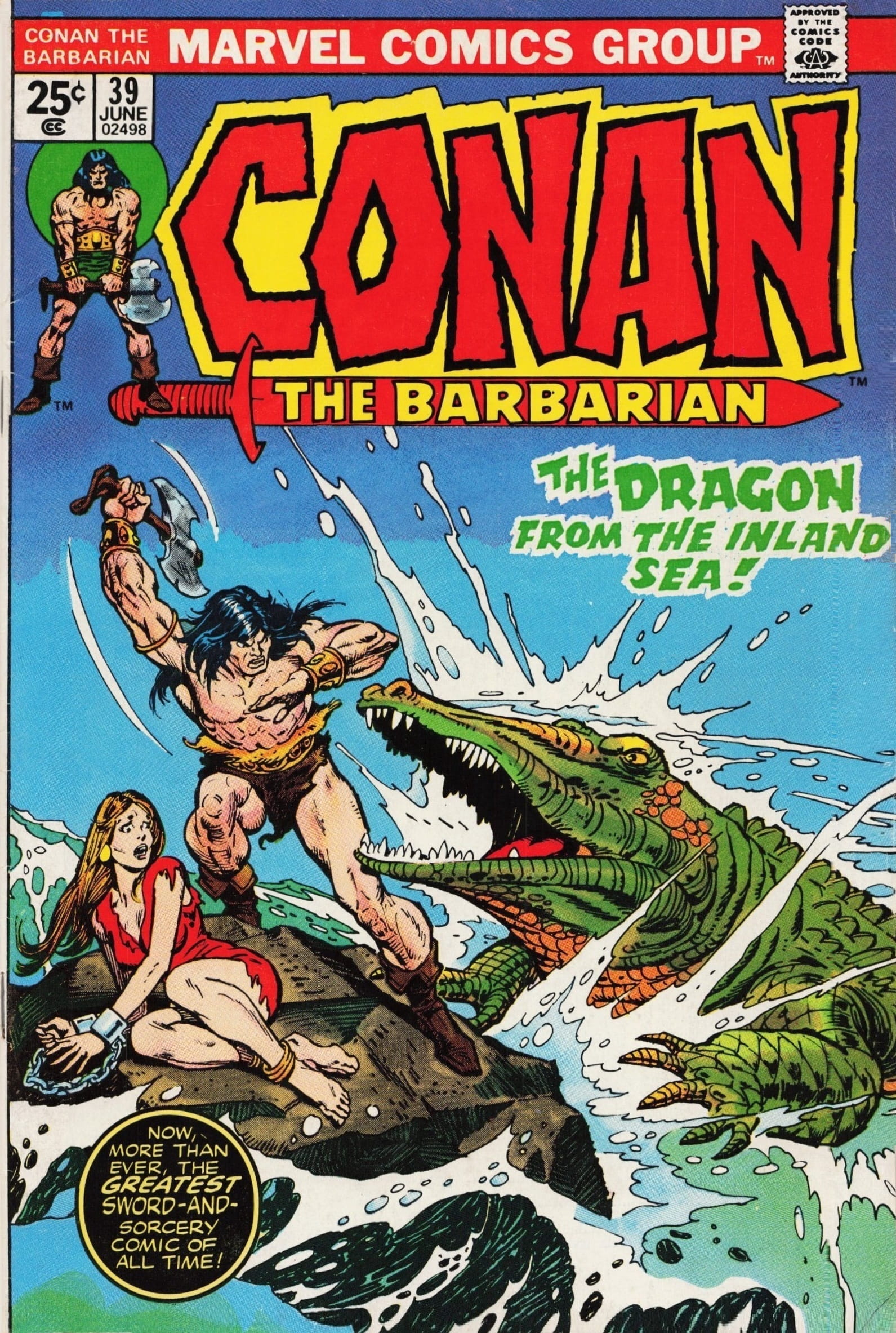
Given my quest, I was recently surprised to learn that DC Comics published an original, six-issue, direct-market S&S mini-series in the 1980s titled Lords of the Ultra-Realm. How, I marveled, did I miss that? I was in my comic shop every week, buying my pulls and cruising for interesting new titles. Spoiler: The early issues of LotUR didn’t print enough copies to meet demand. Still, I missed the more-abundant later issues, as well. I decided to make up for lost time and turned to eBay.
Possibly that wasn’t my greatest decision.
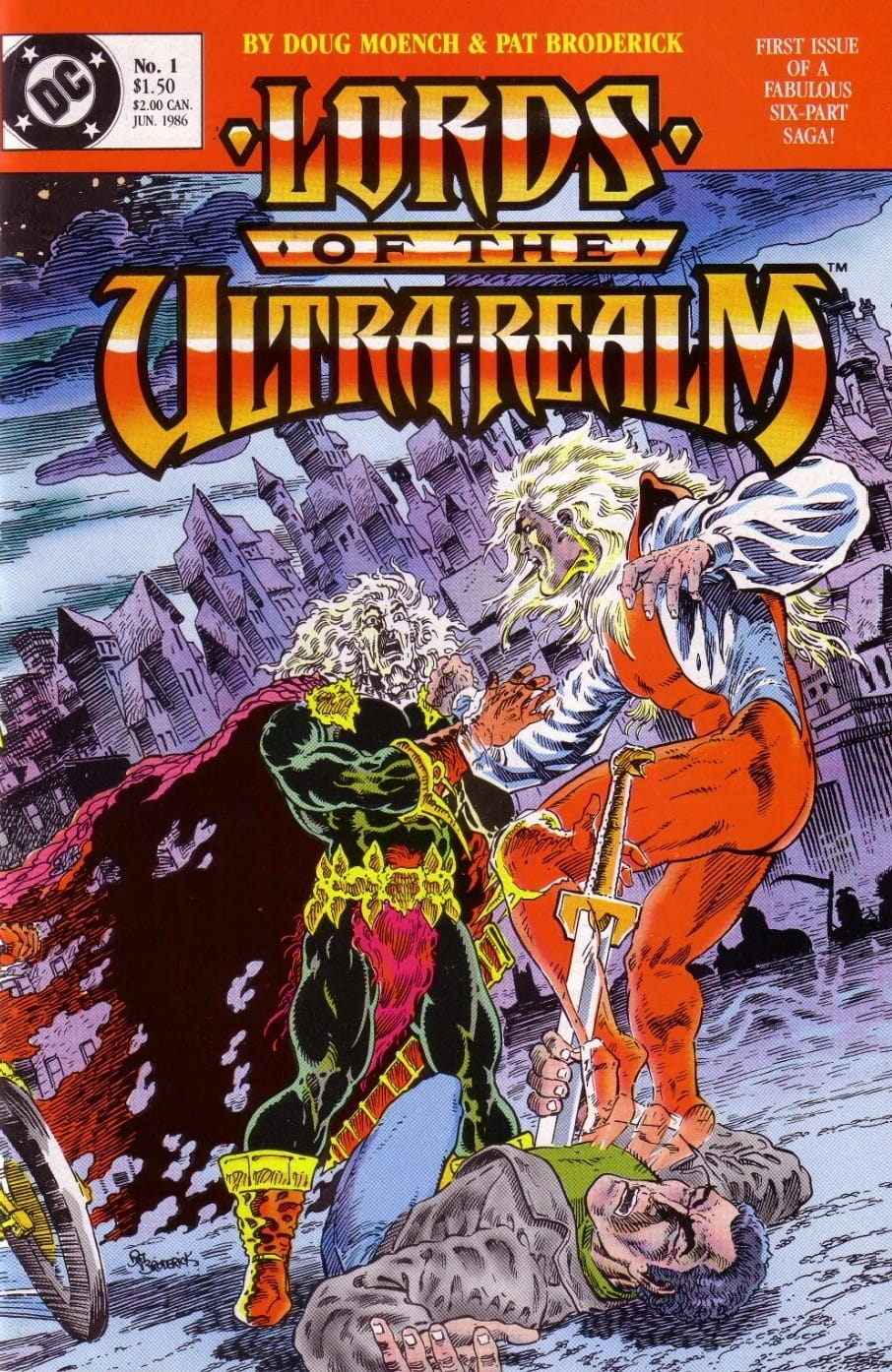
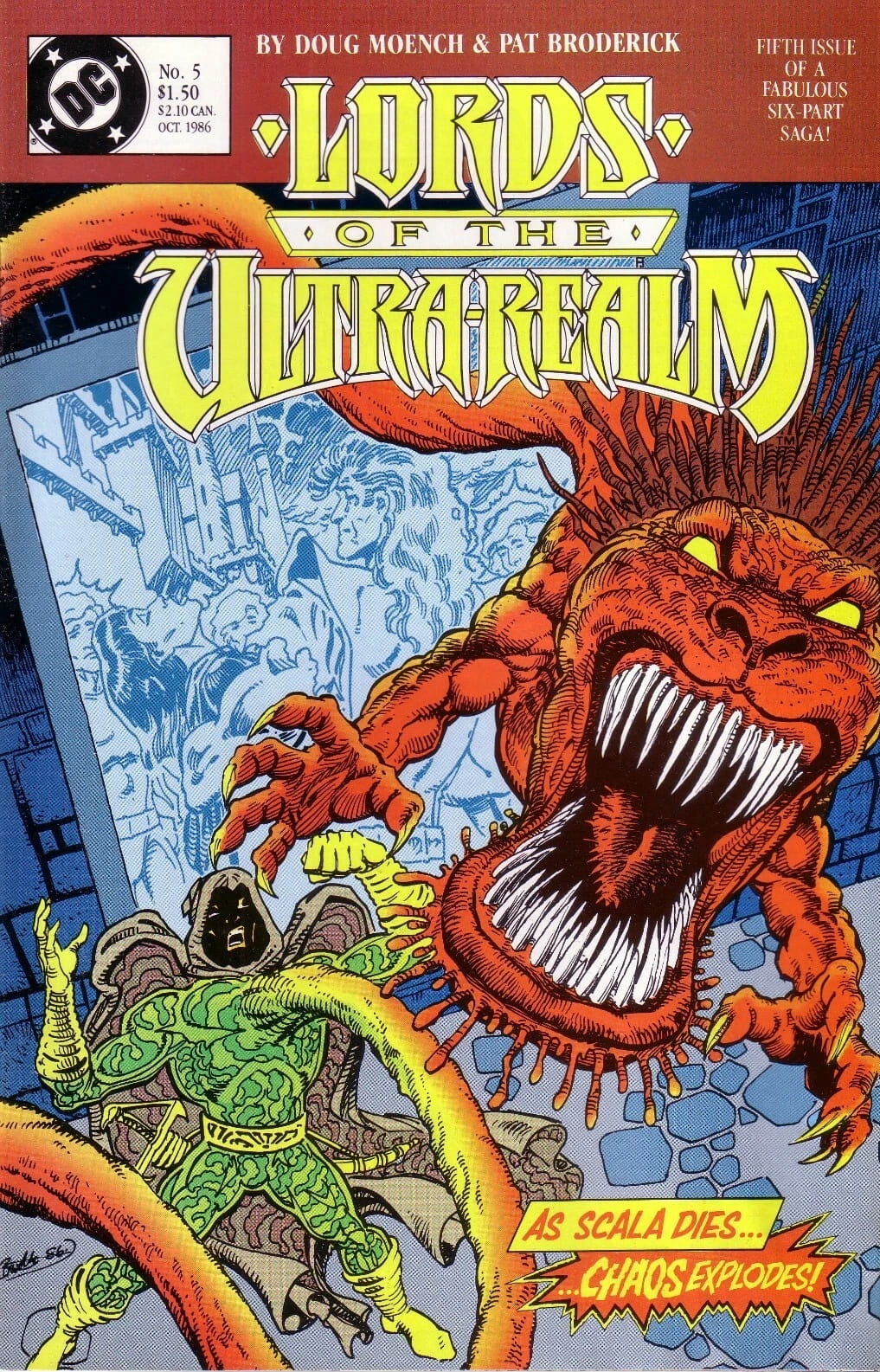
Things did look promising when Lords of the Ultra-Realm #1-#6 (June-November 1986) arrived at my post office. Pat Broderick’s art looked great. And rarely has a comic ventured so far into the wheelhouse of my romantic tastes (hunky guys with long, luxuriant locks). Though, judging by the covers, these dudes were more inclined than most S&S characters to skin-tight spandex.
Superhero-style costumes and hair-metal ‘dos may sound outré now, but they weren’t likely to put off many S&S fans in those years, because the definition of S&S (not to mention the perception of acceptable cishet male behavior and style) was more expansive. Meanwhile, the supply of S&S comic titles was tightening (most series launched in the ’70s being now defunct).
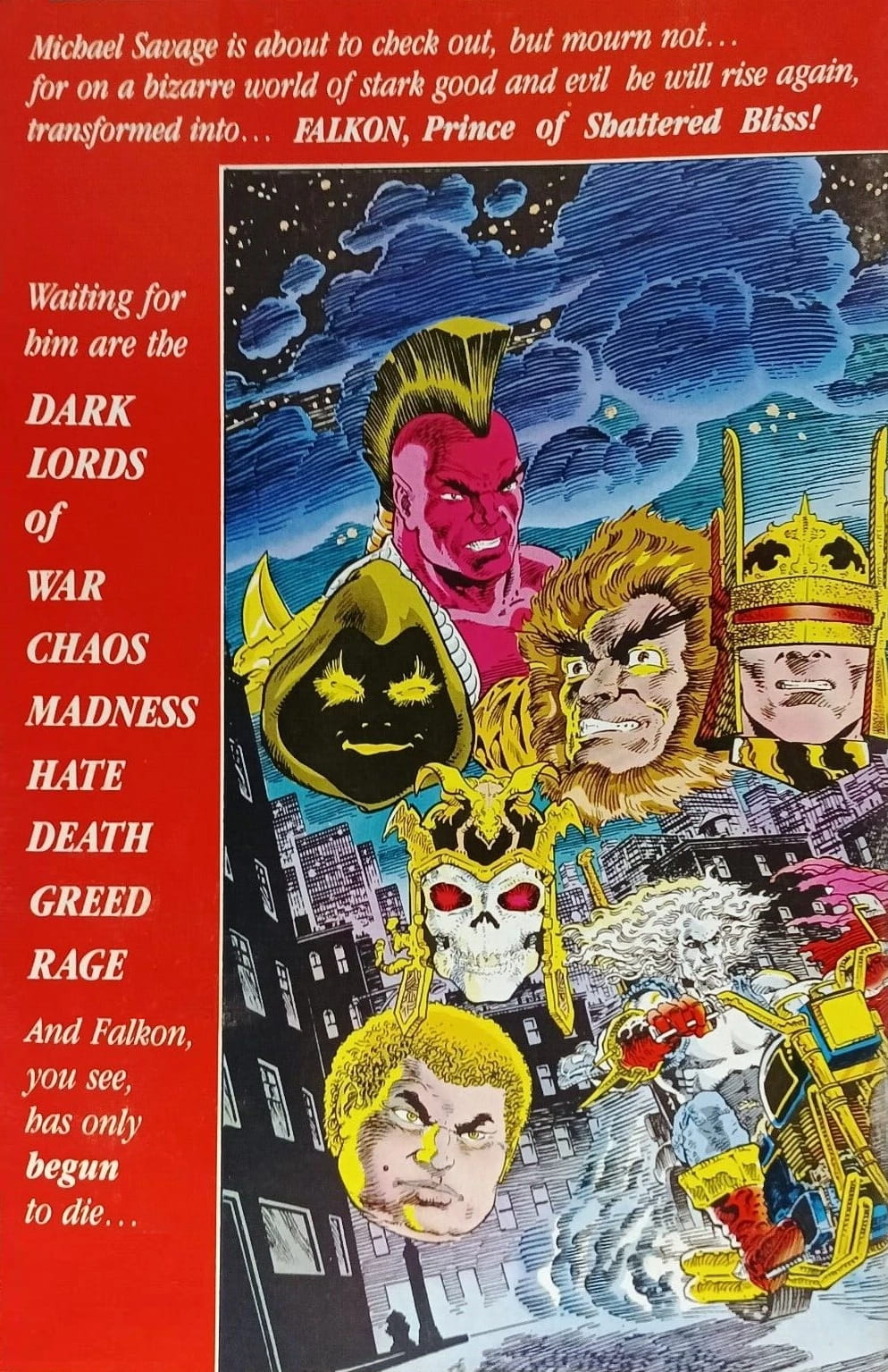
Simultaneously, the mid-century S&S prose boom was waning by the mid-’80s, with many of its fans diverting to Hollywood S&S, D&D tie-in fiction, and/or the burgeoning subgenre we now label epic fantasy. Perhaps the Supermanly tights were intended for cross-over appeal to the expanding fan base of superhero comics, which were then reaching an apotheosis in a pair of concurrent DC titles, Batman: The Dark Knight Returns and Watchmen.
No, the problem with Lords of the Ultra-Realm is not the marketing intentions, the unitards, or the art.
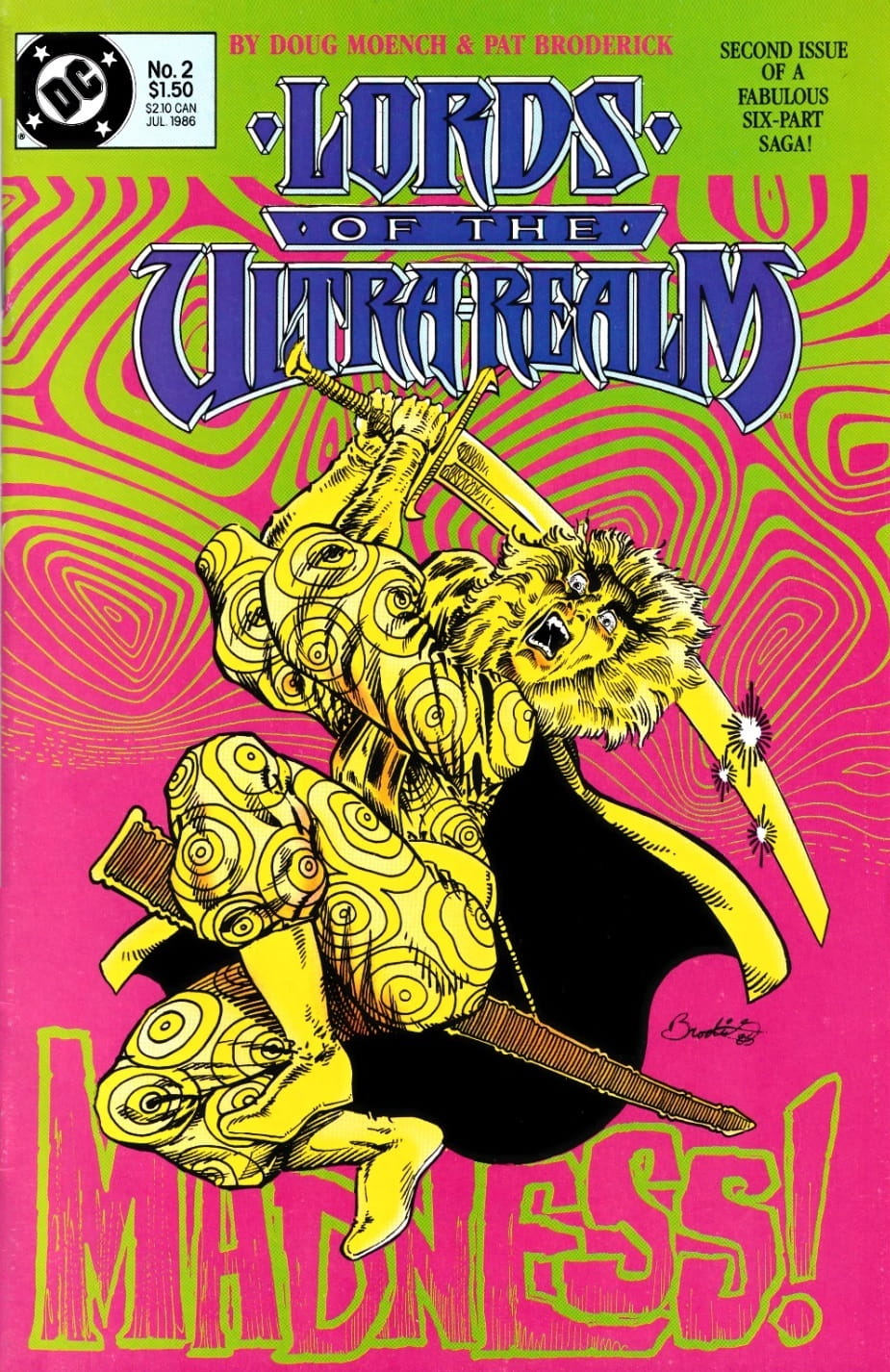
It’s the concept, or, more precisely, an underlying misconception.
In concept, the cosmos of Lords of the Ultra-Realm consists of two parallel but interdependent worlds. Earth is the “foundation world,” and the Ultra-Realm is Earth’s ideal and monstrous counterpart, embodying all Earthly dreams and nightmares. This embodiment means the Ultra-Realm has an eternally sunlit side and an eternally dark side, with half of the Ultra-Realm’s divinities being avatars of Light, and the other half being avatars of Dark (shades-of-gray morality is an Earthly trait).
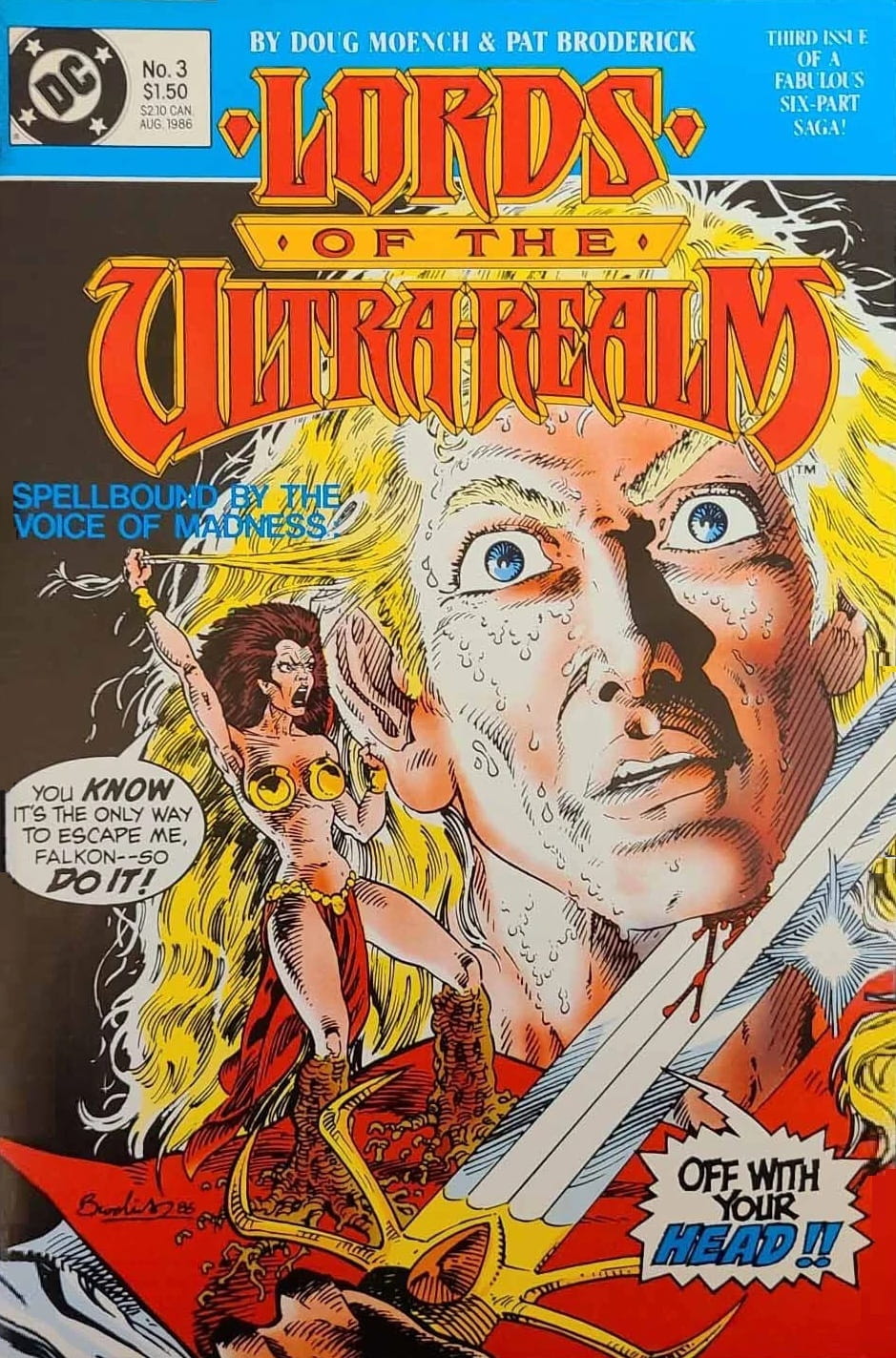
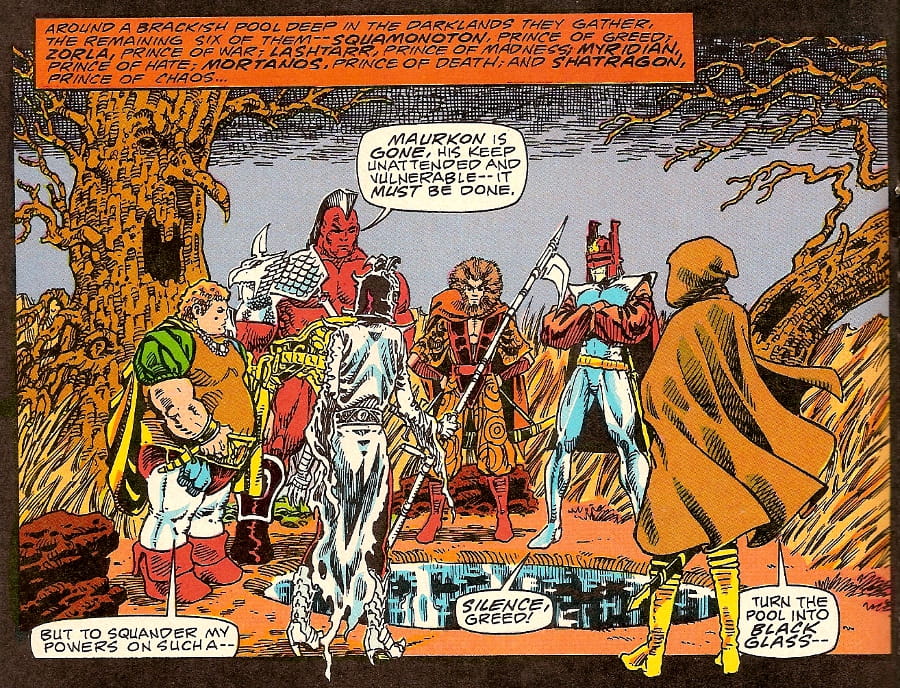
These fourteen avatars have names, but since they are so numerous, and since their characters are basically defined by their traits, I will identify them by title/aspect. Playing for Team Light are the Lords/Ladies of Bliss, Love, Peace, Grace, Enlightenment, Order, and Life. Batting for Team Dark are War, Chaos, Madness, Hate, Death, Greed, and Rage (a hint of the logical flaw may be peeking through here).
Given the stark binaries (Light/Dark, Love/Hate, etc), you may be surprised to learn these characters are nondualistic. They are shapeshifters who, a la Ranma 1/2, can be either Lords or Ladies. Alas, the nondualistic intention is undone in a couple of ways. One is that these avatars are good or evil, depending on whether they’re avatars of the Light or of the Dark, which leads to one-dimensional characterization.
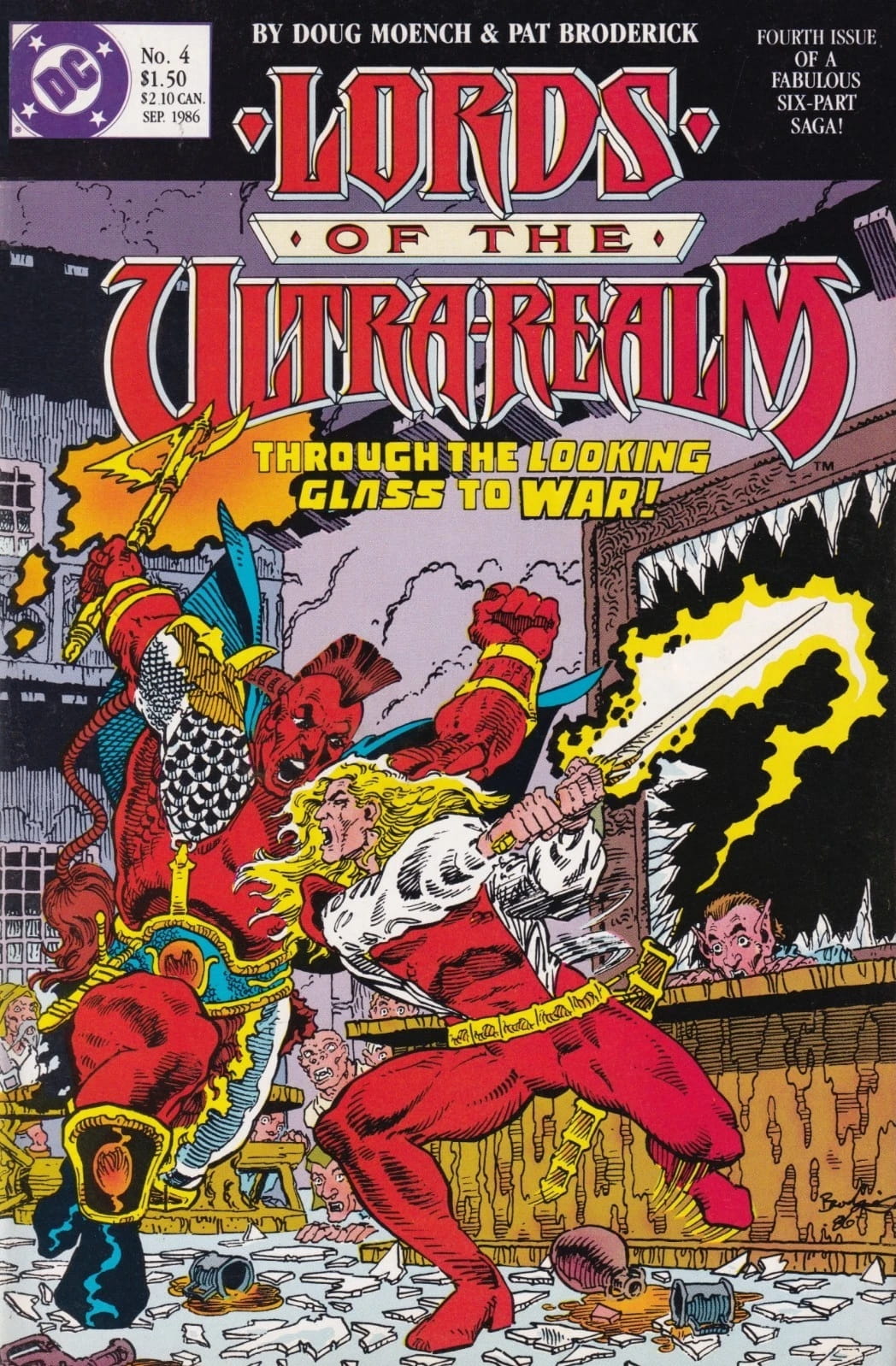
This limitation also affects the art: the good guys look like bland and insipid white-boy rock-star angels, while the bad guys get a much broader and far more interesting range of appearances (as a bonus, some of these bad boys also embody ’70s-’80s trash culture — although they’re still pretty Anglo).
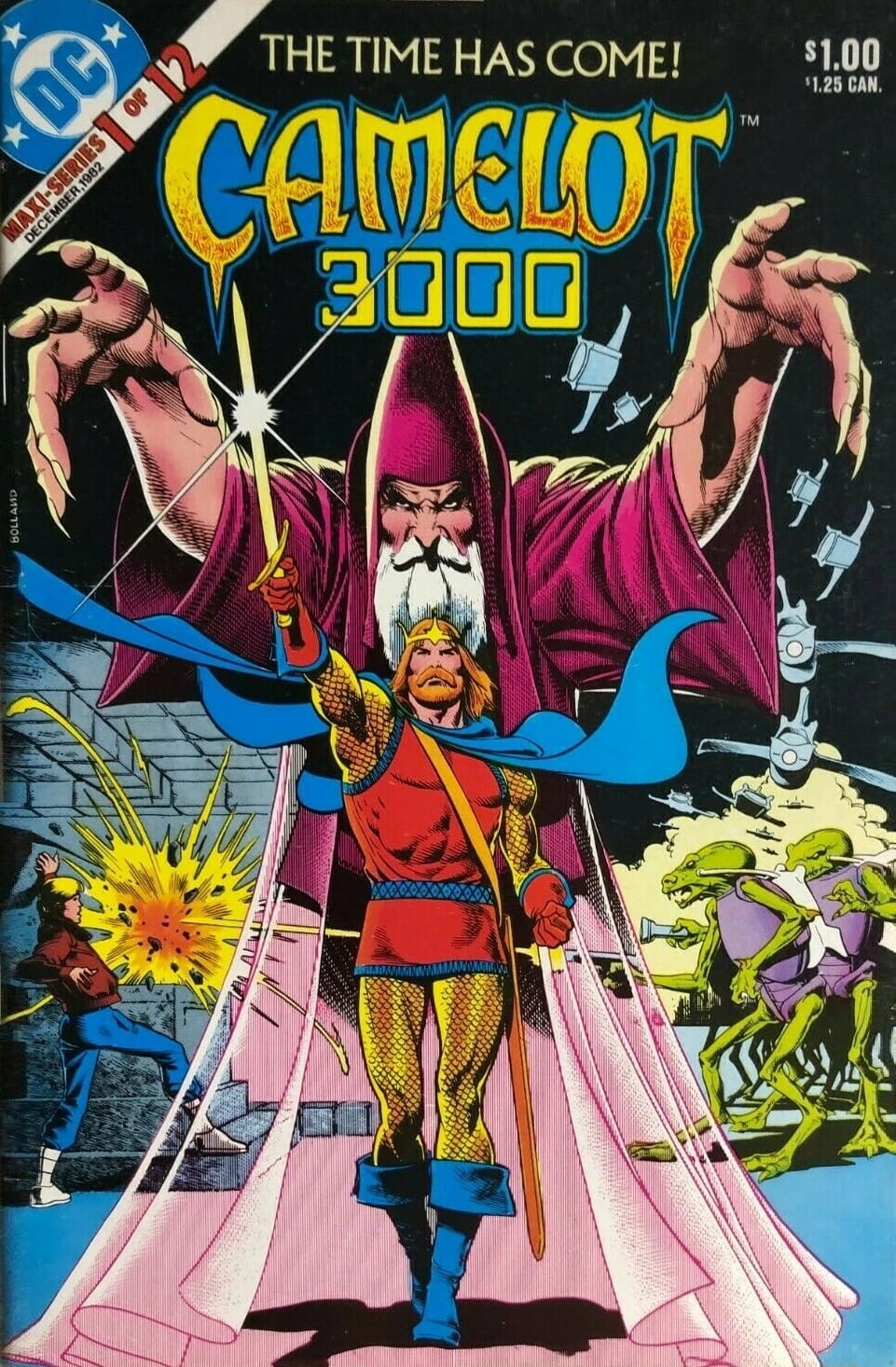
The other hindrance to nondualism is that their genderfluidity is barely utilized. The creators either didn’t recognize that male isn’t a default setting for “person,” or didn’t realize that being female is not inherently a limitation (and, anyway, aren’t these beings godlike? shouldn’t they have fewer limitations than mortals, regardless of gender expression?). In any case, readers hoping for a trans theme in an ’80s comic should turn instead to DC’s problematic, but aware and sympathetic, Camelot 3000 maxi-series.
The Ultra-Realm does have a significant binary (female) supernatural character, Recorder Scala, who is supposed to maintain the Ultra-Realm’s balance between Dark and Light (someone on the creative team has clearly read Moorcock, as well as Howard). Unfortunately, the Ultra-Realm’s balance is upset by an unprecedented act. Rage kills Falkon, the Lord of Bliss.
Since the magnitude of the disruption outstrips Scala’s ability to right the balance, an American ex-prize fighter and Vietnam veteran named Michael Savage, who is a former prisoner of war, suspected enemy collaborator, and amnesiac (though no relation to the “Savage Nation” guy), is drawn into the Ultra-Realm to reincarnate/resurrect as Bliss (shades of John Carter!).
This happens,
“Because [Savage] was and is a rare archetype-soul, the psychic and spiritual foundation for one of the Lords of the Ultra-Realm.”
And it’s Falkon/Savage’s responsibility to restore the Ultra-Realm’s balance between Dark and Light. If he doesn’t, both the Ultra-Realm and Earth are doomed (Tolkien is also an influence).
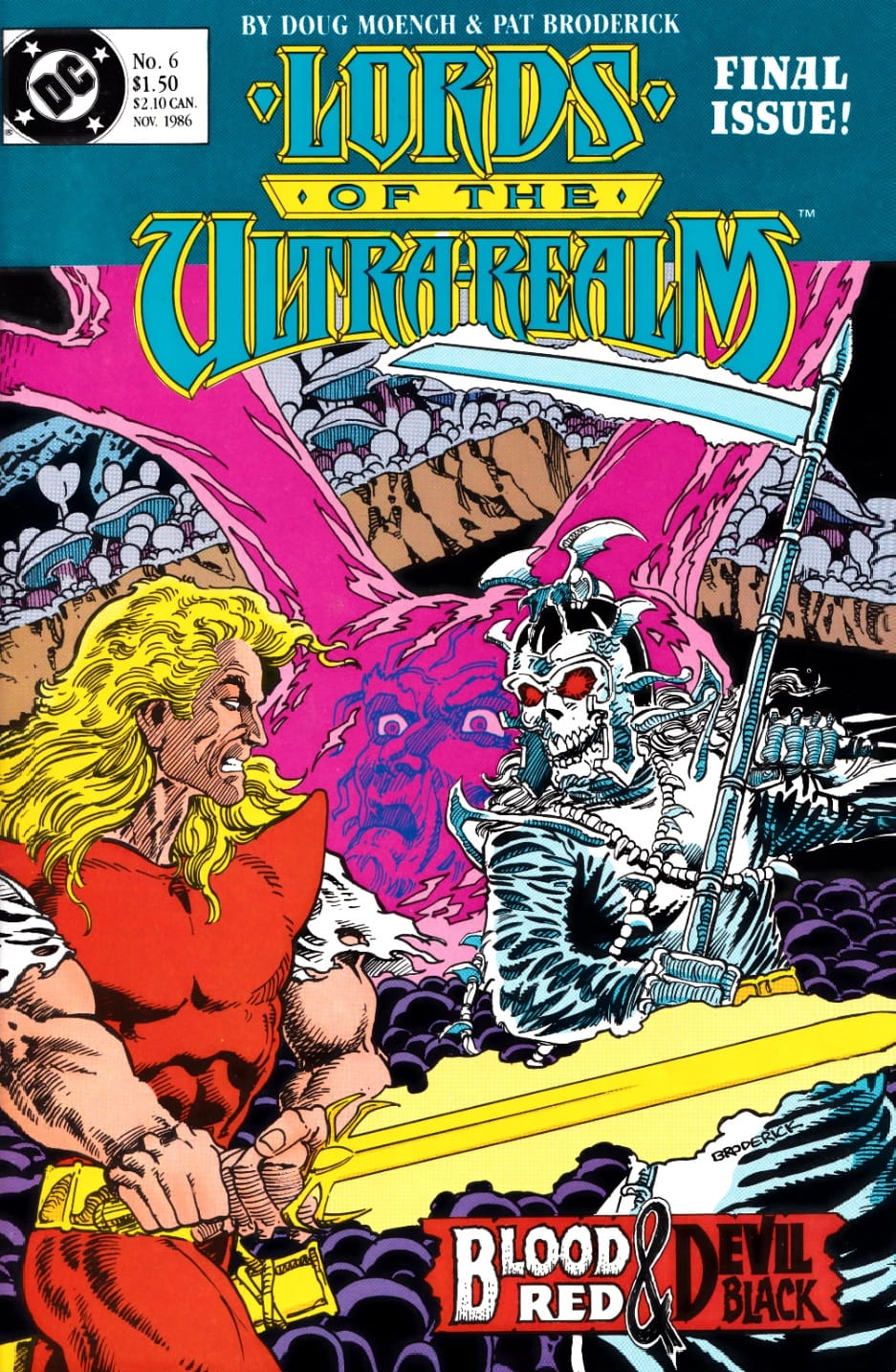
A further complication is the theme of the interdependence of Light and Dark. This gets obscured (or, arguably, cancelled) by Falkon/Savage’s pursuit of the goal, which is a welter of violence and slaughter that empowers evil behavior and tips the balance further. This happens because — as in Star Wars — Light and Dark have been cast as Good and Evil.
Writer/editor Doug Moench is seeking to explore nondualism, as Michael Moorcock explores nondualism with the balance between Law and Chaos which governs his Eternal Champion multiverse. Some readers interpret Moorcock’s Law and Chaos as equating to Good and Evil, but they do not (Nazis, for example, are Lawful Evil).
One does not want Good and Evil to be equal in power and volume (well, not unless one has a significant dysfunction of the moral compass, anyway); yet, in execution, the necessary balance in the Ultra-Realm is between Good and Evil.
Further evidence for LotUR‘s nondualistic theme is the Asian (but not really!) wise mystic character, who talks about the balance between Light and Dark. Broderick’s art helpfully offers the occasional black-and-white yin-yang mandala, and Buddhism gets a mention. However, yin-yang has nothing to do with good and evil (indeed, evil is not a concept recognized by Buddhism, or at least not in the Western sense).
Yin is female or dark energy and yang is male or light energy, and neither is “better” or “worse” than the other; instead, neither can exist without the other, and both are equally necessary. Yin and yang are intended to balance and support, and interbe with each other.
LotUR‘s conflation of the nondualistic concept of yin/yang with the Western good/evil binary leaves the theme (and readers) of LotUR struggling to reconcile what cannot be reconciled by direct equation.
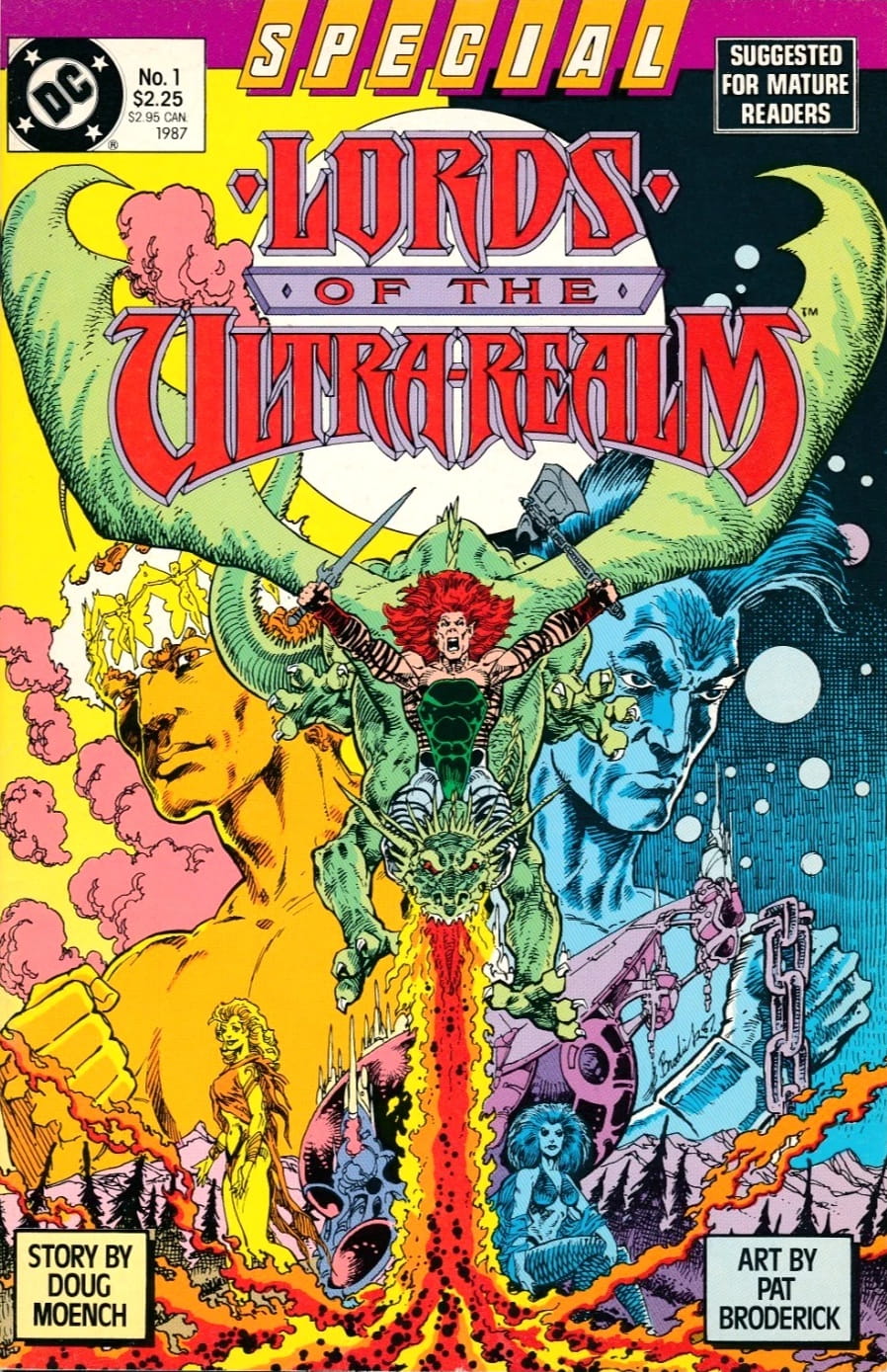
I suppose this misperception is a useful rationalization for all the sword-swinging slaughter, which joins with all the divine power/magic/ mysticism to land the six-issue series squarely in the sword and sorcery subgenre. However, as Moorcock has demonstrated, S&S can have those things and nondualism, too.
LotUR is distinctly inventive and original. You certainly won’t mistake it for any of the influences I’ve mentioned. But, ultimately, the reader may be left too confused by the thematic muddle and the sheer number of characters to greatly appreciate this ambitious and skillfully illustrated incarnation of ’80s S&S.
Cynthia Ward is the author of The Adventure of the Incognita Countess (Aqueduct Press, January 2017), Writing the Other: A Practical Approach (with Nisi Shawl), and more than 70 short stories and chapbooks. Her last article for Black Gate was a look at DC’s Stalker by Paul Levitz, Steve Ditko, and Wally Wood.