Short, Strange Trip: Stalker #1 – 4, by Paul Levitz, Steve Ditko, and Wally Wood
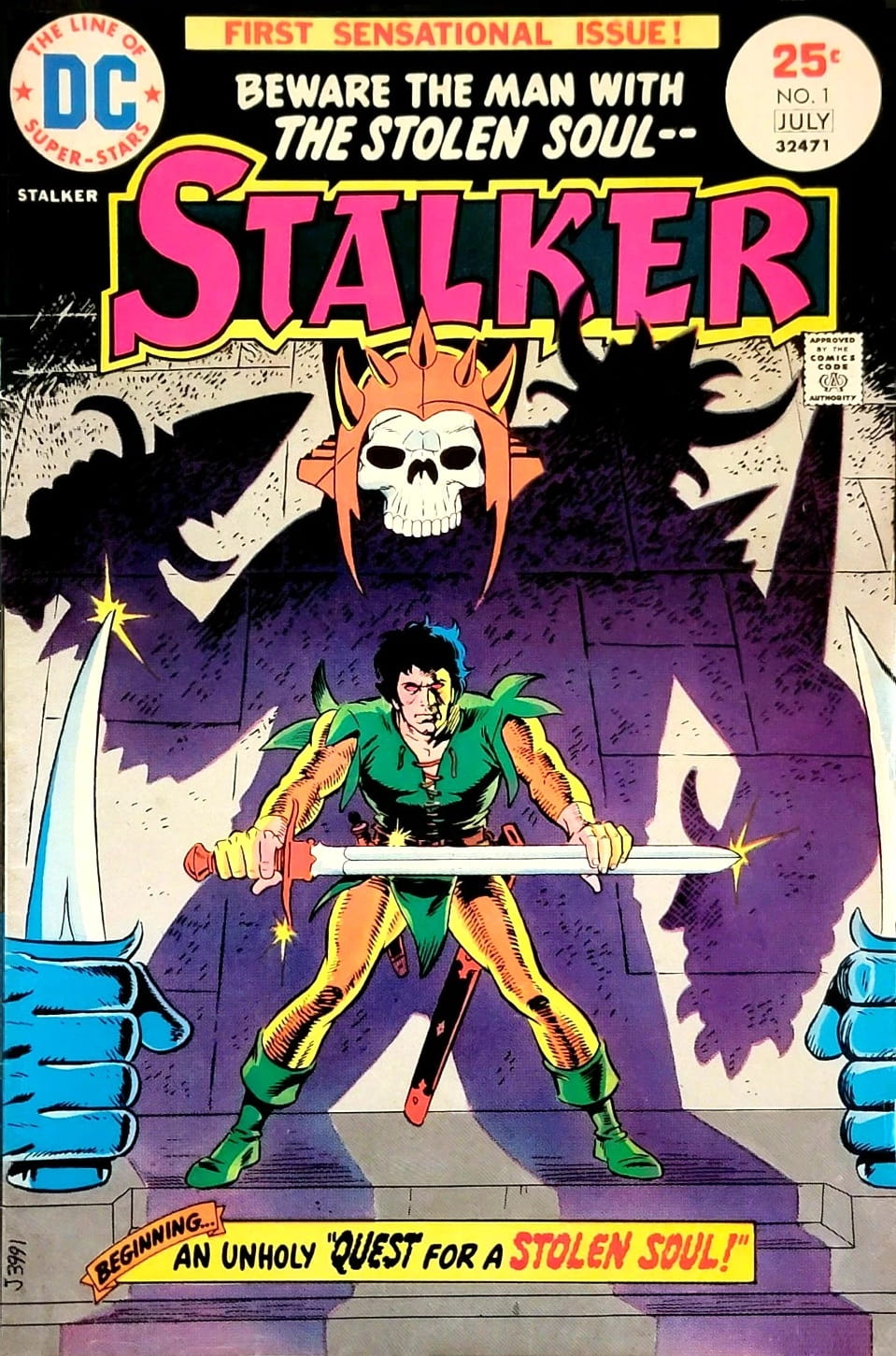
It must have looked like a can’t-lose comic: An original sword and sorcery title with art by two legends. One was Steve Ditko — the co-creator of Marvel’s biggest solo superhero, Spider-Man, and creator of Marvel’s psychedelic occult investigator, Dr. Stephen Vincent Strange. The other was Wally Wood, the storied veteran of EC Comics’ infamous horror and crime titles.
With scripts by future DC Comics President/Publisher Paul Levitz, DC’s new S&S series (launching in July 1975) would be bizarre and amazing and creepy, filled with the touches that made the mid-Twentieth-Century Dr. Strange comic such a trip, and it would be set within the Weird and horrific and sometimes-cosmic environs of a fantasy subgenre still fresh to comics.
And Stalker was all of these things, except a hit. The bimonthly title was unfortunately cancelled in January 1976, after four issues.
[Click the images to stalk larger versions.]
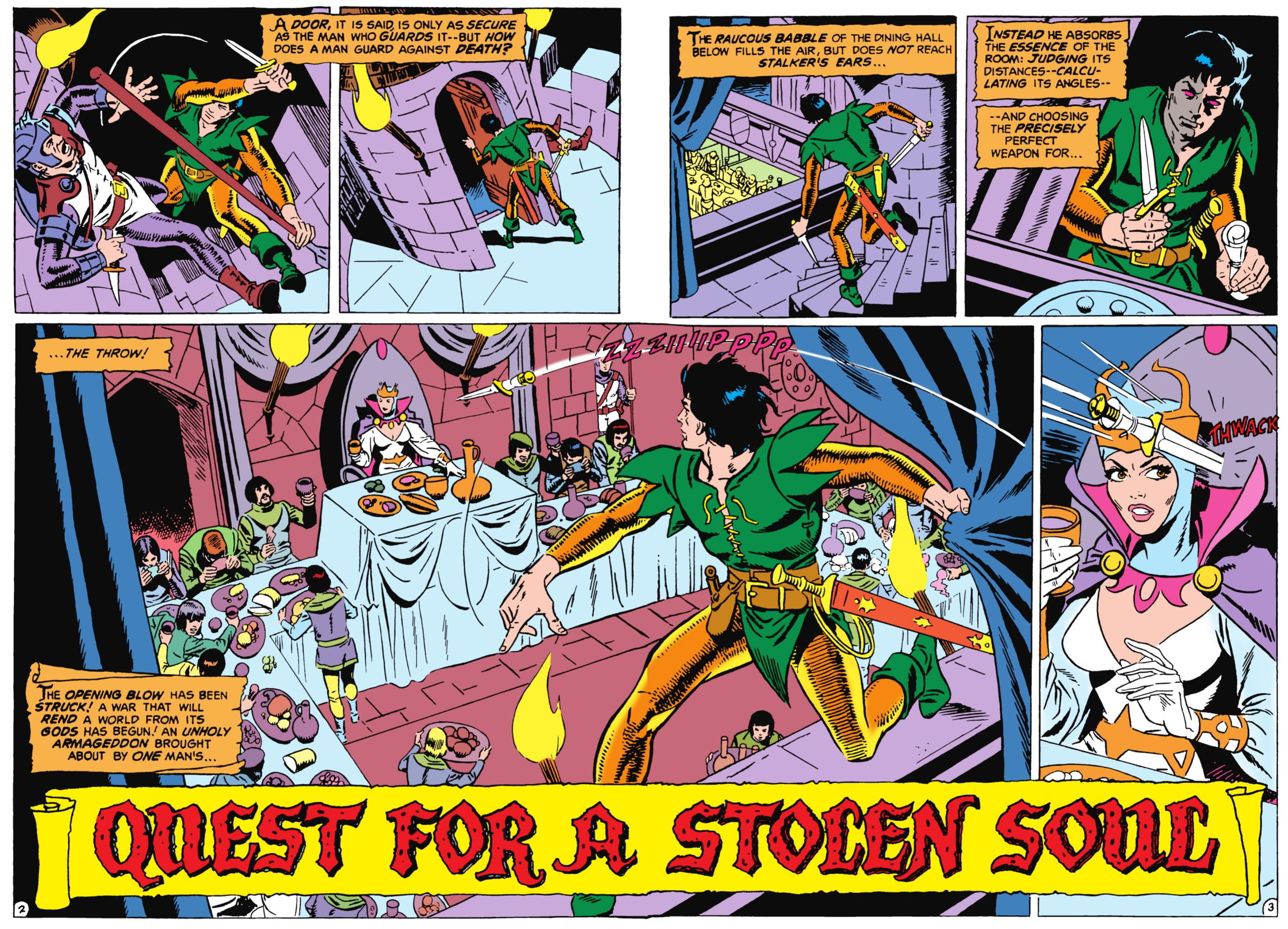
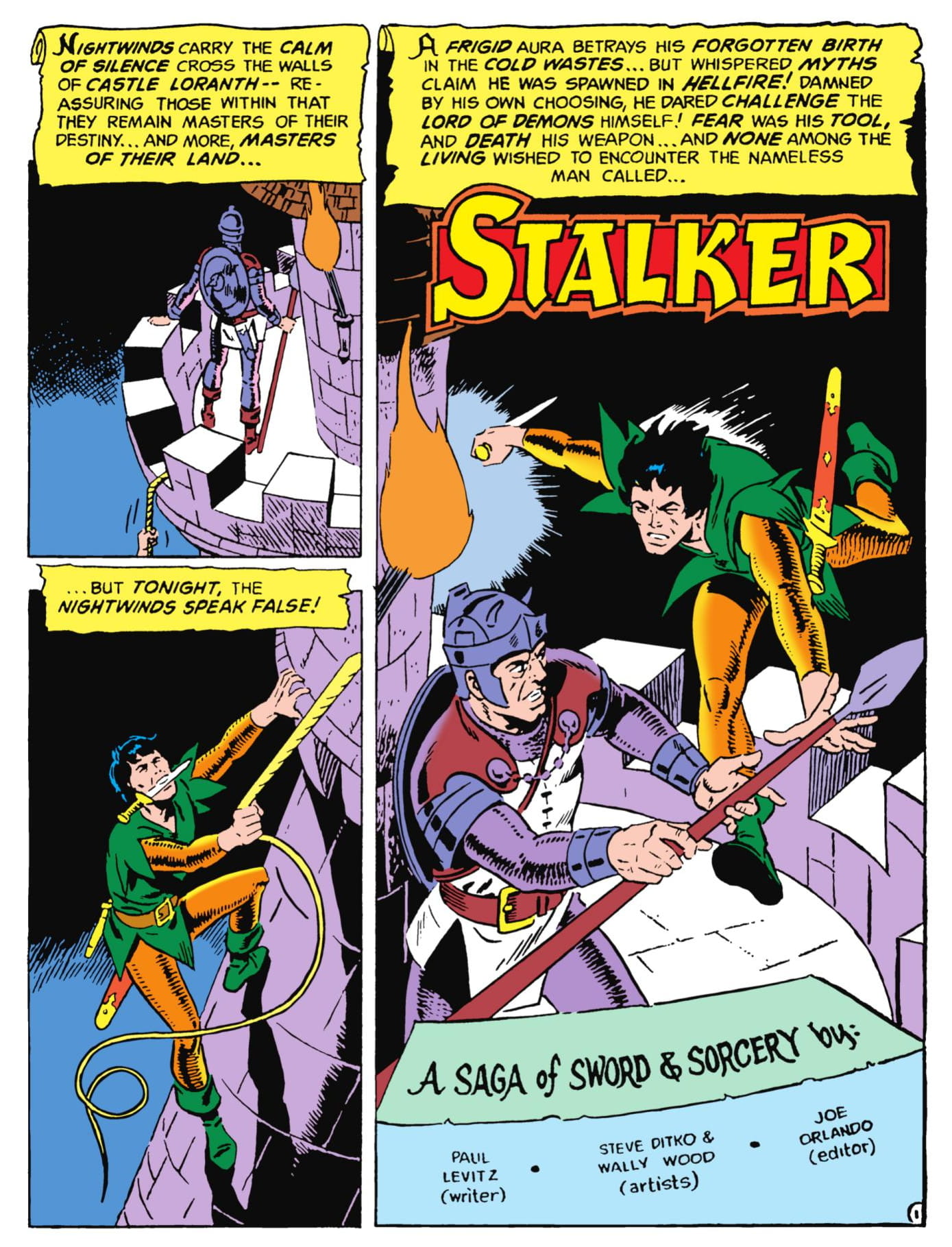
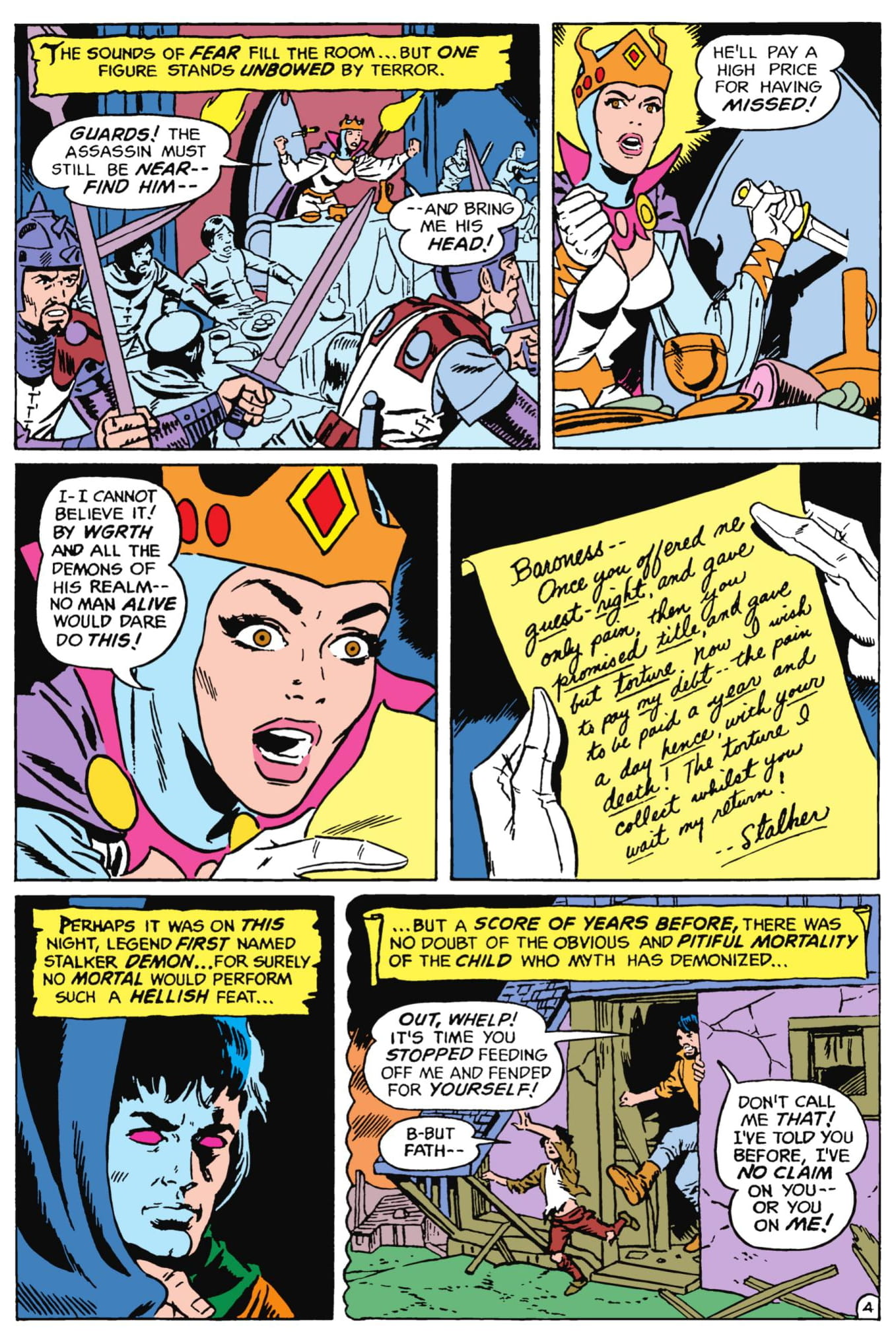
The series gets off to a good start. The warrior/assassin known as Stalker slips into well-guarded Castle Loranth and delivers its lady a message via flung knife, threatening to kill her in one year. A flashback reveals Stalker’s origin as a cast-off, nameless street boy, one brave and resourceful enough to offer his service to the Baroness of the medieval city of Geranth. He pledges his undying loyalty in exchange for training as a knight.
The lady accepts his offer, but she’s a classic classist: she has no intention of following through on the knightly training, as the boy — soon mired in a slave-like existence — angrily realizes.
Theirs is a realm in which the gods take an active role. And when the young man proceeds to the temple of the Demon Lord of Warriors, to pray for a warrior’s skills, Dgrth (sic) manifests, and offers the boy a deal.
I’ll grant you — power — skill — all the arts of killing men ever wished for! You’ll become the living messenger of death — the most invincible foe this world has known!
All the young man need do is kill those Dgrth wants killed and give up his immortal soul.
It’s an offer the boy can refuse. But he won’t need a soul when he dies, right? So he agrees to the bargain, only to have his soul taken immediately.
For Stalker (named by the Demon Lord), the bargain still seems like a great deal. At first. Then he initiates his year-long revenge on the baroness.
The act leaves him hollow. He feels nothing, because he’s soulless — “Torn from [his] humanity.” This is not what he bargained for, so he returns to Dgrth’s shrine, seeking the restoration of his soul.
This proves far easier said than done.
The god of war doesn’t reappear, and his local ecclesiastic doesn’t know how to get to Hell (at least, not while still alive). The only priest who knows the location of the gateway to Dgrth’s realm is the Prior of the Temple at World’s End. Stalker rather wantonly dispatches the local priest (a tipoff to future body-count) and sets off for the end of the world.
This is literally the end of the world, because it’s flat (how a flat planet squares with its people’s time-lost origin on our own global Earth is not revealed in these four issues. Hell’s denizens clearly include space-faring ancestors. Also clearly, to judge by Stalker, by his DC sword-brother Hercules Unbound, and by Marvel’s Conan the Barbarian #1 [October 1970], the Big Two comics companies of the ’70s did not balk at spicing their sword and sorcery with science. But we should rejoin the Soulless One’s adventure, already in progress).
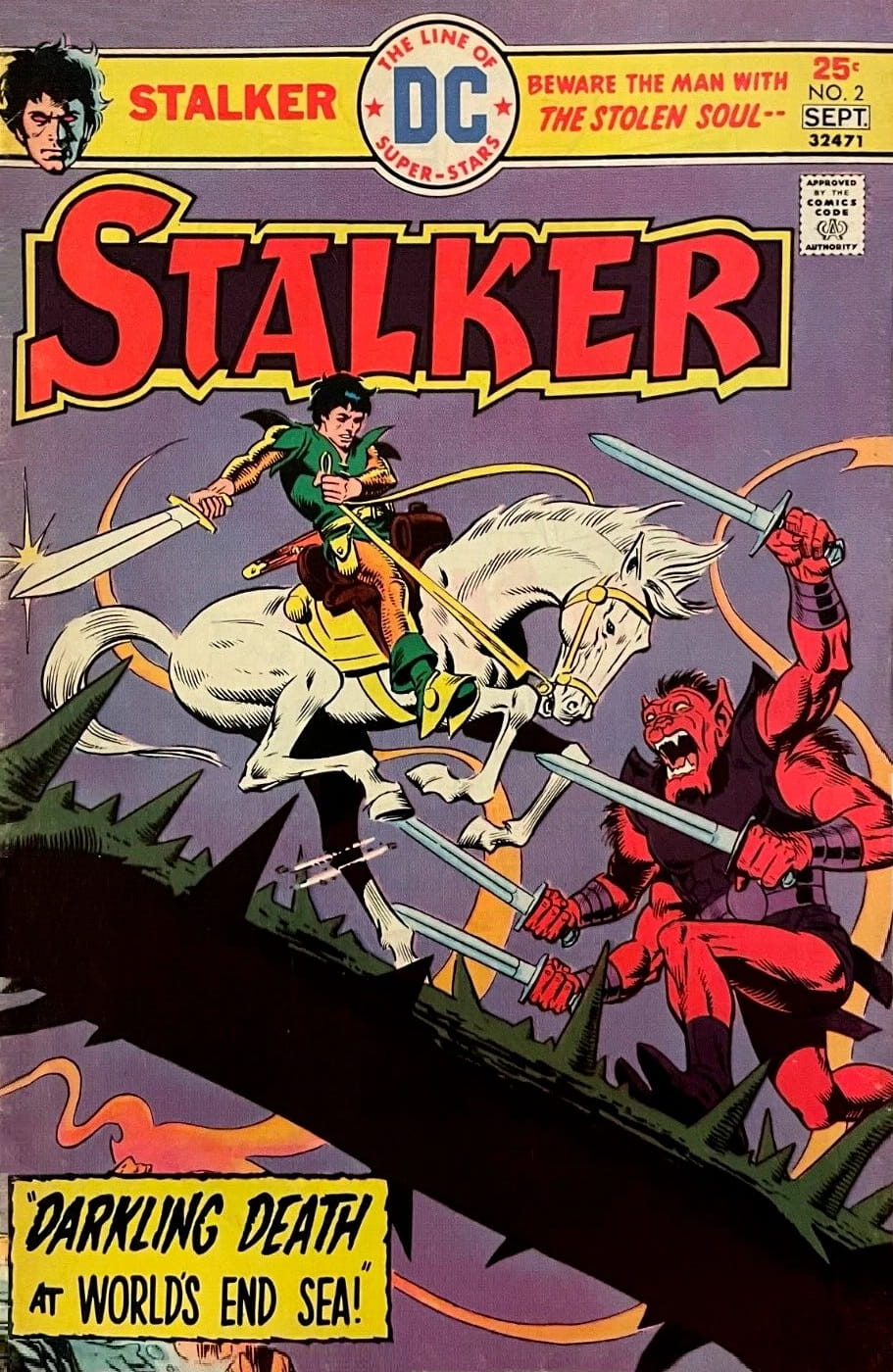
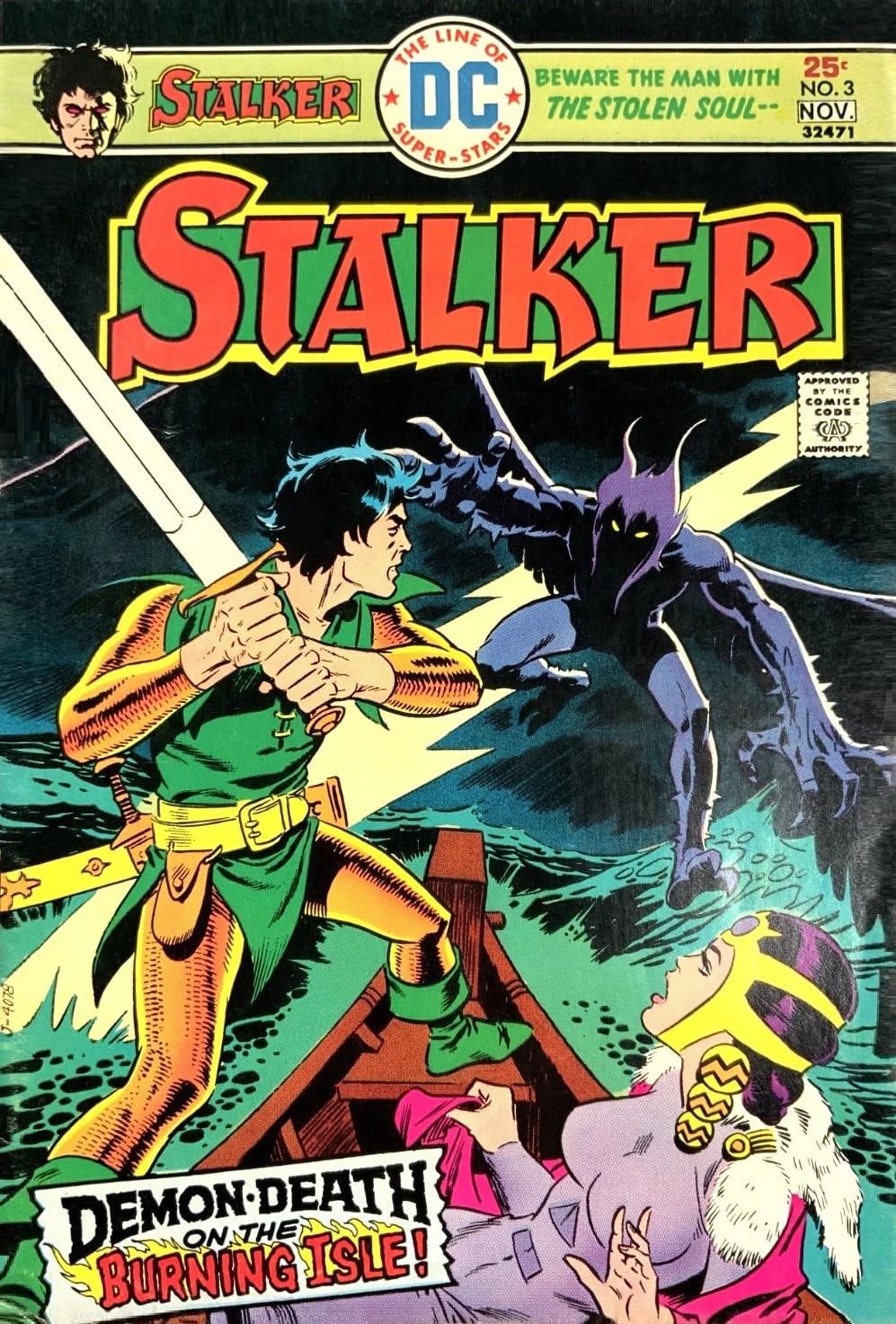
On Stalker’s world, water pours off the edge, and you don’t want to fall off. The peculiarity of this environment is exploited to smart effect, and the visuals are appropriately unearthly. In this regard, the second and third issues really shine — as does the fourth issue when, after many strange and monstrous dangers of World’s End (and possibly also a couple of beauteous and mysterious damsels) threaten the ingenious warrior, he finally enters the even more unearthly world of Hell. The Dr. Strange-meets-Elric-and-Conan vibe is in full oscillation.
Regaining a soul proves trickier than finding and fighting Drgth. Reclamation will require completion of a nearly impossible quest. And the cost of failure will be eternal, with the Demon Lord promising Stalker “the most painful damnation in the eons-long history of Hell!”
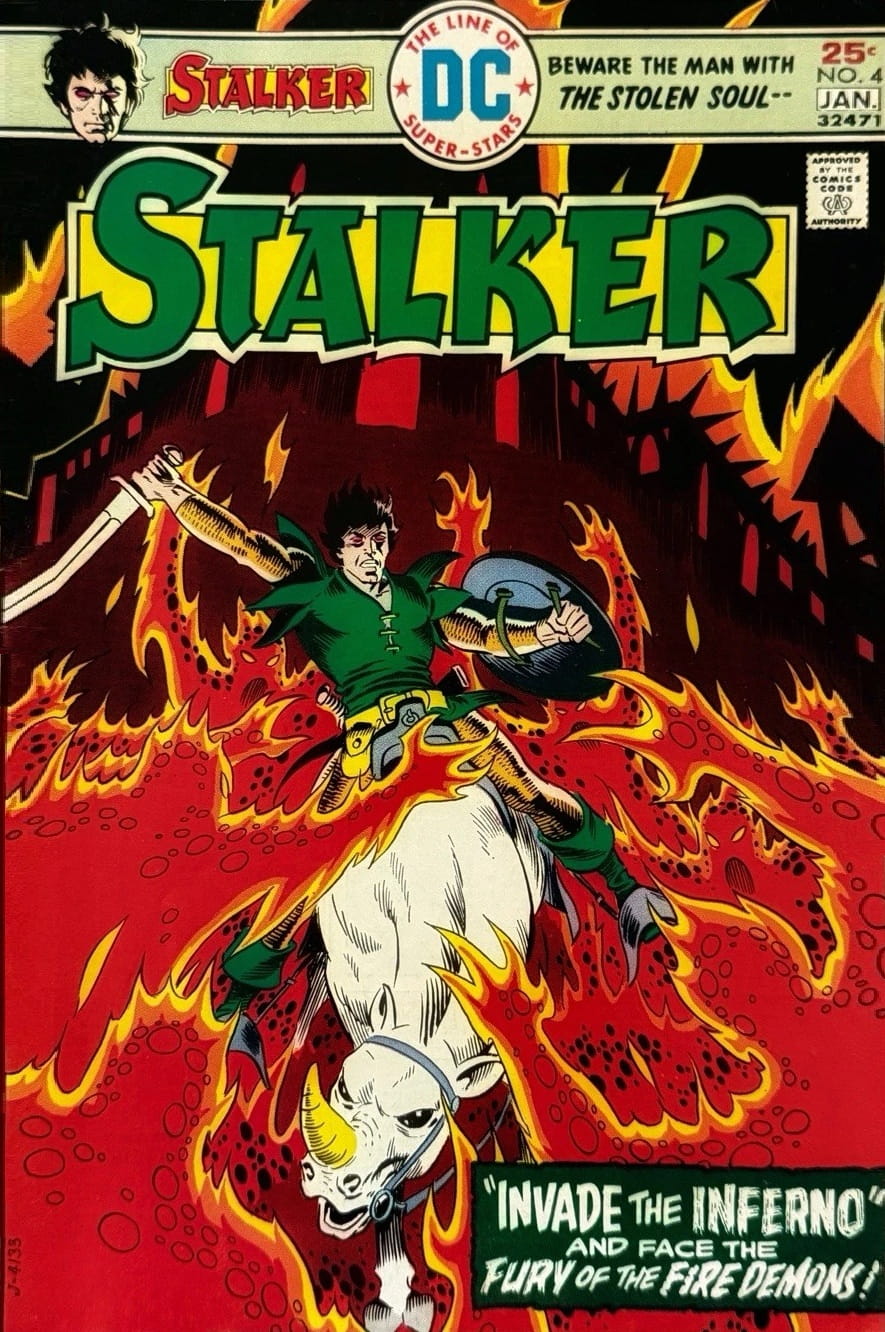
Issue #4 is a frustrating place to cancel the series. Still, it could have been worse — the Stalker-goes-to-Hell subplot is wrapped up, and we aren’t yet launched on the revised soul-quest. Stopping here also sidesteps a bit of a challenge in gaining the goal, which would require a body-count to dwarf the one already racked up. Which would make Stalker something worse than the antihero of the existing issues.
Perhaps it’s just as well my parents thought of comics as kids’ stuff, and turned a blind eye to my reading. They had no idea what changes had been wrought by Marvel’s revolutionary targeting of Baby Boomers and DC Comics’ subsequent reboot of its own superhero universe to attract teenaged and twentysomething readers. My parents were entirely tolerant of my youthful reading habits. But I’m not so sure they would have let me keep reading about the launch and career of what we in the 1970’s were starting to label a serial killer.
Actually, it’s not clear to me that the title’s creators realized that this was what they were doing. Probably — Stalker is clearly intended as an antihero. But it’s also possible the grinding pace and prodigious output of mainstream mid-century comic-book production obscured the long-term implications.
In a way, it’s too bad Stalker wasn’t a somewhat longer, finite mini-series in the ’80s. Such an approach would have been well-suited to the dark implications of an immortal’s despair and a damned mortal’s fate, while putting an end-point on the mass-murdery stuff. A mini-series would also have let the creators open out other implications of soul loss, strengthen character development, and generally gain more space for the plot, while allowing the series to maintain a suitably pulpy pace.
On the other hand, I’m not sure the English-language comic-book world needs yet another mind-bendingly ultraviolent series. Such a series may sometimes lose track of things like plot, characterization, and a reason for readers to care — lacks which would have made for a truly problematic, even monstrous (and yet also boring!) incarnation of Stalker.
The 1970s version is not boring. For all its hurried pacing, its period-piece color choices, and its overreliance on the Euro-medieval template for its post-space-faring otherworld, Stalker is an unusually original work, with an offbeat approach, distinctive art, and an interesting story. It is well worth the attention of sword and sorcery aficionados and of fans of the creators, of Dr. Strange, or of Bronze Age comics. And, fortunately, you don’t need to overpay for old copies on eBay. While not all eBookstores offer them, Amazon currently has all four issues available for purchase in Kindle format, and you can read the complete first issue at 50 Year Old Comics.
I hope you’ll give them a try. I think you’ll enjoy Stalker.
Cynthia Ward is the author of The Adventure of the Incognita Countess (Aqueduct Press, January 2017), Writing the Other: A Practical Approach (with Nisi Shawl), and more than 70 short stories and chapbooks. Her last article for Black Gate was a review of DC’s Red Sonja: Queen of Plagues by Gail Simone and Walter Geovanni.