Feminist Icon in a Chain Mail Bikini: Red Sonja: Queen of Plagues by Gail Simone and Walter Geovanni
 |
 |
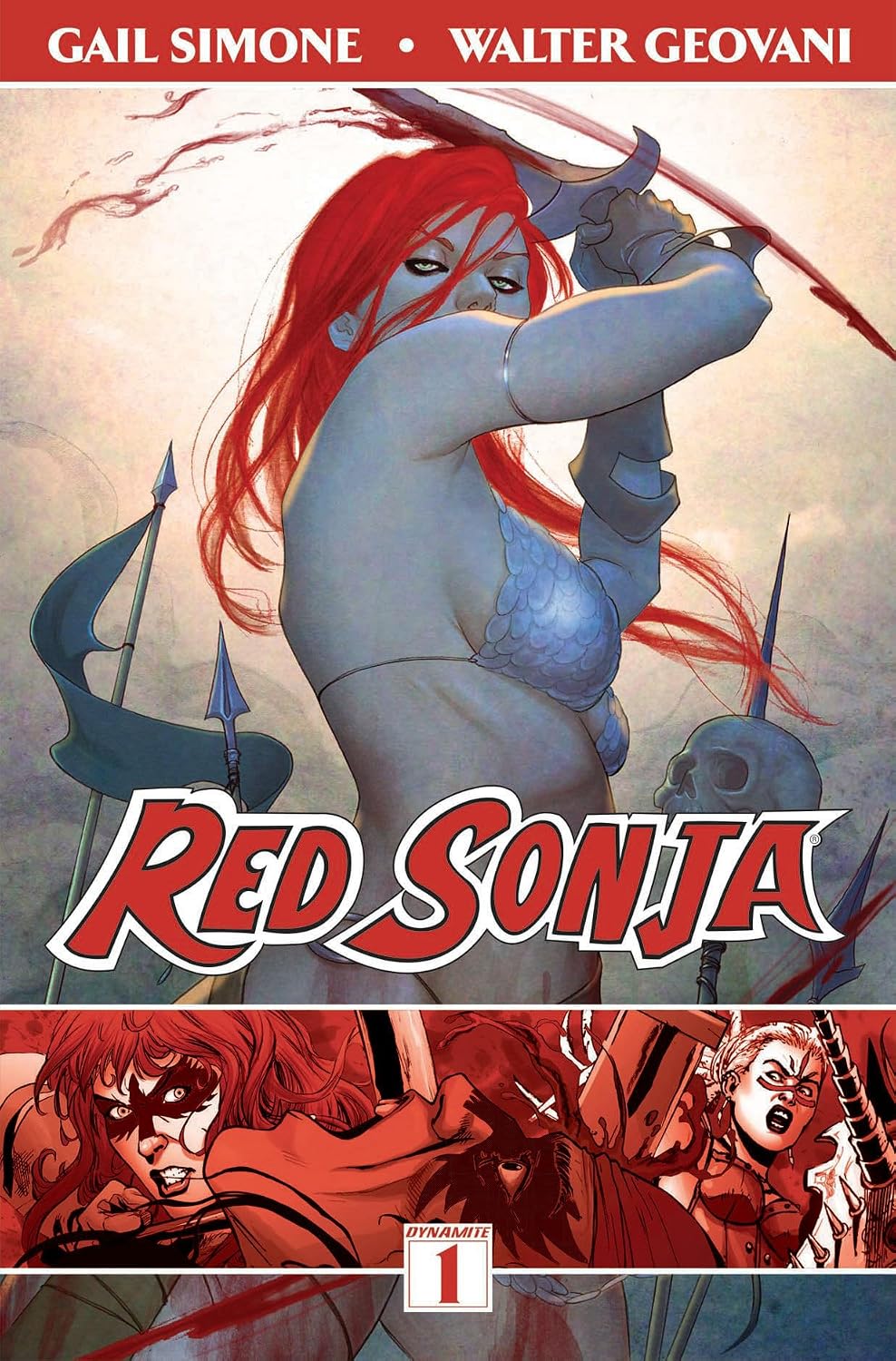
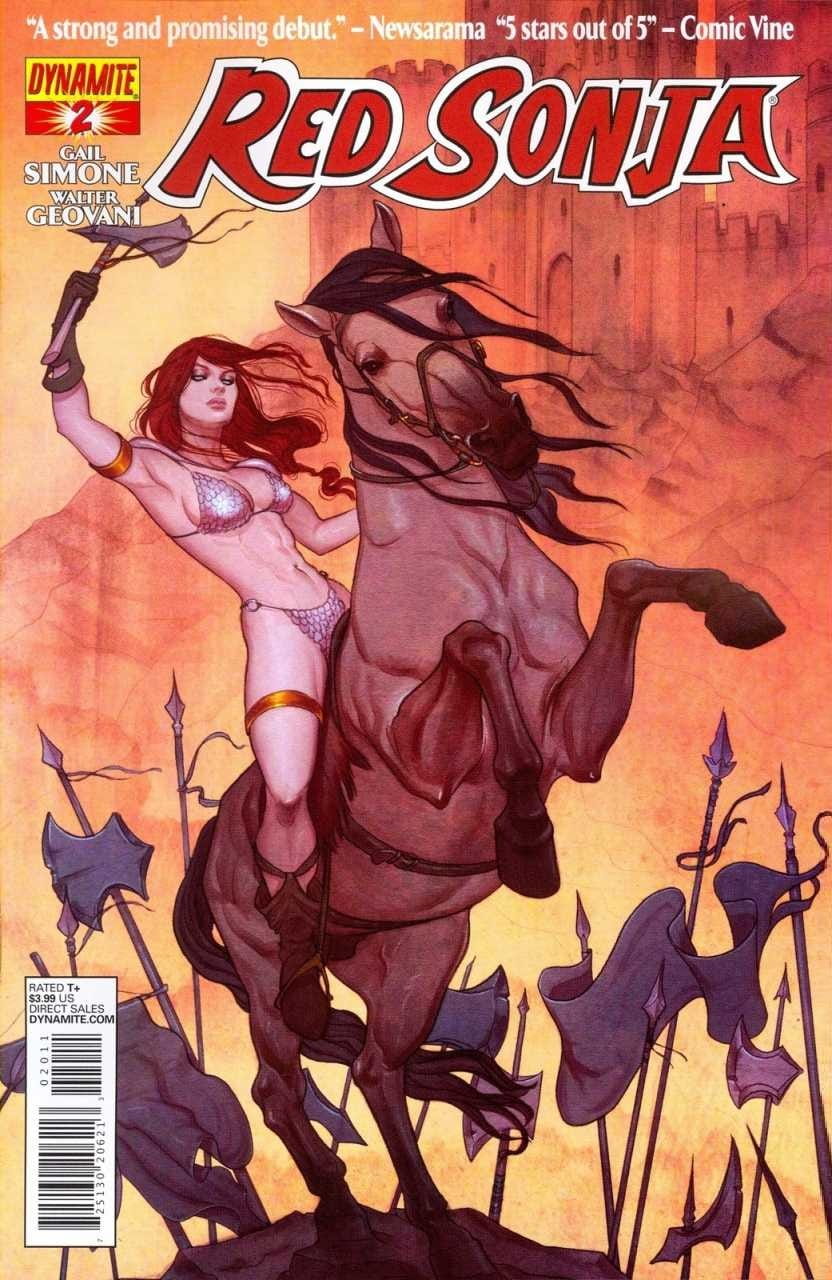
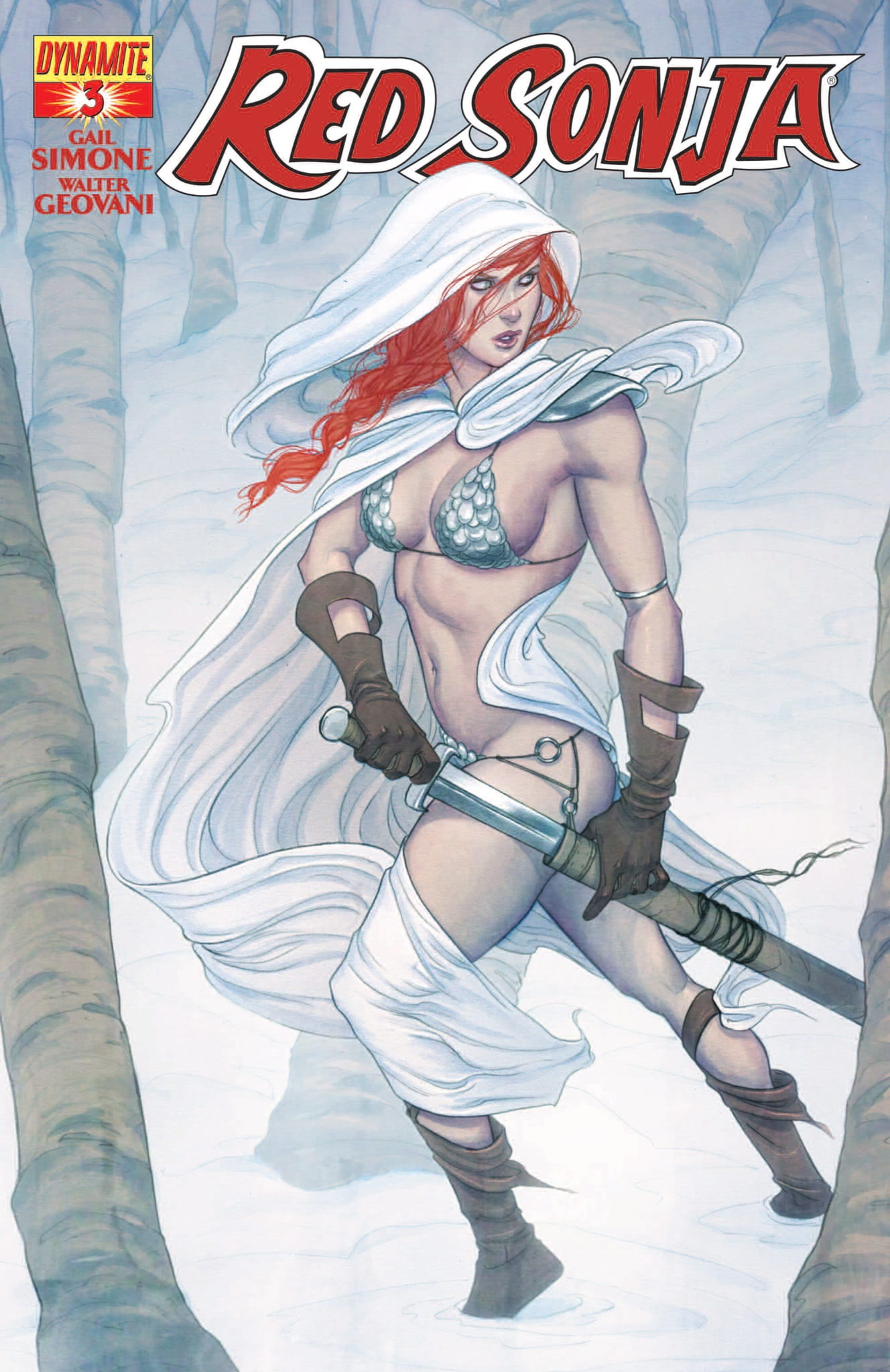
Red Sonja: Volume 1: Queen of Plagues (Dynamite Entertainment, March 4, 2014). Cover by Jenny Frison
If you saw the cover of Red Sonja: Volume 1: Queen of Plagues which accompanies this review before you started reading, your eyes probably popped with shock or narrowed with anger. The odds of either reaction went up if you were unhappy because it sported a cover controversially featuring a chick in a chain mail bikini.
Your reaction to the cover of Red Sonja: Volume 1: Queen of Plagues might not be entirely negative if you grew up reading the 1970s comics which featured the original chick in a chain mail bikini: the indomitable swords and sorcery character Red Sonja, the She-Devil with a Sword. In those years, I thought her chain mail bikini was the stupidest-looking costume ever to appear in a comic book (where there’s never a shortage of competition). Yet I was also inspired. I wanted to learn fencing, and she was supreme with a sword. And, even when an artist sexed her up, Red Sonja was the strongest female character I encountered with any regularity in my teen years.
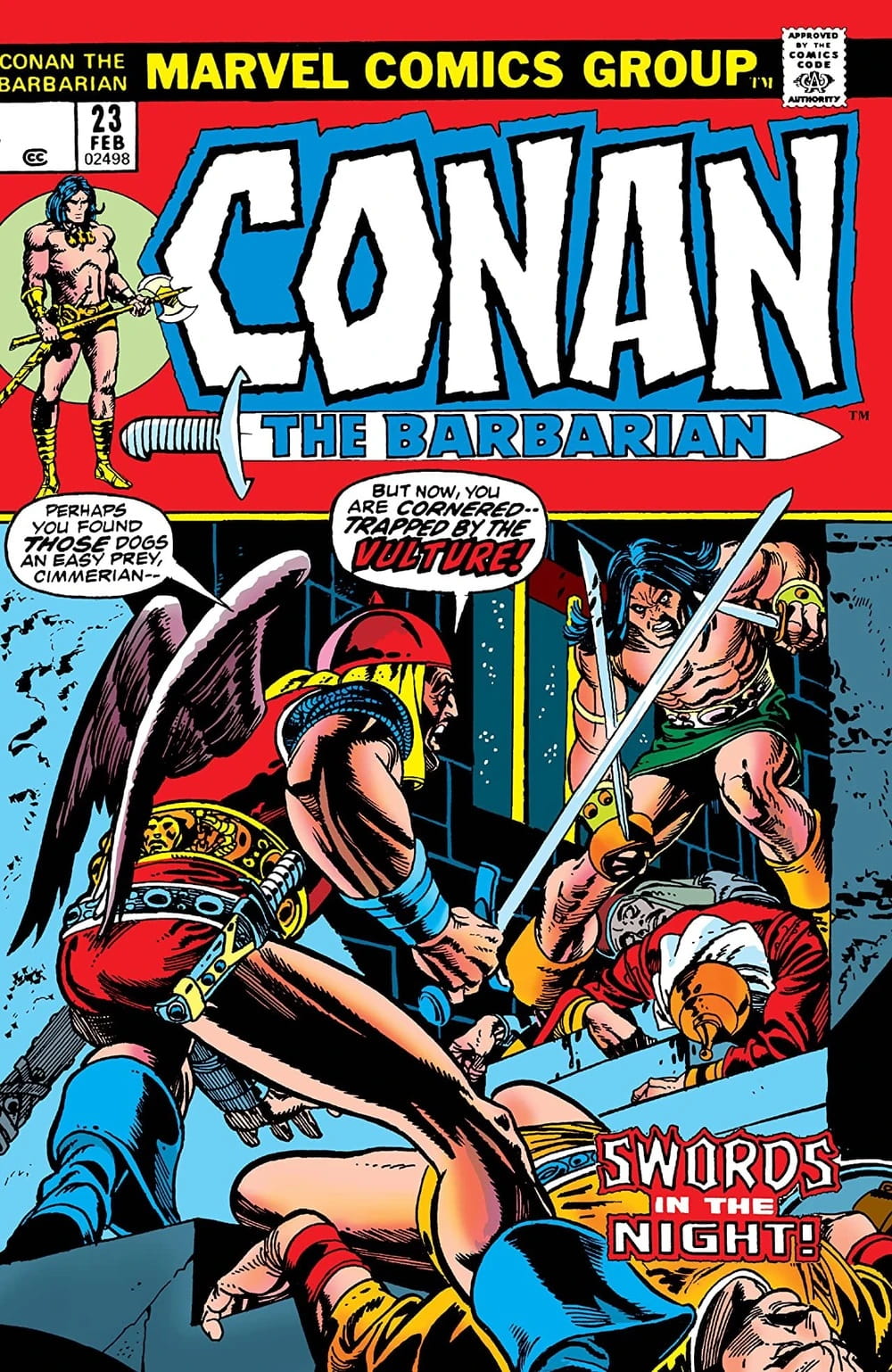
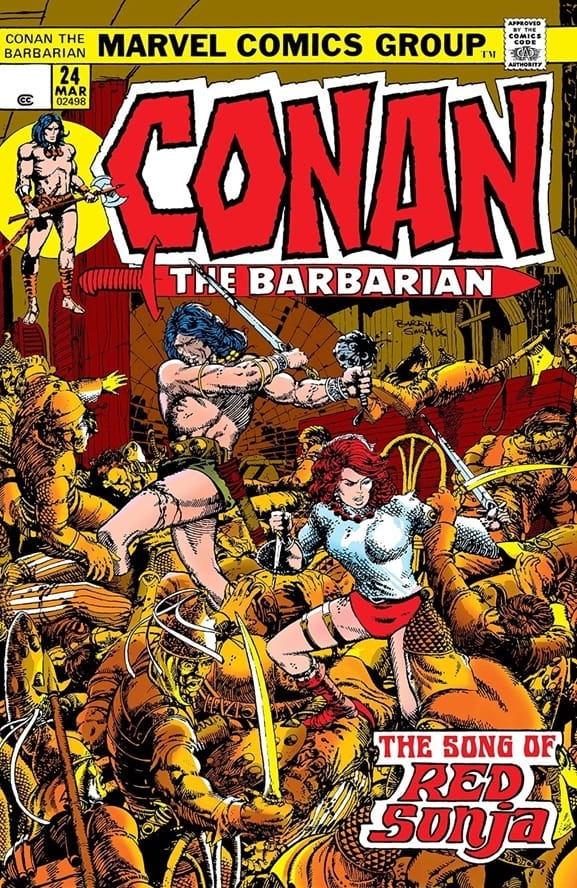
The fierce, take-no-shit swordswoman debuted in Conan the Barbarian #23 and 24 as the more reasonably-dressed creation of writer Roy Thomas and artist Barry Smith (now Windsor-Smith). They based her on a ferocious, take-no-prisoners swordswoman created by pulp author Robert E. Howard, Conan’s creator, in the non-Conan historical adventure, “The Shadow of the Vulture.”
This character, Red Sonya with a “y,” spends the story repeatedly saving the life of the putative hero, a sword-swinging macho blockhead, who never gets an opportunity to return the favor. I appreciated the comics about her literary ‘daughter,’ Red Sonja with a “j,” until writer Roy Thomas left Marvel Comics, and I moved on to The Uncanny X-Men and Joanna Russ.
I never saw the Red Sonja movie, and I missed such capitalist-excess silliness as the Red Sonja/Spider-Man crossover. I even assumed they’d stopped publishing Red Sonja comics.
But in the second decade of the new millennium, I discovered I’d missed generations of Red Sonja comics, from a variety of licensees. Still, I remained uninterested in revisiting the character, since — in all the decades since her creation in 1973 — barely any women have penned a story containing RS (the only ones known to me were Clara Noto, Christy Marx, Louise Simonson, and Marie Javins [and while you will find the names of Danette Couto, Cat Yronwode, and a certain Cindy Ward credited on the splashpage of Conan the Barbarian #115, none received a writing credit.])
 |
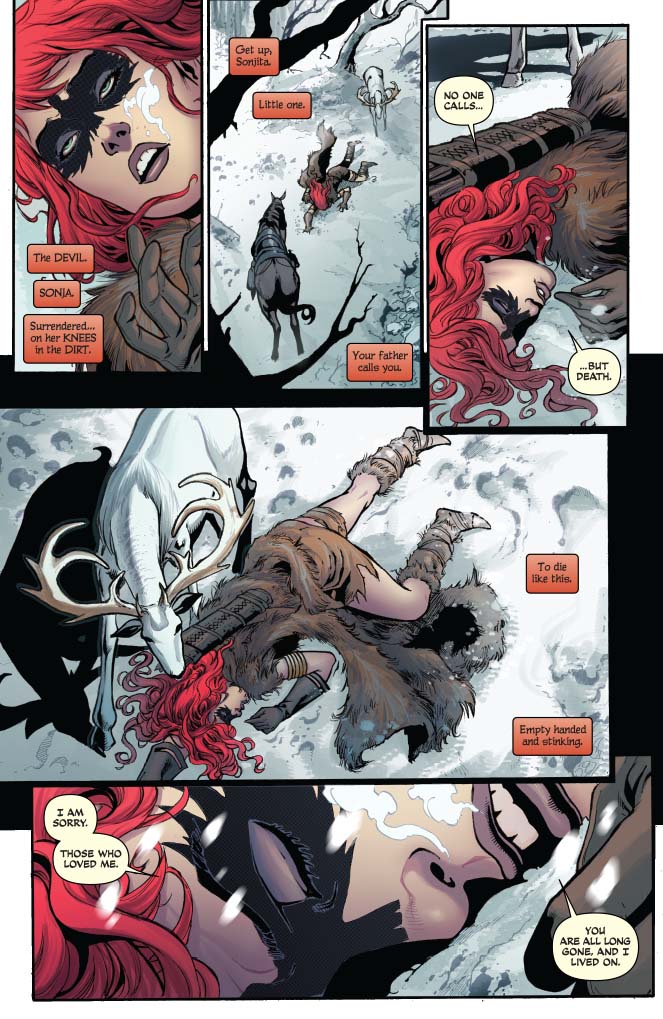 |
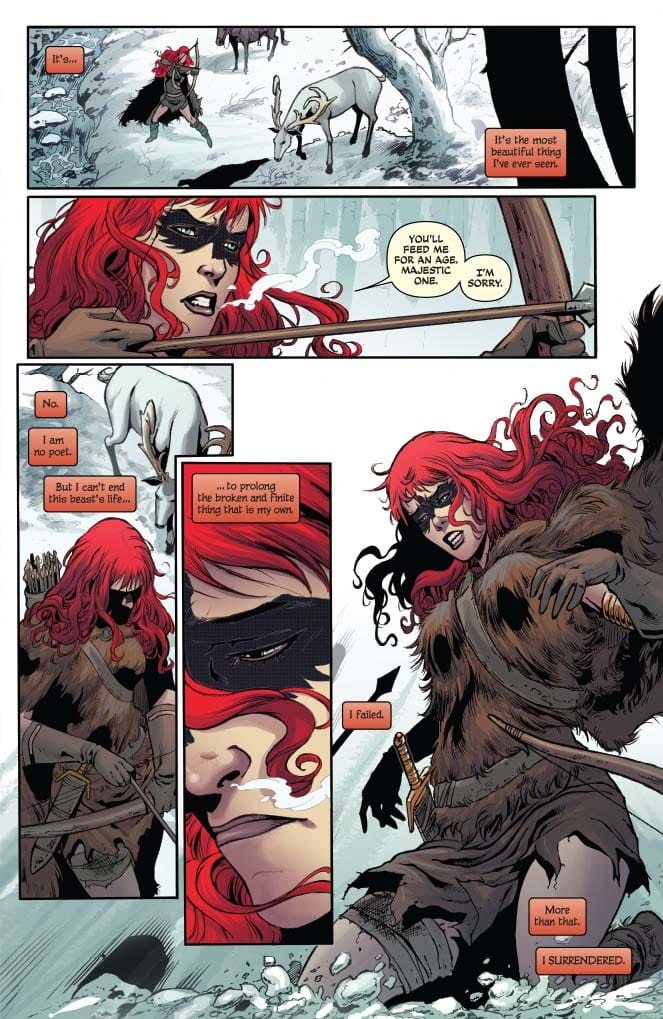
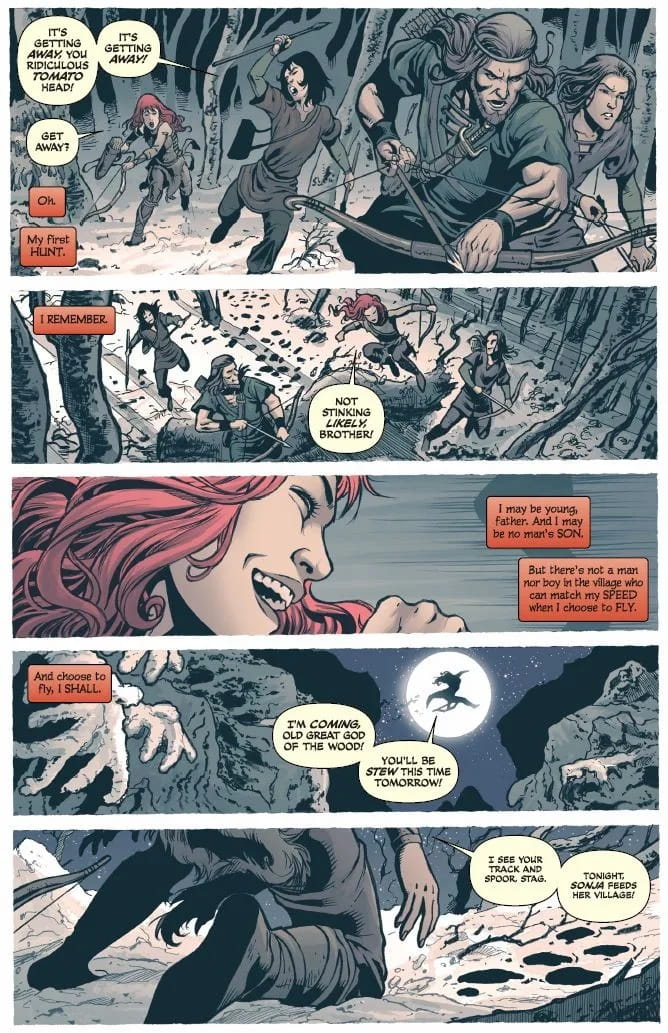
Pages from Red Sonja: Queen of Plagues. Art by Walter Geovanni
Then I heard Red Sonja was gaining a new writer: Gail Simone, who “first came to fan attention through Women in Refrigerators, a website founded in 1999 by a small group of comics fans, including Simone “To [identify] female superheroes who had been killed, raped, or otherwise suffered traumatic indignities as a plot device for a male character” (Wikipedia). I’d heard good things about Simone’s comics scripting, but hadn’t tried her work. So I picked up (or, more accurately, downloaded from NetGalley) her first Red Sonja graphic novel.
To be honest, I thought I was downloading Simone’s first issue of Red Sonja. I didn’t have the time to read a whole graphic novel. But I read the whole graphic novel (which collects all six issues of the Queen of Plagues story arc) in a single sitting, because I couldn’t stop turning those virtual pages.
Queen of Plagues is a reboot, jettisoning four decades of increasingly confused continuity with a new vision of Red Sonja and an unburdened plot (the latter incorporating a mercifully rape-free new origin story). While fresh, the storyline and characterizations manage the tricky feat of remaining true to the original Marvel Comics penned by Roy Thomas. Bucking the current trend of unremittingly (and sometimes-cluelessly) bleak reboots, Simone and Geovanni retain the original comics’ respectful and humor-tinged approach to the characters and material.
They also tell a good, fast-paced, swashbuckling (and yes, bloody) pulp-adventure tale, without sacrificing complexity of storyline or protagonist. And the new team’s Red Sonja is, like the 1970s original, a strong, self-reliant loner and a courageous, deadly warrior (as for her chain mail bikini: more anon).
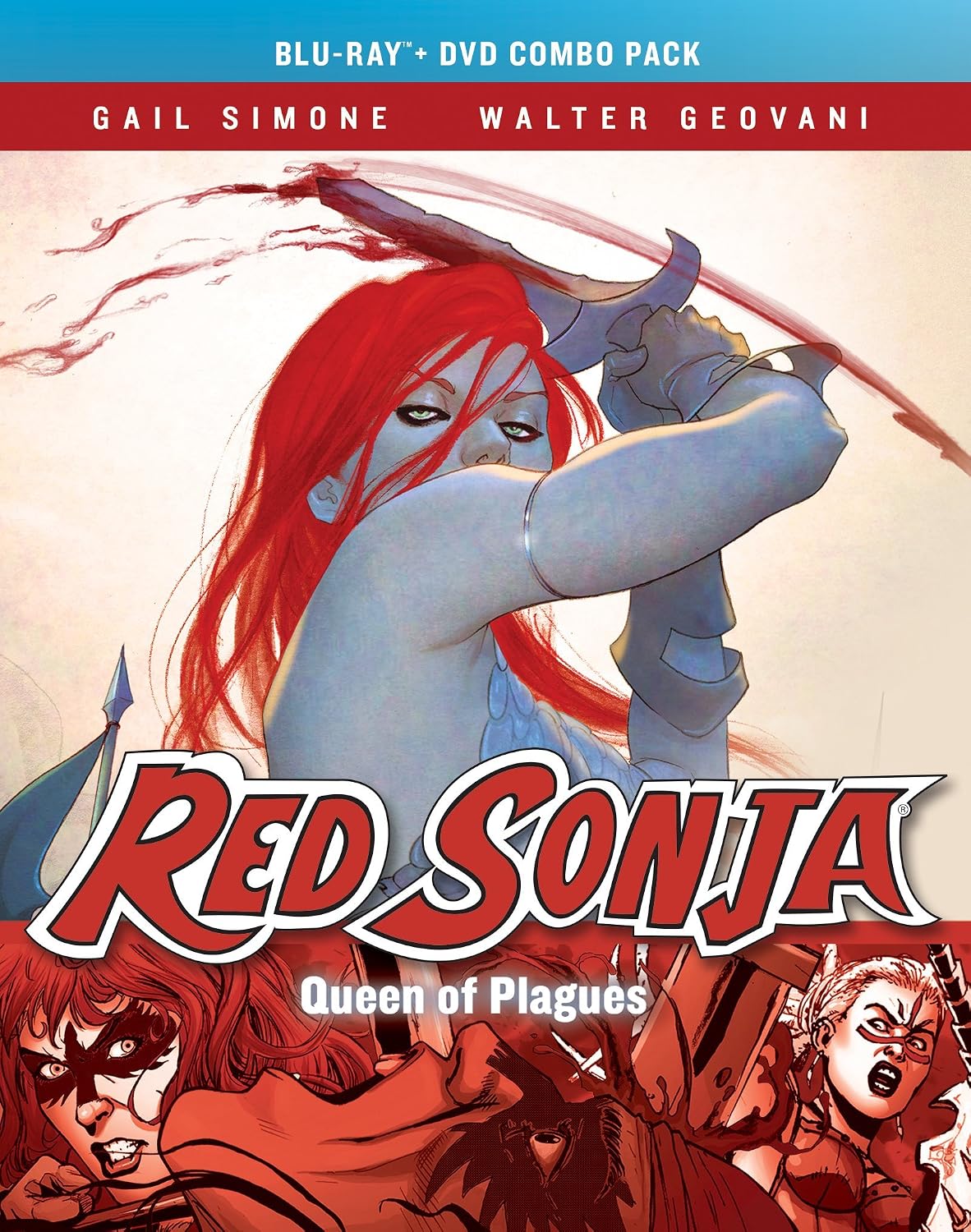
You won’t mistake Queen of Plagues for a 1970s reprint. Artist Walter Geovanni’s strong, distinctive, and generally non-exploitive illustrations owe little to the styles of the men who drew Red Sonja in the early years (too, the evolution of technology has transformed sequential art itself). Writer Gail Simone has a compelling voice and an entertaining approach to plot.
The pair’s collaboration reflects the changes society has undergone since 1973. When it’s time for a besieged city to fight, for example, everyone is expected to take up arms. Too, no woman ends up dead or hurt merely to motivate a dudebro. And a pair of wannabe-warrior sisters, assigned as Red Sonja’s not-always-superfluous bodyguards, grow and change and turn into damned fine young-adult reader-identification characters.
These developments make for an engaging and egalitarian pulp adventure, but they don’t guarantee perfection. A character stabbed through the thigh subsequently performs impossible heroics. The opening dialogue from a bit player, intended to reveal a lack of education, mostly just rings false.
Too, the patches of humorous dialogue won’t please everyone (if you’ve no familiarity with swords and sorcery dialogue, you’ll probably stop reading when you hit an in-jokey line like “O she of the excellent cleavage,” though it issues as one of a stream of starry-eyed superlatives from a hero-worshipping teenage girl).
Other problems include the failure of the local citizenry’s brown skin, described in the included script, to make it to the page (or at least to the digital ARC) and a fairly one-dimensional presentation of the various villains.
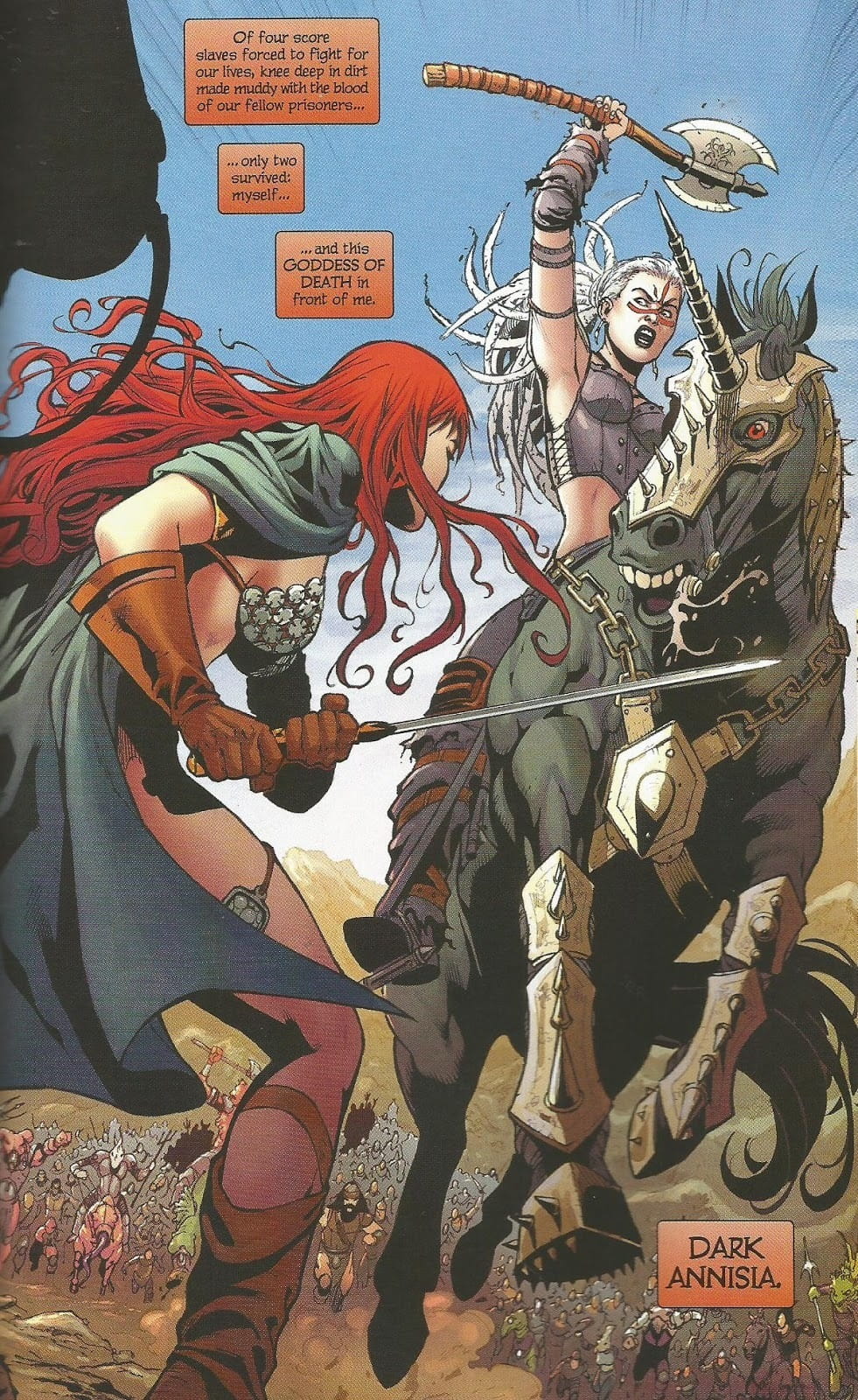
The exception is Dark Annisia, who is less a villain than a force of nature. A tragic antagonist, she is haunted by her past and possibly insane. Three years agone, she and Red Sonja were sisters of the sword: gladiators matched in skill, strength, and determination. Scheduled to fight to the death, they were sprung from slavery on the eve of destruction.
When they finally meet again, Annisia has a major mad on for her former comrade. Love can turn easily to hate, and Annisia was in love with Red Sonja (did I mention there’s a bit of a Xena-and-Gabrielle vibe to the graphic novel?).
Fortunately, Annisia’s antagonism is considerably more complicated than love gone wrong; and she has become, if anything, an even more dangerous opponent for Red Sonja. Perhaps less fortunately, the nature of Red Sonja’s love for Dark Annisia remains precisely ambiguous.
Also less fortunate is the antagonist’s nomenclature of “Dark,” especially in combination with her dreadlocks. This is hardly the first time I’ve seen dreadlocks on a Caucasian (or, for that matter, nonhuman) movie or comics antagonist, and I suppose this is intended to be taken as a symbol of badassness.
But many people “read” dreadlocks as “black” and read antagonist as “villain” and read villain as “evil” and read “dark” as “black” and “evil.” Meanwhile, white protagonists never seem to sport dreads. So Dark Annisia, for all her ghost-pale skin and hair, is coded as “black bad guy.” It’s a very disappointing lapse.
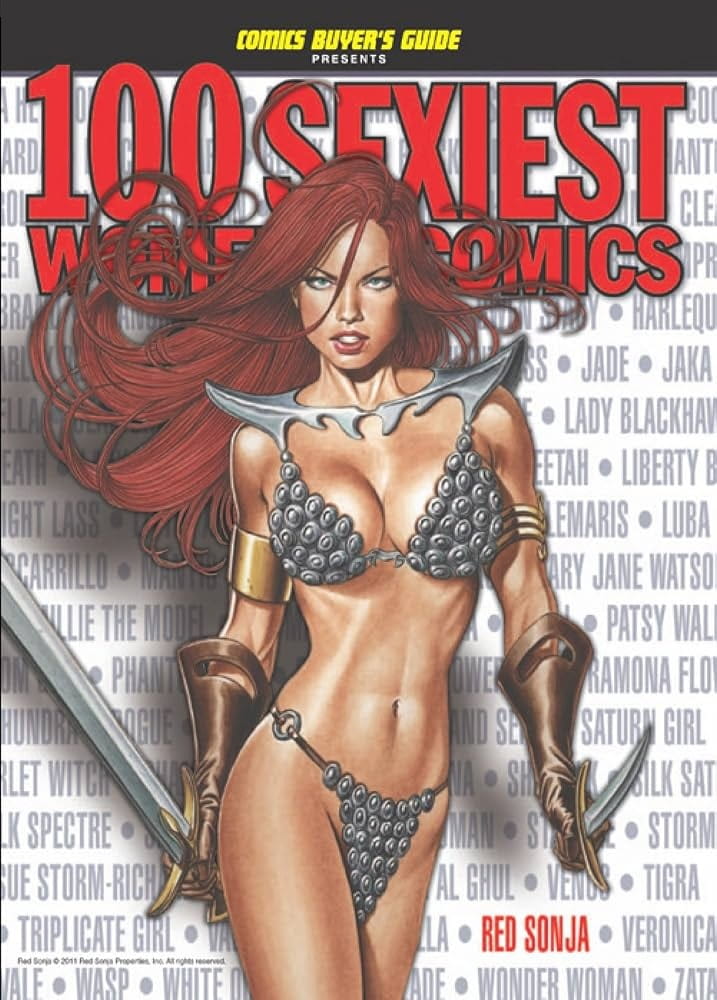
As for Red Sonja’s chain mail bikini: It’s still the stupidest-looking costume I’ve ever seen in a comic book (although it’s technically not as stupid as Conan’s loincloth-only approach to battle), and it’s undoubtedly a good part of the reason the character was ranked first in Comics Buyer’s Guide’s misbegotten masturbatory aid, the “100 Sexiest Women in Comics” issue.
I doubt that bikini will ever go away, for the same reason Superman’s iconic costume never will. But it seems Simone and Geovanni may share my dim view of the chain mail bikini. They replace it with rather less revealing garb early in the graphic novel, and they put Sonja and Annisia in plate armor for their final clash.
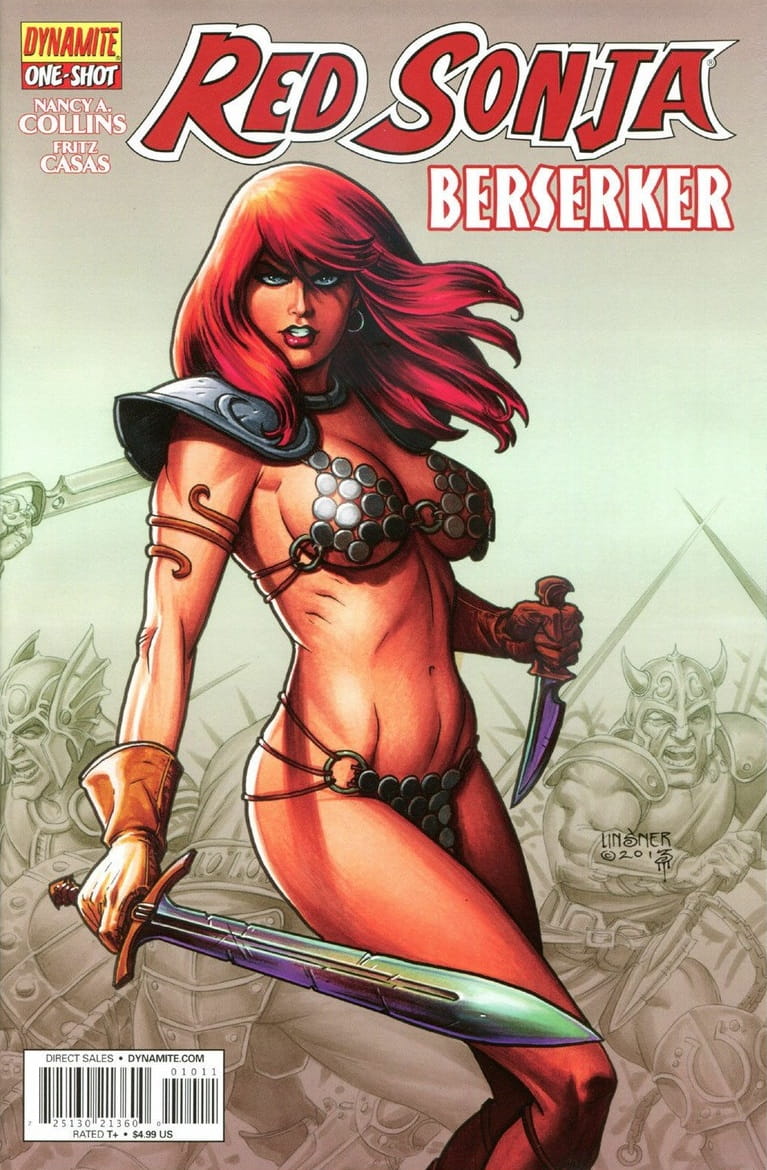
Despite the vexatious aspects of Queen of Plagues, I’m looking forward to Gail Simone and Walter Geovanni’s future volumes of Red Sonja. I’m looking for other comics by Simone. I even plan to check out Red Sonja: Berserker, penned by horror superstar Nancy A. Collins, creator of the badass vampire-hunter Sonja Blue (hmmm).
And, for all the sexist imagery and past and present baggage, if I had teenage daughters or sons, I’d find Queen of Plagues more fit for their eyes than many a young-adult title that comes to mind.
This review originally appeared, in slightly different form, in The Cascadia Subduction Zone, Vol. 4, Issue 2, April 2014.
Cynthia Ward is the author of The Adventure of the Incognita Countess (Aqueduct Press, January 2017), Writing the Other: A Practical Approach (with Nisi Shawl), and more than 70 short stories and chapbooks. Her last article for Black Gate was a review of DC’s Hercules Unbound.
Conan “a sword-swinging macho blockhead”? Hardly. He’s a far more nuanced character under the pen of both Robert E. Howard and Roy Thomas.
Conan isn’t in “The Shadow of the Vulture,” the Robert E. Howard historical adventure in which Red Sonya appears. The man Sonya repeatedly saves is the knight Gottfried Von Kalmbach, who spends much of the story drunk and inappreciative of Sonya’s repeated aid.