A (Black) Gat in the Hand: Will Murray on Dash(iell) and (Lester) Dent
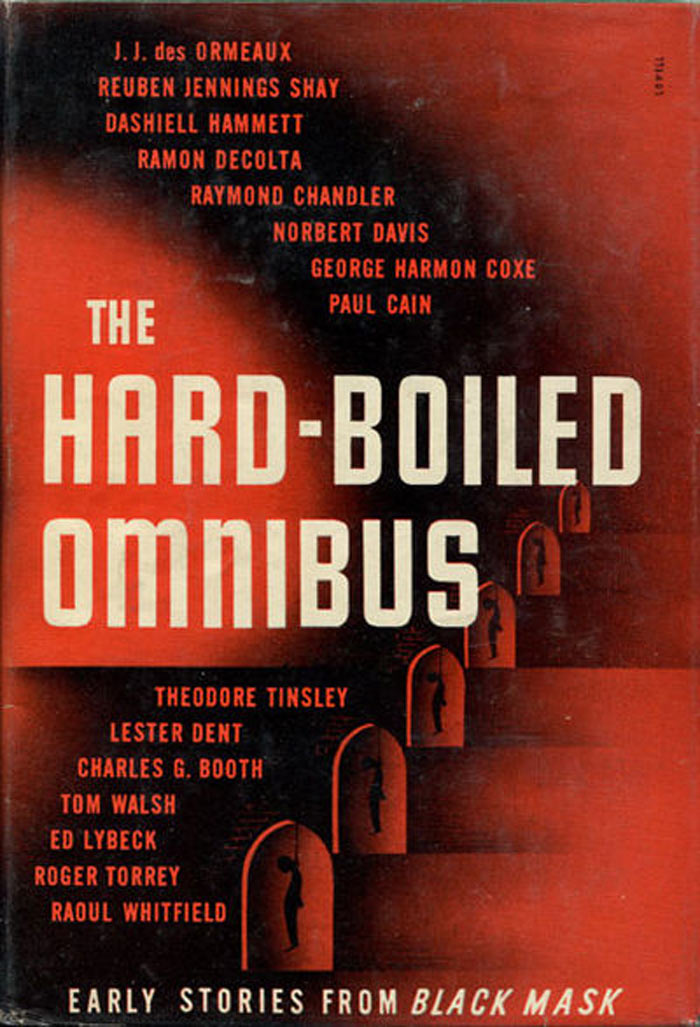 Frequent guest columnist, New Pulp maven Will Murray, is back with more speculation: this time linking about the two biggest names in Pulp. Was Dashiell Hammett a Lester Dent fan? Well, let’s find out!
The so-called Pulp Jungle, as Frank Gruber once called it, was a densely populated wonderland, at least insofar the greatest concentration of pulp magazine writers lived in or in close proximity to New York City, where most of the publishers were established.
Late in life, Theodore Tinsley, a regular contributor to Black Mask, The Shadow, as well as numerous other top pulp titles, recalled:
“Pulpland seems a strange, purple-clouded island, in a warm sea somewhere far off, where some of the damnedest elves and goblins I ever met used to say and do strange things, especially when drunk.”
Thanks in part to the American Fiction Guild, a writer’s association which flourished during the 1930s, a great many of these writers and their editors convened for Friday luncheon gatherings at Rosoff’s restaurant on 43rd Street. They socialized, vacationed together, dated, and even married. It was virtually a subculture delineated and confined by a common vocational focus.
Others, scattered throughout the country, kept in touch by letter. But not everyone knew everyone else, except possibly by reputation.
I’m reasonably certain that Doc Savage writer Lester Dent never met Dashiell Hammett. But they shared an intriguing and long-unsuspected connection.
In December 1930, Lester Dent decided to relocate from Tulsa, Oklahoma, where he had a comfortable job as a teletype repairman, to New York City to write exclusively for the Dell magazine chain as a staff writer. The offer had come by telegram in response to a story Dent had submitted to one of their pulp titles, then struggling for circulation against early Depression headwinds.
By an interesting coincidence, that was the month that Walter B. Gibson dropped by Street & Smith where, to his surprise, he was offered the opportunity to write the first of what became hundreds of novels featuring the nebulous radio personality called The Shadow. This, of course, ultimately led to the creation of Doc Savage, and Lester Dent’s involvement in that long-running series.
Dent and his wife arrived on January 1. When he paid a call to his editor, with whom had only corresponded by letter, Dent was greeted with enthusiasm, according to his own account:
“When I entered the office of Richard E. Martinsen, the Dell official who sent me the telegram, he tossed a copy of Dashiell Hammett‘s latest book at me and said, ‘This is the sort of thing we want you to do. What impresses us about your writing is the fast movement, the brittle violence of emotion and action.’ “
 Dent happened to be a fan of Dash Hammett, who had only recently come into critical prominence through his electrifying detective novels. The previous year, after being serialized in Black Mask magazine, “The Maltese Falcon” had been published in hardcover.
Being asked to write in the Hammett style was no reach for Dent. He was already under the influence of Hammett’s tough, objective style of writing, and was a regular reader of Black Mask magazine, in whose pages Hammett had earned his early reputation.
In a 1935 letter written to a fan, Dent made clear his good opinion of Hammett:
“Dash Hammett is my favorite mystery story writer, and conversely, his mystery yarns are my favorites.”
Although Dent later sold two now-classic stories to Black Mask magazine, this was long after Hammett had moved on from the pulps. So they never appeared in same issue, nor would they likely to have come into contact with one another through editor Joseph T. Shaw.
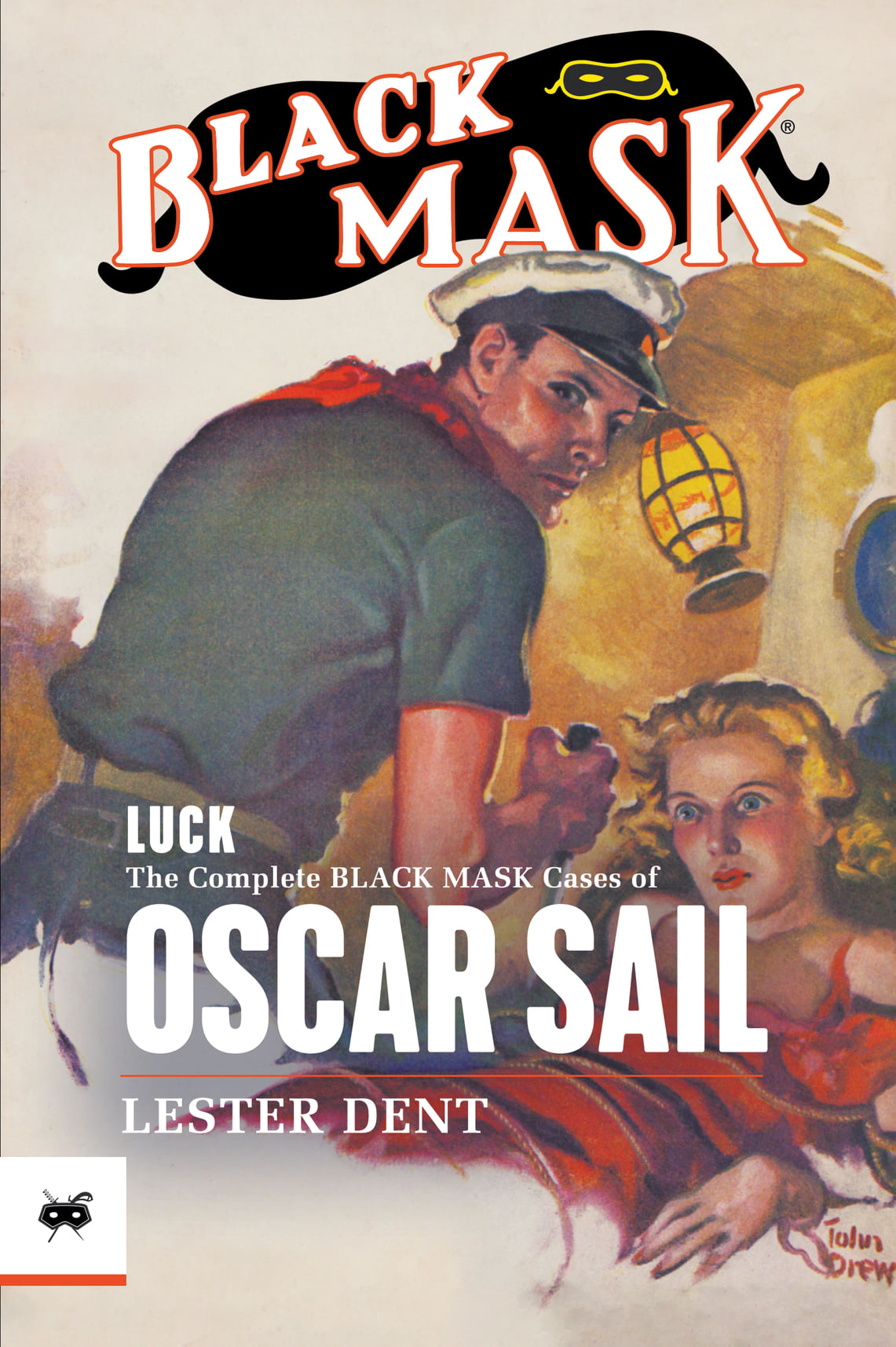
Speaking as the literary agent for the estate of Lester Dent, one of my proudest achievements in that area was when I sold a completely different version of Dent’s first Black Mask sale to The Black Lizard Big Book of Black Mask Stories. “Luck” was sandwiched between classic tales by two by Dent‘s favorite Black Mask writers, Frederick Nebel and Dashiell Hammett, the latter of whom was represented by the original magazine serialization of “The Maltese Falcon.”
I don’t know, but I suspect that when Dent started writing more tongue-in-cheek Doc Savage novels, as well as his puckish Click Rush the Gadget Man series, the lighter tone was at least in part inspired by Hammett’s larkish Thin Man, which was published in 1934. Some of his Doc Savage novels from the middle to later 1930s had elements of the screwball comedy, but tempered for his audience.
I don’t know that Hammett was aware of Lester Dent as a writer, at least under his own name. Once Lester got going on Doc Savage, his byline largely disappeared from the pulps through most of the 1930s.
But Dashiell Hammett was certainly aware of the byline Kenneth Robeson, which was the house name that concealed all Doc Savage writers.
One of the most amazing things I ever read was the following passage from Josephine Hammett Marshall’s Foreword to the Selected Letters of Dashiell Hammett 1921-1960:
‘But why publish them [the letters] now? Well, first of all because I am still around to help make sense of them, to sort out his life from his fiction. I don’t pretend that I, or the letters, can explain him. Papa was lots of people. Some of them show in his fiction. He’s there when Spade tells Brigid O’Shaughnessy that he “doesn’t mind a reasonable amount of trouble.” I can hear him in that cool understatement that must have left Brigid wondering, “Just how much is a reasonable amount, Mr. Spade? And how will I know when you’ve reached it?”
And he’s there in the implication behind the words—He’d do the job, take the risks, but he was no white knight; he wouldn’t “play the sap” for her. That was pretty much how my father met his obligations in life—personal and otherwise. He did what he thought he had to; then he was history. But if you tried to read his life from his work you’d get it wrong.
Yes, there’s a piece of Sam Spade in him, the Op, Ned Beaumont, even Nick Charles, but there’s much more: the man who loved hunting, fishing, and babies, who listened to Gershwin and Haydn, who read Moon Mullins, Doc Savage, and Dostoyevsky, who was a womanizer and a Victorian father. The man I knew and the one I only knew about.’
This was no casual reference. In her 2001 autobiography, Dashiell Hammett: A Daughter Remembers, she cites other popular things her father read and enjoyed, but one and only one was repeated:
“He liked sci-fi—Doc Savage—and the comics—Terry and the Pirates and Snuffy Smith.…”
 Josephine Hammett was born in 1926, so her awareness of her father’s reading interests would no doubt commence in the 1930s. Terry and the Pirates and Snuffy Smith both debuted in 1934, which doesn’t help pinning down when her father might have been reading Doc Savage Magazine. He might easily have read Doc from its inception in 1933 clear through his military serve in the Aleutian Islands during World War II. If not to the end of the run of 1949. We have no way of knowing, other than to conclude from the two references that Dashiell Hammett was a regular Doc reader.
Had he known about this, Lester Dent would have been amazed, if not completely flabbergasted. I doubt if he ever had a clue. Hammett was a West Coast writer. Although he visited New York City often enough, he’s not known to have ever attended a meeting of the American Fiction Guild.
I can’t think of two characters more unlike than the virtuous Doc Savage and the immoral Sam Spade. But Doc Savage was escapist reading, and apparently when Hammett wanted to escape, he turned to Doc Savage Magazine with sufficient frequency to make a lasting impression on his young daughter, despite the fact that she did not live with him after her parents separated not long after her birth.
Since Dent emulated Hammett’s objective style of writing, I wonder if one of the reasons Hammett enjoyed Doc is because it mirrored the style he helped pioneer, which has been dubbed the “hard-boiled” school of detective fiction.
The famous twist ending of The Maltese Falcon where the much-coveted bird turns out to be a lead fake is a twist that Lester Dent copied in several of his stories, particularly in the 1933 Doc Savage novel, The Phantom City, where the platinum treasure over which men killed and died for turns out to be disappointing tin.
According to Josephine Hammett Marshall, as a boy, her father loved to check out books of swashbuckling fiction from the library. Hammett had lifelong health issues, and was rail-thin. I suppose the superhuman Man of Bronze represented some type of heroic ideal that he enjoyed reading about. Certainly, Doc was the opposite of the hard drinking, womanizing celebrity author.
Lester Dent’s close friend, fellow pulpster Frank Gruber, once wrote [Doc Savage] “…was highly regarded by other writers, many declaring that it was the most ingenious and best written of all the series novels.”
One could argue that point. The Shadow was well written on its traditional thriller level and better known to the reading public, while The Spider certainly displayed a more mature pulp style. Clearly, the discerning and well-read Dashiell Hammett counted himself among those writers who were fascinated by Dent’s memorable character.
Nearly a century after his 1933 debut, Doc Savage continues to be the most beloved of the Depression-born pulp heroes. It’s fascinating that a writer of the stature of Samuel Dashiell Hammett would find his adventures so compelling that his daughter remembered her father reading the magazine on what appears to have been a regular basis. But a little sad, too. Hammett essentially stopped writing fiction after The Thin Man in 1934. It’s unfortunate that the greatest detective writer of the 20th century should have devoted so much of his time to reading Doc Savage Magazine—among other diversions––at the expense of his career, which should have continued for another two if not three decades.
According to Doc reader Mark Lambert, Mickey Spillane of I, The Jury fame was another famous fan of Doc Savage. Lambert met Spillane at the premiere of the 1998 documentary, Mike Hammer’s Mickey Spillane, and described the encounter:
‘I chatted with him for a few minutes, told him I was a fan, and then I asked him if he had known Lester Dent, and he said, “Yeah, I knew Les! I did some work at Street & Smith.” Then he looked off and stopped smiling. For a moment I thought I had offended him by asking about another author, but he was actually just thinking. Then he looked at me again, pointed at me and said, “Those two guys––those two guys in Doc Savage! Doc’s assistants––the two who fought with each other all the time––what were their names?” I said, “Monk and Ham.” A huge grin came over his face and he exclaimed loudly, “Yeah! Monk and Ham! I loved those guys!”
Hammett expert Don Herron has pointed out a scene in the 1945 Humphrey Bogart film, Conflict, in which Bogart, Alexis Smith, Sidney Greenstreet and others are seated around a table in a police headquarters interrogation room. Strewn around the table are various unrecognizable books and magazines, among them one discernible cover––the April, 1940 issue of Doc Savage!
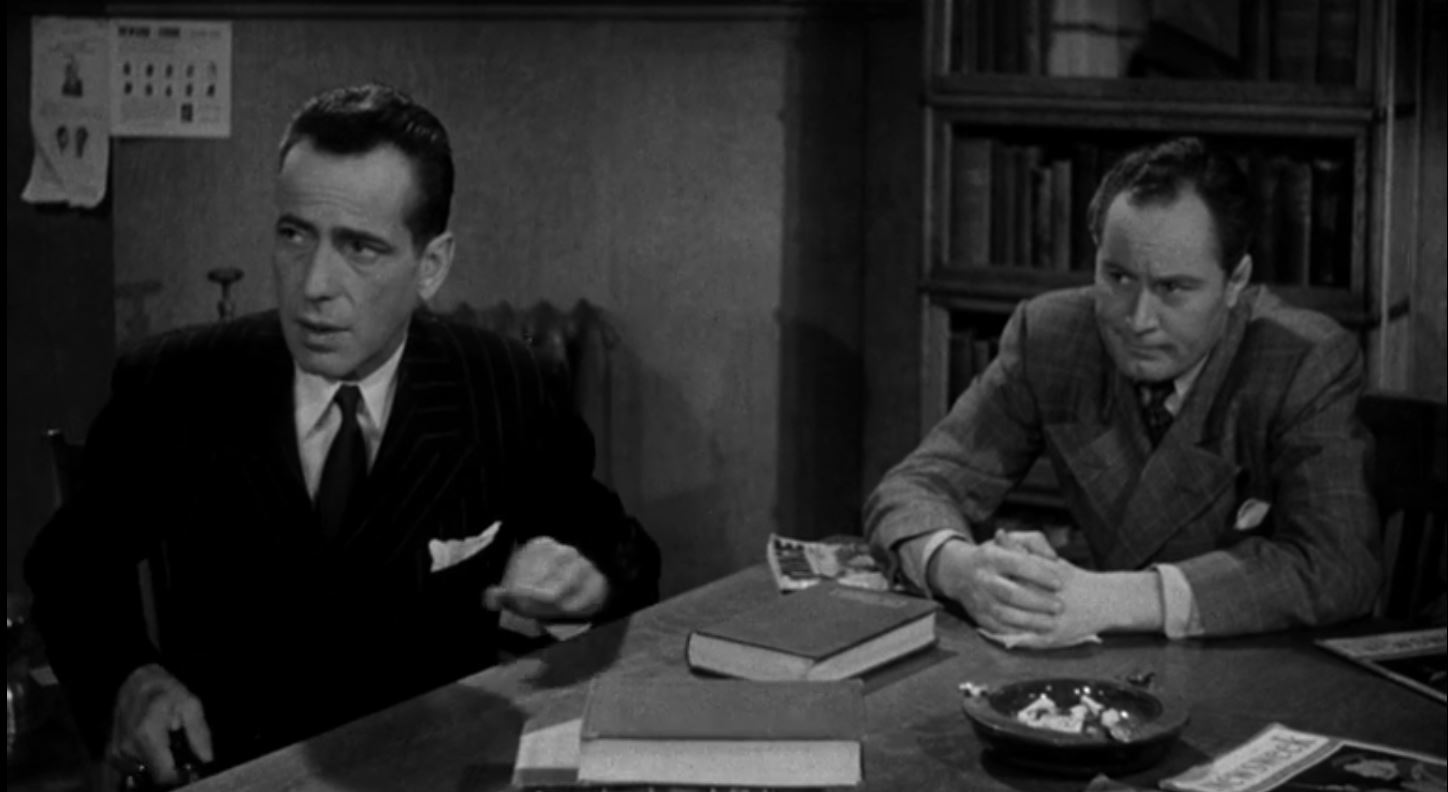
Wouldn’t it be funny if Bogie too read Doc Savage!
Other Will Murray Posts Here at Black Gate
Will Murray on Raymond Chandler’s Other Lost Stories?
Will Murray on Who was N.V. Romero?
Will Murray on Other Lost Raymond Chandler Stories?
Will Murray on Dashiell Hammett’s Elusive Glass Key
Will Murray on Hammett Didn’t Write “The Diamond Wager”
Will Murray on Doc Savage
Prior Posts in A (Black) Gat in the Hand – 2025 (11)
Shelfie – Dashiell Hammett
Windy City Pulp & Paper Fest – 2025
Will Murray on Who was N.V. Romero?
Conan – The Phoenix in the Sword in Weird Tales
More of Robert E. Howard’s Kirby O’Donnell
More Weird Menace from Robert E. Howard – Conrad and Kirowan
Hardboiled Gaming- LA Noire
Western Noir: Hell on Wheels
T.T. Flynn’s Mr Maddox
Dashiell Hammettt’s The Scorched Face (my intro)
Will Murray on Raymond Chandler’s Other Lost Stories?
Prior Posts in A (Black) Gat in the Hand – 2024 Series (11)
Will Murray on Other Lost Raymond Chandler Stories?
Will Murray on Dashiell Hammett’s Elusive Glass Key
Ya Gotta Ask – Reprise
Rex Stout’s “The Mother of Invention”
Dime Detective, August, 1941
John D. MacDonald’s “Ring Around the Readhead”
Harboiled Manila – Raoul Whitfield’s Jo Gar
7 Upcoming A (Black) Gat in the Hand Attractions
Paul Cain’s Fast One (my intro)
Dashiell Hammett – The Girl with the Silver Eyes (my intro)
Richard Demming’s Manville Moon
More Thrilling Adventures from REH
Prior Posts in A (Black) Gat in the Hand – 2023 Series (15)
Back Down those Mean Streets in 2023
Will Murray on Hammett Didn’t Write “The Diamond Wager”
Dashiell Hammett – ZigZags of Treachery (my intro)
Ten Pulp Things I Think I Think
Evan Lewis on Cleve Adams
T,T, Flynn’s Mike & Trixie (The ‘Lost Intro’)
John Bullard on REH’s Rough and Ready Clowns of the West – Part I (Breckenridge Elkins)
John Bullard on REH’s Rough and Ready Clowns of the West – Part II
William Patrick Murray on Supernatural Westerns, and Crossing Genres
Erle Stanley Gardner’s ‘Getting Away With Murder (And ‘A Black (Gat)’ turns 100!)
James Reasoner on Robert E. Howard’s Trail Towns of the old West
Frank Schildiner on Solomon Kane
Paul Bishop on The Fists of Robert E. Howard
John Lawrence’s Cass Blue
Dave Hardy on REH’s El Borak
Prior posts in A (Black) Gat in the Hand – 2022 Series (16)
 Asimov – Sci Fi Meets the Police Procedural
The Adventures of Christopher London
Weird Menace from Robert E. Howard
Spicy Adventures from Robert E. Howard
Thrilling Adventures from Robert E. Howard
Norbert Davis’ “The Gin Monkey”
Tracer Bullet
Shovel’s Painful Predicament
Back Porch Pulp #1
Wally Conger on ‘The Hollywood Troubleshooter Saga’
Arsenic and Old Lace
David Dodge
Glen Cook’s Garrett, PI
John Leslie’s Key West Private Eye
Back Porch Pulp #2
Norbert Davis’ Max Latin
Prior posts in A (Black) Gat in the Hand – 2021 Series (7 )
The Forgotten Black Masker – Norbert Davis
Appaloosa
A (Black) Gat in the Hand is Back!
Black Mask – March, 1932
Three Gun Terry Mack & Carroll John Daly
Bounty Hunters & Bail Bondsmen
Norbert Davis in Black Mask – Volume 1
Prior posts in A (Black) Gat in the Hand – 2020 Series (21)
Hardboiled May on TCM
Some Hardboiled streaming options
Johnny O’Clock (Dick Powell)
Hardboiled June on TCM
Bullets or Ballots (Humphrey Bogart)
Phililp Marlowe – Private Eye (Powers Boothe)
Cool and Lam
All Through the Night (Bogart)
Dick Powell as Yours Truly, Johnny Dollar
Hardboiled July on TCM
YTJD – The Emily Braddock Matter (John Lund)
Richard Diamond – The Betty Moran Case (Dick Powell)
Bold Venture (Bogart & Bacall)
Hardboiled August on TCM
Norbert Davis – ‘Have one on the House’
with Steven H Silver: C.M. Kornbluth’s Pulp
Norbert Davis – ‘Don’t You Cry for Me’
Talking About Philip Marlowe
Steven H Silver Asks you to Name This Movie
Cajun Hardboiled – Dave Robicheaux
More Cool & Lam from Hard Case Crime
A (Black) Gat in the Hand – 2019 Series (15)
 Back Deck Pulp Returns
A (Black) Gat in the Hand Returns
Will Murray on Doc Savage
Hugh B. Cave’s Peter Kane
Paul Bishop on Lance Spearman
A Man Called Spade
Hard Boiled Holmes
Duane Spurlock on T.T. Flynn
Andrew Salmon on Montreal Noir
Frank Schildiner on The Bad Guys of Pulp
Steve Scott on John D. MacDonald’s ‘Park Falkner’
William Patrick Murray on The Spider
John D. MacDonald & Mickey Spillane
Norbert Davis goes West(ern)
Bill Crider on The Brass Cupcake
A (Black) Gat in the Hand – 2018 Series (32)
George Harmon Coxe
Raoul Whitfield
Some Hard Boiled Anthologies
Frederick Nebel’s Donahue
Thomas Walsh
Black Mask – January, 1935
Norbert Davis’ Ben Shaley
D.L. Champion’s Rex Sackler
Dime Detective – August, 1939
Back Deck Pulp #1
W.T. Ballard’s Bill Lennox
Erle Stanley Gardner’s The Phantom Crook (Ed Jenkins)
Day Keene
Black Mask – October, 1933
Back Deck Pulp #2
Black Mask – Spring, 2017
Erle Stanley Gardner’s ‘The Shrieking Skeleton’
Frank Schildiner’s ‘Max Allen Collins & The Hard Boiled Hero’
A (Black) Gat in the Hand: William Campbell Gault
A (Black) Gat in the Hand: More Cool & Lam From Hard Case Crime
MORE Cool & Lam!!!!
Thomas Parker’s ‘They Shoot Horses, Don’t They?’
Joe Bonadonna’s ‘Hardboiled Film Noir’ (Part One)
Joe Bonadonna’s ‘Hardboiled Film Noir’ (Part Two)
William Patrick Maynard’s ‘The Yellow Peril’
Andrew P Salmon’s ‘Frederick C. Davis’
Rory Gallagher’s ‘Continental Op’
Back Deck Pulp #3
Back Deck Pulp #4
Back Deck Pulp #5
Joe ‘Cap’ Shaw on Writing
Back Deck Pulp #6
The Black Mask Dinner
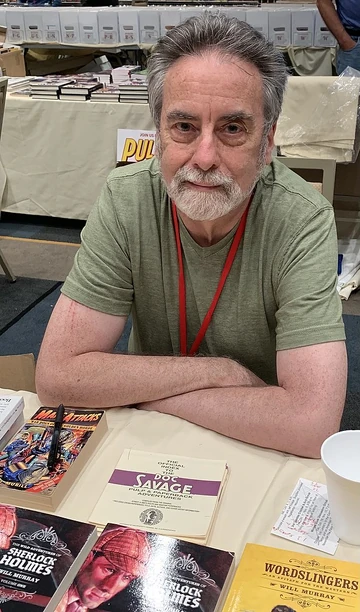 There are some outstanding names in the ‘New Pulp’ field, but William Patrick Murray’s probably stands above them all. Along with Doc Savage, Will has written Tarzan and The Spider. And he’s quite the Sherlock Holmes writer. Short stories, comic books, radio plays, nonfiction essays and books – Murray has done it all. He created The Unbeatable Squirrel Girl for Marvel Comics, and his collection of essays on Doc Savage, Writings in Bronze, is a must read. I love a good book introduction, and Murray has written some fine ones for Steeger Books. Visit his website Adventures in Bronze.

Bob Byrne’s ‘A (Black) Gat in the Hand’ made its Black Gate debut in 2018 and has returned every summer since.
His ‘The Public Life of Sherlock Holmes’ column ran every Monday morning at Black Gate from March, 2014 through March, 2017. And he irregularly posts on Rex Stout’s gargantuan detective in ‘Nero Wolfe’s Brownstone.’ He is a member of the Praed Street Irregulars, and founded www.SolarPons.com (the only website dedicated to the ‘Sherlock Holmes of Praed Street’).
He organized Black Gate’s award-nominated ‘Discovering Robert E. Howard’ series, as well as the award-winning ‘Hither Came Conan’ series. Which is now part of THE Definitive guide to Conan. He also organized 2023’s ‘Talking Tolkien.’
He has contributed stories to The MX Book of New Sherlock Holmes Stories — Parts III, IV, V, VI, XXI, and XXXIII.
He has written introductions for Steeger Books, and appeared in several magazines, including Black Mask, Sherlock Holmes Mystery Magazine, The Strand Magazine, and Sherlock Magazine.
You can definitely ‘experience the Bobness’ at Jason Waltz’s ’24? in 42′ podcast.
Fantastic post full of great information! I never noticed Dent’s Docs being influenced by Hammett’s writings. Now I have to revisit them and see. Thanks, Gents!