Browsed by
Category: Series Fantasy

Goth Chick News: For Love or Money? Anne Rice Resurrects the Vampire Lestat

Goth Chick News: For Love or Money? Anne Rice Resurrects the Vampire Lestat

Anne Rice
Anne Rice

Long before Edward, Angel, or Erik; before vampires owned bars, fell in love with humans, or (heaven forbid) sparkled in sunlight – there was The Vampire Lestat.

Anne Rice single-handedly catapulted vampires into vogue in 1976 with her debut novel Interview with the Vampire. Until then, vampires hadn’t been cool since Bela Lugosi brought Dracula to the Broadway stage in 1927.

Rice’s characters and subsequent novels spawned nothing less than a new vampire sub-culture in the early 80s, giving rise to clubs, music, clothing lines, and more copycat literary off-shoots than can easily be counted.

As a native of New Orleans, Rice made the city itself one of her main players, creating a tourism boom. To this day, and much to the chagrin of the neighbors, Rice devotees continue to flock to First Street in the Garden District to view Rice’s former house, which was the setting for several of her novels. Fans from around the globe follow top-hat-wearing guides around the French Quarter on “vampire tours” and come October, every corner tchotchke shop is sold out of plastic fangs and dental adhesive in preparation for the annual Vampire Ball.

And for many years, I too donned velvet and lace, making an annual pilgrimage to partake in the most interesting masquerade ball you could ever imagine. At that time, Rice herself participated in these events, reigning as the Grande Dame of Darkness over her loving throngs.

Read More Read More

The Novels of Michael Shea: Assault on Sunrise

The Novels of Michael Shea: Assault on Sunrise

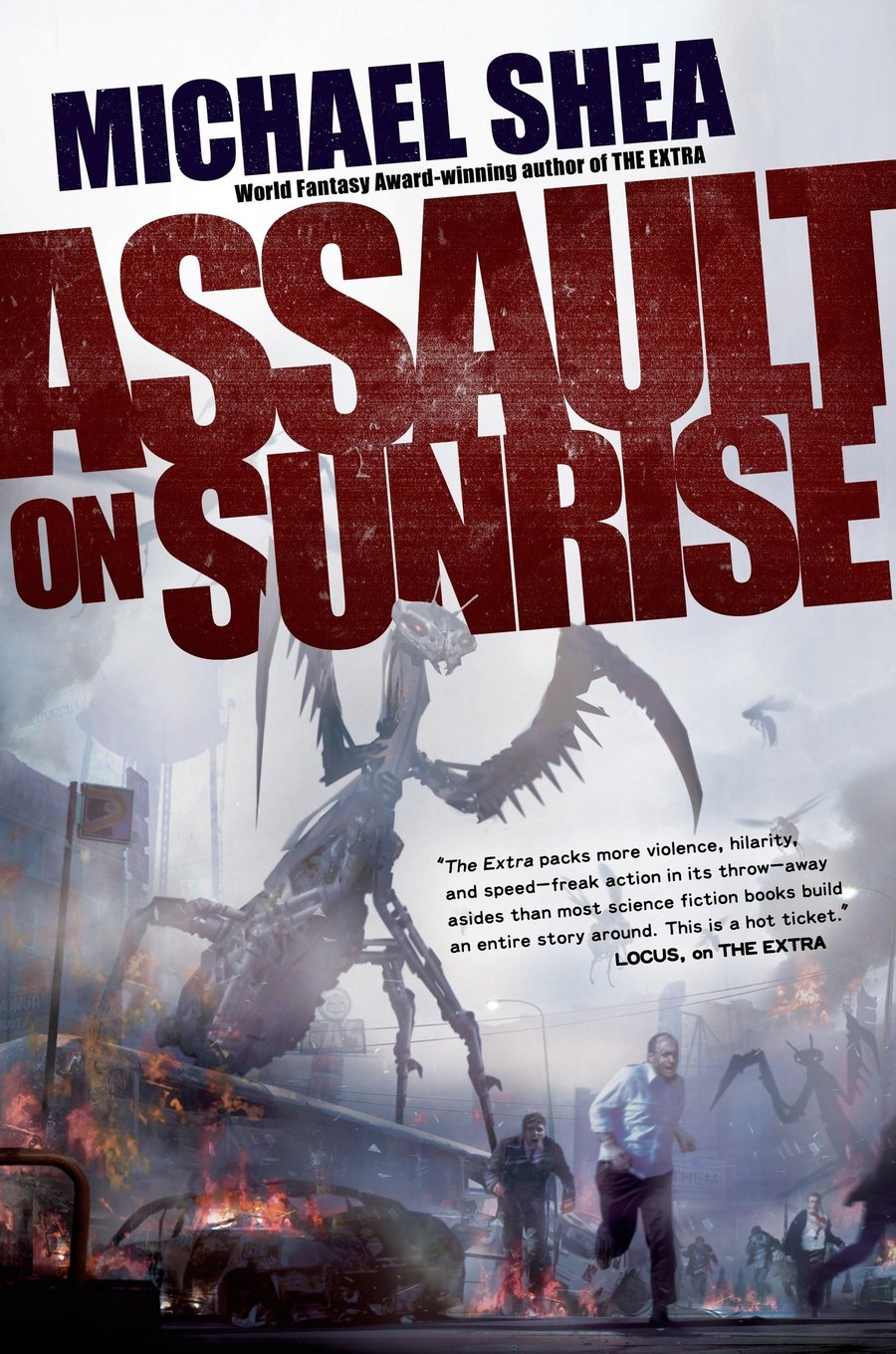
Assault on Sunrise-smallWe’re back on the record with the fourth installment of our survey of the books of Michael Shea, who passed away last month. This time, we’re looking at his final novel, Assault on Sunrise, the sequel to The Extra and the second book of The Extra Trilogy — which, sadly, will presumably never be completed. As I mentioned last time, I honestly wasn’t sure it was the same Michael Shea when I first saw the cover of The Extra, as it looked more like an urban thriller than the kind of adventure fantasy Michael was famous for. With this volume, all my doubts were swept away. Only Michael Shea could pull off a giant-insect attack with this kind of panache in 2013.

Less than a hundred years in the future, pollution, economic disaster, and the rapacious greed of the corporate oligarchy has brought America to its knees and created dystopian urban nightmares, of which L.A. may be the worst.

Curtis, Japh, and Jool are film extras, who — with the help of a couple of very gutsy women — survived being anonymous players in a “live-action” film in which getting killed on-screen meant getting killed for real. Surviving the shoot made them rich enough to escape the post-apocalyptic Hell that L.A. has become. But their survival was not what Panoply Studios’ CEO Val Margolian had in mind, especially since it cost his company millions.

Now he’s taking his revenge. After several plainclothes police are found dead in the former extras’ new home, the bucolic, peaceful town of Sunrise, California, the entire town is subjected to Margolian’s invidious plan to punish the entire town… and make a fortune doing it. Margolian has created toxic, murderous wasp-like mechanical creatures to set upon the people of Sunrise, while his film crew captures the carnage in what promises to be the bloodiest “live-action” film yet. With their haven from L.A. besieged by the deadly assault, the former extras — and their fellow townspeople — are faced with a grim task: to defeat the creatures and take back their town and their freedom. Michael Shea’s Assault on Sunrise is a saga of courage and sacrifice in a world gone mad.

Assault on Sunrise was published August 13, 2013 by Tor Book. It is 287 pages, priced at $25.99 in hardcover and $12.99 for the digital edition. There is no paperback edition. I bought my copy new on Amazon for $3.98 in early March; discounted copies are still relatively plentiful from several sellers.

Read More Read More

Jon Sprunk’s Blood and Iron, Volume One of The Book of the Black Earth, on Sale Today

Jon Sprunk’s Blood and Iron, Volume One of The Book of the Black Earth, on Sale Today

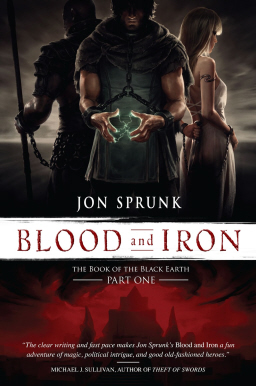
Blood and Iron Jon Sprunk-smallJon Sprunk’s highly anticipated Blood and Iron, the first book in his new series, The Book of the Black Earth, finally goes on sale today. We gave you the scoop on the book last month; last week Jon peeled back the curtain on the book’s origins in a guest post at Fantastical Imaginations.

The Book of the Black Earth series is set in the same secondary world as my Shadow Saga, but in a different region far to the east of Caim’s adventures. It follows three people as they struggle for freedom in an ancient land called Akeshia, where magic is worshipped and powerful God-Kings (and –Queens) hold the power of life and death over a vast race of people.

Horace is a shipbuilder and sailor who embarks on a Great Crusade for his country, but winds up shipwrecked on the shores of his enemy. Taken captive and made a slave, he discovers a hidden talent for sorcery, and thereby comes of the attention of the local ruling queen. Alyra is a slave. As one of the queen’s handmaidens, she is lovely, intelligent, and obedient. She is also a spy in the service of a foreign government, sent to turn the greedy eyes of the Akeshians away from her homeland. Jirom is a former mercenary turned gladiator. Dragooned into the queen’s army, he joins a group of subversive slaves who crave freedom…

One of the things I really wanted to tackle in this series was an original magic system. I played around with a few concepts until I hit on one that fit my world and my story. It plays on the basic “elemental” magic (earth, air, fire, and water) with a few twists of my own.

Jon Sprunk is the author of the Shadow Saga (Shadow’s Son, Shadow’s Lure, and Shadow’s Master) and a mentor at the Seton Hill University fiction writing program. He is a regular blogger for Black GateBlood and Iron was published by Pyr Books on March 11, 2014. It is 445 pages and is available in trade paperback for $18.00 ($11.00 for the digital version). Learn more at Pyr Books or read our exclusive excerpt here.

The Novels of Michael Shea: The Extra

The Novels of Michael Shea: The Extra

The Extra Michael Shea-smallWe’re continuing our look at the career of Michael Shea, who died last week, leaving behind a legacy of underappreciated novels. We started with his Sword & Sorcery classic Nifft the Lean (1983) and his dark fantasy In Yana, the Touch of Undying (1985).

Now we turn to something more recent, the first of a pair of novels that Locus Online called “dark, satirical novels about the movie industry.” The Extra arrived unexpectedly in hardcover in 2010, and when I first saw it I remember wondering if this was the same Michael Shea – it looked more like a biotech thriller than the kind of moody, cutting edge fantasy we’d come to expect from him. But, as Locus noted, there was a sharp satirical edge to this novel of a murderous, out-of-control Hollywood:

Producer Val Margolian has found the motherlode of box-office gold with his new “live-death” films whose villains are extremely sophisticated, electronically controlled mechanical monsters. To give these live-action disaster films greater realism, he employs huge casts of extras, in addition to the stars. The large number of extras is important, because very few of them will survive the shoot.

It’s all perfectly legal, with training for the extras and long, detailed contracts indemnifying the film company against liability for the extras’ injury or death. But why would anyone be crazy enough to risk his or her life to be an extra in such a potentially deadly situation?

The extras do it because if they survive they’ll be paid handsomely, and they can make even more if they destroy any of the animatronic monsters trying to stomp, chew, fry, or otherwise kill them. If they earn enough, they can move out of the Zoo — the vast slum that most of L.A. has become. They’re fighting for a chance at a reasonable life. But first, they have to survive…

The Extra was followed three years later by Attack on Sunrise, the second book in the Extra Trilogy. It was also set in a future Southern California, this time featuring a reality TV series based on the invasion of a small bankrupt town by murderous robot wasps. We’ll cover that one in our next installment.

Read More Read More

Future Treasures: Mary Robinette Kowal and Blake Hausladen Read from Upcoming Books at Capricon

Future Treasures: Mary Robinette Kowal and Blake Hausladen Read from Upcoming Books at Capricon

Mary Robinette Kowal reads from Valour and Vanity at Capricon 2014

There are lots of reasons to attend conventions. To meet your favorite authors, to network with fellow writers and editors, to browse in the Dealer’s Room (yeah!), to check out the Art Show, to attend entertaining panels.

But the thing I find most delightful these days is author readings. There’s something about hearing beloved characters brought to life right in front of you by the author herself that’s truly magical. In just the past few years, I’ve been lucky enough to attend readings by Peter S. Beagle, Gene Wolfe, Neil Gaiman, Patty Templeton, C.S.E. Cooney, Martha Wells, Fredric Durbin, and Steven Erikson, among many others.

It’s also a great way to discover new writers. I make it a priority to attend as many readings as I can by writers I’m not familiar with. And let me tell you, that’s really paid off — I’ve discovered some of my favorite new writers because I had an empty 30 minute slot between the Firefly panel and the midnight showing of Destroy All Monsters. Over the decades, that’s included people like Charles Saunders, N. K. Jemisin, Mark Sumner, Bradley Beaulieu, Alex Bledsoe, and — believe it or not — George R.R. Martin.

Take my advice: if you find yourself in a place where professional storytellers are willing to stand before you and entertain you, take advantage of it. You won’t be sorry. You can attend that anime panel next year.

A few weeks ago, I was at Capricon 34 in Wheeling, Illinois, with a few other Black Gate staffers, including Patty Templeton and Steven Silver. We didn’t have a booth — we haven’t bothered with one since the print version of the magazine died in 2011 — and I’m still getting used to being able to wander without being tied to the Dealer’s Room. I didn’t get to attend everything I wanted to — I missed Wesley Chu’s Saturday morning reading because I was mailing back issue orders at the post office — but I did catch some terrific panels. And, not too surprisingly, the most delightful and entertaining events at the convention were three readings, from Hugo-Award Winning author Mary Robinette Kowal, Strange Horizons editor Mary Anne Mohanraj, and self-published writer Blake Hausladen.

Read More Read More

Swords and Edgar Rice Burroughs

Swords and Edgar Rice Burroughs

Burroughs-MarsERB is probably best known to people who enjoy Fantasy and SF as the creator of the John Carter of Mars series, the Carson of Venus books, and the Pellucidar world-in-the-centre-of-the-earth stories. Then, of course, there’s Tarzan, probably second only to Dumas’s Three Musketeers as a source of movies, TV shows, and comics.

Following up on my recent sword-fighting posts, I’d like to talk about two ERB novels that are much less well-known than the ones I refer to above, and yet which have the same spirit of adventure and, for me almost more important, the same emphasis on sword play.

Both The Outlaw of Torn (1914) and The Mad King (1915) are what used to be called “romantic adventures.” This wasn’t because there was a love interest (though everyone familiar with ERB’s work knows there was), but because of the extraordinary demands placed on the hero, usually for extreme action, courage, fortitude, and sacrifice.

The Indiana Jones films are probably the closest deliberate modern equivalent to this genre, and while it’s hard for us to think of Iron Man, or Spiderman, as romantic adventurers, in the way the term was understood back then, that’s exactly what they would be.

Read More Read More

Year of the Unicorn by Andre Norton

Year of the Unicorn by Andre Norton

Andre Norton Year of the Unicorn-smallOn the first day of the Year of the Unicorn, twelve and one young women are to be delivered to the Wastelands beyond High Hallack and into the hands of sorcerous shape-changers known as the Were Riders. In battle, they change their forms into those of fierce animals, instilling terror in their opponents, then ripping them apart with tooth and claw.

The lords of High Hallack turned to the Riders in their desperate search for any defense against the unstoppable invaders from Alizon across the sea. The Riders agreed, but demanded payment of those brides-to-be, due on the first day of the new year following the war’s end.

Andre Norton’s novel, Year of the Unicorn, introduces Gillan, an orphan relegated to a dreary future in the abbey of Norstead, who instead exchanges herself in secret for one of the appointed brides. In disguise, she rides into the Wastes in search of any life beyond the one she seems fated to. There she finds her beastly groom and discovers her magical powers.

Since discovering how good Andre Norton’s Witch World series is, I’ve been slowly making my way through its sixteen books. (There are later books by other writers, but it’s Norton’s original writing that has hooked me.) The four novels and dozen or so stories I’ve read so far have ranged in style from wild science-fantasy to swords & sorcery to Gothic mystery. Some have even read like fairy tales from a world catty-corner to our own. Year of the Unicorn, first novel in the High Hallack sequence, is one of those.

As a child, Gillan was rescued at sea from Alizon raiders by a High Hallack nobleman. She was too young to know where she was from or how she came to be captured, but her dark hair leads him to believe she’s from the East. Deciding that if she was worth the Alizoners’ trouble she might have some future value, the nobleman raises her in his own household.

Read More Read More

Expand Your Digital Library with 300 Kindle Books for $3.99 or Less

Expand Your Digital Library with 300 Kindle Books for $3.99 or Less

three-parts-dead-smallI don’t know about you, but when I first bought my Kindle, I dreamed of having a vast portable library of great new fantasy books, patiently acquired through diligent bargain hunting. Also, I dreamed about Jennifer Lawrence in a Carmen Miranda banana hat, but that’s a different topic.

The Kindle turned out to be pretty great. Huge avalanche of great new digital books over the last few years — also great. But who has time to constantly hunt for the latest discounts?

John DeNardo at SF Signal, that’s who. John regularly keeps up-to-date on digital special offers at Amazon.com and reports on them in fabulous detail. But this morning, he outdid himself, posting a list of 300 Science Fiction, Fantasy, and Horror Kindle eBook deals for $3.99 or less — including some of the most intriguing books we’ve covered in the last few months:

The Winds of Khalakovo by Bradley Beaulieu — $0.99
The Straits of Galahesh by Bradley Beaulieu — $0.99
Legends: Stories in Honor of David Gemmell edited by Ian Whates — $3.99
The Woodcutter by Kate Danley — $0.99
The Death of the Necromancer by Martha Wells — $2.99
Three Parts Dead by Max Gladstone — $2.99
Necropolis by Michael Dempsey — $1.99
Clockwork Phoenix edited by Mike Allen — $3.99
The Shambling Guide to New York City by Mur Lafferty — $1.99
Stories, edited by Neil Gaiman and Al Sarrantonio — $3.79
Chrysanthe by Yves Meynard — $1.99
The Lives of Tao by Wesley Chu — $3.79

And many, many others. See John’s detailed list of discount digital delights at SF Signal. And remember to thank him, next time you see him.

New Treasures: Necessary Evil by Ian Tregillis

New Treasures: Necessary Evil by Ian Tregillis

Necessary Evil Ian Tregillis-smallWe celebrate the start of many a fantasy series here on Black Gate; I think we should pay just as much attention when an author brings one to a close. Especially when it involves Nazi supermen, the warlocks of Britain, and world-destroying Cthulhu-like monsters, like Ian Tregillis’s Milkweed alternate history trilogy.

We covered the first volume, Bitter Seeds, when it was released in paperback in 2012. Volume two, The Coldest War, was published in paperback in July of last year, and the closing volume, Necessary Evil, arrives in paperback today.

12 May 1940. Westminster, London, England: the early days of World War II.

Again.

Raybould Marsh, one of “our” Britain’s best spies, has traveled to another Earth in a desperate attempt to save at least one timeline from the Cthulhu-like monsters who have been observing our species from space and have already destroyed Marsh’s timeline. In order to accomplish this, he must remove all traces of the supermen that were created by the Nazi war machine and caused the specters from outer space to notice our planet in the first place.

His biggest challenge is the mad seer Gretel, one of the most powerful of the Nazi creations, who has sent a version of herself to this timeline to thwart Marsh. Why would she stand in his way? Because she has seen that in all the timelines she dies and she is determined to stop that from happening, even if it means destroying most of humanity in the process. And Marsh is the only man who can stop her.

Ian Tregillis’s latest novel, Something More Than Night, a murder mystery set in Heaven, was published in hardcover in December. Emily Mah interviewed him for Black Gate early last year, and our roving reporter Howard Andrew Jones reported on Ian’s appearance (and his uncanny resemblance to our Managing Editor) at ConFusion in Detroit just last month.

Necessary Evil was published today by Tor Books. It is 384 pages, priced at $14.99 in trade paperback and $9.99 for the digital edition. See all of our recent New Treasures here.

The Ballantine Adult Fantasy Series: The Wood Beyond the World by William Morris

The Ballantine Adult Fantasy Series: The Wood Beyond the World by William Morris

The Wood Beyond the World William Morris-smallThe Wood Beyond the World
William Morris
Ballantine Books (237 pages, June 1969, $0.95)
Cover art by Gervasio Gallardo

With this installment in my reviews of the Ballantine Adult Fantasy series, we come to the first volume by a man who has one of the worst reputations for prose in the series.

I’m talking of course about William Morris. Lin Carter published four of Morris’s works in five volumes; The Well at the World’s End came in at two volumes. Carter appears to have had plans for another four volumes.

In his introduction, Carter makes the claim that Morris invented the modern quest fantasy. Personally, I think that may be stretching things a bit. Morris did invent a number of things, including the Morris chair, but I’m not sure he should get sole credit for modern fantasy.

I must admit I came to this book with some trepidation. After the Adult Fantasy line was canceled, the Newcastle Forgotten Fantasy Library published 24 volumes, with five by Morris. I attempted to read one, the collection Golden Wings and Other Stories, about ten or twelve years ago. I didn’t get very far.

Fortunately, The Wood Beyond the World isn’t a long book. Furthermore, it’s broken up into short chapters, with a line break and a heading before every paragraph or two. Of course with Morris, paragraphs can be more than a page long.

Read More Read More