Not So Juvenile: Star Man’s Son / Daybreak 2250 A.D. by Andre Norton
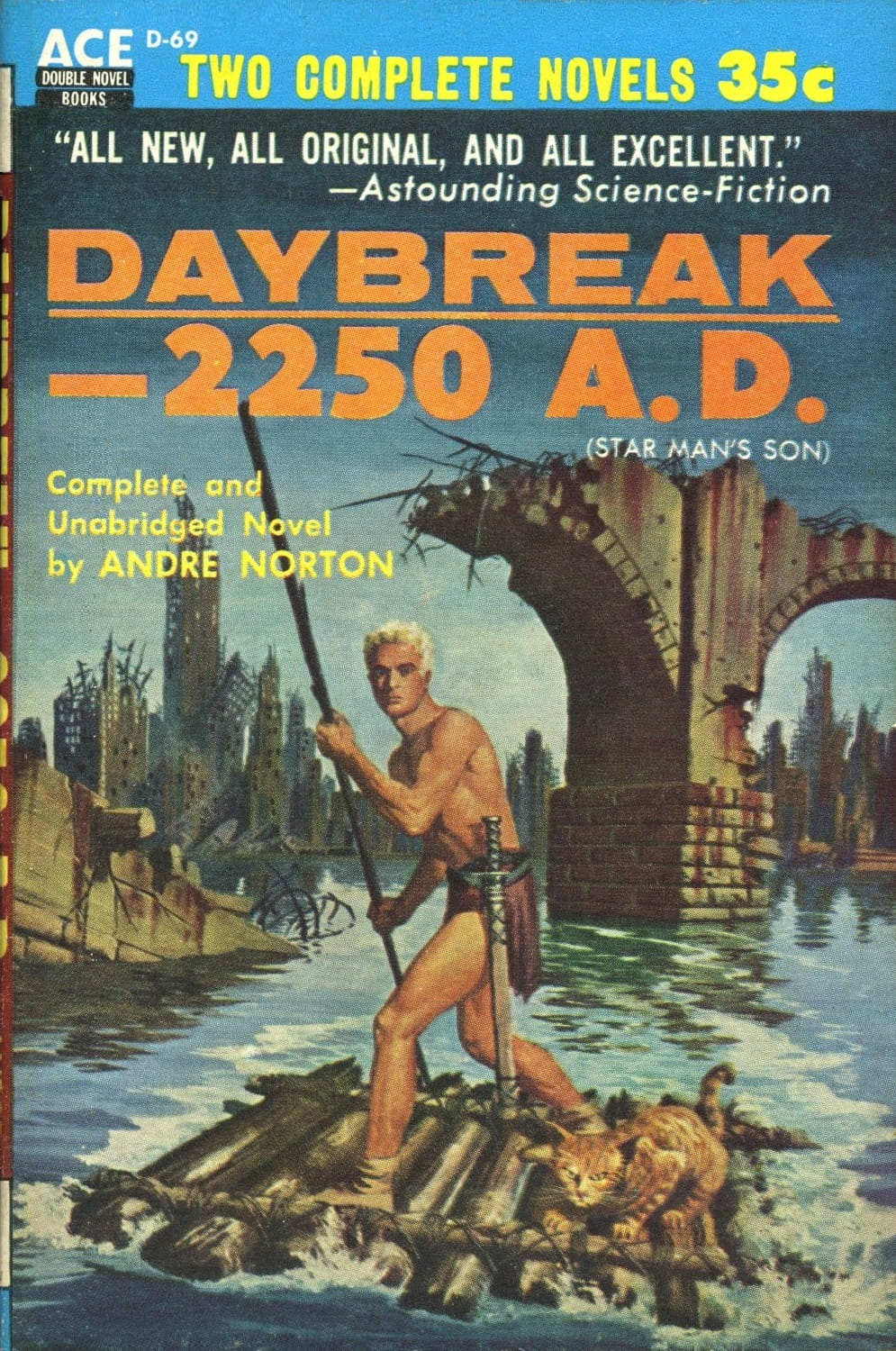
I started intentionally looking for science fiction to read in elementary school. Our city library had one big room full of fiction for young readers, from preschool through high school, so I found books that were meant for readers older than I was — but I enjoyed reading them, even if I didn’t understand everything that happened to their protagonists. The top two science fiction writers, for me and I think for a lot of other people, were Robert Heinlein and Andre Norton.
Norton had written half a dozen novels, mostly historical, before she ventured into science fiction in 1952 with Star Man’s Son. But it seems to have been successful; she wrote a new fiction novels nearly every year for some time after that, and I went on reading the library copies at least up through Catseye in 1961.
[Click the images for giant cat versions.]
 |
|
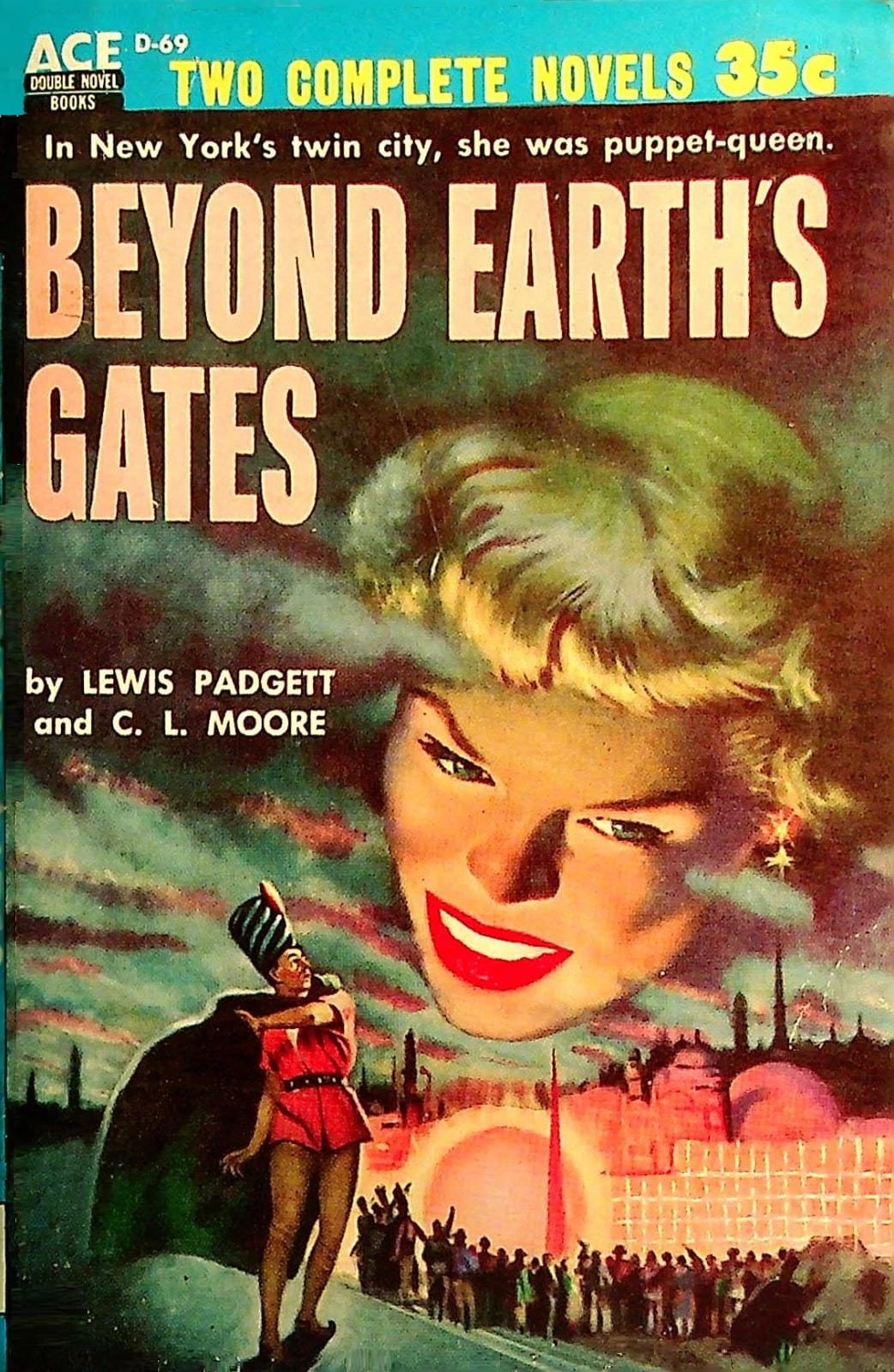
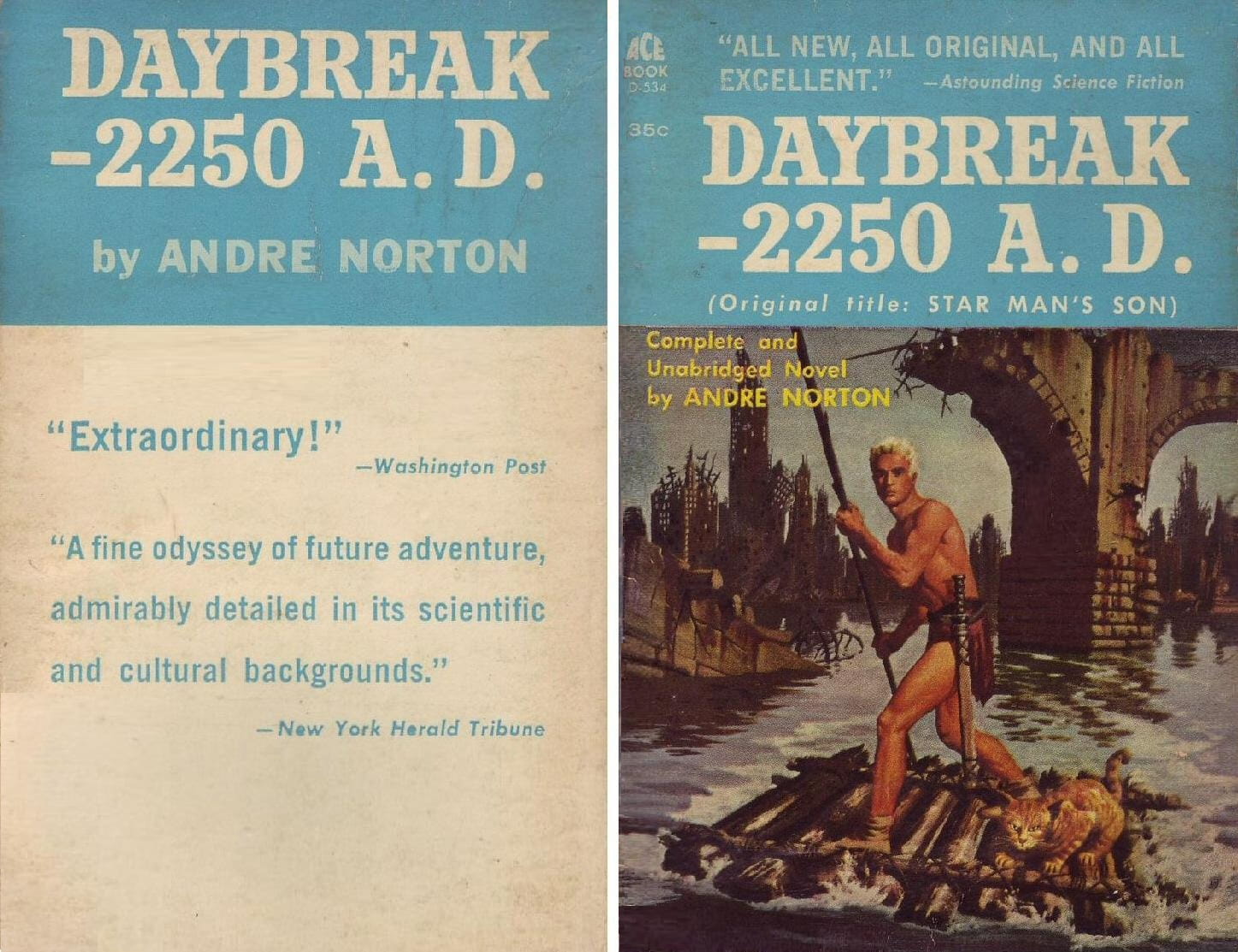
Ace Double D-69: Beyond Earth’s Gates by Lewis Padgett (Henry Kuttner) and C.L. Moore,
and Daybreak 2250 A.D. by Andre Norton (Ace, 1954). Covers by Harry Barton, unknown
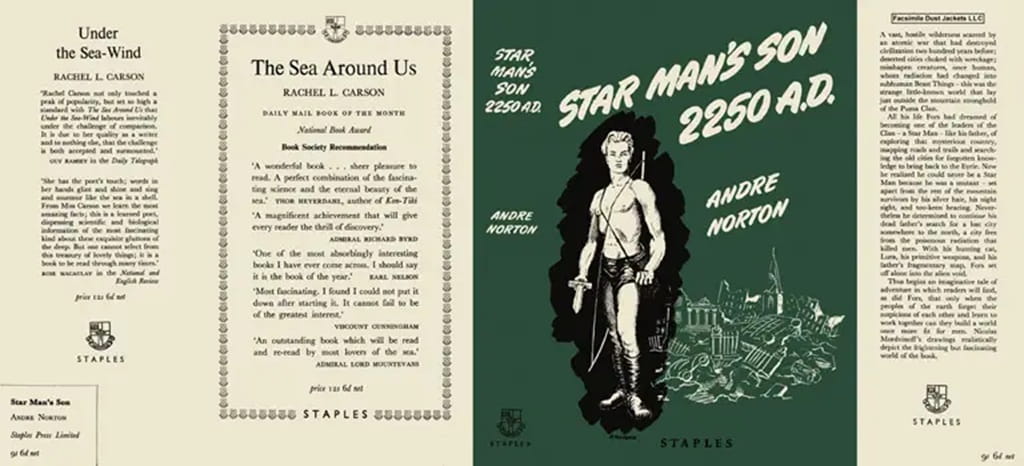
Star Man’s Son was a cleverly chosen title. It clearly signaled that this was science fiction. But it wasn’t, as the words seem to promise, a story about travel between the stars. Its Star Men were the elite of a hidden community high in the mountains, called the Eyrie, whose mission was to go out into the largely depopulated lands around them and look for the ruins of cities, both to find treasures such as colored pencils and to try to recover the lost knowledge of their builders.
Star Man’s Son is one of the founding works of the post-nuclear-war genre, published only seven years after Hiroshima, but envisioning a world devastated by nuclear weapons: massively depopulated, with many areas left lethally radioactive, and with parts of the land geologically transformed.
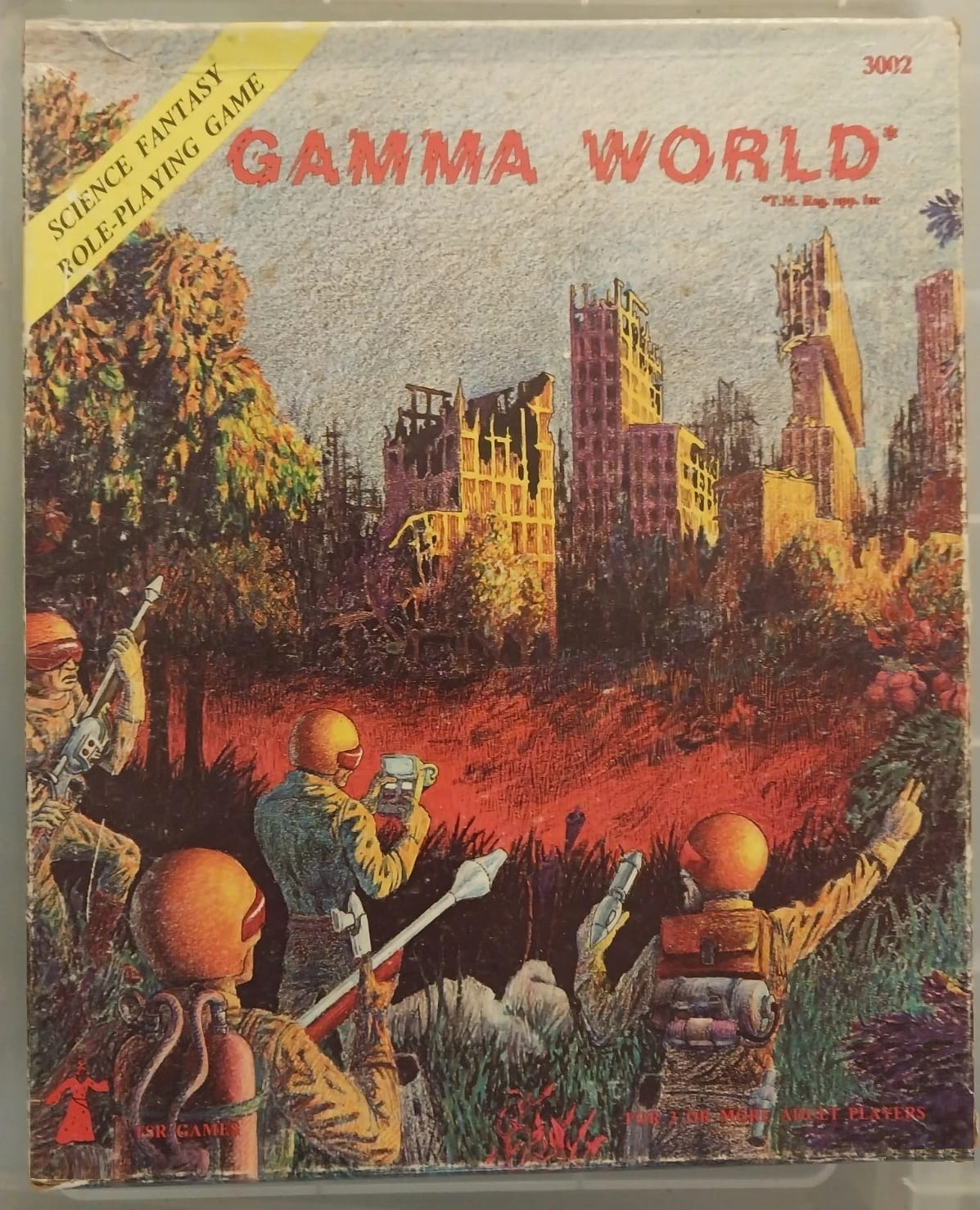
As a by-product of the radioactivity, there are mutant forms of various species, including human beings. In fact this setting could be a prototype for the early roleplaying game Gamma World.
Norton’s hero, Fors, is one of these mutants, and that’s the starting point for her story’s conflict. Fors’s father was a Star Man, and a very successful one. But Fors’s mother came from a different culture, the Plains People, who lead a nomadic existence in the deserted lands outside the Eyrie; and Fors himself has mutant traits, both visible — white hair — and invisible — night vision and preternaturally keen ears.
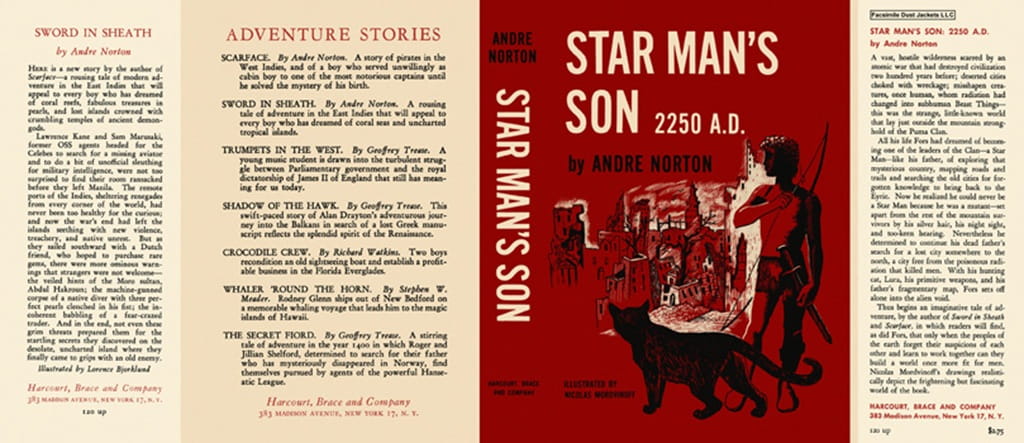
Orphaned by his father’s death on an expedition into the wilderness, Fors wants to succeed him as a Star Man, but is repeatedly rejected, out of a prejudice against mutants. At 17, after his sixth and final rejection, Fors rebels, stealing his father’s gear (but not his father’s star, which he hasn’t earned) and venturing out into the wild lands on his own, looking for a fabled lost city of the ancient world that would prove his worth.
Norton doesn’t link any locations to familiar geographic names, but her readers would naturally have assumed that her story took place in North America. From her descriptions, the Eyrie could be in the Rocky Mountains, perhaps in Colorado; the plains might be Kansas or Nebraska; and the city that Fors eventually finds might be any major Midwestern city, though I’ve long assumed that it was Chicago, and apparently other readers commonly do the same. (This isn’t like Pangborn’s postapocalyptic setting, with little kingdoms bearing easily parsed names such as Bershar, Penn, or Vairmant.)
The combination of ruined structures and depopulation is curiously similar to Tolkien’s realm of Arnor, which would appear a few years later in The Fellowship of the Ring; Tolkien rejected any suggestion that the One Ring was an allegory for the atomic bomb, but both stories seem to reflect the idea of a fallen higher civilization, analogous to Rome, and perhaps the idea that the industrial West could also fall was made more credible by the destructiveness of the World Wars.
Another parallel to what Tolkien would publish is the existence of an inherently hostile race, the Beast Things. Like Tolkien’s orcs, they have a roughly human form, but one that’s hideous to human eyes; in this case, they have faces and clawed hands that make them resemble gigantic rats.
The Beast Things seem to lead entirely collectivized tribal existences and to be naturally cruel and hostile to human beings.
And in Star Man’s Son, where they previously were a minor threat, dangerous mostly to solitary explorers, they have emerged to more organized hostility, attacking various human groups in vast hordes (where those hordes came from is no clearer than it was for the “goblins” in The Hobbit; such enemy races tend to have a nightmarish fecundity).
Their origins are obscure, but they’re clearly mutants, and help explain where the common hostility to mutants came from.
 |
 |
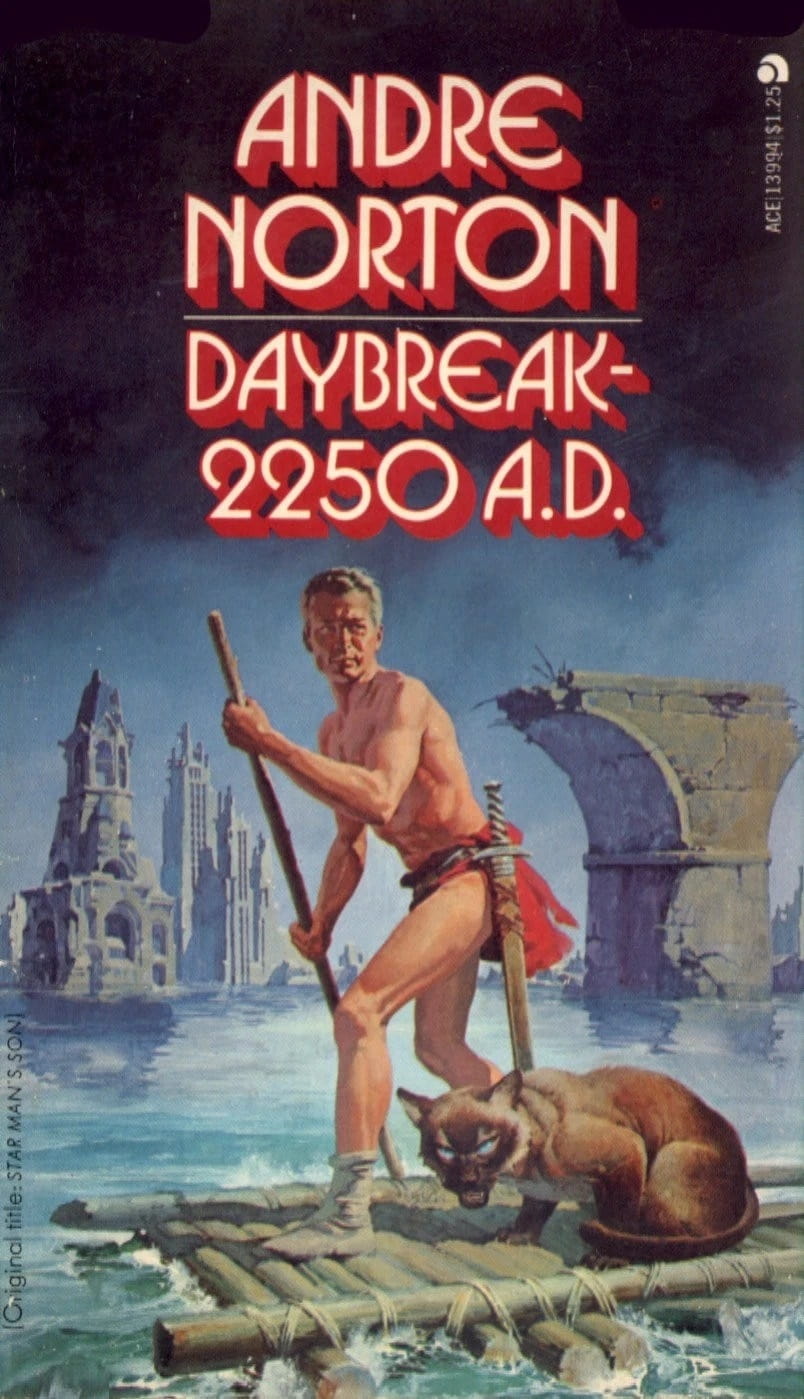
The 1977 cover refresh from Ace Books. Cover artist also unknown
Fors’s own venture acquires a companion from a different culture still, with its own traditional heritage from the more civilized past: Arskane, whom Fors pulls out of a pit trap and treats with an antibiotic salve (and in return, Arskane introduces him to coffee, which Fors doesn’t like at all!).
From Norton’s description, it’s clear that Arskane is Black, and it’s curious that where Heinlein found it necessary to hint cryptically at Rod Walker’s ethnicity in Tunnel in the Sky, published only a few years later in 1955 (his publisher was worried about sales in the South),
 |
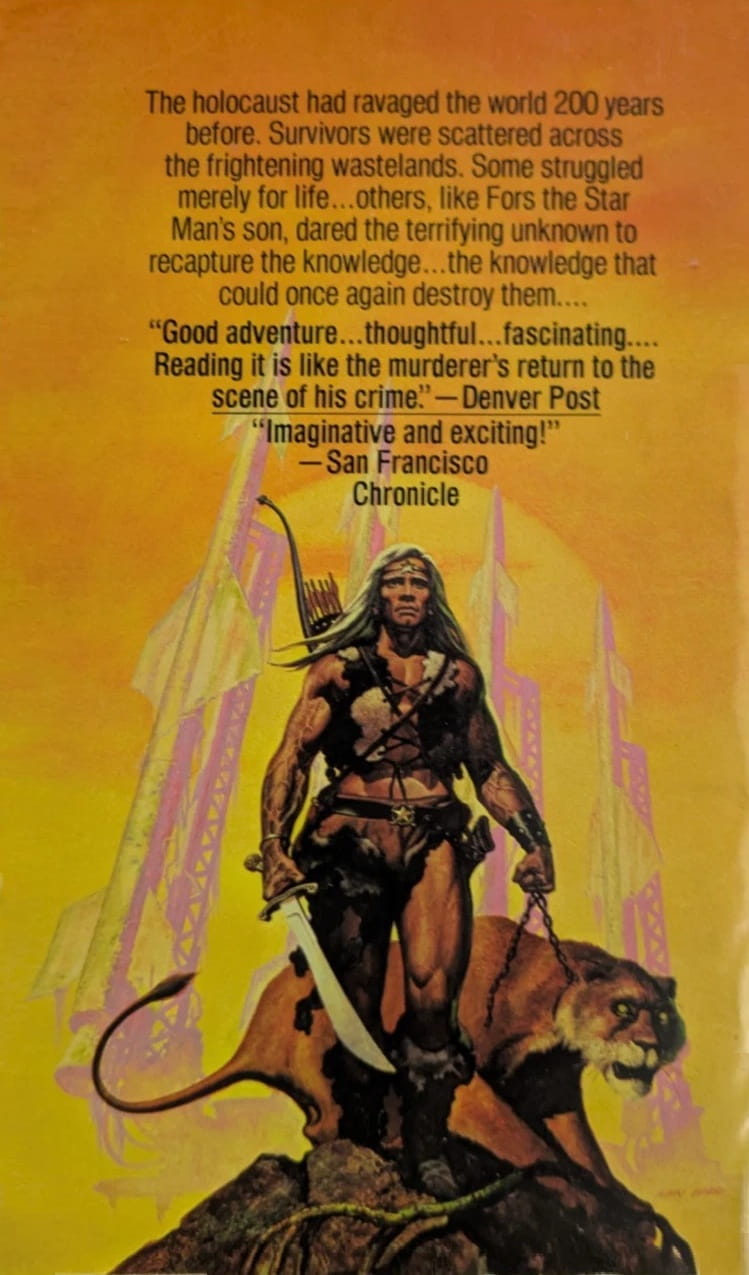 |
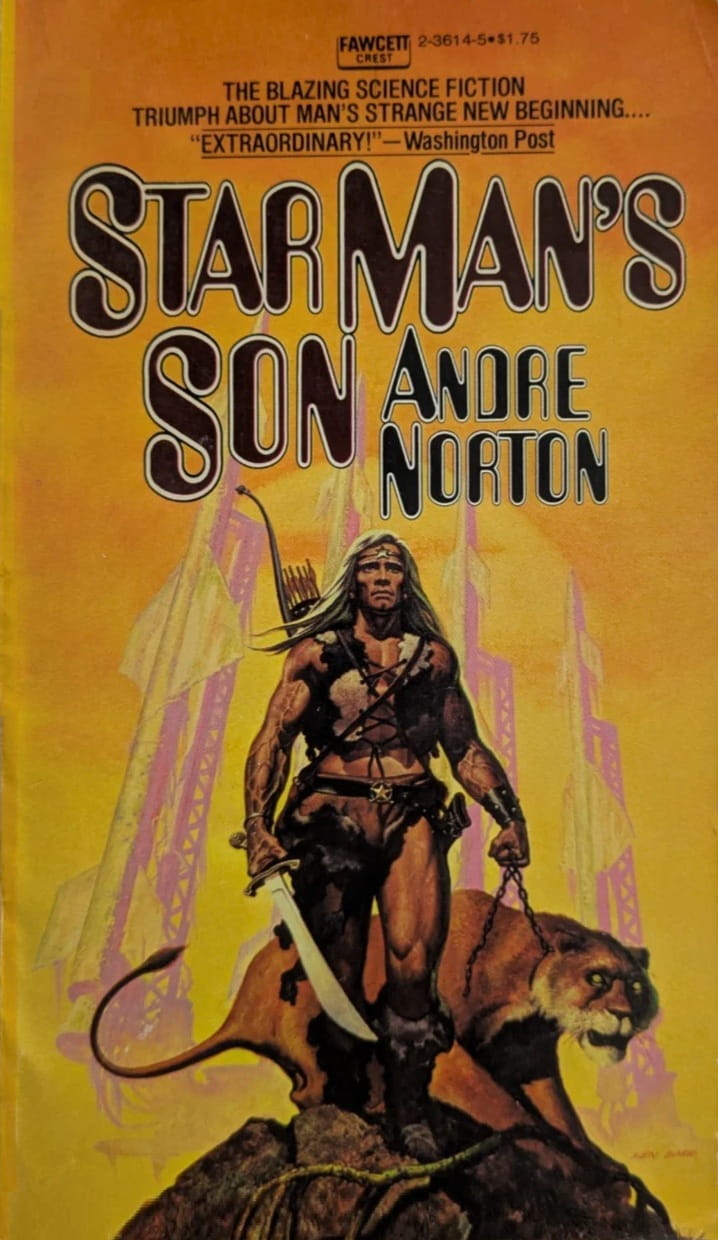
Fawcett Crest paperback edition, which returned to the
original title (Fawcett Crest, August 1978). Cover by Ken Barr
Norton didn’t have any trouble showing Fors and Arskane teaming up and even coming to regard each other as brothers. (Or might Heinlein have been unnecessarily worried?) Arskane’s account of his people’s origins to Fors makes them descendants of aviators, and perhaps Norton was thinking of the Tuskegee Airmen and expecting her readers to do likewise. And in parallel, Norton mentions a legend that the Eyrie was originally a base for an intended venture into space, which is why its elite explorers are called Star Men.
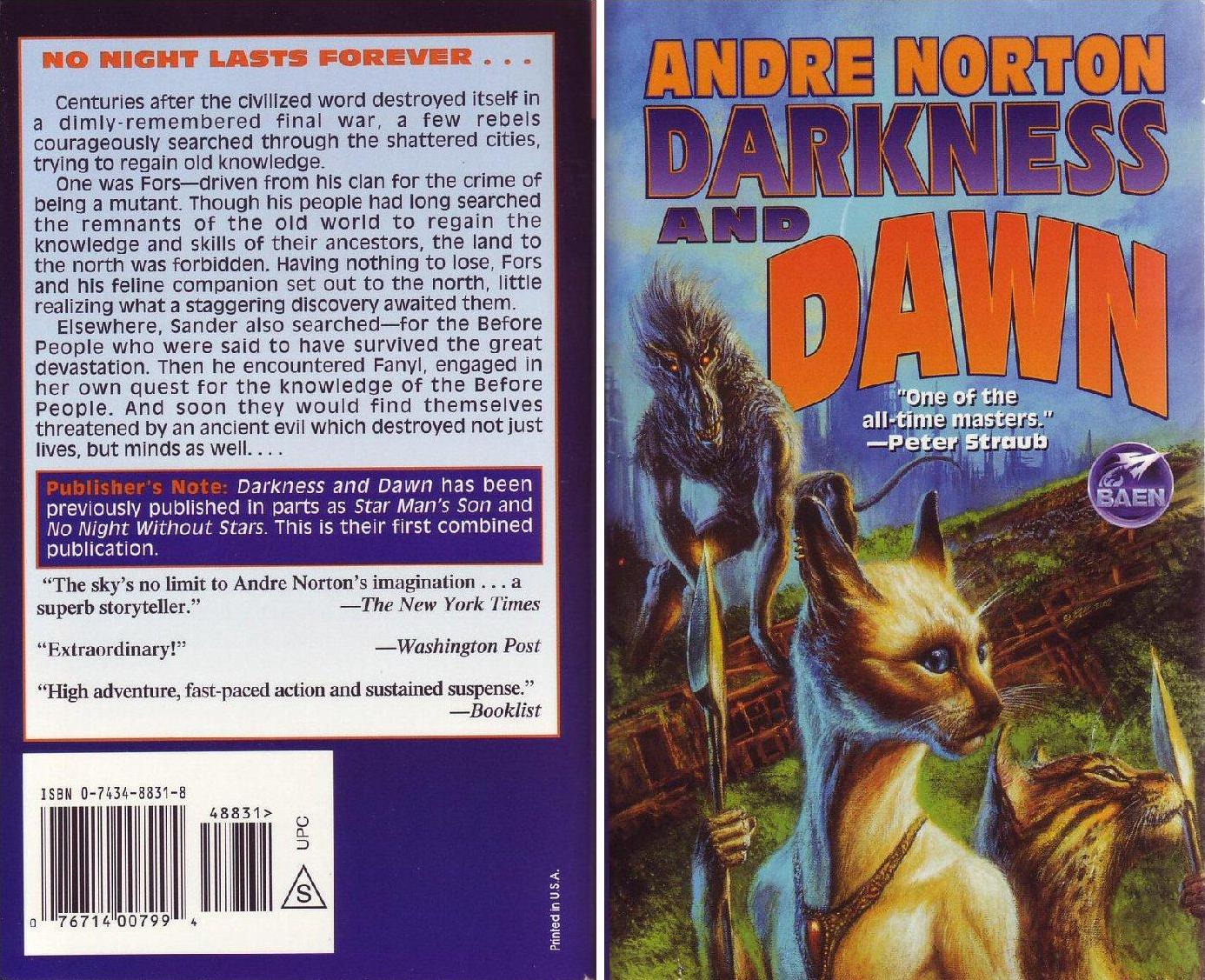
Fors is also accompanied by another mutant: Lura, descended from domestic cats, but grown larger and apparently empathic through the effects of radiation. (The image of the symbiotic goes back a long way before Honor Harrington.)
Lura is described as having a coat coloration similar to Siamese cats. She accompanies Fors through most of his journeys and is only temporarily parted from him during one major crisis. Aelurophilia seems to be a common trait among science fiction writers and readers, and Norton does a persuasive job of appealing to it.
All of this shows that the novel’s recurring theme is mutation: The Beast Things, Lura, Fors himself, and a variety of exotic life forms such as a race of diminutive lizards that tend farms and wield poisonous weapons are all mutants. And the novel’s continued point is that “mutant” as such is not a moral category: Mutation can be either good or bad, depending on what the mutant does.
At the novel’s climax, we have the mutant Fors playing a vital role in a stratagem aimed to have all the human forces unite against an army of the mutant Beast Things — and then confronting a threatened outbreak of war between the different formerly allied human forces. Norton seems to be making a point similar to St. Paul’s statement that “Here there is no Greek or Jew, circumcised or uncircumcised, barbarian, Scythian, slave, or free” — or, in this case, mutant or nonmutant.
Indeed, her characters raise the question of whether it’s good to preserve the unchanged likeness of the ancient humanity that destroyed its own civilization in a vast war.
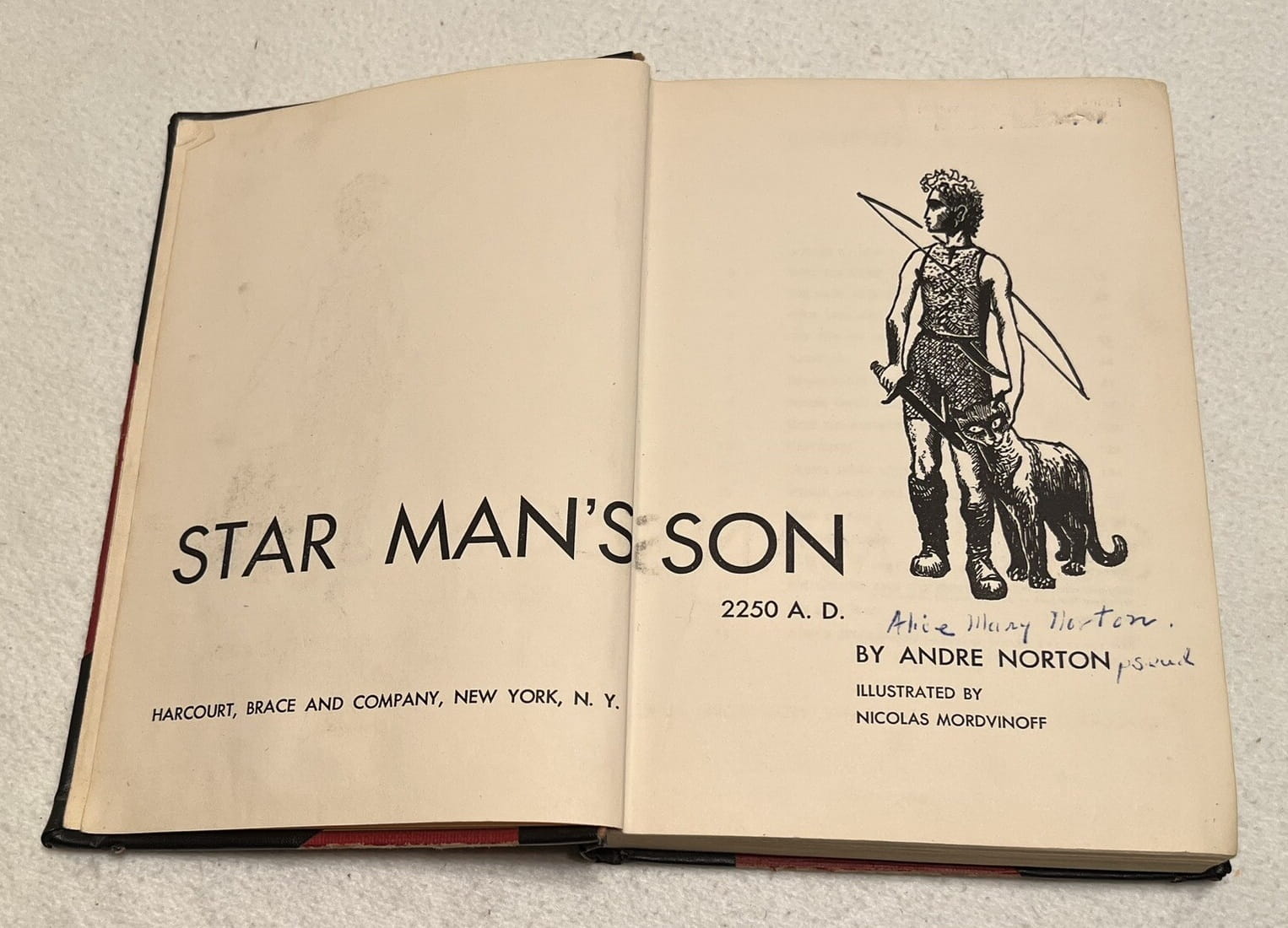
In a review of this novel, quoted in the copy I read, the Denver Post called it “a good adventure story which is a thoughtful book as well,” and I think that’s a fair summary. Like Heinlein, Norton assumed that her readers would be interested in serious themes and able to make sense of them; and that was part of what made her a leading author of “juvenile” science fiction.
William H. Stoddard is a professional copy editor specializing in scholarly and scientific publications. As a secondary career, he has written more than two dozen books for Steve Jackson Games, starting in 2000 with GURPS Steampunk. He lives in Lawrence, Kansas with his wife, their cat (a ginger tabby), and a hundred shelf feet of books, including large amounts of science fiction, fantasy, and graphic novels.
My first sf novel, purchased from the Scholastic Book Service, with the same cover illustration as the Ace 1977 edition (though mine is printed earlier). At the time, I recall a lot of atomic apocalyptic (Fail-Safe; On the Beach; Alas, Babylon) and post-apocalyptic (Davy; Daybreak; Hiero’s Journey) fiction. It seems a bit later we got the rash of post-apocalyptic RPGs (Gamma World (Blern!!); Aftermath; The Morrow Project). I am not sure that the connection to fiction was quite as clear as the Tolkien D&D linkage. But it must be there.
The 1977 cover is by Gino D’Achille.
In the late ‘60s-early ‘70s British publisher Gollancz issued many of Norton’s juveniles, and copies of many of them found their way into the Australian public library system. I suspect I wasn’t the only young budding SF enthusiast who this read of lot of her work. “Star Man’s Son” was the first of her books I can recall borrowing and reading; I hadn’t realised until now that it was her very first SF novel.
A couple of years ago I reread SMS for the first time in over half a century. I enjoyed it, and thought it held up quite well – though my youthful doubts remain that centuries-old tinned fruit found in the ruins of an atomic-blasted city would still be editible!
One of if not the first sci-fi novel I read on my own. Might also be Ender’s Game. But I had to get it through Inter-Library-Loan and was one of Ace reprints but converted to be library format. Great, now I’m probably going to ebay, more $ for “Physical Media”. Serious, we GOT to get some kind of publishing service that can print things “Ace Double” mass market paperback style.
And yep later I found out Andre Norton was a lady. No, I didn’t feel ‘betrayed’ or any nonsense. I got it that years back there were strong social biases so some good writers the publishers stuck their necks out to publish them under anglicized, masculine names to avoid threats or actual violence or at least massive subscription cancels.
Or just used the initials, as with C.L. Moore.
It’s generally understood that Andre Norton’s choice of pseudonym (which she fairly quickly adopted as her legal name) was due to her earliest novels, which were in the “boy’s story” genre — thus, the prejudice she was dealing with was not SF readers or publishers, but juvenile book publishers.
C. L. Moore chose to use initials — I am told — so as not to reveal to her bosses at her day job that she had a side gig.
By the mid-’50s it was widely known in the SF field that Norton was a woman. That said, Gnome publishing did publish a couple of her novels under ANOTHER male pseudonym, Andrew North.
“Daybreak-2250 A.D.” is by far my favorite Norton novel. Can’t remember when I read it but I recall that I enjoyed it and thought it captured the “Gamma World” vibe. As one who gets most of my books from used book sources, there is never a shortage of her books – most with terrific covers. I find her writing style (more action oriented with characters almost fully developed) and the book length (around 200p) to be what I look for in a sci fi story. Thanks for the article.
This was the second or third Andre Norton book I ever read (first was Storm Over Warlock). I was in the fifth grade, and the school library had maybe half a dozen of her books as I recall. As an adult, I find her books I read when I was a kid still very readable today.
Well that just gave me a huge flashback to my youth, combing through the mass market shelves of the local bookstores. Considering I went through a huge post-apocalyptic novel phase around this time I can’t explain why I never picked this up. Ebay here I come.
Thanks for the reminder.
The “empathic cat” is one of those delightful mainstay tropes of science fiction. Does anyone know where it originated? Was it with Norton? The “Dr. Moreau” stories don’t quite fit it, so I don’t think that’s where it sprang from.
It shows up in Drake’s “Honor Harrington” (1992+), Greeno’s “Ghatti’s Tale” (1993), Sinclair’s “Games of Command” and follow-up shorts (2007), and several of the short stories in collections like “Alien Pets” (1998). Whenever a series makes companion animals a thing (McCaffrey’s Pern; any of the magical fantasies that require familiars), an empathic cat is sure to show up. Even Cherryh’s Chanur and Norman’s Sholans could be said to be a natural outgrowth of the trope.
Don’t forget Robert Adams’ Horseclans books, which not only have empathic (or telepathic) cats, but are also post-apocalyptic.
Good point! I did miss those.
Reminded me of Fritz Leiber’s “Spacetime for Springers” (1958) about cats used in space travel. I don’t recall which “powers” they had. May require a re-read.
Or Cordwainer Smith’s “The Game of Rat and Dragon” (1955), where the titular extradimensional ‘dragons’ threaten human spaceships that must be protected by telepaths working together with cats, who visualize the ‘dragons’ as big rats.
Oh, Leiber’s and Smith’s works sound like good early candidates, though seemingly not quite as early as Norton. Maybe the mid-fifties was a groundswell for the trope. …I wonder if “The Game of Rat and Dragon” inspired Argus’ “Kitty Cat Kill Sat” (2023), since there are a few conceptual parallels.
I don’t Leiber is really doing an empathic cat story, though his story falls into the larger category of SF where cats are important. Gummitch has no communication with Old Horsemeat or Kitty-Come-Here, and his brief mental contact with Sissy is both unrepeatable and tragic. Gummitch was not at all a space traveller, but lived in a house or apartment with a mundane human family. Which is not to denigrate “Space-Time for Springers,” one of my favorite SF stories ever.
Fair enough. I don’t know “Space-Time for Springers,” so I’ll trust that you have the better sense of it. But I will point out that space travel is not necessary for it to be empathic cat sci-fi or sci-fi that includes empathic cats; Gayle Greeno’s novels don’t include any form of space travel at all. Rather, in those stories, a planetary colony has had a sort of post-apocalyptic degeneration, and rebuilt their society with a justice system based on the ghatti (empathic/telepathic cats) traveling with roving judges on horseback.
That’s true. The remark about space travel was addressed to Pederson’s original comment, not to yours.
I think there are several related tropes here: the empathic cat, the uplifted cat (such as Cordwainer Smith’s C’mell), the catlike alien (such as E.E. Smith’s Vesta, a very early example). And both the uplifted cat and the alien cat can look like catgirls, though there are many who don’t. The significance seems to be somewhat different.
Ah. Roger, that.
Agreed on the point about related/morphing tropes.
This is another one of hers that I still haven’t read, despite having owned a copy for … 40+ years? Something in that ballpark.
I did recently read the first few Forerunner books (only one of which, Forerunner Foray, I’d read in my childhood) and thought they held up quite well.
Thanks for the essay. I read this many decades ago, but really had no recollection what it was about anymore.
I’ve told this story before, but I’ll tell it again here. Some time ago I was talking to my brother-in-law Scott, and he, knowing that I read a lot of science fiction, told me that when he was a kid he found a paperback science fiction novel, and was reading it and really enjoying it, when his father saw him, grabbed the book, tore it in half and threw it way, saying “I don’t want you reading trashy sci-fi stuff!” Scott told me that all he remembered about the book was that the cover had a guy on a raft with a cat.
I thought to myself, “I know that book!” I didn’t say anything to Scott, but at the first chance I went to a used bookstore, and found an old Ace paperback with the original Ace Double cover (though it was a single edition) — not the Gino D’Achille copy (and I’m surprised D’Achille, a talented artist, so blatantly copied another artist’s work.) The next time I saw Scott, I gave him the book — and he recognized it right away. Very gratifying.
Now, that was a great kindness. I hope he enjoyed it as much as he did as a boy.
A friend in 9th grade let me borrow his copy– with the Ken Barr cover. I remember it being quite good and totally overlapping with Gamma World. AND after reading this article, I had to jump on Ebay and get myself a copy!