Browsed by
Category: Books

What Has Orbit’s Expansion Wrought?

What Has Orbit’s Expansion Wrought?

Vivian Shaw Strange Practice-smallI know most readers don’t pay attention to publishers. But I do. And I’ve been watching the astounding success of Orbit, the SF and Fantasy imprint of Hachette Book Group, for the past few years. Their breakout books include Andrzej Sapkowski’s New York Times bestselling Witcher series, James S. A. Corey’s The Expanse, Ann Leckie’s Ancillary Justice, M.R. Carey’s The Girl With All the Gifts, and even Black Gate author John R. Fultz’s Books of the Shaper trilogy.

When Orbit US announced a major expansion two years ago, I was curious what it would bring. Turns out quite a bit… here’s just a sampling of some of their releases over the past 24 months.

Mur Lafferty’s Six Wakes
Greg Bear’s War Dogs trilogy
Ian Tregillis’s Alchemy Wars trilogy
Kim Stanley Robinson’s New York 2140
Alastair Reynolds’s Locus Award-winning Revenger
N.K. Jemisin’s Nebula nominee The Obelisk Gate
Brian McClellan’s new Gods of Blood and Powder series

That’s a darned impressive list. Of course, many of those authors probably would have been published even without the expansion… but you can’t say the same for their newer writers.

Not every publisher that hits it big plows some of their revenue back into developing new writers — Bantam Spectra, for example, once one of the most experimental and risk-friendly imprints, has shrunk their line to essentially a single author: George R.R. Martin. Martin is by far the top-selling fantasy writer in the field, but Bantam isn’t using that huge success to fund the search for their next new author. At least not as far as I can see.

Read More Read More

Self-published Book Review: The Ghost Box by Mike Duran

Self-published Book Review: The Ghost Box by Mike Duran

Ghost_box_coverI’d like to keep the monthly schedule going, so please keep sending me books to review — see the instructions here.

Reagan Moon is a paranormal reporter working for the Blue Crescent, an LA tabloid. He’s good at his job, and one of the things that makes him so good is he doesn’t believe. Oh sure, there are strange things out there: cults and designer drugs and brain hacks, but nothing supernatural. Nothing that can’t be explained. He hasn’t believed in much since his dad died, and his girlfriend’s, Ellie’s, death less than a year ago only made him more of a cynic.

But tabloids don’t pay a whole lot, and if a rich eccentric wants to pay him to talk to a medium, he’s game. The problem is that Klammer wants him to make contact with Ellie, hinting that she wasn’t incinerated in a freak accident but rather harvested for some grotesque purpose. In grand noir tradition, Reagan is soon dodging the police on suspicion of being involved in the death of said medium. Whether holed up with the Mad Spaniard and his daughters, Kanya and Cricket, in their Asylum for strange artifacts, or following a lead to the Spiraplex, a grand building/science experiment centered around a giant statue of Anubis, and built by Klammer’s old business partner and rival, Soren Volden, Reagan is constantly in over his head.

The Ghost Box is the first book in Mike Duran’s Reagan Moon series. I reviewed the second book, Saint Death, last year, but I figured I should go back and cover the first one. Mike Duran started publishing in the Christian market, writing novels such as The Resurrection and The Telling, both of which contained supernatural elements that don’t neatly fit Christian theology, for which he received blow back from many readers of Christian fiction. The Ghost Box is an effort to get outside the narrow restrictions that limit what he can do in Christian publishing. Mike Duran doesn’t hide his Christian worldview, but neither is he pushy about it.

In fact, it’s clear that Reagan Moon is not a believer in pretty much anything. And there’s no conversion experience in this book. Or rather, it’s not a conversion to Christianity so much as a conversion to hope, an acknowledgment that there’s more to this world than the physical, that our spirits do survive after death.

Of course, to get there, Reagan Moon first has to see it with his own eyes. Enter Rival’s Curtain.

Read More Read More

A Book That Makes You Yearn to be Stranded on a Desert Island: Modern Classics of Fantasy edited by Gardner Dozois

A Book That Makes You Yearn to be Stranded on a Desert Island: Modern Classics of Fantasy edited by Gardner Dozois

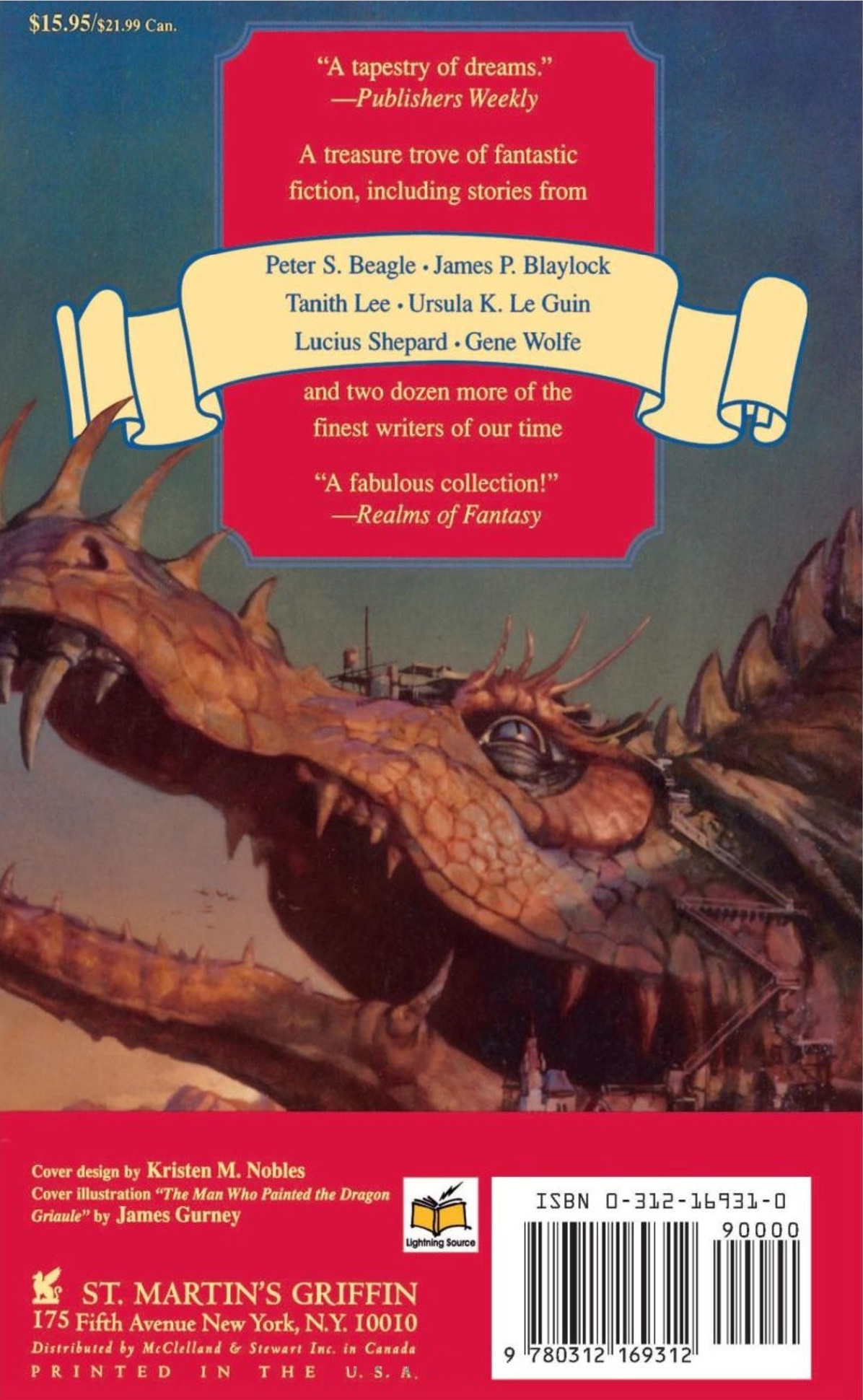
Modern Classics of Fantasy-small Modern Classics of Fantasy-back-small

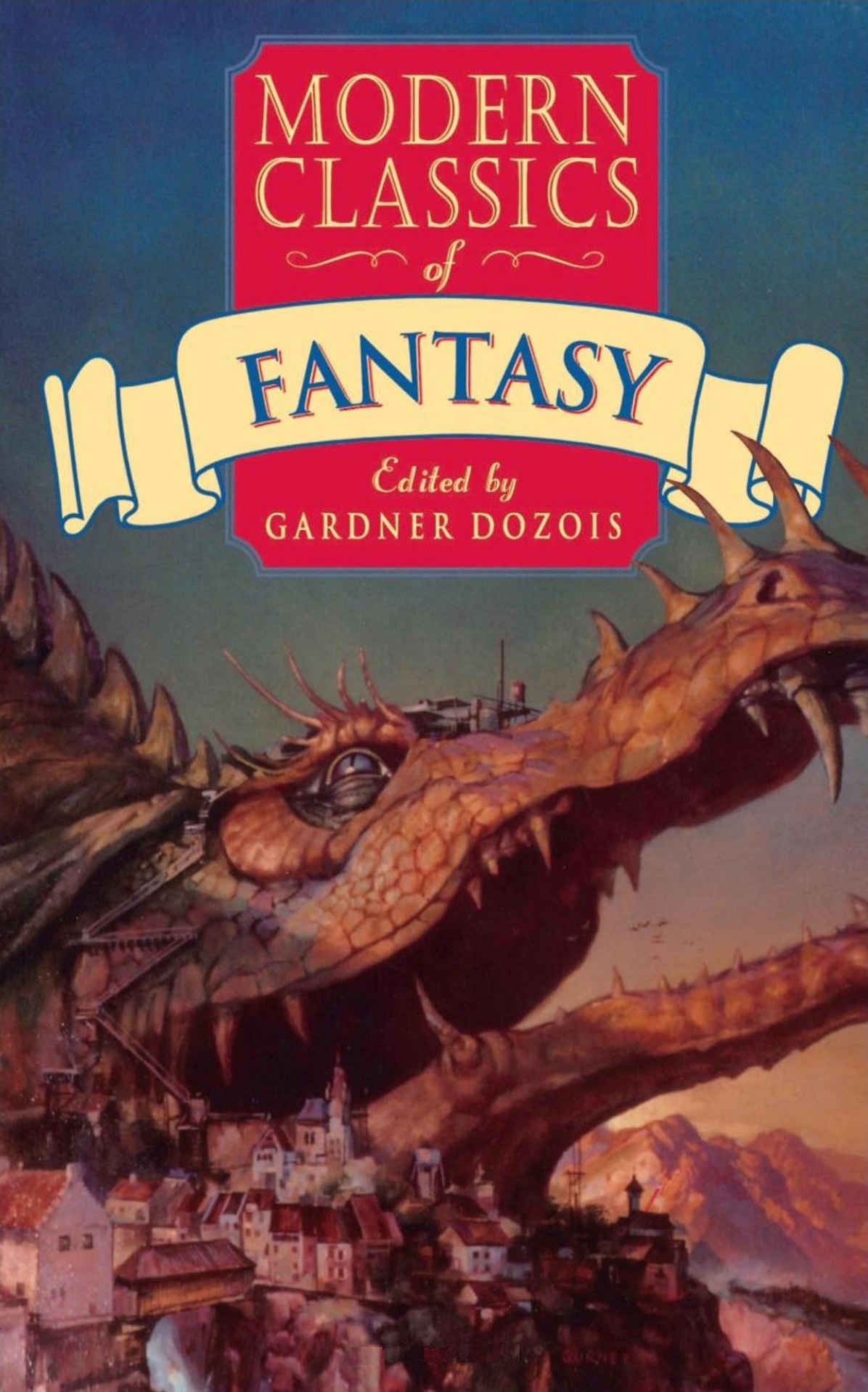
Like most of you folks, I used to have more reading time. Like, a ton more reading time. Whole summer vacations just lazing around with my feet on the furniture and my nose in an epic fantasy. Nowadays I’m lucky to negotiate a three-day weekend and, believe me, that kind of reading time is much too precious to devote to a single author. Yes, reading vacations still tend to be devoted to big books — I haven’t broken that habit– but these days more often than not they’re thick anthologies that let me sample a wide range of writers. And usually anthologies curated by an editor who’s earned my trust.

That’s why I’m so partial to Gardner Dozois. He’s got great taste, for one thing. For another, he produces big books, the kind you can plan a vacation around. One of my favorites is his massive survey anthology Modern Classics of Fantasy, which is the kind of book that makes you wish you could be stranded on a desert island. Sure, I’d probably go hungry and miss the internet. But if it meant I finally had 15 uninterrupted hours to read this thing cover to cover, it’d totally be worth it.

Read More Read More

Any Sufficiently Advanced Technology…

Any Sufficiently Advanced Technology…

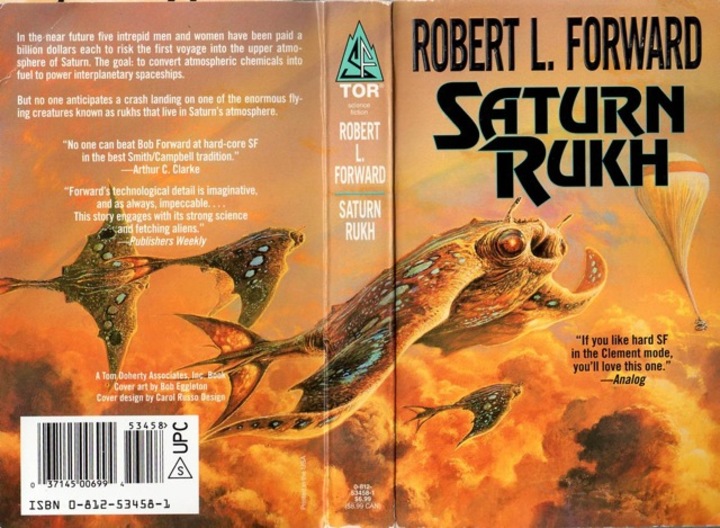
saturn rukh cover

I know this is a fantasy blog, but for this one I want to appeal to the third (and most famous) of Clarke’s laws, which is “Any sufficiently advanced technology is indistinguishable from magic,” because I want to talk about the scienciest, most extrapolatey, most out there science fiction, which isn’t overtly different from fantasy except in aesthetic.

This comes from my musings about writing a story set in orbit of a neutron star, and also because I was recently discussing with a friend where to find the hardest SF.

I get a lot of ideas when I read other authors. I love seeing what science people know and transform into story, and I love seeing that unique kind of creative ambition.

Some caveats: When I looked in my book shelf for examples to show a friend, I came up with three authors and six titles. My shelves don’t have every book, and so I’ll certainly miss some stunning works.

Read More Read More

Vintage Treasures: Starship/Non-Stop by Brian Aldiss

Vintage Treasures: Starship/Non-Stop by Brian Aldiss

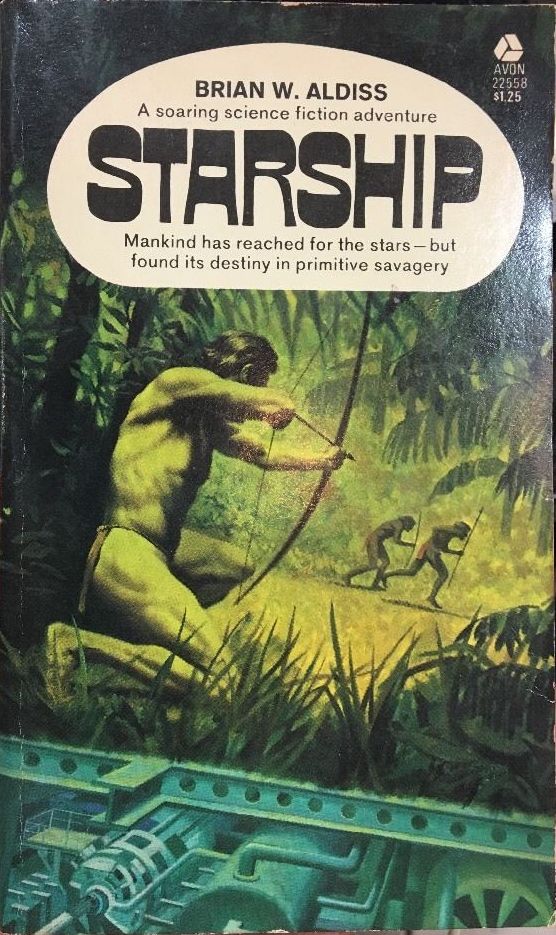
Brian Aldiss Starship Signet-small Brian Aldiss Starship Avon-small Brian-Aldiss-Non-Stop-Pan-small
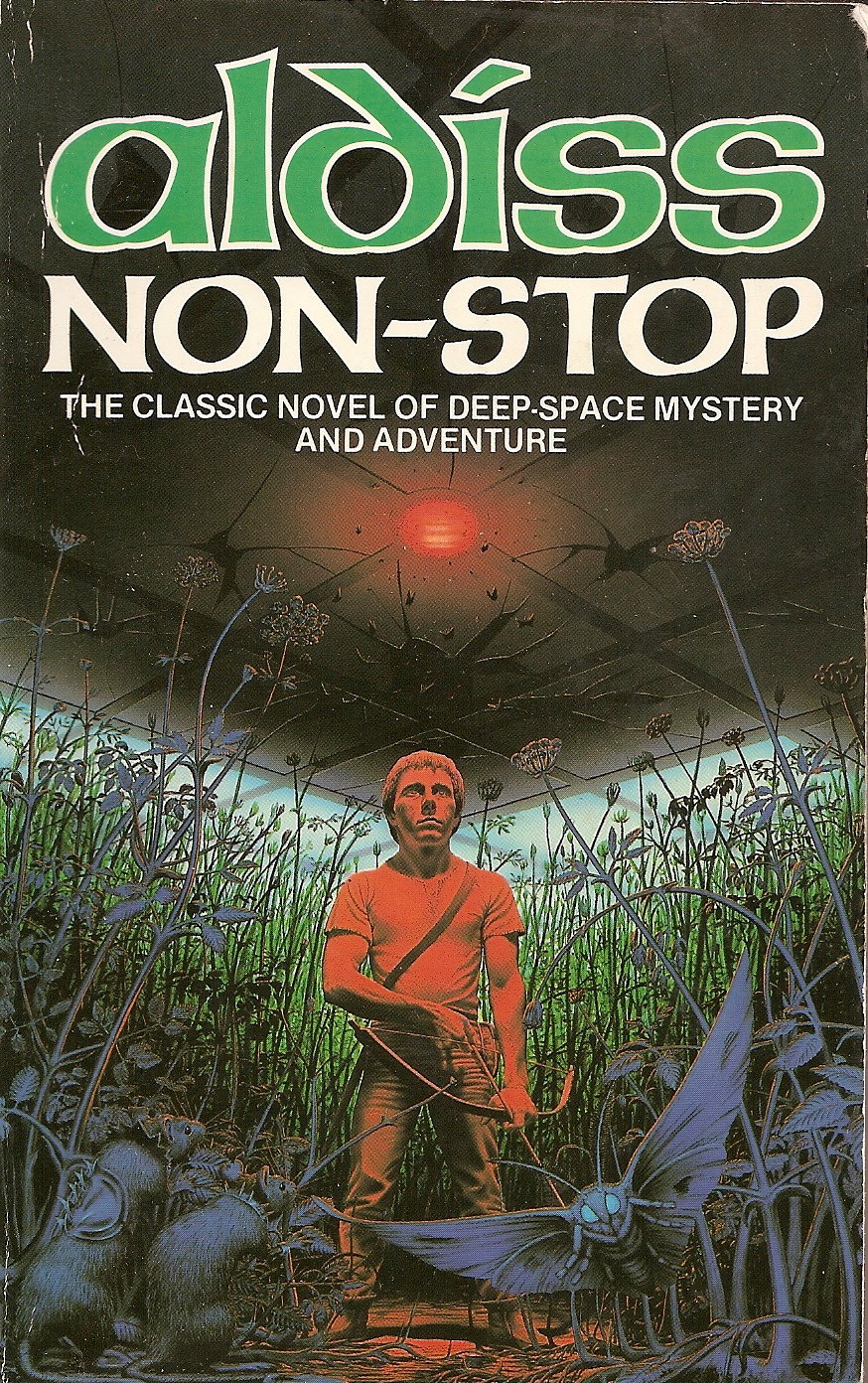
Brian Aldiss Non-Stop Grafton-small Brian Aldiss Non-Stop Carroll and Graf-small Brian Aldiss Non-Stop Masterworks-small

Joe Wehrle’s terrific review of Brian Aldiss’ Hothouse short story cycle in the latest issue of The Digest Enthusiast piqued my interest in other Aldiss classics. There’s certainly a lot to consider — Aldiss has written some thirty novels, including The Dark Light Years (1964), Report on Probability A (1968), Barefoot in the Head (1969), The Eighty-Minute Hour (1974), The Malacia Tapestry (1976), and The Helliconia Trilogy, just to mention a few. His most recent novel Finches of Mars was published in 2012, and his short story “Abundances Above” appeared in Postscripts 36/37 last year, shortly before the author’s 91st birthday (!!).

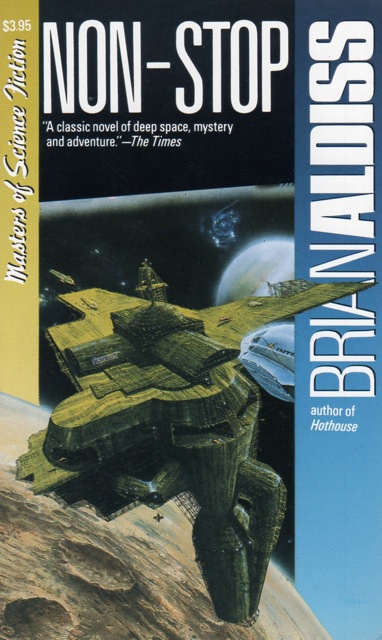
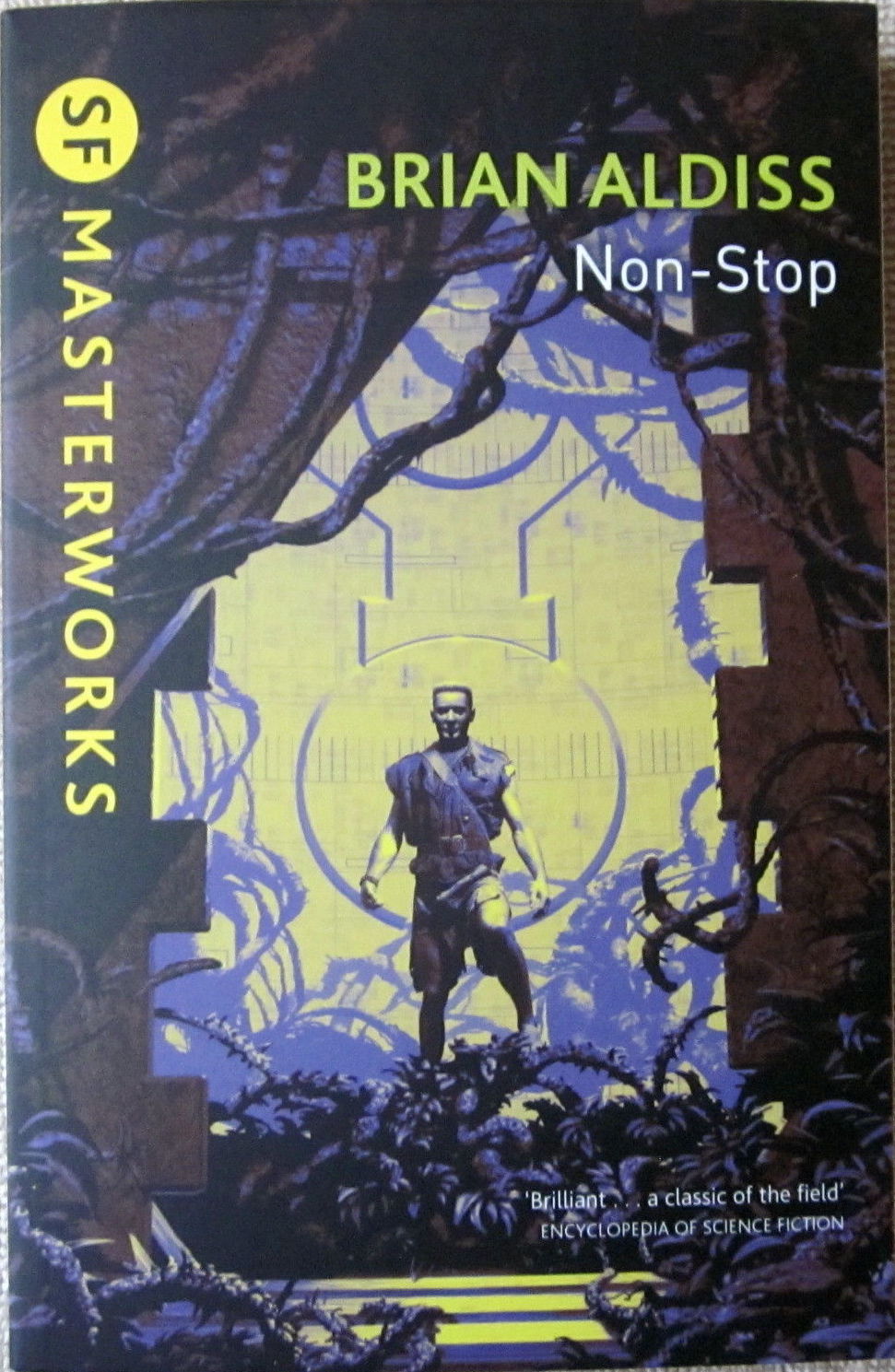
But any serious study of Brian Aldiss should probably start with his first novel Non-Stop, published in 1958. The tale of a generation ship whose inhabitants have degenerated into near barbarism, it was an instant classic, and remained in print for over five decades. The novel was re-titled Starship for its 1959 appearance in the US; that title stuck through multiple editions. I’ve collected a sample of a half-dozen of my favorite covers above, starting with the 1963 Signet paperback (top left, cover by Paul Lehr) and progressing through the decades to the 1989 Carroll & Graf edition (bottom middle, art by Tony Roberts) and the SF Masterworks edition (2000, cover by Fred Gambino).

Read More Read More

A Novel You’ve Been Waiting For Your Whole Life, and Then Some: The Strange Case of the Alchemist’s Daughter by Theodora Goss

A Novel You’ve Been Waiting For Your Whole Life, and Then Some: The Strange Case of the Alchemist’s Daughter by Theodora Goss

The-Strange-Case-of-the-Alchemists-Daughter-Theodora-Goss-smallWhat if a genius decided to combine a fantastical feminist romp with a classic whodunnit of the mackintosh-wearing era… and tossed in some madcap Dickensian adventure?

You’d have yourself The Strange Case of the Alchemist’s Daughter by Theodora Goss, a 400-page extravaganza featuring five women you have dreamed of in your heart of hearts but have never seen on paper. Better yet, they’re the daughters of legendary characters from classic fantasy and science fiction.

When Mary Jekyll’s mother dies, the young inheritor of her meager estate discovers her father — Henry Jekyll himself — associated with a troubling league of gentlemen endowed with brilliant scientific ambition. With the help of Diana Hyde, a feral and headstrong spitfire (and daughter of Mr. Hyde), and a miraculous and unwilling scientific marvel named Beatrice, whom her revered father has tainted with poison from noxious plants, Mary embarks on a quest to discover just what her father’s band of brothers sought to accomplish.

Along the way, they enlist the help of an exemplary detective named Sherlock Holmes, his cherished assistant, Watson, and Catherine Moreau, daughter of the most barbaric and daring scientist of them all. Unless you factor Doctor Victor Frankenstein into the equation… whom, now that we mention him, happens to be the father of the last partner in crime, a kindhearted giantess named Justine who harbors a tale potent enough to warrant a novel of its own.

I appreciate Goss’s innumerable acts of kindness toward readers who have not yet read the classic works of literature to which she has paid tribute. (I confess, I am guilty as charged. Dear friends have told me in the past that I need to read Frankenstein, and I agree. It must happen). By doing so, Goss has eschewed the How Much Do You Know About This Facet of Nerddom? quiz routinely thrust upon so many innocent fans, allowing her readers to bask in the wisdom and whimsy of her characters instead.

Additionally, Goss honors the infamous gentlemen who have carried their stories through the years with the fierce compassion of an author reckoning with the staggering contradictions of the human species. And these men have to contend with their fair share of reckoning. That is, the ones who survive.

Read More Read More

Old New Pulp: Byron Preiss’ Weird Heroes

Old New Pulp: Byron Preiss’ Weird Heroes

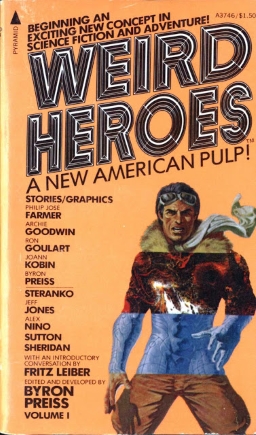
Weird Heroes Volume 1Weird Heroes was a series of eight books put out by Byron Preiss Visual Publications from 1975 through 1977, a copiously-illustrated mix of novels and short stories that aimed at creating a new kind of pulp fiction with new kinds of pulp heroes. The series had a specific set of ideals for its heroes, linked with an appreciative but not uncritical love of pulp fiction from the 1920s through 40s. Well-known creators from comics and science fiction contributed to the books, and one character would spawn a six-volume series of his own. And yet Preiss’ long-term plans for Weird Heroes were cut short with the eighth volume, and today it’s hard to find much discussion of the books online (though they’re well-remembered when they are discussed). That absence is a little surprising, as a whole new generation of writers has come along with an interest in creating new pulps. Now that we’re separated from Weird Heroes by about the amount of time it was separated from the original pulps, it’s well worth a look back at its truncated run.

Editor Byron Preiss was only 21 years old when he founded Byron Preiss Visual Publications in 1974, and the company began putting out two series of illustrated paperbacks the next year, Weird Heroes and Fiction Illustrated (which ran for four volumes with a fifth issued under a different name). Both were packaged by BPVP to be published by Pyramid Books. Weird Heroes started its run with two anthologies of short fiction that, according to Preiss’ introductions to both books, were conceived as a single volume but divided up due to length constraints. Over the course of the series’ run, it published work by Archie Goodwin, Steve Englehart, Harlan Ellison, and Michael Moorcock, alongside art by Jim Steranko, Alex Niño, Neal Adams, and P. Craig Russell.

In the editorial matter within the first book, Preiss laid out what he hoped to do with the series. Across a general introduction, a historical discussion of “old American pulp,” and an interview with Fritz Leiber later on in the book, Preiss articulated a specific sense of what old pulps did well, what they did poorly, what he wanted to take from them, and what he wanted to improve on. He also wrote about presenting an alternative to the heroes that had emerged up to that point in 1970s popular culture. Broadly, he wanted to recapture the storytelling thrills of pulp fiction and its sense of wonder, while avoiding its misogyny and racism — and unlike what he saw in both the pulps and much 1970s hero fiction, he wanted to find a way to resolve stories and conflicts without the use of violence and murder.

Read More Read More

Goth Chick News: What if Noah Brought More Than Animals on the Ark…?

Goth Chick News: What if Noah Brought More Than Animals on the Ark…?

Could it be Satan-small

Admittedly, I’m a sucker for old-fashioned, biblical-inspired horror. There’s something about texts that old that seems to add a layer of plausibility to a story. Once, following a very odd conversation with a minister’s wife attending my college, I spent one whole summer researching obscure ancient religious texts in which you can find the inspiration for most of your nightmares.

Okay, so I didn’t get out much in those days.

But what remains is an attraction to stories like Constantine, The Seventh Sign and The Rite for their otherworldly creepiness, so when I got word of a fairly new release by Christopher Golden called Ararat, I dashed right out to get my hands on a copy.

Read More Read More

Star Punk Story Building in Interplanetary Hunter

Star Punk Story Building in Interplanetary Hunter

Interplanetary Hunter Barnes
I caved and bought some old Pulp.
Interplanetary Hunter Barnes
Monster Manual-style insets describing the various creatures.

I caved and bought some old Pulp.

I couldn’t help it. I was at Eastercon and in the dealers room, and there was Durdles Books with shelves and boxes that took me back to my early teens trawling used bookstores and charity shops for volumes with spaceships on the cover.

And since I started writing my The Eternal Dome of the Unknowable series, I’ve been exploring the roots of what I call Star Punk, the covers were cool… so I came home with some faded paperbacks of yesteryear.

One of these was Interplanetary Hunter by Arthur K Barnes.

What hooked me was the lovely Monster Manual-style insets describing the various creatures. It was actually published before roleplaying was thing in 1956 (mine is the 1972 Ace reprint), and compiled from stories that went out in magazines from 1937-1946, making it technically Golden Age.

And it tells.

It’s definitely in the category of classics you shouldn’t recommend to young people (I talked about this in my first ever BG article!). It’s a good light read, the style and lead-in may be fast and furious — pulpy goodness — but it suffers from Quaint Future and some Quaint Delivery, including excruciatingly detailed science and pseudoscience, complete with equations.

Read More Read More

New Treasures: The Year’s Best Military and Adventure SF, Volume 3 edited by David Afsharirad

New Treasures: The Year’s Best Military and Adventure SF, Volume 3 edited by David Afsharirad

The Year's Best Military and Adventure SF Volume 3-smallWhen you read as many Year’s Best volumes as I do, you come to accept a certain amount of story overlap. Yes, most of the editors do their best to coordinate with each other, but this is still a pretty small field, and with more than a half dozen Year’s Best titles every year, some repetition is to be expected. That’s one of the strengths of David Afsharirad’s Year’s Best Military and Adventure SF — he walks his own path, and in the three years he’s been doing this, I’m not sure there’s been any overlap with his fellow editors. Here’s the TOC for the newest installment, now on sale.

Preface by David Afsharirad
Introduction by David Weber
“Cadet Cruise” by David Drake (Baen.com, May 2016)
“Tethers” by William Ledbetter (Baen.com, November 2018)
“Unlinkage” by Eric Del Carlo (Analog Science Fiction and Fact, March 2016)
“Not in Vain” by Kacey Ezell (Black Tide Rising, 2016)
“Between Nine and Eleven” by Adam Roberts (Crises and Conflicts, 2016)
“Sephine and the Leviathan” by Jack Schouten (Clarkesworld, Issue 118, July 2016)
“The Good Food” by Michael Ezell (Beyond the Stars: At Galaxy’s Edge, 2016)
“If I Could Give This Time Machine Zero Stars, I Would” by James Wesley Rogers (Unidentified Funny Objects 5, 2016)
“Wise Child” by Steve Miller and Sharon Lee (Baen.com, June 2016)
“Starhome” by Michael Z. Williamson (Baen.com, October 2016)
“The Art of Failure” by Robert Dawson (Compelling Science Fiction, Issue 1, April/May 2016)
“The Last Tank Commander” by Allen Stroud (Crises and Conflicts, 2016)
“One Giant Leap” by Jay Werkheiser (Strange Horizons, November 21 2016)
“The Immortals: Anchorage” by David Adams (Beyond the Stars: A Planet Too Far, 2016)
“Backup Man” by Paul Di Filippo (Terraform, April 7 2016)

The Year’s Best Military and Adventure SF, Volume 3 was published by Baen on June 6, 2017. It is 336 pages, priced at $16 in trade paperback and $8.99 for the digital edition. The cover is by Greg Bobrowski. We covered the first volume here, and the second volume here. Read story samples at the Baen website.