Browsed by
Category: Magazines

The February Magazine Rack

The February Magazine Rack

Apex-Magazine-Issue-80-rack Asimovs-Science-Fiction-February-2016-rack Back-Issue-86-rack Clarkesworld-113-rack
Interzone-262-rack Uncanny-Magazine-Issue-8-rack Beneath-Ceaseless-Skies-192-rack Weird-Fiction-Review-6-rack

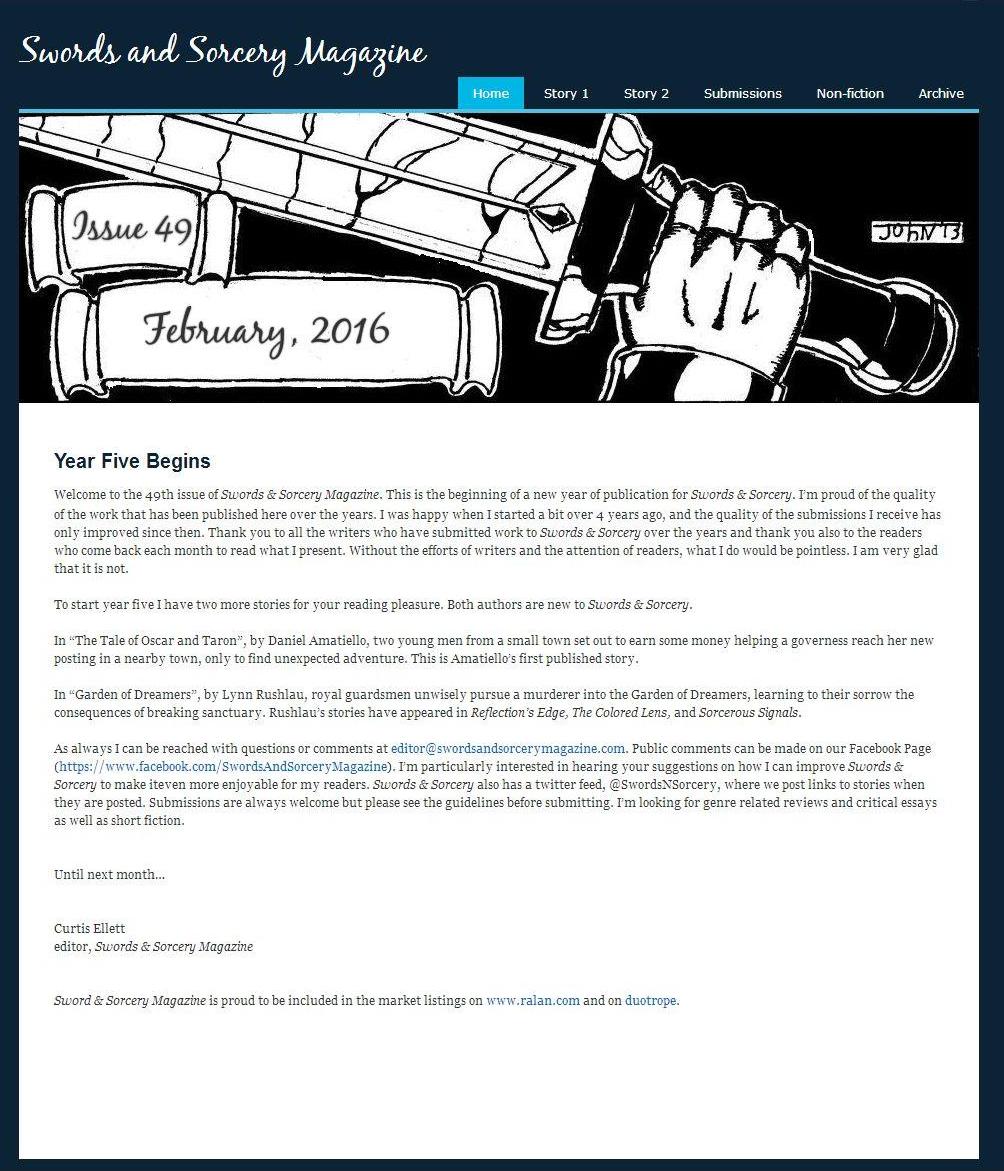
The last two weeks have produced some tremendous new fiction and articles. We started our coverage of TwoMorrows Publishing’s altogether splendid comics magazine Back Issue with issue #86, containing their giant-sized look at Marvel Bronze Age Giant comics. For fans of classic magazine art, our man Doug Ellis dug into his massive collection to examine early interior illustrations from Kelly Freas and Richard Powers. For vintage magazine readers, we took a look at Galaxy magazine’s $6,500 Novel-Writing Sham from 1953, and Thomas M. Disch’s detailed review of the Best Science Fiction of 1979, from the February 1981 issue of F&SF. For those looking for Award recommendations, we surveyed the annual Locus Recommended Reading List, compiled by the editors of Locus magazine, and the always-reliable Rich Horton’s Hugo Recs. Finally, Fletcher Vredenburgh contributes his January Short Story Roundup, reviewing Swords and Sorcery 48, Grimdark Magazine #6, and Heroic Fantasy Quarterly #27.

Check out all the details on the magazines above by clicking on the each of the images. Our Late January Fantasy Magazine Rack is here.

As we’ve mentioned before, all of these magazines are completely dependent on fans and readers to keep them alive. Many are marginal operations for whom a handful of subscriptions may mean the difference between life and death. Why not check one or two out, and try a sample issue? There are magazines here for every budget, from completely free to $35/issue. If you find something intriguing, I hope you’ll consider taking a chance on a subscription. I think you’ll find it’s money very well spent.

Read More Read More

Beneath Ceaseless Skies 192 Now Available

Beneath Ceaseless Skies 192 Now Available

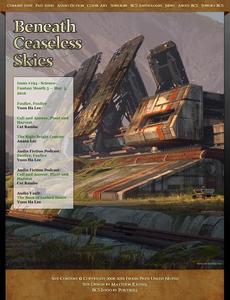
Beneath Ceaseless Skies 192-smallThe February 4th issue of Beneath Ceaseless Skies features their 400th story — a damn impressive milestone. BCS has been showcasing the best authors in the business, and promoting and developing new fantasy writers, since 2008. It has become one of the most important periodicals in the business, and you owe it yourself to check it out.

Issue 192 has original short fiction from K.J. Parker and Tamara Vardomskaya, a podcast, and a reprint by the marvelous Rachel Swirsky. Scott Andrews has also changed up the cover art; this issue features “Plains of Another World” by Leon Tukker.

Told By An Idiot” by K.J. Parker
I accepted that master Allardyce had the potential to write the greatest play ever; a play so good that if God were to summon Mankind before the bar of Heaven and demand to know one good reason why He shouldn’t send a second flood and drown the lot of us, all we’d have to do is hand Him the manuscript and there’d be no case to answer. I knew that, in order to write this play, master Allardyce needed to drink himself stupid, get beaten up twice a week, and generally mash himself down into a cheese, like the cider-makers do, before he could ferment and distil his very essence into words on a page. But I have a business to run, and I need crowd-pleasers. Master Allardyce’s monument-more-enduring-than-bronze would just have to wait until I retired. Accordingly, I gave him no peace.

The Three Dancers of Gizari” by Tamara Vardomskaya
It dawned on me that he enjoyed watching me squirm; a proud competent woman but to him just Nahemiah’s commoner puppet. “Ten thousand!” I spat out the words intentionally in the heaviest Tavalland accent that the theater had eradicated in me twelve years before. “Ten thousand thalers for your measly sculpture that the Opera rejected!”

Read More Read More

January Short Story Roundup

January Short Story Roundup

oie_1623615pLzdaIcYIt has finally gotten cold here in the Northeast, but I’ve got plenty of thunderous swords & sorcery stories to keep me busy indoors reading. January brought not only Swords and Sorcery Magazine’s usual complement of two stories, but also issues of Heroic Fantasy Quarterly and Grimdark Magazine. That’s a terrific way to kick off the new year.

Swords and Sorcery Issue 48, as editor Curtis Ellett writes, brings four years of publication to a close, which is pretty impressive. That’s like fifteen years in internet time, so congratulations are in order.

The issue kicks off with the impressive (and impressively titled) “The Quarto Volume, or Knowledge, Good & Evil” by Ken Lizzi. Cesar is a member of a mercenary company in a land similar to Renaissance Italy but with demons and wizards. Those who control those spirits control the world, and that’s a small number of people. Now, Cesar learns, there’s the possibility of power escaping into the hands of the many. Cesar is cut from the same cloth as any number of roguish heroes, but Lizzi’s prose lends him a clear voice and the setting has great potential. An earlier Cesar the Bravo story was included in the anthology Pirates & Swashbucklers from a few years back. Considering my love of all things piratey (check out the article Howard Andrew Jones and I did about Captain Blood), I’ll probably be buying that soon.

Read More Read More

Back Issue 86 Now Available

Back Issue 86 Now Available

Back Issue 86-smallBack Issue is one of the best comic magazines on the market, especially if you’re a fan of comics of the 70s, 80s, and today. The latest (February) issue is a 100-page giant, celebrating the Marvel Bronze Age Giants like Marvel Tales, Fantasy Masterpieces, and Marvel Triple Action. I have many fond memories of curling up with those lengthy treasures long ago, and looking through the full-color digital issue preview brought them all back. Here’s the issue description.

Back Issue #86 (bonus-size 100 Full-Color pages, $9.95) takes a big look at Marvel Bronze Age Giants and Reprints! We open Marvel Comics’ vaults for an in-depth exploration of its GIANT-SIZE series! Plus: indexes galore of Marvel reprint titles, Marvel digests and Fireside Books editions, and the last days of the “Old” X-Men. Featuring the work of DAN ADKINS, ROSS ANDRU, RICH BUCKLER, DAVE COCKRUM, GERRY CONWAY, STEVE GERBER, STAN LEE, WERNER ROTH, ROY THOMAS, and more. Re-presenting the cover of Giant-Size Marvel Triple Action #1 by JOHN ROMITA, SR.! Edited by MICHAEL EURY.

See the full details on issue 86 at the TwoMorrows website.

Back Issue is edited by Michael Eury, and published by TwoMorrows Publishing. Issue #86 is cover-dated February 2016. It is 100 pages in full color, priced at $9.95. The cover is by John Romita, Sr. An eight-issue subscription is $73 in the US ($31.60 for the digital version). Order right from the TwoMorrows website.

See our Late January Fantasy Magazine Rack here, and all of our recent Magazine coverage here.

Interzone #262 Now on Sale

Interzone #262 Now on Sale

Interzone 262-smallThe January/February issue of Interzone magazine is now on sale. With the new year comes a new cover artist, Vincent Sammy, who illustrates this issue with a piece titled “The Orion Crusades” (click the image at right for a bigger version.)

Interzone #262 contains six stories:

“The Water-Walls of Enceladus” by Mercurio D. Rivera
“Empty Planets” by Rahul Kanakia
“Geologic” by Ian Sales
“Circa Diem” by Carole Johnstone
“A Strange Loop” by T.R. Napper
“Dependent Assemblies” by Philip A. Suggars

Non-fiction this issue includes an interview with artist Vincent Sammy, on his thoughts on providing the cover art for the next six issues, Future Interrupted by Jonathan McCalmont, Time Pieces by Nina Allan, this month on Virgina Woolf, plus David Langford’s Ansible Link, and the regular columns: book reviews, Nick Lowe’s Mutant Popcorn film reviews, and Tony Lee’s DVD column, Laser Fodder. Issue 262 is nearly 100 pages and packed with fiction, columns, and top-notch art.

Interzone is the sister magazine of Black Static, both are published by TTA Press in the UK. The distinguished Andy Cox is the editor of both.

Read More Read More

Gypsies, Paupers, Demons and Swans: Rich Horton’s Hugo Recs

Gypsies, Paupers, Demons and Swans: Rich Horton’s Hugo Recs

The Two Paupers CSE Cooney-smallI cover a lot of short fiction magazines and novels, but I never feel adequately prepared for the Hugo ballot. But that’s okay, because I know people who read every single short story published in English, and can point me in the right direction.

Well, one person. Rich Horton. Seriously, he reads them all. No, really. All of them. When he modestly claims he doesn’t, he’s lying. He’s read some of ’em twice.

And he has great taste, too. So when he compiles lists of the best fiction published last year, we lesser mortals should pay attention. For example, here’s his rundown on the best novellas published in 2015:

The Two Paupers, by C. S. E. Cooney (Fairchild Press)
“Gypsy,” by Carter Scholz (Gypsy plus …,  F&SF)
“The Four Thousand, the Eight Hundred,” by Greg Egan (Asimov’s SF, December 2015)
“The Bone Swans of Amandale,” by C. S. E. Cooney (Bone Swans)
“The Boatman’s Cure,” by Sonya Taaffe (Ghost Signs)
Wylding Hall, by Elizabeth Hand (Open Road/PS Publishing)
Penric’s Demon, by Lois McMaster Bujold (Penric’s Demon)
Teaching the Dog to Read, by Jonathan Carroll (Subterranean)
Sunset Mantle, by Alter S. Reiss (Tor)

Congratulations to Black Gate website editor emeritus C.S.E. Cooney for placing two novellas in Rich’s list!

Read More Read More

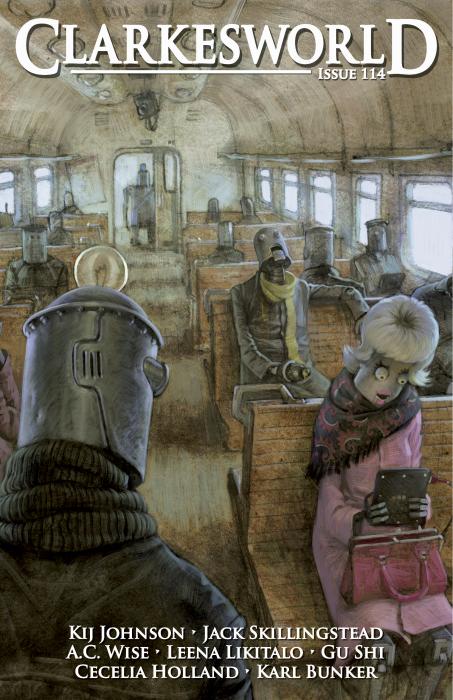
Clarkesworld 113 Now Available

Clarkesworld 113 Now Available

Clarkesworld 113-smallNeil Clarke makes a pretty big announcement in his editorial this issue.

It’s time to give up the day job. My family and I are trying to work out how to make that happen, but we need help to do so. If you are already subscribing to Clarkesworld or Forever, then thank you, that’s keeping the option on the table. If you haven’t been subscribing, now’s the time that would make the biggest difference to the future of this magazine.

I’ve mentioned before that a small percentage of our readers converting to subscribers would do the trick, but that’s easier said than done. Experience says that Clarkesworld will only be part of the puzzle. The new SFWA job helps. Forever helps. The anthologies help. Nothing stands on its own, but like a crowdfunding project, all the little bits add up to take you to your goal.

I think this is going to be a good year.

If you’re a fan of Neil and Sean’s work at Clarkesworld (and you definitely should be), then perhaps you might consider a subscription… this is the year when your support could really have an impact. And if you’ve never tried Clarkesworld or Forever, this is a great time to do so. Check out their support page — or why not buy their upcoming Clarkesworld: Year Eight anthology? It collects all the stories from last year, and the proceeds go towards supporting the magazine.

Issue #113 of Clarkesworld has four new stories by Paul McAuley, Benjanun Sriduangkaew, Nick Wolven, and An Owomoyela & Rachel Swirsky, and two reprints by Ted Kosmatka & Michael Poore, and Kim Stanley Robinson.

Read More Read More

Thomas M. Disch on the Best Science Fiction of 1979

Thomas M. Disch on the Best Science Fiction of 1979

The Best Science Fiction of the Year 9 Terry Carr-small Best Science Fiction Stories of the Year Ninth Annual Collection Gardner Dozois-small The 1980 Annual World's Best SF Donald A. Wollheim-small

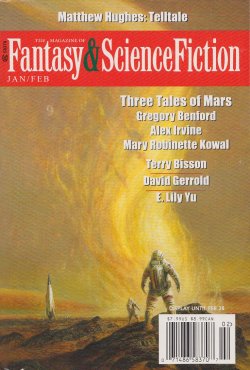
The Magazine of Fantasy and Science Fiction February 1981-smallThe Magazine of Fantasy & Science Fiction has put some delightful old content on their website for those who care to look, and earlier this month I came across their reprint of Thomas M. Disch’s Book column from the February 1981 issue, in which he compares the three Best of the Year volumes published the previous year.

1979 was a marvelous year for short SF, with many stories destined to become classics — including George R.R. Martin’s brilliant “Sandkings,” and his Hugo Award-winning “The Way of Cross and Dragon,” Barry B. Longyear’s novella “Enemy Mine,” Donald Kingsbury’s “The Moon Goddess and the Son,” Vonda N. McIntyre’s “Fireflood,” Orson Scott Card’s “Unaccompanied Sonata,” Richard Cowper’s “Out There Where the Big Ships Go,” and many others. Of course, Disch was as curmudgeonly as always.

The annuals are out, and here, if we can trust the amalgamated wisdom of our four editors, are the thirty best stories of 1979. It is in the nature of annual reports to pose the question, Was it a good year? and it pains me, as both a shareholder and a consumer, to answer that for science fiction, as for so many other sectors of the economy, 1979 was not a good year.

Against such a sweeping judgment it may be countered that sf is not a unitary phenomenon nor one easily comparable to a tomato harvest. Sf is a congeries of individual writers, each producing stories of distinct and varying merit. A year of stories is as arbitrary a measure as mileage in painting. Nevertheless, that is how the matter is arranged, not only by anthologists but by those who organize the two prize-giving systems, SFWA, which awards the Nebulas, and Fandom, which gathers once a year to hand out Hugos. The overlap between the contents of the annuals and the short-lists for the prizes is so great that one may fairly surmise that something like cause-and-effect is at work. As the nominating procedures are conducted in plain view, it seems certain that the editors will keep their eyes open for the likeliest contenders, since the annual that most successfully second-guesses the awards nominees has a clear advantage over its rivals.

Tomato harvest! At least he makes me laugh.

Read More Read More

February 2016 Asimov’s Science Fiction Now on Sale

February 2016 Asimov’s Science Fiction Now on Sale

Asimov's Science Fiction February 2016-smallIn her editorial in the latest issue of Asimov’s Science Fiction, Sheila Williams explains why SF often gets a bad rap for predicting the future.

As I write this, I am awash in the flood of published reminisces about Back to the Future Part II’s journey into the future…. Most of these ruminations seem to be rather disappointed with the real 2015… They claim that these special effects from a late eighties flight of fantasy were somehow promised to all of us, but the future didn’t deliver.

I’ve seen these sort of complaints levied at science fiction on numerous occasions. Robots don’t have positronic brains, dilithium crystals are not a thing, and settlements on the Moon and Mars remain a distant dream. Yet anyone who’s at all conversant with SF soon realizes that most science fiction is descriptive rather than predictive…

For all his forward thinking, Isaac was as much a product of his time as any writer. Although he eventually became an outspoken advocate for women’s rights, his early fiction described a society that wasn’t very different from his own… While I’d love to have an FTL drive that would take me to Terminus and Trantor, I don’t want the future to look like the world of 1951, and I don’t expect it to look like 2016. I don’t fault the young man who created that society unaware of the actual changes in mores and social structure that lay ahead anymore than I’d fault today’s writers for not getting their future facts straight.

I’m glad that our prospects are still unknown. I wouldn’t mind a jetpack, but I’m happy that so far we aren’t standing on Nevil Shute’s beach waiting for death from nuclear fallout or from Racoona Sheldon’s screwfly solution.

The first interview I ever did, as a young internet blogger for SF Site in 1997, was a phone interview with the late writer and editor Algis Budrys. He argued the exact same thing. “Why should SF predict anything?… SF is for speculating, not predicting,” he told me. I debated the point at the time, but over the years I’ve come to see that he — and Sheila — are right.

Read Sheila’s complete editorial here.

Read More Read More

The Galaxy Science Fiction $6,500 Novel-Writing Sham

The Galaxy Science Fiction $6,500 Novel-Writing Sham

Galaxy Science Fiction March 1953-smallIn the March, 1953 issue of Galaxy Science Fiction, H. L. Gold announed a novel contest. Simon and Schuster and Galaxy partnered together to offer a $6,500 prize, “guaranteed to the author of the best original science fiction novel submitted.”

The $6,500 was only a minimum for the first world serial and TV rights. It was the largest cash prize offered to date for a science fiction novel. Other details were that the contest closed October 15, 1953, and the novel had to be between 60,000 and 75,000 words. Anyone could enter, with the following caveats:

…except employees of the Galaxy Publishing Corp. and of Simon and Shuster, Inc., and their families; AND authors who are ineligible because of contractual obligations to their present publishers… which means, in effect, that contestants will NOT be competing with most of the established ‘big names’ of science fiction.

When you consider that cars could be purchased for about $2,000 in 1953, this was an enormous prize. And let’s face it: how many of us would still be happy to sell a novel in today’s market for $6,500?

Given that the contest ended long ago, I had to find out who won. The winner was Edson McCann, whose novel Preferred Risk was serialized in Galaxy in 1955 and later published by Simon and Schuster that same year. Congratulations, Edson!

Oh… except there never was an Edson McCann.

Read More Read More