Browsed by
Category: Series Fantasy

New Treasures: The City of Dreaming Books by Walter Moers

New Treasures: The City of Dreaming Books by Walter Moers

The City of Dreaming BooksWalter Moers got my attention with his first novel in English, The 13½ Lives of Captain Bluebear, which relates adventures of human-sized bear with blue fur on the fictional continent of Zamonia.

Okay, I know how that sounds. But Moers, who’s also a cartoonist and painter, brings cartoon sensibilities to the page with consummate skill, and his whimsical tales of Zamonia have captured hearts and minds around the world. The 13½ Lives was followed by Rumo, A Wild Ride Through the Night, and The Sorcerer’s Apprentice.

The City of Dreaming Books sounds like his most intriguing title yet, featuring a city-sized library filled with secrets, haunted by the mysterious Shadow King…

Optimus Yarnspinner has inherited from his godfather an unpublished manuscript by an unknown writer. He sets off to track down the mysterious author, who disappeared into Bookholm — the so-called “City of Dreaming Books.” Yarnspinner falls under the spell of this book-obsessed metropolis, where an avid reader and budding author can find any number of charming attractions — priceless signed first editions, salivating literary agents, and for-hire critics. But as Yarnspinner pursues the trail of the missing author, the darker side of Bookholm begins to unveil itself — cold-blooded book hunters, fearsome cyclopean booklings, sharp-toothed animotomes, and of course, the Shadow King, whose howls rise from deep beneath the city at night. Will Yarnspinner survive his quest into this world where reading is a genuine adventure?

Like most of his books, this one features a cover by Moers, and numerous black & white illusrations throughout. Moers’ art is as charming as it is unique, equal parts Virgil Finlay and Dr. Seuss.

I found the brand new sequel, The Labyrinth of Dreaming Book, in the Dealer’s room at Windycon last week for the first time. That means it’s time for me to stop dithering and finally read this one.

The City of Dreaming Books was published by Overlook Press in 2008. It is 462 pages, priced at $17.95 in trade paperback at $11.99 for the digital edition. It was translated from the German by John Brownjohn.

The Series Series: Tales from Rugosa Coven by, Um, Me

The Series Series: Tales from Rugosa Coven by, Um, Me

While we wait for my current publisher to send me the new cover art, here’s my last publisher’s art for a novella in the Rugosa Coven Series.

A tight deadline for turning around my galley proofs meant I had to choose: either skip my regular blogging gig here, or blog about the only book I’ve had time to look at for the past two weeks: my own. I can’t very well review a book I wrote–not just because of the temptation to brag about it, but also because the nitpicky galley proof process is forcing me to second-guess every word of it, at a point in the production process in which only a few of those words can be changed. Should you buy my book? If anyone had asked me last night while I was doing battle for the last time with a paragraph that has been driving me crazy for the past seven years, I honestly don’t know what I’d have said. John O’Neill assures me that Black Gate‘s readers will be interested in my own experience writing a fantasy series and preparing it for publication, so here goes.

Once upon a time, there was a call for short story submissions from a horror magazine. The editors were looking for very short works of psychological horror on the theme of “the life interrupted.” I tend to write long, and I’d never written horror before (and since the story that came to me grew up to be a comedy, I still haven’t), so I thought I’d challenge myself by trying to write something for the call. I wanted to start with a character whose life, pre-interruption, was already unusual. My protagonist arrived in my head by way of this personal ad on the fictitious dating website PaganSingles.com:

Divorced Wiccan female, 32, seeks realistic rebound guy. Petite and trim brunette. Enjoys the ocean, 19th century novels, long Sunday mornings with the New York Times. Atlantis cranks need not apply.

What would be the most horrifying interruption possible in the life of a skeptical post-modern Neo-Pagan who prides herself on not being a New Ager? Discovering that the New Agers were right about something, anything, and why not Atlantis?

Read More Read More

New Treasures: Magic and Loss by Nancy A. Collins

New Treasures: Magic and Loss by Nancy A. Collins

Magic and Loss-smallNancy A. Collins has had a long and distinguished career in dark fantasy. Her first novel, Sunglasses After Dark (1989), became an immediate classic of vampire fiction, and her character Sonja Blue went on to appear in two additional novels: In The Blood (1992), and Paint It Black (1995). Her three-volume Vamps series from HarperTeen began in 2008, and her brand new adult series Golgotham began in 2010 with Right Hand Magic, followed a year later by Left Hand Magic.

The third volume, Magic and Loss, arrived last week, and it continues the tale of Tate Eresby, an artist who moves to Golgotham, Manhattan’s centuries-old supernatural district. The neighborhood is populated by creatures from myth and legend, but its most prominent citizens are the Kymera, a race of witches who maintain an uneasy truce with New York’s human population.

It has been several months since Tate Eresby developed her new magical ability to bring whatever she creates to life, but she is still learning to control her power. Struggling to make a living as an artist, she and Hexe can barely make ends meet, but they are happy.

That is until Golgotham’s criminal overlord Boss Marz is released from prison, bent on revenge against the couple responsible for putting him there. Hexe’s right hand is destroyed, leaving him unable to conjure his benign magic. Attempts to repair the hand only succeed in plunging Hexe into a darkness that can’t be lifted — even by news that Tate is carrying his child.

Now, with her pregnancy seeming to progress at an astonishing rate, Tate realizes that carrying a possible heir to the Kymeran throne will attract danger from all corners, even beyond the grave…

Nancy Collins has been writing dark urban fantasy since before it existed as a sub-genre, and she still does it far better than most. Magic and Loss was published November 5th by Roc; it is 290 pages, priced at $7.99 for both paperback and digital versions.

See all of our recent New Treasures here.

Sharon Shinn’s Royal Airs: A Review

Sharon Shinn’s Royal Airs: A Review

BGRAFirst of all, I love getting snail mail. Postcards are great, letters are better — but best of all is a lumpy Manila package with something mysterious inside of it.

But when I came home to see my mailbox was stuffed full of a Manila envelope from Sharon Shinn, there was no mystery.

There was only a short squeal and a jig. I knew what awaited me. I bounded up the stairs to the third floor, reciting all the while:

“Her book! Her book! Her newest book!!!”

Because Sharon? Rocks.

(I mean, I thought she rocked long before I met her, but after John O’Neill introduced us at one of those World Fantasy breakfasts where you can’t believe you’re eating pancakes with a woman whose books you devour regularly, she rocked about a thousand times more.)

Royal Airs is the second in the “Elemental Blessings” series, which take place in the Kingdom of Chialto. It’s an exciting time in this secondary world, with “smoker cars” taking over for horse-drawn carriages, the blushing dawn of flying machines, alliances forming and falling apart with realms across the mountains and seas, the delicate balance of power between the regent, the primes of the Five Houses, and the heirs to the throne.

All of this and magic too!

Read More Read More

New Treasures: Hooded Man by Paul Kane

New Treasures: Hooded Man by Paul Kane

Hooded Man Paul Kane-smallThere are lots of retellings of Dracula out there (just in the last two weeks William Patrick Maynard covered of Marvel’s Dracula, Lord of the Undead, James Maliszewski examined Bela Lugosi’s turn as Count Dracula in the 1931 Universal film, and John R. Fultz looked at NBC’s new series Dracula.) Same with Sherlock Holmes (see the trailer for Season Three of BBC One’s adaptation here), and the Tales of King Arthur and his noble knights (examples from the past two weeks here and here).

Hell, they recently retold Carrie and John Carpenter’s Halloween, and those stories are barely 30 years old.

For my money, the legend that doesn’t get re-told enough is the tale of Robin Hood. I can think of only a handful of really fine versions in the last 30 years, including Parke Godwin’s novel Sherwood, Richard Carpenter TV series Robin of Sherwood, and Robin McKinley’s novel The Outlaws of Sherwood. So I was pleased to see a new omnibus collecting all three novels of Paul Kane’s post apocalyptic retelling, Hooded Man.

When nine-tenths of the world died horrifically, Robert Stokes lost everything, including his wife and his son. The world about him gradually descended into a second Dark Age, and the former policeman retreated into the woods near Nottingham, becoming a hunter, living off the land and avoiding any form of human contact… until now.

A new foreign despot, De Falaise, has looked on England and found it ripe for conquest. He leads an army of mercenaries through the Channel Tunnel and works his way up the country, pillaging as he goes. When De Falaise arrives at Nottingham and sets up his new dominion, Robert finds himself drawn reluctantly into the resistance, and assumes the mantle of the famous legend of Robin Hood, in a guerrilla war that will take him and his followers to the limits of endurance and beyond.

This volumes collects the novels Arrowhead, Broken Arrow, and Arrowland. Paul Kane’s other novels include Of Darkness and Light and The Gemini Factor. His short story collection, The Butterfly Man, was released in 2011 by PS Publishing. Although it’s standalone, Hooded Man is part of The Afterblight Chronicles series, which also includes School’s Out Forever by Scott K. Andrews and The Afterblight Chronciles: America by Simon Spurrier, Rebecca Levene and Al Ewing.

Hooded Man was published June 11, 2013 by Abaddon. It is 704 pages, priced at $12.99 in trade paperback and $9.99 for the digital version.

A Contagious Love of Fantasy: Lin Carter’s Imaginary Worlds

A Contagious Love of Fantasy: Lin Carter’s Imaginary Worlds

Lin Carter Imaginary Worlds-smallI recently did a review here at Black Gate of L. Sprague de Camp’s 1976 Literary Swordsmen and Sorcerers: The Makers of Heroic Fantasy. De Camp’s book is one of the few histories of the genre of fantasy around, and it is a great and enjoyable book. But it’s not the only one, nor probably the most favored. I get the sense from others’ comments that the Best History of Fantasy title probably goes to Lin Carter’s 1973 Imaginary Worlds.

Each of the chapters in de Camp’s book is dedicated to a separate writer. But most of the chapters in Carter’s book are centered around themes; in each chapter he examines fantasy writers that explore that theme well. In addition, Carter’s concluding chapters contain advice to authors on how to write fantasy. I found this latter part less interesting.

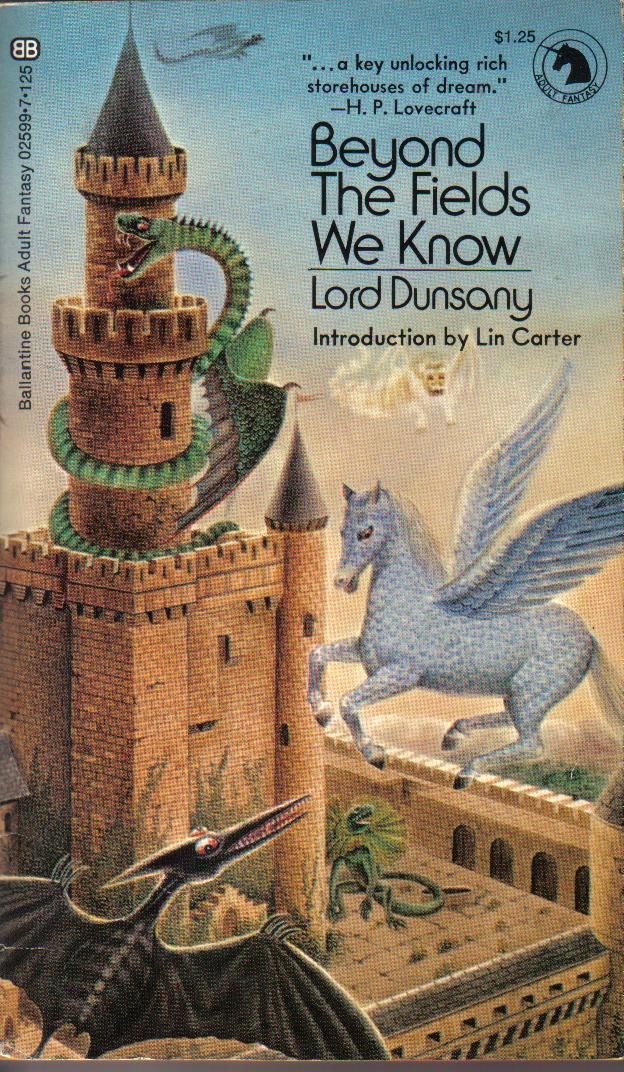
One of the plusses I pointed out for de Camp’s history was that you could tell he loved the genre. The same must be said in spades for Lin Carter. Carter wrote the introduction for Literary Swordsmen, and I was very excited to read de Camp’s book just on the strength of Carter’s intro. Imagine how enthusiastic I was to get Carter’s own book on the subject! (I’ve also heard that Carter’s intros to the Ballantine Adult Fantasy are fantastic as well.)

Carter’s love of fantasy is contagious. He writes with a real verve for his favorite fantasy authors, books, and tropes. Carter is unapologetic about his love for fantasy and seems completely unaffected by criticisms of childishness or escapism. Given his thoughtful interactions with the genre, he does not come off as a slavish fanboy. Instead, Carter strikes me as an intelligent and committed fantasist. Quite refreshing! I wish he were still alive.

Often when I read or hear other people talk about their favorite authors or books, I make notes for possible future purchases. If you’re setting out for yourself the task of trying to catch up on the great works of fantasy, the many references that Carter gives can leave you feeling exhausted.

But Carter is also good at pointing out what you probably shouldn’t bother with or if you’re only going to read one book by author X, make sure you read just Y. These suggestions are incredibly helpful and lessen your anxiety if you are indeed trying to catch up on the great works. (Speaking of which, I definitely want to get a copy of The Worm Ouroboros by E. R. Eddison. De Camp and Carter both raved about it.)

Read More Read More

The Blinding Knife by Brent Weeks Wins the 2013 David Gemmell Legend Award

The Blinding Knife by Brent Weeks Wins the 2013 David Gemmell Legend Award

The Blinding Knife-smallBrent Weeks’s The Blinding Knife, the second volume of The Lightbringer Saga, has won the David Gemmell Legend Award for Best Fantasy Novel of 2012.

The David Gemmell Legend Award is a fan-voted award administered by the DGLA. This is the fifth year for the Legend Award; it was first granted in 2009 to Andrzej Sapkowski’s Blood of Elves; in 2010 to Graham McNeill’s Empire: The Legend of Sigmar, in 2011 the winner was Brandon Sanderson’s The Way of Kings, and last year The Wise Man’s Fear by Patrick Rothfuss received the honors.

The nominees for the 2013 award also included The Red Country by Joe Abercrombie, Stormdancer by Jay Kristoff, King of Thorns by Mark Lawrence, and The Gathering of the Lost by Helen Lowe.

The Morningstar Award for Best Fantasy Debut was awarded to Malice by John Gwynne.

The Ravensheart Award for best Fantasy Book Jacket Artist went to Didier Graffet & Dave Senior for the cover of The Red Country by Joe Abercrombie.

Our man-on-the-scene, roving reporter Harold M. Page, will report in with complete details on the ceremonies right here on Thursday.

Complete details are available at the DGLA website.

Congratulations to all the winners!

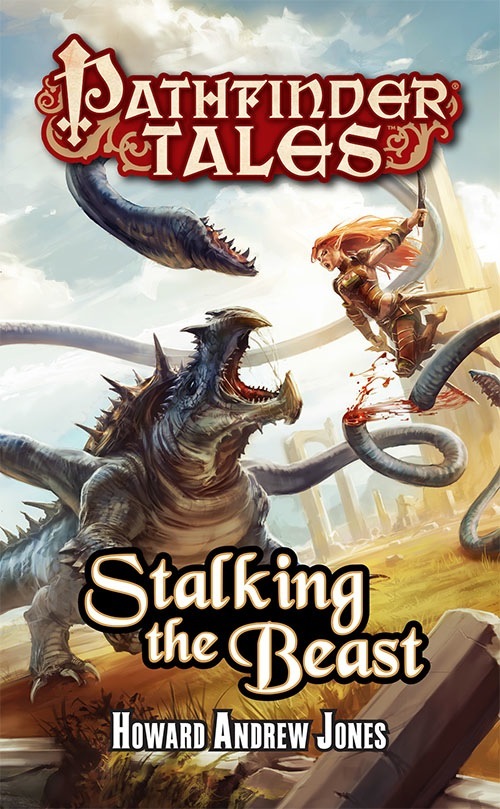
New Treasures: Pathfinder Tales: Stalking the Beast by Howard Andrew Jones

New Treasures: Pathfinder Tales: Stalking the Beast by Howard Andrew Jones

Pathfinder Tales Stalking the Beast-smallIt’s funny. I talked to Howard nearly every day while he was writing this book, and heard the blow-by-blow as he devised the plot and fleshed out the characters, recognized the growing excitement in his voice as the novel came together and he contributed his own unique talents and fine narrative gifts to the collaborative bit of gaming genius that is Pathfinder. It almost felt like reading the book would be superfluous.

And then I read the description below and realized hearing all the behind-the-scenes details meant absolutely nothing. It’s like saying you know how a gourmet dish will turn out because you’ve seen all the ingredients. I may have watched Howard lay all the pieces out on his writing table, but the true magic comes in how they all fit together. I’m excited to find out and I know I’ll be delighted.

When a mysterious monster carves a path of destruction across the southern River Kingdoms, desperate townsfolk look to the famed elven ranger Elyana and her half-orc companion Drelm for salvation. For Drelm, however, the mission is about more than simple justice — it’s about protecting the frontier town he’s adopted as his home, and the woman he plans to marry.

Together with the gunslinging bounty hunter Lisette and several equally deadly allies, the heroes must set off into the wilderness, hunting a terrifying beast that will test their abilities — and their friendships — to the breaking point and beyond. But could it be that there’s more to the murders than a simple rampaging beast?

From critically acclaimed author Howard Andrew Jones comes a new adventure of love, betrayal, and unnatural creatures, set in the award-winning world of the Pathfinder Roleplaying Game.

Interested? Paizo has promised us enough free copies for a giveaway. Stay tuned for details and you could win your own copy.

Pathfinder Tales: Stalking the Beast was published this week by Paizo. It is 400 pages, priced at $8.99 in paperback. No word on the digital edition yet. Howard’s previous Pathfinder book was Plague of Shadows, released in 2011. His most recent novel was The Bones of the Old Ones.

Vintage Treasures: The Best of Fredric Brown

Vintage Treasures: The Best of Fredric Brown

The Best of Fredric Brown-smallWelcome to the 13th installment of my ongoing examination of one of the most influential book series of my youth, Lester Del Rey’s Classics of Science Fiction line. This time, we’re looking at the 1977 release, The Best of Fredric Brown, edited by Robert Bloch (who had his own entry in the series eleven months after this one, which I discussed back in July.)

The Classics of Science Fiction line was my introduction to many of the major SF and fantasy writers of the 20th Century (well, that and The Hugo Winners, which first introduced me to Poul Anderson, Walter C. Miller, Arthur C. Clarke, and others, and of course the various volumes of The Science Fiction Hall of Fame).

All that education didn’t teach me much about Fredric Brown, however. A week ago, I probably could have named only one Fredric Brown short story from memory, “Arena” — which, admittedly, I dearly loved. I first read it in The Science Fiction Hall of Fame, Volume One, where it was selected as one of the finest short stories ever written, but even before that, I knew it as the Star Trek episode of the same name.

You probably think of it as, “Isn’t that the one where Kirk throws styrofoam rocks at the Gorn?”

Yes. Yes it is. And even though it has been much-parodied (including a brilliant video game commercial starring an 80-year old William Shatner and an aged Gorn in a re-match), it’s still one of the finest episodes of the original series.

So before I sat down to assemble my notes for this article, I took my paperback copy of The Best of Fredric Brown with me on a business trip, to a banking show in Las Vegas, and used the opportunity to reacquaint myself with the author. Honestly, I wasn’t expecting all that much. Not every installment in the Classics of Science Fiction could be a winner.

My mistake.

The Best of Fredric Brown is one of the best short story collections I’ve read in years. Brown is frequently compared to O. Henry for his gift for twist endings and the comparison is apt. Even when you’re on the alert, Brown manages to constantly surprise and delight you in a way that very few authors — in the genre or out — can pull off.

Read More Read More

The Art of Magic

The Art of Magic

Growing up, Halloween was my favorite holiday. Christmas is great for the presents and Thanksgiving for the feast, but Halloween has a connection with the supernatural that always enthralled me. Ghosts, demons, undead, witches — these were (and are) my meat and mead.

When it comes to fantasy stories, magic is what calls to me. In some stories, the magic is subtle. In others, it’s loud and proud. Here are some of my favorite uses of magic in fantasy.

The Wheel of Time

The Wheel of Time by Robert Jordan: Jordan created one of the most detailed magical systems that I’ve ever read. The powers of the Aes Sedai are rich and varied, and they all originate from an elemental structure that feels both familiar and innovative. Especially in the early books, where the younger characters are learning how to access their power, the unfolding of this magic coincides very well with the physical exploration of Mr. Jordan’s story world. Also, it must be said that Jordan is adept at describing magical battles between wielders of massive power, something that trips up many other authors.

Read More Read More