Browsed by
Category: Series Fantasy

Tales of the Wold Newton Universe, Part 4 of 4

Tales of the Wold Newton Universe, Part 4 of 4

Tales of the Wold Newton Universe-smallOctober marked the release of Tales of the Wold Newton Universe, a new anthology from Titan Books that collects, for the first time ever in one volume, Philip José Farmer’s Wold Newton short fiction, as well as tales set in the mythos by other Farmerian authors.

The Wold Newton Family is a group of heroic and villainous literary figures that science fiction author Philip José Farmer postulated belonged to the same genetic family. Some of these characters are adventurers, some are detectives, some explorers and scientists, some espionage agents, and some are evil geniuses. According to Mr. Farmer, the Wold Newton Family originated when a radioactive meteor landed in Wold Newton, England, in the year 1795. The radiation caused a genetic mutation in those present, which endowed many of their descendants with extremely high intelligence and strength, as well as an exceptional capacity and drive to perform good, or, as the case may be, evil deeds. The Wold Newton Universe is the larger world in which the Wold Newton Family exists and interacts with other characters from popular literature.

To celebrate the release of the new anthology, we’ve asked the contributors to discuss their interest in Philip José Farmer’s work and to tell us something about how their stories in the book specifically fit into the Wold Newton mythos.

For today’s installment, please welcome author and co-editor of Tales of the Wold Newton Universe, Win Scott Eckert.

Christopher Paul Carey
Co-editor, Tales of the Wold Newton Universe

Read More Read More

New Treasures: Copperhead by Tina Connolly

New Treasures: Copperhead by Tina Connolly

Copperhead-smallI first met Tina Connolly at the World Fantasy Convention in San Diego in 2011. She was charming, witty, and very entertaining — precisely the kind of person you want to follow around to all the good parties. I tried this enthusiastically for a while, until someone from the con committee patiently explained to me that this was called “stalking” and was, like, illegal.

Fortunately, Tina Connolly is also a very talented writer. And reading her novels (I’ve discovered) is exactly like hanging out with the author at a great party. The same sparkling wit, the same penetrating intelligence. Except, unlike at parties, I can pause the conversation to look up words without looking stupid.

Tina’s first novel Ironskin was an historical fantasy set in an alternate version of early 1900s England, and was nominated for a Nebula Award last year. The sequel Copperhead has finally arrived, and it looks just as delightful as the first volume.

Helen Huntingdon is beautiful — so beautiful she has to wear an iron mask.

Six months ago her sister Jane uncovered a fey plot to take over the city. Too late for Helen, who opted for fey beauty in her face — and now has to cover her face with iron so she won’t be taken over, her personality erased by the bodiless fey.

Not that Helen would mind that some days. Stuck in a marriage with the wealthy and controlling Alistair, she lives at the edges of her life, secretly helping Jane remove the dangerous fey beauty from the wealthy society women who paid for it. But when the chancy procedure turns deadly, Jane goes missing — and is implicated in a murder.

Meanwhile, Alistair’s influential clique Copperhead — whose emblem is the poisonous copperhead hydra — is out to restore humans to their “rightful” place, even to the point of destroying the dwarvven who have always been allies.

Helen is determined to find her missing sister, as well as continue the good fight against the fey. But when that pits her against her own husband — and when she meets an enigmatic young revolutionary — she’s pushed to discover how far she’ll bend society’s rules to do what’s right. It may be more than her beauty at stake. It may be her honor… and her heart.

Copperhead was published by Tor Books on October 15th. It is 318 pages, priced at $24.99 in hardcover, and $11.99 for the digital edition.

A Hero in the Service of Organized Crime: A Review of Jhereg by Steven Brust

A Hero in the Service of Organized Crime: A Review of Jhereg by Steven Brust

oie_250265755JIVFDZI’m always excited to find a new author, especially one with a long back catalogue for me to plunge into. With 26 novels to his name, Steven Brust is one of those finds.

When I first started blogging about swords & sorcery I spent some time looking around for newer books and series (newer for me meaning anything written after 1984). Again and again, people suggested Steven Brust’s Dragaeran Empire series. Without reading too much about it I learned the main protagonist, Vlad Taltos, had a little pet dragon. Right away my brain flashed some kind of warning and, fearing the books might be too cute by half, I rejected them.

Well, a few weeks ago Bill Ward wrote very highly of the adventures of Vlad Taltos. I figured why not? For a penny (plus $3.99 shipping) I ordered The Book of Jhereg (1999), an omnibus containing the series’ first three books: Jhereg, Yendi, and Teckla. Though still apprehensive of the little dragon, I started on Jhereg (1983) and blew through it in two days. Well I’m feeling a little foolish now for not having overcome my dracophobia much sooner.

The Dragaerans are nearly immortal, seven foot tall beings with slightly pointed ears and more finely featured than humans. Their society is divided into seventeen houses, each with its own traits and skills. Humans are a small and disfavored minority. The human Vlad Taltos is an assassin in House Jhereg, the Dragaeran equivalent of the mafia.

Read More Read More

Last Chance to Win a Copy of Howard Andrew Jones’ Stalking the Beast

Last Chance to Win a Copy of Howard Andrew Jones’ Stalking the Beast

Pathfinder Tales Stalking the Beast-smallTwo weeks ago, we announced a contest to win one of five copies of Stalking the Beast, compliments of Paizo Publishing.

In the weeks since the book’s release, Howard has been interviewed by Suvudu, released a sample chapter from the book, and posted the first two parts of his new story “Bells For the Dead,” featuring the gunslinging bounty hunter Lisette from Stalking the Beast, at Paizo.com.

Man. I need a full-time staff just to keep up with the guy.

How do you win one of those sweet giveaway copies? Easy — just tell us about your favorite sword & sorcery tale — novel or short story. Send us a one-paragraph review telling us what makes it so special, and be sure to include the author and (if it’s a short story) where you read it.

We’ll publish the best responses here on the blog and randomly draw five names from all qualifying entries. Those five winners will each receive a copy of Stalking the Beast, compliments of Paizo Publishing.

To enter our contest, just send an e-mail to john@blackgate.com with the title “Stalking the Beast,” and your one-paragraph entry, before December 1, 2013.

All entries become the property of New Epoch Press. No purchase necessary. Must be 12 or older. Decisions of the judges (capricious as they may be) are final. Terms and conditions subject to change as our lawyers sober up and get back to us. Not valid where prohibited by law, or outside the US and Canada.

Good luck!

New Treasures: Watcher of the Dark

New Treasures: Watcher of the Dark

Watcher of the Dark-smallYou’d think that, after nearly 40 years of collecting science fiction and fantasy, I’d be accustomed to looking past the cover while on the hunt of promising new books.

Naaah. Good covers are underrated, and great covers can tell you a more than a simple plot summary. And Watcher of the Dark has a very intriguing cover indeed, featuring a fabulously detailed Lovecraftian horror dominating a bone-strewn alien landscape, while a sinister blind man looms over the whole affair, plotting his evil… wait a minute.

Is that blind guy the hero, exorcist Jeremiah Hunt? My. He’s definitely got a certain style (click the image at right for a bigger version.) This is even more intriguing than I thought.

New Orleans was nearly the death of Jeremiah Hunt, between a too-close brush with the FBI and a chilling, soul-searing journey through the realm of the dead that culminated with a do-or-die confrontation with Death himself.

Hunt survived, but found no peace. When he performs an arcane ritual to reclaim the soul of the magically gifted, beautiful women who once saved him, he must flee the law once again, to the temporary sanctuary of Los Angeles, city of angels.

In L.A., Hunt must contend with Carlos Fuentes, who sees in the blind exorcist a means to obtain the mystical key that opens the gates of Hell. Fuentes knows Hunt’s weakness is his loyalty – to the woman he loves and to another supernaturally gifted friend – and threatens to torture them in order to get Hunt help complete his dreadful quest.

Read More Read More

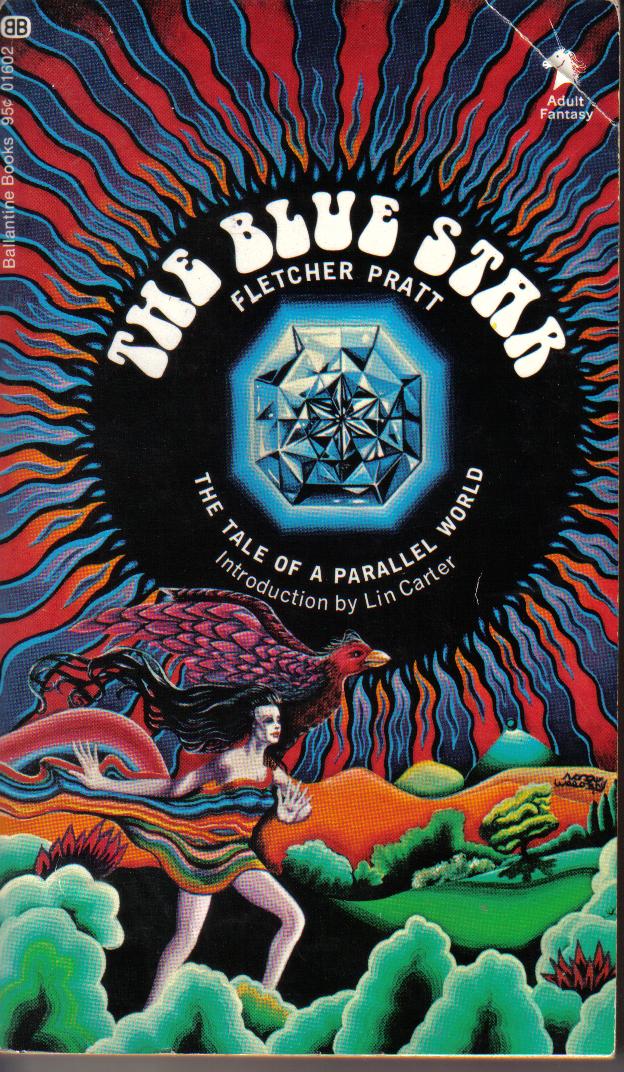
Manly Wade Wellman, Fletcher Pratt, and Appendix N: Advanced Readings in D&D

Manly Wade Wellman, Fletcher Pratt, and Appendix N: Advanced Readings in D&D

Who Fears the Devil-smallI’ve been waiting for Mordicai Knode and Tim Callahan at Tor.com to get to both Manly Wade Wellman and Fletcher Pratt as part of their ongoing exploration of Gary Gygax’s famous Appendix N — and not very patiently, either.

Manly Wade Wellman is consistently one of the most beloved authors we feature here at Black Gate. Just three days ago Fletcher Vredenburgh reviewed his Battle in the Dawn: The Complete Hok the Mighty, and a while back new Black Gate blogger Alex Bledsoe offered a fine reminiscence of Wellman’s Appalachian fantasy tales in “How I Discovered Silver John.” The most popular contest in our history was our call for The Best One-Sentence Reviews of Manly Wade Wellman, and the winners received a copy of Haffner Press’ gorgeous The Complete John Thunstone.

And Fletcher Pratt? He wrote The Well of the Unicorn, one of the 20th Century’s most acclaimed heroic fantasy novels (none other than Lester del Rey called it “The best piece of epic fantasy ever written.”) With his frequent collaborator L. Sprague de Camp, he was also the author of the very popular Incomplete Enchanter and Gavagan’s Bar series.

So I’ve been looking forward to both authors receiving the Appendix N treatment. And now at last the wait is over.

Sadly, Tim doesn’t seem to fully briefed on the greatness that is Manly Wade Wellman:

I didn’t know anything about Manly Wade Wellman before Mordicai and I embarked on this project. I had never heard of the author, outside of the mention of his name in Appendix N.

Ouch. Well, I’d read almost nothing by Clark Ashton Smith prior to last week (when I read his brilliant pulp horror story “The Vault of Yoh-Vombis“), so I guess we all have our blind spots.

The real question is: What does Tim think of Wellman now?

Read More Read More

Lin Carter and the Ballantine Adult Fantasy Series

Lin Carter and the Ballantine Adult Fantasy Series

Beyond the Fields We KnowMany fantasy fans don’t realize how good they have it these days. Fantasy stories dominate the best seller lists, set box office records, and are some of the highest rated programs on television.

This hasn’t always been the case. In the years following the Second World War, fantasy in popular culture went into a decline. The reasons for this are beyond the scope of this post, primarily because I don’t want to write a doctoral thesis. Once was enough.

What I’d like to address in this and following posts is the resurgence of fantasy in the 1960s and 1970s, specifically fantasy published by Ballantine Books in what became known as the Adult Fantasy Series.

The catalyst that led to the current fantasy boom was J. R. R. Tolkien’s Lord of the Rings, of course. Although initially published by Ace in editions not authorized by Tolkien, Ballantine Books ended up as the publisher of the authorized editions. The books were a tremendous success. Readers began clamoring for more fantasy.

Ian and Betty Ballantine followed up The Lord of the Rings with, in addition to some other work by Tolkien, the Gormenghast trilogy by Mervyn Peake, four novels by E. R. Eddison (The Worm Ouroboros, Mistress of Mistresses, A Fish Dinner in Memison, and The Mezentian Gate), A Voyage to Arcturus by David Lindsay, and The Last Unicorn and A Fine and Private Place, the latter two by Peter S. Beagle. Considered precursors to the actual Adult Fantasy series itself, many of these books were later reprinted as part of the series with the unicorn head colophon.

Read More Read More

The Hero’s Struggle

The Hero’s Struggle

The Swords of Lankhmar-smallConan the Barbarian. Elric of Melnibone. Fafhrd and the Gray Mouser. Gilgamesh. Hercules. Hector of Troy.

These giants of heroic fantasy (and the mythology from whence it springs) strode across the landscape of my imagination as a young man. They were my guiding stars when I started to write my own stories. But what were they teaching me?

When I think about these heroes, one thing that comes through is their incredible lust for life. Even when they lapse into melancholy, they never stop striving, never stop fighting, and that struggle is the essence of life. Whether it’s Conan carving out a place for himself in the kingdoms of Hyborea, or Elric fighting to keep his fragile body alive with potions and sorcery, or Hector facing the dread Achilles to protect his home, these heroes confront the challenges of their ages.

Their struggles say a lot about humanity. How far would we go to protect our own? Where is the line between justice and vengeance? Is violence ever warranted?

So when it came time to create the heroes for my own stories, I didn’t set out to emulate these characters, but time and time again I noticed certain parallels. For instance, Caim (the main character of my Shadow Saga) has many of the physical traits of the Gray Mouser, but married to a personality more like Conan. Caim is direct in his sneakiness, deliberate in his dealings, and he possesses a code of honor that, although rather bleak and brutal to most people, elevates him above his peers.

Heroes often fight. They tend to love and mourn with superhuman passion. But first and foremost, they struggle. With their enemies, with their societies, with the gods, and oftentimes even with themselves. They struggle, and so must our contemporary heroes who wish to tread in their titan-sized footsteps.

New Treasures: Assassin’s Dawn: The Complete Hoorka Trilogy, by Stephen Leigh

New Treasures: Assassin’s Dawn: The Complete Hoorka Trilogy, by Stephen Leigh

Slow Fall to Dawn-small Dance of the Hag-small A Quiet of Stone-small Untitled-3

[Click on any of the images above for bigger versions.]

Paperback publishing has come a long way since the early 80s. Improved binding and glues have made producing thicker books much more economical. Or something, I dunno. But we’re definitely living in the golden age of the omnibus, when publishers are cramming shelves with big, fat paperbacks collecting forgotten fantasy and SF series from prior decades, all for about the same price as every other dopey paperback.

Is that a great deal, or what?  I certainly thought so on Saturday, when I found a handsome volume collecting all three novels in Stephen Leigh’s long out-of-print science fantasy Hoorka Trilogy on the shelves at Barnes & Noble. Assassin’s Dawn includes Slow Fall to Dawn (1981), Dance of the Hag (1983), and A Quiet of Stone (1984). The Hoorka are a guild of assassins with a strict code: any victim that can survive until dawn may go free, unmolested. But the consequences of this law can be harsh, especially when the client has no such scruples, as their leader Gyll discovers as he tries to take his guild offworld, into the newly thriving Alliance, a star-spanning organization attempting to put together the pieces of a once-great empire.

Stephen Leigh is also the author of The Crystal Memory, Dark Water’s Embrace, Dinosaur Planet, Speaking Stones, The Bones of God, and The Abraxas Marvel Circus. His publisher DAW has been something of a pioneer in the fantasy omnibus biz, with a nice assortment from Terry A. Adams, Tanya Huff, Marion Zimmer Bradley, C. J Cherryh, Jennifer Roberson, S. Andrew Swann, Peter Morwood, and many others.

Assassin’s Dawn was published May 2013 by DAW. It is 610 fat pages, priced at $8.99 for both the paperback and digital versions.

Tales of the Wold Newton Universe, Part 3 of 4

Tales of the Wold Newton Universe, Part 3 of 4

Tales of the Wold Newton Universe-smallLast month marked the release of Tales of the Wold Newton Universe, a new anthology from Titan Books that collects, for the first time ever in one volume, Philip José Farmer’s Wold Newton short fiction, as well as tales set in the mythos by other Farmerian authors.

The Wold Newton Family is a group of heroic and villainous literary figures that science fiction author Philip José Farmer postulated belonged to the same genetic family. Some of these characters are adventurers, some are detectives, some explorers and scientists, some espionage agents, and some are evil geniuses. According to Mr. Farmer, the Wold Newton Family originated when a radioactive meteor landed in Wold Newton, England, in the year 1795. The radiation caused a genetic mutation in those present, which endowed many of their descendants with extremely high intelligence and strength, as well as an exceptional capacity and drive to perform good, or, as the case may be, evil deeds. The Wold Newton Universe is the larger world in which the Wold Newton Family exists and interacts with other characters from popular literature.

To celebrate the release of the new anthology, we’ve asked the contributors to discuss their interest in Philip José Farmer’s work and to tell us something about how their stories in the book specifically fit into the Wold Newton mythos.

For today’s installment, please welcome author and co-editor of Tales of the Wold Newton Universe, Christopher Paul Carey.

Win Scott Eckert,
Co-editor, Tales of the Wold Newton Universe


Read More Read More