Browsed by
Category: Series Fantasy

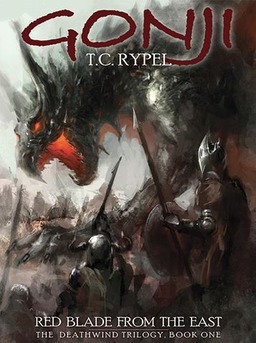
Gonji: The Deathwind Trilogy by T. C. Rypel

Gonji: The Deathwind Trilogy by T. C. Rypel

oie_1919231MrGw3CJVDrift back in time to the eighties when swords & sorcery was preparing to die, at least as a force in fantasy publishing. Where once Andrew Offutt and Lin Carter as well as Robert E. Howard packed the shelves of your local B. Dalton, they were about to be crowded out by the rise of the Tolkien clones. Exciting authors like Charles R. Saunders who were leading S&S down new paths would see their heroic fiction production curtailed by sales numbers that didn’t meet publishers’ expectations.

Today, technological advancements have paved the way for the return of ancient adventurers. The internet has allowed old and new fans to find each other and connect with writers to create a camaraderie of creators and consumers. Quality print-on-demand publishing, e-books, and small presses using those tools have led to the resurrection of several heroes, including Saunders’ own Imaro and Dossouye. Another of those revived heroes is T. C. Rypel’s Gonji, a half-Japanese, half-Scandinavian warrior first introuduced thirty years ago, wandering the slopes of the Carpathian Mountains in search of a mysterious force known as the Deathwind.

When T. C. Rypel delivered his first novel to Zebra Books back in the early eighties it was over thirteen-hundred pages long. While that’s nothing peculiar these days, back then it was seen as unprecedented and Zebra’s response was to break it up into three distinct books. Rypel’s titles for the resultant three volumes were Red Blade from the East, The Soul Within the Steel, and Deathwind of Vedun. Zebra decided to take Rypel’s third title and reassign it to the first book, then re-title the last two Samurai Steel and Samurai Conflict. Their changes provide a hint of what the publisher had in store for the books.

Read More Read More

New Treasures: Bloodstone by Gillian Philip

New Treasures: Bloodstone by Gillian Philip

Bloodstone Gillian Philip-smallBack in May I reported on Firebrand, a new novel by Gillian Philip, first volume in her Rebel Angels series. Here’s what I said, in part:

Firebrand seems like exactly the kind of fast-paced adventure Black Gate readers are interested in… The second and third volumes, Bloodstone and Wolfsbane, are already in print in the UK. Interestingly, while all three books are marketed as YA there, Tor has mainstreamed them here in the US. It’s an interesting switch, and I’m curious to see how the market reacts.

The reviews were strong, as it turns out. Publishers Weekly called it “A stirring tale of loyalty and love,” and over at SF Site Dave Truesdale drew parallels with none other than Lord Dunsany:

Packed with Machiavellian court intrigue of the most cold-blooded sort, horrible monster-beings from the realm of faery in league with Queen Kate, and the looming threat of the world of faery possibly destroyed forever, Firebrand is a fresh and welcome reimagining of oft-worked ground first laid out by Lord Dunsany and, as Dunsany wrote, far “beyond the fields we know.”

He had me a “horrible monster-beings from the realm of faery.” Bring on Book Two!

The second volume, Bloodstone, has now arrived. In this installment Sithe warriors Seth and Conal MacGregor continue their hunt for the Bloodstone demanded by their Queen, making secret expeditions across the Veil… with violent consequences that may devastate their family and their entire clan.

Bloodstone was published by Tor on November 19, 2013. It is 399 pages, priced at $24.99 in hardcover, and $11.99 for the digital edition.

See all of our recent New Treasures here.

The Series Series: Heart of Briar by Laura Anne Gilman

The Series Series: Heart of Briar by Laura Anne Gilman

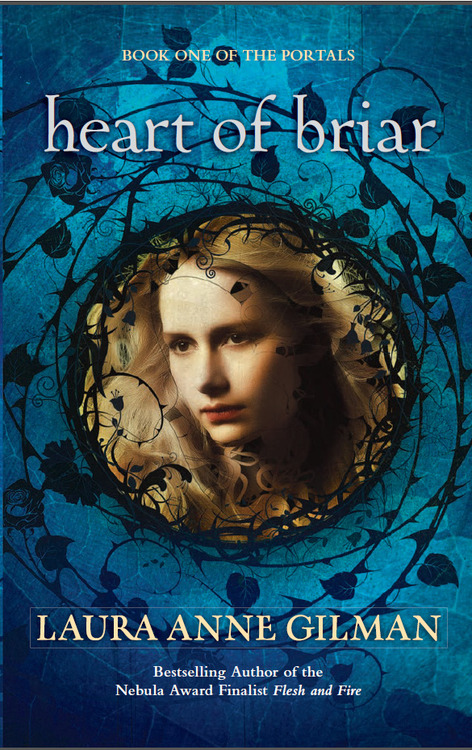
Heart of Briar Laura Ann Gilman-smallShe got me. I didn’t expect to get caught up in this book, thought I would just read the first couple of chapters, because it’s not my usual kind of thing. Gilman uses some of the tropes of paranormal romance, but she’s using them to do bigger things, some of which I did not see coming.

If you’re severely allergic to romance, the virtues to be found in Heart of Briar will not be enough to balance the book for you, even though it is not clear at the end of this volume who the male romantic lead for the series will turn out to be. If you’re severely allergic to urban fantasy, you might not make it past the nice young geek couple looking up from their computer screens to discover, to their horror, a parallel society of supernatural beings that’s about to smash into their technology-centered happily ever after.

After my last review here, of a book that was inaccurately marketed as the first volume of a new series, I want to note how refreshing it is that this week’s title is, as promised on the cover, Book One of The Portals. It helps to know a little folklore, but even that’s unnecessary. Gilman has written plenty of books before. I haven’t read any of them. It’s possible there’s some crossover with her other series, but I never felt like I was out of the loop.

On the contrary, I usually felt like I was sometimes more in the loop than the protagonist was. Poor Jan is not a fantasy reader, did not consume volumes of folklore and mythology as a child, doesn’t know what she’s being warned about when the supernatural characters try to confess to her that they can’t be trusted. They’re good in their ways, which are fundamentally incompatible with human ways.

Fortunately for everyone in Jan’s world, she’s sufficiently brave, stubborn, devoted, and open-minded to catch up, keep up, and bring something new to the local shapeshifters’ efforts to repel an invasion from an extraordinarily hostile version of the Fae. Gilman’s fairyland bears a remarkable resemblance to the chilling otherworld of C.L. Moore’s great pulp sword and sorcery classic story “Black God’s Kiss.” Gilman’s elves behave in ways befitting extradimensional perils from a Clark Ashton Smith story. It’s a little jarring to see a book that uses some of the trappings of paranormal romance to give the vintage Weird Tales treatment to what starts out looking like a retelling of Tam Lin, but ultimately I think Heart of Briar succeeds at the strange balancing act it attempts. You see now why this novel was worth bringing to the attention of Black Gate readers?

Read More Read More

The Series Series: The Shadow’s Heir by K.J. Taylor

The Series Series: The Shadow’s Heir by K.J. Taylor

The Shadow's Heir-smallThis book is not the first volume in a new series, no matter what its cover says. It’s marketed as the first volume in a new trilogy, The Risen Sun, that happens to be in the same setting as The Fallen Moon, but with every page I read, I felt the lack of resonances that the author clearly intended and expected for readers who had already read her first three books.

The Shadow’s Heir was good enough that I may someday backtrack to Taylor’s debut, The Dark Griffin. Of course, since this is really the fourth volume in the series, it has enough spoilers about the first three volumes that I’ll need to wait years for my memory of this book to fade. The review quotes about those earlier volumes promise “twisty plots,” and they won’t be twisty for me until I forget nearly everything I just read.

If the book were bad, I’d just shrug and move on. As it is, I’m annoyed on the author’s behalf at the marketing folks at Ace. (This is, of course, an injudicious thing to admit, because I would give my eyeteeth to sell my trunk manuscript to Ace. Not that they’d want my eyeteeth. Imagine the slushpile horror story!) I would love to understand the marketing decision better, because it seems to me that telling people The Shadow’s Heir is a good entry point to Taylor’s fictional world might sell copies in the short run, but would surely turn readers off in the long run.

This book holds the payoff for several plotlines I could have been deeply invested in, had I read them from the beginning. Instead, I was keenly aware at every payoff point of how hollow the big scenes felt to me in comparison to structurally similar scenes in other series.

How on earth am I going to talk in any detail about the virtues and peculiarities of The Shadow’s Heir while avoiding spoilers about three previous volumes I haven’t read? Well, here goes.

Read More Read More

Harpy’s Flight by Megan Lindholm (aka Robin Hobb)

Harpy’s Flight by Megan Lindholm (aka Robin Hobb)

oie_2355541zLiqR1TsBefore becoming the better known Robin Hobb, Mary Astrid Lindholm Ogden wrote under the pen name Megan Lindholm. Today, what little she writes under the Lindholm name tends to be contemporary fantasy. Initially, though, some of it came very close to heroic fantasy. Ogden’s first published story was a swords & sorcery tale under the Lindholm byline, in Jessica Amanda Salmonson’s important 1979 anthology Amazons!.

That first story, “Bones for Dulath,” introduced a pair of traveling adventurers: the stolid wagon driving Ki and her more lighthearted companion Vandien. In a review of Amazons! I wrote last year I said:

It’s not an especially exciting story but Ki’s voice and the easy camaraderie between the two feels real and comfortable. Ki and Vandien find themselves face to face with a strange, dangerous mountain creature and a town of people who’ve come to see it as a god. I’ve read a few of Lindholm’s novels under the Robin Hobb name and enjoyed them but they’re more mainline fantasy than this good slice of S&S.

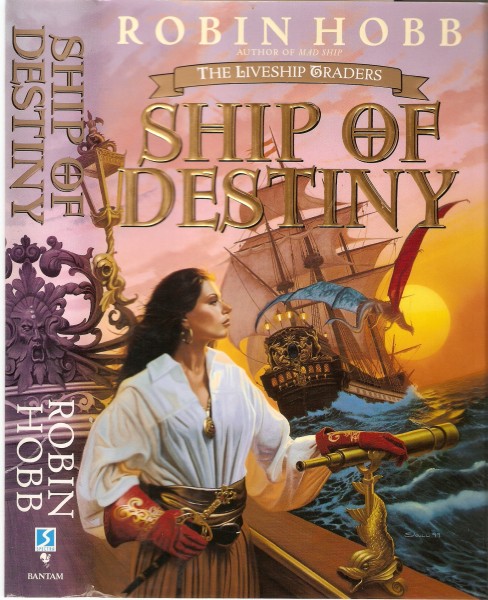
In her first published novel, Harpy’s Flight (1983), Lindholm returned to Ki and Vandien to tell how they met and became companions. It’s not the work of heroic fantasy I was expecting based on “Bones for Dulath,” but instead something closer to the mainline fantasy of her Hobbs books. Still, it is good solid work, particularly for a first book. Lindholm/Hobb has a tremendous talent for creating truly strange, alien worlds and peopling them with multi-dimensional human characters, not simply hangers for a bundle of traits and quirks. That talent is beautifully displayed throughout Harpy’s Flight.

Read More Read More

The Ballantine Adult Fantasy Series: The Blue Star by Fletcher Pratt

The Ballantine Adult Fantasy Series: The Blue Star by Fletcher Pratt

The Blue StarThe Blue Star
Fletcher Pratt
Ballantine Books (242 pages, May 1969, $0.95)
Cover art by Ron Walotsky

Lin Carter chose Fletcher Pratt’s novel The Blue Star to be the inaugural title in Ballantine’s Adult Fantasy series. I’ve found nothing that explicitly says why this novel rather than another, but a remark in his introduction provides a clue.

Prior to this publication, The Blue Star had only been published in an omnibus edition along with Fritz Leiber’s Conjure Wife and James Blish’s There Shall be no Darkness in 1952. This was 17 years prior to Ballantine reprinting it and two years before The Lord of the Rings was first published. Carter wrote, “I am pleased to have been instrumental in getting this remarkable novel back into print again.”

The novel tells the story of Rodvard Bergelin, who is a clerk in the genealogical offices of the Empire in the capital city of Netznegon. Not given an actual name, the Empire is in decay. Ruled by a Queen whose only heir has been exiled, political intrigue abounds. Rodvard is a member of a revolutionary group known as the Sons of the New Day. They have Bolshevik overtones, but when they eventually gain power, things resemble the French Revolution.

The other protagonist is a young woman who is a witch, Lalette Asterhax. In Pratt’s world, magic is real, but only witches can use it. The only exception is through a gem known as a Blue Star. Not all witches have one, but Lalette does. The power to be a witch is hereditary, passed from mother to daughter. A witch gains her powers when she loses her virginity.

The Sons of the New Day order Rodvard to seduce Lalette. Neither is really interested in the other. Rodvard is taken with a voluptuous young noblewoman who has started hanging around his office. Lalette, on the other hand, is being pursued by an old nobleman, Count Cleudi. In order to get away from him and out from under her mother’s thumb, Lalette reluctantly yields to Rodvard’s advances.

Read More Read More

The Series Series: Seven Forges by James A. Moore

The Series Series: Seven Forges by James A. Moore

Seven Forges-smallThis is your book. The books I’ve reviewed in the Series Series so far have had many virtues, and some of them have been exactly my sort of thing, but in most cases, I’ve had to include a caveat about how they might not be your sort of thing. This time I can say, if you’re a regular reader at Black Gate, the book I’m reviewing is exactly your bucket of grog.

James A. Moore dedicates Seven Forges in part “to the memory of Fritz Leiber and Robert E. Howard for the inspiration.” That dedication sets the bar high, and caused me a bit of readerly apprehension, because so many writers have imitated badly those two greats of the sword and sorcery tradition. Moore is far more than an imitator, though. He does some fresh, counterintuitive things with the genre conventions. More than once, he startled me into saying out loud, “I didn’t see that coming.”

The weirdest thing about this first volume of what will clearly be a series about a total war on a cosmic scale — complete with an entire national pantheon consisting only of war gods — is that most of the book consists of a troubled but earnest effort at establishing peace. Our hero Merros Dulver leads an expedition from a stable empire that hasn’t faced a truly threatening enemy in over a thousand years into the Blasted Lands, where the last batch of now-mythic enemies used to live. The Fellein Empire once mastered sorceries so reminiscent of nuclear weapons, I briefly wondered whether Seven Forges might be far-future science fiction in disguise.

But the people who live on the far side of the Blasted Lands would be right at home in Robert E. Howard’s Hyboria. Conan might have seen in them a civilization he could love — if civilization is the right word for the Sa’ba Taalor. In a hidden valley surrounded by volcanic mountains that are also sort of gods, which are also sort of the ruins of the seven cities destroyed in the distant past, the Sa’ba Taalor have spent the past thousand years in the pursuit of perfect individual excellence in all the arts of war. Their gods saved them from the cataclysm, and ever since, the Sa’ba Taalor have repaid their gods with perfect obedience of divine law, and, for that matter, divine whim. These gods give prophecies, speak directly into the minds of their worshippers, perform geological miracles, and do other, stranger things that remain intriguing mysteries at the novel’s end. Above all, the seven gods of the Seven Forges require constant readiness for ass-kicking.

Read More Read More

Seductive Sorceress Queens, Decadent Civilizations, and Moon-lit Brawls: A Review of Bloodstone by Karl Edward Wagner

Seductive Sorceress Queens, Decadent Civilizations, and Moon-lit Brawls: A Review of Bloodstone by Karl Edward Wagner

Bloodstone Karl Edward Wagner-smallI love used book shops. And when I say love, I damn well mean love; anything that offers me a Kane Book for less than a pound is pretty much saying ‘I do’ in my book. You just can’t buy that kind of passion, unless you happen to offer me a Kane book for under a…. oh, never mind!

Now, if you’re a bit of a fantasy connoisseur (and if you’re reading this you probably are) you’ve likely heard of Kane, or at least Karl Edward Wagner; the guy’s novels sell for an arm and a leg on Amazon and are showered with praise at every turn. So you can understand my excitement upon finding the book, and my anticipation when I opened it up.

The story follows Kane as he stumbles upon an intriguing ring during a raid. His interest piqued, Kane investigates further and finds that it is actually linked to a legendary giant gem named ‘Bloodstone’ which would, apparently, look really nice in his front garden. Needless to say Kane decides to look for it, and his search leads him to an ancient city somewhere in a forest, one that serves as a kind of no man’s land for two warring leaders: Malchion, and Dribeck.

What follows is some seriously top-notch sword and sorcery; the first few chapters are brilliant, filled to the brim with Gothic imagery and seductive sorceress queens, decadent civilizations, moon-lit brawls with lurid beasts; all the good stuff that made me fall in love with the genre. It’s got everything: mysticism, super-science, monsters, a lost city, and an ancient civilization.

And the first couple of skirmishes with a race of lizard men, the Rillyti, (who happen to be the very same lizard men who made Bloodstone) are all excellently done, filled with a real unpredictability, and a truly tangible sense of danger. It really reads like something you’d find in the pages of Weird Tales, alongside the latest Conan tale, or Solomon Kane’s newest yarn.

And it’s great fun. The kind that is a lot harder to find today (a few exceptions aside). At this stage, the thunder in its pacing was audible, the weight of its sword blows palpable, the dirt and grit and grime of its world was seeping into the room. And I loved every moment.

So why, Mr Wagner, why oh why, did you slow it down?

Read More Read More

New Treasures: Darkwalker by E.L. Tettensor

New Treasures: Darkwalker by E.L. Tettensor

Darkwalker-smallDarkwalker is the debut fantasy novel from E.L. Tettensor and it offers an intriguing mix of both the familiar and the new — just what I’m looking for, I think.

The setting is Kennian, part of the backwater Five Villages, which seems a lot like 19th-century England if you squint. Stepping into the scene is Police Inspector Nicolas Lenoir, tasked with investigating a dark mystery. Folks here for the most part scoff at the supernatural — but don’t tell the thing hunting Inspector Lenoir. This one looks like a fine mix of fantasy and mystery in a fog-shrouded Victorian-era (ish) landscape, with plenty of original touches to keep things interesting.

He used to be the best detective on the job. Until he became the hunted…

Once a legendary police inspector, Nicolas Lenoir is now a disillusioned and broken man who spends his days going through the motions and his evenings drinking away the nightmares of his past. Ten years ago, Lenoir barely escaped the grasp of the Darkwalker, a vengeful spirit who demands a terrible toll on those who have offended the dead. But the Darkwalker does not give up on his prey so easily, and Lenoir has always known his debt would come due one day.

When Lenoir is assigned to a disturbing new case, he treats the job with his usual apathy — until his best informant, a street savvy orphan, is kidnapped. Desperate to find his young friend before the worst befalls him, Lenoir will do anything catch the monster responsible for the crimes, even if it means walking willingly into the arms of his own doom…

Darkwalker: A Nicholas Lenoir Novel was published by Roc Books on Dec 3, 2013. It is 368 pages, priced at $7.99 for the paperback and for the digital edition. Read an excerpt on the Penguin website here.

See all of our recent New Treasures here.

John R. Fultz’s Seven Sorcerers On Sale Today

John R. Fultz’s Seven Sorcerers On Sale Today

Seven SorcerersWe’re celebrating a major publishing event at the Black Gate rooftop headquarters today: the arrival of Seven Sorcerers, the third novel in John R. Fultz’s Books of the Shaper series.

When Seven Princes, the first book in the series, arrived in January 2012, it marked the debut of a major new fantasy talent. Seven Kings cemented that reputation, and over the next two years, John graduated from promising new novelist to full-fledged literary star. The critical acclaim for the first two books has been stellar — Barnes & Noble called them “flawless epic fantasy,” Library Journal praised Seven Princes as “A stand-out fantasy series from an author with an exceptional talent for characterization and world building,” and io9 labeled the same novel “Epic with a capital EPIC.”

John’s talent is too big to be contained just in novels — on June 3, 2013, 01Publishing published his first collection The Revelations of Zang, gathering his baroque and fascinating sword & sorcery Zang Cycle, featuring the tale of a revolt against the nine Sorcerer Kings whose power displaced the gods themselves.

We published three stories from John R. Fultz’s Zang Cycle in the print version of Black Gate: “Oblivion Is the Sweetest Wine,” that tale of Taizo the thief and his daring heist in spider-haunted Ghoth (BG 12); “Return of the Quill,” in which Artifice’s long-simmering plan to bring revolution to the city of Narr finally unfolds (BG 13); and the prequel story “The Vintages of Dream” (BG 15). Next, John took us back in time to Artifice’s first year as a member of the travelling Glimmer Faire in “When the Glimmer Faire Came to the City of the Lonely Eye,” which appeared as part of the Black Gate Online Fiction line here in January.

Somehow missed out on all the excitement? Read the excerpts and stories linked above or try the complete first chapter of Seven Kings for free. Get more details on Seven Sorcerers here.

Seven Sorcerers was published today by Orbit Books. It is 448 pages, priced at $17 in trade paperback and $9.99 for the digital edition. Look for it in bookstores everywhere — and stay tuned to Black Gate for a special opportunity to win a signed copy!