Browsed by
Category: Books

Tabitha Reviews The School for Good and Evil
Tabitha Reviews The School for Good and Evil

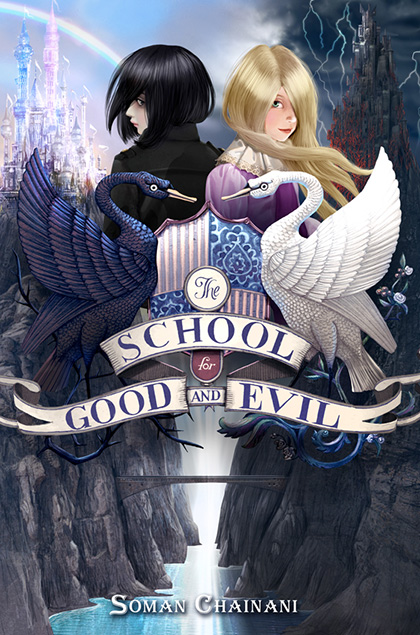
The-School-for-Good-and-EvilThe School for Good and Evil
By Soman Chainani
HarperCollins (488 pages, May 14, $16.99 hardcover/$10.99 digital)

The School for Good and Evil is a major summer release from HarperCollins, with a national marketing campaign and lot of pre-release buzz, and it’s already getting a lot of attention.

We know what to do with young adult books getting a lot of attention here at Black Gate – we give them to Tabitha, the thirteen year-old reviewer who covered The House of Dead Maids and All the Lovely Bad Ones for us, among others. We’re glad to have her join us again, even though she makes us feel old and out of touch.

Black Gate: Tabitha, welcome back to the Black Gate offices!

Tabitha: Thanks, I guess.

Before we get started, why don’t you tell us a little about yourself.

Didn’t we do that last time?

Yes but that was like a hundred years ago. All the people who read your last reviews probably got old and died.

Wow. Okay, in that case, I turn 114 this year. I’m going to high school next year. On the introvert scale, I’m beyond “vampire.”

“Beyond vampire.” What does that mean? Explain it for old people.

I scream in agony whenever I set foot outside my house.

Read More Read More

The Dying Earth: An Appreciation

The Dying Earth: An Appreciation

Tales of the Dying EarthLast Sunday, May 26, veteran genre writer Jack Vance died at the age of 96. John O’Neill posted a fine overview here of his career; testament to Vance’s influence on other writers can be seen in remembrances by Christopher Priest and George R.R. Martin. Prolific and talented, Vance was a significant figure. I thought I’d do my humble bit to mark his passing with a look at perhaps his best-known series, books which named a subgenre of speculative fiction: The Dying Earth.
The first book in the sequence, The Dying Earth, was a collection of linked short stories published together as a novel in 1950. The second volume, 1966’s Eyes of the Overworld, ties together a half-dozen short stories (of which five had been previously published in The Magazine of Fantasy & Science Fiction) into a sprawling picaresque adventure. After Michael Shea wrote and published an authorised sequel in 1974, A Quest for Simbilis, Vance returned to his setting and lead character in 1983 with Cugel’s Saga. Parts of this book too had been previously published as short fiction, but again the episodic structure worked, creating the sense of an unwinding yarn, a shaggy-dog story — a feel similar to the previous book while still highly individual. The final book, 1984’s Rhialto the Marvellous, was a collection of longish tales featuring new main characters; one story, the last in the book, had been published in 1973.

All four books are set in the unimaginably far future, when a red sun wearily makes its way through the skies of Earth and the moon is no more. Powerful magicians memorise spells based on obscure mathematics and command otherworldly entities. The world is nothing we recognise: not only has every culture and civlisation we have ever known passed away unremembered, but the basic geography of the planet has changed. There are fewer people on the planet, it seems, though far more quasi-human entities; technology’s mostly regressed to pre-industrial levels, except for rare magical artifacts. If ‘magic’ is the right word. What seems to be magic may only be forgotten technology. Who, this far away in time, can recall?

Read More Read More

New Treasures: The Mist-Torn Witches by Barb Hendee

New Treasures: The Mist-Torn Witches by Barb Hendee

The Mist-Torn WitchesI remember when I first saw Dhampir, the opening volume of Barb and & J.C. Hendee’s Noble Dead saga, back in 2003.

A supernatural medieval fantasy packed with vampire hunters, assassins, ancient castles, and mysterious guilds? That went right on my to-be-read pile. It was still there when Thief of Lives arrived twelve months later. And the third volume, Sister of the Dead. There are now a dozen, and I’ve surrendered all hope. Those two write faster than I can read.

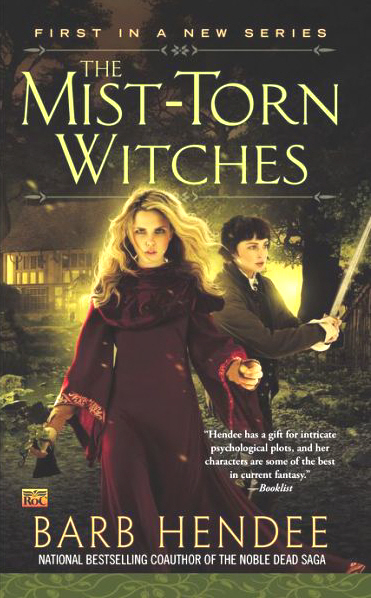
So that’s why I was pleased when Barb Hendee’s solo effort, The Mist-Torn Witches, arrived in May. It’s the first in a brand new series, but it has many of the same elements that attracted me to The Noble Dead. In one volume, I can be on top of everything and not have to hang my head in shame when we talk about Hendee at the Black Gate reading club. Big green recliner, here I come.

In a small village in the nation of Droevinka, orphaned sisters Céline and Amelie Fawe scrape out a living selling herbal medicines in their apothecary shop. Céline earns additional money by posing as a seer and pretending to read people’s futures.

But they exist in a land of great noble houses, all vying for power, and when the sisters refuse the orders of a warlord prince, they must flee and are forced to depend on the warlord prince’s brother, Anton, for a temporary haven.

A series of bizarre deaths of pretty young girls is plaguing the village surrounding Prince Anton’s castle. He offers Céline and Amelie permanent protection if they can use their “skills” to find the killer.

With little choice, the sisters enter a world unknown to them — of fine gowns and banquets and advances from powerful men. Their survival depends on catching a murderer who appears to walk through walls and vanish without a trace — and the danger grows with each passing night.

The Mist-Torn Witches was published by Roc Books on May 7. It is 326 pages, priced at $7.99 for both the paperback and digital versions.

See all of our recent New Treasures articles here.

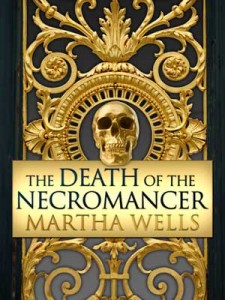
Black Gate Online Fiction Presents the Complete The Death of the Necromancer by Martha Wells

Black Gate Online Fiction Presents the Complete The Death of the Necromancer by Martha Wells

The Death of the Necromancer KindleBlack Gate is very proud to announce that we will be presenting the complete fantasy novel The Death of the Necromancer, by Martha Wells, as part of our Online Fiction series, starting this Sunday, June 2.

The Death of the Necromancer is one of the most important fantasy novels of the past 20 years. When I ran SF Site, we received an advance proof in 1998, and it electrified our entire office. In his review, senior editor Wayne MacLaurin wrote:

Take a great Sherlock Holmes novel, mix in a heavy dose of Steven Brust’s Jhereg, and you’ll have some idea of what you can expect… Martha Wells’ first two novels, The Element of Fire and City of Bones, were praised for their rich detail and original concepts. The Death of the Necromancer raises those two points to new levels… It’s a stunning achievement.

When we polled all 40 regular reviewers for our “Best of the Year” awards, The Death of the Necromancer topped more ballots than any other book, and to no one’s surprise it was nominated for a Nebula Award.

Martha Wells has a long history with Black Gate. We published three long novellas featuring her heroes Giliead & Ilias, starting with “Reflections” in Black Gate 10; followed by “Holy Places(BG 11), and “Houses of the Dead (BG 12). Her stories are fast-paced mysteries, filled with deeply human characters on a splendidly realized stage, and her appearance in BG brought us a whole new audience. Her most recent article for us was “How Well Does The Cloud Roads Fit as Sword and Sorcery?,” which appeared here March 13.

Martha Wells is the author of fourteen fantasy novels, including City of BonesThe Element of Fire, The Cloud Roads, and The Serpent Sea. Her most recent novel is the YA fantasy Emilie and the Hollow World, published by Strange Chemistry Books in April. Her web site is www.marthawells.com.

The Death of the Necromancer was originally published in hardcover by Avon EOS in 1998. The complete, unedited text will be serialized as part of our Black Gate Online Fiction line, starting this Sunday, June 2.

Is This a Kissing Book?

Is This a Kissing Book?

Tanya Huff Blood Price Blood TiesLet me get one thing out of the way immediately: It’s my belief that the increase in the numbers of female protagonists in the last thirty years (yes, it’s been that long) is directly related to the increase in the numbers of female authors (yes, it’s that simple). Female readers have been here all along. You can trust me on that one.

Last week I was talking about dual heroes, when is a pair a true pairing, and when a hero/sidekick combo? I mentioned Fafhrd and the Grey Mouser, for me the original hero pair, and some of their literary descendants. But I left it until this week to talk about a much more recent phenomenon, the female/male hero pair.

Now, just to be clear, I don’t mean a book with a male protagonist, and his female companion – until recently known as a “regular book.” Nor do I mean a book with a female protagonist and a male second lead – until recently known as a “romance novel.” What I mean is the same kind of dual hero I talked about before, where both main characters are equally important to the story, but where one happens to be a woman, and one happens to be a man.

Having established the usefulness of a pair of protagonists (each brings a unique perspective and different skills to the problem-solving; the presence of a “friend” establishes the emotional accessibility of both characters; the chance to reveal character through conversation [thanks to Alex Bledsoe for some of these ideas], and, especially, the usefulness of a country/city pair) does having a female/male pair do anything in particular for us?

Read More Read More

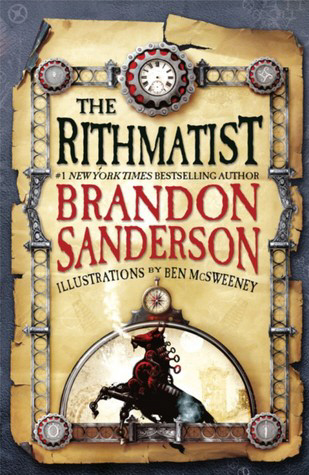
New Treasures: The Rithmatist by Brandon Sanderson

New Treasures: The Rithmatist by Brandon Sanderson

The RithmatistBrandon Sanderson is one of the hardest working writers in the business — and one of the most successful.

It’s not unusual for a prolific novelist to release a book a year. What is unusual is to consistently beat that pace while producing highly acclaimed, massive fantasy epics.

Just consider the last few years — starting with the 688-page Warbreaker (2009), which our reviewer Charlene Brusso called “the cure for trilogy fatigue” (not to be outdone, our Reviews Editor Bill Ward also noted that portions “approach the compulsive readability of the best page-turners.”)

A year later, Sanderson released the 861-page Wheel of Time novel Towers of Midnight, written from Robert Jordan’s notes. The same year (!), his massive 1,008-page novel The Way of Kings won the 2011 David Gemmell Legend Award (our review is here.)

In 2011, it was the new Mistborn novel The Alloy of Law; in her review Charlene said it was “full of neat ideas, crackling dialogue, and a very big helping of dry wit.”

In 2012, Sanderson published the unusual science fantasy The Emperor’s Soul, from Tachyon Publications.

That’s not even including the various short fiction and novellas he published during the same period — or the two complete novels in his juvenile fantasy series, Alcatraz Versus the Knights of Crystallia (2009) and Alcatraz Versus the Shattered Lens (2010).

Seriously, I’m getting tired just typing all the titles. How does he do it?

Moving into 2013, Sanderson’s first release was the 912-page A Memory of Light in January (our coverage here); he also has the upcoming science fiction novel Steelheart in September.

That’s not all, of course. His third 2013 book is the just-released The Rithmatist, a comparatively short (for Sanderson) 372 pages. For those not doing the math at home, that brings his published page count for the year to 1,696 — down from 2,173 in 2010, but we try not to judge.

Read More Read More

The Top 50 Black Gate Blog Posts in April

The Top 50 Black Gate Blog Posts in April

Pressure mounts, but Tales was my most successful and well received novel, so I'm still feeling the love.We presented nearly 100 new articles on the Black Gate blog last month, covering virtually every aspect of fantasy — from Kickstarter to Red Sonja , Space: 1999 to exotic food.


Why do we do it? Here’s a clue: it’s not the great pay, or the breezy offices of our rooftop headquarters here in downtown Chicago. It’s not the allure of maverick journalism, and the way publishers tremble when we walk into a room. It’s not the travel, or the lousy expense accounts, or the drunken nights playing poker with George R.R. Martin and Gordon van Gelder (man, that guy can bluff). It’s not the endless review copies of the latest fantasy releases, or the —

Hold up there, Sparky. Review copies? Ummm, those are pretty cool. Yeah, free books never get old. Forget what I just said. We pretty much do it for the freebies.

Plus, we do it for you, our fans. For the great letters to send us, and the thoughtful comments, and those books you mail us with sticky notes that say, “Just thought you’d like this!” Seriously, you guys rock. Also, free books. Those are great too.

Here’s what the Black Gate supercomputer tells us were the 50 most popular articles we published last month. Enjoy. And keep those comments and mail coming!

  1. Art of the Genre: The Joy and Pain of Kickstarter [and How Backed Projects Still Fail]
  2. An Open Letter from Jeremy Lassen at Night Shade Books
  3. Vintage Treasures: Chaosium’s Thieves World
  4. Red Sonja: The Novels
  5. Teaching and Fantasy Literature: Writing Fantasy Heroes
  6. Night Shade Attempts to Avoid Bankruptcy with a Sale to Skyhorse Publishing
  7. The Company That Time Will Never Forget: A Visit to Edgar Rice Burroughs, Incorporated
  8. Red Sonja: The Movie 
  9. Are You Going to Eat That?
  10. Vintage Treasures: The People of the Black Circle by Robert E. Howard 


  11. Read More Read More

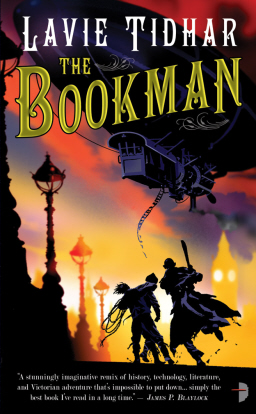
New Treasures: The Bookman Histories by Lavie Tidhar

New Treasures: The Bookman Histories by Lavie Tidhar

The Bookman HistoriesI’m a big fan of these Angry Robot omnibus volumes. Talk about reading feasts… I can settle into my big green chair with a bag of chips and one of these babies, and I’m set until August.

They’re surprisingly diverse, too. There’s Tim Waggoner’s zombie detective saga The Nekropolis Archives, Aliette de Bodard’s Aztec mystery series Obsidian & Blood, Andy Remic’s blood-drenched sword-and-steampunk epic The Clockwork Vampire… and now we have Lavie Tidhar’s steampunk serial-killer trilogy The Bookman Histories to add to the list.

The trilogy opened with 2010’s The Bookman (cover here), described as “a steam-powered take on V for Vendetta.” Set in an alternate Victorian London on the verge of the first (cannon-powered, naturally) expedition to Mars, the book follows the exploits of the young poet Orphan, who witnesses a stunning attack by a masked terrorist that paralyzes the city. Filled with mysterious automatons, airships, exploding books, pirates, giant lizards, pirates, and more airships, The Bookman was the first novel from the short fiction author whom Locus called “an emerging master.”

Camera Obscura (2011) introduced us to the mysterious and glamorous Lady De Winter, agent of the Quiet Council. Tasked with solving a locked-room murder on Rue Morgue in Paris, De Winter soon finds herself drawn into a far more sinister mystery.

The series wraps up with The Great Game (2012), which begins with Mycroft Holmes’ murder in London. It falls to Holmes’ protégé Lucy Westerna to solve the case — but before she does she crosses paths with a young Harry Houdini and a retired shadow executive named Smith (team up!). Together they find the trail leads inexorably to a foreboding castle in Transylvania… and to get there they’re need to cope with with airship battles, Frankenstein monsters, alien tripods, and more.

The Bookman Histories contains all three novels in one fat 1,022-page package. It was published by Angry Robot in December, 2012; the paperback is $15.99, and the digital version is $9.99. Lavie Tidhar won the 2013 World Fantasy Award for Best Novel for Osama; this is a guy who is clearly going places. Ignore him at your peril.

You can see all of our recent New Treasures articles here.

Vintage Treasures: The World Invisible by Shulamith Oppenheim

Vintage Treasures: The World Invisible by Shulamith Oppenheim

The World InvisibleI just found a dusty plastic bag stuffed full of paperbacks tucked in a corner of my living room. Hidden behind another pile of books, of course. Near as I can figure, I bought them at Capricon back in February (possibly at the same time as Peter Haining’s Vampire anthology.) Man, I need a better filing system.

There’s some good stuff in it, though. If I did indeed buy them, and the bag didn’t just spontaneously materialize from the ether, then I clearly have great taste. Or maybe I just patronize fabulous booksellers. Whatever the case, the bag was filled with vintage paperbacks by Norman Spinrad, Robert Silverberg, Jerry Sohl, and Lloyd Arthur Eshbach. The most intriguing item, however, was a slender Ace paperback from 1984, The World Invisible by Shulamith Oppenheim.

Beware the world invisible.

It lies in forest shadows beneath the hills, and below the waves that pound so fiercely on Scotland’s shores.

It is a world of beauty and magic, of fey creatures wondrous beyond imagination.

But beware.

Do not cross its boundaries or consort with its denizens. Or you will never be content with the human world again…

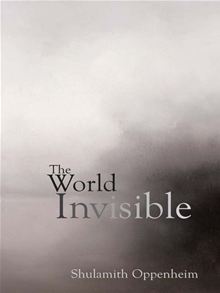
Okay, I have no idea who Shulamith Oppenheim is. According to some hasty research at her website, she’s a children’s writer with 14 books to her credit, including one about Albert Einstein, who was best man at her wedding (!). The World Invisible appears to be her only adult fantasy. It was reprinted in 2007 by White River Press, with the world’s most boring cover (what is that? An island? A fog machine? It’s like a travel book for blind people). Seriously, if you want to read it, the Ace version with the Don Maitz cover is the one to get (click on the image at right for a full-sized version).

The World Invisible was published by Ace Books in 1984. It is 198 pages in paperback, with an original price of $2.75. I figure I paid around two bucks for my copy. It is currently in print in both paperback and digital formats from White River Press.

See all of our recent Vintage Treasures articles here.

Paul Di Filippo on “A” is for Android and Other Tales: Masters of Science Fiction Vol. #8

Paul Di Filippo on “A” is for Android and Other Tales: Masters of Science Fiction Vol. #8

Milton Lesser A is for AndroidOver at Locus Online, Paul Di Filippo has a look at the latest Masters of Science Fiction reprint from Armchair Fiction, this one focused on Milton Lesser, author of Slaves to the Metal Horde and The Thing from Underneath.

If you do not know the enchantingly retro line of SF/F/H books published by Armchair Fiction… then I offer you now an eye-popping introduction. Visit his site and marvel at the vast range of vintage fiction, long out of print, lovingly repackaged with period artwork. Names as seminal as those of Fritz Leiber, Clifford Simak and Edmond Hamilton consort with the bylines of lesser craftsmen… The Armchair Fiction catalogue opens an essential window onto a vital and overlooked and still enjoyable portion of our history.

The latest entry in their “Masters of Science Fiction” series is awarded to Milton Lesser, who bears a name the majority of modern fans will probably be unfamiliar with. Lesser was one of those working-stiff writers back in the day who turned out intelligent, yet perhaps sometimes over facile, goods to suit whatever market was looking for material and paying a decent word rate… Truly the work of a Master? Did it exhibit a genuine affinity for the mode, a sense of wonder, some unique ideation? Does it seem hokey and clunky today, or do its narrative virtues still engage and reward?

We last looked at Armchair Fiction — via Paul W. Fairman’s The Girl Who Loved Death and Murray Leinster’s Planet of Dreadlast January.

Curiously, this book is listed under the variant title “A” as in Android at Amazon.com and other places. I haven’t seen a copy myself, so I can’t confirm which title is correct.

“A” is for Android (or maybe “A” as in Android) was published January 30 by Armchair Fiction. It is 320 pages in trade paperback, priced at $16.95. There is no digital edition. See more details at the Armchair Fiction site here, and you can read Paul’s complete review here.