Browsed by
Category: Books

Deepest, Darkest Eden edited by Cody Goodfellow
Deepest, Darkest Eden edited by Cody Goodfellow

oie_11233710dfgxIM2cClark Ashton Smith, one third of the Weird Tales triumvirate along with H. P. Lovecraft and Robert E. Howard, has been a favorite of mine ever since I bought a copy of the Lin Carter-edited collection Hyperborea. I was thirteen or fourteen and Smith’s archly told stories of the titular prehistoric land and its impending doom before an encroaching wall of ice, stunned me. I was long familiar with Lovecraft’s purple prose, yet nothing had really prepared me for Smith’s cynical, lush, and utterly weird writing. The stories were stunning and I was a fan.

I was pretty excited when John R. Fultz announced that he had a story in soon-to-be-published Deepest, Darkest Eden,  a collection of new stories edited by Cody Goodfellow and set in Smith’s Hyperborea. As soon as I finished reading Fultz’ post (and letting my brain drink in the gloriously pulpy cover by Mark E. Rogers) I headed over to publisher Miskatonic River Press’ site and ordered my copy. I couldn’t wait to get the return to Clark Ashton Smith’s decadent, dying land into my hands.

For me, stories set in someone else’s created world, or using their characters, need to center on what makes the original special. They don’t need to replicate it exactly, and with Clark Ashton Smith’s idiosyncratic prose it would be a mistake to try, but they should aim for similar artistic goals. Ryan Harvey, in his long article about Smith’s Hyperborean Cycle, concluded that it’s an “unusual medley of elements, with Lovecraftian themes rubbing against satiric jabs, elevated mocking language, black jokes, and a sense of a slow, chilly annihilation that cannot be escaped”. That gives any author setting out to play in Smith’s imaginary Hyperborea a wide array of ideas to pursue.

Many of the stories in Deepest, Darkest, Eden — and there are eighteen plus two poems — are very successful at meeting my test for success. Several of the authors have clearly subsumed the alternately funny and despairing world view of Smith and mixed it with their own talents to create worthwhile additions to the Hyperborean Cycle.
…

Read More Read More

The Nightmare of History: Chang Hsi-Kuo’s City Trilogy

The Nightmare of History: Chang Hsi-Kuo’s City Trilogy

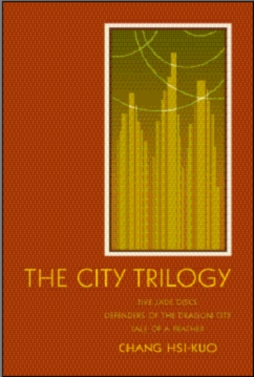
The City TrilogyLast week I noted that Tor’s promising that they’ll be publishing an English translation of Liu Cixin’s Three-Body Trilogy, a highly successful work of Chinese science fiction. Tor says that this will be the first publication of a science fiction novel from mainland China. But, as the statement implies, it won’t be the first Chinese-language sf novel translated into English. You can take a look in the comments of the linked article at Tor for examples; as it happens, I’ve got one of those exceptions to hand, Chang Hsi-Kuo’s City Trilogy, translated by John Balcom and published in one volume in 2003. (Chang, a Taiwanese, has had his name romanised in a number of different ways; I’m using here the name given him on my copy of the English translation of his book.)

According to Balcom’s introduction, the first book of the series, Five Jade Disks, was published in Taiwan in 1984. The next, Defenders of the Dragon City, came in 1986. Tale of a Feather completed the series in 1991. But before the novels, Chang had written a short story called “City of the Bronze Statue,” published in 1980; written in the style of a history or guidebook, it told the story of a bronze statue built at the centre of a colony city on an alien world, and how the statue was broken down and reforged as different rulers took control of the city and systems of government rose and fell. The story’s now the prologue to the trilogy, which itself tells of desperate wars in and around the same city, Sunlon City.

The short story and the trilogy both grapple with history, though in different ways. You can see elements of China’s and Taiwan’s past in the background of the trilogy’s alien setting, in the cycle of dynasties and factions. What comes through clearly, even to someone like me whose understanding of Chinese history is basic at best, is a sense of fatalism. This is science fiction that deals with the big questions, with the sweep of time and the nature of destiny. It’s sometimes a struggle to work through, due to the way that it presents these themes, but I think in the end it’s a convincing success.

…

Read More Read More

New Treasures: Magic and Loss by Nancy A. Collins

New Treasures: Magic and Loss by Nancy A. Collins

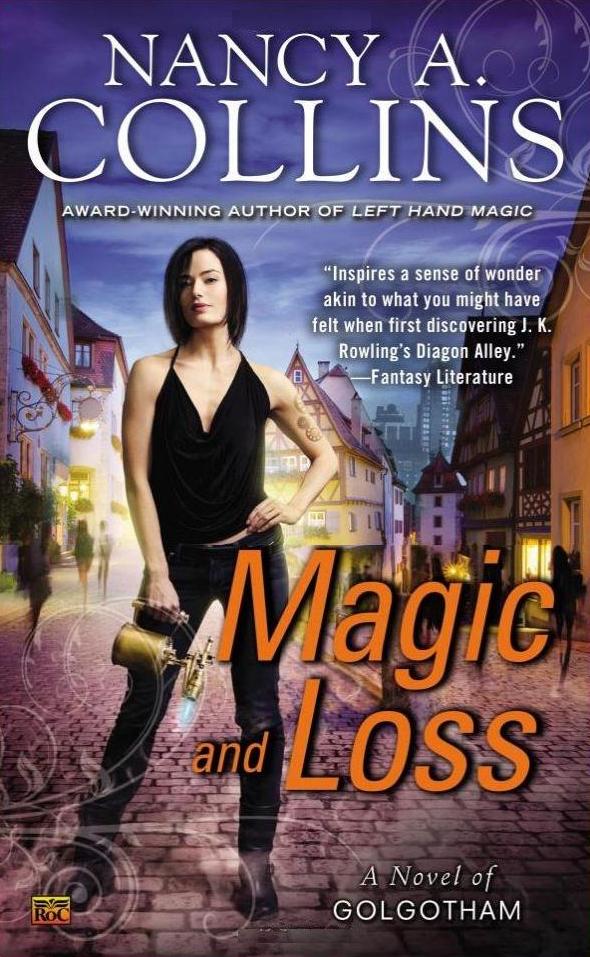
Magic and Loss-smallNancy A. Collins has had a long and distinguished career in dark fantasy. Her first novel, Sunglasses After Dark (1989), became an immediate classic of vampire fiction, and her character Sonja Blue went on to appear in two additional novels: In The Blood (1992), and Paint It Black (1995). Her three-volume Vamps series from HarperTeen began in 2008, and her brand new adult series Golgotham began in 2010 with Right Hand Magic, followed a year later by Left Hand Magic.

The third volume, Magic and Loss, arrived last week, and it continues the tale of Tate Eresby, an artist who moves to Golgotham, Manhattan’s centuries-old supernatural district. The neighborhood is populated by creatures from myth and legend, but its most prominent citizens are the Kymera, a race of witches who maintain an uneasy truce with New York’s human population.

It has been several months since Tate Eresby developed her new magical ability to bring whatever she creates to life, but she is still learning to control her power. Struggling to make a living as an artist, she and Hexe can barely make ends meet, but they are happy.

That is until Golgotham’s criminal overlord Boss Marz is released from prison, bent on revenge against the couple responsible for putting him there. Hexe’s right hand is destroyed, leaving him unable to conjure his benign magic. Attempts to repair the hand only succeed in plunging Hexe into a darkness that can’t be lifted — even by news that Tate is carrying his child.

Now, with her pregnancy seeming to progress at an astonishing rate, Tate realizes that carrying a possible heir to the Kymeran throne will attract danger from all corners, even beyond the grave…

Nancy Collins has been writing dark urban fantasy since before it existed as a sub-genre, and she still does it far better than most. Magic and Loss was published November 5th by Roc; it is 290 pages, priced at $7.99 for both paperback and digital versions.

See all of our recent New Treasures here.

Watch the First Trailer for Winter’s Tale

Watch the First Trailer for Winter’s Tale

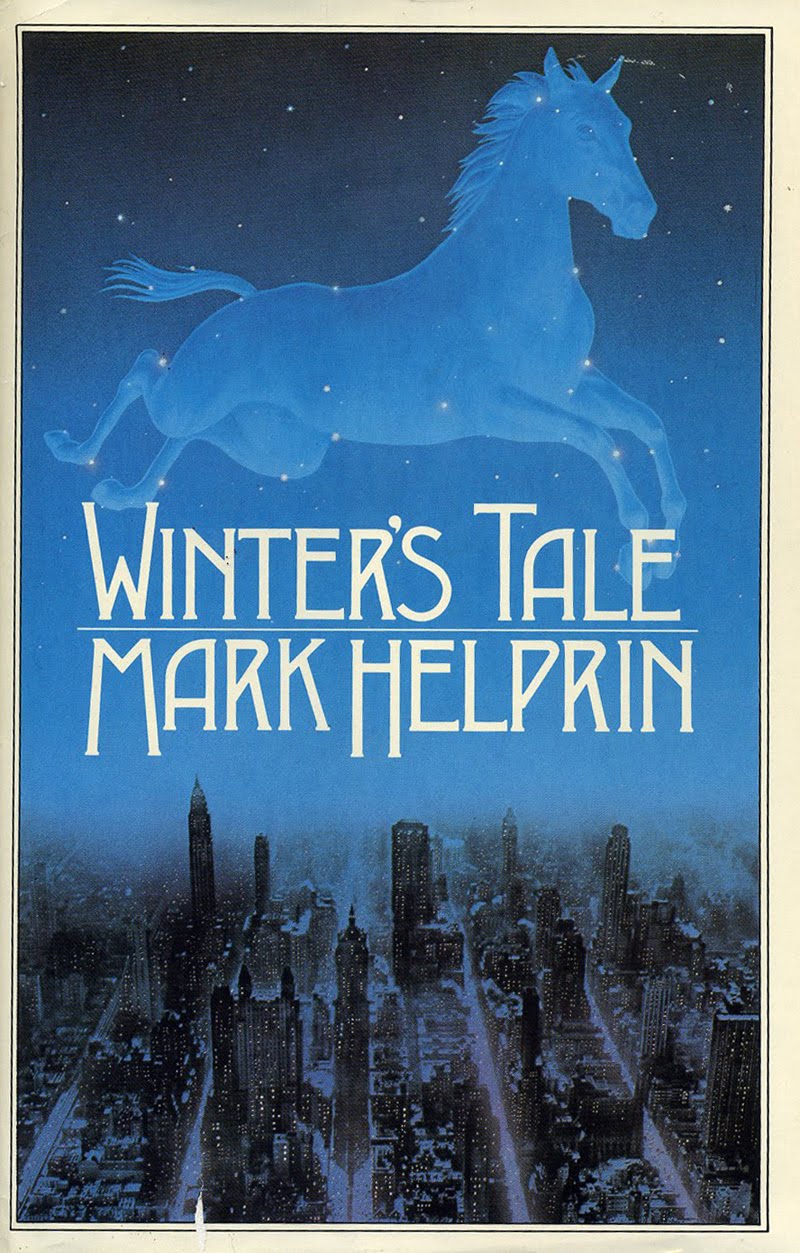
Winter's Tale Mark Halprin-smallMark Helprin’s 1983 novel Winter’s Tale was perhaps the prototype for modern urban fantasy. No, it didn’t have vampires or werewolves, but it was a star-crossed love story set in a mythic New York City, with a great villain — and a magical horse.

Mark Helprin isn’t really known as a fantasy writer; he’s chiefly known for his literary novels A Soldier of the Great War, Memoir From Antproof Case, and others. His three books for children — Swan Lake, A City in Winter, and The Veil of Snows — are certainly magical, and not just due to Chris Van Allsburg’s superb illustrations, but Winter’s Tale is his only adult work that crossed over into genre territory.

But Winter’s Tale was joyfully embraced by fantasy fans, and not simply because the main character is a thief. It is a epic tale of love, loss, and the mysteries of death.

The story opens in an imaginary 19th Century Manhattan, an industrial Edwardian-era metropolis that shares some characteristics with the city we know. It centers on Peter Lake, the son of two immigrants denied admission at Ellis Island.

Desperate, Peter’s parents set him adrift in a tiny ship in New York Harbor, where he is eventually found among the reeds and adopted by the rough-and-tumble Baymen of the Bayonne Marsh. Peter grows up to be a mechanic — and a skilled cat burglar. He who stakes out a fortresslike mansion in the Upper West Side and, when he’s certain it’s unoccupied, he breaks in.

But the home isn’t empty. Inside is Beverly  Penn, a shut-in heiress dying of consumption, and the most beautiful woman Peter has ever seen. What begins as a robbery becomes a love story — and a driving quest that spans nearly a century.

Winter’s Tale was adapted for the screen by Akiva Goldsman, who is also directing. It stars Colin Farrell, Jessica Brown Findlay, Russell Crowe, and Jennifer Connelly, and is scheduled for release on Valentine’s Day of next year. Warner Bros. has released the first trailer for the film, and it’s shaping up to be one of the most promising big-budget fantasies of 2014. Check it out below.

…

Read More Read More

New Treasures: The Illusion of Steel by Lenora Rose

New Treasures: The Illusion of Steel by Lenora Rose

The Illusion of Steel-smallI was at Windycon 40 here in Chicago over the weekend, one of my favorite local conventions. As usual, I spent half my time in the excellent Dealers Room, wandering between Bob Garcia’s booth, the well stocked Dreamhaven Books table, and the splendid Starfarer’s Despatch booth — always packed with vintage paperbacks in terrific condition, and where I did most of my shopping.

But the big surprise this year was Raechel Henderson’s Eggplant Literary Productions. I’ve known Raechel for years, since she started the marvelous Spellbound magazine in 2001, and always admired her tenacity in the face of the dire forces of modern publishing. Raechel completed a successful Kickstarter back in July to fund a special Spellbound and Spindles issue of the magazine, and I dropped by her table to congratulate her and see what was new.

I knew she’d have a fine range of new titles, but I wasn’t prepared for the flourishing back catalog of fantasy novellas, novels, and surprises Raechel had produced in just the past few months. Eggplant is rapidly emerging as one of the most promising and productive new publishing houses in the industry, with brand new titles from Laura J. Underwood, Lori Ann White, Patricia Russo, Martin Clark, Lenora Rose, and many others. I’ll showcase several here in the next few weeks — starting with a fast-paced tale of shape-shifters, werewolves, and magic blades from new author Lenora Rose.

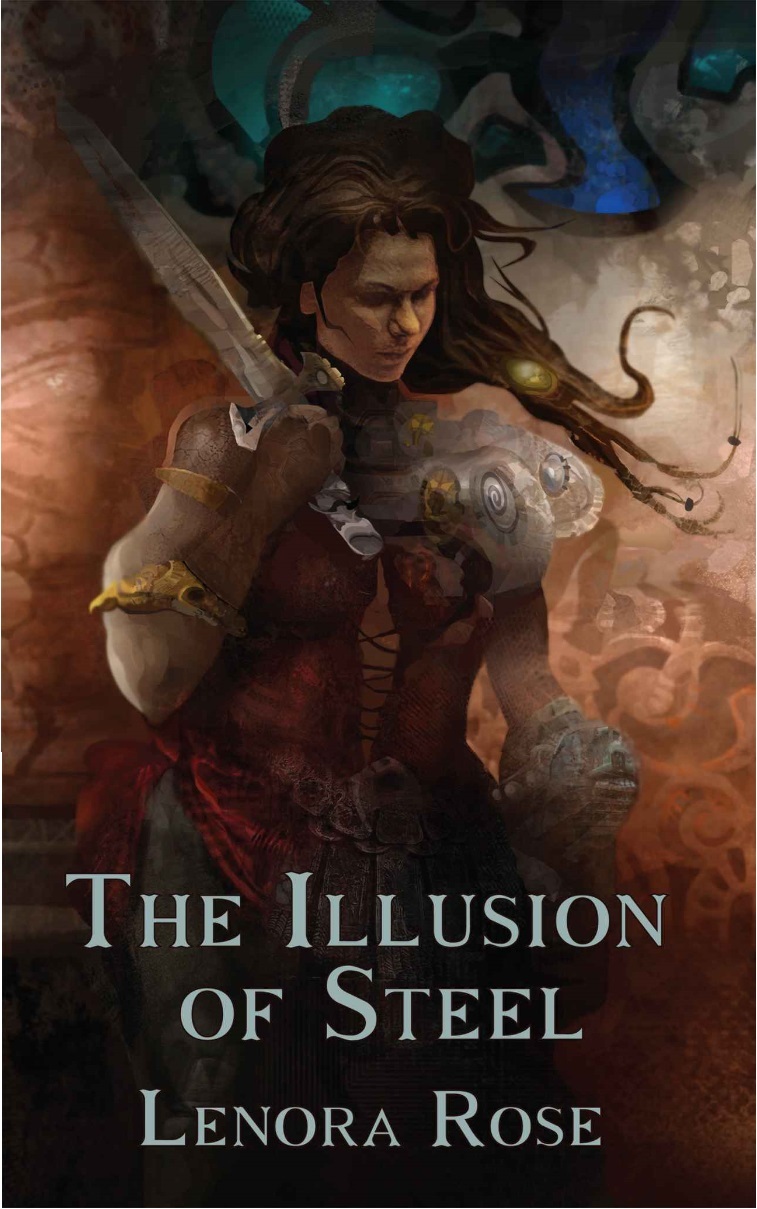
Not even a shape-shifter can hide from her past forever.

Abandoned by her mother as a child, never knowing her father, Kanna Mendrays understands how to hide. She has used her shapeshifting ability to mask who she is, what she is, even her gender. Now that she has come to Melidan Tower to heal, she finds her defenses crumbling.

Peace is scarce here. Biadei — the friend who saved her life and brought her to the Tower — goes mad at each full moon. The aged Lord Daemon — infamous for having killed the man who abused him — seems to know too much about her. Every room of the Tower presents Kanna with a mystery when all she wants is to be left alone.

And now she has begun to hear a voice: the spirit of Lord Daemon’s victim, whispering to her through a sword named Desecrator. When Biadei is captured by werewolves, it promises, “Give me Daemon, and I will save your friend. Give me Daemon, and you will know the truth about your family…”

The Illusion of Steel was published December 14, 2012 by Eggplant Literary Productions. It is 70 pages, priced at $4 in digital format. It is currently available from Amazon.com, Barnes & Noble, Kobo, and OmniLit. The gorgeous cover is by Alex Martínez. Read an excerpt at the Eggplant website.

Fredric Brown, Stanley G. Weinbaum, and Appendix N: Advanced Readings in D&D

Fredric Brown, Stanley G. Weinbaum, and Appendix N: Advanced Readings in D&D

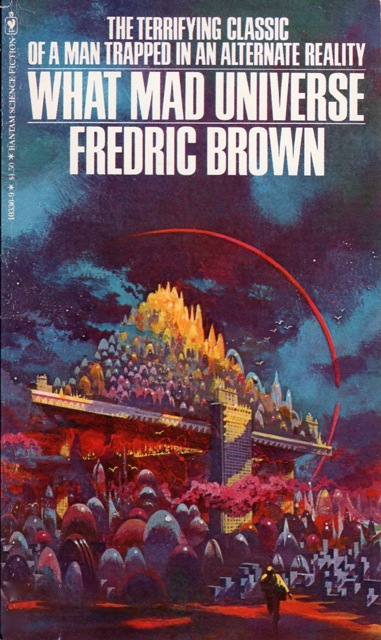
What Mad Universe-smallTime to get caught up with the tireless Mordicai Knode and Tim Callahan, as they trek towards the finish line of their epic Appendix N re-read over at Tor.com.

This time, they take a look at two names very familiar to Black Gate readers: Fredric Brown and Stanley G. Weinbaum, both of whom we’ve discussed recently, and at considerable length.

In fact, just last week I examined The Best of Fredric Brown, calling it “one of the best short story collections I’ve read in years.” Any collection which included “Arena,” “Puppet Show,” and “The Geezenstacks” has to be considered a classic, and I was looking forward to seeing what our intrepid literary explorers thought of it.

Not much, going by Tim’s analysis:

A spaceman single-handedly battles for the fate of the human race. A god plays war games with knights and bishops. Test tube babies become the new anointed ones. A mountaineer comes face-to-face with a yeti. Earth’s first contact with Mars goes horribly awry.

These are things that happen in the stories, often very short stories, of Fredric Brown. I can see why Gary Gygax liked them.

Unfortunately, their connection to Dungeons & Dragons is vague at best. They seem to fall into a category that, after reading most of these Appendix N recommendations, I can now confidently call Somewhat Clever Things Gary Gygax Enjoyed but are Pretty Tedious to Read Today.

Like the works of L. Sprague de Camp and Fletcher Pratt, the stories by Fredric Brown seem to be the kinds of tales that would delight Gygax with their intellectual playfulness and that might be reason enough for their inclusion on his list of recommended reading, but the cleverness only goes so far, and the stories feel pretty thin otherwise.

Bah. I don’t mean to critique the critic, but I think Tim was asleep at the switch here. Maybe he should have read these magical tales on a long plane-ride to Las Vegas, like I did, instead of hunched over his laptop, thirty minutes before deadline.

…

Read More Read More

Tell Us Your Favorite Sword & Sorcery Tale, and Win One of Five Copies of Stalking the Beast!

Tell Us Your Favorite Sword & Sorcery Tale, and Win One of Five Copies of Stalking the Beast!

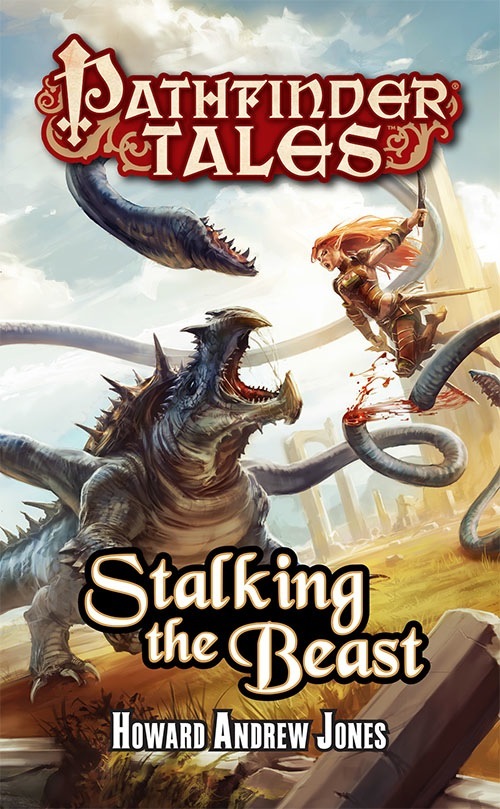
Pathfinder Tales Stalking the Beast-smallWe enjoy discussing sword & sorcery here at Black Gate. And we love to give away free stuff. So this week, we decided to combine our two favorite hobbies.

Specifically, we want to hear about your favorite sword & sorcery tale — novel or short story — and we want to give you one of five copies of Howard Andrew Jones’s exciting new Pathfinder Tales novel, Stalking the Beast, the follow-up to his hit Pathfinder release Plague of Shadows,

All five copies were provided by the fine folks at Paizo Publishing. Paizo will mail copies directly to five randomly-selected qualifying entrants.

How does this work, exactly?

It’s simple. Just send us a one-paragraph review of your favorite sword & sorcery novel or short story. Tell us what makes it so special and be sure to include the author and (if it’s a short story) where you read it.

Old or new, acknowledged classic or overlooked masterpeice, makes no difference. If it’s your favorite, we want to hear about it. And we’ll publish the best entries right here at Black Gate.

To enter our contest, just send an e-mail to john@blackgate.com with the title “Stalking the Beast,” and your one-paragraph entry, before December 1, 2013.

All entries become the property of New Epoch Press. No purchase necessary. Must be 12 or older. Decisions of the judges (capricious as they may be) are final. Terms and conditions subject to change. Sorry, US entrants only. Not valid where prohibited by law. Eat your vegetables.

And good luck!

New Treasures: Hooded Man by Paul Kane

New Treasures: Hooded Man by Paul Kane

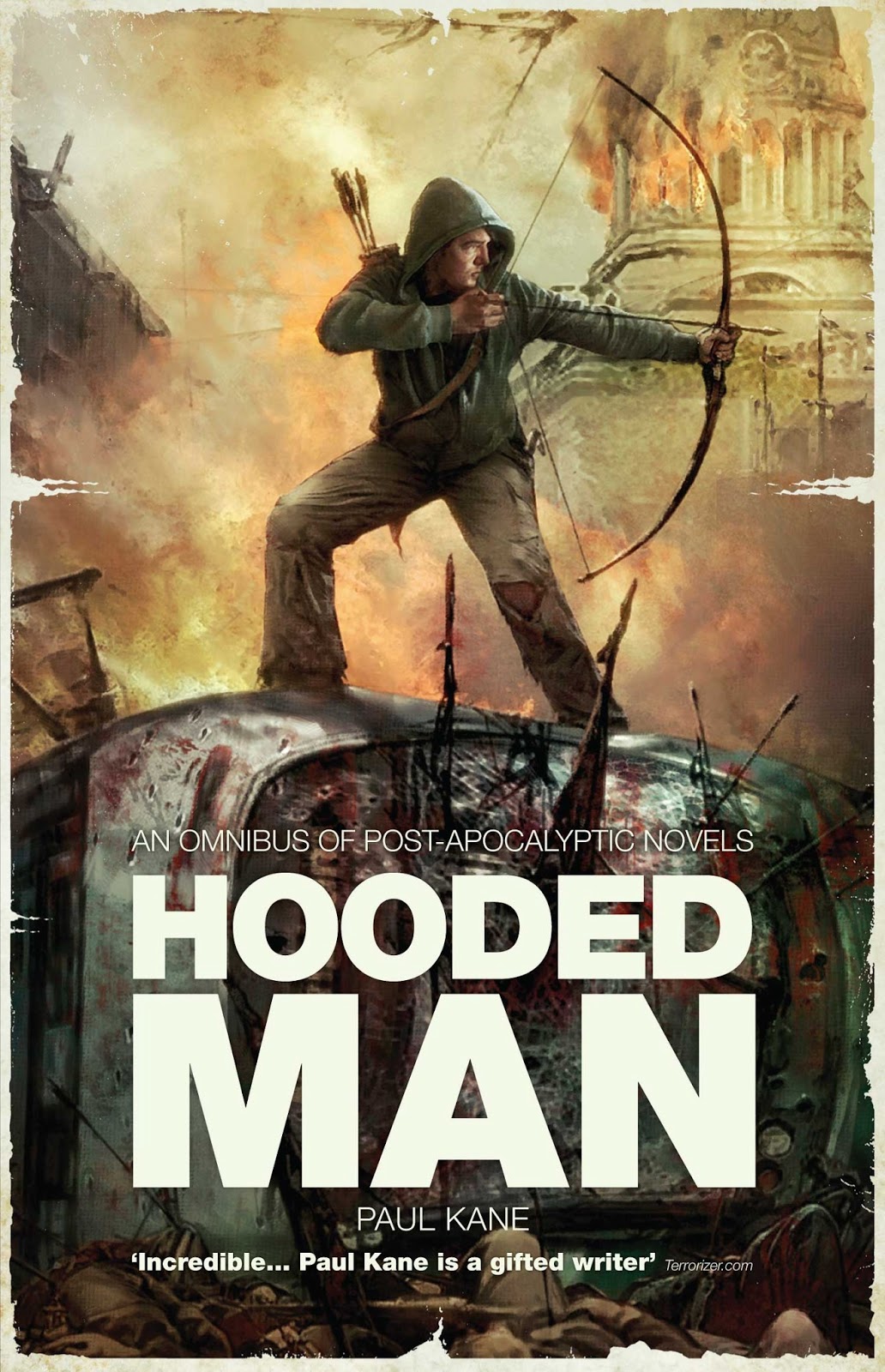
Hooded Man Paul Kane-smallThere are lots of retellings of Dracula out there (just in the last two weeks William Patrick Maynard covered of Marvel’s Dracula, Lord of the Undead, James Maliszewski examined Bela Lugosi’s turn as Count Dracula in the 1931 Universal film, and John R. Fultz looked at NBC’s new series Dracula.) Same with Sherlock Holmes (see the trailer for Season Three of BBC One’s adaptation here), and the Tales of King Arthur and his noble knights (examples from the past two weeks here and here).

Hell, they recently retold Carrie and John Carpenter’s Halloween, and those stories are barely 30 years old.

For my money, the legend that doesn’t get re-told enough is the tale of Robin Hood. I can think of only a handful of really fine versions in the last 30 years, including Parke Godwin’s novel Sherwood, Richard Carpenter TV series Robin of Sherwood, and Robin McKinley’s novel The Outlaws of Sherwood. So I was pleased to see a new omnibus collecting all three novels of Paul Kane’s post apocalyptic retelling, Hooded Man.

When nine-tenths of the world died horrifically, Robert Stokes lost everything, including his wife and his son. The world about him gradually descended into a second Dark Age, and the former policeman retreated into the woods near Nottingham, becoming a hunter, living off the land and avoiding any form of human contact… until now.

A new foreign despot, De Falaise, has looked on England and found it ripe for conquest. He leads an army of mercenaries through the Channel Tunnel and works his way up the country, pillaging as he goes. When De Falaise arrives at Nottingham and sets up his new dominion, Robert finds himself drawn reluctantly into the resistance, and assumes the mantle of the famous legend of Robin Hood, in a guerrilla war that will take him and his followers to the limits of endurance and beyond.

This volumes collects the novels Arrowhead, Broken Arrow, and Arrowland. Paul Kane’s other novels include Of Darkness and Light and The Gemini Factor. His short story collection, The Butterfly Man, was released in 2011 by PS Publishing. Although it’s standalone, Hooded Man is part of The Afterblight Chronicles series, which also includes School’s Out Forever by Scott K. Andrews and The Afterblight Chronciles: America by Simon Spurrier, Rebecca Levene and Al Ewing.

Hooded Man was published June 11, 2013 by Abaddon. It is 704 pages, priced at $12.99 in trade paperback and $9.99 for the digital version.

A Contagious Love of Fantasy: Lin Carter’s Imaginary Worlds

A Contagious Love of Fantasy: Lin Carter’s Imaginary Worlds

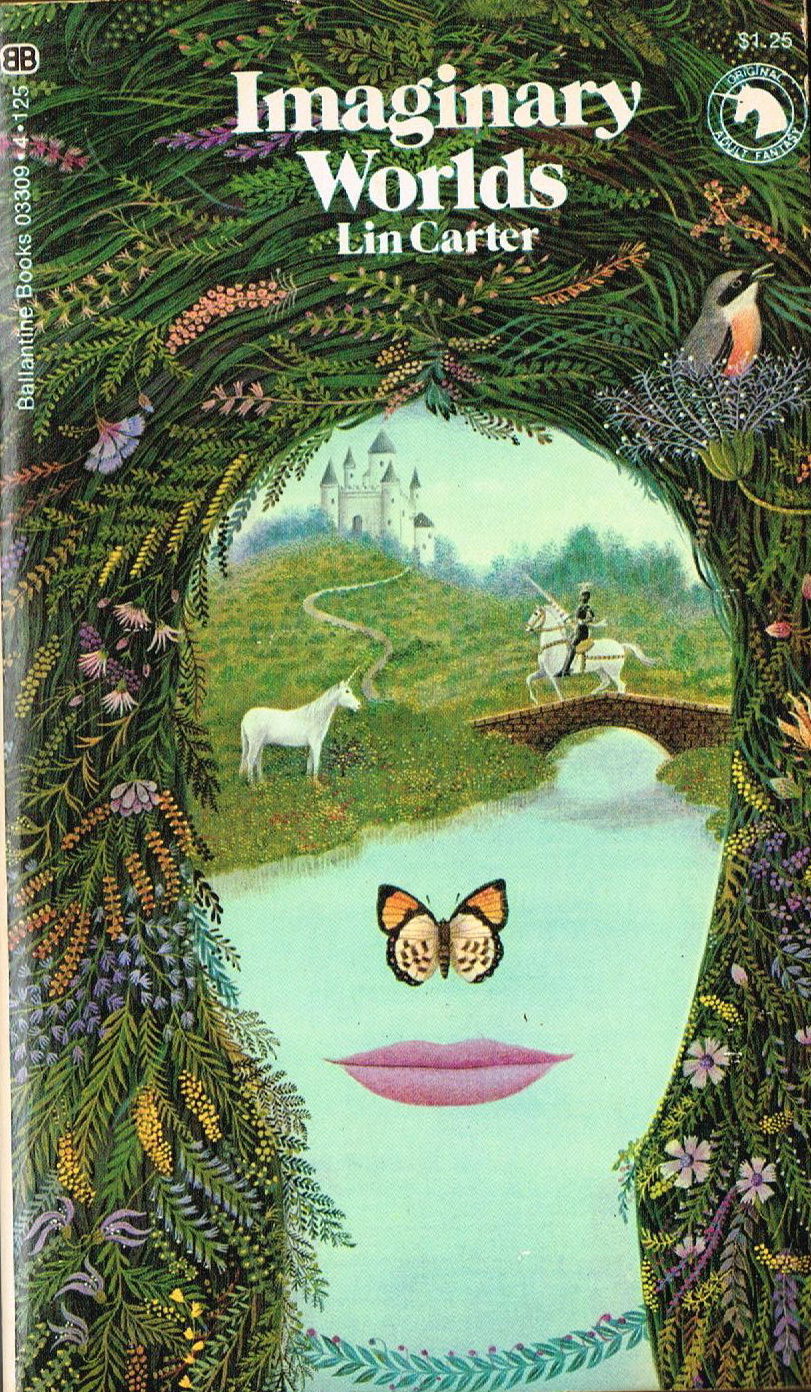
Lin Carter Imaginary Worlds-smallI recently did a review here at Black Gate of L. Sprague de Camp’s 1976 Literary Swordsmen and Sorcerers: The Makers of Heroic Fantasy. De Camp’s book is one of the few histories of the genre of fantasy around, and it is a great and enjoyable book. But it’s not the only one, nor probably the most favored. I get the sense from others’ comments that the Best History of Fantasy title probably goes to Lin Carter’s 1973 Imaginary Worlds.

Each of the chapters in de Camp’s book is dedicated to a separate writer. But most of the chapters in Carter’s book are centered around themes; in each chapter he examines fantasy writers that explore that theme well. In addition, Carter’s concluding chapters contain advice to authors on how to write fantasy. I found this latter part less interesting.

One of the plusses I pointed out for de Camp’s history was that you could tell he loved the genre. The same must be said in spades for Lin Carter. Carter wrote the introduction for Literary Swordsmen, and I was very excited to read de Camp’s book just on the strength of Carter’s intro. Imagine how enthusiastic I was to get Carter’s own book on the subject! (I’ve also heard that Carter’s intros to the Ballantine Adult Fantasy are fantastic as well.)

Carter’s love of fantasy is contagious. He writes with a real verve for his favorite fantasy authors, books, and tropes. Carter is unapologetic about his love for fantasy and seems completely unaffected by criticisms of childishness or escapism. Given his thoughtful interactions with the genre, he does not come off as a slavish fanboy. Instead, Carter strikes me as an intelligent and committed fantasist. Quite refreshing! I wish he were still alive.

Often when I read or hear other people talk about their favorite authors or books, I make notes for possible future purchases. If you’re setting out for yourself the task of trying to catch up on the great works of fantasy, the many references that Carter gives can leave you feeling exhausted.

But Carter is also good at pointing out what you probably shouldn’t bother with or if you’re only going to read one book by author X, make sure you read just Y. These suggestions are incredibly helpful and lessen your anxiety if you are indeed trying to catch up on the great works. (Speaking of which, I definitely want to get a copy of The Worm Ouroboros by E. R. Eddison. De Camp and Carter both raved about it.)

…

Read More Read More

The Blinding Knife by Brent Weeks Wins the 2013 David Gemmell Legend Award

The Blinding Knife by Brent Weeks Wins the 2013 David Gemmell Legend Award

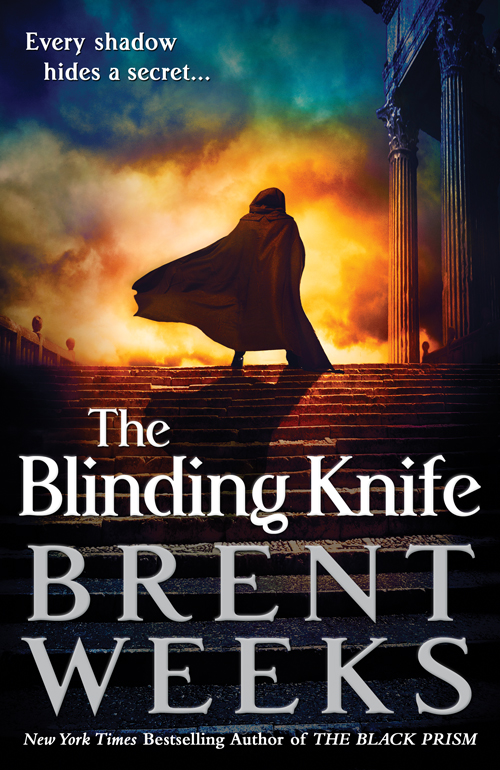
The Blinding Knife-smallBrent Weeks’s The Blinding Knife, the second volume of The Lightbringer Saga, has won the David Gemmell Legend Award for Best Fantasy Novel of 2012.

The David Gemmell Legend Award is a fan-voted award administered by the DGLA. This is the fifth year for the Legend Award; it was first granted in 2009 to Andrzej Sapkowski’s Blood of Elves; in 2010 to Graham McNeill’s Empire: The Legend of Sigmar, in 2011 the winner was Brandon Sanderson’s The Way of Kings, and last year The Wise Man’s Fear by Patrick Rothfuss received the honors.

The nominees for the 2013 award also included The Red Country by Joe Abercrombie, Stormdancer by Jay Kristoff, King of Thorns by Mark Lawrence, and The Gathering of the Lost by Helen Lowe.

The Morningstar Award for Best Fantasy Debut was awarded to Malice by John Gwynne.

The Ravensheart Award for best Fantasy Book Jacket Artist went to Didier Graffet & Dave Senior for the cover of The Red Country by Joe Abercrombie.

Our man-on-the-scene, roving reporter Harold M. Page, will report in with complete details on the ceremonies right here on Thursday.

Complete details are available at the DGLA website.

Congratulations to all the winners!