Browsed by
Category: Books

New Treasures: Pathfinder Tales: Stalking the Beast by Howard Andrew Jones
New Treasures: Pathfinder Tales: Stalking the Beast by Howard Andrew Jones

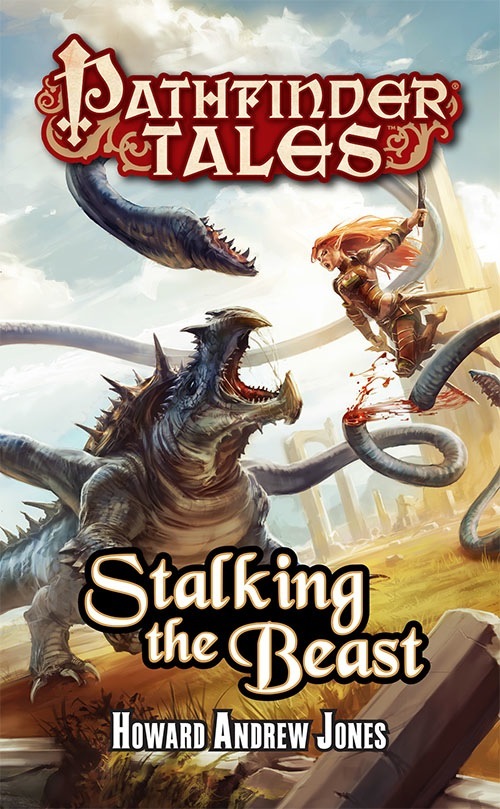
Pathfinder Tales Stalking the Beast-smallIt’s funny. I talked to Howard nearly every day while he was writing this book, and heard the blow-by-blow as he devised the plot and fleshed out the characters, recognized the growing excitement in his voice as the novel came together and he contributed his own unique talents and fine narrative gifts to the collaborative bit of gaming genius that is Pathfinder. It almost felt like reading the book would be superfluous.

And then I read the description below and realized hearing all the behind-the-scenes details meant absolutely nothing. It’s like saying you know how a gourmet dish will turn out because you’ve seen all the ingredients. I may have watched Howard lay all the pieces out on his writing table, but the true magic comes in how they all fit together. I’m excited to find out and I know I’ll be delighted.

When a mysterious monster carves a path of destruction across the southern River Kingdoms, desperate townsfolk look to the famed elven ranger Elyana and her half-orc companion Drelm for salvation. For Drelm, however, the mission is about more than simple justice — it’s about protecting the frontier town he’s adopted as his home, and the woman he plans to marry.

Together with the gunslinging bounty hunter Lisette and several equally deadly allies, the heroes must set off into the wilderness, hunting a terrifying beast that will test their abilities — and their friendships — to the breaking point and beyond. But could it be that there’s more to the murders than a simple rampaging beast?

From critically acclaimed author Howard Andrew Jones comes a new adventure of love, betrayal, and unnatural creatures, set in the award-winning world of the Pathfinder Roleplaying Game.

Interested? Paizo has promised us enough free copies for a giveaway. Stay tuned for details and you could win your own copy.

Pathfinder Tales: Stalking the Beast was published this week by Paizo. It is 400 pages, priced at $8.99 in paperback. No word on the digital edition yet. Howard’s previous Pathfinder book was Plague of Shadows, released in 2011. His most recent novel was The Bones of the Old Ones.
Weird of Oz: Hallowe’en Postmortem

Weird of Oz: Hallowe’en Postmortem

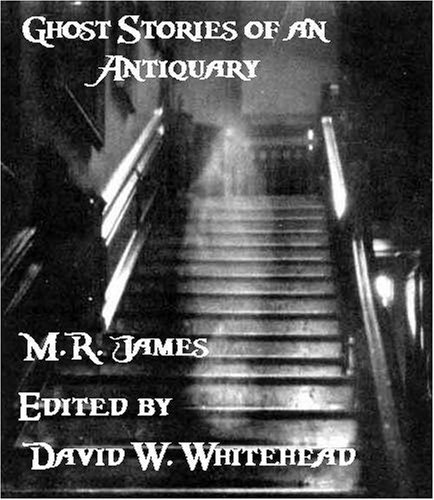
more ghost storiesHallowe’en always passes, for me, with a waft of melancholy, like a chilly breeze blowing down the last few clinging maple leaves.

Leaf 1: R.I.P. Hallowe’en 2013

This October was a busy one for me. Five days out of seven, I was hosting a ghost tour, accompanied on many of those nights by a bona fide “paranormal investigator.” The thirty or so guests we conducted into the shadows each night had quite a time and I must admit — note that I characterize myself as an “open-minded skeptic” — I may have had a paranormal experience or two myself. After having been “Haunted Master of Ceremonies” for these tours the past three years, dozens of evenings, that was a first. Maybe I’ll write about it sometime, somewhere. I have to process it a bit more first, try to debunk it and exhaust alternate explanations.

You might say I have a little Scully and a little Mulder in my head. Not that I have split personality disorder or anything, but when something happens, these two sides of my mind — the rational, scientific side and the childlike-wonder side who “wants to believe” — begin laying out their competing narratives to explain the event. Which side wins out? Both. Neither. This world is a mysterious place and no one’s gotten to the bottom of it. I certainly won’t.

I’ll just keep celebrating the mystery and fastidiously trying to avoid ever getting bored by it. Boredom is the end; it’s death; it’s deciding you don’t really care what’s going on. Whenever that starts to happen (and it does, friends, as you creep along toward gray hair and creaky bones), I retreat to the proverbial “black gate,” to the wellsprings of fantasy, to the towers of science fiction, to the tombstones of horror. Visiting imagined worlds reminds the disenchanted traveler how endlessly bizarre and fascinating and surprising is this world in which we live.

…

Read More Read More

Vintage Treasures: The Best of Fredric Brown

Vintage Treasures: The Best of Fredric Brown

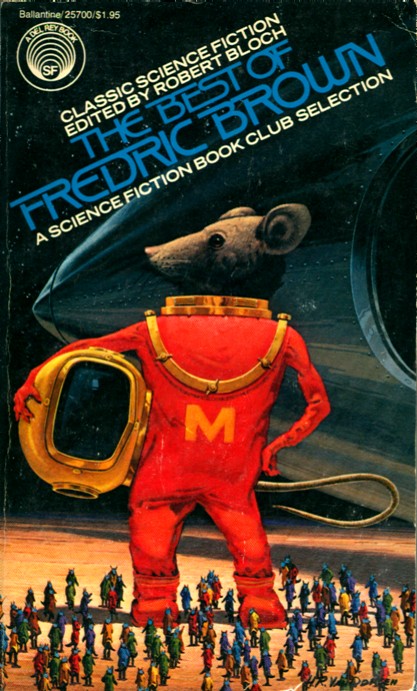
The Best of Fredric Brown-smallWelcome to the 13th installment of my ongoing examination of one of the most influential book series of my youth, Lester Del Rey’s Classics of Science Fiction line. This time, we’re looking at the 1977 release, The Best of Fredric Brown, edited by Robert Bloch (who had his own entry in the series eleven months after this one, which I discussed back in July.)

The Classics of Science Fiction line was my introduction to many of the major SF and fantasy writers of the 20th Century (well, that and The Hugo Winners, which first introduced me to Poul Anderson, Walter C. Miller, Arthur C. Clarke, and others, and of course the various volumes of The Science Fiction Hall of Fame).

All that education didn’t teach me much about Fredric Brown, however. A week ago, I probably could have named only one Fredric Brown short story from memory, “Arena” — which, admittedly, I dearly loved. I first read it in The Science Fiction Hall of Fame, Volume One, where it was selected as one of the finest short stories ever written, but even before that, I knew it as the Star Trek episode of the same name.

You probably think of it as, “Isn’t that the one where Kirk throws styrofoam rocks at the Gorn?”

Yes. Yes it is. And even though it has been much-parodied (including a brilliant video game commercial starring an 80-year old William Shatner and an aged Gorn in a re-match), it’s still one of the finest episodes of the original series.

So before I sat down to assemble my notes for this article, I took my paperback copy of The Best of Fredric Brown with me on a business trip, to a banking show in Las Vegas, and used the opportunity to reacquaint myself with the author. Honestly, I wasn’t expecting all that much. Not every installment in the Classics of Science Fiction could be a winner.

My mistake.

The Best of Fredric Brown is one of the best short story collections I’ve read in years. Brown is frequently compared to O. Henry for his gift for twist endings and the comparison is apt. Even when you’re on the alert, Brown manages to constantly surprise and delight you in a way that very few authors — in the genre or out — can pull off.

…

Read More Read More

2013 World Fantasy Award Winners Announced

2013 World Fantasy Award Winners Announced

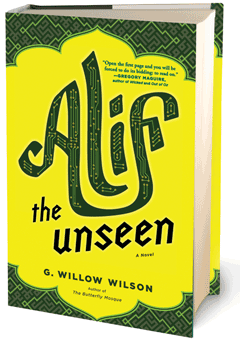
alif-the-unseenYou’d think that, since I’m unable to attend World Fantasy this year, they’d keep the convention low key. I mean, no sense rubbing it in, right?

No such luck. I hear there was just as much excitement, just as many panels, and just as many fabulous parties as always. It’s like they don’t care.

They even gave out just as many awards as usual. Well, even if I couldn’t attend, at least I can read the same award-winning fantasy as everyone else. See, that’s what’s great about awards — they’re fair to everybody.

This year’s winners of the World Fantasy Awards are:

Novel:

Novella:

  • “Let Maps to Others,” K.J. Parker (Subterranean, Summer 2012)

Short Story:

  • “The Telling,” Gregory Norman Bossert (Beneath Ceaseless Skies, Nov 29, 2012)

…

Read More Read More

A Look Into the Heart of the Great Continent: Milt Davis’ Woman of the Woods

A Look Into the Heart of the Great Continent: Milt Davis’ Woman of the Woods

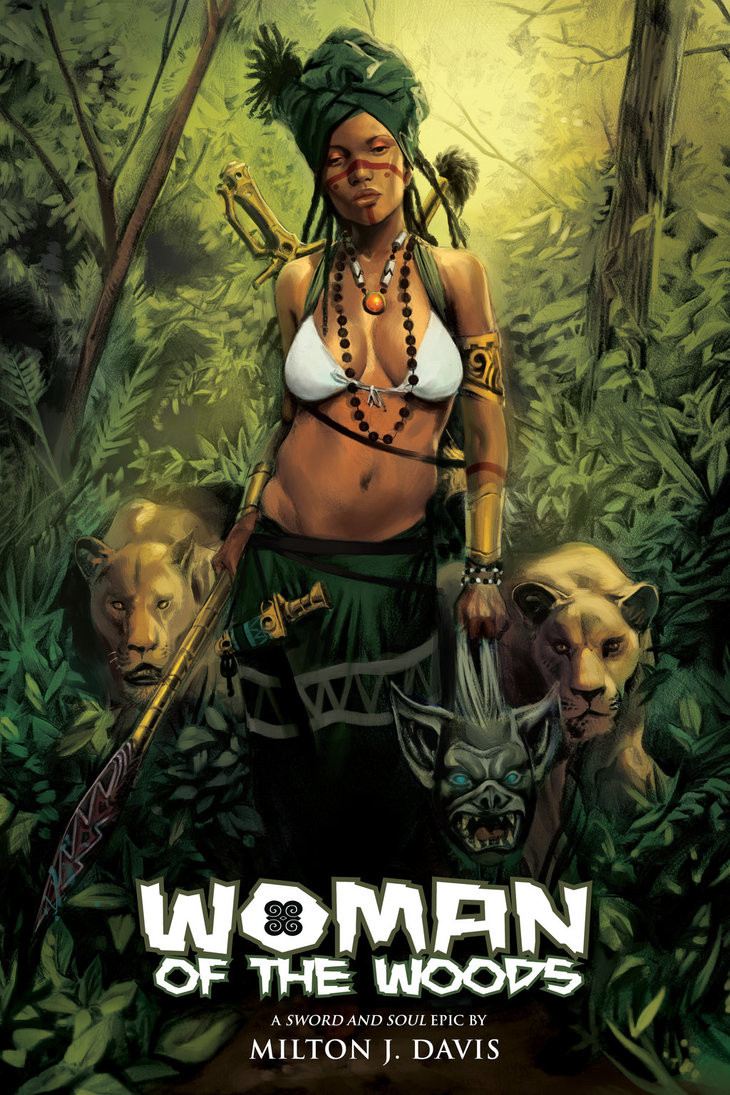
Woman of the Woods - smallSword and Soul is a genre that embraces the pulp-style action and adventure of Sword and Sorcery with the world-building of Heroic and Epic Fantasy.

It was born in the 1970s, when famed author Charles Saunders created Imaro, the first black fantasy hero in Sword and Sorcery fiction. Using the diverse mythologies, religions, histories, and traditions of Africa and its many ancient cultures, Sword and Soul offers us a look into the heart of that great continent and the rich heritage of its people. The setting is often an alternate-world version or a forgotten age of prehistoric Africa, something that is often ignored in fantastic fiction, other than those tales of “the great white hunter in Darkest Africa.”

The beauty of Sword and Soul — what makes it unique and refreshing for me — is that it revolves around a world, its people and cultures and traditions, that are not usually represented in the medieval, European-based worlds of fantasy.

Milton J. Davis (author of Changa’s Safari, Meji, and co-editor, along with Charles Saunders, of the anthologies Griots and the upcoming Griots 2: Sisters of the Spear) is at the forefront of the new Sword and Soul movement, leading a wave of new authors who are building new worlds and expanding on old concepts and traditions.

In Woman of the Woods, Davis returns to the world of Meji and introduces us to a new character, Sadatina. She’s a young Adamu girl on the threshold of womanhood, who finds herself at the center of a war between her people and their old enemy, the Mosele. For all the action, adventure, and magic, this is also a dramatic “coming of age” story, with real flesh and blood characters that have a past and carry the emotional weight and baggage everyone collects over the years.

…

Read More Read More

Self-published Book Review: The Nameless Dwarf by D. P. Prior

Self-published Book Review: The Nameless Dwarf by D. P. Prior

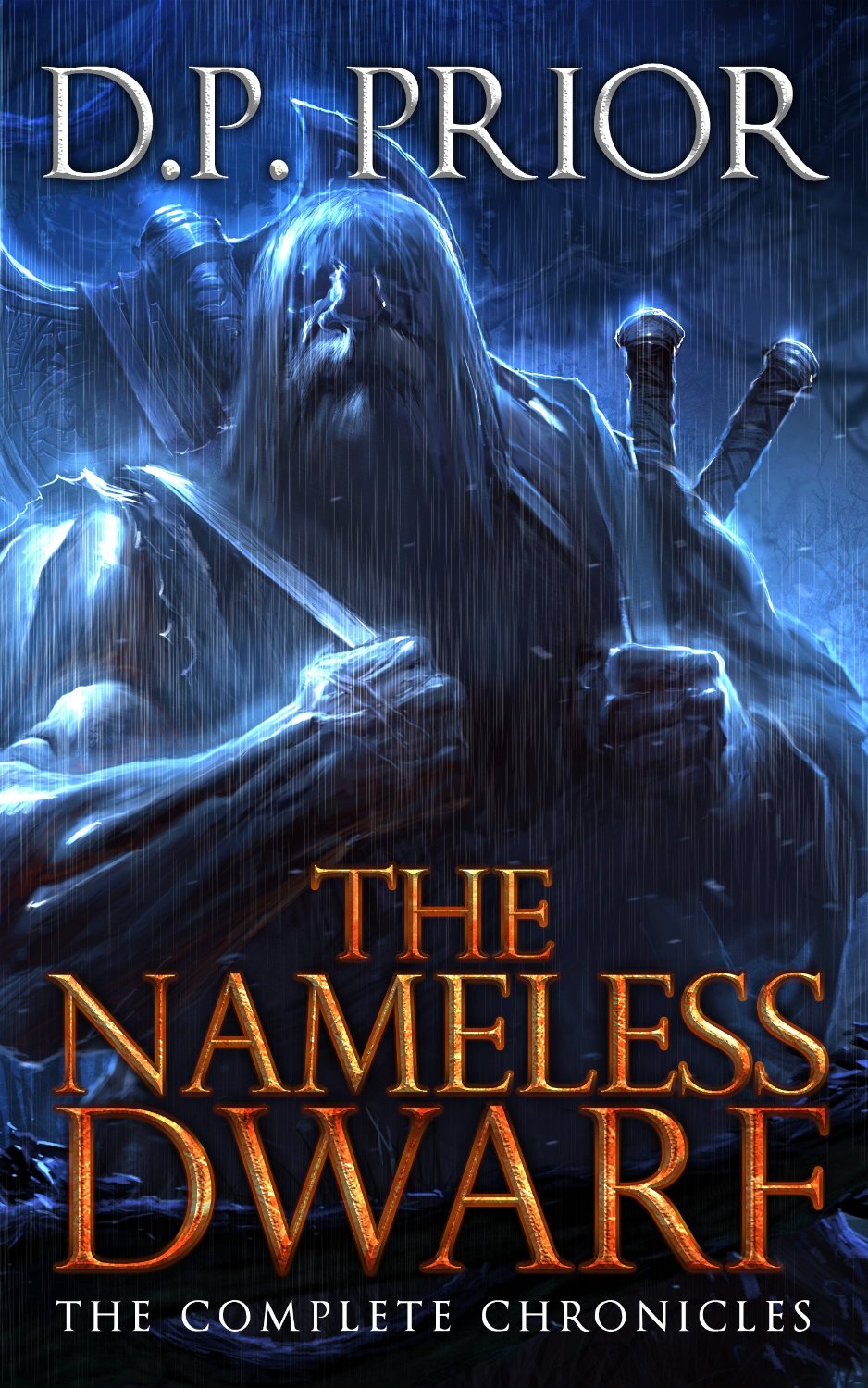
Nameless_chroniclesI have a soft spot for dwarves. I consider elves over-used Mary Sues and I could go another decade or two without reading another story about fairies, but give me short smiths with beards and axes who drink too much and I’ll keep reading. Which brings us to this month’s self-published book: The Nameless Dwarf: The Complete Chronicles. This wasn’t a book that the author submitted to me by my normal process: I’ll get back to those next month. This time, I actually bought the book from Amazon for actual money, because hey, it was about a dwarf.

Nameless (and yes, everybody calls him Nameless) has a bit of a history. Much of it is chronicled in earlier books, only a couple of which seem to be available from Amazon. Because of this, I decided to take a chance on The Nameless Dwarf without reading about Nameless’s previous adventures. The problem is that the backstory is a bit much to take in all at the beginning. The long and short of it is that Nameless came in possession of a cursed axe. Despite this, he engaged in a number of adventures with the well-known hero Shader, but later, the axe overcame him and caused him to do all sorts of unsavory things, including butchering a lot of his fellow dwarves and becoming a tyrannical dictator and driving them to war, until at last his people fled. When Nameless was finally freed of the cursed axe, he decided that he needed to seek his people out, not to ask forgiveness, which was impossible, but to tell them they could go home, before their exile in the nightmare lands of Qlippoth destroy them utterly. And that’s where the novel begins. I can’t help feeling that the backstory would have had more power if I had been able to read the earlier books and there were plenty of references to people and events from the previous stories that I would have liked to know more about. But even so, there was enough explained at the beginning that I wasn’t entirely lost.

…

Read More Read More

Plot, Plain and Simple

Plot, Plain and Simple

Writing the Novel From Plot to PrintI may have mentioned this before, but now that I’ve started talking about problems associated with plot, I’ll mention it again: There’s a lot of talk out there about plot-driven narratives versus character-driven narratives, where the former is “bad” and the latter is “good.”

Here’s the skinny: these are terms useful to the book reviewer or critic. They’re not useful to the writer and here’s why: There is no plot without character and there is no character without plot. Specifically, there’s no action without a character to perform it, and no characters without actions to define them. Nothing happens unless someone decides to do it, and unless someone does something, there’s no plot. In fact, there’s no story. This is true for every novel, every short story, every film, every TV show, and an awful lot of poetry. Regardless of genre.

There are things like allegories and satires, in which this might be debatable. Of course, the primary purpose of these is not to tell a story, but to get a particular point across, so screwing with the narrative is okay and even expected. But the best of these will at the very least pretend to include character and plot.

Last week, I talked about how badly-used plot devices often arise out of the writer ignoring character and “making” something happen, often to manipulate the reactions of readers and viewers. You can avoid this by asking yourself some simple questions right at the start. Many of us start writing with character in mind, so we ask ourselves, “Given this type of person, what kind of interesting things can happen to her?” Even if you start somewhere else, however, one of the first questions you’ll have to ask yourself is “Whose story is it?”

…

Read More Read More

An Inkling of the Internal Life: The Novels of Charles Williams

An Inkling of the Internal Life: The Novels of Charles Williams

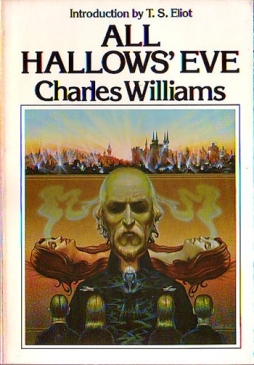
All Hallows' EveI observed the other day that the end of October’s a good time for reading classic weird fiction. This morning, as young ghosts and goblins of all sorts are preparing their evening’s depredations, I’m writing about a subject I’ve wanted to deal with for a while: the novels of Charles Williams. Williams was born in 1886, and died in 1945; a scholar, poet, editor, and theologian as well as a novelist, he’s probably the third-best-known of the informal group of Oxford Christians called the Inklings, behind C.S. Lewis and J.R.R. Tolkien. A Christian fascinated with the occult, his novels are tales of the supernatural and the numinous at play in the ‘real’ world. He wrote of ghosts, magi, and the Holy Grail, among other things, and his stories, laboured and profound, are some of the strangest fantasies I know.
I’ll start with some biographical detail (much of which I found in Humphrey Carpenter’s book The Inklings). Williams was hired by the Oxford University Press in 1908, and soon rose to become an editor. His first book of poems was published in 1912. In 1917 Williams was married, and in the same year was initiated into the Fellowship of the Rosy Cross, a successor organisation to the faction-ridden occult group called the Order of the Golden Dawn. He continued to write poetry through the 1920s, and in 1927 wrote two masques, a kind of ceremonial drama. He’d begun lecturing at local institutes, and soon after the masques wrote his first novel, Shadows of Ecstasy. He couldn’t find a publisher for it at first, but his second book, War in Heaven, made it to print in 1930. Three more novels followed: Many Dimensions in 1931, then The Place of the Lion and The Greater Trumps in 1932. Shadows of Ecstasy was finally published in 1933.

…

Read More Read More

Mind Meld: Worthy Media Tie-ins

Mind Meld: Worthy Media Tie-ins

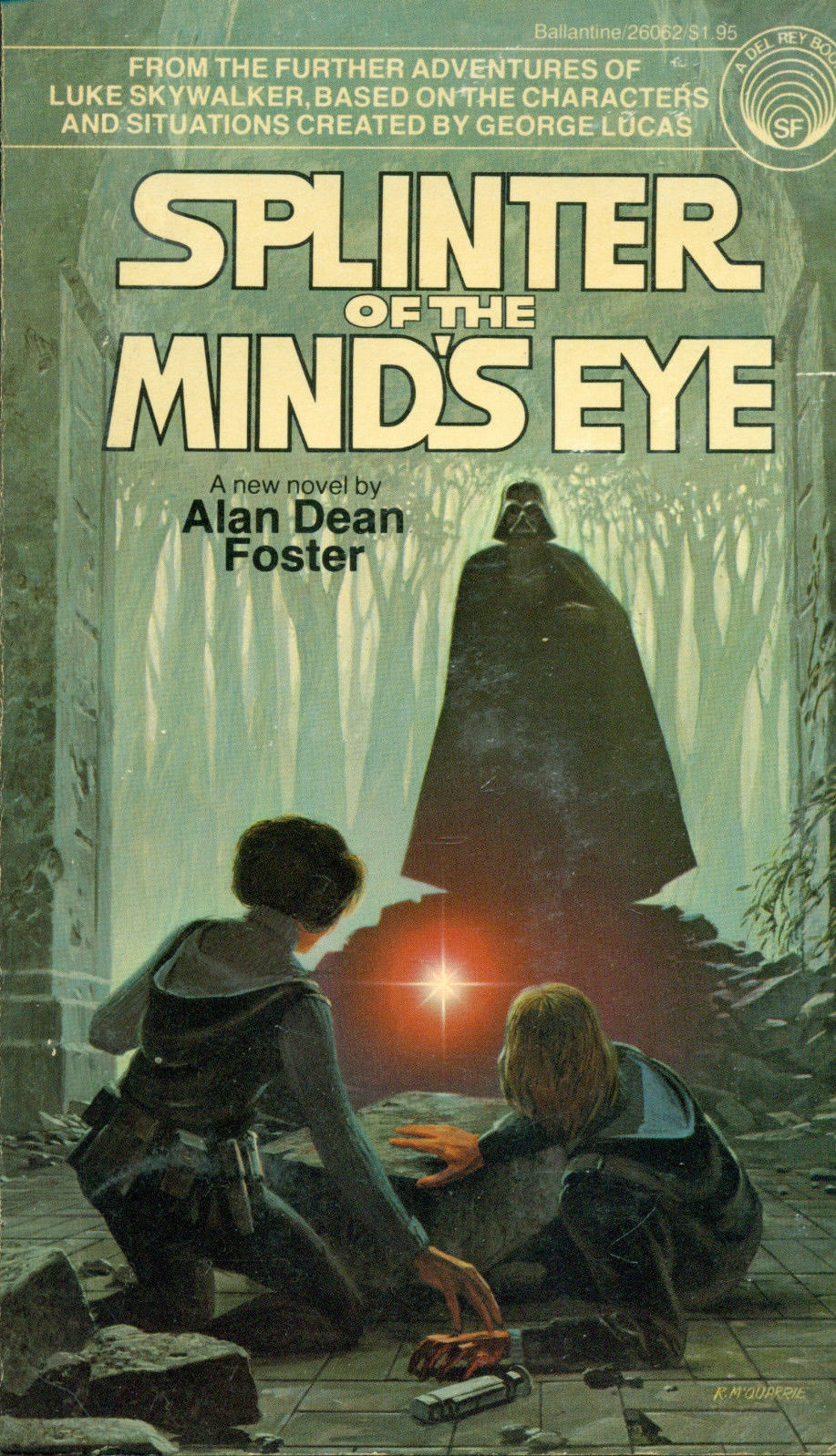
Splinter of the Mind's Eye-smallI was honored to be invited to participate in a Mind Meld article at SF Signal earlier this month. The topic was “Worthy Media Tie-ins,” so of course I took the chance to expand on my love of James Blish’s Star Trek books — particularly Star Trek 2, one of the very first books I ever owned, which I first mentioned a few weeks back in my review of The Best of James Blish.

What made James Blish’s Star Trek tie-in books so great? They were fun, fast-paced, and most of all, familiar. Before I plucked Star Trek 2 off the rack, the adult section of the bookstores was a strange and unfriendly place, filled with covers of stiff, formally attired men and much less stiff, partially-attired women. In short, Blish’s books were a gateway drug to a much wider world. With phasers.

But the book I was really dying to talk about was Alan Dean Foster’s Splinter of the Mind’s Eye, the very first Star Wars tie-in novel and the book that launched an entire publishing empire:

Splinter Of The Mind’s Eye isn’t just a media tie-in novel. It’s sort of an alternate-world, parallel-universe media tie in novel. A tie-in novel for a Star Wars universe in some time-stream that has nothing at all to do with our universe.

This is because Splinter Of The Mind’s Eye was written well before the release of The Empire Strikes Back. Before we knew that Vader was Luke’s father, before Han and Leia started making goo-goo eyes at each other, and before Leia traded in her princess gowns for a blaster with a full clip.

So Luke and Leia get a little more frisky in this book than you would reasonably expect from long-lost siblings, and Leia is a bit more of a helpless princess than you would anticipate after seeing Empire. Also, Darth Vader is a total dick, and has no compunctions at all about carving Luke up with his glowy red light sabre. Clearly, the paternity results had not arrived yet.

It’s not all about me, of course. There are some excellent discussions of other classic media tie-ins. John Mierau — who also has fond memories of Splinter of the Mind’s Eye — talks about Eric Nylund’s much-loved Halo novel The Fall of Reach; Aaron Rosenberg highlights Max Allan Collins’s Dark Angel trilogy, which tied up the dangling storylines after the TV series was canceled; James L. Sutter explores Richard A. Knaak’s classic DragonLance series The Legend of Huma; and Chadwick Ginther celebrates David Annandale’s entry in the Warhammer 40,000 universe, Death of Antagonis — among many others.

Enjoy the entire article here. Thanks to Andrea Johnson at SF Signal for the invite — I had a blast doing this one.

New Treasures: Man Made Boy by Jon Skovron

New Treasures: Man Made Boy by Jon Skovron

9780670786206_ManMadeBoy_JK.inddParanormal romance has been the biggest trend in modern fantasy in the last decade. As Eddie so succinctly put it in Knight of the Dinner Table: The Java Joint, “Publishing today is all about getting hot and heavy with the unholy.”

But while it certainly may seem that modern publishing has jettisoned all the old taboos and explored every conceivable relationship and forbidden love triangle with the monsters that once terrified us — sexy vampires, sultry demons, brooding werewolves, enigmatic fae, horny spirits, shy zombies, and on and on — one classic creature has been sorely neglected. One of the great cinematic monsters, who has unfairly been overlooked in this modern pageant of passion.

You know where I’m going with this.

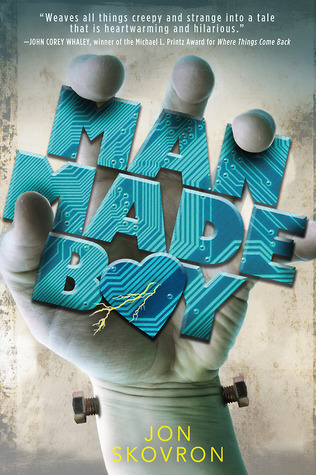
Sure, maybe Frankenstein’s monster isn’t really leading man material. But let’s face it — he’s gotta be a cut above zombies and ghosts (and, depending on the quality of parts we’re talking, possibly well above werewolves and demons too). Thus, I was well pleased to see Man Made Boy cross my desk earlier this month, a major fantasy release that looks to rectify this cruel oversight.

Love can be a real monster.

Sixteen-year-old Boy’s never left home. When you’re the son of Frankenstein’s monster and the Bride, it’s tough to go out in public, unless you want to draw the attention of a torch-wielding mob. And since Boy and his family live in a secret enclave of monsters hidden under Times Square, it’s important they maintain a low profile.

Boy’s only interactions with the world are through the Internet, where he’s a hacker extraordinaire who can hide his hulking body and stitched-together face behind a layer of code. When conflict erupts at home, Boy runs away and embarks on a cross-country road trip with the granddaughters of Jekyll and Hyde, who introduce him to malls and diners, love and heartbreak. But no matter how far Boy runs, he can’t escape his demons—both literal and figurative — until he faces his family once more.

This hilarious, romantic, and wildly imaginative tale redefines what it means to be a monster — and a man.

Man Made Boy was written by Jon Skovron, published on October 3 by Viking. It is 368 pages, priced at $17.99 in hardcover and $10.99 in digital format.