Blogging Sax Rohmer’s The Return of Dr. Fu-Manchu, Part Two: “The Cry of the Nighthawk”
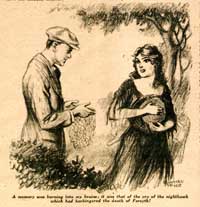 “The Cry of the Nighthawk“ was the second installment of Sax Rohmer’s Fu-Manchu and Company. The story made its debut in Collier’s on December 26, 1914 and was later edited to comprise Chapters 4-6 of the second Fu-Manchu novel, The Devil Doctor first published in 1916 in the UK by Cassell and in the US by McBride & Nast under the variant title, The Return of Dr. Fu-Manchu.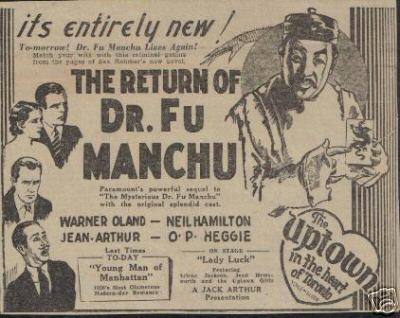
Rohmer’s tale bears definite similarities to his first Fu-Manchu story, “The Zayat Kiss” (1912) in that the story opens with Dr. Petrie at work in his principal vocation caring for a patient called Forsyth who has turned up at his residence late that evening with a badly infected hand. Petrie, in true pulp fashion, fails to recognize that Forsyth is the spitting image of Nayland Smith with a moustache.
Finished with his patient, Petrie goes to his study to find Smith with the lights out staring frantically outside just as he had at the opening of “The Zayat Kiss.” Petrie joins him and they watch poor Forsyth walk to his doom under the elms. They hasten outside after hearing the cry of a nighthawk and retrieve Forsyth’s dead body with its mutilated face. Only then does Petrie realize that Forsyth is Smith’s doppelganger and the duo then deduce that the poor man shared the fate intended for Smith.
 The holidays are over and according to AccuWeather, approximately 70% of the United States has snow on the ground and for a whole lot of you, this may be just a rare enough occurrence that for the moment, you’re mildly amused. But trust me when I tell you the novelty of throwing it at each other, sliding down it, or for a select group of you, writing your name in it, is going to wear off. And that’s when the cabin fever sets in.
 The Long Look

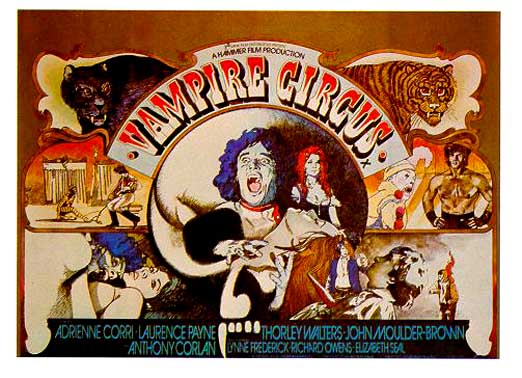 Vampire Circus (1972)

 Last week, I discussed my
 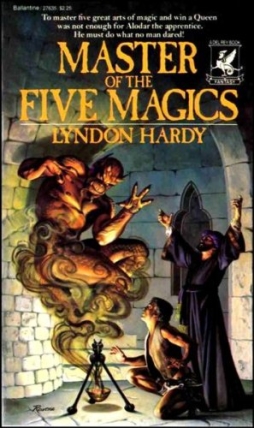 I’ve been thinking lately about fantasy in the 1980s. More specifically, about the wave of fantasy fiction that began to be published in the late 70s, in the wake of The Sword of Shannara and the first Thomas Covenant books, and which over the following years developed into fantasy as we know it now. So far as I can learn, it seems that this was when fantasy really took root as a novel category — that is, when fantasy novels stopped being relatively rare events and began to flourish as a genre. As a result, I think, it was a time when the idea of fantasy broadened; new ideas and forms and voices were tried, even if certain assumptions (like a quasi-medieval-European setting) were often unquestioned. What I wonder is whether certain things tried then and since almost forgotten are in fact worth revisiting.