Swords & Sorcery and The Fantastic Swordsmen, edited by L. Sprague de Camp
 |
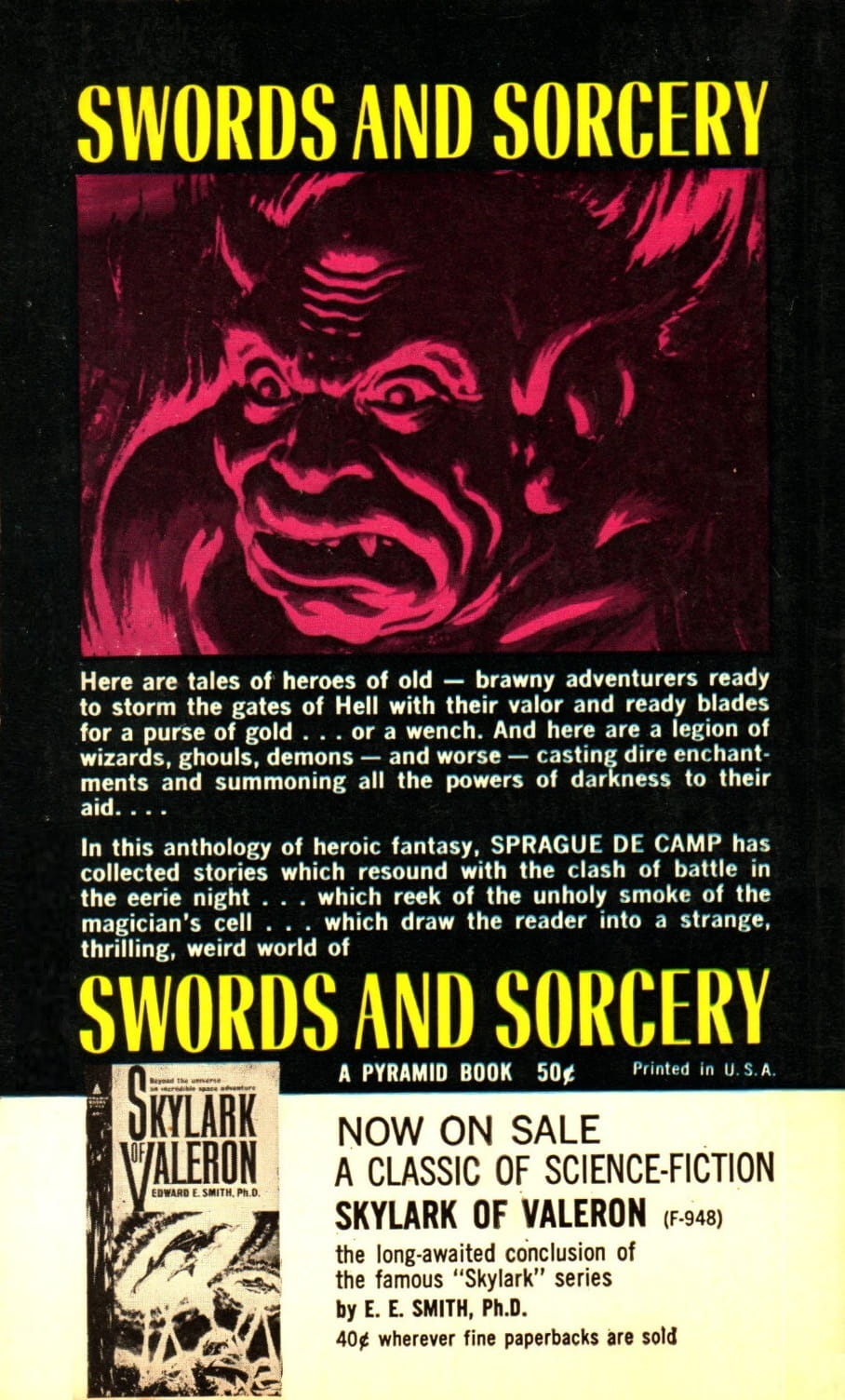 |
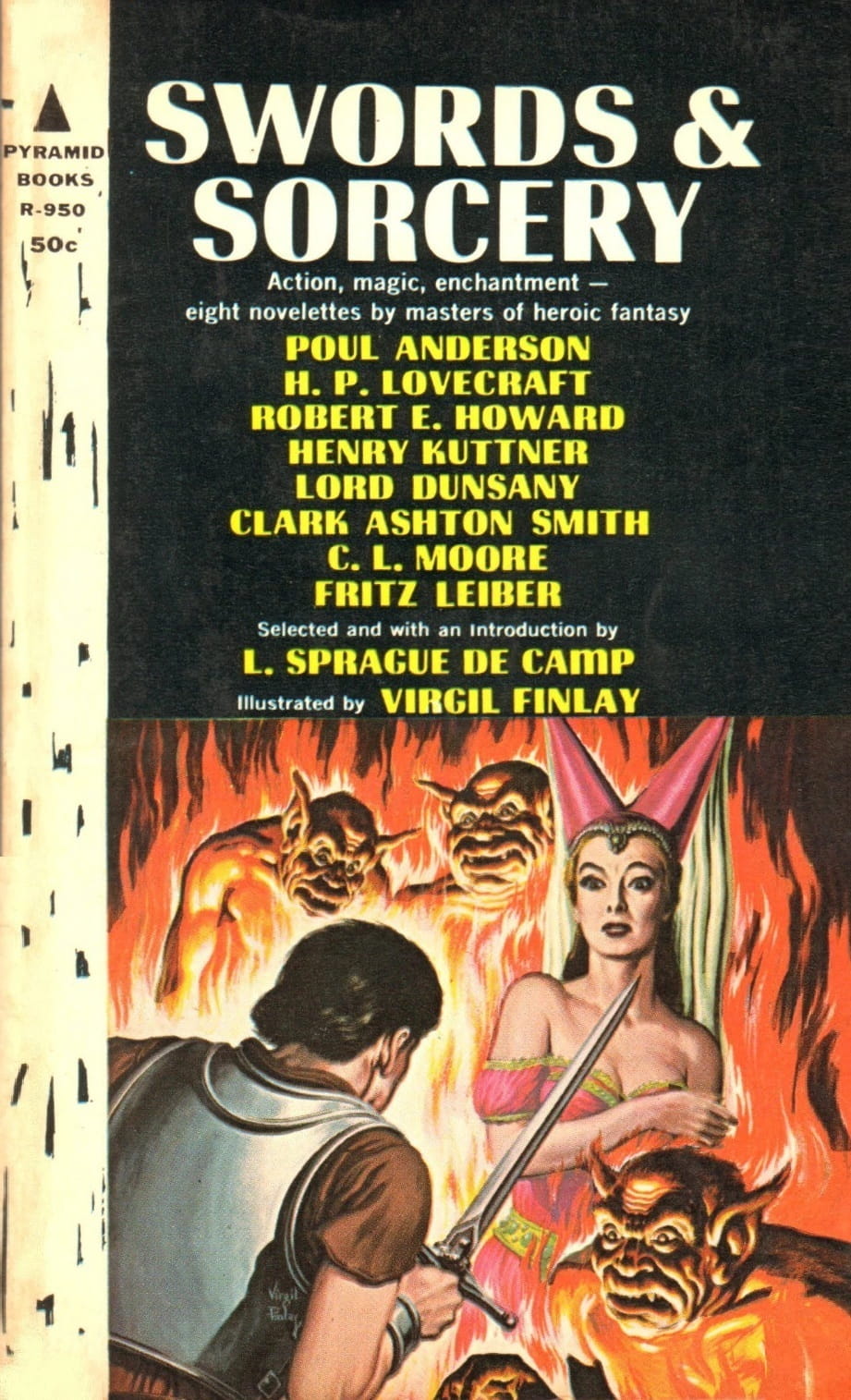
Swords and Sorcery: Stories of Heroic Fantasy, edited by L. Sprague de Camp
(Pyramid Books, December 1963). Cover by Virgil Finlay
Here are two more Sword & Sorcery anthologies edited by L. Sprague de Camp. Both are from Pyramid Books. Swords & Sorcery is 1963, with interior illustrations by Virgil Finlay. ISFDB indicates the cover is by Finlay as well, although it looks to me very much in the cover style of the second book, The Fantastic Swordsmen (1967), where the cover is attributed to Jack Gaughan. Some of the experts who visit this page probably know the truth.
1. Swords & Sorcery is a nice collection. It contains “Shadows in the Moonlight” (Conan) by Robert E. Howard, and stories by Poul Anderson (the excellent “Valor of Cappen Varra”), Fritz Leiber (Fafhrd, Gray Mouser), Kuttner (Prince Raynor), Lord Dunsany, C. L. Moore (Jirel), Clark Ashton Smith, and Lovecraft (“The Doom that Came to Sarnath”). The introduction on “Heroic Fantasy” by de Camp tends to piss some people off that I know, although I’m not one of those particularly. It suggests that S&S is purely escapist reading. I think it does make for a good escape from life’s mundanities but there’s more to it than just that.
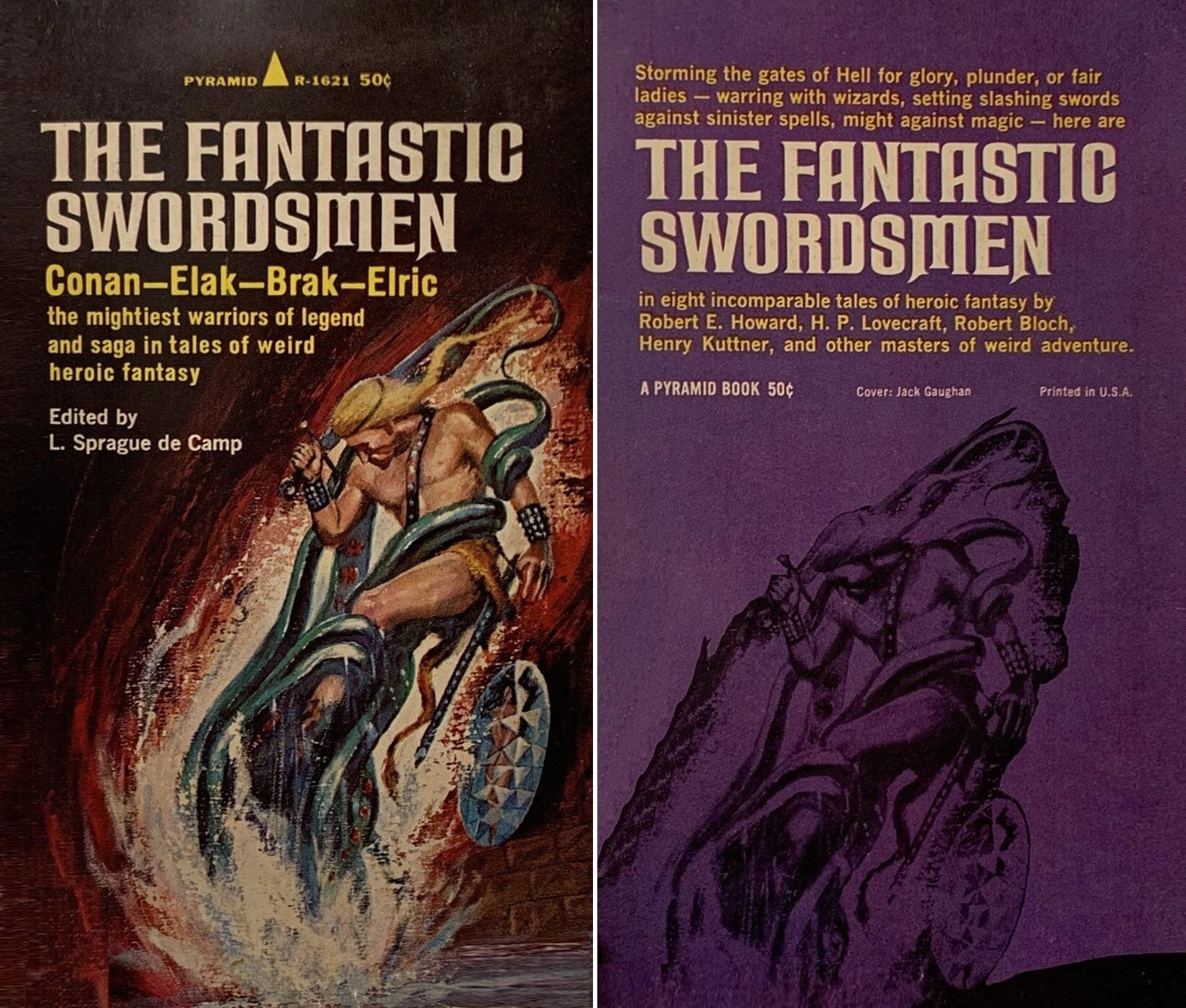
2. The Fantastic Swordsmen is also a pretty good collection, with stories about Conan, Elak, Brak, and Elric, along with a few new items. The cover shows us Brak. The Conan story is one that de Camp finished from a Howard outline and isn’t terribly strong. There’s also a very early story by Robert Bloch, which, while well written, shows his lack of storytelling experience at the time.
Fantastic Swordsmen also contains:
“Tellers of Tales” an intro by L. Sprague de Camp
“Black Lotus” by Robert Bloch
“The Fortress Unvanquishable, Save for Sacnoth” by Lord Dunsany
“Drums of Tombalku” by REH and L. Sprague de Camp
“The Girl in the Gem” by John Jakes (Brak)
“Dragon Moon ” by Henry Kuttner (Elak of Atlantis)
“The Other Gods” by H.P. Lovecraft
“The Singing Citadel” by Michael Moorcock (Elric & Moonglum)
“The Tower” by Luigi De Pascalis, who also wrote an Afterword
Charles Gramlich administers The Swords & Planet League group on Facebook, where this post first appeared. His last article for us was a review of The Imaro Saga by Charles Saunders. See all of his recent posts for Black Gate here.
Regarding the Swords & Sorcery cover, ISFDB says “the cover and 3 of the interior pieces are signed”, and, sure enough, after I enlarged the cover image, I spotted “Virgil Finlay” right under the swordsman’s right armpit. Thank the Web gods for the ‘+’ button!
Cool! What a place to hide it.
I bought and read Swords and Sorcery when it first came out. I’ve always remembered the Poul Anderson story, which was a big influence on my concept of trolls, and it introduced me to Jirel of Joiry. But I’ve never understood how “The Doom That Came to Sarnath” counted as S&S.
Definitions were more fluid in those days? I suppose of Lovecraft’s stories, Sarnath does come closest to S&S in some ways — at least, I could see it as background for a more S&S-inflected story or some such.
I agree that it could be a set up or background for more S&S oriented stories.
I always figured the Lovecraft story was just about what was a potential seller. It’s definitely not S&S, though as Joe says below, it could make an interesting setting for S&S tales. We also know that De Camp started working with Lin Carter around this time and Carter was a big proponent for HPL so maybe there was some of that influence
In my opinion Finlay was the premier interior illustrator of our field, but wasn’t nearly as impressive as a cover artist. I do think the cover looks like his color work, and I see that Eugene found his signature.
It’s a good collection. Besides the Anderson story, I’d rank the Dunsany at the top.
Isn’t this the anthology that caused people to credit de Camp for inventing the term “Sword and Sorcery”? I know that it’s been established that it was actually used at least a couple years earlier, though — and someone even found a review back about a decade that arguably used the term. Still — does the introduction use the term, or attempt to define it?
I’m at work right now and don’t have the copy handy but I’ll have a look when I get home at the introduction. I agree on Finlay. Better for interior illustrations than for covers.
I’m not hating on L. Sprague DeCamp at all. After all, without him, I don’t know that we would still be reading Conan and Robert E Howard today. I can’t really say how good his writing was because all I ever read by him is what he did in the Ace Conan series.
That all said, how could someone be so out of touch with his readers and still manage to be successful? Or is that just my interpretation?
Also, I find it strange, that despite DeCamp’s kind of passive-aggressive critiques and arm-chair psychoanalysis of Howard, – I don’t think he ever really “got” Howard – they played key parts in each other’s work.
For better or worse, DeCamp greatly helped cement Howard’s legacy. On the flip-side, I don’t think any of us would be familiar with DeCamp at, if he hadn’t ever written any Conan pastiche.
Crazy how all that panned out.
I’ve read a fair amount of De Camp’s stuff and some is quite good. Lest Darkness Fall, for example. He was always consistently professional in his work but he didn’t write a lot that I personally resonated with. I certainly hear the most mention of De Camp today in Conan circles but I imagine he’d still be remembered well by SF historian types. I’ve got at least 15 books by him that I haven’t read yet, and that’s partly because I’m doubtful they will strongly engage me.