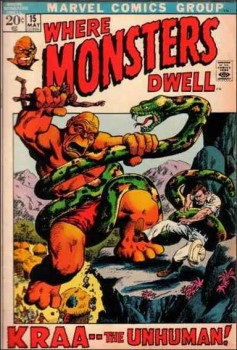
More Mogollon Memories: Jack Kirby’s Monsters and the Mogollon Monster Live on the Rim
 My Grandad claimed he saw the Mogollon Monster once, when he drove up the Rim to visit the land they’d bought to build the cabin. He had pulled to the side of the road, let his dog out to run, and the dog got wind of something that upset him.
I don’t know more of the story than that — Grandad’s no longer around to fill the gaps and, anyway, maybe he’d embellish just to get a rise out of us.
When we were young, he and Nan drove us up to visit the land, and my Grandad was a very quiet man while Nan chattered away keeping us entertained.
But at one point, when we’d gotten way up as near the sky as you can get in Arizona, where the snowdrifts were two feet deep, Grandad pulled to the side of the road, without a word, got out, came around back of the truck, opened the tailgate, grabbed each of us, methodically, and tossed us into the snow.
We laughed fit to burst, then Nan dusted the snow off our pants, loaded us back up, and we were on our way.


 I don’t know how I forgot “superhero” when I wrote about