Browsed by
Category: Vintage Treasures

Into the Night: She Is the Darkness by Glen Cook Part 2

Into the Night: She Is the Darkness by Glen Cook Part 2

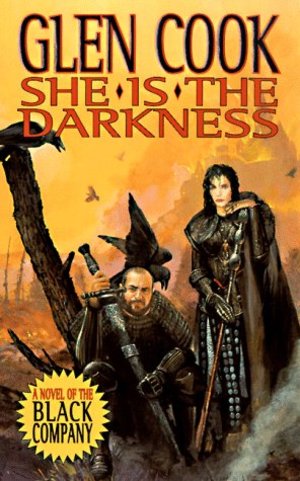
0812555333.01.LZZZZZZZI think this reread of She Is the Darkness (1997) took me so long because I subconsciously remembered how disappointing it is. The first half (reviewed last week), despite a bunch of problems, is all right because of Cook’s usual talent at creating cool characters and sticking them into tough situations. It also had some epic battle scenes. As the Black Company inched its way toward the Shadowmaster’s fortress, the good managed to outweigh the bad. This was not the case for the book’s second half, despite some crowning moments of awesome. Not at all.

We left off last week’s post with the siege of Overlook about to begin. The Taglian legions raised and trained by Croaker and Lady invest the fortress. The great castle eventually falls not to starvation or the walls being thrown down, but to a coup de main. Overlook is so vast and so undermanned that Lady and her most loyal troops were able to secretly bore their way into its foundations and operate from within. After much planning (and magical scouting by Murgen), Lady is able to capture Longshadow.

Back in Taglios the Prince’s sister, the Radisha Drah, starts hunting down the Black Company’s allies. She has always feared the Company; now that Longshadow is defeated the time is ripe for its destruction. Having assumed a betrayal would come (as it always does for them), Croaker has readied the Company for the for the final trek to Khatovar.

The road to Khatovar lies to the south of Overlook, through something called the Shadowgate. From the gate come the shadows — deadly spectral things Longshadow and the Shadowmasters could control to a certain extent. Beyond the gate lies a great barren circular plain. From the gates (turns out there are more than one) are roads leading to the plain’s center, like the spokes of a wheel. And there stands a ruined fortress even greater than Overlook. Its inner courtyard measures nearly a mile across.

Certain the answer to where or what Khatovar is lies within, Croaker leads the core of the Black Company, along with its most important prisoners, — Longshadow, Howler, and Soulcatcher — into the ruins. But instead of answers, what lies behind the broken walls is a devastating trap. The book ends with the most important military commanders and veterans of the Black Company in stasis, and Soulcatcher racing back to Taglios in order to unveil some yet-undescribed scheme.

Read More Read More

New Treasures: Redder Than Blood by Tanith Lee

New Treasures: Redder Than Blood by Tanith Lee

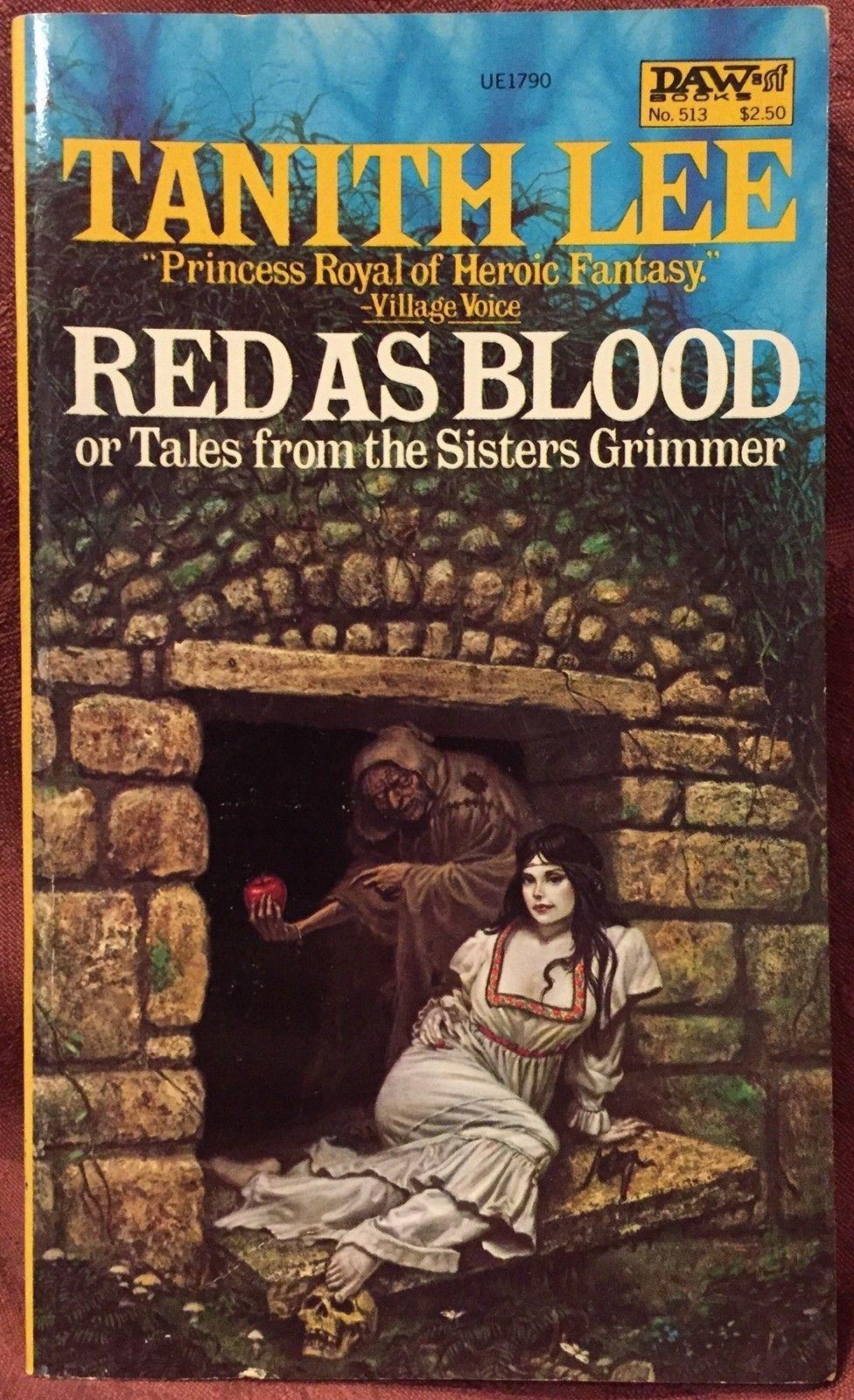
Redder Than Blood Tanith Lee-small Redder Than Blood Tanith Lee-back-small Red-as-Blood-or-Tales-from-the-Sisters-Grimmer-medium

Tanith Lee passed away in 2015, and at the time I worried that meant her work would quickly vanish from bookstores.

That hasn’t happened, and it’s mostly due to the efforts of her long-time publisher DAW Books, who over the last three years has gradually been returning some of her most popular work to print in gorgeous new paperback editions, including all five Flat Earth novels, the Wars of Vis trilogy, the Birthgrave trilogy, and the just-released novella collection Companions on the Road. Most have covers by French artist Bastien Lecouffe Deharme (website here).

I’m especially appreciative that DAW also saw fit to release a brand new short story collection of dark fairy tales, Redder Than Blood, last year. It’s a companion volume to Red as Blood, or Tales from the Sisters Grimmer (1983), a paperback original published by DAW with a Michael Whelan cover no less than twenty-five years ago (above right).

Read More Read More

Vintage Treasures: Take Back Plenty by Colin Greenland

Vintage Treasures: Take Back Plenty by Colin Greenland

Take Back Plenty-small Seasons of Plenty-small Mother of Plenty-small

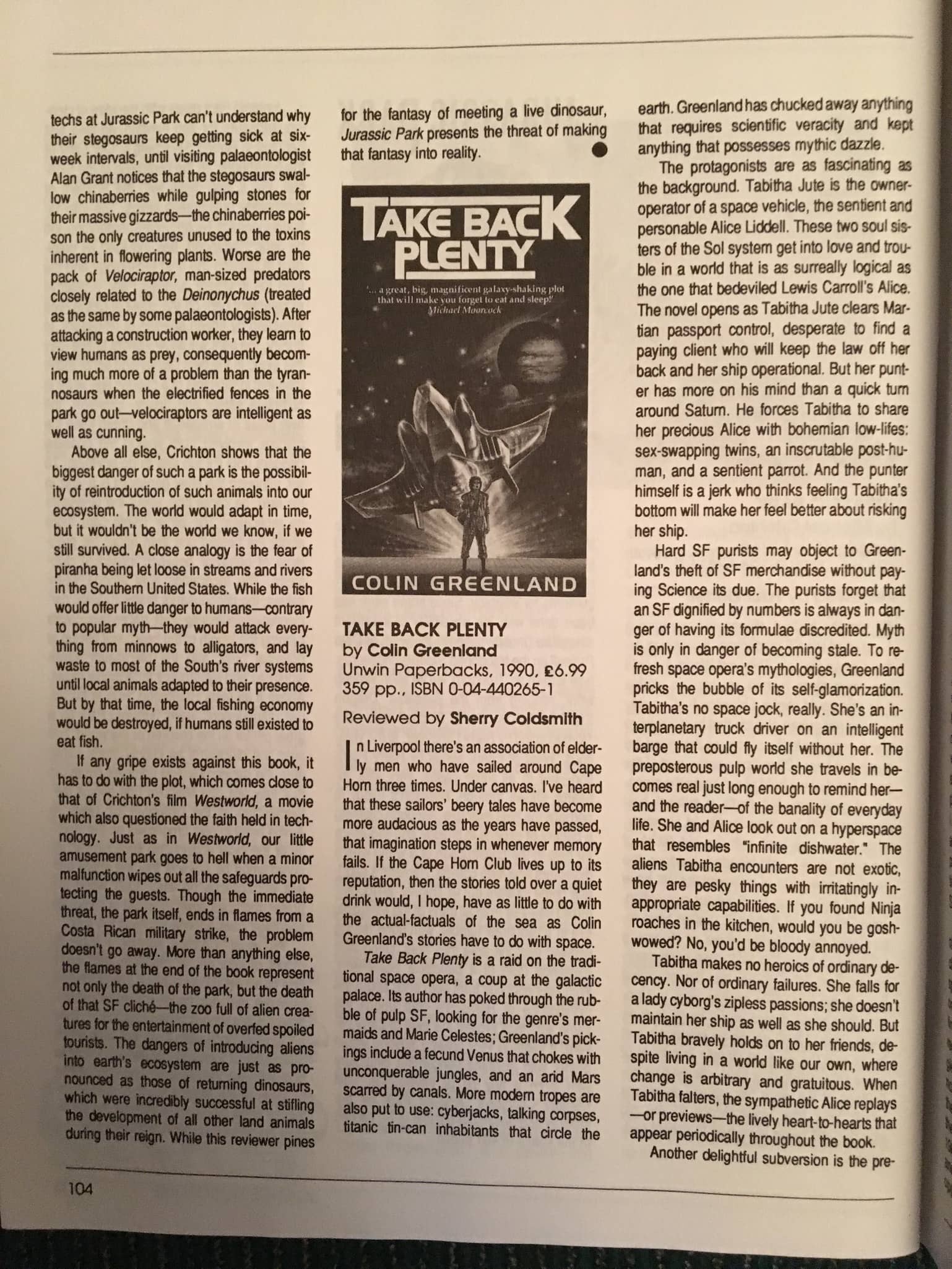
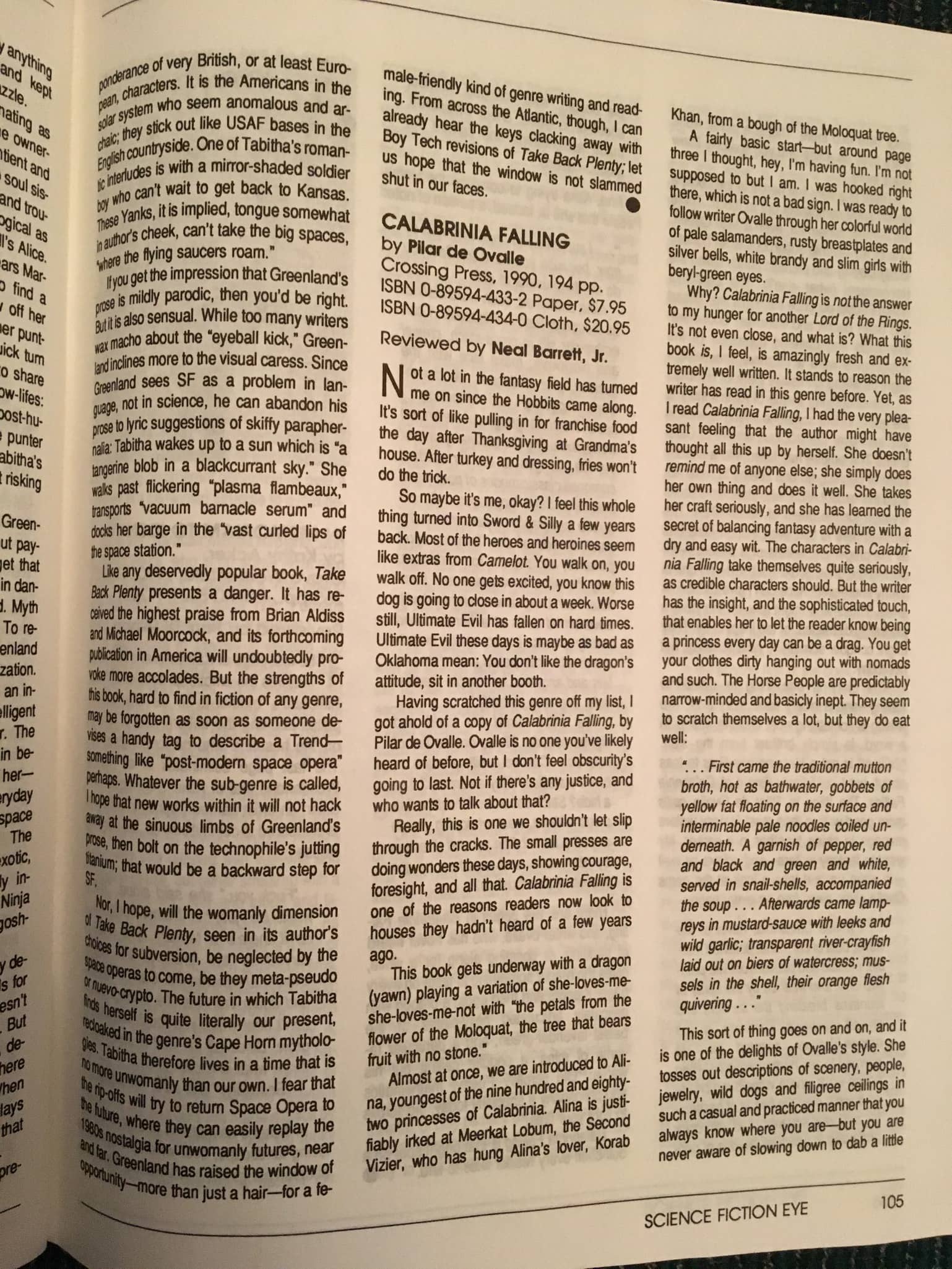
I’ve been buying up back issues of Science Fiction Eye, one of the better SF review zines of the 90s. SF Eye had a marvelous stable of hot young writers, including Bruce Sterling, Richard Kadrey, Paul Di Filippo, Pat Murphy, Gary Westfahl, Tony Daniel, Charles Platt, John Shirley, Jack Womack, Elizabeth Hand, Mark Laidlaw, and many others. I thought I’d enjoy revisiting the cutting edge genre journalism I found so thought provoking two decades ago, but what I really find entertaining this time around is the high quality reviews. Especially coverage of now-forgotten books like Colin Greenland”s Take Back Plenty (1990) the opening novel of his gonzo space opera trilogy featuring Tabitha Jute. Here’s a snippet of Sherry Coldsmith’s excellent review, from the Winter ’91 issue, which I bought on eBay last month for $7.50.

Take Back Plenty is a raid on the traditional space opera, a coup at the galactic palace. Its author has poked through the rubble of pulp SF, looking for the genre’s mermaids and Marie Celestes. Greenland’s pickings include a fecund Venus that chokes with unconquerable jungles, and an arid Mars scarred by canals. More modern tropes are also put to use: cyberjacks, talking corpses, titanic tin-can inhabitants that circle the Earth. Greenland has chucked away anything that requires scientific veracity and kept anything that possess mythic dazzle.

The protagonists are as fascinating as the background. Tabitha Jute is the owner-operator of a space vehicle, the sentient and personable Alice Liddell. These two soul sisters of the Sol system get into love and trouble in a world that Is a surreally logical as the one the bedeviled Lewis Carroll’s Alice.

Take Back Plenty won both the British Science Fiction and Clarke awards for Best Novel; it was followed by two sequels, Seasons of Plenty (1995) and Mother of Plenty (1998). Greenland’s last two books, Spiritfeather (2000) and Finding Helen (2003) appeared only in the UK. You can read Coldsmith’s complete review of Take Back Plenty (and the tail end of the enthusiastic notice of Crichton’s Jurassic Park) here — page 1 and page 2. See all our recent Vintage Treasures here.

Birthday Reviews: John D. MacDonald’s “Ring Around the Redhead”

Birthday Reviews: John D. MacDonald’s “Ring Around the Redhead”

BG_MacDonaldOtherWorldsEvery so often, I prove that the Black Gate firewall needs some serious tightening up by jumping in and putting up a post where I don’t belong (many readers and fellow bloggers believe that would be the entirety of the Black Gate website…). So, if you’re reading this, the crack web monitoring team hasn’t seen it yet. Don’t tell Steven Silver. He might gnaw through the restraining chain around his ankle and crawl over to my desk in the cellar…basement…journalist’s suite to thrash me.

John Dann MacDonald, my favorite author and one of the best writers of the twentieth century – in any genre – was born on July 24th, 1916. MacDonald, Harvard MBA and a lieutenant colonel in the Office of Strategic Services during World War II, was thirty years old when he began writing for the pulps in 1946. Through hard work and talent, MacDonald quickly became successful, selling to the mystery and sports magazines.

He graduated to the slicks more quickly than most pulpsters and he began writing paperback novels in 1950, mostly for Fawcett Gold Medal and Dell. And in 1960 he created his famous non-private eye, Travis McGee, in The Deep Blue Goodbye. MacDonald wrote over 400 short stories and five dozen novels.

It’s less well-remembered that in the late forties and early fifties, MacDonald wrote a great deal of science fiction: over fifty short stories and two novels. He tired of the genre and essentially quit cold turkey in 1952, writing only seven more stories and one novel (The Girl, The Gold Watch & Everything, which was made into a movie with Robert Hays and Pam Dawber) in the final thirty-four years of his life. He wrote that he tired of science fiction and simply quit writing it.

“Ring Around the Redhead” appeared in the November, 1948 issue of Startling Stories (His “Shenadun” had been in the September issue). It was anthologized in 1953 and again in 1967. I read it in Other Times, Other Worlds, a collection consisting entirely of science fiction stories by MacDonald.

Bill Maloney, an inventor, is on trial for murdering his next door neighbor. There’s no body, just some brain and hair bits. Anita Hempflet, the classic nosy neighbor (you know, the kind that says “I don’t mind anybody’s business but my own” and then proceeds to gossip like it’s an Olympic event) weighs in with her nose in the air, saying that Bill has been shacked up (remember: it’s 1948) with a pretty redhead who seems to be deaf and was wearing some odd, metallic clothing when she appeared.

Read More Read More

Next Year in Khatovar: She Is the Darkness by Glen Cook Part 1

Next Year in Khatovar: She Is the Darkness by Glen Cook Part 1

oie_2353716i3KOHmsdA skinny, mangy mongrel raced past and on the dead run clamped jaws on a startled crow. He got a wing.

All the crows in the world descended on him before he could enjoy his dinner.

“A parable,” One-Eye said. “Observe! Black crows. Black dog. The eternal struggle.”

“Black philosopher,” Croaker grumbled.

“Black Company.”

One-Eye and Croaker from She Is the Darkness

It’s summer, I’m busy living a summer life. As Glen Cook books go, She Is the Darkness (1997) is a long one. Um, something, something, something. All that’s to say I’m breaking my review into two parts. It’s not what I’d normally do, but I don’t want to lose the momentum of reading the books back to back. Remember: beyond here lie spoilers.

At the end of the previous book, Bleak Seasons, the Black Company under the restored leadership of Croaker, aka the Old Man, aka the Captain, was girding its loins for the final march on the last stronghold of Longshadow, the last Shadowmaster.

Overlook is pretty much Glen Cook’s version of Barad-dûr. Its walls rise to a hundred feet, and are covered in protective spells. Inside lurk untold numbers of soldiers backed by the terrible sorcery of the erstwhile Taken, Howler, and Longshadow himself.

In the field, ex-Black Company chief-of-staff Mogaba leads Longshadow’s last remaining army. Aided by another defector, Blade, Mogaba cannot imagine himself being beaten, and lies in wait for the Black Company and the soldiers of Taglios to attempt to force the pass over the Dhanda Presh Mountains.

Oh, and the wife of new Black Company Annalist Murgen was murdered by the Deceivers. During an assassination attempt on Croaker in the Palace of Taglios, a group of killers found their way into the living quarters of Murgen’s family and left his wife Sahra and her son dead. While not a completely broken man, Murgen is allowing himself to become addicted to traveling through time and space on the spirit of the comatose wizard, Smoke. Officially, Murgen’s doing this to spy on Longshadow and other things important to the health and welfare of the Black Company, but really it’s to avoid the depression brought on by the killing of Sahra. It continues to be a poorly explained and clunky device.

The death of Sahra is also not as simple as it seems. There’s a terrible secret surrounding it, and even though his late wife’s family, including the thoroughly kickass Uncle Doj, know what happened, Murgen doesn’t uncover it for many months. In a series flush with emotionally raw events, what really happened the night of Sahra’s death is one of the hardest in the whole series.

The entire first half of She Is the Darkness concerns the movement of Croaker’s forces towards the showdown with Mogaba’s and Blade’s. Meanwhile Murgen, flying on the wings of Smoke’s psyche, spies for his commander and fills in all the gaps for the reader, giving us an inside look at the doings of the Company’s enemies. There’s no getting around it, much of the first half of the book’s a slog. It might reflect some sort of logistical and strategic masterpiece if it occurred in real life, but on the page it moves like molasses on a winter day. Nonetheless, the book isn’t a disaster, just frustrating.

Read More Read More

Birthday Reviews: C.M. Kornbluth’s “The Remorseful”

Birthday Reviews: C.M. Kornbluth’s “The Remorseful”

Cover by Richard Powers

C.M. (Cyril M.) Kornbluth was born on July 23, 1923 and died on March 21, 1958.

Kornbluth died relatively young, but his work and memory have been kept alive. His short story “The Meeting,” finished by his frequent collaborator Frederik Pohl, earned them a Hugo Award in 1973 and he was nominated for four solo Hugo Awards prior to his death. His novelette “The Little Black Bag” won a Retro Hugo in 2001. In 1986, his novel The Syndic was inducted into the Prometheus Award Hall of Fame. His 1951 short story “The Marching Morons” is still considered a touchstone of science fiction

Frederik Pohl bought “The Remorseful” for Star Science Fiction No. 2, which was published in December 1953. The story also appeared in New Worlds Science Fiction #29 in November 1954. The story was included in Kornbluth’s posthumous collection The Marching Morons and Other Famous Science Fiction Stories. In 1976, it was translated into German for publication in Titan 1, edited by Pohl and Wolfgang Jeschke. The story showed up again in The Best of C.M. Kornbluth, and Robert Weinberg, Stefan Dziemianowicz, and Martin H. Greenberg included it in 100 Astounding Little Alien Stories. It was finally included in the NESFA Press collection His Share of Glory: The Complete Short Science Fiction of C.M. Kornbluth, edited by Timothy Szczesuil.

Kornbluth relates two stories in “The Remorseful.” The first tells of a man who walks across a barren Earth after an apocalypse has depopulated the planet. The other tells about an alien invasion of the solar system, focusing less on their activities and more on their alien nature as a sort of hive organism which can drop portions of itself off to explore/invade the outer planets and learn about the outposts mankind has set up.

Read More Read More

Vintage Treasures: The Bridge of Lost Desire by Samuel R. Delany

Vintage Treasures: The Bridge of Lost Desire by Samuel R. Delany

The Bridge of Lost Desire-back-small The Bridge of Lost Desire-small

Samuel R. Delany is one of the greatest science fiction writers alive today. He got his start when his wife Marilyn Hacker became an assistant editor at Ace Books under Donald A. Wollheim, and helped him publish his first novel The Jewels of Aptor as an Ace Double in 1962, when he was just 20 years old. Since then he’s won virtually every award our field has to offer, including the Hugo, Nebula, and Locus Awards. In 2013 the Science Fiction Writers of America named him a SFWA Grand Master.

I’ve steadfastly collected the various paperback editions of Delaney’s books over the years, including his classics The Einstein Intersection (1967), Nova (1968), Dhalgren (1975), and Triton (1976). I believed (rather reasonably, I thought) that I had all of his major work. So earlier this year I was more than a little surprised to stumble on one I never knew existed: The Bridge of Lost Desire, a 1988 collection of three fantasy novellas from St. Martin’s Press.

The Bridge of Lost Desire is the fourth and last volume in Delany’s Nevèrÿon fantasy series. Unlike his science fiction novels, the Nevèrÿon books were never particularly popular, and have been out of print for over two decades. The first three were published as paperback originals by Bantam Books between 1979-85, with gorgeous covers by the fantasy artist Rowena. The Bridge of Lost Desire was first published as an Arbor House hardcover, and reprinted in what I can only assume was a poorly distributed mass market paperback edition by St. Martin’s Press in 1988.

Read More Read More

Birthday Reviews: Valerie J. Freireich’s “Vashti and God”

Birthday Reviews: Valerie J. Freireich’s “Vashti and God”

Cover by Mel Odom
Cover by Mel Odom

Valerie J. Freireich was born on July 21, 1952.

Freireich has written four novels in her Harmony of Worlds series, beginning with the Compton Crook Stephen Tall Memorial Award-nominated Becoming Human. Her short story “Sensations of the Mind” was a quarterly winner of the Writers of the Future Award in 1991.

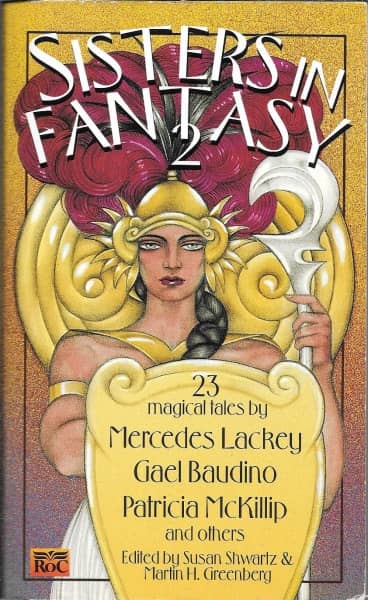
She wrote “Vashti and God” for Susan Shwartz and Martin H. Greenberg for the anthology Sisters in Fantasy 2. Published in 1996, the story has never been reprinted.

In the Biblical book of Esther, Queen Vashti only appears in seven verses of the first chapter and is mentioned in two verses of the second chapter. Despite this, or perhaps because of it, her character is something of a tabula rasa. Vashti’s refusal to appear before King Ahasuerus has led to her being adopted by some as a feminist icon. In “Vashti and God,” Valerie J. Freireich fleshes out Vashti’s story and motivations in support of a more feminist interpretation.

The story is told mostly in flashback after Vashti has been removed as the queen and made a maid in the Great King’s household, where Esther now sits in her place. The flashbacks detail the seven days of feasting that lead up to Vashti’s demotion. During that time, as Vashti realizes more and more that the woman are segregated and unimportant to their husbands, she also begins to hear a voice spurring her to take action and she demands that her husband invite the women to join their husbands on the last day of the feast. When he commands her attendance, and only her attendance, she refuses to come, leading to her punishment and replacement.

However, the voice, which she attributed to the Persian god Ahuramazda, wasn’t done with her and begins to tell her to support Esther’s own dealings with the Great King. Although Vashti complies with the god’s request, she also comes to realize that the commands weren’t coming from Ahuramazda, nor were they for the benefit of women, Vashti, or the Great King, but rather they were the commands of Esther’s god and all she could do was warn her ex-husband that he should not try to interfere with Esther’s god’s plans if he wanted to thrive.

Read More Read More

A Ball of Confusion: Bleak Seasons by Glen Cook

A Ball of Confusion: Bleak Seasons by Glen Cook

oie_16212649x4iuiFoAWith Bleak Seasons (1996), Glen Cook broke a six year hiatus from the series that had made his reputation as an important voice in epic fantasy. The previous book, Dreams of Steel (1990), had ended in chaos, with Lady and Croaker reunited, but their newborn daughter stolen by murderous Deceiver, Narayan Singh. The siege of Dejagore was finally lifted, but Soulcatcher remained at large and the Shadowmaster Longshadow continued to build his mega-fortress, Overlook, and field powerful armies. During that six very long years, I became increasingly doubtful I’d ever learn what happened next, or just what made the siege of Dejagore so horrible.

And then Bleak Seasons appeared — just showed up on a Barnes and Noble shelf one day. I bought and devoured it almost immediately. I couldn’t really say my questions had been answered since it had been so long since the last book I forgot some of them. On top of that, the book was a mess; its narrator literally jumping around in time with no clear rhyme or reason. That it was packed with tons of great stuff made it a frustrating read. All the good bits were enough to tilt it to the good side, and I trusted Cook enough to hope the next book would be a return to form.

My reread of the book over the last two days didn’t change my opinion one bit. Well, except that reading Bleak Seasons right up against Dreams of Steel does make all the cool stuff cooler. The jumping around in time, that remains frustrating and poorly explained and with little obvious justification.

Bleak Seasons opens with a short chapter that clearly tells us four years have passed and terrible things have happened. Based on the timelines in the previous book there would seem to be no way this could make sense unless something drastic had happened.

The second chapter introduces us to the book’s narrator, Murgen. The youngest member of the six Company survivors from the original trilogy, he was standard-bearer and, before the disaster under the walls of Dejagore, Annalist-in-training. He opens with a tour of the city of Dejagore during the siege and an introduction of the factions defending it against the army of the Shadowmaster Shadowspinner.

The Black Company and its Taglian auxiliaries have split into two camps. The first is composed of the Northerners and most of the men recruited on the road to Taglios, and is led by Murgen — because no one else wants to be in charge. The second, and stronger, is led by Mogaba and his fellow Gea-Xle warriors. Mogaba is not happy with the situation and soon it’s clear he has it in for Murgen and friends.

Mogaba, possessed of a will of steel and a willingness to do every single bloody act necessary, is the overall commander of the defense of Dejagore. As supplies dwindle, Mogaba routinely ejects members of the Jaicuri population to almost certain death. Later, it’s learned he has returned his fellow Gea-Xle to the darkest part of the Black Company’s origins as soldiers of Kina, the goddess of destruction.

The Nyueng Bao are a third party; a group of pilgrims from the distant Main River delta in the east who had the misfortune to be caught in Dejagore when the siege started. They are secretive, insular, and, it becomes clear quickly, dangerous. Finally, the native Jaicuri, peaceful by nature and beaten down by years of Shadowmaster rule, just try to stay on the good side of Mogaba’s and Murgen’s soldiers and hope for the best.

Read More Read More

A Relative Journey: Starflight 3000 by R.W. Mackelworth

A Relative Journey: Starflight 3000 by R.W. Mackelworth

Starflight 3000-Balllentine

Cover by Chris Foss

While perusing the shelves of Bookdealers of Rosebank, in Johannesburg, an excellent shop that sadly closed its doors a while back, I came across a nondescript book with an unbent spine. Finding a used paperback of any age with a good-as-new spine is a rarity, and I was drawn to it.

I slipped it from its recess and took a closer look. It was a Ballantine paperback with an intriguing space ship on a wrap around cover. The title was Starflight 3000 by R.W. Mackelworth.

I had never heard of Mackelworth, but then again I am not the best informed on science fiction authors. While I was impressed with its pristine condition, it also set off some warning bells. Why was it unread? Was the story that bad? But hey, nothing ventured, nothing gained. And besides, it was a very reasonable price. I bundled it with some other selections and headed to the cashier.

Read More Read More