Browsed by
Category: Vintage Treasures

From the Moon to Mars: The British Library Science Fiction Classics by Mike Ashley

From the Moon to Mars: The British Library Science Fiction Classics by Mike Ashley

Lost Mars The Golden Age of the Red Planet-small Moonrise The Golden Age of Lunar Adventures-small

The Moon and Mars have fascinated science fiction writers for generations, although I thought the era of classic Mars and Moon anthologies was over. But it turns out that’s not the case. At least not while editor Mike Ashley is on the job, anyway.

Lost Mars: The Golden Age of the Red Planet, which collects pulp-era tales (and pre pulp-era tales) from Wonder Stories, Amazing Stories, Astounding, and Worlds of If, was published in April 2018. Its sister anthology Moonrise: The Golden Era of Lunar Adventures, with stories from F&SF, Amazing, Tales of Wonder, Astounding, New Worlds, and Fantastic, arrives in September. Both are part of the British Library Science Fiction Classics, which I’ve never heard of, but for which I immediately have a deep and passionate love. Near as I can figure out, it’s a relatively new imprint devoted to early 20th Century SF. Or maybe just stories of Mars and the Moon, I dunno. But either way, love love love.

These are very welcome books. They include tales of adventure and exploration from the pre-spaceflight era (the most recent stories are from 1963, only two years after the start of the Apollo space program), which means they’re not particularly concerned with getting the science right. Scientific verisimilitude was the province of late 20th Century SF; these stories concern themselves chiefly with imagination and adventure.

And when it comes to the Moon and Mars, human imagination has been pretty darn fertile. These books contain some of the greatest SF ever written, including Arthur C. Clarke’s brilliant tale “The Sentinel,” which inspired 2001: A Space Odyssey, and Stanley G. Weinbaum’s groundbreaking “A Martian Odyssey,” which Isaac Asimov said, “had the effect on the field of an exploding grenade. With this single story, Weinbaum was instantly recognized as the world’s best living science fiction writer.” There’s also a Martian Chronicles tale by Ray Bradbury, an excerpt from H.G. Wells’ classic First Men in the Moon, and stories by Walter M. Miller Jr, J. G. Ballard, Gordon R. Dickson, Edmond Hamilton, John Wyndham, E. C. Tubb, and many others.

Read More Read More

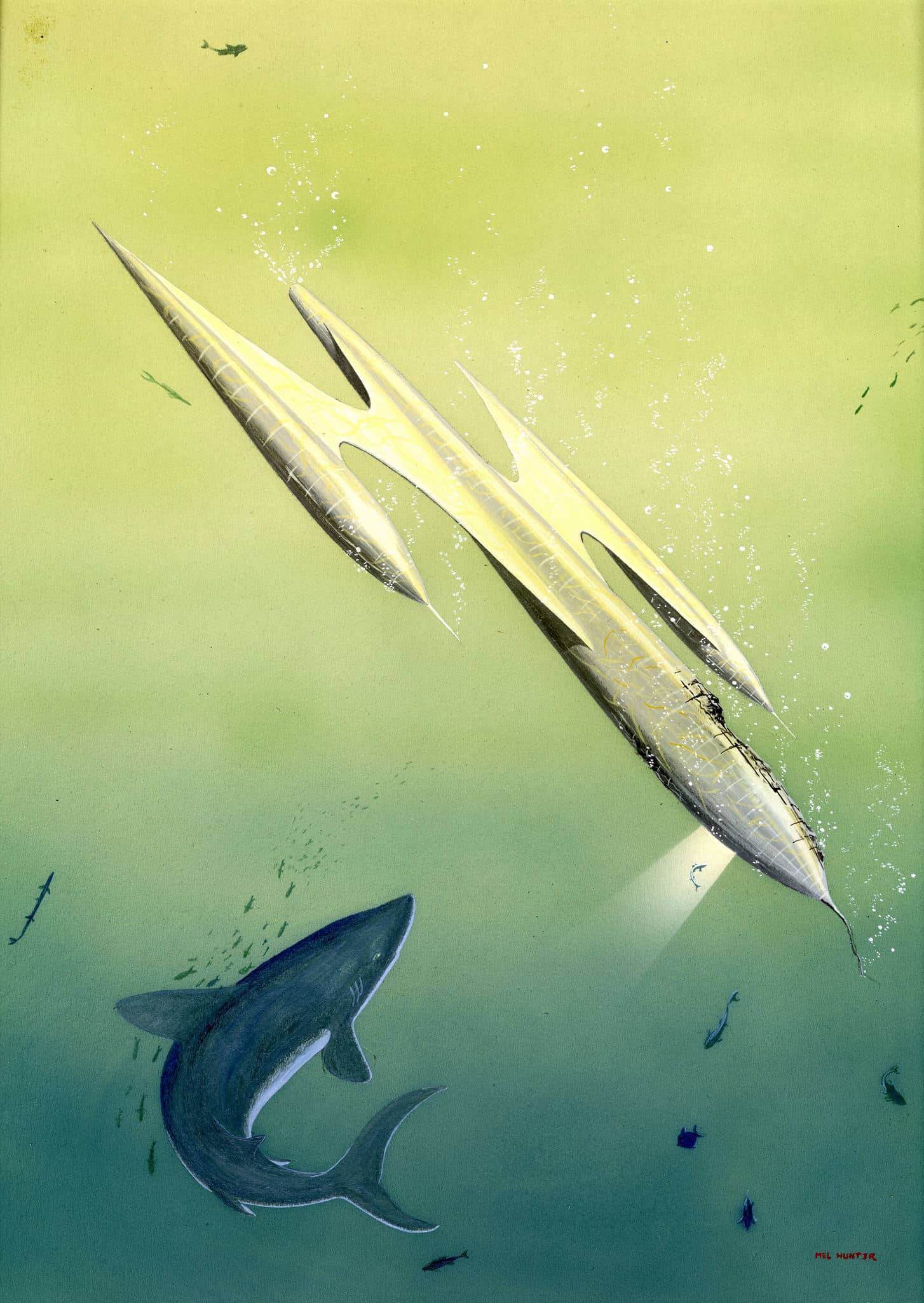
Mel Hunter and Hal Clement’s Needle

Mel Hunter and Hal Clement’s Needle

hunter clement needle unpublished-small

The Monday before this year’s San Diego Comic-Con, I drove up to LA to visit a longtime SF fan and art collector. Among the two dozen pieces of art I picked up from him is this painting by artist Mel Hunter. Hunter was active in the SF field, contributing cover art to paperbacks and digests, as well as digest interiors, primarily from the early 1950’s until the early 1960’s, though he was still contributing an occasional cover into the early 1970’s. From December 1955 through December 1957, he also was the art director of If (the sister magazine to Galaxy). Over time, the painting has suffered some damage along the edges, so this image is a bit cropped.

Written on the back of the illustration board is a note stating that this painting is an unpublished illustration for Needle by Hal Clement, and that Hunter gave this painting to Edward Everett Evans and Thelma Evans. Another note below that mentions that the collector I bought it from purchased this from the estate of E.E. Evans (who passed away on December 2, 1958) for $25. Not surprisingly, I paid significantly more for it!

Read More Read More

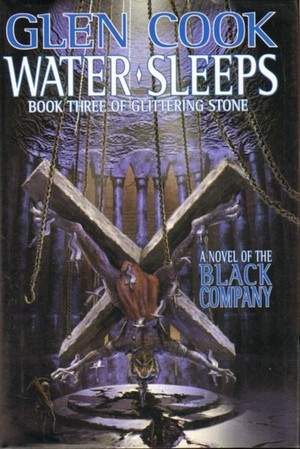
Fifteen Years Gone: Water Sleeps by Glen Cook, Part 1

Fifteen Years Gone: Water Sleeps by Glen Cook, Part 1

Water Sleeps.

In their homes, in the shadowed alleyways, in the city’s ten thousand temples, nervous whispers never cease. The Year of the Skulls. The Year of the Skulls. It is an age when no gods die and those that sleep keep stirring restlessly.

In their homes, in the shadowed alleyways or fields of grain or in the sodden paddies, in the pastures and forests and tributary cities, should a comet be seen in the sky or should an unseasonable storm strew devastation or, particularly, if the earth should shake, they murmur, “Water sleeps.” And they are afraid.

oie_1372930SSs2Hx7jI wish I had managed to finish the ninth Black Company book, Water Sleeps (1999), in a single go because, after two frustrating choppy books, Cook is back on his game. Yes, it’s very different than the bloody, battle-focused earlier books, but Water Sleeps, so far, is a tight story with narrative complexity, brutal twists, and more world-building than any of the others.

The previous volume, She is the Darkness, ended with most of the Black Company’s senior officers  — Croaker, Lady, and Murgen — and several important prisoners — the Prahbrindrah Drah of Taglios, Howler, and Lisa Bowalk — trapped by Soulcatcher and held in stasis on the demon-haunted plain of Glittering Stone.

As Water Sleeps opens, we quickly learn that Croaker et al. have been imprisoned for nearly fifteen years. Murgen’s Standardbearer-in-training, Sleepy, is acting Captain, aided by Murgen’s Nyueng Bao wife, Shara, and the increasingly feeble One-Eye and Goblin. Soulcatcher has declared herself Protector of Taglios, has made the Radisha Drah little more than a puppet, and has rendered her councilors toothless. For a decade and a half, the survivors of the Company have been hunting for a way to free their colleagues from Soulcatcher’s trap, while constantly reminding her that the Black Company never lets a betrayal go unpunished.

Sleepy is not only Captain, she’s also the Company’s Annalist. In her hands, there’s greater attention paid to politics and culture than in the other volumes. Unlike Croaker and Lady, Sleepy doesn’t see Soulcatcher and the other power brokers in Taglios just as obstacles. They are part of a complicated nexus of power centers and religious beliefs. Through her, Cook explores and underscores how they manage to run a vast realm. She’s also the only narrator in any of the books who has religious beliefs. When she explains the three main religions of Taglios — Gunni, Shadar, and her own Vehdna — she does it with a degree of sympathy absent from Croaker’s or Lady’s books.

Read More Read More

Birthday Reviews: Mary C. Pangborn’s “The Confession of Hamo”

Birthday Reviews: Mary C. Pangborn’s “The Confession of Hamo”

Cover by Lawrence Ratzkin

Mary C. Pangborn was born on August 13, 1907 and died on February 20, 2000.

Pangborn didn’t publish very many works during her career. Her first story appeared in 1979 and she published six stories by 1985 with one more appearing in 1996. Although she has written a novel, it has not yet been published. Three of her stories appeared in the Universe series, another in the New Dimensions series, one in Fantasy and Science Fiction.

Mary C. Pangborn’s third story was “The Confession of Hamo,” originally published in 1980 in Terry Carr’s Universe 10. Carr enjoyed the story so much that he included it the next year in his Fantasy Annual IV. When Several of the stories that appeared in the Fantasy Annual series were translated into Spanish for inclusion in the book Fantasias in 1989, “The Confession of Hamo” was one of them.

The title of “The Confession of Hamo” tells the reader exactly what they should expect, although without any of the details. Hamo, living in fifteenth century England, is confessing his sins to Brother Albertus, although it isn’t entirely clear that Hamo is fully aware of the extent and nature of his sins. Hamo has been traveling the countryside with his friend, Tom o’Fowey, who calls himself Moses the Mage. The two scam people into believing that they can change base metal into gold.

Through their travels, they occasionally meet up with another charlatan who goes by the name Black Jamie, who teaches them how to make it appear that they are creating gold. Although Hamo never explicitly identifies Black Jamie, it is clear that he is a representation of the Devil. Instead, Hamo is more concerned about the crime of alchemy that he and Tom practiced, although at the same time he is clearly proud of the scam they perpetrated.

Eventually, Black Jamie sends Hamo on a quest, warning him that part of himself would be taken from him. Hamo’s biggest concern that he would lose his genitalia proves to be unfounded, although he does lose an non-tangible part of himself which proves to be a huge problem for someone who earns their money scamming others. Hamo, who now calls himself the Accursed, also finds that Tom has been taken prisoner by the sheriff, and it’s up to the now destitute Hamo to figure out a way to free him without his own biggest asset.

Read More Read More

The Big Little SF Magazines of the 1970s

The Big Little SF Magazines of the 1970s

analog-aug-74-smallAn earlier version of this article was published in Black Gate 10.

These columns are focused on the history of SF – and so far that has turned out to mean mostly discussion of 50s oriented subjects, with some leakage into nearer years. But now I’d like to take a look at a rather more recent, and rather less celebrated, period. The 1970s. The time of wide ties, leisure suits, and disco. And also the time I discovered SF, and the SF magazines.

My first look at real SF magazines is a moment I remember with a continued thrill. Sometime in late July 1974, in Alton Drugs in Naperville, IL, I wandered by the newsstand and my eyes lit on three magical covers: the August 1974 issues of Analog, Galaxy, and F&SF. That day I bought Analog. The cover story was “Enter a Pilgrim” by Gordon R. Dickson, with a striking, odd, John Schoenherr painting, featuring an alien with a lance and ceramic-appearing armor (a sort of Schoenherr trademark, that ceramic-like surface).

I read that issue quickly and the next day I bought Galaxy, which featured “The Day Before the Revolution,” an Ursula K. Le Guin story that would win a Hugo, as well as parts of two different serials – The Company of Glory by Edgar Pangborn and Orbitsville by Bob Shaw. Of course that issue was also read before the day was out, and the next day I bought F&SF – a very important issue in its own way: it featured John Varley’s first published story (or perhaps his co-first story, as we will see later.) It wasn’t long before I had added Amazing and Fantastic to the roster. Soon I was subscribing to several magazines, and buying the others each month at the newsstand.

Those five were all the major, well-distributed, magazines there were by 1975. Alas, I just missed seeing If, Galaxy’s long time companion: it was discontinued at the end of 1974, and for some reason my local newsstand didn’t carry it, at least not those last few months.

I had formed an opinion, based on received conventional wisdom, that the “Big Three” of SF magazines had been Astounding/Analog, F&SF, and Galaxy since 1950: certainly that was the case in 1975. (You will get an argument for many years prior to that, however: there are partisans for Startling Stories in the early 50s, for If at various times, especially during Frederik Pohl’s peak editorial period in the mid-60s, and for Amazing and Fantastic under Cele Goldsmith’s editorial hand in the early 60s.)

Galaxy, however, was in some financial trouble. Under Jim Baen’s editorship it enjoyed a couple of years as a truly wonderfully enjoyable magazine, but when he left the decline was swift. However, Galaxy’s place in the “Big Three” was quickly taken by Isaac Asimov’s Science Fiction Magazine. And throughout the 70s, the sister magazines Amazing and Fantastic, edited by Ted White, were the other major prozines.

Read More Read More

Derek Reads Alan Moore’s Swamp Thing for the First Time

Derek Reads Alan Moore’s Swamp Thing for the First Time

Saga of the Swamp Thing-small

In my continuing effort to cover many of the classic comic runs, this spring, after much reluctance, I went to my public library and took out the first few trades of Alan Moore’s Swamp Thing, published by DC comics in the early 1980s and marking the beginning of the British Invasion of comics (which I discussed in a previous post here).

I’ve talked about Alan Moore’s work a few times, like when I recently read Halo Jones for the first time, and when I mused about what a Watchmen-like look at the planetary romance genre might look like, in four parts I, II, III, IV.

I’ve also talked a bit about horror comics of the 1970s, when I looked at Marvel’s Son-of-Satan, and also this spring, I was reading Marvel’s Tomb of Dracula for the first time. I’m not going to blog about Tomb of Dracula, but Black Gate‘s William Patrick Maynard did a 13 part (!) series on it, starting here.

Part of my reluctance in starting Swamp Thing was partly because I was a superhero guy, and second of all, I wasn’t really sure what kind of story might be in the offering with a swamp monster. And once in a hotel in Cuba, with nothing else to do, and with nothing else on, I watched about 15 minutes of the Swamp Thing movie, which (a) didn’t impress me and (b) was based on pre-Moore material anyway.

Read More Read More

Vintage Treasures: Conquerors from the Darkness by Robert Silverberg

Vintage Treasures: Conquerors from the Darkness by Robert Silverberg

Conquerors from the Darkness Master of Life and Death Silverberg-small Conquerors from the Darkness Master of Life and Death Silverberg-back-small

1979 Ace edition, paired with Master of Life and Death. Cover by Frazetta.

Robert Silverberg’s novella “Spawn of the Deadly Sea” appeared in the April 1957 issue of Science Fiction Adventures. He expanded it to novel length in 1965, retitling it Conquerors from the Darkness in the process. It wasn’t one of Silverberg’s more successful novels, at least from a commercial standpoint. Today it’s considered a juvenile, and it was reprinted only a handful of times, including a 1979 Ace paperback in which it was paired with Master of Life and Death and given a typically colorful Frank Frazetta cover (above).

In his introduction to the Ace edition Silverberg talks about Robert E. Howard, and it’s one of Silverberg’s few early SF novels with a clear Howard influence. Perhaps as a result, the book certainly has its fans. Here’s an extract from James Reasoner’s enthusiastic review on his blog.

Conquerors from the Darkness is exactly the sort of vivid, galloping action yarn that made me a science fiction fan in the first place. At first it seems like a heroic fantasy novel, set in some totally different universe than ours. The oceans cover the entire planet except for a few floating cities. The only commerce is between those cities, and keeping the seas safe for the merchant vessels is a Viking-like group known as the Sea-Lords. The hero of the novel, a young man named Dovirr, lives in one of the cities but wants to be a Sea-Lord and take to the oceans. He gets his wish and rapidly rises in the ranks, and along the way the reader learns that this is indeed Earth, a thousand years after alien invaders flooded the planet for reasons known only to them, preserving a little of humanity in those floating cities… the alien Star Beasts return to take over the planet again, and Dovirr and his comrades have to find some way to stop them with swords and sailing ships.

Read More Read More

Birthday Reviews: Robert Holdstock’s “Magic Man”

Birthday Reviews: Robert Holdstock’s “Magic Man”

Cover by Alun Hood
Cover by Alun Hood

Robert Holdstock was born on August 2, 1948 and died on November 29, 2009.

He won a British Science Fiction Award (BSFA) for the original novelette “Mythago Wood” in 1981, and the novel version earned him the 1984 BSFA and the 1985 World Fantasy Award. The second book in the series, Lavondyss, won the BSFA in 1988. Holdstock’s novella “The Ragthorn” won the World Fantasy Award in 1992 and the BSFA Award the following year. He won a third BSFA in 1989 for Best Artist for the anthology Other Edens III, shared with Christopher Evans. He won a special Prix Imaginaire in 2003 for La forêt des mythagos, tome 1 and tome 2, two volumes that contained five Mythago Wood novels. The following year, he won the Prix Imaginaire for his novel Celtika. He was awarded the Karl Edward Wagner Award posthumously in 2010.

“Magic Man” was originally published in Mary Danby’s anthology Frighteners 2 in 1976 and reprinted in Danby’s 65 Great Tales of the Supernatural three years later. Holdstock included it in his collection The Bone Forest and it showed up in the reprint anthology Great Vampires and Other Horrors. The story was translated into German for an appearance in Heyne Science Fiction Magazin #5 in November 1982 and into French in 2004 for a collection of Holdstock’s works, Dans la vallée des statues et autres récits.

On the face of it, “Magic Man” seems to be a face-off between One Eye, the old man in a group of prehistoric hunters who paints images of the hunt on the walls of the shrine-cave, and He Who Carries a Red Spear, the leader of the bands hunting bands. There is clearly no love lost between the men and the situation is made worse because Red Spear’s son enjoys hanging around with One Eye and wants to learn to draw.

One Eye teaches Red Spear’s son to paint in the cave, but, while he teaches technique and discusses proper topics, he fails at the most basic level to explain to the boy the importance of painting in the shrine-cave. While some poo-poo the cave’s effectiveness, it is clear that what is painted there influences the day’s hunt, down to the number of bison the hunters capture. When the clash between Red Spear and One Eye escalates, One Eye instructs the boy to paint a scene which clearly shows that One Eye plans to murder Red Spear, which would put the entire tribe at risk.

Read More Read More

Birthday Reviews: July Index

Birthday Reviews: July Index

Cover by David Christiana

Cover by Mel Odom
Cover by Mel Odom

Cover by Oscar Grand

January index
February index
March index
April index
May index
June index

July 1, Genevieve Valentine: “ From the Catalogue of the Pavilion of the Uncanny and Marvellous, Scheduled for Premier at the Great Exhibition (Before the Fire)”
July 2, Kay Kenyon: “The Executioner’s Apprentice
July 3, Michael Shea: “Fast Food
July 4, Peter Crowther: “Cliff Rhodes and the Most Important Voyage
July 5, Jody Lynn Nye: “Theory of Relativity
July 6, John Langan: “The Unbearable Proximity of Mr. Dunn’s Balloons

Read More Read More

Vintage Treasures: Fata Morgana by William Kotzwinkle

Vintage Treasures: Fata Morgana by William Kotzwinkle

Fata Morgana William Kotzwinkle-small Fata Morgana William Kotzwinkle-back-small

William Kotzwinkle isn’t much talked about today. Now that I think about it, he didn’t get as much attention as he deserved 30 years ago, either.

That’s likely because of the fact that, while he wrote a fair degree of fantasy, he was chiefly published by mainstream publishers. His World Fantasy Award-winning novel Doctor Rat (1976) was published in hardcover by Alfred A. Knopf, and The Bear Went Over the Mountain (1996), about a bear who finds a manuscript buried in the woods and uses it to become a New York literary sensation, was published by Doubleday. It was also nominated for a World Fantasy Award. His most famous book, the novelization of E.T., was published in paperback by Berkley in 1982.

Bantam Books released a pair of Kotzwinkle’s popular early fantasies in matching paperback editions: Doctor Rat and Fata Morgana (1977), his fifth novel. Fata Morgana, a genre-blending hard-boiled detective/fantasy, follows Inspector Picard as he investigates a conjurer whose fortune-telling machine is causing a sensation in 1861 Paris. David DeValera at Goodreads has a fine synopsis:

Fata Morgana is a solid mystery with fantasy elements that elevate it from sleuth versus villain into an enigmatic and elusive tale tinged with Gypsy mystery, parlor games and extortionist magic. Inspector Picard, (career descending and body weight ascending), is on the trail of Ric Lazare who is bilking high-society members out of considerable cash. Ric Lazare possesses a machine that foretells the future, but this alone does not explain his hold on those in his circle of influence. Picard investigates with the intention of exposing the salon scam of a medium and his costly advice; instead, he encounters the unknown — Black Magic, Grand Bewitching, the creations of a German toy maker, and a nagging foreshadowing of events, particularly his own demise…

Fata Morgana has been out of print since 1996, but is well worth tracking down. A digital version was published by E-reads in 2012. The Bantam edition above was published in September 1980; it is 195 pages, priced at $2.95. The cover is by Sandy Kossin.