Browsed by
Category: Vintage Treasures

Barry Malzberg on the Pocket Best of…. Volumes

Barry Malzberg on the Pocket Best of…. Volumes

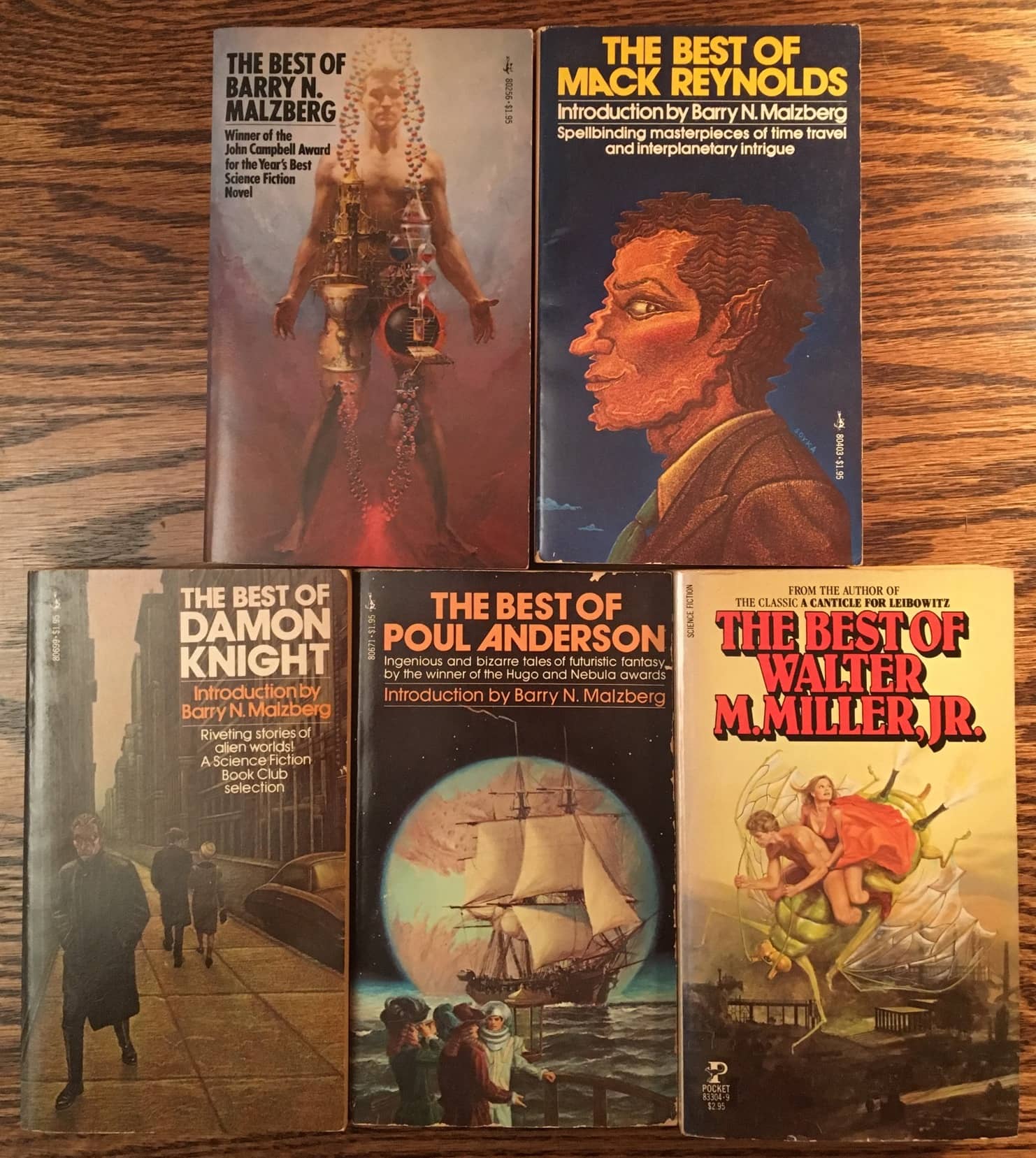
Barry MalzbergOn Friday I wrote here about the Best of collections from Pocket Books published in the late 70s, which featured Robert Silverberg, Poul Anderson, Walter M. Miller, and many others. Most had introductions by Barry Malzberg, the respected editor who’d helmed Amazing and Fantastic (and future editor of the SFWA Bulletin), and I wondered aloud if the books had been edited (or ghost-edited) by Malzberg.

Reader Alvaro Zinos-Amaro, author of Traveler of Worlds: Conversations with Robert Silverberg, leaped into action. “I asked Barry if he did the editing & teaser texts, per your speculation,” he told me. “Here’s his answer, which he said was fine to share.” Based on the comments on that post, I thought you lot might be as interested as I was, so here’s Barry’s reply.

The eight Best of collections were conceived by Robt. Gleason, the sf editor at the time [my novel] Beyond Apollo was acquired for sublicense from Random House and he remained there from 1972-1976. Those collections were acquired by him; he was fired in 1974 (went over to Playboy Press) and succeeded by his young assistant (b. 1952) Adele Leone Hull.

It was her idea to commission me for the eight Introductions (at $75 apiece!) and she wrote the cover copy; I had nothing to do with the collections beyond the Introductions. Hull was the sf editor at Pocket Books until 1978, went over very briefly to Pyramid and when Pyramid in 1979 was fully absorbed (under the Jove imprint) into Harcourt she became an agent.

That’s the first confirmation I have that there were eight volumes in the series with a Malzberg intro (I count at least 10 overall), so I’m doubly grateful to Alvaro for passing that along. Our previous coverage of Barry includes my thoughts on his collections Astounding Science Fiction in the 1950s and Bug-Eyed Monsters (both co-edited by Bill Pronzini), and his novel Underlay.

Birthday Reviews: Edo van Belkom’s “The October Crisis”

Birthday Reviews: Edo van Belkom’s “The October Crisis”

Cover by Barclay Shaw

Edo van Belkom was born on July 14, 1962.

Van Belkom won the Bram Stoker Award for his short story “Rat Food,” co-written with David Nickle. He has won the Aurora Award three times, for the short story “Hockey’s Night in Canada,” for editing Be VERY Afraid!, and for his novel Wolf Pack. He has written erotica under the pseudonym Evan Hollander and has written at least two Deathlands novels using the James Axler house name.

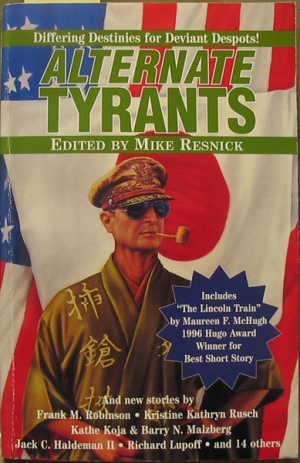
In the 1990s Mike Resnick published several alternate history anthologies, including Alternate Tyrants, which took various world leaders and put them in a situation which allowed them to exercise their dictatorial desires. Edo van Belkom’s submission was “The October Crisis,” a Canadian alternate history which has never been reprinted.

“The October Crisis” of the title of Edo van Belkom’s alternate history was a period that lasted for most of October in 1970 when members of the Front de libération du Québec took hostages in Quebec in an attempt to forward their separatist movement. While Canadian Prime Minister Pierre Trudeau implemented the War Measures Act, permitting himself a wide range of powers, the measures expired in November in our own timeline. In the world of van Belkom’s story, Trudeau continued to use the powers to suppress any dissent, political or journalistic.

The story follows our own timeline pretty closely until Trudeau decides to use the acts powers against the kidnappers directly, and also orders the secretive murder of the released kidnapping victim in order to drum up further support for his policies. At this point in the story, van Belkom switches point of view to have the leader of the opposition, Robert Stanfield, describing Trudeau’s excessive actions to Richard Nixon to attempt to get the US to intervene in the growing tyranny in Canada. Van Belkom introduces some ambiguity at this point, leaving the question open as to whether Nixon will respond to Stanfield’s pleas to help, or give into his own tyrannical tendencies to model his own manner of leading the US after the policies instituted by Trudeau.

Read More Read More

The Pocket Best

The Pocket Best

The Pocket Best Science Fiction-small

We’ve spent a lot of time here at Black Gate celebrating Del Rey’s Classics of Science Fiction line from 1974-88 (The Best of Eric Frank Russell, The Best of Fritz Leiber, etc.); nearly two dozen paperback originals reprinting early short stores by C.L. Moore, Leigh Brackett, Edmond Hamilton, Henry Kuttner, John W. Campbell, Philip K. Dick, Fredric Brown, Murray Leinster, Robert Bloch, Jack Williamson, and many others. The series was the equivalent of a Masters-level course in science fiction and, taken as a whole, formed an essential library of 20th Century SF. The entire series, including all the reprints, is cataloged at IMDB. None of the volumes have been reprinted since 1988, and there are no digital versions, but the series was popular enough that copies are easy to find and not particularly expensive. (See below for a handsome set I bought last month for $40).

Lester del Dey wasn’t the only publisher to see the value of a line of Best of collections, of course. Donald Wollheim more or less pioneered the idea with The Book of  A.E. van Vogt (DAW Books No. 4, 1972) and The Book of Brian Aldiss (No. 29, 1972), and followed with nine more from Frank Herbert, Philip K. Dick, Gordon R. Dickson, Philip Jose Farmer, Fritz Leiber, Fred Saberhagen, Poul Anderson, John Brunner, and Andre Norton. Like most early DAW efforts though, these were slender volumes; they’re also not as numerous, and the packaging isn’t nearly as attractive as the Del Rey books, so they aren’t as collectible.

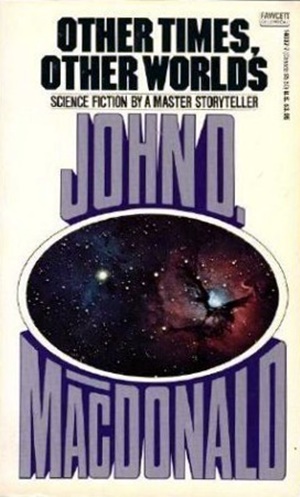
There was another publisher who gave del Rey a run for his money, however. Between 1976 and 1980 Pocket Books produced nearly a dozen substantial collections showing off the science fiction authors in their catalog, including Jack Vance, Robert Silverberg, Harry Harrison, John Sladek, Keith Laumer, Damon Knight, Poul Anderson, Barry N. Malzberg, Mack Reynolds, and Walter M. Miller.

Read More Read More

R.A. Lafferty, the Past Master of Science Fiction

R.A. Lafferty, the Past Master of Science Fiction

Past Master-small Past Master-back-small

R.A Lafferty is one of my absolute favorite classic SF writers. Though I’ve never read any of his novels.

Yeah, I know that sounds weird. But Lafferty is remembered today mostly for his brilliant short fiction, collected in priceless collections like Nine Hundred Grandmothers (1970), Strange Doings (1972), and Lafferty in Orbit (1991). And his novels… well, they’re not so well remembered. There are a lot of theories about this. In his wonderful SF biography Past Masters (the title of which is an homage to Lafferty), Bud Webster quotes Mike Resnick, who was close to Lafferty:

There were a number of people… who thought he was the most brilliant short story writer in the field. But his novelettes weren’t as good, and except for Space Chanty (sic) his novellas were unexceptional, and his novels were for the most part mediocre. I blame his drinking for this. If he could grind out a story in one or two sittings, he could be brilliant. But if a novel took him 50 writing sessions, you get the feeling that each day he had to refresh his memory of what the hell he wanted to do, how he wanted to say it, etc.

Not all of Lafferty’s novels have a poor rep. His first, Past Master (1968), was nominated for both the Hugo and Nebula, and today has become one of the most collectible SF paperbacks ever published by Ace Books, with good-condition copies commanding $50-85 and up on eBay.

Read More Read More

A Perfect Dream of Summer: The Mad Scientists’ Club

A Perfect Dream of Summer: The Mad Scientists’ Club

The Mad Scientists' Club-small The Mad Scientists' Club-back-small

In 1970, when I was ten, my city (Bell Gardens, California) built a new state-of-the-art library — right across the street from my house. (It was then that I knew that I was the favorite of the gods. The vicissitudes of life have since led me to revise that reckless assumption, but then I no longer live across the street from a library.) Every time I walked through the building’s doors (five or six times a day, probably), I sent up a silent thanks to Richard M. Nixon, whose name was prominently displayed on the dedication plaque by the entrance, even though he really had nothing to do with the project. (He had other things on his mind in those days — boy, did he.)

I practically lived in that library, and I knew every shelf of the large children’s section intimately; I could have drawn a quite accurate map of the layout from memory, with large arrows pointing to the location of my favorite books, many of which I checked out repeatedly and read over and over again. I retain fond memories of those stories, though nothing in the world would persuade me to reread most of them.

This is because few things in life are more hazardous than returning to a beloved children’s book after the passage of many years. It’s doubly dangerous if the work in question is one that’s “just” a children’s book and not one of those — like Alice in Wonderland or Peter Pan or The Wind in the Willows or the Little House books — that depth and brilliance and long endurance have accorded the status of literature.

There are exceptions, though, children’s books that might be less ambitious than the aforementioned classics but which can still engage an adult reader in search of something more than mere nostalgia. Exceptions like The Mad Scientists’ Club.

Read More Read More

Standing on Zanzibar

Standing on Zanzibar

Ken Lam confronts-small

Toronto police constable Ken Lam confronts the perpetrator of the Yonge Street van massacre,
April 23, 2018. The driver left his vehicle and repeatedly “drew” his cellphone as if it were a
firearm, 
pointing it and shouting at Lam to shoot him. Without firing a shot, the constable
forced the 
suspect to the sidewalk and handcuffed him.

This year marks the 50th anniversary of the publication of John Brunner’s Stand on Zanzibar. Besides its wonderful title (say it aloud!), the 1968 novel is worth remembering for its author’s uncanny predictions of what 21st century culture and technology might look like.

I use the word “predictions” hesitantly, since I feel that too often we lend a sort of second-rate legitimacy to authors who write stories of the future when we focus on such of their predictions that may have, in some way or other, “come true.” Jules Verne “predicted” the submarine, H.G. Wells tank and aerial warfare, E.M. Forster the internet, and so on. It becomes a form of damning with faint praise. If we focus on an author’s talent for alleged “prediction,” we can overlook the extent to which in expostulating futures, these authors actually wrote about their own time, and did so with insight and creativity. From this point of view, the extrapolations that didn’t “come true” are just as meaningful as those that did, but by focusing on just the “accurate” predictions, by depicting these writers as somehow Nostradamus-type prophets, we make clear that they’re not being judged for their literary value. Instead, they have been relegated to a room separate from that of the genuine canon of literary greats, their predictive ability categorizing each of them less as a genuine creative artist than as a clever algorithm, like a particularly well-programmed weather app.

Indeed, the SF genre is full of talented artists who remained within the genre and never particularly got their due as literary writers: the iconic status that such prolific genre authors as Ray Bradbury, Arthur C. Clarke, and Harlan Ellison now enjoy was gained not when they wrote specifically “literary” books, but when they skipped that step and when straight into writing scripts for well-regarded films and TV shows, a kind of canonization into popular culture (reinforced by the knowledge that in these cases, their art gained them large paycheques) that any literary writer would envy.

Read More Read More

Vintage Treasures: Nebula Winners Fourteen, edited by Frederik Pohl

Vintage Treasures: Nebula Winners Fourteen, edited by Frederik Pohl

Nebula Winners Fourteen-small Nebula Winners Fourteen-back-small

Back in May, more or less on a whim, I paid $6.59 for a copy of the British paperback edition of Nebula Winners Fourteen, edited by Frederik Pohl. I already had the Bantam version (see below) but the gorgeously moody cover by the great Bruce Pennington hypnotized me, and what could I do?

I’m glad I did it, anyway. In this hot Illinois summer, a book I can dip into while relaxing on the porch is a perfect antidote, and having Nebula Winners Fourteen conveniently on hand has reminded me just how outstanding the Nebula anthologies were, and are, year after year. This one, for example, includes the three 1978 Nebula short fiction award winners, plus a 30-page excerpt from the winning novel:

“The Persistence of Vision,” by John Varley (Best Novella)
“A Glow of Candles, a Unicorn’s Eye,” by Charles L. Grant (Best Novelette)
“Stone,” by Edward Bryant (Best Short Story)
An Excerpt from Dreamsnake, by Vonda N. McIntyre

But it also includes some superb nominees, as selected by Pohl, including C. J. Cherryh’s Hugo Award-winning short story “Cassandra,” and Gene Wolfe’s massive 60-page novella “Seven American Nights.” I imagine Pohl got a lot of grief for cramming two long novellas into a slender paperback, displacing a lot of award-nominated short fiction in the process, but the years have proven the astuteness of his choice. “Seven American Nights” is one of the most acclaimed stories of the 70s, still discussed and enjoyed today, whereas the winner in the novella category, Varley’s “The Persistence of Vision,” is considered by many to be overrated (including by me.)

Read More Read More

Black Gate Book Club, Downbelow Station, Final Discussion

Black Gate Book Club, Downbelow Station, Final Discussion

BdS1Welcome to the final round of the Black Gate Book Club, where we hash out or feelings and impressions on C.J. Cherryh’s 1981 classic Downbelow Station (DbS).  We also give DbS our final score– and things get contentious!

Need to catch up on the discussion?  Easily done with these convenient links to the first, second, third, and fourth rounds.

Adrian S.

I finished DbS last week. Third time was on the money!  Since I appeared to be the slow elephant I assume that everyone else was probably finished before I was.  In our set-up for the Black Gate Book Club we said that we’d give a final 1 to 10 rating on the books and this is our opportunity for that, as well as for final thoughts/quibbles/arguments.

Me? I’m going to give DbS a 6 out of 10.

I acknowledge the vastness of the story and the world(s) that Cherryh constructed. It is intricate, it is dynamic, it is chaotic; she has two generations of station masters vs. two generations of saboteurs, vs. a rag-tag Company Fleet, vs. an unknown foe of the Union forces, and throws in the Downers and the Merchanters and all that.

That said, did we really have to spend 300 pages setting the board so that some things could start happening? Yes, I get it, a slow burn, small disasters leading to bigger disasters.  But 300 pages of it?

300 pages of characters that seem completely interchangeable. Is there much of a difference between Angelo Konstantin and his sons Emilio and Damon.  Is there much of a difference between Emilio and Damon?   Ditto Jon Lucas and his two sons?   Double ditto between Conrad Mazian and Seb Azov.  Double damn ditto the women in the story,  Miliko (Emilio’s wife) and Elene (Damon’s).

I’m going to expand on something that Chris Hocking said about Cherryh’s lack of a sense of wonder. Not only is there no real sense of wonder, but Cherryh seems to be able to only write one real emotional state—a crippling sense of dread (CSoD).  And that’s why each of those characters comes across pretty much the exact same way—they all have intricately explored, elaborated, and expanded CSoD.  There seems to be no character that she doesn’t put into a claustrophobic environment to stew in their own cold terror.

That’s why Jon Lukas, Jessad, Ambassador Ayers and even Satin stand out in this story like giants—they are the only characters who take an active hand in their own fate.  Even Bran Hale and the goon from Q , secondary characters at best, bestride Downbelow Station like colossi because they do something. The rest just bounce around like terrified pinballs until they are finally forced to take some action.

Read More Read More

On Rivers of Blood: Fevre Dream by George R.R. Martin

On Rivers of Blood: Fevre Dream by George R.R. Martin

Fevre Dream Subterranean-small

For many of his fans, George R.R. Martin’s A Song of Ice and Fire (aka A Game of Thrones, the title of the first book in the series) is considered to be his masterpiece. Undoubtedly GOT is his magnum opus, but for me his masterpiece is 1982’s Fevre Dream, which is one of my favorite vampire novels. Everything about this novel — setting, characters, prose, theme — reads as if Martin had channeled Mark Twain and Bram Stoker, had conjured them from beyond the veil to look over his shoulders while he penned this wonderful tale.

Fevre Dream is set in the antebellum south of the United States between the years 1857 to 1870, along the Illinois, Ohio, and Mississippi Rivers. The main characters are a riverboat captain named Abner Marsh, a big, ugly, gruff but honest and honorable man, and Joshua York, a heroic and noble vampire who many of his kind eventually come to think of as their savior, the Pale King. The main thread deals with Marsh’s partnership and eventual friendship with York. And it’s this unlikely friendship that is at the heart and soul of this incredibly thoughtful and well-written novel. It begins when York approaches Marsh one night and offers him a grand business opportunity — to build the largest, fastest and most glorious riverboat ever seen, a riverboat painted all sparkling white, to which they give the name Fevre Dream.

Read More Read More

Birthday Reviews: Robert Lynn Asprin’s “No Glad in Gladiator”

Birthday Reviews: Robert Lynn Asprin’s “No Glad in Gladiator”

Cover by Gary Ruddell

Robert Lynn Asprin was born on June 28, 1946. He died on May 22, 2008.

Asprin won the coveted Balrog Award for the Thieves’ World anthologies Shadows of Sanctuary and Storm Season. The first anthology in the series, Thieves’ World, was nominated for the World Fantasy Award. In addition to his work on the shared world series, Asprin is also known for his long-running Myth series, featuring Skeeve and Aahz. Other series, often written with co-authors, include Phule’s Company, Time Scout, and The Cold Cash War. For a time, Asprin was married to Lynn Abbey, who co-edited several of the Thieves’ World anthologies and eventually resurrected the series in the 2000s.

“No Glad in Gladiator” was published in the ninth volume of the Thieves’ World series, Blood Ties, edited by Asprin and Lynn Abbey in 1986. Its only reprinting was in the third Thieves’ World omnibus edition which included volumes 7-9, The Shattered Sphere.

The gladiator slave Jubal was one of the first characters introduced in the Thieves’ World shared world series, conceived by the series creator, Robert Lynn Asprin. By the time the ninth volume rolled around, Jubal had enjoyed his triumphs and suffered his set backs. In “No Glad in Gladiator,” Asprin has cast him in the role of eminent grise, showing a meeting between Jubal and Chenaya, a Rankene noblewoman and gladiator who is trying to make her way in Sanctuary.

Despite both characters’ background as gladiators, “No Glad in Gladiators” is a relatively static story. Asprin has the two characters sitting in a room talking, Chenaya’s looking for an alliance with Jubal and Jubal, after explaining why he isn’t interested in an alliance, explains to Chenaya all of her shortcomings. The story doesn’t fully work without its larger context. Jubal provides enough information about himself for the reader to understand who he was, and is, but Chenaya’s history is only painted in broad strokes, making her something of an enigma.

Read More Read More