Browsed by
Category: Vintage Treasures

Black Gate Book Club, Downbelow Station, Fourth Discussion

Black Gate Book Club, Downbelow Station, Fourth Discussion

DBS7

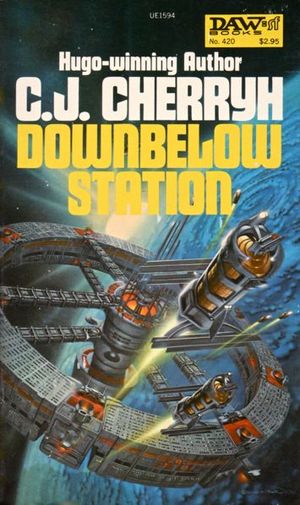
Welcome back to the Black Gate Book Club! We are rapidly closing in on C.J. Cherryh’s Downbelow Station (DbS).  You can get to speed with the first, second, and third rounds.

Adrian S.

Fourth round!

Okay, page 285 and Fletcher, you are right that things are (finally) happening quick. The Union Fleet has dropped into the system, and the Company Fleet and the militia go out to meet them.  I like the idea that all the ships look the same on scan, whether they are jump-capable merchanters or in-system merchanters, or Fleet Carriers or whatever—they all look the same until they maneuver or start to fire.

Jon Lukas has become the bad guy that he was hinted at with a full murderous take-over of Downbelow Station.   Of course, he’s made a choice on which side he’s on, gambling that the Union is going to win, and from there getting roped into helping Union win.  This puts him with a lot of targets on his back.

Kressich is in the exact same boat, but with more targets on his back, he’s terrified of his people in Q, and terrified of his own security, but once the shooting starts, he is one of the few people who has security and has people.

The relationship of the “leaders” to their armies/militias is interesting.

Read More Read More

The Wonderful Adventures of “Mr. Jones,” the Electric Man

The Wonderful Adventures of “Mr. Jones,” the Electric Man

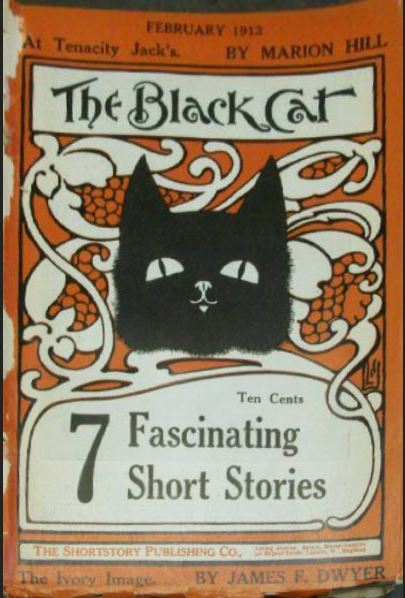
1913-02 The Black Cat cover

A special treat this time: a lost robot story that nobody has seen for more than a century.

Supernatural tales, ghost stories, odd occurrences, mysterious disappearances, and bizarre inventions all found a home in The Black Cat, a magazine founded in 1895, a year before the first pulp magazine appeared. Mike Ashley calls it “a spiritual ancestor to Weird Tales.” The stories were proto-genre, a mixture of what then got called “unusual” stories, a term that must have had more currency in the 19th century. It was founded by 44-year-old Herman Daniel Umbstaetter, who went by the initials H. D. Not content with being editor and publisher, he seeded the magazine with his own stories, some under pseudonyms, until it took off on its own. Covers were illustrated by his much younger wife Nelly, usually with some variation of the stylized black cat staring spookily out at the reader that appeared from from the first issue.

Read More Read More

Vintage Treasures: Jack Dann & Gardner Dozois’ 40-Volume Reprint Library

Vintage Treasures: Jack Dann & Gardner Dozois’ 40-Volume Reprint Library

Bestiary Dann Dozois-small Aliens Among Us-small

The impending release of Gardner Dozois’ 35th and final Year’s Best anthology next month brings us to the end of an era. Hard as it is to believe, after his final books are released in the next few months, there will be no more magazines, stories or anthologies from one of the most gifted editors the field has ever seen.

Many readers are unaware that, as prolific as Gardner was as a magazine and Year’s Best editor — 17 years at the helm of Isaac Asimov’s Science Fiction Magazine, and 35 years as the editor of the annual Year’s Best Science Fiction — his greatest contribution to the field, at least in terms of raw numbers, was as an editor of standalone anthologies. He produced many dozens, including 21 volumes collecting stories from Asimov’s, such as Isaac Asimov’s Detectives (1998) and Isaac Asimov’s Halloween (2001), most co-edited with Sheila Williams.

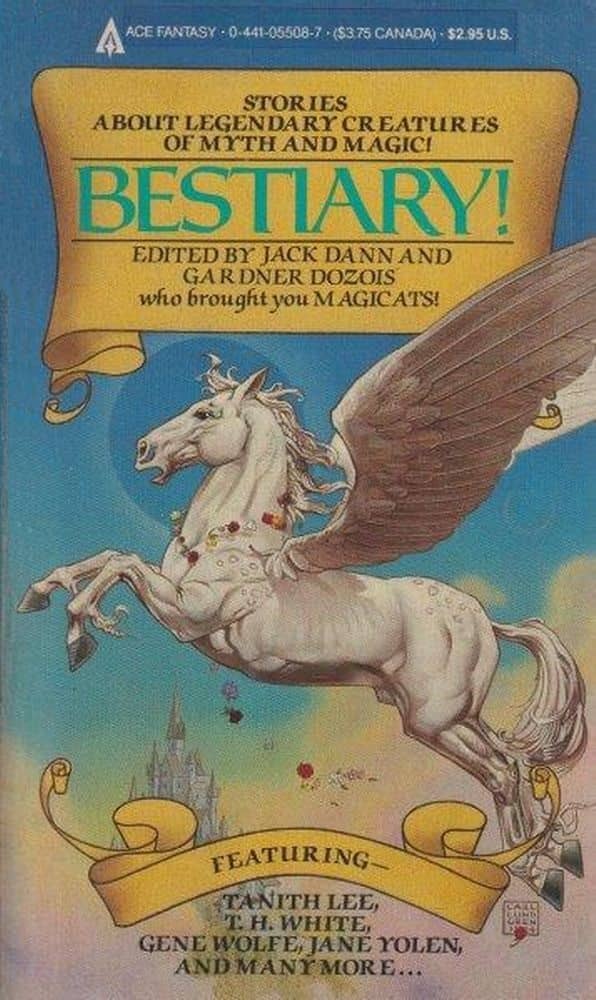
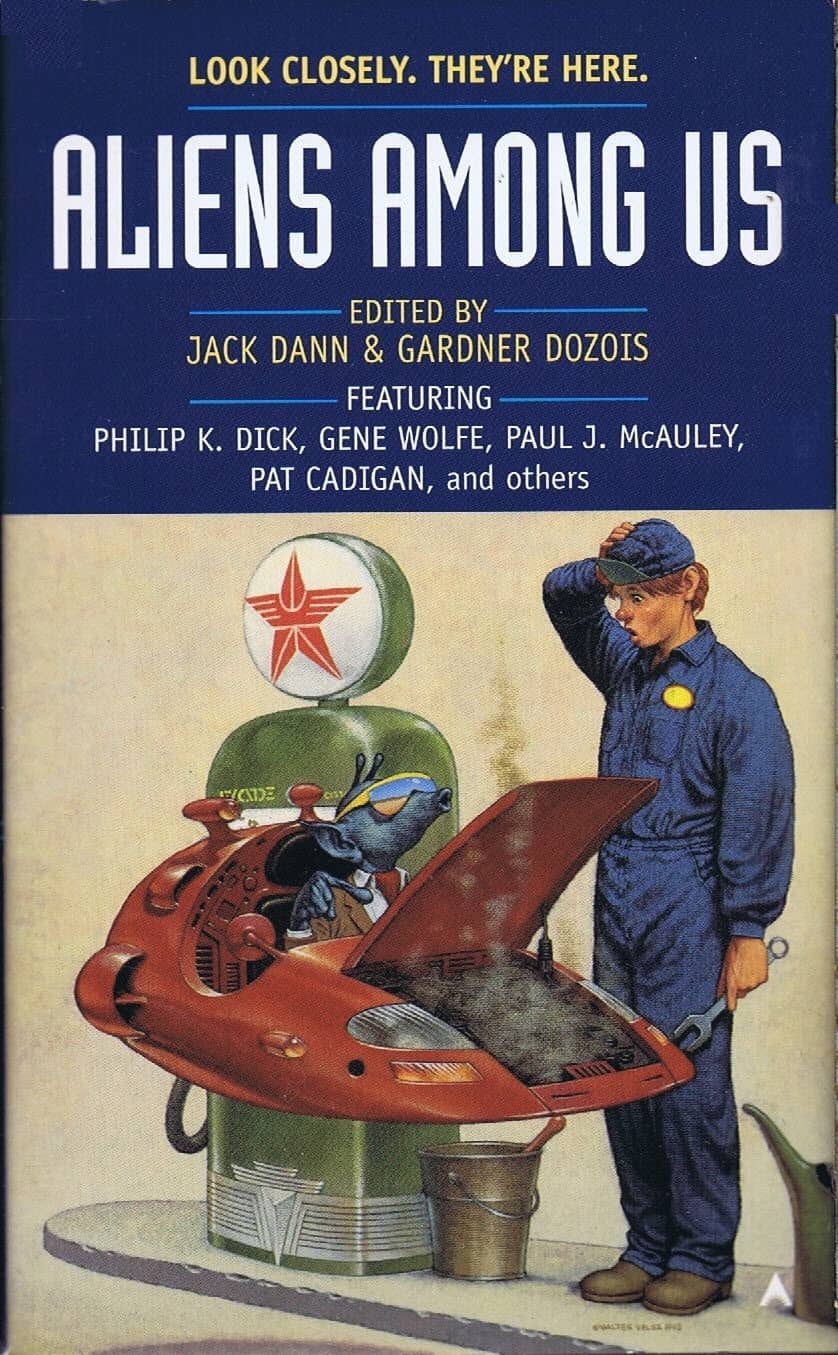
But his most fruitful partnership was with Jack Dann, which whom he co-edited some 40 themed science fiction and fantasy anthologies between 1976 and 2009, almost all paperback originals with Ace Books. These included 22 volumes in the Exclamatory Series, called that because the anthologies had one-word titles with an exclamation point, like Magicats! (1984), Bestiary! (1985), and Invaders! (1993), and an additional 18 themed reprint volumes, such as Armageddons (1999), Aliens Among Us (2000), and A.I.s (2004).

Read More Read More

Birthday Reviews: Mercedes Lackey’s “A Different Kind of Courage”

Birthday Reviews: Mercedes Lackey’s “A Different Kind of Courage”

Cover by Richard Hescox

Mercedes Lackey was born on June 24, 1950.

Lackey has been nominated for the Lambda Award three times, winning for her novel Magic’s Price in 1991. Her novel The Ship Who Searched, written in collaboration with Anne McCaffrey, was nominated for the Seiun Award and her novel The Fire Rose was nominated for the Sapphire Award. In addition to her collaborations with McCaffrey, she has also collaborated with Joseph Sherman, Ru Emerson, and Mark Shepherd on the Bard’s Tale series, with Ellen Guon and Rosemary Edghill on the Bedlam Bard series, with husband Larry Dixon, Holly Lisle, Cody Martin, and Roberta Gellis on the SERRAted Edge series. Other collaborators include Dave Freer, Eric Flint, Andre Norton, Marion Zimmer Bradley, James Mallory, C.J. Cherryh, and others.

“A Different Kind of Courage” was Lackey’s first sale and originally appeared in Free Amazons of Darkover, a shared world anthology set in Marion Zimmer Bradley’s world of Darkover and edited by Bradley in 1985. The story was reprinted by Steven H Silver and Martin H. Greenberg in Magical Beginnings, an anthology of the first stories by various fantasy authors. In 1988, “A Different Kind of Courage” was translated for the German publication of Freie Amazonen von Darkover.

Rafi is an outcast, someone who doesn’t fit in anywhere and has failed at everything she has tried to do. After she was ejected from training as a Keeper, her father planned to marry her off to Lord Dougal, who has a reputation for having his wives killed. Rather than marry Dougal, she runs away and joins the Free Amazons, where she quickly discovers she has neither the strength, stamina, nor ability to be successful. Her partial training as a Keeper, however, causes her to be sent on a mission with Caro and Lirella, neither of whom want to be saddled with her. One evening, they sent her out to gather firewood, a task she also fails.

Upon returning to her companions, she finds that they have been attacked and, although they have defeated their attackers, both have horrible wounds. Rafi does what she can for them, overcoming her fear of their pack animals to use them to drag the women inside where she treats their wounds and keeps them warm. She also uses her Keeper training to reach out to seek additional help. She does what she can through the night, but by the time help arrives, Rafi is, herself, on the verge of death.

Read More Read More

Black Gate Book Club, Downbelow Station, Third Discussion

Black Gate Book Club, Downbelow Station, Third Discussion

Welcome to the second round of discussion on C.J. Cherryh’s classic 1981 novel Downbelow Station. New to the program? Check out the first and second rounds. We lose Chris on this one, perhaps a casualty of a bad Jump from the Beyond. Fletcher and myself carry the standard of the Black Gate Book Club as best we can!

Adrian S.

DBS5

Third round! And it is appropriate that I just started book 3 of DbS.  I’m on page 190, so I have surpassed my previous record of 169.

What can I say at this point? Well, my guess that conspicuously-absent Admiral Mazian was, in fact, behind the destruction of several company/neutral stations has borne out to be true!  I guess the big game is to try to force the Union to take control of these damaged stations and spread themselves too thin?  And to put all their resources at a station called Viking—the only 100% working station in Union space, I guess?  And to attack/destroy/cripple it and thus break the Union.

Of course, Union seems to be playing the same trick — forcing the refugees all to Downbelow Station, which has now become the one 100% working station in Company space.

So that’s what the power-players are doing, and everyone else is just running around between their feet.

I like how Cherryh illuminates parts of the plot, then occludes other parts. The sudden retreat of Mazian’s fleet from the Viking attack — was it due to Ambassador Ayer’s orders, or some other factor?

But again, I have to say that Jon Lukas, who does the right things for the wrong reasons, is still coming off as one of the only active people in the book. Honestly, how hard is it to get on the goddam PA system and say “Yes, the fleet is coming, no we are not all gonna die, keep calm and carry on.” Hard enough that only Jon Lucas can do it and keep Downbelow Station from tearing itself apart in a panic!

Satin, the Downer now working on Downbelow Station, is also active in that she is following her vision-quest thing regardless of what the older Downers and the Lukas-men and everyone else thinks.

Read More Read More

Birthday Reviews: Vivian Vande Velde’s “The Granddaughter”

Birthday Reviews: Vivian Vande Velde’s “The Granddaughter”

Cover by Bran Weinman
Cover by Brad Weinman

Vivian Vande Velde was born on June 18, 1951.

Her novel Never Trust a Dead Man received the Edgar Award for Best YA Novel in 2000 and Heir Apparent was nominated for the Mythopoeic Award for Children’s literature in 2003.

Vande Velde initially published “The Granddaughter” in her 1995 collection Tales from the Brothers Grimm and the Sisters Weird. The story was selected by Terri Windling for inclusion in The Year’s Best Fantasy and Horror: Ninth Annual Collection, edited with Ellen Datlow. Asdide from those appearances, the story has not been reprinted.

Retellings of fairy tales have a long established role, in fact the earliest version of fairy tales are often just the first version of a retelling of an oral tradition. Vivian Vande Velde has targeted the story of “Little Red Riding Hood,” which dates back at least as far as the tenth century and has been retold by both Charles Perrault and the Brothers Grimm. In “The Granddaughter,” Vande Velde’s focus is on the wolf, who can speak and is good friends with the title character’s grandmother.

Little Red Riding Hood, who is also known as Lucinda in this version, although she prefers the nickname, is an aspiring actress, almost completely self-centered, and horrified that her grandmother would be friends with a wolf, even one who can speak. The wolf, for his part, is equally horrified at Lucinda’s attitudes and inability to allow anyone else speak during a “conversation.” Not, at first understanding the grandmother’s reluctance to have Lucinda visit, the wolf quickly comes around to her point of view and works to rescue the woman from her granddaughter’s visit.

Read More Read More

Birthday Reviews: Andrew Weiner’s “Bootlegger”

Birthday Reviews: Andrew Weiner’s “Bootlegger”

Cover by Joyce Kline

Andrew Weiner was born on June 17, 1949.

Weiner’s story “The Third Test” was nominated for the British SF Association Award. He has also been nominated for the Aurora Award three times, for the original story “Station Gehenna” (which he expanded to a novel), “Eternity, Baby,” and “Seeing.”

“Bootlegger” was published in 1997 by Robert J. Sawyer and Carolyn Clink in the anthology Tesseracts6. The story has not been reprinted.

“Bootlegger” tells the story of Marshall Baron, a washed up musician who discovers that there are CDs being circulated that purport to be bootlegs of some of his early music. The problem is that he knows that he never recorded or wrote the songs that are on the albums, although voice analysis claims they are by him. He has Alderman, one of his agents, try to find the source of the bootlegs so they can figure out what is happening.

Alderman’s investigations lead him to Greenspan, a fan of Baron’s who has written several gossipy books about the singer. Although Baron wants nothing to do with the man, whom he considers a crank, Greenspan will only reveal his source of the bootlegs to Baron, nobody else. Greenspan’s revelation is that he has access to another world where Baron’s career had a different, more successful, trajectory. He feels that Baron could still make a difference in their own world, spark the revolution that his early music promised, although Baron disagrees, feeling that the revolution has passed.

Greenspan is not only a fan of Baron’s work, but also jealous of him and something of a radical. If Baron isn’t going to use his talents to make the world a better place, Greenspan is going to use his ability to access other worlds to create the world that he feels is necessary, even if it means taking Baron away from everything that he has achieved. Greenspan’s plans work within the context of the story, although when fully explored, there were other, less disruptive options he could have chosen.

Read More Read More

Birthday Reviews: Harry Turtledove’s “Half the Battle”

Birthday Reviews: Harry Turtledove’s “Half the Battle”

Cover by Tony Roberts

Harry Turtledove was born on June 14, 1949.

Turtledove began publishing using the pseudonym “Eric G. Iverson” and has also published under the names “Mark Gordion,” “H.N. Turteltaub,” and “Dan Chernenko.” Known for his alternate history novels and epics, he has also published numerous science fiction and fantasy works. In 1994 his novella “Down in the Bottomlands” received the Hugo Award. He won the Sidewise Award for Alternate History twice, for his novels How Few Remain and Ruled Britannia. Two of the novels in his Young Adult Crosstime series have won awards. Gunpowder Empire won the 2004 Golden Duck Hal Clement Award given by SuperConDuckTivity and The Gladiator received the 2008 Prometheus Award. His novel WorldWar: In the Balance received the Italia Award in 1996. Turtledove served as Toast Master at Chicon 2000, the Worldcon. In 1995 he received the Forry Award from LASFS.

“Half the Battle” was published by Jerry Pournelle in 1990, in volume 9 of his There Will Be War anthology series, After Armageddon. The story has not been reprinted.

The story opens sometime after an apocalyptic event has destroyed civilization in southern California. A new society has arisen around several small kingdoms, with Turtledove looking at the king of Canoga. When a book is found that describes a machine that the ancients had that can spit bullets, a machine gun, King Byron has his artificers try to replicate the lost device to replace the slow matchlocks his troops are using. The fact that King Byron and his people knew the gun could exist gave them the edge in re-creating it.

The story uses several time jumps to explore where this future will go. In each period, King Byron’s descendants have managed to extend and consolidate the kingdom’s power and in each period, they come across other devices of the ancients that they work to replicate, because knowing it can be done is “half the battle.”

Read More Read More

Black Gate Book Club, Downbelow Station, Second Discussion

Black Gate Book Club, Downbelow Station, Second Discussion

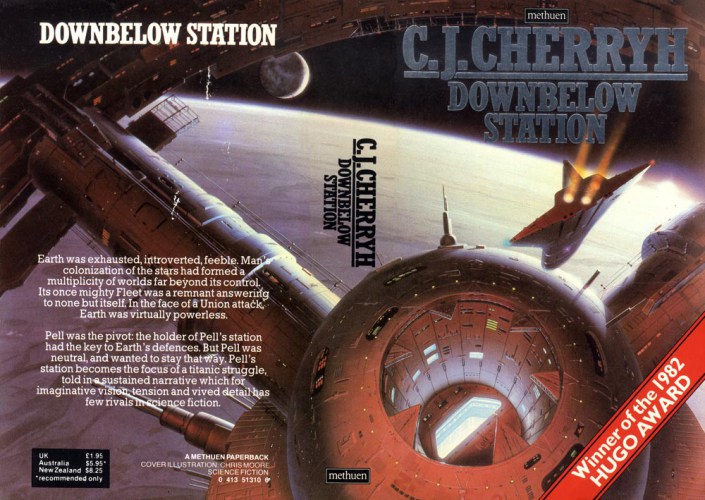
Downbelow Station UK-smallWelcome to the second round of discussion on C.J. Cherryh’s classic 1981 novel Downbelow Station. New to the program? The first discussion can be found here.

Chris Hocking gets the ball rolling this time around.

Chris Hocking

Hi people,

I had business travel to do and took Downbelow Station on the plane for some serious reading. I came away from it realizing that I had developed an unusual (for me at least) attitude toward the book.

This is an intense SF novel depicting otherworldly conflict in alien environments, but it’s tone is resolutely workaday and normalized. The exotic situations and scenes described are experienced by the characters, and presented to the reader, with matter-of-fact realism. We follow several characters whose histories and position are laid out and fitted into this fictional environment with great skill. This is a story of interplanetary war, of political maneuver and counter-maneuver, of individuals and policy makers struggling to deal with the critical issues and collateral adjustments that inevitably arise in wartime. It is executed by Cherryh with remarkable depth and solidity: the environment meshes completely with the story being told and the overall effect is very convincing. This is a powerful and deep imagination at work.

Yet having said all that, I find the book a half-step out of phase with my own reading tastes. The consistent desperation of most of the characters, the grueling effects of war and displacement are all well done and appropriate to the story being told, but for me the cumulative effect was kind of enervating. I’ve read enough bleak modern fiction and noir that this didn’t bother me much in itself, but it was coupled with the notable absence of an element I tend to seek in Science Fiction.

Read More Read More

Experience Poul Anderson’s Complete Psychotechnic League from Baen Books

Experience Poul Anderson’s Complete Psychotechnic League from Baen Books

The Complete Psychotechnic League Volume 1-small The Complete Psychotechnic League Volume 2-small The Complete Psychotechnic League Volume 3-small

Art by Kurt Miller

When I learned last September that Baen Books was reprinting Poul Anderson’s classic Psychotechnic League stories, I wrote a brief history of the series. Here’s what I said, in part.

The Psychotechnic League began as a Future History, a popular beast among short SF writers of the 40s and 50s. Anderson published the first story, “Entity,” in the June 1949 issue of Astounding Science Fiction, and set the opening of his series a decade in the future. The series continued for the next two decades, (appearing in Astounding, Planet Stories, Worlds Beyond, Science Fiction Quarterly, Cosmos, Fantastic Universe, and other fine magazines), eventually extending into the 60s. In the process, his “Future History” gradually became an “Alternate History,” as actual history trampled all over his carefully constructed fictional timeline.

That didn’t seem to bother readers though, and the tales of the Psychotechnic League remained popular well into the 80s. The series included some 21 stories, including three short novels: The Snows of Ganymede (1955), Star Ways (1956), and Virgin Planet (1957). The short stories and one of the novels were collected in a trilogy of handsome Tor paperbacks in 1981/82, with covers by Vincent DiFate. Now Baen books is reprinting the entire sequence in a series of deluxe trade paperbacks, starting with The Complete Psychotechnic League, Volume 1, on sale next month.

Volume 1 was released right on schedule last October, and Volume 2 followed in February. The third and final book will be released next month.

Read More Read More