Browsed by
Category: Vintage Treasures

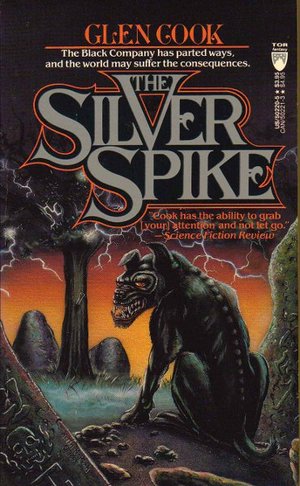
An End to the End: The Silver Spike by Glen Cook

An End to the End: The Silver Spike by Glen Cook

oie_11558360wYZzXP1And so we come to end of the line for several of the main characters of the Black Company trilogy. The end of the third book, The White Rose, saw the storied mercenary company whittled down to a handful of survivors. The group — five veterans, the empire’s erstwhile ruler the Lady, and Croaker in the lead — decided to travel south and find Khatovar, the fabled home city of the Black Company.

Darling, otherwise known as the rebel leader the White Rose, chose to remain in the North rather than accompany Croaker and the rest of her friends. The wizard Silent, in love with with Darling, chose to remain with her despite her not having reciprocal feelings. Raven, also in love with Darling, stayed behind too, but rejected, went off with Case, the young imperial soldier he’d befriended.

Published four years after The White Rose, The Silver Spike (1989) is a sort of odd book that attempts to tie up several loose ends. It covers a lot of ground, constantly bouncing between several narratives and the better part of two continents. Concerned as much with giving ends to a host of characters as he is with the aftermath of the rebellion, Cook doesn’t tell a totally cohesive story.

Over here, several characters are chasing down a revived enemy only to be suddenly yanked away to face a different threat. Another storyline follows a new set of characters as they commit an act of great stupidity that leads to many deaths and horrendous destruction. There’re lots of very cool bits of business, but The Silver Spike feels like several books jammed together rather inelegantly. Perhaps if Cook had written a giant, sprawling work, like one of today’s thousand-page tomes, he could have made it come together better. But at only 313 pages, there’s little space for the rambling the book is given to.

The Silver Spike begins with Philodendron Case introducing and explaining himself. A minor character in The White Rose who found himself attached to Raven, now he’s a primary character.

This here journal is Raven’s idea but I got me a feeling he won’t be so proud of it if he ever gets to reading it because most of the time I’m going to tell the truth. Even if he is my best buddy.

Talk about your feet of clay. He’s got them run all the way up to his noogies, and then some. But he’s a right guy even if he is a homicidal, suicidal maniac half the time. Raven decides he’s your friend you got a friend for life, with a knife in all three hands.

My name is Case. Philodendron Case. Thanks to my Ma. I’ve never even told Raven about that. That’s why I joined the army. To get away from the kind of potato diggers that would stick a name like that on a kid. I had seven sisters and four brothers last time I got a head count. Every one is named after some damned flower.

Read More Read More

Vintage Treasures: The Ends of the Earth by Lucius Shepard

Vintage Treasures: The Ends of the Earth by Lucius Shepard

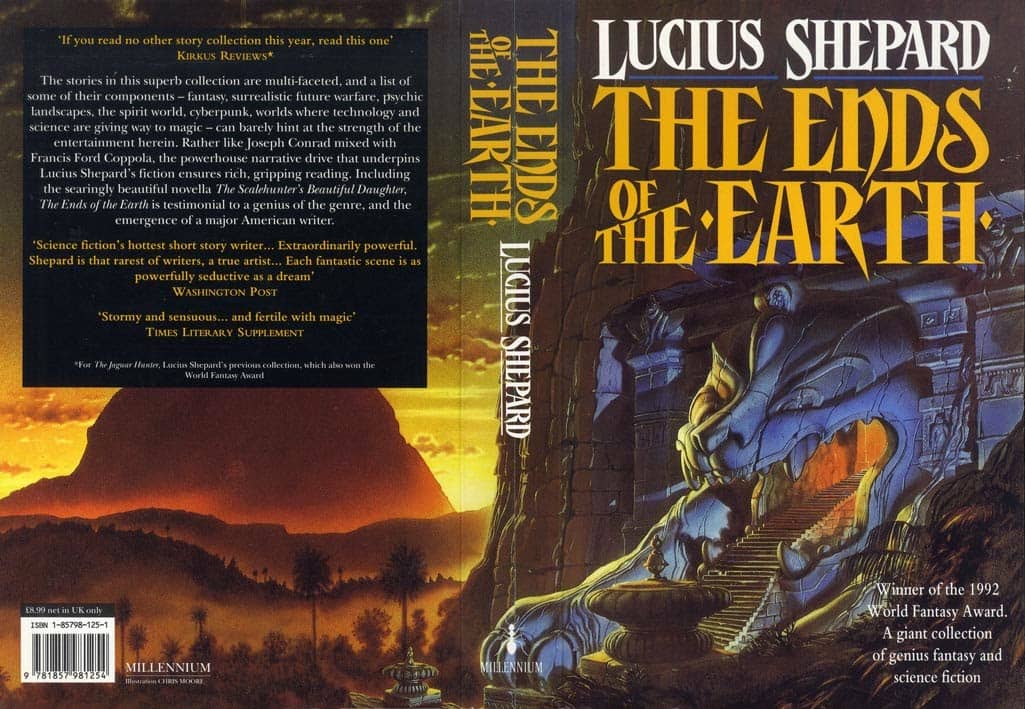
Lucius Shepard The Ends of the Earth-small

When he died in 2014, it was my unfortunate duty to write an obituary for Lucius Shepard. I considered him one of the finest short fiction writers in the genre in the 80s and 90, and tried to explain why in three short paragraphs. Here’s the core of what I wrote.

I first encountered him in the pages of Omni magazine in 1988, with his novelette “Life of Buddha.” I remember being astounded with the natural realism of his dialog, which captured the flow of modern speech in a way I’d never seen before. I read his brilliant Nebula Award-winning novella “R&R” — which opens with an artillery specialist in Central America getting a glimpse of a war map and wondering if he’s somehow caught up in a war between primary colors — and the novel it turned into, Life During Wartime (1987). His dark visions of the near future frequently involved inexplicable wars, and he wrote extensively about Central America, where he lived briefly.

Four years after his death, Shepard is in danger of being forgotten. Virtually all of his work is out of print, and his finest work — his award-winning short stories — is getting harder to find. Fortunately, it’s not getting more expensive. Those who know what to look for can snap up his best collections are bargain prices. In April I was the only bidder on eBay for a brand new copy of his World Fantasy Award-winning The Ends of the Earth (1991), and won it for the criminally low price of $7.99. It’s one of the finest fantasy collections of the last 30 years.

Read More Read More

Birthday Reviews: Joe Haldeman’s “Blood Brothers”

Birthday Reviews: Joe Haldeman’s “Blood Brothers”

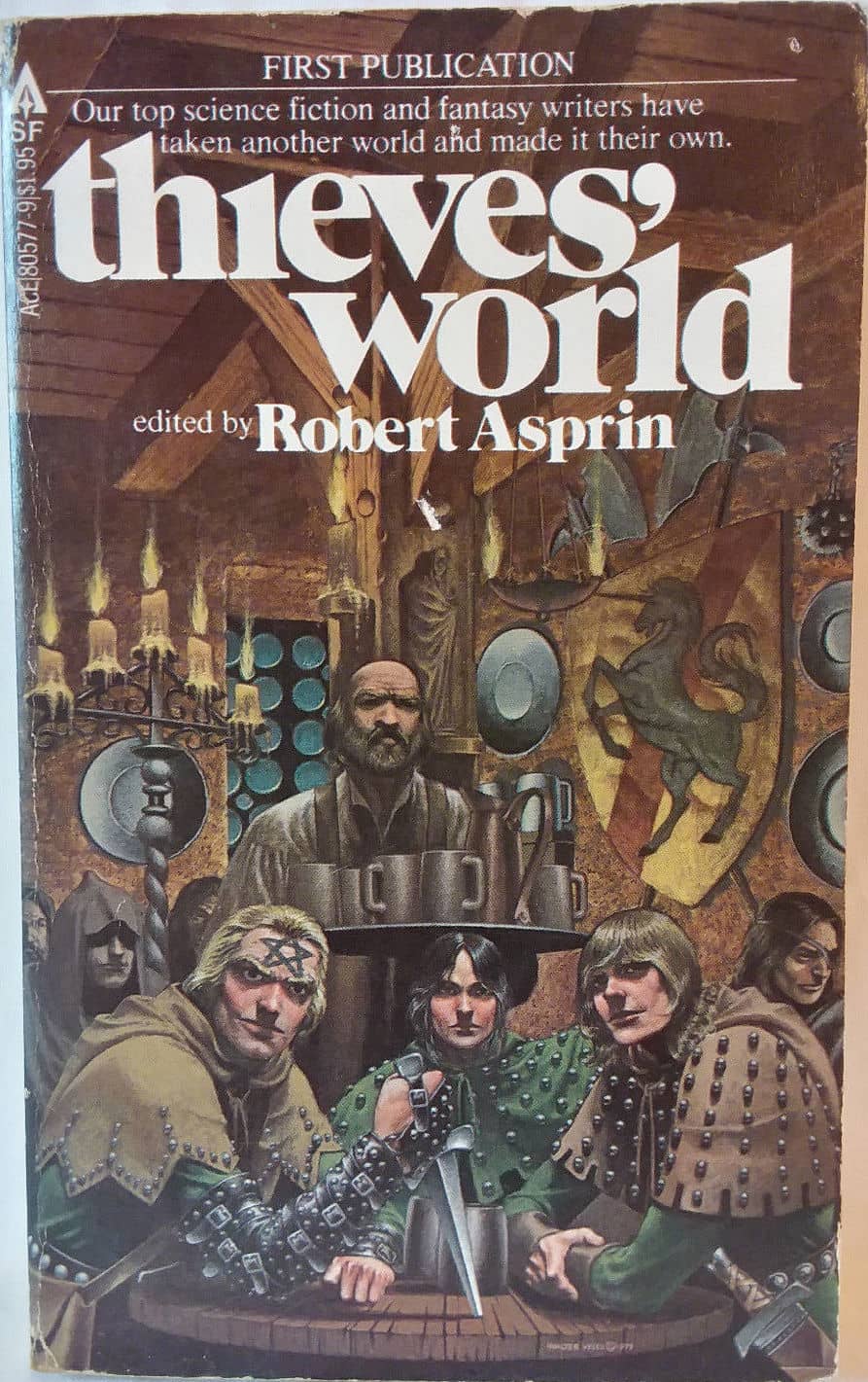
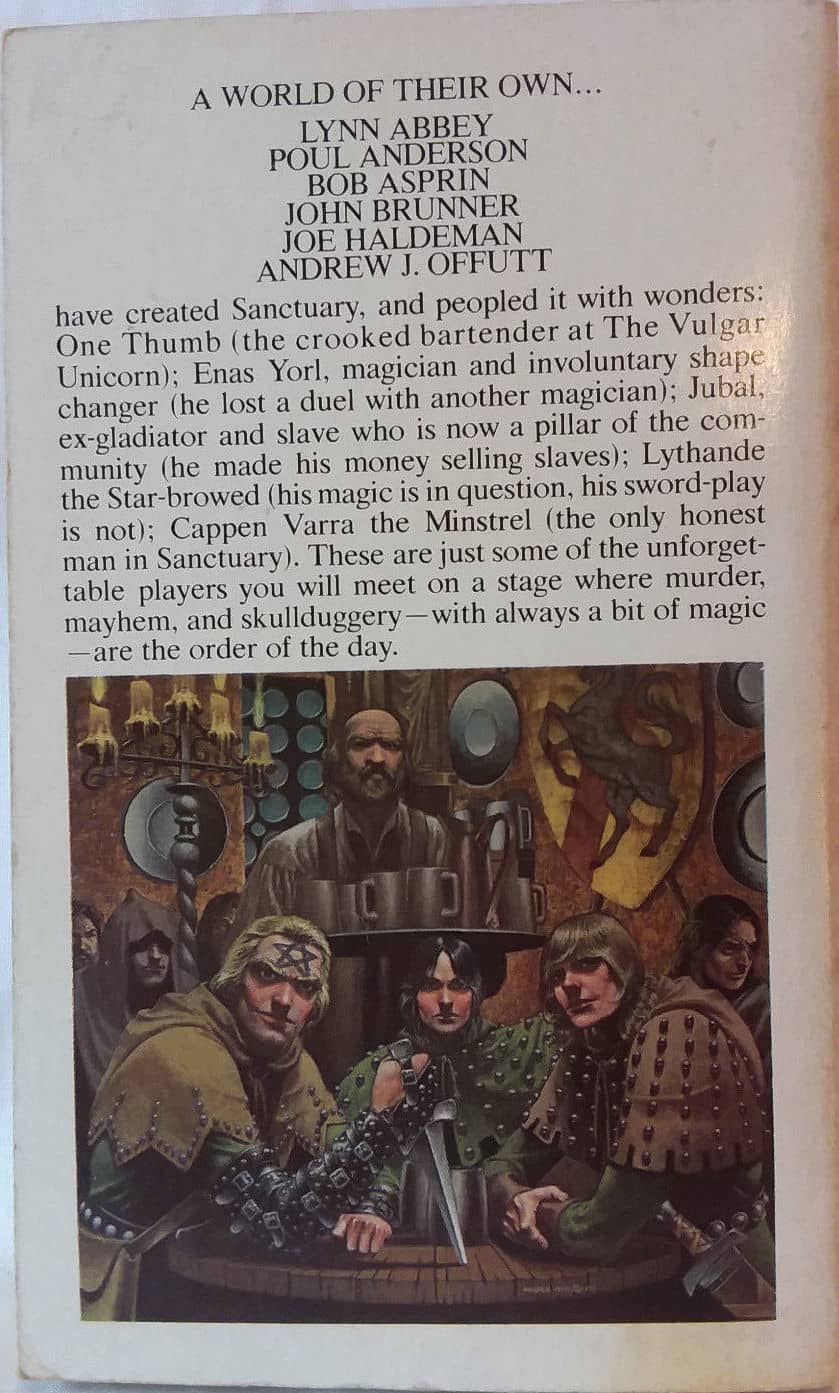
Thieves' World-Walter-Velez-small Thieves' World-Walter-Velez-back-small

Cover by Walter Velez

Joe Haldeman was born on June 9, 1943.

Haldeman received his first Hugo and Nebula Award for his debut novel, The Forever War. He won both awards again for his novella “The Hemingway Hoax” and his novel Forever Peace. Haldeman received the Nebula Award on two other occasions for his short story “Graves,” which also won a World Fantasy Award, and his novel Camouflage. He also has two additional Hugo Awards for the short stories “Tricentennial” and “None So Blind.” Forever Peace also was honored with the John W. Campbell Memorial Award and Camouflage tied for a James Tiptree Jr. Memorial Award and won the Southeastern SF Achievement Award. He was won three Rhysling Awards, the Ignotus Award, and the Ditmar Award as well.

DeepSouthCon presented Haldeman with a Phoenix Award in 1983. He was one of the pro Guests of Honor at ConFiction, the 1990 Worldcon in The Hague. Along with his wife, Gay, he was awarded a Skylark Award by NESFA in 1996. In 2004, he was recognized with a Lifetime Achievement Award by the Southeastern SF Achievement Award. Haldeman received a Robert A. Heinlein Award from the Heinlein Society in 2009 and in 2010 he was recognized as a Damon Knight Grand Master by SFWA. In 2012, he was inducted into the Science Fiction Hall of Fame.

“Blood Brothers” was Joe Haldeman’s only contribution to Robert Lynn Asprin’s shared world anthology series Thieves’ World, appearing in the debut volume in 1979. Written for the project, its reprint life has been limited, appearing in Sanctuary, an omnibus of the first three volumes of the Thieves’ World anthologies in 1982, and again in the omnibus Thieves’ World: First Blood in 2003, which reprinted the first two volumes of the series. Haldeman also included the story in his own collection, Dealing in Futures, originally published in 1985.

One Thumb was a major character in the early Thieves’ World shared world anthologies, created by Joe Haldeman for his story “Blood Brothers.” Shown by other authors in the series as powerful and mysterious, Haldeman’s own depiction of the owner of the Vulgar Unicorn was of a nearly amoral man, given to theft, murder, and rape. In the course of Haldeman’s short story, One Thumb, also known as Lastel, commits an assassination, a murder, deals in drugs, and considers his need to rape women.

Read More Read More

Remembering Michael D. Weaver

Remembering Michael D. Weaver

Mercedes Nights-small My Father Immortal Michael Weaver-small

I was on ISFDB and noticed that today marks the 20th anniversary of Mike Weaver’s death.

Michael D. Weaver broke into the SF field with Mercedes Nights in 1987 and looked like he was going to be The Next Big Thing (or one of them, anyway). He published seven novels in nine years before dying at the age of 37.

At St. Martin’s Press, I worked on his first two novels, particularly his second one, My Father Immortal. In those pre-email days, he would call almost every day about this or that. He came to New York for the SFWA Authors and Editors party with his girlfriend, whose name was Angel (if my memory serves) and whose dress and looks led some people to think she had been hired from an escort service. (She hadn’t.) I got drunk at the party and made the mistake of telling Mike how I thought his novel was ideal for teens — how the book worked as a great metaphor for adolescence. He didn’t call for several days after that.

If memory serves, he died in a freakish accident — something like falling in the yard and having his head land in a bucket or puddle, where he drowned.

Read More Read More

Birthday Reviews: Kate Wilhelm’s “State of Grace”

Birthday Reviews: Kate Wilhelm’s “State of Grace”

Orbit 19
Orbit 19

Kate Wilhelm was born on June 8, 1928 and died on March 8, 2018.

She won the Hugo Award twice, for her novel Where Late the Sweet Birds Sang and the book Storyteller: Writing Lessons and More from 27 Years of the Clarion Writers’ Workshop. She won the Nebula three times for the short stories “The Planners” and “Forever Yours, Anna,” and the novelette “The Girl Who Fell into the Sky.” She helped establish the SFWA and Clarion Workshop, and helped run the early Milford Writers Workshops. Along with husband Damon Knight, she was a Pro Guest of Honor at Noreascon Two and received the Gallun Award for contributions to science fiction. She was inducted into the Science Fiction Hall of Fame in 2003. She received an inaugural Solstice Award in 2009 and in 2016, the awards was renamed the Kate Wilhelm Solstice Award in her honor.

Wilhelm sold “State of Grace” to Damon Knight for inclusion in Orbit 19 in 1977. It appeared in her collection Somerset Dreams and Other Fictions in 1978 and in the collection State of Grace, part of Pulphouse Publishing’s Author’s Choice Monthly series in 1991. In 1980, the story was translated into French for the publication of Quand somerset rêvait, a translation of Somerset Dreams and Other Fictions.

“State of Grace” is the story of a deteriorating marriage in a suburb of Louisville, Kentucky. The narrator believes she has seen small creatures living in the oak tree in her backyard and she begins to work to protect the unseen creatures and take care of them, providing them with food, water and other essentials. Her husband, on the other hand, gets the inkling that there may be something in the tree that could be worth quite a bit of money and he decides he needs to capture them.

The argument over the tree escalates as she tries to help the creatures and he gets more and more anxious about their presence and his attempts to remove them, including a brief try to cut down the tree. When he goes into the tree, something causes him to change his mind and he accepts the creatures’ presence.

Read More Read More

Vintage Treasures: The Healer’s War by Elizabeth Ann Scarborough

Vintage Treasures: The Healer’s War by Elizabeth Ann Scarborough

The Healer's War-small The Healer's War-back-small

Elizabeth Ann Scarborough has had a long and fruitful career that stretches back to her first novel, Song of Sorcery, in 1982. Over the next 34 years she produced a virtually book every year, writing over 40 novels and 4 collections, including The Songkiller Saga trilogy, the Godmother trilogy, Nothing Sacred and Last Refuge, and over a dozen novels co-authored with Anne McCaffrey, many in the Acorna series.

Scarborough earned a reputation for dependable and often playful light fantasy, with such novels as The Harem of Aman Akbar (1984), The Drastic Dragon of Draco, Texas (1986), and her cats-in-space series Tales of the Barque Cats. But she was capable of more than that. Scarborough spent five years as an nurse with the US Army, including one year in Da Nang, Vietnam during the war, and in 1988 she turned that experience into The Healer’s War, which became her most acclaimed and celebrated novel. It won the Nebula Award the following year. Kirkus Reviews wrote “Scarborough writes powerfully and convincingly of the war,” and Publisher’s Weekly said,

Army nurse Kathleen McCulley’s… tour of duty at China Beach puts the young woman from Kansas through the usual mixture of empathy for the Vietnamese and anger at the indifference or outright racism of army personnel. The unanticipated twist is a hallucinatory journey through the jungle with a one-legged Vietnamese boy, a battle-seasoned but crazy soldier and a magic amulet given her by a dying holy man. Although its moralizing invites comparison with TV’s MASH and Twilight Zone, Scarborough’s light, fluid storytelling and the authentic, pungent background keep this novel interesting.

The Healer’s War was published in hardcover by Doubleday Foundation in November 1988, and reprinted in paperback by Bantam Spectra 12 months later. It is 313 pages, priced at $4.99 in paperback. The cover is by Braldt Bralds. It is currently available in print and digital formats from Open Road Media. See all our recent Vintage Treasures here.

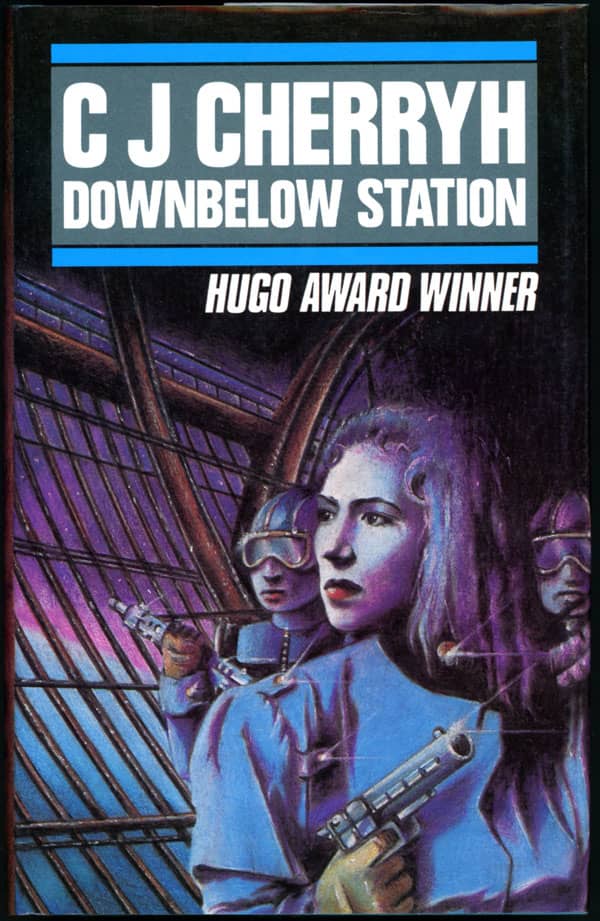
Black Gate Book Club, Downbelow Station, First Discussion

Black Gate Book Club, Downbelow Station, First Discussion

Downbelow Station-small Downbelow Station-back-small

Welcome to the very first post of the Black Gate Book Club!  What are we up to?  As Fletcher Vredenburgh said in his introduction to the Book Club:

The plan is to read Downbelow Station over the month of June and post a discussion of it each Monday afternoon. This time around, the Book Club participants will include Adrian Simmons, Charlene Brusso, Chris Hocking, and me. We’d love it if you’d read along with us and join in the conversation.

Of course, it is now Wednesday, not Monday, and Charlene had to bow out of this round because life intrudes. Never the less, Vredenburgh, Hocking and I soldiered on! Below is our exchange:

Read More Read More

New Treasures: The Rise of the Terran Federation, edited by John F. Carr

New Treasures: The Rise of the Terran Federation, edited by John F. Carr

The Rise of the Terran Federation-back-small The Rise of the Terran Federation-small

H. Beam Piper was one of my earliest discoveries, and he quickly became one of my favorite SF writers. I snapped up every book with his name on it in the mid-70s, all Ace paperback editions with gorgeous Michael Whelan covers.

Piper committed suicide a few months after I was born, in November 1964. But his work has endured, and as recently as 2011 John Scalzi published Fuzzy Nation, a retelling of Piper’s most famous novel Little Fuzzy. Last year editor John F. Carr assembled an anthology of a handful of Piper’s Federation and Paratime Police tales, and invited Wolfgang Diehr, David Johnson, and Jonathan Crocker to contribute fiction set in Piper’s universe. He added a pair of essays by John A. Anderson, The Early History of the Terran Federation and Chartered Companies of the Terran Federation, and his own preface, The Terro-human Future History, and the result was The Rise of the Terran Federation, published in hardcover by Pequod Press. Here’s the description.

The Rise of the Terran Federation is new collection of new and old stories chronicling the rise of H. Beam Piper’s Terran Federation. With story introductions and essays on the establishment of the Federation, this book is the ultimate overview of the beginning of Piper’s crowning creation, the Terro-Human Future History. This collection will include some of Piper’s early Federation stories, like “Edge of the Knife” and Omnilingual.”

This collection also contains new stories about the aftermath of the Third and Fourth World Wars, the Thorans and life on Baldur. The Rise of the Terran Federation is an essential work for fans of Piper’s future history and his unique view of what lies ahead for mankind.

There are precious few SF writers whose work has endured five decades. Piper didn’t live long enough to see it, but his stories have entertained three generations of SF fans, and I expect them to still be in print 50 years from today.

Read More Read More

Vintage Treasures: Particle Theory by Edward Bryant

Vintage Treasures: Particle Theory by Edward Bryant

Particle Theory-back-small Particle Theory-small

Cover by Richard Powers

Edward Bryant died last year, at the age of 71. He was widely acclaimed for his short fiction, and published some 121 stories between 1970 and 2017. He won back-to-back Nebulas, for “Stone” (1978) and “giANTS” (1979). Wikipedia notes that “By 1973, he had gained acclaim for stories with a conversational style that mask rather dark realities,” and that seems right to me. His produced a single novel, Phoenix Without Ashes (1975), co-written with Harlan Ellison. After his death Mad Cow Press published the tribute anthology Edward Bryant’s Sphere of Influence, with fiction by Connie Willis, Steve Rasnic Tem, Kevin J. Anderson, Lucy Taylor, Bruce Holland Rogers, and many others.

I knew Bryant chiefly as a book reviewer, and he was excellent, somehow blending both a discerning eye for fiction with an infectious enthusiasm for the genre. He published many hundreds of reviews — have a look at his entry at the Internet Science Fiction Database, and you’ll begin to appreciate just how deeply Bryant explored the fiction he loved. I was a regular reader of his book columns at Locus (1989-2006), Twilight Zone Magazine, (1987-89), and especially Cemetery Dance (1990-98).

Recently I’ve become more interested in reading his short stories, though. He published half a dozen collections, including Among the Dead and Other Events Leading Up to the Apocalypse (1973), Cinnabar (1976), and Predators and Other Stories (2014). But his major collection appears to be Particle Theory (Timescape Books, 1981), which includes both of his Nebula Award-winning tales, plus no less than five other Nebula nominees (the title story, “Strata,” “The Thermals of August,” “Shark,” “The Hibakusha Gallery”) and three Hugo nominees (“The Thermals of August,” “Stone,” and “giANTS”).

Read More Read More

Mack Reynolds: Science Fiction Author and… African Explorer?

Mack Reynolds: Science Fiction Author and… African Explorer?

20180509_125350

On a recent writing retreat in Tangier, Morocco, I was going through back issues of the Tangier Gazette, an English-language newspaper from the International Zone era. During this time, which lasted from 1924–1956, Tangier was run by several different European nations plus the United States. The governments gave people a free hand, and Tangier became notorious for allowing things that were illegal everywhere else — drugs, homosexuality, and prostitution. That attracted writers such as William S. Burroughs, Paul and Jane Bowles, and many others.

The April 6, 1956, edition of the Gazette has this little tidbit about Mack Reynolds, a prominent science fiction author of his day. His career got started shortly after World War Two in the detective pulps, and he soon branched out to write science fiction. Reynolds had a taste for travel and moved to Mexico in 1953. He and his wife soon pulled up stakes and set off on an epic ten-year trip through Europe, North Africa, and the Far East, supported by his science fiction and travel writing. The trip finally ended with their return to Mexico.

During his time in Morocco, he and his wife struck out into what is now Mali to visit Gao and Timbuktu. This is not an easy trip now, and back then it was an epic journey few attempted. Just look at what happened to Kit Moresby in The Sheltering Sky.

Read More Read More