Into the Weird: Weird Tales, July-August 1923 (Volume 2, Number 1), Part 2
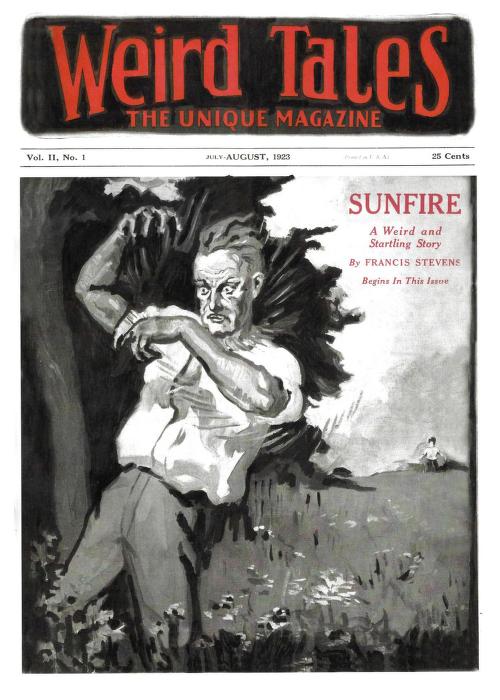
Weird Tales, July-August 1923
The first weird tale on offer is “Sunfire,” by Francis Stevens, which is blurbed on the cover (“A Weird and Startling Story”) and is one of the two-part stories, concluding next issue. ‘Francis Stevens’ was the pen name of Gertrude Mabel Barrows Bennett, who wrote most of her stories in a period from 1917 to 1920; “Sunfire” seems to have been the last work published in her lifetime, and apparently there is speculation that she wrote it before 1920. Bennett was very successful in her relatively brief time as a writer, with stories in big magazines like Argosy and All-Story Weekly. Her multi-part story The Heads of Cerberus was serialised in The Thrill Book, a quasi-predecessor to Weird Tales, and has been called the first alternate-world story; I don’t read it that way, but I can see how it’s possible.
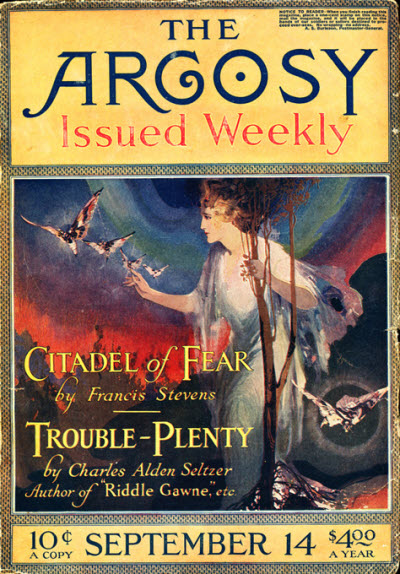
The Argosy, September 14, 1918, containing Part 1 of “The Citadel of Fear,” by Francis Stevens.
Outside the pyramid is an apparently abandoned seaplane. Inside, the adventurers find a white woman dancing with a gigantic centipede, and an immense spherical diamond catching the rays of the sun falling from above. The Americans try to talk to the woman, and explore the inner sanctum of the pyramid. By the end of the first part of the story, they’ve been drugged by the woman and taken prisoner. The second part of the story sees them make their way to freedom and find answers to the mysteries of the strange pyramid.
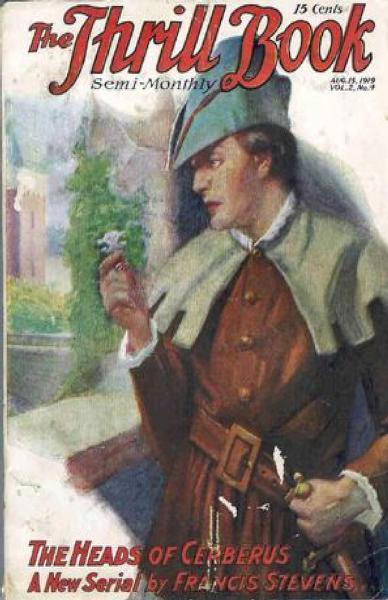
The Thrill Book, August 15, 1918, containing Part 1 of “The Heads of Cerberus,” by Francis Stevens.
The characters are distinctive enough as archetypes go, and there is some amount of forward motion that comes from them bouncing off each other. At times that actually works against the story, though, as internal bickering further slows events down. You never have the sense that there’ll be an outright betrayal, so there’s not much internal tension within the group; they’re not engaging enough that one wants to follow them on their own right; and the story’s not gripping enough to always pull us on nevertheless. The prose is solid enough pulp stuff, but doesn’t quite have the strength to make the tale compelling. And there’s some unpleasant racism; the way in which the people who built the pyramid are described, and for that matter the way the guides are described, clearly comes out of a sense of racial hierarchy. Plus, there’s a moment where a character uses the nuclear option of racial slurs for the sake of a cheap gag.
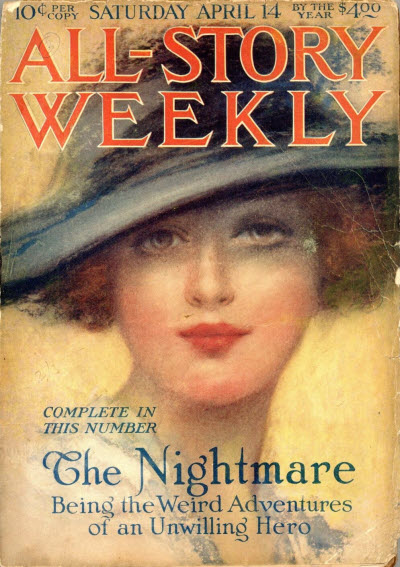
All-Story Weekly, April 14, 1917, containing “The Labyrinth,” by Francis Stevens.
The second story in this issue comes from George Warburton Lewis. I didn’t care for his story in the first issue of Weird Tales, “The Return of Paul Slavsky,” or for the story he had in the fourth issue, “The Blade of Vengeance.” Here, though, with a tale called “The Outcasts,” he takes a step forward. I don’t think it’s a great story, and I’m not sure I’d say it’s especially good, but it is an improvement that at least tries to do some interesting things.
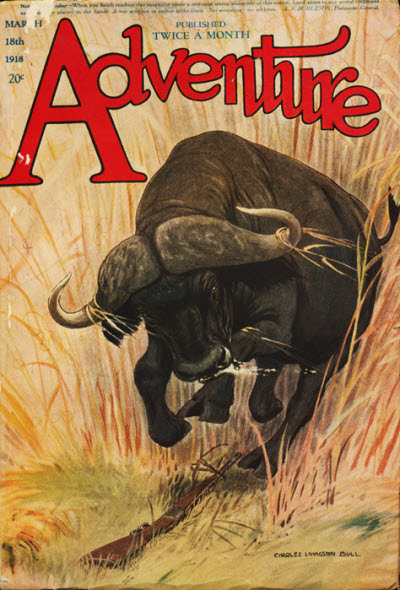
Adventure, March 18, 1918, containing “Devious Are the Ways,” by George Warburton Lewis.
This doesn’t sound like much, and I’m not sure the way the Man changes his attitude to the dog always works. The story’s only four pages, and while there’s a starkness to the style that works at that length, having the Man shift from hostile to friendly back to hostile requires a dexterity of touch Lewis doesn’t quite display. But a lot else in the story does succeed.
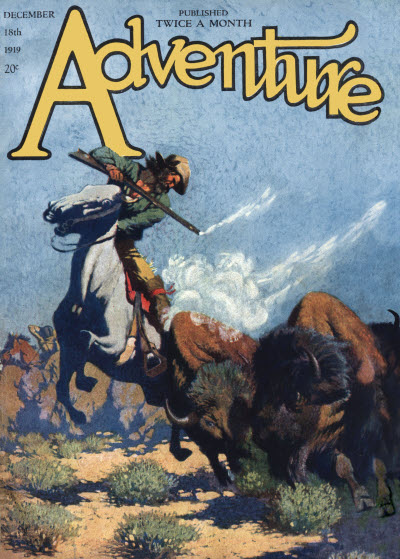
Adventure, December 18, 1918, containing “Dreamer’s Rest,” by Captain George Warburton Lewis.
The prose doesn’t quite sustain the story, though. It’s too heavy-handed too often, notably at the end. I think the implied contrast of Man and dog-wolf is strong, but the way the contrast is worked out weakens the idea; at the conclusion the dog’s described in terms of its ancestry in a way that undermines its individuality. You could, in fact, lose the last paragraph and probably have a significantly stronger story. As it is, there’s still an unusual strength in the tale. If it’s flawed, it’s probably still one of the better pieces in the magazine’s run so far, and (as we shall see) definitely one of the better pieces in this issue.
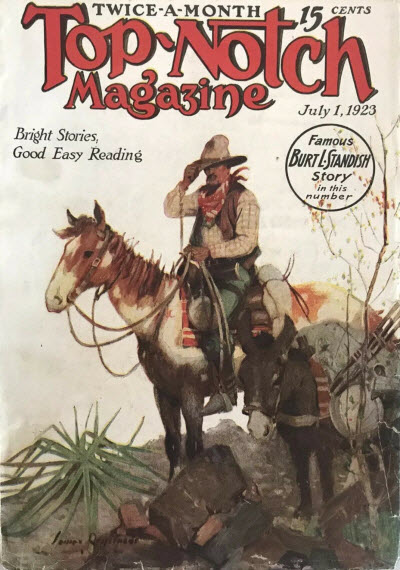
Top Notch, July 1, 1923, containing “When Knives Save Lives,” by Captain George Warburton Lewis.
This story’s three and a half pages, told to us by a magazine writer sent on a dark and stormy night to interview leading psychologist Ormond Wier in his palatial mansion. Wier greets him at the door and leads him through a maze to a palatial study, then leaves him in the massive black-draped room, which is filled with a dozen Egyptian sarcophagi. Curiosity overcomes the narrator. He opens one of the sarcophagi and finds a modern corpse coated in a metal plating; a second sarcophagus has another corpse, but then he sees the first sarcophagus he opened has vanished.
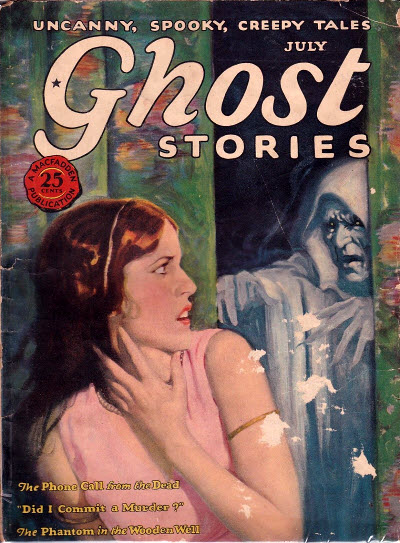
Ghost Stories, July 1927, containing “The Night of a Thousand Eyes,” by Charles A. Freeman and George Warburton Lewis.
The story has some ideas in it, I’ll give it that. They come at you in fast succession, and make no coherent sense. The tale’s almost nightmarish, but is too crude to really work on that level. What looks like a reasonably interesting sardonic voice in the early chapters is swiftly discarded, presuably to convey how terrified the narrator is. But the style’s overwrought, the sequence of events is functionally random, and the climax is ham-handed. If the story has some engagingly berserk moments, it’s impossible to take seriously as a connected narrative.
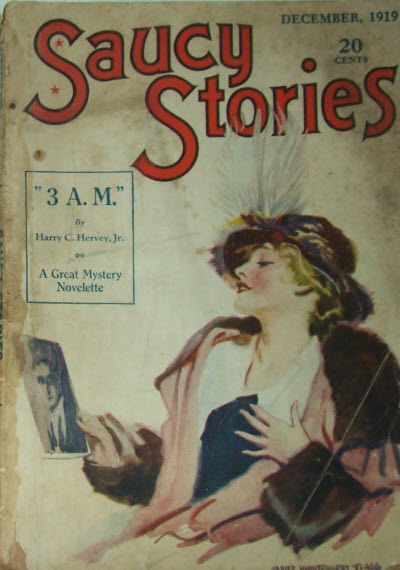
Saucy Stories, December 1919, containing “Afterwards,” by Culpeper Chunn.
The ending’s both melodramatic and pointless. The anecdote never builds into a story. There’s no details about either Borgen or Doctor X. There’s no tension, or any real mystery. There’s no setting, or anything I can find that might build reader interest. It’s a page-filler and a time-waster, and that’s about all there is. And I note that the story never does properly establish how to feel about the procedure; is it really sinister, or not? (Which is to say that it’s not established whether one should call Doctor X the man with the cure, or his operation mindcrime. So that’s a missed opportunity.)
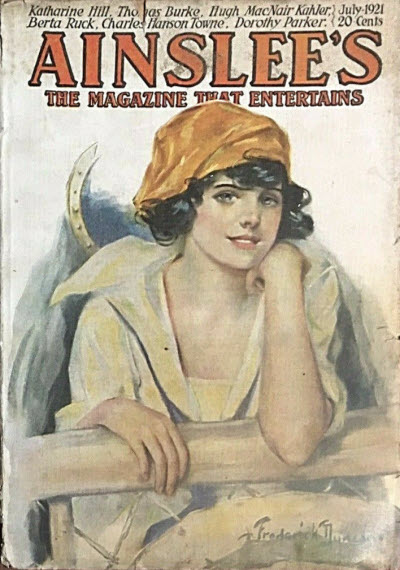
Ainslee’s, July 1921, containing “The Third Rater,” by Valma Clark.
Our narrator is Claude Van Nuys, a buyer with the House of Harrow, who provides art and antiques to “a Fifth Avenue clientele.” Trawling through antique shops in Cape Cod, he comes across examples of painting in the manner of the Classical Greeks which intrigue him enough that he hunts down the painter, an old hermit named “Tinker” Twining. The two men bond over their love of art, Van Nuys is caught in a storm and stays overnight with Twining, and Twining tells him the story of how he became a hermit.
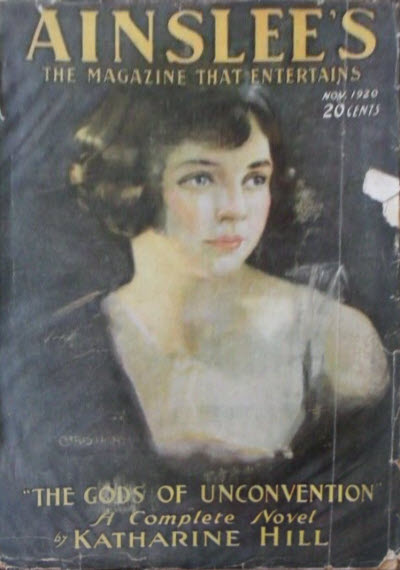
Ainslee’s, November 1920, containing “The Grin,” by Valma Clark.
Such is Twining’s story; a couple of years later, Van Nuys is talking after an auction with louche collector Max Bauer, and when Bauer shows him half of a familiar pottery fragment he realises that Twining’s enemy Lutz survived and took a new name. Knowing how guilty Twining felt about the murder, he entices Bauer to come to Twining’s home without letting on about their shared past; but Twining, who Bauer/Lutz knew as Cheever Gooding, is on his deathbed, and it’s too late for any meaningful resolution. Twining has Van Nuys give Bauer his half of the pottery fragment in an attempt at making amends, then dies, his decades-old discovery of the true chronology of Greek art long since proven by other hands. Bauer walks off with the fragment of great art, and Van Nuys is left hoping that there’s some justice in the afterlife as it appears lacking on Earth.
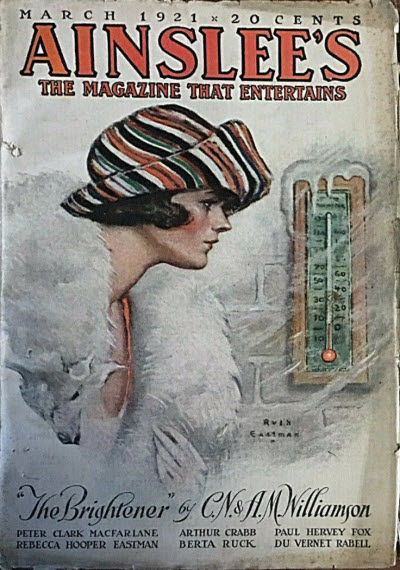
Ainslee’s, March 1921, featuring “The Middle of the Tale,” by Valma Clark.
It has to be said, also, that there’s some Anti-Semitism in the story; Lutz is described in the past as “the handsome, spoiled, Byronic type: a full-blooded dark man, part Jew,” and in Van Nuys’ present-day narration as having “some Jewish blood.” In both cases these asides are part of descriptions that emphasise his crassness and sensuality. Which is to say they imply an Anti-Semitic idea that Jews cannot be among the first rank of artists and art appreciators. Which, since the story’s all about the appreciation of classic art, is fairly significant.
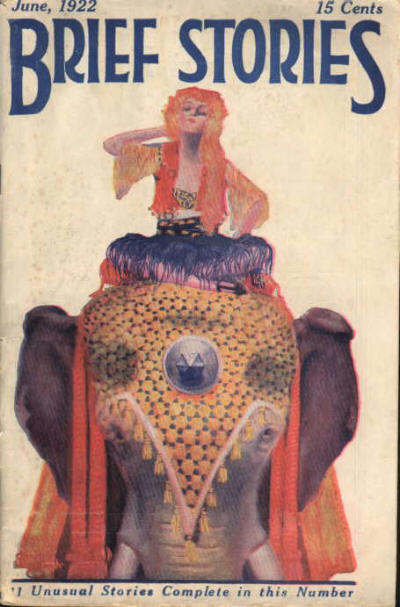
Brief Stories, June 1922, featuring “Sauce Piquante,” by Valma Clark writing under the name Lyssa Carrol.
The story’s very nearly a great success, not least because it has a powerful ending that avoids easy outs. It does a lot of things right. Still, there are some real flaws. In the end, at least there’s this: one of the longer stories in the issue, it never wears out its welcome, which is to say it never feels overlong. If that sounds like damning with faint praise, it gives an idea of the level of much of the rest of the fiction here.
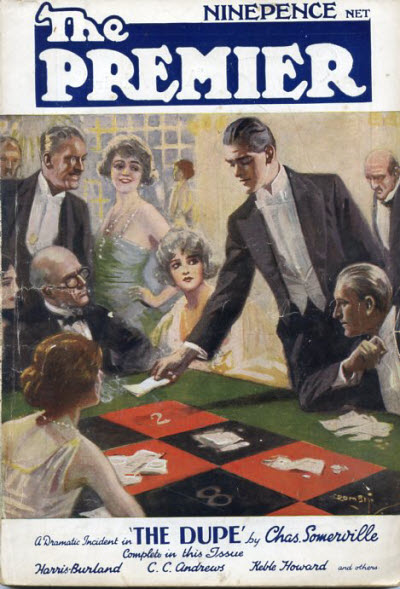
The Premier Magazine #131, January 10, 1922, containing the original publication of “The Strange Case of Jacob Arum,” by John Harris-Burland.
Our narrator is John Hart of Harthaven Hall, the leading citizen of the five hundred or so people of the town of Harthaven where, one day, a mysterious man named Jacob Arum buys a house and comes to live with his Black servant, Brike. The crippled Arum never sets foot out of door and becomes a figure of mystery in the town, until he invites Hart to his home and insists on making Hart the executor of his will. Hart agrees, in part because he’s fascinated by Arum’s niece, Audrey Pinson, who has come to live with him.
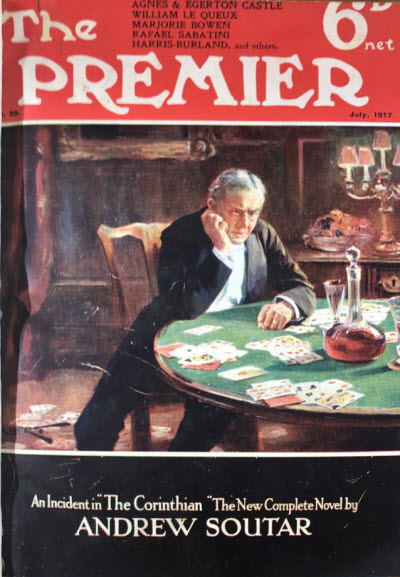
The Premier Magazine #39, July 1917, containing “The Man with the Green Umbrella,” by John Harris-Burland.
There’s no foreshadowing of this twist. The fake Arum and Brike, we are told, are shot by the police rather than allow themselves to be captured. Happy ending all around.
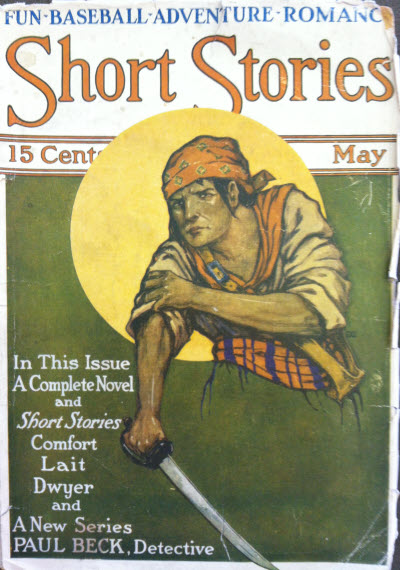
Short Stories, May 1917, containing “The Poison League,” by John Harris-Burland.
If the prose is smooth, other than the ugliness of the racism, it never really builds a sense of atmosphere. I think I can see the kind of story this is trying to be, with the mystery of Brike’s actions and magic ceremony intended to create a sense of unease; but there’s a lack of specificity that keeps any sense of eerieness from building. Instead it toddles on along with unpleasant characters saying unpleasant things, and something like a climax happens, and then it keeps going, and after what might have been a twist a big slathering of exposition wraps up the story. It is both dull and exasperating.
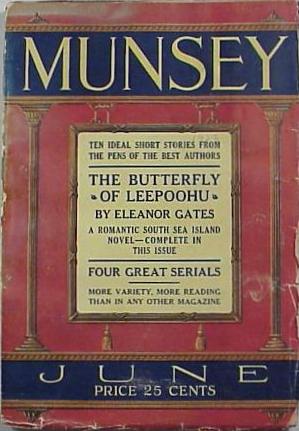
Munsey’s Magazine, June 1923, containing “Prison Bars,” by Isabel Walker.
There’s nothing good in the story, and the only really remarkable thing is how thoroughly racist it is. Black Cunjer doesn’t even get a particularly good scene, remaining silent and impassive in two confrontations with Oberman. The workers are portrayed as superstitious idiots, their dialogue written in exaggerated eye-dialect. Oberman isn’t an interesting character, an alcoholic blowhard; this means there isn’t really the material for a properly dramatic conflict. The prose is poor, and the twist that results in Oberman’s death is both unlikely and not especially clever. There isn’t even any real supernatural element to it; nothing properly weird.
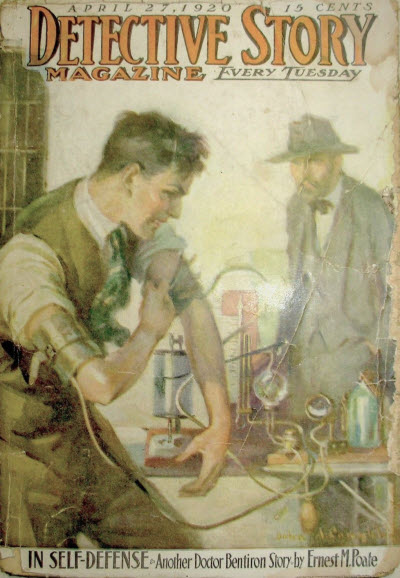
Detective Story Magazine, April 17, 1920, containing “His Last Stretch,” by Bryan Irvine.
That narrator is one Hal Steadman, who opens his story at a séance attended by a medium, two “prominent members of a psychological research society,” and another ghost. Hal reflects on his terrible loneliness as a ghost, then flashes back to describe the meat of his story: his friendship from childhood with Terrence Garlock, how they grew up and went to college together, how they co-founded a newspaper in “one of the most politically and morally corrupt cities in America” and saw the paper fail. After other business ventures go south they decide to take up a life of crime together as modern-day Robin Hoods. They gather an elite gag of crooks around them, and begin making the wealthy pay.
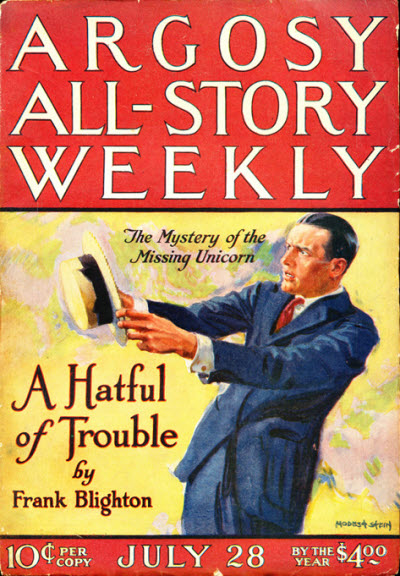
Argosy All-Story Weekly, July 28, 1923, containing “The Key,” by Bryan Irvine.
The prose is reasonably effective, but the story does fall apart into a series of disconnected incidents, especially after Hal’s death. There’s a conceptually nice scene near the end where Hal attends a meeting of his gang, the Black Hawks, and finds the dead Hawks outnumber the living. But nothing really comes of it; there’s no plot point setting anything up, and it doesn’t do much other than demonstrate how the gang’s falling apart. The story’s oddly torn between being plot-oriented and character-oriented; neither are particularly well-handled, but both do have some interesting moments.
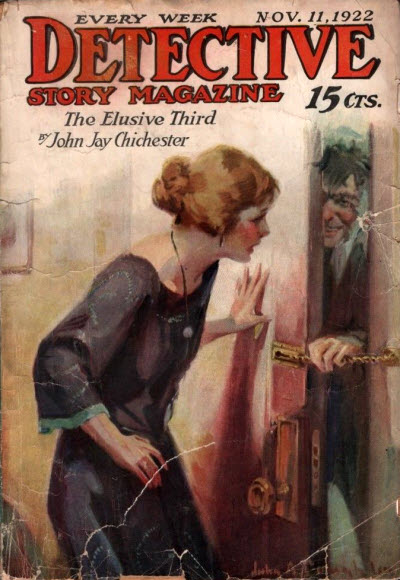
Detective Story Magazine, November 11, 1922, containing “The Hole in the Wall,” by Bryan Irvine.
But modern readers are most likely to note what reads as a clear gay subtext. I’ve mentioned in the past that some of the stories of this era involve a lady coming between two close male friends, and that it’s difficult to tell sometimes if that’s a queer subtext, period misogyny, or both. It’s hard not to see this case as tending closer to the queer-subtext end of the spectrum. Hal tells us early on that “Ours was a friendship — aye, love! — in which the test of time had failed to find a flaw.” The emotional climax of the story comes when the two men are reunited after death, “and we floated away, hand in hand.”
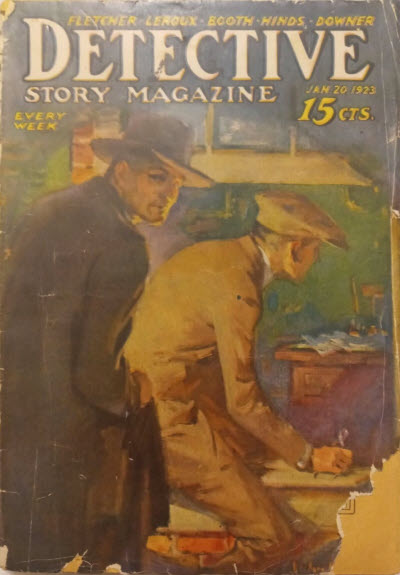
Detective Story Magazine, January 20, 1923, containing “Chapel Bunk,” by Bryan Irvine.
That momentum more-or-less continues in Earl Wayland Bowman’s “Senorita Serpente.” Bowman was a well-established pulp writer, but this would be his only story for Weird Tales. It’s a weird western piece that takes place in the ‘ranchito’ at Socorro (presumably Socorro, New Mexico). There, the beautiful ‘cortesana’ Serrano lives with an old watchman named Lobo, and frequents “the dance place kept by the big one, she who smokes mirrihuana, and is called ‘Old Bonanza.’” Serrano takes lovers, who vanish or have their minds destroyed, but is oddly sad. Then two cowboys arrive in town, “Skinny” Rawlins and “th’ Ramblin’ Kid.”
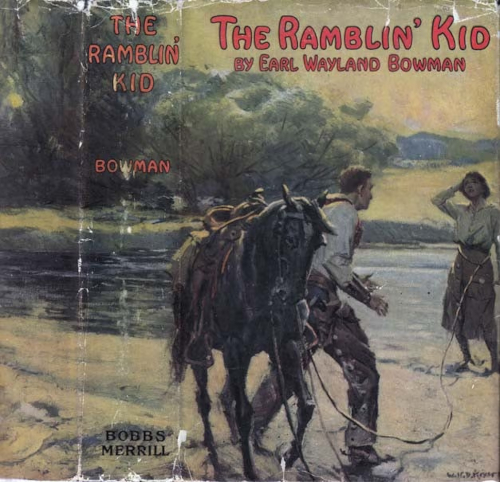
The Ramblin’ Kid, by Earl Wayland Bowman
It’s a chaotic story, told a little out of order, and fitting a lot of stuff into three pages and a bit. At its best, it’s charmingly berserk. At it’s worst, it’s confused, with a setting that never really comes together. Overall, I think it works, though the mix of cowboy tale, vampire story, and fantasy never feels like a smooth blend. Worth noting that this is technically a media tie-in story; th’ Ramblin’ Kid first appeared in Bowman’s 1920 novel The Ramblin’ Kid, which was made into a film that would come out in October, 1923. The magazine doesn’t seem to have promoted its connection to an upcoming motion picture, though.
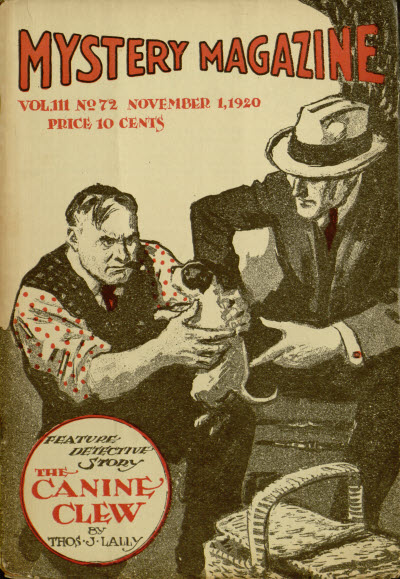
Mystery Magazine #72, November 1, 1920, containing “Trinkets of Tragedy,” by D.L. Radway.
That’s not me sending up the abruptness of the ending. It really does end that quickly, and lacking any real sense of resolution. The description of the ghosts is fine enough, but there’s no sense of a point to the story at all. It’s not good, but at less than two pages at least it’s short.
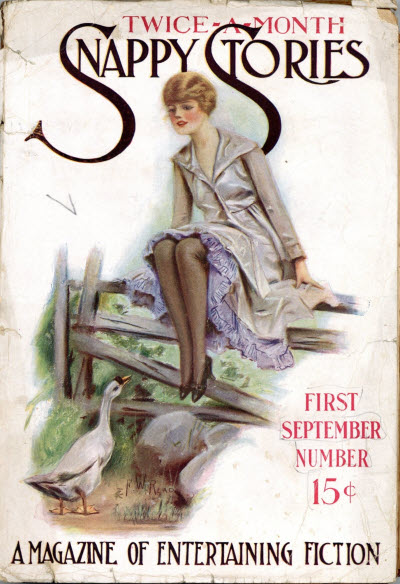
Snappy Stories, First September Number, 1917, containing “Fantasia,” by Vincent Starrett.
Our narrator, Stormont, is part of “the Brotherhood,” a group of vigilantes somewhere in the woods and mountains of the United States, in what Stormont describes as a “bleak district of blood and hate.” The group’s raison d’être is not made clear; we follow them in the story as they set out to assassinate one Robert Hamelin, lawyer and scholar. What Hamelin did to draw the death sentence is not specified, but we learn that Sardis, one of the Brotherhood, is attracted to Hamelin’s young wife. Flood, the captain of the Brotherhood, leads his men to Hamelin’s home and sends his lieutenant, Stormont, to scout the place; Stormont sees Hamelin’s wife, indescribably beautiful and “as triumphantly young as when she had left her own civilization,” and falls in love with her at once. He accidentally gives himself away, reports in, and the Brotherhood goes to confront Hamelin. They speak with a figure they believe to be Hamelin, and Flood orders his men to fire; but the figure they face is the wife.
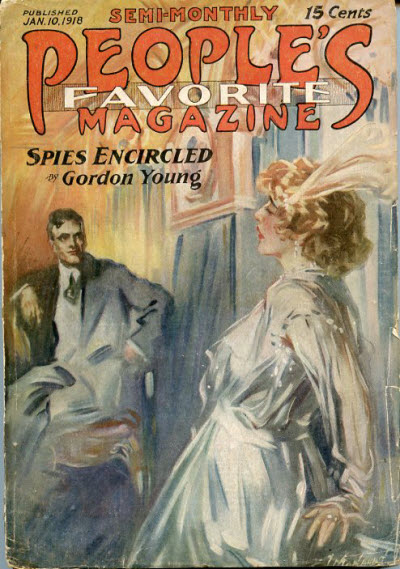
People’s Favorite Magazine, January 10, 1918, containing “A Bassanio of the Air,” by Vincent Starrett.
It’s only two and a half printed pages, and it moves well, with some good terse writing. The character work ought to feel forced, particularly Stormont’s love at first sight, but instead you wonder whether living in the backwoods with such a small group of people might prime someone to fall at once for somebody whose mere existence hinted at a wider world. I think the tale works because there’s a powerful starkness here, which refuses to fill in details like Hamelin’s crime or the beliefs of the Brotherhood.
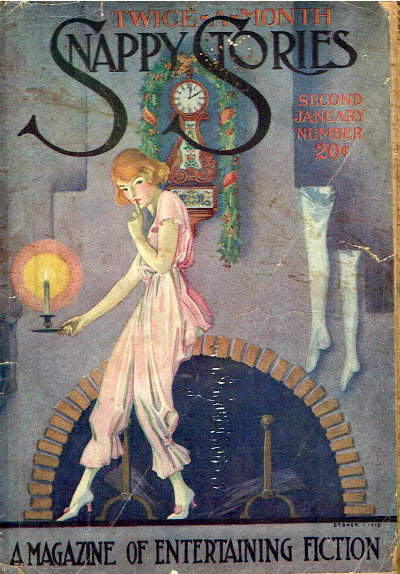
Snappy Stories, Second January Number, 1918, containing “Reparation,” by Vincent Starrett.
But maybe not. Klan or not, though, the story works to the extent that it’s a dark story of revenge and murder. It encourages the reader, I think, to find the Brotherhood unsympathetic. It’s an example of a pulp story that aims at a certain kind of grim hard-bitten sophistication. I don’t know if it works all the way through, but enough of it does that I think it ends up one of the better stories in the issue.
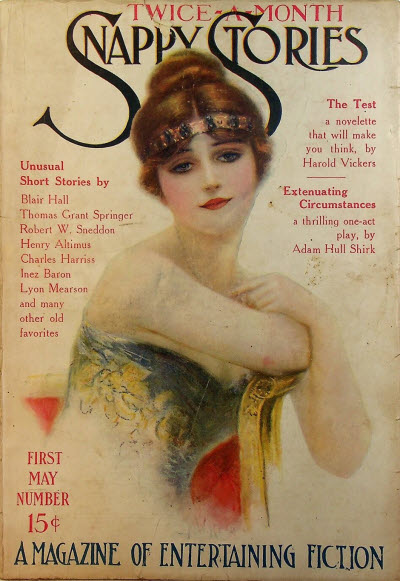
Snappy Stories, First May Number, 1916, containing “Extenuating Circumstances,” by Adam Hull Shirk.
Burton explains to Fallon that Marjorie, who has taken to visiting her parents’ graves, was terrified into a nervous collapse by a local hypnotist named Valdemar. Coincidentally, at this point a mentally challenged local named Peleg White turns up to tell the two men he saw Marjorie at the graveyard where her parents are buried, and watched her pull something out of the ground that caused a loud shriek. Burton and Fallon interview Marjorie with no result, but the next day Peleg’s back with a strange root Marjorie gave him, with the order to sell it for less than forty cents. Fallon pays Peleg, and goes with Burton to visit Marjorie again.
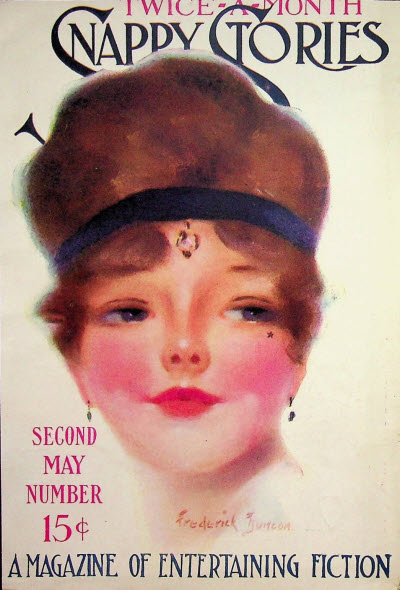
Snappy Stories, Second May Number, 1916, containing “The Warp and the Woof,” by Adam Hull Shirk.
The story’s prose is clunky, the plot’s both obvious in its outline and nonsensical in its details, and the characters are ciphers at best. Marjorie, the nominal centre of the story, barely gets a line of dialogue. The pacing is especially bad, taking too long to really get going, then having its climactic action happening all at once, then explaining motives and details at length until it comes to a stop. There isn’t anything especially interesting here that I can find, in approach or imagery. It’s not aggressively bad, but it’s certainly not good. (I note that Clark Ashton Smith’s poem “The Garden of Evil” immediately follows the story, logical given a certain similarity of imagery, and it’s striking how much more interesting the sonnet is than the fiction.)
Theodore Snow Wood’s “People Vs Bland” is next. Wood has three known fiction credits, while his day jobs included time as a lawyer and an accountant. This story, the last of his three known works, is a ghost story about a lawyer.
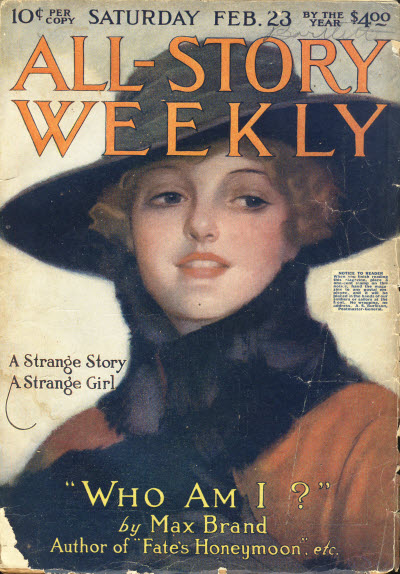
All-Story Weekly, February 23, 1918, containing “The Puttun Job,” by Theodore Snow Wood.
It’s surprisingly effective, given that you can see the ending coming from a mile off. The mystery aspect, revolving around how a man could have gotten out of the skyscraper unseen, works. So if the supernatural element’s obvious, the legal drama’s effective. I have questions about how likely any of it is, given that Trollusk took the case with less than twelve hours notice, showed up without knowing the details of events, and apparently never spoke with Bland to ask about his family and realise he only had the one murdered brother. But the story does move fast enough, once it gets going, that you don’t think too much about it. It’s not great work, it’s more than a little creaky, but it’s serviceable enough, does what it wants, and has some moments of atmosphere in the scenes of Trollusk working late at night in his office alone.
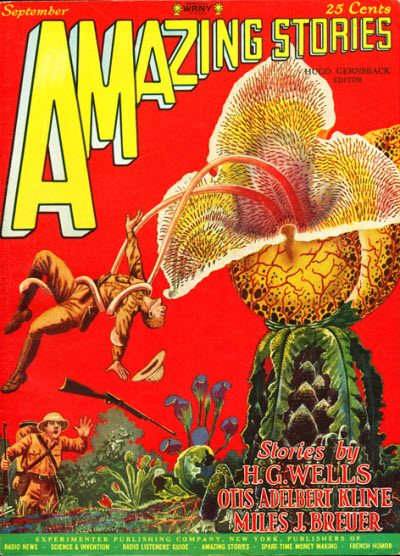
Amazing Stories, September 1927, containing “The Radio Ghost,” by Otis Adelbert Kline.
That happens at about the halfway mark of the story, which runs slightly more than two pages. Ryan and the ghost argue about the reality of the ghost, Ryan goes to give it a kicking, he falls and knocks himself out, he wakes and all the mysteries are resolved. So the story’s a trifle about an Irishman who drinks and is afraid of ghosts (and uses a surprisingly gratuitous anti-Italian slur to refer to a friend of his); but it has to be said the construction’s solid. The background of the dead body given in the denouement is nicely set up in the argument earlier, and the inevitable revelation that the ghost was a physical reality after all comes by paying off a detail that was casually set up near the start. It’s a story that does what it wants to do, in other words, even if it’s not the most sophisticated tale ever told.
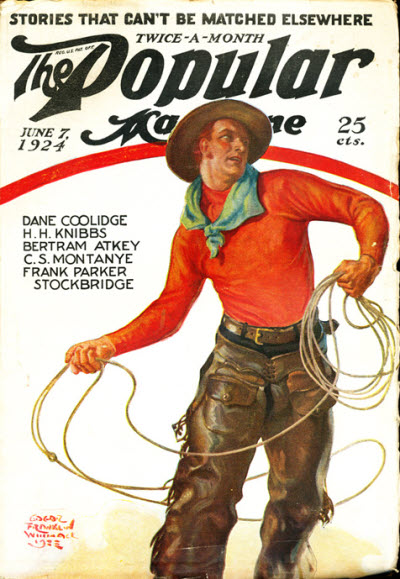
The Popular Magazine, June 7, 1924, containing “A Change in the Contract,” by J. Paul Suter.
Jugrand, Marvin, and Craddock are three men, the titular guard of honour, keeping vigil by the dead body of their friend, Doctor Wilford Sawyer. They talk, and we learn some of Sawyer’s background; an older man, he lost his memory at around the age of 20, relearned everything, became a doctor and their friend, then about two months ago fainted during an operation. He awoke with the name of a town in his mind, which he thought might be the clue to the still-missing memories of his childhood. Craddock got a shaky letter from him, went to find him, and discovered him dead on the threshold of a burned-out house.
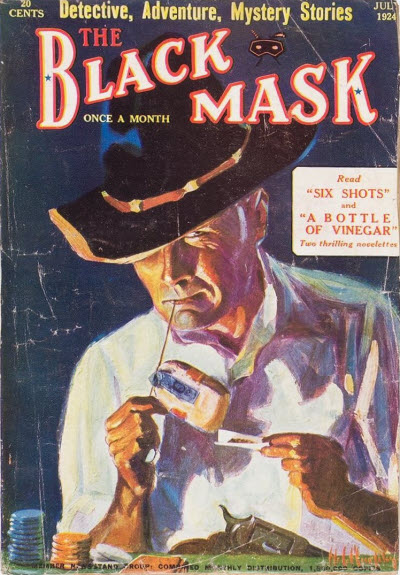
The Black Mask, July 1924, containing “Caught,” by J. Paul Suter.
It’s an interesting structure, and it works because of the delicacy and precision of the writing. It recalls something like Bierce’s “An Occurrence At Owl Creek Bridge,” but is stranger than that. The final emotional punch is nearly as powerful, though, because Suter’s skill makes Sawyer real. He’s set up as a figure of mystery, and of some awe to his younger friends, and then when we follow him from his perspective he seems young and even foolish, as he was once, and in that variety he comes alive as a character.
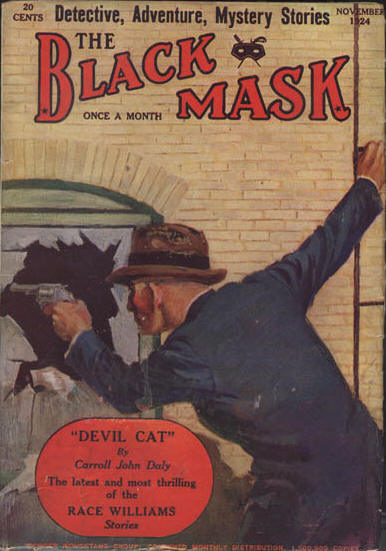
The Black Mask, November 1924, containing “The Problem of the Man Who Sowed the Wind,” by J. Paul Suter.
But it’s also a deeply emotional story, in the sense that it’s about a powerful emotional moment that shaped a man’s life, and how he comes to revisit it at the end of his life, and how he passes that on to another man. It would have been easy for this moment to have come across as pathos, as a simple and obvious tragedy; in fact I think we feel it as Sawyer does, as an individual and distinctive horror. It’s that precision of emotional affect that marks the story and that really makes it work, along with the distinctive, layered structure. It is, as I say, the only story in this issue that I believe succeeds entirely, start to finish.
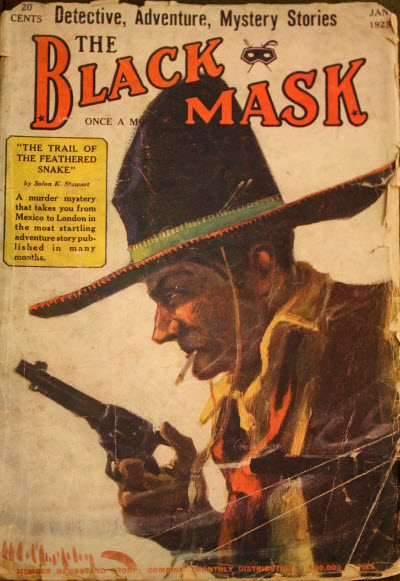
The Black Mask, January 1925, containing “The Little Blonde Nightmare,” by J. Paul Suter.
At least there’s a majority of stories that deal with the outright supernatural or science-fictional. But I wonder now whether, if some of the stories here and in past issues were possibly originally intended for Weird Tales’ sister magazine Detective Tales, that might have given the magazine part of its distinctive character. Stories like “The Outcasts” and “Riders In the Dark” have nothing really weird about them, but the hard-boiled tone verging on a kind of stark elemental horror has become part of the magazine’s nature, a kind of toughness or bleakness or darkness.
Still, overall, this issue feels like what we have seen of Weird Tales thus far, and gains from being a little weirder than past issues; but it’s also got more outright bad stories and more racism. One step forward, two steps back. The magazine is evolving, but what is it turning into? What way will it go in the future? With due respect to Paul Suter and some other writers, after five issues we’re still some distance from seeing anything that would establish the magazine as a classic. How much longer can the magazine last without finding some major talent?
Find all my posts about Weird Tales here!
Matthew David Surridge is the author of “The Word of Azrael,” from Black Gate 14. You can buy collections of his essays on fantasy novels here and here. His Patreon, hosting a short fiction project based around the lore within a Victorian Book of Days, is here. You can find him on Facebook, or follow his Bluesky account, @bookofdays.