Browsed by
Category: Books

Vintage Treasures: Ronald Welch’s Knight Crusader
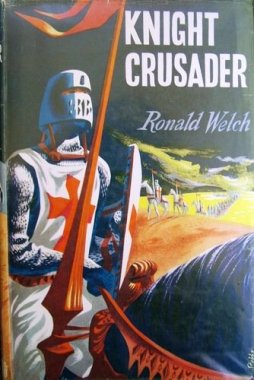
Vintage Treasures: Ronald Welch’s Knight Crusader

Knight Crusader
“The British Harold Lamb”

Try not to lick your cracked lips. Don’t think of water. Listen to the Saracen arrows buzz past. Don’t flinch! Most of all, hold the line!

Grumpy old Sir Fulk can’t stand the heat. He raises his helm and ignoring the shouts of the other crusaders, waits while his son, Sir Joscelin, shares the last of his flask.

Whirrrrrrr! Thock!

An arrow takes Sir Fulk in the throat. There’s blood, there’s thrashing, and the old knight dies in the arms of his son, the effete Sir Joscelin.

Kurtzhau – age 6 – lets out a cry, as if he too were there, riding out under the baking 12th-century sun to face the army of Saladin. This is four years ago and I’m reading aloud from Ronald Welch’s Knight Crusader.

Now, Sir Joscelin — he of the camp voice, the silk clothing, perfumed handkerchief, the tough-as-nails young warrior who enjoyed winding up his conservative father with his decadent ways – charges out solo, determined on revenge.

Another cry from Kurtzhau. He draws up the covers. It’s Sunday morning, we’re reading in bed, and only now am I remembering that Ronald Welch, though nominally writing Children’s Fiction — he won the Carnegie medal for this — is ruthless with his body count.

Like the Crusader army, I’m caught in a cleft stick. If I stop, Kurtzhau won’t have closure. If I go on… well… Sir Philip, the hero, has a “character shield.” Let’s just say that his friends don’t.


…

Read More Read More

To Elf or Not To Elf: Races in Fantasy Lit

To Elf or Not To Elf: Races in Fantasy Lit

Evangeline Lilly in The HobbitA long, long time ago, I wrote my first novel. This was decades before I would get published. I was fresh out of college with grand ideas about how my book would set the fantasy world on fire. The story featured a main character that was half human and half elf, who set out to defend his elven kin from a nation of hostile orcs.

Yeah, I know. Not exactly groundbreaking. I’m thankful that novel was never published, more because of the shitty writing than the plot or characters. Yet, it brings up an interesting debate within fantasy literature.

Are races like elves, dwarves, orcs, and goblins fair game for modern fantasy?

Now, off the cuff, I’m inclined to say yes. You can write about anything you desire. Who am I to judge, right? However, while that may be the politically-correct answer, a little more digging turns up some complex issues for the modern writer.

My first introduction to those “classic” fantasy races was Prof. J.R.R. Tolkien’s The Lord of the Rings saga, and it was continued in my formative years via games like Dungeons and Dragons and Warhammer Roleplay. Growing up on a diet of elves and orcs, it was little wonder that I choose to feature them in my own early writing. I suspect that most authors begin by emulating their literary idols, but eventually you need to break away and find your own brand of storytelling. It’s difficult to find your voice when you’re playing in someone else’s sandbox.

But what about authors who genuinely want to write about these races? Here’s why I would advise against it.

…

Read More Read More

Support The Great Way, an Epic Fantasy Trilogy by Harry Connolly

Support The Great Way, an Epic Fantasy Trilogy by Harry Connolly

The Great Way Harry ConnollyWe try not to pimp too many Kickstarter projects here on the BG blog. We know you’re probably as tired of hearing about them as we are. But today, we’re making an exception for Harry Connolly.

Why? Because he’s awesome.

Harry’s first fiction sale, “The Whoremaster of Pald,” originally appeared in Black Gate 2, and quickly became one of the most popular stories we’ve ever published. It was also the first tale we presented online in its entirety, and that experiment was so successful it helped launch the entire Black Gate Online Fiction line. Harry returned to the decadent city of Pald in BG3 with “Another Man’s Burden,” and his brilliant tale of a civilization on the brink of extinction, “Soldiers of a Dying God,” appeared in Black Gate 10. We couldn’t keep him to ourselves forever, and Harry’s first three novels — Child of Fire, Game of Cages, and Circle of Enemies, together comprising the Twenty Palaces trilogy — were published by Del Rey between 2009 and 2011.

Harry wasn’t won over by Kickstarter right away, pointing out the platform is a fantastic resource but not right for every project in his January 2013 column “Let me tell you about my ambitions, and why they don’t include Kickstarter (right now).” He’s apparently come around, however: on September 19, he kicked off a campaign to fund the completion of The Great Way, an epic fantasy trilogy about a supernatural invasion that destroys an empire.

The first draft of The Great Way is already complete, and weighs in at a whopping 300,000 words. Harry has made Chapter One of the first volume, The Way into Chaos, available on his blog. Cover artist Christian McGrath has agreed to do the cover art for all three books as a stretch goal, if the campaign reaches $34,000.

That’s a pretty safe bet; as of this writing, it stands at $33,300 (well past its original $10,000 goal), and shows no signs of slowing down. The Kickstarter ends on Oct 19th, so there’s still time to back it and ensure that you get copies of an exciting new fantasy trilogy from one of the best new writers in the genre. Check it out here.

Can’t Keep a Great Buncha Folks Down

Can’t Keep a Great Buncha Folks Down

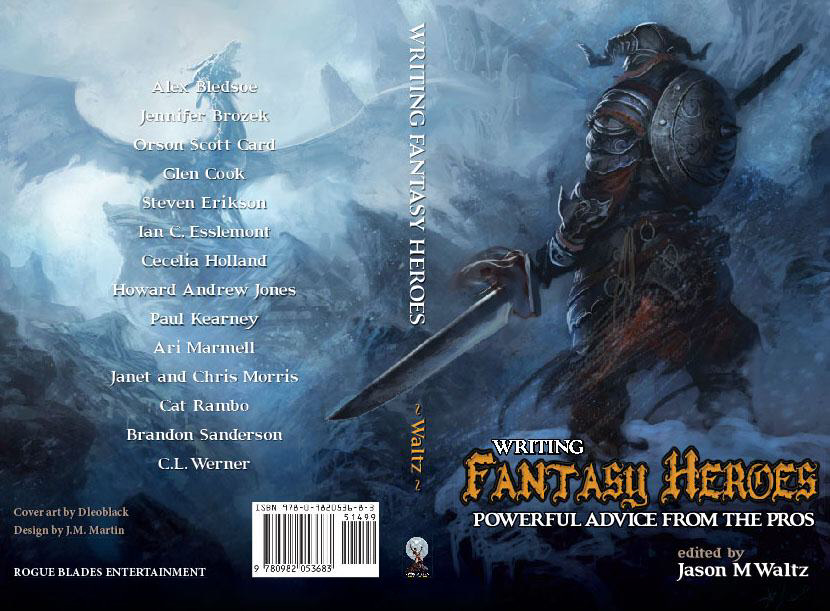
Writing Fantasy HeroesOr as Charlie Daniels sang, “RBE will rise again.” Or maybe not, but it is what he was thinking. Or maybe not.

It is, however, the truth. RBE (Rogue Blades Entertainment) has resurfaced online, finally putting up its first website in two years at Rogue Blades Presents.

It’s been a bit and then some, but the house is making strides and a comeback’s round the bend. The site is up, the books are all listed, the authors and artists are accounted for, and the future looks promising.

In recreating the site, I even discovered something spectacular: all of the old Home of Heroics posts! Granted, they’re buried in a mass of gibberish in an XML file, but it’s nothing a little elbow grease, good eyes, and lots of time won’t salvage. Volunteers?

Drop on by the new joint and share your thoughts of it; grab a book while you’re there.

Appendix T

Appendix T

aljUnless one considers charts, tables, and mathematical formulas to be “illustrations,” the original edition of GDW’s science fiction roleplaying game Traveller (1977) contains only one piece of genuine artwork: namely, the portrait to the right. That portrait, by an uncredited artist, depicts Alexander Lascelles Jamison, the example character whose career is detailed in the first volume of the classic SF RPG. Like all Traveller characters, before he starts seeking his fortune among the stars, Jamison has already had a career, in this case in the merchant service, where he mustered out with his own ship and the rank of captain.

Looking at that portrait, I found myself remembering a quote from “Margin of Profit,” a story by the late Poul Anderson, first published in the September 1956 issue of Astounding Science Fiction. That story, too, depicts an interstellar merchant captain:

He was a huge man, two meters in height and broad enough to match. A triple chin and swag belly did not make him appear soft. Rings glittered on hairy fingers and bracelets on tawny wrists, under snuff-soiled lace. Small black eyes, set close to a great hook nose under a sloping forehead, peered with laser intensity.

Anderson’s merchant is, of course, Nicholas Van Rijn, president of the Solar Spice & Liquors Company, and one of the more famous characters from the period between the end of the Golden Age of Science Fiction and the rise of the New Wave.

…

Read More Read More

Sword & Sorcery for the Girl Who Wants to be Conan: Gaie Sebold’s Babylon Steel

Sword & Sorcery for the Girl Who Wants to be Conan: Gaie Sebold’s Babylon Steel

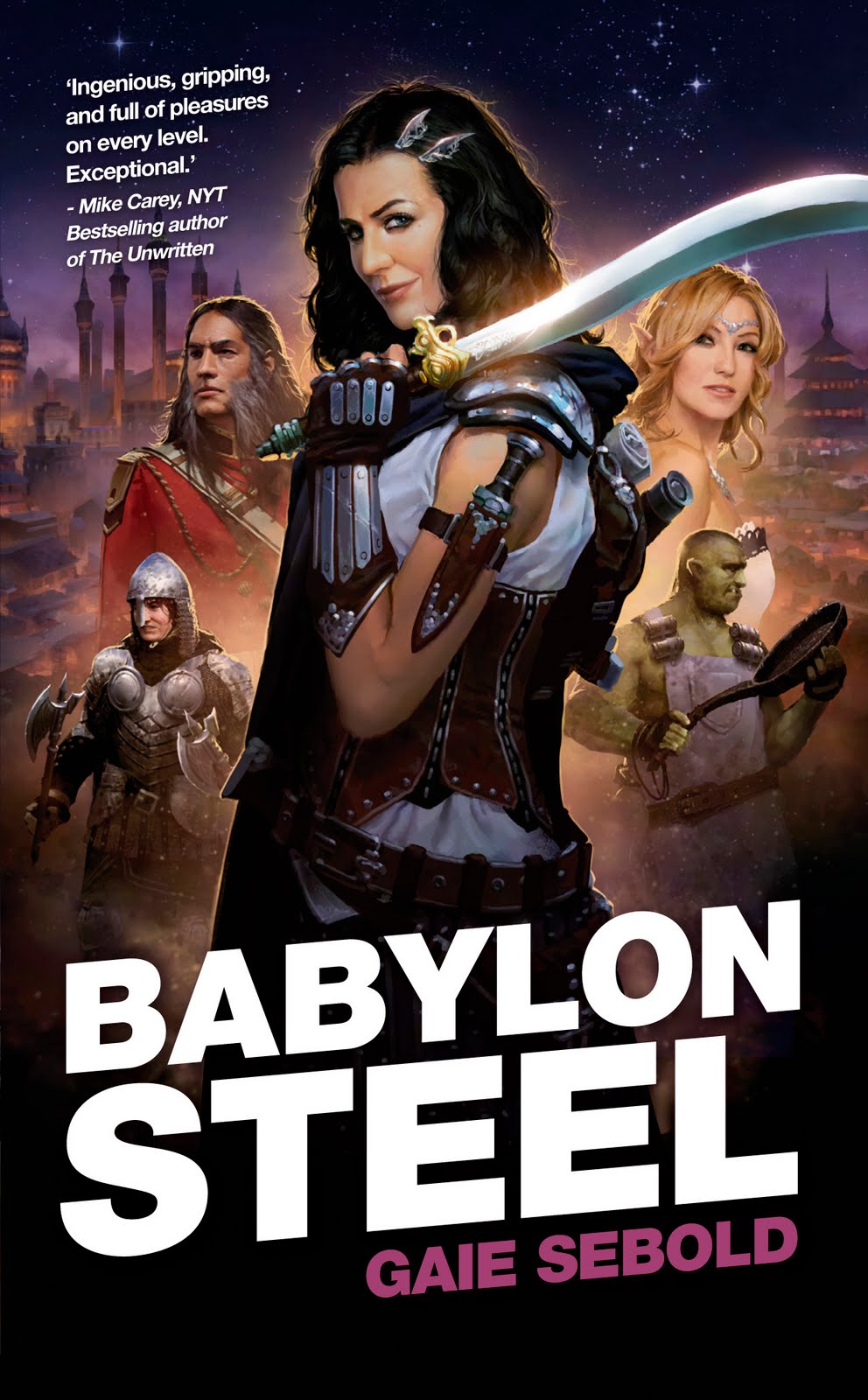
Babylon Steel-smallI can’t keep up with all the fabulous fiction rolling off the assembly lines of the great factories of modern publishing (I can just barely stay on top of the story-a-week we publish here at Black Gate, truth be told). It’s amazing… I spend all day – and most of the night – reading and writing about this genre, and still can’t encompass it all. Either we live in amazing times, or being hopelessly clueless is just an intrinsic part of my nature.

Eh. Probably a little of both.

Fortunately, there are other bloggers out there to help me out. Liz Bourke’s “Sleeps With Monsters” column at Tor.com helped me out this week, by pointing me to Gaie Sebold’s debut fantasy novel, Babylon Steel.

Now, anyone can miss a novel or two, but I have no excuse for not being on top of this one. For one thing, Solaris has been putting out terrific fantasy recently, and obviously deserves more attention; for another, I’ve had my eye on Gaie Sebold ever since I bought her brilliant and funny “A Touch of Crystal” (co-written with fellow Brit Martin Owton), the tale of a shopkeeper who discovers some of the goods in her New Age shop are actually magical, for Black Gate 9. Here’s Liz:

Gaie Sebold’s Babylon Steel (Solaris, 2011) is a remarkably entertaining debut. It’s as though someone took the best bits of Robert E. Howard and the fantasy noir city of Simon R. Green’s Hawk and Fisher novels, threw in some more Cool S**t ™, and reimagined them through a lens that foregrounded female perspectives. This is sword-and-sorcery pulp wish fulfillment for the kind of girl who wanted to be Conan… And that? That makes one of the most awesome things I’ve read this year…

Sebold evokes mood and atmosphere — and character — very well. And the climactic BOOM LIKE THAT is an earned one.

An excellently entertaining book. Give me more like this. MORE I TELL YOU.

Babylon Steel was nominated in two categories for the Gemmell Awards: The Morningstar (best newcomer) and the Legend (best novel). It came out so long ago now that there’s already a sequel (dang! I really am clueless). Dangerous Gifts appeared in January of this year.

Babylon Steel was published in December 2011 by Solaris. It is 544 pages, priced at $7.99 in paperback and $6.99 for the digital edition.

New Treasures: Ghosts Know by Ramsey Campbell

New Treasures: Ghosts Know by Ramsey Campbell

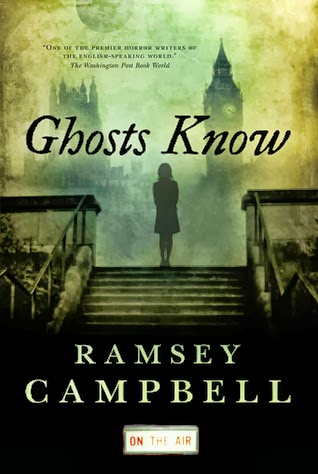
Ghosts Know-smallLook at that, it’s October already. And you know that that means, don’t you? It’s spooky reads season, when all the major publishers inundate us with the year’s best creepy fiction.

I like to try new authors every October. Ramsey Campbell is hardly new, but I know him almost exclusively through his short fiction. I’ve been wanting to try one of his novels for years, and this appealing new hardcover from Tor will fit the bill nicely.

Graham Wilde is a contentious, bombastic host of the talk radio program Wilde Card. His job, as he sees it, is to stir the pot, and he is quite good at it, provoking many a heated call with his eccentric and often irrational audience. He invites Frank Jasper, a purported psychic, to come on the program. He firmly believes that the man is a charlatan, albeit a talented one. When Jasper appears on his show, Wilde draws upon personal knowledge about the man to embarrass him on air, using patter similar to that which Jasper utilizes in his act.

Wilde’s attack on Jasper earns him the enmity of his guest and some of the members of his audience. He next encounters Jasper when the psychic is hired by the family of a missing adolescent girl to help them find her. Wilde is stunned and then horrified when Jasper seems to suggest that he might be behind the girl’s disappearance.

Thus begins a nightmarish journey as circumstantial evidence against Wilde begins to mount, alienating his listeners, the radio station, and eventually, his lover. As Wilde descends into a pit of despair, reality and fantasy begin to blur in a kaleidoscope of terror….

Ghosts Know was published by Tor Books on October 1st. It is 285 pages, priced at $25.99 for the hardcover and $12.99 for the digital edition.

Black Gate Online Fiction: The Sacred Band by Janet Morris and Chris Morris

Black Gate Online Fiction: The Sacred Band by Janet Morris and Chris Morris

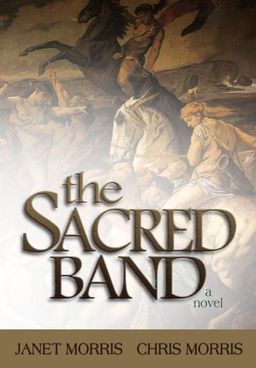
The Sacred Band-smallBlack Gate is very pleased to offer an exclusive excerpt from The Sacred Band, a new novel in the Sacred Band of Stepsons series by Janet Morris and Chris Morris.

The Sacred Band of Thebes lives on, a world away, in this mythic novel of love in war in ancient times. In 338 BCE, during the Battle of Chaeronea that results in the massacre of the Sacred Band of Thebes, the legendary Tempus and his Stepson cavalry rescue twenty-three pairs of Theban Sacred Banders, paired lovers and friends, to fight on other days. These forty-six Thebans, whose bones will never lie in the mass grave that holds their two hundred and fifty-four brothers, join with the immortalized Tempus and his Sacred Band of Stepsons, consummate ancient cavalry fighters, to make new lives in a faraway land and fight the battle of their dreams where gods walk the earth, ghosts take the field, and the angry Fates demand their due.

Janet Morris alone and Janet Morris and Chris Morris jointly have authored six previous novels and two novelized anthology volumes in their Sacred Band of Stepsons series. Some works in this series were previously published in somewhat different form in the Thieves World® shared universe, or as authorized works taking place beyond Sanctuary®.

The Sacred Band was published in trade paperback and an electronic edition by Paradise Publishing in 2010; the first Kerlak hardcover edition appeared in 2011 and the first trade and electronic editions from Perseid Press in 2012. It is 618 pages, priced at $24.95 in trade paperback.

The complete catalog of Black Gate Online Fiction, including stories by John C. Hocking, Michael Shea, Ryan Harvey, Peadar Ó Guilín, Vaughn Heppner, Aaron Bradford Starr, Martha Wells, Nina Kiriki Hoffman, E.E. Knight, C.S.E. Cooney, Howard Andrew Jones, and many others, is here.

Read “Shock Troops of the Gods,” a complete chapter from The Sacred Band, here.

The Thinning of Thinness: Susan Palwick’s The Necessary Beggar

The Thinning of Thinness: Susan Palwick’s The Necessary Beggar

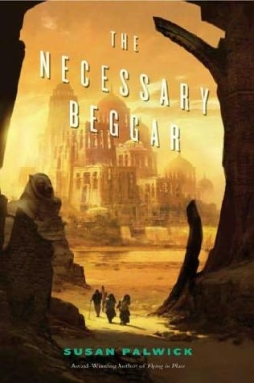
The Necessary BeggarOf the many useful terms suggested by John Clute in The Encyclopedia of Fantasy, perhaps the most useful is the idea of ‘thinning.’ Clute sees certain archetypal patterns frequently recurring in fantastic fiction and thinning’s a part of that. It is the lessening that afflicts threatened fantasylands, a type of diminishment. It’s the fading of magic, the passing of the great old order. Sometimes, eventually, the greatness of the past is restored, though perhaps in a different form.
Archetypes by their nature are constantly taking on new guises. I found an intriguing example of the thinning-and-recovery motif of fantasy in Susan Palwick’s 2005 YA-ish novel, The Necessary Beggar. Her second novel, it won an Alex Award, awarded by the American Library Association to books written for adults, but with “special appeal” to teens; her first novel, 1993’s Flying in Place, won the Crawford Award for Best First Fantasy Novel. In 2007, Palwick published her third novel, Shelter, as well as a collection of short fiction, The Fate of Mice. 2013 saw the publication of her most recent book, Mending the Moon.

The Necessary Beggar is an interesting exploration of thinning because it literalises and inverts the whole idea. It follows a family exiled from their home in the (relatively) magical land of Gandiffri after one of them is convicted of murder. They’re sent through a dimensional portal, ending up in this world, in Nevada in the not-too-distant future. They’re held in a refugee camp for a while, but eventually manage to leave the camp and try to make a new life in America.

…

Read More Read More

Self-Published Book Review: Mistress of the Dancing Bones by Thomas Alexander

Self-Published Book Review: Mistress of the Dancing Bones by Thomas Alexander

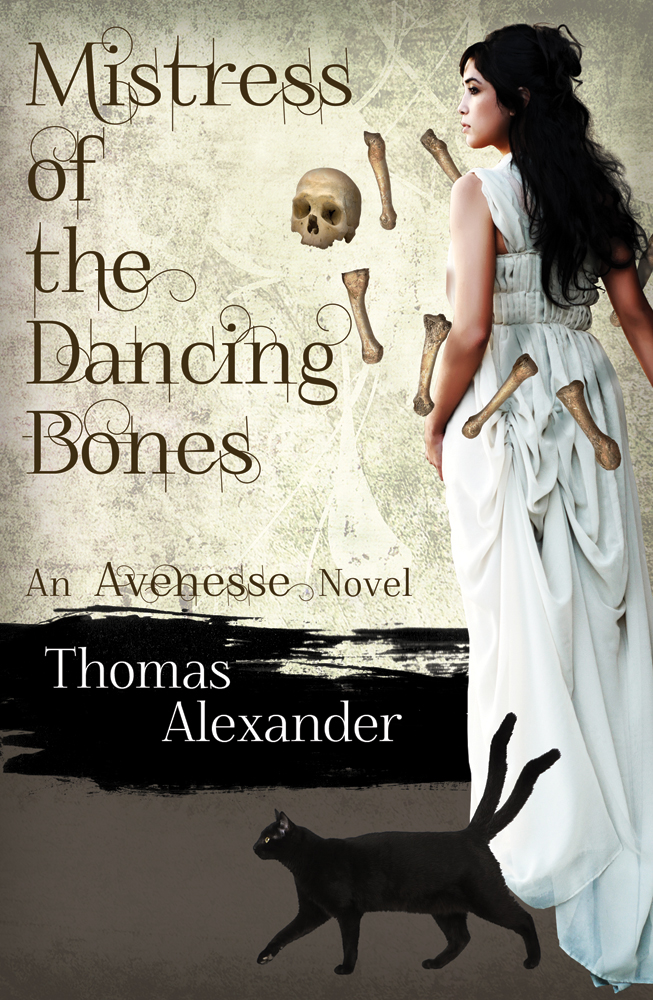
Dancing-Bones-CoverThis month’s self-published book is Mistress of the Dancing Bones by Thomas Alexander.

Four hundred years ago, the Deathlords threatened to destroy all of humanity. It was the nephilim who saved the human race. Thus was the Code Sanguine founded: humans swore to serve the nephilim, and if required, give them their blood, while the nephilim swore to protect humanity, and raise the best of the humans to nephilim themselves. For before the Code Sanguine, the nephilim were known by another name: vampires.

Ashia is the daughter of a nephilim warlord, Marcel Boucher, and his human wife. This does not make her a nephilim, or even part nephilim. She is fully human until embraced by the nephilim. She is also, thanks to her mother, Dahraki, one of the dragon-blooded, and that gives her access to another kind of magic, the necromancy of the Than Khet. Unfortunately, the servant who secretly tutored her in Than Khet magic neglected to tell her that it is incompatible with becoming nephilim. Should a Than Khet be embraced as a nephilim, she would go mad as the two parts of herself warred.

When he discovers what has happened, Ashia’s father is furious. All his dreams for his daughter have come crashing down. But larger problems plague Ashia’s family. Renegade vampires are plaguing Marcel’s territory and the family’s enemies are placing the blame squarely on Marcel and his willingness to embrace barbarians rather than civilized Avensh as nephilim. In order to discover the truth, Ashia agrees to accompany the legendary nephilim witch-hunter Dusang and his demon-cat-fey ally, Tama, in tracking down the renegades and discovering the truth behind a conspiracy that involves not only renegades and political enemies, but the Deathlords themselves.

I am generally not a fan of vampire novels. I prefer my vampires as antagonists rather than as love interests. And for the love of God, sunlight better burn, or at least weaken, them, not cause them to sparkle. So I was taking a chance on this novel, but I’m glad I did.

…

Read More Read More