Browsed by
Category: Blog Entry

Don’t Mess With the Amazons: The Wonder Woman Movie

Don’t Mess With the Amazons: The Wonder Woman Movie

Gal Gadot as Wonder Woman

Gal Gadot as Wonder Woman

A lot has been said about Patty Jenkins’ movie Wonder Woman, pretty much all of it by people smarter and more qualified than I.

But given that I do a lot of comic books musing for Black Gate, and that I also reviewed Rogue One and Dr. Strange, I wanted to give Wonder Woman the attention it deserves.

Superhero movies are what they are.

Read More Read More

The 33% Mark: When it’s OK to Stop Drafting Go Back and Edit

The 33% Mark: When it’s OK to Stop Drafting Go Back and Edit

"Ticket to the last station!"
“Ticket to the last station!”

When you’re writing that first draft, standard advice is: Don’t go back to edit!

Make like Omar Khayyám:

The Moving Finger writes; and, having writ,
Moves on: nor all thy Piety nor Wit
Shall lure it back to cancel half a Line,
Nor all thy Tears wash out a Word of it.

Or if you prefer, Guderian:

Ticket to the last station.

Yes, the ideal first draft is a blitzkrieg: rampage onward with the story, ignore pockets of resistance, you can catch them on the second draft.

However, you are neither a medieval Persian ruminating on life, nor a Panzer general.  For all we like to skin it with the aesthetic or the macho, writing is its own activity. The truth, so I’ve learned, is more complex.

Read More Read More

The Play’s The Thing

The Play’s The Thing

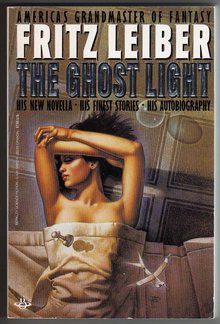
Leiber Ghost LightHere at Black Gate we often have posts on films and TV shows as they connect with or pertain to our favorite genre(s). If we don’t talk as much (or at all) about live drama, it’s probably because there’s not as much SF or Fantasy happening on the stage as there is on the screen. I’d think we’d all agree that with a very few exceptions stage effects are simply not equal to the kind of special effects SF and Fantasy often need.

But if we don’t see our favourite novels and stories on the stage, we certainly do see the opposite: we see the stage in our novels and stories.

We’re all familiar with the “play within a play” concept since we had to read Hamlet in high school. After all, practically every Fred Astaire movie musical is about a musical production, and there can’t be anyone alive who doesn’t know that Singing in the Rain is about making a movie musical. But again, what I’m looking at here is play-within-the-story. We should note that if we follow in Shakespeare’s footsteps, the device has to have purpose. In Hamlet, the play was “the thing to catch the conscience of the king,” that is, it played an integral part of the plot. The same should be true if we see the device in a short story or novel.

Read More Read More

“A World Gone to the Dogs”: City by Clifford D. Simak

“A World Gone to the Dogs”: City by Clifford D. Simak

These are the stories that the Dogs tell when the fires burn high and the wind is from the north. Then each family circle gathers at the hearthstone and the pups sit silently and listen and when the story’s done they ask many questions:

“What is Man?” they’ll ask.

Or perhaps: “What is a city?”

Or: “What is a war?”

from the Editor’s Preface to City
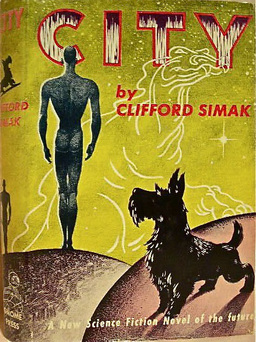
oie_671529XHRO0a33City (1952), by Clifford D. Simak, unfolds over thousands of years, telling of the end of humanity, the rise of dogs and robots to terrestrial preeminence, and finally, the near abandonment of Earth. It’s a fix-up of nine stories, eight written between 1944 and 1951, and one more, added to later editions, in 1973. It is a book conceived of in anger and despair, yet one that strives to posit a better, more humane world — even if it’s one devoid of humans.

Perhaps because we, by which I mean the post-WW II generations, have grown up aware of the deepest, most evil tendencies of humanity, it’s difficult to appreciate completely the anger and despair over what happened during the 1930s and 40s. Years after its publication, Simak said:

“The series was written in a revulsion against mass killing and as a protest against war.”

That revulsion was so intense that Simak contemplated the extinction of his own species and its replacement by a better one.

I suppose following the First World War, there was some hope that humanity would avoid that sort of mass slaughter again. Instead, it only increased by many magnitudes. In an essay on City, Robert Silverberg wrote that the story “Desertion” was written in 1943 in direct response to reports from Europe about the Holocaust. Simak was a gentle writer, so there is little anger or bitterness in the novel, but he wasn’t prone to sentimentality either. His depiction of humanity’s downfall and supplantation is remorseless.

When Simak collected the stories, he presented them as a tales told by dogs to each other as perhaps no more than legends. For each story, Simak wrote an interstitial explaining what different dog philosophers thought about the veracity of each story, as well as any meaning it might hold for their society.

Read More Read More

Support the Literary Wonder & Adventure Show!

Support the Literary Wonder & Adventure Show!

Literary Wonder & Adventure Show

Dream Tower Media, fine folks behind the Literary Wonder & Adventure Show, have launched a Patreon site to help fund it and offset some of the extensive costs of creating a top-notch audio program. And you know what that means. That’s right — you can now help support the creation of new episodes in this fine podcast series!

And Robert Zoltan (and his pal Edgar the Raven) have some terrific new episodes in the pipeline. They will be following up their popular interviews with BG blogger Ryan Harvey, fantasy author Scott Oden, and neglected genius Howard Andrew Jones, with THE GOLDEN AGE OF SCIENCE FICTION. With Special Guest, Hugo, Locus and Robert A. Heinlein award-winning author, Allen Steele in Part 1, and Hugo-nominee Becky Chambers (A Closed and Common Orbit) in Part 2.

Check out some of their earlier episodes, and learn more about how to support this worthy project at the Patreon site.

In 500 Words or Less … Never Now Always by Desirina Boskovich

In 500 Words or Less … Never Now Always by Desirina Boskovich

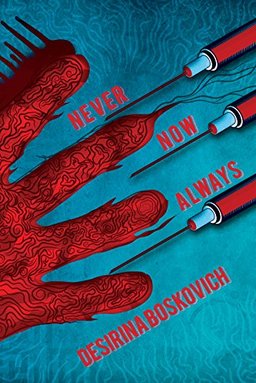
oie_21364ndRY5yGNever Now Always
By Desirina Boskovich
Broken Eye Books (88 pages, $9.99 paperback, June 2017)

A while back I had an idea for a short story about people caught up in a massive alien invasion, where humanity is rounded up and imprisoned in gray, windowless compounds while their captors run nefarious experiments, all of which is part of some mysterious, overarching plot a la Lost and the like. Then I told myself something like that has been done so many times that it wasn’t worth bothering, and I tucked the idea away on a mental shelf and haven’t looked at it since.

I bring this up because the novella Never Now Always by Desirina Boskovich takes that core premise of people imprisoned and experimented on by mysterious overlords and spins it so effectively, adding layers of dark surrealism and uncertainty to create a deeply compelling story. Never Now Always has a War of the Worlds/The Fifth Wave vibe with a literary style, propelled by the fact that the story’s three protagonists (and practically the only characters focused on) are constantly having their memories stolen and/or modified, stripping away most of their identity by removing the thing that makes each of us distinct. Main character Lolo knows that she has to find her sister, Tess, but everything else is an uncertain blur, to the point that she doesn’t even know the words for things. Boskovich weaves those language gaps into the narrative with a subtlety that is also easy to read and follow – something that a lot of surrealist and literary fiction doesn’t pull off.

There are cycles repeated here, as Lolo and the others try to find and support each other and ultimately escape, but the ongoing layers of mystery means that there is never a moment without intrigue. Is their bizarre prison on Earth, or somewhere else? Are Lolo and the others children, or adults who have lost their semantic and episodic memories – or something else? Are the Caretakers around them seeking to experiment, indoctrinate, or possibly protect these humans from self-inflicted harm?

Read More Read More

Stories from a S&S Griot: Nyumbani Tales by Charles R. Saunders

Stories from a S&S Griot: Nyumbani Tales by Charles R. Saunders

“I am going to tell a story,” the griot says.
“Ya-ngani!” the crowd responds, meaning “Right!”
“It may be a lie.”
“Ya-ngani.”
“But not everything in it is false.”
“Ya-ngani.”
The griot begins his tale.

                                       from “Amma” by Charles R. Saunders

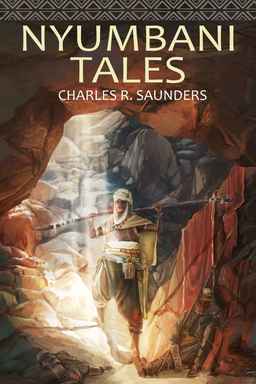
oie_2919383060rtzPRDFor those unfortunates unacquainted with Charles R. Saunders and the tales he’s woven, you can read plenty about them here at Black Gate. Suffice it to say he is called the father of sword & soul. Starting in the 1970s, he took the elements of swords & sorcery — mighty heroes, beautiful women, monsters, deadly magic, and more monsters — and turned them to his own purpose.

A fan of sci fi and fantasy growing up in the 1950s and 60s, by the time he graduated college in 1968, he was frustrated with a lot of what he was reading. As he recounted in an interview with Amy Harlib in The Zone:

I began to realise that in the SF and fantasy genre, blacks were, with only few exceptions, either left out or depicted in racist and stereotypic ways. I had a choice: I could either stop reading SF and fantasy, or try to do something about my dissatisfaction with it by writing my own stories and trying to get them published. I chose the latter course.

It was to the great benefit of heroic fantasy that Saunders made the choice he did. In addition to helping expand the horizons of the genre beyond the European settings that dominated it back then, he also created two monumental characters.

Imaro is the outcast warrior who eventually finds his destiny as champion against the forces of evil. Dossouye is an exiled warrior-woman from the kingdom of Abomey. The stories and novels featuring Imaro and Dossouye belong on the shelves of any S&S fan. If you haven’t read them yet, I suggest you snag copies of Imaro: Book I and Dossouye, clear off whatever else you’re reading, and get started.

Read More Read More

Fantasy Warriors and Plastic Toy Soldiers on Memorial Day

Fantasy Warriors and Plastic Toy Soldiers on Memorial Day

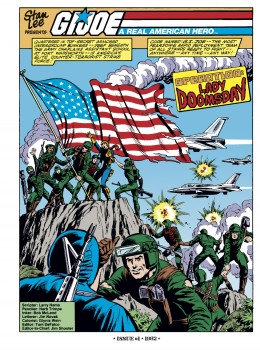
gijoe-treasury-edition-special-page-01Black Gate is a site devoted to fantasy and science fiction, and an inordinate amount of fantasy and science fiction is devoted to soldiers, warriors, barbarians, slaughter and destruction. Which I’m all for in my fiction.

Today, though, here in the United States, we observe Memorial Day and remember real soldiers and fallen warriors. So, if you don’t mind, for the blog today I am posting the transcript of the speech I delivered this morning at the Memorial Day service in Elgin, Minnesota. It is short (I kept it to one page). And if you came here looking for your daily dose of fantasy, don’t worry — the speech contains at least one reference to ghosts and alternate realities (How could it not? It is a speech by Oz)…

I brought a plastic army man with me today because I want to talk about the grim knowledge we gain as we grow up, the understanding that comes along with putting aside childish things. When I was a boy — my son’s age, and he loves to play with army men — we’d set them up and knock them over. Make our gun and explosion noises, like we’d learned from the movies. It was all right; they’re just pieces of plastic.

Read More Read More

The Great Savage Sword Re-Read: Vol 5

The Great Savage Sword Re-Read: Vol 5

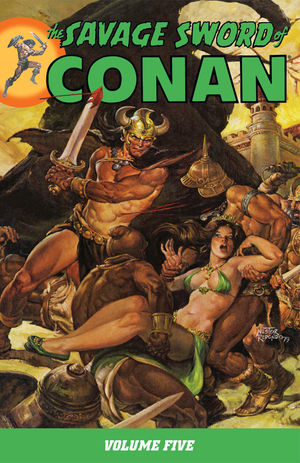
-SSoC-Vol5This series explores the Savage Sword of Conan collections from Dark Horse reprinting Marvel Comics’ premiere black-and-white fantasy mag launched in the mid-70s. Previous installments: Vol 1 / Vol 2 / Vol 3 / Vol 4

Volume 5 collects issues #49 – 60 (1980 -’81), and it begins with the proverbial bang. Reigning art champs John Buscema and Tony DeZuniga return for a 4-issue adaptation of the L. Sprague DeCamp/Lin Carter novel CONAN THE LIBERATOR. These four issues are gorgeous–the Buscema/DeZuniga team is firing on all cylinders.

Story-wise this adaptation succeeds far better than the previous DeCamp/Carter adaptation, CONAN THE BUCCANEER (collected in Volume 4). Whereas BUCCANEER tended to meander and lack proper pacing, LIBERATOR moves at a brisk pace and gives us more classic Conan time.

LIBERATOR is basically a military fantasy with bit of sorcery thrown in to complicate the saga of Conan’s revolt against a mad tyrant. We have a beautiful spy, a scheming wizard, and a truly insane king who butchers his own subjects in a futile quest for immortality. Here is the story untold by Conan creator Robert E. Howard: The story of exactly how Conan became King of Aquilonia.

Read More Read More

A Grab-Bag of Comic Reviews: Southern Bastards, Jaegir, Deep End

A Grab-Bag of Comic Reviews: Southern Bastards, Jaegir, Deep End

Southern Bastards-small

My comic reading has jumped all over the place this month, but I’ve been finding lots of good stuff.

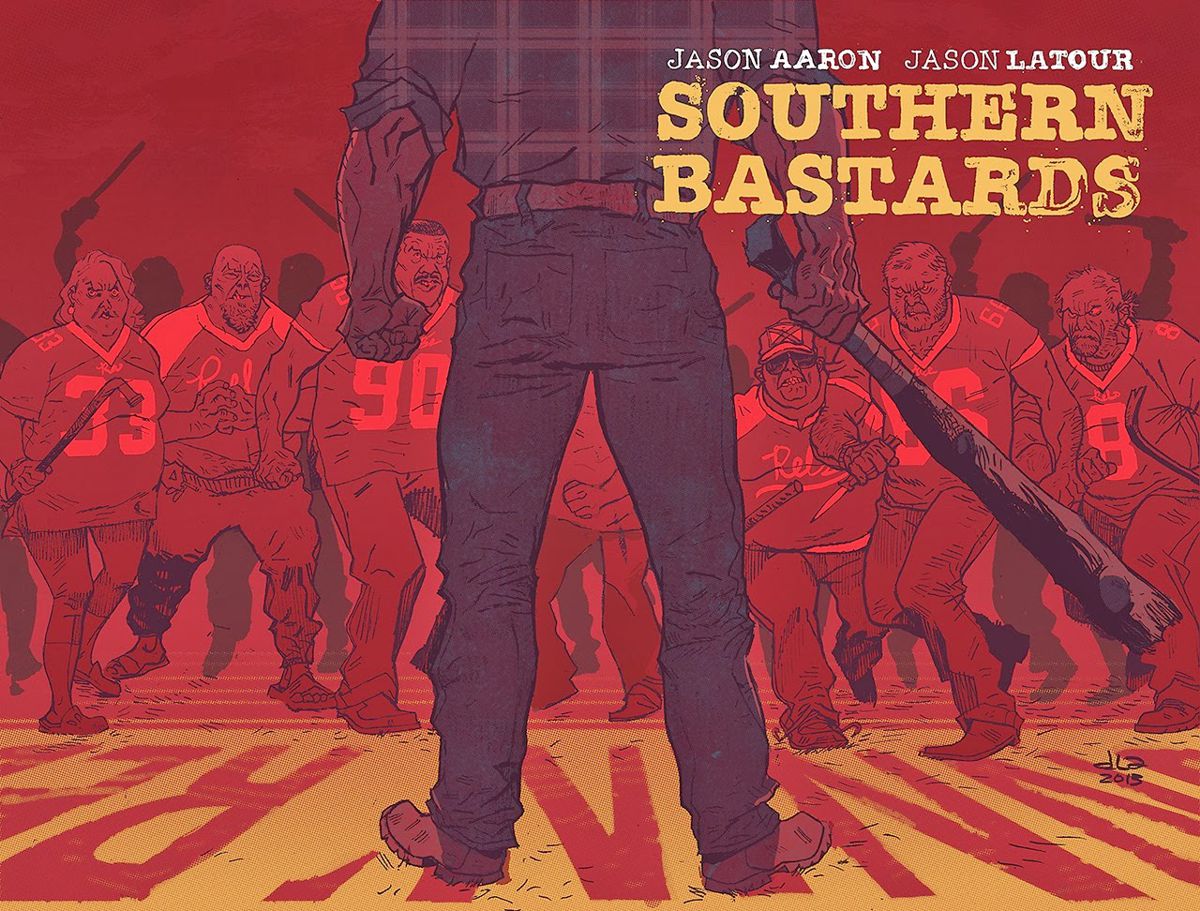
Southern Bastards: I picked up Southern Bastards as part of a massive Image Humble Bundle last year. I finally got to Volume 1 this 2014 series by Jason Aaron and Jason Latour.

It was scary amazing.

I know nothing about the deep south, but both Jasons come from there. Their mission is: to write about the place they grew up in in all the ways it is peaceful, primal, timeless, haunted, hateful, spiritual, beautiful and scarred.

Read More Read More