Browsed by
Category: Blog Entry

Warning: This Comic Will Make You Smarter – Top Cow’s Think Tank

Warning: This Comic Will Make You Smarter – Top Cow’s Think Tank

Think Tank 01001 PREVIEW-small

Recently I’ve been reading Think Tankby Matt Hawkins and Rahsan Ekedal at Top Cow (under Image Comics). It’s a series that started in 2012, ran for about a dozen issues, has had subsequent small series since, and as of 2016, was under movie development.

It looks like a comic that was written for me.

Warning and apology: There is *no* fantasy in this post or in this comic. The story is based on the technology of right now, and what is easily plausible in the next decade or two. Strictly speaking, I would be hard-pressed to call it science fiction. It’s now, just the parts we don’t see.

But in a very real sense, it fits into the aesthetic of fantasy in that we are looking into an unfamiliar world through a story that tells us a lot about ourselves. So, sorry.

Read More Read More

A Rose By Any Other Name . . .

A Rose By Any Other Name . . .

AlicePeople can have all kinds of reasons to use another name, or to change their names permanently, for that matter. There are personal or family reasons, like marriage or adoption. There are political or social reasons, like marking a religious conversion, or immigration – though that last’s not as common now as it was in the early to mid-20th century. My own father, for example, changed his name to Malan because British authorities – to whom he had to report regularly as a displaced person after WWII – suggested that he try to sound less Polish since he was planning to stay in England. He chose a name much in the news at that time, and that’s why my brother and I are often asked if we’re South African.

Setting these examples aside, however, actors and writers are probably the next large group of people who frequently change their names – or at least use other names as a pseudonym, or nom-de-plume, if you prefer. (A friend of mine once referred to her real name as her nom-de-nom.)

Read More Read More

February Short Story Roundup

February Short Story Roundup

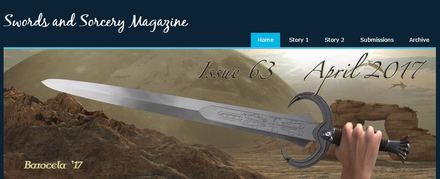
oie_13616139DhBwLErAnother month, another roundup of solid swords & sorcery short fiction for your enjoyment. Follow along for a look at February’s offerings.

Swords and Sorcery Magazine Issue 61 kicks off its sixth year of publication with a bang; actually, a pair of bangs. The first little explosion comes in the form of a group of friends making stupid decisions in Tom Lavin’s “Trouble in the Viscount Tavern.” Deon surprises his friends Tenny and Ruald with a strange book left behind by an inn guest. Though its cover advertises it as Giselder Farnbrak’s Herbs and Homely Cooking, inside are spells. Despite misgivings from Deon, the others start to read some out loud for a lark. Lavin’s description of the resulting horrors is bone-chilling.

Read More Read More

Kong: Forget Jurassic Park; Book Your Next Family Vacation to Skull Island!

Kong: Forget Jurassic Park; Book Your Next Family Vacation to Skull Island!

kong skullOkay, I loaded the family up in the van today and we went to see the big ape, the Eighth Wonder of the World tearing it up at the box office.

It delivered pretty much what we all wanted and expected, from the youngest son on up to the oldest boy in the family (that would be me, the boy pushing 45). That is to say, there isn’t going to be any “Oscar buzz” around it (like there is with Logan), but big-budget popcorn B-movies don’t get much better.

A lot of people were excited to see Tom Hiddleston in this movie, and then disappointed to see his performance wasn’t much like Loki: he’s the fairly bland leading man, but he executes the role fine. Likewise for Brie Larson, the anti-war photojournalist who tags along on a hunch that there’s more going on in this expedition to an uncharted island than some mundane mapping (boy is her hunch right!). Samuel L. Jackson and John Goodman have more memorable parts, but those, too, are pretty one-dimensional types. The real stand-out, as you’ve probably heard, is John C. Reilly as the WWII fighter pilot who has been stranded on the island for 28 years.

Enough said about the human cast, because, really, they’re all just bit parts to the Main Attraction: Let the Kaiju Main Event begin!

Kong: Skull Island is a lean, mean movie that barely hits the two-hour mark. Can you believe this Kong is more than an hour shorter than Peter Jackson’s outing with the Primary Primate back in 2005? It cuts out what some critics considered a meandering, overlong first act in Jackson’s film, getting straight to the action and then not letting up – right up to the closing shot that zooms in on Kong’s pupil as it reflects the towering rock formation in the center of Skull Island. It also does not grind the action to a halt to capture the big ape and haul him off to New York: this is all Skull Island, baby. The Island “where evolution is not finished,” and its many, many weird denizens.

Read More Read More

Things Your Writing Teacher Never Told You: The Multiple Personalities of Omniscient 3rd Person: Spotlight on “Folksy Narrator/ Storyteller”

Things Your Writing Teacher Never Told You: The Multiple Personalities of Omniscient 3rd Person: Spotlight on “Folksy Narrator/ Storyteller”

Discworld-small

This is part 10 in the Choosing Your Narrative Point of View Series.

This style is most often seen, within the fantasy genre, in fairytales, fables, and humorous fantasy by authors such as Terry Pratchett, Neil Gaiman, and others.

It is not unusual to see this technique used in other genres and subgenres, as well. It is characterized by a distinctive, often folksy, voice that clearly establishes an additional “character” in the narrative, who usually does not take part in the action. It is often, quite literally, a disembodied voice. This is true in Pratchett’s Discworld.

A good example of this is the oft-used introduction to Terry Pratchett’s Discworld. The version shown here is from the opening paragraphs of The Fifth Elephant.

Read More Read More

Oz’s Bag of Holding, TV Edition: Ash vs Evil Dead, Barney Miller, Parks & Recreation: What do these Sitcoms Have in Common?

Oz’s Bag of Holding, TV Edition: Ash vs Evil Dead, Barney Miller, Parks & Recreation: What do these Sitcoms Have in Common?

ashAnswer: They’re all in my bag of holding. I will now draw them out and discuss them.

Parks and Recreation

Parks and Recreation (2009-2015) has no reason to be mentioned on a site devoted to fantasy, but I’ll rationalize my inclusion of it here by pointing out that the character Ben Wyatt (Adam Scott) is a legit connoisseur of science fiction and fantasy, frequently making allusions and drawing analogies to Star Wars or Star Trek or The Lord of the Rings that fly over his colleagues’ heads. We’ve all been there, surrounded by coworkers (or classmates, or family members) who do not share our outside interests and passions. (Then we found the Internet. And, if we were really fortunate: conventions.)

In one episode, coworkers encourage Ben to take a break for a day, to cut loose and totally indulge himself at the mall. While they’re getting facials and manicures, he purchases and dresses up in a Dark Knight costume.

The refreshing thing about Ben is that he is not written as the stereotypical sitcom caricature of a nerd. He is somewhat socially awkward but smart and sharp, on top of things. He’s actually a more “normal,” down-to-earth, audience-POV person, surrounded as he is by flamboyant and eccentric characters. He is respected and, in one case, adored (he becomes the love interest of Amy Poehler’s lead character Leslie Knope).

Read More Read More

Goth Chick News: A LARPing We Will Go…

Goth Chick News: A LARPing We Will Go…

Black Gate LARP-small

The conversation in the office at my day job was, for once, interesting this week. I overheard several of the engineers discussing LARPs, meaning Live Action Role Play, an activity with which I only have a nodding familiarity. The topic occasionally comes up at the various Cons we cover each year, in the context that cosplayers are sometimes also LARPers.

As there was no way I was going to blow my Black Gate cover by jumping in the middle of the engineers’ discussion, I decided to do a bit of investigation on this topic. I became curious to know how popular LARPs actually were, what type of scenarios are explored and who were the people engaged in the activity?

First, to begin as they say, at the beginning…

LARP is described as one-part improvisational theater, one-part reenactment and one-part role playing game. As you may have guessed, it owes its structure origin to Dungeons and Dragons. Like D&D, a game master or GM (vs a dungeon master) determines the rules and the setting of the game, and may also influence events or act as a referee during play. Unlike D&D where players build and describe their characters through a narrative, LARP players take on the physical role of their player character (PC) and act out the storyline in a real environment.

Read More Read More

The End of the Matter: Viriconium Nights by M. John Harrison

The End of the Matter: Viriconium Nights by M. John Harrison

Viriconium Nights-smallThe three novels of the Viriconium sequence, The Pastel City, A Storm of Wings,  and In Viriconium, are not the entirety of M. John Harrison’s intricate, multi-faceted portrayal of the titular city. A fourth book, Viriconium Nights (1984), collects seven stories written between 1971 and 1983. Each is strange, some bordering on the inpenetrable, but all attempt to shine lights onto new aspects of the larger story.

As he did with each succeeding novel, Harrison twists, recasts, and reweaves characters, thematic melodies, and locations first found in The Pastel City.  Sometimes, as with that book’s ostensible hero, tegeus-Cromis, things seem to be exactly as they were before. Other times, particularly with the city of Viriconium itself, they are changed considerably. Its very name becomes mutable, one time being Uriconium, another just Vriko. This reminds us of one of Harrison’s central ideas: that there is no real “there” to Viriconium; it is just a bundle of words painted on a page at its creator’s discretion.

Viriconium Nights commences with “The Lamia & Lord Cromis.” tegeus-Cromis is in search of the lamia, a beast which has slain numerous members of his family. Though he appears to have accepted the same will happen to him, still he sets out accompanied by the wonderfully named Dissolution Khan and the dwarf gladiator, Morgante. The hunt ends in a morass of complications, death, and unclarity.

Read More Read More

Nero Wolfe’s Brownstone: A Nero Wolfe Mystery

Nero Wolfe’s Brownstone: A Nero Wolfe Mystery

Wolfe_ChaykinHutton2We’re in to March and The Public Life of Sherlock Holmes has made it to three years here at Black Gate. Every Monday morning, I’ve written about a thousand words about some topic I hoped would be interesting, without missing a deadline. I’ve thoroughly enjoyed this column and very thankful that Black Gate was willing to let me ramble on about a wide range of topics. For I certainly did that!

But I’m having trouble keeping up with the demands of weekly blogging (I know it appears I just slap these things together, but I actually do a lot of reading and research) and there are a couple of writing projects I want to tackle in 2017, and for me as it is for most folks, time is a scarce commodity. So, I’ll be wrapping up The Public Life of Sherlock Holmes with the March 20th post. I convinced the powers that be here not to put a restraining order on me at Black Gate World Headquarters (in large part by signing over all future post royalties…) and I’ll be allowed to post something once in a while. And I’m going to continue contributing to the Modular column. This is a great blog to write for and I’m pleased to still be part of the family. If still the odd cousin that doesn’t get talked about at the reunions.

One of my two major writing projects for the year involves my favorite mystery series, Rex Stout’s Nero Wolfe.

In early 2000, A&E aired a one-off movie, The Golden Spiders. It starred Canadian Maury Chaykin as Rex Stout’s famous detective, Nero Wolfe, and Timothy Hutton as his man Friday, Archie Goodwin. Reviews were positive and a year later, the first of an eleven-episode series aired, The Doorbell Rang.

Read More Read More

A Response to Thomas Parker’s Master List of Fantasy, Science Fiction, and Horror Literature

A Response to Thomas Parker’s Master List of Fantasy, Science Fiction, and Horror Literature

IMG_4426
Big lists can be intimidating…

I was reminded of something while perusing Thomas Parker’s laudable Master List of Fantasy, Science Fiction, and Horror Literature last week ( or “The List” — posted HERE on Black Gate).

Each of us likely has a book or two (or ten) we adore – absolutely cherish and consider indispensible – that will never appear on any of these lists (unless we compile our own list).

These are gems worthy of our love, yet they are just not that well known, or they have been overlooked or mostly forgotten. Some books, after all, are trees that grow for hundreds of years, while others are flowers that bloom in glory and then are gone.

Later on I might mention a few that I admire, but I will not be arguing that any of them should be on Parker’s or any of the other lists. My thesis here is simply that there are far more great books than can be squeezed onto a top 500 or top 700 or top 5,000. And that’s wonderful news, isn’t it?

Put another way:  If some horrible cosmic accident occurred in the multiverse that wiped out all 700 of the books (and book series) on Parker’s list – suddenly none of them existed here on our version of Earth – much of our great fantasy, science-fiction, and horror literature would be lost, granted. Still, I believe we could, from what remained, start right back at square one and compile another list of 700 books just as worthy  and strongly representative of the genres.

Of course, why we even need such lists is simple: One reason there are so many great books and so many good books is because there are so many books. Period. (With between 600,000 and 1,000,000 new ones being added each year in the United States alone.) And, as you might guess, the ratio of the good to the bad, mediocre, ambivalent, hackneyed, limp is, well, daunting. If you try to find the great or the good without guidance, the odds are stacked against you. Like going alone to Manhattan without a map and just assuming you’ll walk around and stumble into the best places.

Read More Read More