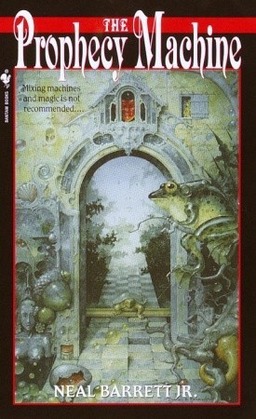
Duelists, Animal People, and Machinery Not Meant to be Fiddled With: The Prophecy Machine by Neal Barrett Jr.
 The late Neal Barrett Jr. wrote around thirty novels and seventy short stories. I’ve only read a little bit from his works, which include sci-fi and fantasy as well as crime fiction and magic realism. He seems to have slipped under the radar of most genre readers. On the other hand, everything I’ve read about the man marks him as one of those special authors held in high esteem by other writers.
My own experience with Barrett started when I found a copy of Aldair, Master of Ships in the attic. The back of the book hinted at the story’s plot, asking:
Where is humanity? What legacy has true mankind left to its manlike descendants that they must relive our past?
I was fourteen and that was enough to hook me. (In fact, only for a short, embarrassingly snooty period in my early twenties would that have been too pulpy to catch my eye.) Even so, I was struck by the strangeness of Barrett’s Roman Empire recreated with pig-men at odds with ursine and lupine barbarians. It took me several years to track down the other three books in that series, but it was well worth it. Now, of course, you can get all four together as a single e-book. There’s a wonderful strangeness and a blackly mocking sense of humor to these books that hold up well to this day.
My next run-in with Barrett also came about by accident. During a 1999 book run to the Montclair Book Center, I found the post-apocalyptic-set Through Darkest America (1987) and on a whim I bought it. Pretty much by the third or fourth page I realized I was not in a comic book, Mad Max world, but something so dismal and bleak it disturbed me to the marrow. What followed was an utterly grim coming-of-age story, where innocence is ripped away and violence is the standard.
When a second trip to Montclair secured me the sequel, Dawn’s Uncertain Light (1989), instead of joining in conversation on the ride home, I read most of the book, to the annoyance of my friends. The impact wasn’t as severe as the first book, but it still made me uncomfortable. Together, these books have a power that leaves me chilled if I just think about them for too long. If you think Cormac McCarthy’s The Road is the be-all and end-all of despairing post-apocalypse stories, I’m here to tell you you’re wrong and I’ll leave it at that.
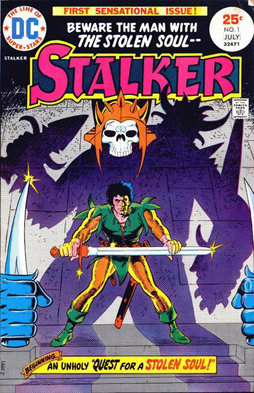 The first stop I made on my shopping expedition last Boxing Day was at my local neighbourhood comics store, which happens to be conveniently located two and a half blocks from my house. There, I found a deal in the back-issue bins: issues 1 to 4 of Stalker, a DC fantasy comic from the 70s. I’d vaguely heard of the title, but knew nothing about it. I thought I remembered hearing that it had good art, which I imagined perhaps meant work by somebody like Nestor Redondo or Ernie Chan. I was way off. In fact, the art was by the remarkable team of Steve Ditko and Wally Wood. As a result, it’s wonderful. And more than that: it’s truly weird fantasy art in every sense.