Half A Century of Reading Tolkien Part Ten: Beren and Lúthien edited by Christopher Tolkien
So it was, but it is said that in recompense Mandos gave to Beren and to Lúthien thereafter a long span of life and joy, and they wandered knowing thirst nor cold in the fair land of Beleriand, and no mortal Man thereafter spoke to Beren or his spouse.
from The Quenta Silmarillion
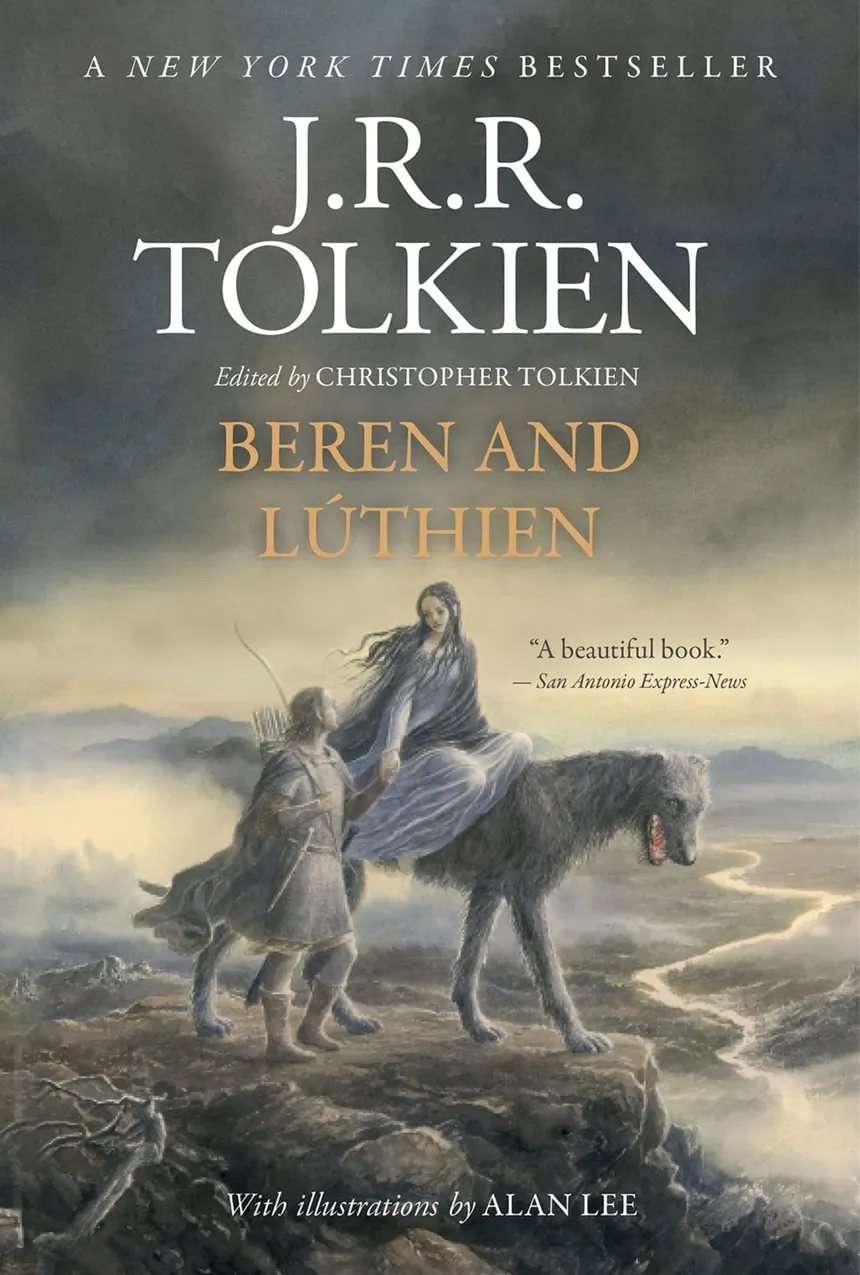
When I wrote about The Silmarillion last year, without much detail, I described the story of Beren and Lúthien as the great love story of Middle-earth. Inspired by Prof. Tolkien’s love for his wife, Edith, as well as the story of Orpheus and Eurydice, its narrative is integral to the events of The Lord of the Rings. Aragorn’s lineage goes straight back down the millennia to the couple, as does Elrond’s.
Christopher Tolkien, continuing the great work he undertook to edit and publish the greatest portion of his father’s work developing the myths, legends, and tales of Middle-earth, published three books brining a jeweler’s eye to the three great tales contained with The Silmarillion; The Children of Húrin (2007), Beren and Lúthien (2017), and The Fall of Gondolin (2018). Much more than with The Children of Húrin, Beren and Lúthien digs deeply into the evolution of the story, presenting multiple versions and commentary.
To begin, Beren is the only survivor of a band of human survivors from the great battle where the Dark Lord, Morgoth, destroyed the greater element of the army of elves and men that had kept him trapped in his realm. After the battle, Beren, his father, and ten other men, fought as outlaws against the Morgoth’s forces, until they were betrayed. All save Beren are killed.
After many great deeds and trials, Beren flees south and comes into the hidden elf kingdom of Doriath. There he spies Luthien, daughter of the king of Doriath, dancing, and is enchanted. She in turn sees Beren, and both fall in love. Her father, King Thingol, refuses to give his daughter’s hand in marriage to a mortal. Only if he could bring back one of the Silmarils, the great jewels forged by Feanor, from the crown of Morgoth, would he consent.
Though obviously a task considered impossible, Beren and a band of elves set out to try. They never even make it to the land of Morgoth, instead, being intercepted by his lieutenant, Sauron. Though imprisoned and tortured, they never reveal who they really are or what they’re doing so close to the Dark Lord’s lands. One by one, trapped in Sauron’s dungeon, they are devoured by his great wolves.
Meanwhile, after surviving trials of her own and gaining the friendship of the mighty dog, Huan, Lúthien arrives at Sauron’s keep in search of Beren. Huan kills the wolves and werewolves of Sauron, while with her own powerful magic, Lúthien overcomes Sauron and frees Beren.
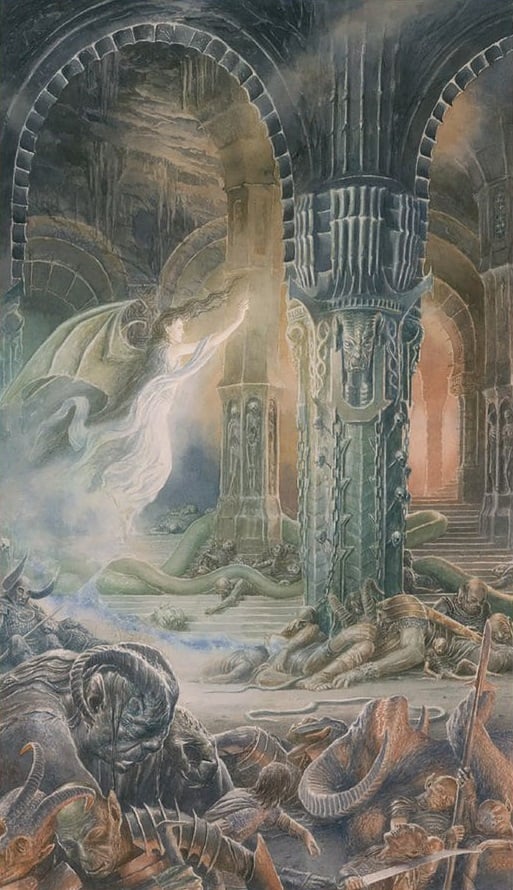
They return to Doriath, but Beren is still intent on recovering a Silmaril from Morgoth. He again sets out into the terrible lands of the Dark Lord but struggles with despair and loneliness. When he sings a song of great sorrow, Lúthien and Huan hear it and come to him. Disguised as a werewolf and vampire, they steal into Angband, Morgoth’s fortress. Revealing her true self, Lúthien offers to dance and sing for the Dark Lord. It is a dance woven through with powerful magic and puts all of his court of evil to sleep. Beren then pries a Silmaril from the slumbering enemy’s crown. Only when he tries to take a second one, he rouses their foes and must flee.
And she beguiled Morgoth, even as his heart plotted foul evil within him; and she danced before him, and cast all his court in sleep; and she sang to him, and she flung the magic robe she had woven in Doriath in his face, and she set a binding dream upon him—what song can sing the marvel of that deed, or the wrath and humiliation of Morgoth, for even the Orcs laugh in secret when they remember it, telling how Morgoth fell from his chair and his iron crown rolled upon the floor.
The great wolf, Carcharoth, bred especially to defeat Huan, chases and attacks. Beren tries to ward off the beast with the Silmaril, but it bites off his hand and swallows the jewel. Immediately, the gem causes the beast such pain that it drives it mad and charges off, bringing terror and horror wherever it runs.
Too swift for thought his onset came,
too swift for any spell to tame;
and Beren desperate then aside
thrust Lúthien, and forth did stride
unarmed, defenceless to defend
Tinúviel until the end.
With left hand he caught at hairy throat,
with right, from which the radiance welled
of the holy Silmaril he held.
As gleam of swords in fire there flashed
the fangs of Carcharoth, and crashed
together like a trap, that tore
the hand about the wrist, and shore
through brittle bone and sinew nesh,
devouring the frail mortal flesh;
and in that cruel mouth unclean
engulfed the jewel’s holy sheen.
On returning to Doriath, when Thingol learns that a Silmaril was indeed stolen from Morgoth, he relents and allows Beren to marry Lúthien. When the wolf, mad with pain, enters the kingdom, a party, including Beren and Thingol sets off to hunt it. The wolf is finally killed, but only after mortally wounding Beren and Huan. Overcome with grief, Lúthien dies from sorrow. When her spirit arrives in the Halls of the Dead, she sings a song of such beauty and power that she and her husband are returned to life, to live out their days as mortals.
This is the way the story of Beren and Lúthien emerged finally in the pages of The Silmarillion. It did not start out that way and cataloguing the numerous ways it evolved and mutated is what Christopher Tolkien set out to do with this little volume. It is an interesting book, though, without having read The Silmarillion I imagine it would make little sense.
The earliest version, and the most drastically different, began in 1917 as The Tale of Tinúviel. It’s far more like a fairy tale than the epic style of Tolkien’s later writing. Beren is not a man, instead a Gnome. In these early tales, the great elves later called Noldor, go by this name, which Tolkien linked to the Greek word for thought or intelligence. With images of Huygen’s and Poortvliet’s red-capped little fellows appearing in my head at every appearance of the word, it was a bit disconcerting.
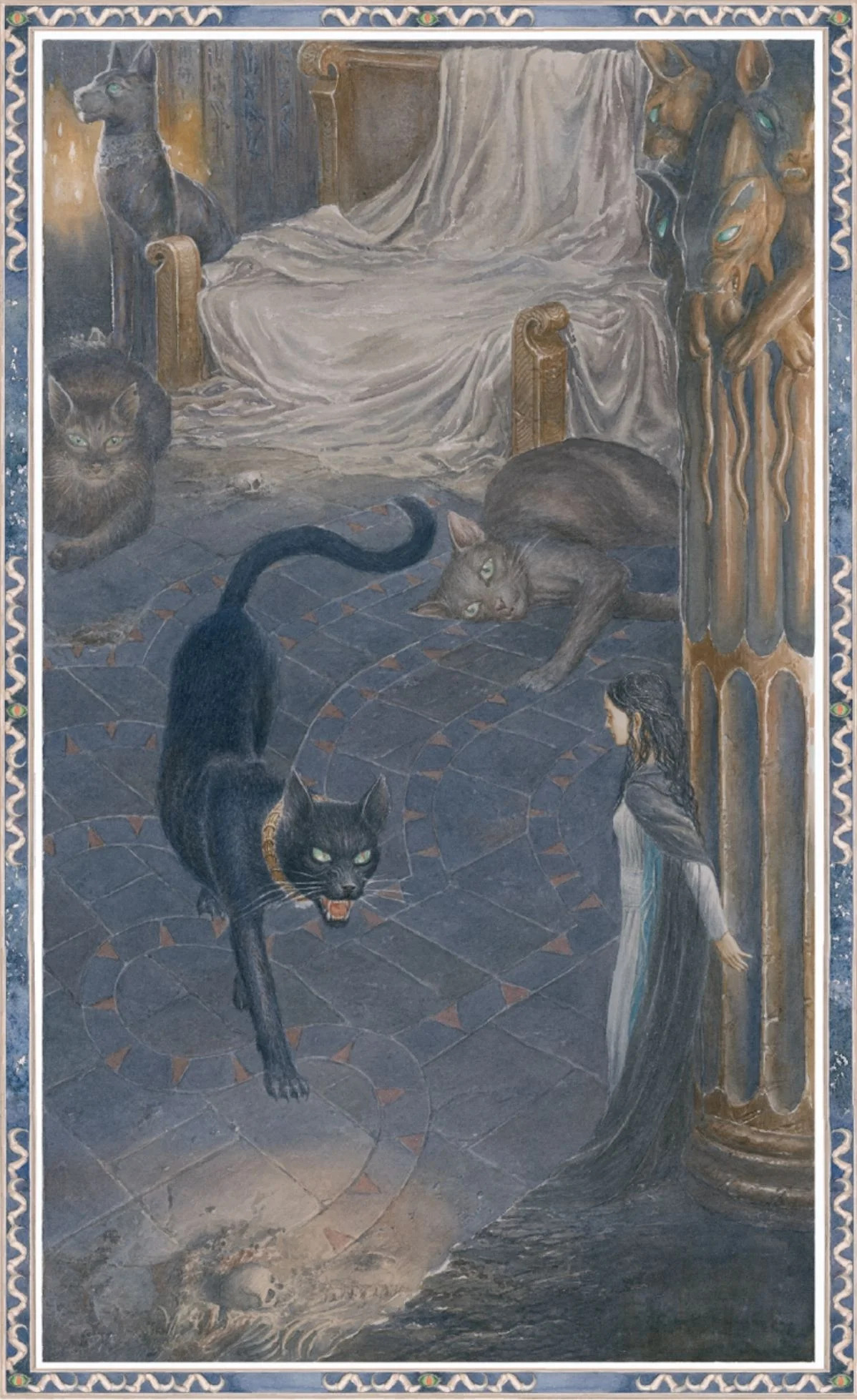
The cat, of course, doesn’t help. What cat you ask? Well, instead of Sauron, the enemy who imprisons him is Tevildo, a great cat with a retinue of lesser cats at his side. On its own, it works well creating a real fairytale atmosphere, but as part of the lore of Middle-earth it lacks the necessary deeper, darker shading.
Beren is less determined than he’ll eventually be portrayed, but as in all the story’s variations, Lúthien takes on the Orphean role and risks great harm to save him. As the tale evolves, she is clearly Tolkien’s great heroine. Beren bolts forward with the subtlety of an angry bull, unable to restrain himself and think things through. She is always thoughtful, ever planning, and wise and clever in ways that can actually trick the great powers of evil in her path.
Later, Tolkien began reworking the tale into an epic poem, The Lay of Leithian. Unfinished, it still runs to 14 of the planned 17 cantos and is over 4200 lines long. It is much more in line with The Silmarillion‘s version of Lúthien’s and Beren’s tale than the earlier version. Beren is now a man. This means the tragic aspect of an immortal falling in love with a mortal appears for the first time. The malignant feline, Tevildo, has been replaced with Thû, a formative version of Sauron. I appreciate the great effort the professor made in writing the poem, but I prefer the finished prose form.
The most interesting thing learned from reading is that this, and the rest of what’s contained in The Silmarillion, are the stories Tolkien wanted to write after the success of The Hobbit. According to his son,
In October he said in a letter to Stanley Unwin, the chairman of Allen and Unwin, that he was ‘a little perturbed. I cannot think of anything more to say about hobbits. Mr Baggins seems to have exhibited so fully both the Took and the Baggins side of their nature. But I have only too much to say, and much already written, about the world into which the hobbit intruded.’ He said that he wanted an opinion on the value of these writings on the subject of ‘the world into which the hobbit intruded’; and he put together a collection of manuscripts and sent them off to Stanley Unwin on 15 November 1937. Included in the collection was QS II, which had reached the moment when Beren took into his hand the Silmaril which he had cut from Morgoth’s crown.
Only later did he land on satisfactory artistic solution:
‘I offered them the legends of the Elder Days, but their readers turned that down. They wanted a sequel. But I wanted heroic legends and high romance. The result was The Lord of the Rings.
As a reader, I am grateful for the creation of The Lord of the Rings, but it’s always a little bit dispiriting to be reminded how often art must bend to the will of commerce if it’s to even exist.
I am not as obsessed with all the professor’s backstage undertakings as I once was. I’m completely satisfied with the LOTR’s appendices and Unfinished Tales. Long ago I decided I didn’t need all twelve volumes of The History of Middle-earth. I only bought this book because I’d read and loved The Children of Húrin. I had the mistaken understanding that Beren and Lúthien and The Fall of Gondolin were more like that. They are more literary excavations than coherent narratives.
This is a book for Tolkien completists. It has real value to anyone intrigued by how Middle-earth’s great romance grew from a fairy tale beginning to something worthy of 4200 + lines of poetry and more. Nonetheless, I am glad I read it and will read the succeeding volume about Gondolin one day. Still, it’s not a book I imagine ever reading in toto again.
Roads Go Ever Ever On
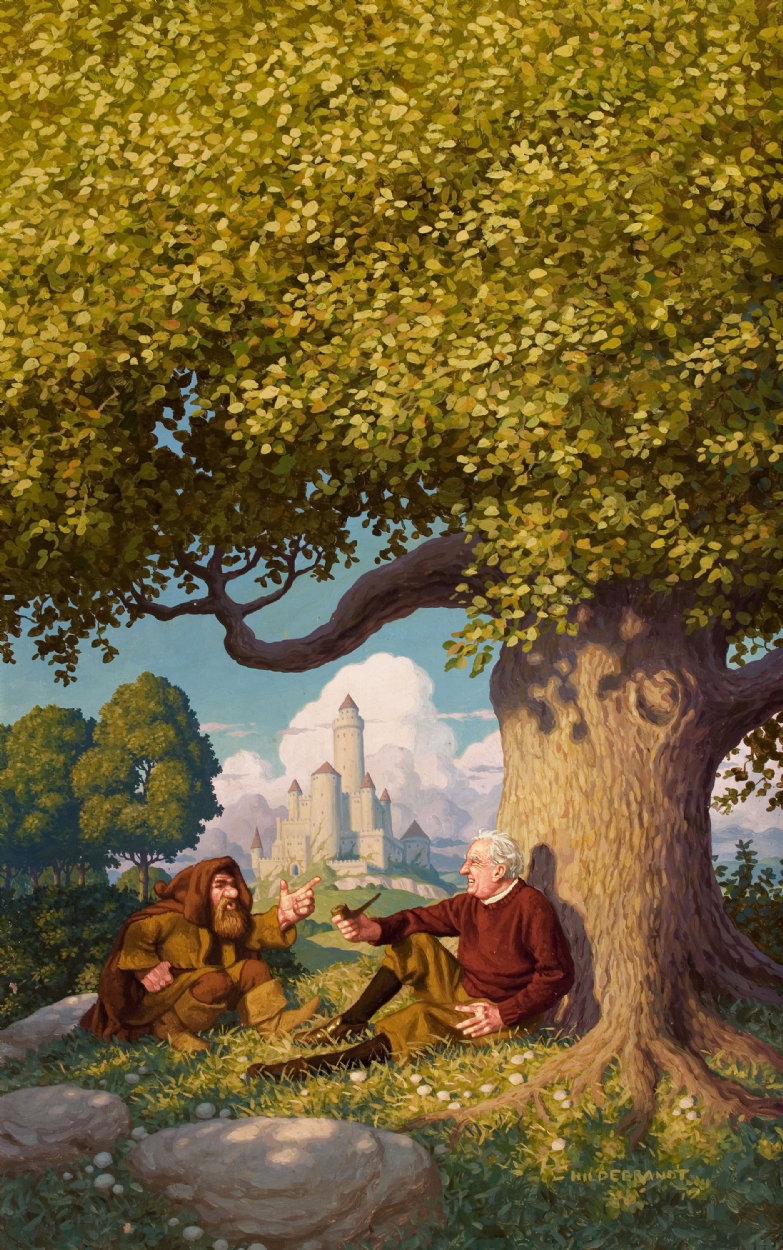
With this essay, I’m bringing down the curtain on Half a Century of Reading Tolkien. Ten dedicated pieces and two related ones seem enough. There are notions floating about my brain for future work, but for now, I’ll let them rest and perhaps germinate into full-fledged ideas. I’m more than satisfied with what I’ve done here at Black Gate and reader’s responses. Some of the comments directly affected how I approached the professor’s work in succeeding articles.
I have enjoyed this undertaking immensely, as I hope many of you have. It’s pleasing to find that The Hobbit still brings me joy, and The Lord of the Rings and parts of The Silmarillion still move and thrill me. It was also exciting to bring more knowledge of history, Christianity, and myth to reading these works. That was important to developing a deeper understanding of what Prof. Tolkien was doing artistically and thematically. There’s great beauty in Tolkien and revisiting it has been a rewarding undertaking.
I definitely enjoyed the chance to revisit curiosities and side bits like the Rankin and Bass shows, the Ralph Bakshi movie, and Bored of the Rings. Even Terry Brooks’ The Sword of Shannara was more interesting coming so close upon the heels of rereading Tolkien.
For those who don’t remember, this entire project grew out of me hate-watching Peter Jackson’s Lord of the Rings movies (the expanded editions with even more things to hate-watch). I easily watched all three movies three times in the course of preparing for and writing the first four articles. Looking back a year or so, I stand by my dismissal of them and, even more so, by my complete disdain for the The Hobbit movies.
Last year, concerning those last three dreadful films, I wrote “I feel like I watched them for penance for any and all sins I’ve ever committed and will yet commit.” I watched them again after writing that and have concluded there are no sins I could still commit in my life that would ever make me deserve such punishment. Even Morgoth himself might offer me condolences for having seen them.
Let me leave you with some words from Christopher Tolkien from an interview in Le Monde. First, his opinion on the LOTR movies, “They eviscerated the book, making it an action film for 15-25 year olds.” More importantly, though, he added “The gap that has widened between the beauty, the seriousness of the work, and what it has become, all of this is beyond me. Such a degree of commercialization reduces the aesthetic and philosophical significance of this creation to nothing. I only have one solution left: turn my head.”
The books will remain. They are there for the reading any time. For as many times as I’ve read them, I imagine, well, hope, many more times remain.
Half a Century of Reading Tolkien: Part One
Half a Century of Reading Tolkien: Part Two – The Fellowship of the Ring by JRR Tolkien
Half a Century of Reading Tolkien: Part Three — The Two Towers by JRR Tolkien
Half a Century of Reading Tolkien: Part Four — The Return of the King by JRR Tolkien
Half a Century of Reading Tolkien: Part Five — From the Beginning: The Hobbit by JRR Tolkien
Half a Century of Reading Tolkien: Part Seven — The Sword of Shannara by Terry Brooks
Half a Century of Reading Tolkien: Part Eight — The Silmarillion by JRR Tolkien
Grimmer Than Grim: The Children of Húrin by J.R.R. Tolkien
Fletcher Vredenburgh writes a column each first Sunday of the month at Black Gate, mostly about older books he hasn’t read before. He also posts at his own site, Stuff I Like when his muse hits him
This article brings a bone-deep satisfaction of conclusion to your series. Thank you for writing and sharing these; for my part, they have provided me a sense of understanding about the Tolkien world and the deep-running passions of it, in spite of never being able to enjoy it myself. Deep gratitude for that.
Thank you very much. You were instrumental in helping me dig deeper into Tolkien’s writing than I might have.
I’m not sure about the tension between art and commerce. On one hand, being able to envision the audience to whom one’s work will be addressed can be a big help to deciding what to work on; on the other, it can give focus to the work as it progresses. Commercial motives seem to have contributed not only to Tolkien’s work but to Shakespeare’s and Dostoyevsky’s, and for that matter to some really good movies and music. Now admittedly there are cases such as Emily Dickinson, who was utterly devoid of commercial motives and wrote a lot of memorable poems, but I don’t think it’s as simple as the two being opposed. I wouldn’t want to give up The Lord of the Rings as an artistic creation . . .
Of course I’m incredibly grateful Unwin’s prompting, though driven by a desire to repeat The Hobbit’s success, led to the LOTR. It is a work of art, just one that’s been written with some sort of audience in mind beyond its author. I just feel sympathy for JRRT being directed away from what he saw as his great work to something else.
I think the tension between art and commerce is often what leads to great works of art that actually speak to greater audiences. Old Hollywood is a magnificent example of the balance and tension between the two that led to films of great popular success as well as real artistic depth and merit.
When I think about the pressures put on artists to perform by their audience and their publishers, I think about Conan Doyle, who was sick of Holmes and threw him off a waterfall. But his fans and The Strand publishers put enough pressure on Sir Arthur that he produced a diamond, The Hound of the Baskervilles, to shut them up.
On the other hand, I feel no need to pressure GRRM. I would tease him, if offered the chance, though.
I’ve always been fascinated by how artistic aspirations and commerce intersect. One example that springs to mind is William Gibson, who was commissioned to write Neuromancer by Terry Carr, despite never having written anything other than a handful of short stories. He got paid up-front and so felt obligated to deliver, and may never have discovered his true potential otherwise.
I’d rate The Hobbit over LOTR personally. What’s interesting is that – in that instance – Tolkien had to compromise his vision not for financial reasons but to cater to his audience. He wrote a chapter every Xmas for his children (or so I’ve always heard) the central irony being that whereas LOTR defined High Fantasy, its predecessor actually subverted many of the conventions of that genre – ie, you have a fantasy world in which most of the characters are motivated by greed and self-interest rather than heroic ideals.