Browsed by
Category: Vintage Treasures

Vintage Treasures: The Man Who Awoke by Laurence Manning

Vintage Treasures: The Man Who Awoke by Laurence Manning

The Man Who Awoke-smallI love dollar bins. If you’ve ever been in the Dealer’s Room at a convention, or any decent bookstore, you know what I’m talking about. The jumbled box at the foot of the booth, virtually ignored, with a hand-scrawled note on the lid: “All books — $1.”

I was at Capricon 34 this weekend here in Chicago and dropped by Greg Ketter’s booth in the Dealer’s Room. Greg is a great guy, owner of DreamHaven Books in Minneapolis, one of the last great science fiction bookstores. I’m pretty sure I was in the middle of a conversation with someone when I saw three boxes peeking under from under his booth with a hand-written “$1” sign. Next thing I know, I’m sitting on the floor, surrounded by neat little stacks of books on the carpet.

There’s nothing like finding a book you’ve always wanted in a dollar bin. Except maybe finding a treasure you didn’t even know existed. And that’s what happened when I pulled out a pristine copy of Laurence Manning’s 1975 paperback The Man Who Awoke from the bottom of the box.

The Man Who Awoke is a collection of five novelettes originally published in Wonder Stories in 1933. It follows the adventures of Norman Winters, a scientist who finds a way to put himself into suspended animation and wake up every 5,000 years. He encounters vastly changed human civilizations at every stop, until he awakens one last time in the year 25,000 A.D.

I read the first story in the pages of that pinnacle of Western Modern Literature, Isaac Asimov’s pulp anthology Before the Golden Age, and really enjoyed it. Winters awakens in 5,000 A.D. to find the city of New York gone, and in its place a thick forest — and humanity struggling to survive.

It was a rip-snortin’ slice of pulp escapism… or was it?

Read More Read More

Vintage Treasures: A Touch of Infinity/ The Man With Nine Lives by Harlan Ellison

Vintage Treasures: A Touch of Infinity/ The Man With Nine Lives by Harlan Ellison

A-Touch-of-Infinity-smallI enjoy collecting vintage SF and fantasy paperbacks of all kinds. But I get the most pleasure out of the Ace Doubles.

The Ace Doubles have a lot of things going for them in terms of raw collectibility. They were edited by Donald A. Wollheim, one of the most accomplished editors our genre has ever seen, and the authors in their stable reads like a Who’s Who of major talent of the era. Best of all, they had some really terrific covers, including some truly iconic SF images.

Of course, even among the Ace Doubles, some are more collectible than others. Certainly the early novels of Philip K. Dick are near the top of the list, as are novels by Asimov and Dean Koontz. But speaking as someone who’s bought and sold Ace Doubles for many years, I think Harlan Ellison’s A Touch of Infinity (paired with The Man With Nine Lives) may be the most in demand.

Lots of reasons for this. Ed Valigursky’s classic cover, featuring a spacesuit-clad future person hiding in the rubble from invading flying saucers, clearly didn’t hurt. 54 years after this book went on sale, I still want to find out what that’s all about. A Touch of Infinity is also Ellison’s first short story collection and that alone makes it remarkable. And the novel on the flip side, The Man With Nine Lives, has never been reprinted… so if you’re an Ellison collector, this is the only way to get it.

On top of all of that though, this little book is simply a pure slice of 60s nostalgia. It’s a way to transport yourself back half a century, to a time when science fiction was still fresh and new; when Harlan Ellison was an unknown name, a hotshot young writer with only two previous books to his name; and when a mainstream publisher still tried their best to package his singular voice as typical paperback SF.

It wasn’t long before books by Ellison became a major event in the genre, so his first humble releases have a unique appeal to collectors — almost as if he were appearing in a secret identity.

Read More Read More

Apocalypse Then, and Now

Apocalypse Then, and Now

Robert Heinlein Farnham’s Freehold-smallLast week, I was talking about Paul O. Williams’s The Pelbar Cycle,  which generated a comment about the changing nature of the apocalypse. After all, nowadays we hardly ever see that word without “zombie” in front of it. As my commentator noted, the idea of a nuclear apocalypse largely disappeared after the 1980s. Perhaps this is a natural outcome of the ending of the Cold War – with the two big nuclear powers no longer at odds with one another, the threat of nuclear war effectively disappeared.

Or did it? It’s not a plot point for any of the books, so it’s not a spoiler for me to tell you that the events of The Pelbar Cycle follow both a natural and a nuclear disaster. The (then) big two nuclear powers knew that an impending meteor strike would look like nuclear events and agreed not to react, but other, smaller nuclear nations either weren’t aware, or didn’t believe, and they did react, bringing about the world that Williams describes.

That didn’t happen in Larry Niven and Jerry Pournelle’s phenomenal Lucifer’s Hammer (1977). In their case (again, no real spoilers here), the apocalyptic event is a comet strike and the nuclear powers refrain from “mistaking” it for an attack. There’s plenty of politics in the story, but it’s the politics of survival and not so much the politics of war.

Read More Read More

Take a Trip to Haven — The Free City

Take a Trip to Haven — The Free City

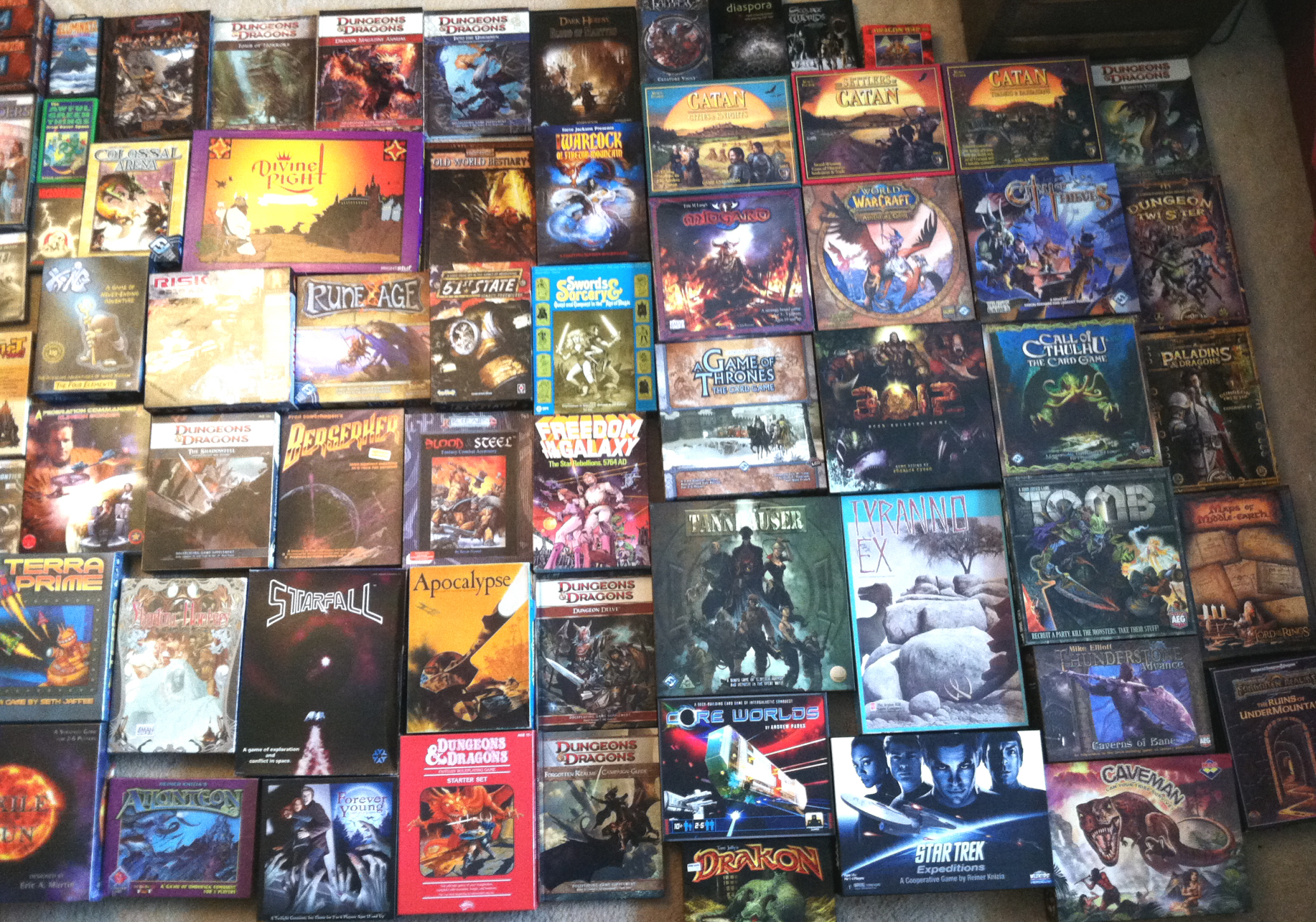
Haven the Free City-smallIn the early days of role playing, rule systems were plentiful. Really, you couldn’t set foot in a game shop without tripping over a new RPG system. Every game company on the planet was trying to grab a piece of the rapidly-exploding market with a new game focused on pirates,  science fiction, the Bronze Age, the Wild WestKing Arthurhorror movies, the fall of Moria, the Federation, Middle Earth, Jack Vance’s Dying Earth, Judge Dredd’s Mega-City One, the Marvel Universe… heck, there were even role playing games about high school, fer cryin’ out  loud.

Supplements? They were a dime a dozen. Virtually every one of the systems above had at least half a dozen. Want the complete scoop on Midgard? Wolfgang Baur has you covered. Desperately need advice on how to survive in a dungeon? Check. Or how about a trip to the mysterious lost Empire of the Aztecs?

Adventures? Lordy, yes. Countless fabulously detailed adventures, from Gygax’s classic The Temple of Elemental Evil; to the home of King Kong, Monster Island; to the ruins of Parlainth, an ancient capital that vanished from the face of the Earth; to Call of Cthulhu scenarios based on actual tales by H.P. Lovecraft. You couldn’t throw a stick without bouncing off half a dozen epic adventures.

Was there anything an avid gamer couldn’t find, in the first heady decades of our hobby?

Yes, there was. If there was anything as scarce as hen’s teeth, it was a thriving, living city setting.

And no wonder. Ruined cities, they were a cinch. Pretty map and an encounter key. But an inhabited city? With a functioning economy, logically consistent government, sinister underworld, bustling marketplaces, and larger-than-life heroes, villains, and just plain folk going about their business? That took a level of imagination — and commitment to design — on a whole new scale.

There were a few attempts at city settings, some better than others. But for my money, the most successful, and easily one of the most ambitious, was Gamelord’s marvelous Haven — The Free City.

Read More Read More

The Ballantine Adult Fantasy Series: The King of Elfland’s Daughter by Lord Dunsany

The Ballantine Adult Fantasy Series: The King of Elfland’s Daughter by Lord Dunsany

King of Elflands Daughter Front HiResThe King of Elfland’s Daughter
Lord Dunsany
Ballantine Books (242 pages, June 1969, $0.95)
Cover art by Bob Pepper

The second volume Lin Carter chose for the Adult Fantasy line was Lord Dunsany’s The King of Elfland’s Daughter. In my opinion, it is it far superior to Fletcher Pratt’s The Blue Star.

The “Lord” in the author’s byline isn’t an affectation. Edward John Moreton Drax Plunkett was the 18th Baron Dunsany (1878-1957). He was a tall, lean man. His accomplishments could put most people to shame. Soldier, Member of Parliament, author, poet, playwright, chess champion, hunter, and sportsman.

Dunsany began his writing career with short fiction, set mostly in imaginary lands and much of it slight in terms of plot and character. These tales greatly influenced H. P. Lovecraft, who wrote in this vein until moving on to develop the Cthulhu mythos.

Dunsany’s later series about Jorkens concerns a man who tells tall tales in a bar for drinks. These stories were the precursors of and influences on Arthur C. Clarke’s White Hart, L. Sprague de Camp and Fletcher Pratt’s Gavagan’s Bar, and Sterling E. Lanier’s Brigadier Ffellowes. A further discussion of Dunsany’s influence can be found here.

Dunsany turned to writing novels after publishing a number of short fiction collections. Among his novels, many consider The King of Elfland’s Daughter to be his finest. Lin Carter gives a brief introduction, not only discussing this particular work,but Dunsany’s work in general.

Set in the kingdom of Erl, the story opens with a parliament of craftsmen making an unusual request of the king. They want to be ruled over by a monarch who is “a magic lord.” He grants their request, but tells his son Alveric that it is not from wisdom that they make this request. And indeed, the parliament will come to deeply regret their request before the book’s final page is turned.

Read More Read More

An Empire Unacquainted with Defeat by Glen Cook

An Empire Unacquainted with Defeat by Glen Cook

oie_32154116Ox9HKeIGlen Cook is the author of some of my hands-down favorite books. I hold out his Black Company series as arguably the best military fantasy ever written. The early Garrett books set a standard for the blending of fantasy and hardboiled fiction. But what introduced me to Cook and made me a fan for life was his earlier work, the Dread Empire series, starting with the short story “Filed Teeth.”

The first time I ever saw the name Glen Cook was on the first three Dread Empire books, bound together with a rubber band on the bottom shelf in my local used book store. I didn’t like the cover illustrations (I still don’t) and I thought the whole “Dread Empire” thing seemed a little too dopey.

Then my dad tossed me Orson Scott Card’s Dragons of Darkness anthology. The first story in it, “Filed Teeth,” was set in the aftermath of a great war involving the Dread Empire and it blew me away! I had to have those books I had casually dismissed only a few weeks before.

The next day I took the bus to the book store and bought all three. I devoured them. They’re not as polished as many of his later books, but there are episodes of genius that range from vast fantastic battles to tender moments of pathos. The series introduces us to Cook’s likable trio of rogues, Bragi Ragnarson, Mocker and Haroun bin Yousif. The books begin with the trio scheming to make themselves wealthy beyond compare, and culminates in a war between huge armies and unbelievably powerful sorcery. If you like his other books, I highly recommend them.

Since then I’ve bought most of Cook’s books as soon as they hit the shelves. The six years I had to wait between the sixth and seventh Black Company books were among the worst I’ve encountered as a reader. The news that a new Black Company book is in the wings has me twitching.

Read More Read More

Revisiting the Monsters that Lurked in Gumball Vending Machines

Revisiting the Monsters that Lurked in Gumball Vending Machines

stickersMy children are old enough now that, the moment I take them into Kmart or the grocery store, they immediately hone in on the bank of vending machines strategically placed just by the Entrance/Exit.

“Daddy, can I have some quarters?” my daughter asks, exactly duplicating the words I so often pleaded here, in this very spot, thirty-odd years ago. “Pleeeease.” (Strategic parental answer, which I now understand intimately: “If you’re good in the store, you can get one on the way out.”)

Although the look and the operation of the machines have changed but little — dishing out a gewgaw in a clear plastic shell through the metal trapdoor after that final satisfying click of the knob — the “premium prizes” themselves have changed with the times, and they set you back two or three quarters now (300% inflation for flimsy gewgaws and cheap knickknacks!).

Popular for my children these days are grow-animals (made of absorbent rubber that grows up to 600% in water!), rubber ducks whose eyes bug out when you squeeze them, cute little alien creatures (made in China, but clearly inspired by Japan), laser-light rings, and – that perennial fave – temporary tattoos. (Okay, maybe things haven’t changed that much with either the content or the delivery.) But when I went for that little twisting crank of palm-sized bliss, I was usually drawn by the monsters…

Read More Read More

In Praise of Little, Big by John Crowley

In Praise of Little, Big by John Crowley

Little Big-smallOne of the great pleasures of adulthood is stumbling onto those unexpected moments when the world reveals that it still has secrets to impart. John Crowley’s novel Little, Big provokes in me exactly that response.

Those who have read the book fall into two distinct categories. The first group raises baffled eyebrows and perhaps does not even make it through Book One; when this group sat down to order, this is clearly not the meal they expected or wanted. The second group adores Little, Big, and can barely speak coherently about it for fear of needing to sit down suddenly or perhaps burst into a gully-washer of hand-wringing tears. I belong to the latter crowd and what I love best about Little, Big (1981) is that I have only the most limited understanding of why the book affects me as it does.

Let’s face it, I read books now as a writer, which means I am in the business of unpacking the techniques and hidden machinery of every tome I plunder — sorry, not plunder: read. I really meant to say “read.” Plunder is for pirates.

My point remains: the better the book, the more I want to plumb its mysteries, vivisect its wildly beating heart, and fully behold what makes it tick.

With Little, Big, I remain largely in the dark. In the dark, and in tears.

Read More Read More

Vintage Treasures: The Legion of Space by Jack Williamson

Vintage Treasures: The Legion of Space by Jack Williamson

The Legion of Space-smallA few months ago I wrote about The Best of Jack Williamson, a fun refresher course for me in one of the great science fiction writers of the pulp era. It also reminded me that I wanted to read his Legion of Space novels, one of the most popular pre-Campbell space operas.

Time is running out, too. Isaac Asimov, a huge fan of The Legion of Space when he first read it in Astounding Stories in 1934, sadly found it virtually unreadable when he returned to it as an adult. It’s not unusual for these early pulp novels to be a tough read as you get a little older — if you want to really enjoy them, you pretty much have to experience them first in your youth. And since I turn 50 this year, I figured I better get cracking.

The story goes that Jack Williamson was in a Great Books course when he heard that Henryk Sienkiewicz, the Nobel Prize-winning writer of Quo Vadis, had written at least one of his novels by mashing The Three Musketeers with Shakespeare’s John Falstaff. Recognizing a brilliant idea when he heard it, the young Williamson took Falstaff and the Musketeers and shot them into space, and went looking for a market for his new masterpiece.

Williamson’s Legion, the military and police arm of the newly-liberated Solar System, was led by Jay Kalam and the brilliant warrior Hal Samdu. The part of Falstaff is played by Giles Habibula (frequently described on the jacket copy as “the incomparable Giles Habibula!”, with an exclamation mark). The setting is the 30th Century, where the solar system is colonized but mankind dares venture no further, since the first team of interstellar explorers to Barnard’s Star returned as barely-alive madmen, babbling about a massive planet filled with deadly aliens — and a city inhabited by evil “Medusae,” floating jellyfish with terrible powers.

Astounding turned out to be the right market at the right time. Editor F. Orlin Tremaine published The Legion of Space as a five-part serial, beginning in April 1934. It was a success and Williamson followed with The Cometeers, a four-part serial in Astounding starting  in May 1936, and then One Against the Legion, a three-parter starting in April 1939. All three were collected in 1980 as Three from the Legion; one of the first books I ever purchased from the Science Fiction Book Club. Williamson re-visited the Legion a final time, nearly 50 years after he penned their first adventure, with The Queen of the Legion, an epic set after the disbanding of the Legion. It was published in 1983.

I’ve been reading a lot of pulp fiction recently, and mostly enjoying it — especially the short work of Clark Ashton Smith (“The Vaults of Yoh-Vombis“), Murray Leinster (“Proxima Centauri“), and the fanzines that cover the pulps, like Fantasy Review. I have high hopes that The Legion of Space will add to that list.

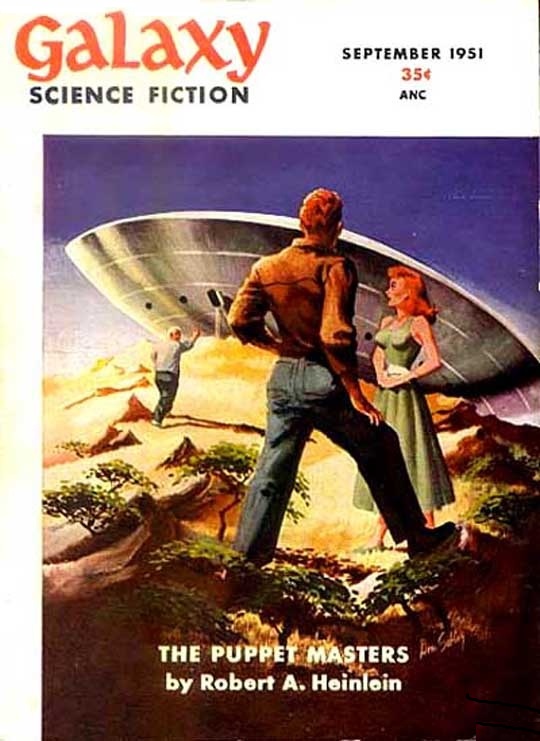
Galaxy Science Fiction, August 1951: A Retro-Review

Galaxy Science Fiction, August 1951: A Retro-Review

Galaxy Science Fiction August 1951-smallSometimes when I look at the table of contents for Galaxy, I can almost hear Horace Gold chuckling. In the August, 1951 issue, for example, there are stories from both Lester del Rey and Ray Bradbury. But every issue is full of talented authors, though some became more famous with the passage of time. I think it would be a struggle to compete against such a formidable magazine.

“Beyond Bedlam” by Wyman Guin — Everyone in society has Multiple Personality Disorder with two strong personalities. The treatment is to allow each personality to live on its own for five days at a time, and the rules of society forbid interacting with the worlds of one’s own alternate personality. Each personality has its own name, its own job, its own spouse. Yet in the case of Bill and Conrad, who share a single body, their wives are within the same physical body. Bill’s curiosity leads him into an interaction with Conrad’s wife, and over time, it develops into an affair — something that the Medicorps would deal with severely if they found out.

Guin mistakenly uses the term schizophrenia throughout the piece, but there has been confusion between that and Multiple Personality Disorder for decades, so it’s easily ignored. This is really an amazing story — highly imaginative and suspenseful. It pulled me along quickly and I couldn’t tell where it would go; I just knew I wanted to find out. This was my favorite piece in the issue.

“Operation Distress” by Lester del Rey — During his return trip from Mars, Bill Adams notices a rash on his hands. It quickly spreads, and he’s denied clearance to land on Earth. Instead, he’s ordered to land on the moon, where a dedicated, risk-taking physician will assess his health. If Bill’s carrying a new disease, it will likely kill both men.

One curiosity beyond the story: the byline had a typo of Lester del Ray. Oops. The logistics within the story felt very realistic. It’s well-written with a nice pace. And it’s interesting that a story with such a dire plot can have a genuine, light-hearted ending.

Read More Read More