Browsed by
Category: Series Fantasy

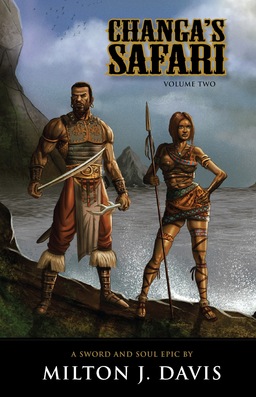
Changa’s Safari: Volume 2 by Milton Davis

Changa’s Safari: Volume 2 by Milton Davis

oie_122213ZGX0sjXjI read fantasy — and swords & sorcery in particular — because it’s fun. Like most middle-class Americans I lead a very safe life, which I’m very happy about, but from which I sometimes like to take a break. Occasionally I need to hear the whoosh of a sword just missing Conan’s head, to peer down into the dark alleys of Tai-tastigon from the rooftops of strange gods’ temples, to smell the fires of Granbretan’s vile sorceries. Sometimes I need to get out of my content, comfortable place and journey to places unknown and fantastic.

Milton Davis, sword & soul maven, delivers exactly that kind of trip in Changa’s Safari: Volume 2 (2012). The story of swashbuckling merchant Changa Diop traveling the 14th century Indian Ocean, it continues the adventures of Changa’s Safari: Volume 1 (2010), which was reviewed by Charles “Imaro” Saunders on Black Gate several years ago.

Once a prince of the Bakongo, Changa was sold into slavery when his father was killed by the sorceror Usenge. He was rescued from the slave-fighting pits of Mogadishu by a kindly merchant. His rescuer, Belay, taught him how to be a trader and eventually made him his heir.

Vol. 1 tells of the arrival of a great Chinese fleet off the East Africa coast and Changa’s journey alongside it back to China with his own fleet. There he confronts — boldly and with plenty of sword flourishing and magic — all manner of things you’d hope to meet in this kind of story: evil demigoddesses, pirates, conniving courtiers, and a Mongol horde. You know, the good stuff.

Volume 2 picks up a short time after Changa and his ships have left China for home. Home is Sofala, once a prosperous port in present-day Mozambique. It’s a long way from the Straits of Malacca (where the book opens with a tremendous multi-ship battle against Sangir pirates) to Sofala, which leaves a lot of room for adventure.

Read More Read More

Future Treasures: Sword of the Bright Lady by M.C. Planck

Future Treasures: Sword of the Bright Lady by M.C. Planck

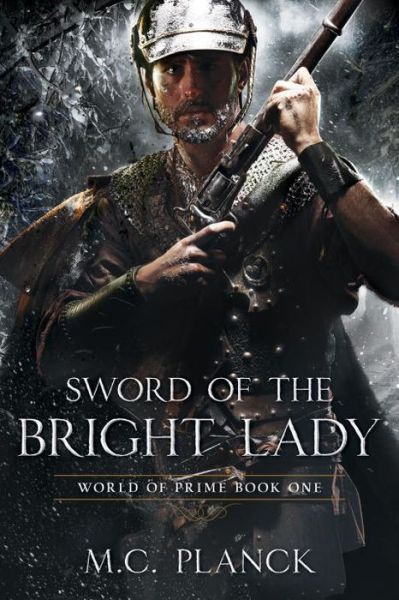
sword-of-the-bright-lady-mc-planck-smallM.C. Planck is the author of The Kassa Gambit, an SF novel released in hardcover by Tor last year. For his second novel, he turns to fantasy, with the tale of a mechanical engineer transported to a world in midst of an eternal war.

Christopher Sinclair goes out for a walk on a mild Arizona evening and never comes back. He stumbles into a freezing winter under an impossible night sky, where magic is real — but bought at a terrible price.

A misplaced act of decency lands him in a brawl with an arrogant nobleman and puts him under a death sentence. In desperation he agrees to be drafted into an eternal war, serving as a priest of the Bright Lady, Goddess of Healing. But when Marcius, god of war, offers the only hope of a way home to his wife, Christopher pledges to him instead, plunging the church into turmoil and setting him on a path of violence and notoriety.

To win enough power to open a path home, this mild-mannered mechanical engineer must survive duelists, assassins, and the never-ending threat of monsters, with only his makeshift technology to compete with swords and magic.

But the gods and demons have other plans. Christopher’s fate will save the world… or destroy it.

Sword of the Bright Lady is the first novel of World of Prime. The conceit of a contemporary hero transported into a fantasy world isn’t used as much as it used to be — obvious examples are John Carter of Mars, The Chronicles of Thomas Covenant, and Joel Rosenberg’s Guardians of the Flame novels — but I still find it an interesting one.

Sword of the Bright Lady will be published by Pyr Books on September 9, 2014. It is 440 pages, priced at $18 in trade paperback and $11.99 for the digital edition.

New Treasures: Tower Lord by Anthony Ryan

New Treasures: Tower Lord by Anthony Ryan

Tower Lord-smallI have a pretty standard routine when I wander the aisles at book stores. It goes like this.

  1. Find a great book I want to read immediately.
  2. Discover it’s the second installment in a series.

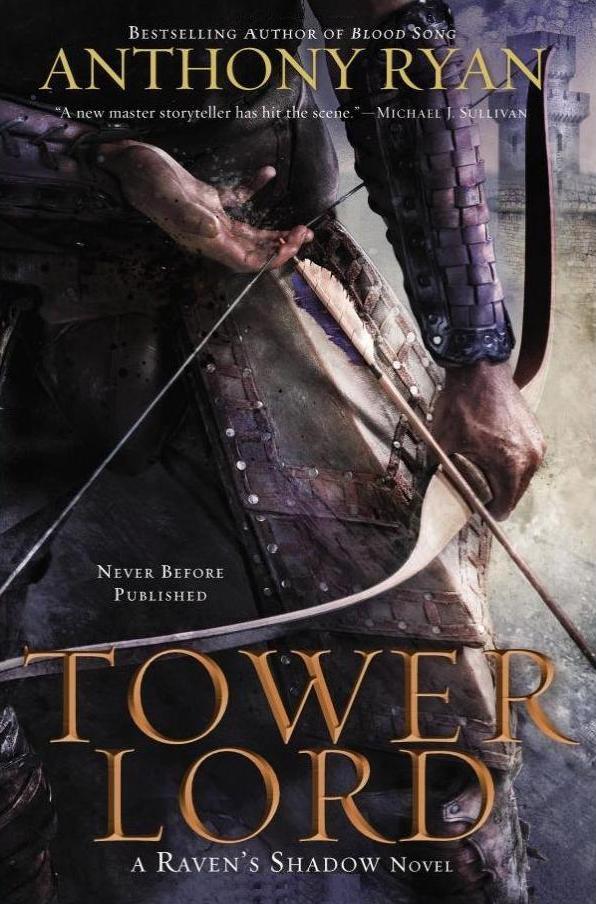
Seriously. Happens every time. Most recently, it happened with Anthony Ryan’s second novel Tower Lord, which drew me in with the title alone (Wait, Tower Lord? Like some guy with no kingdom, just a kick-ass tower? That rocks!) What can I tell you, I’m a man with simple needs.

Vaelin Al Sorna, warrior of the Sixth Order, called Darkblade, called Hope Killer. The greatest warrior of his day, and witness to the greatest defeat of his nation: King Janus’s vision of a Greater Unified Realm drowned in the blood of brave men fighting for a cause Vaelin alone knows was forged from a lie. Sick at heart, he comes home, determined to kill no more. Named Tower Lord of the Northern Reaches by King Janus’s grateful heir, he can perhaps find peace in a colder, more remote land far from the intrigues of a troubled Realm.

But those gifted with the blood-song are never destined to live a quiet life. Many died in King Janus’s wars, but many survived, and Vaelin is a target, not just for those seeking revenge but for those who know what he can do. The Faith has been sundered, and many have no doubt who their leader should be. The new King is weak, but his sister is strong. The blood-song is powerful, rich in warning and guidance in times of trouble, but is only a fraction of the power available to others who understand more of its mysteries. Something moves against the Realm, something that commands mighty forces, and Vaelin will find to his great regret that when faced with annihilation, even the most reluctant hand must eventually draw a sword.

Yup, yup, Darkblades, realms in chaos, weird magic. Whatever. They had me at “Tower Lord of the Northern Reaches.” I’ve been blindly seeking the wrong material possessions my entire life. I don’t even remember what I wanted before I saw this book. All I want now is to be a Tower Lord. I could have my own zip code.

Read More Read More

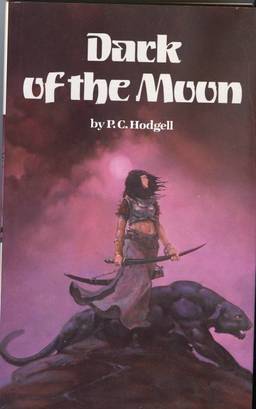
Dark of the Moon by P. C. Hodgell

Dark of the Moon by P. C. Hodgell

“Just once, why can’t we have a simple crisis?”

Jame from Dark of the Moon

oie_21182141KKAZmv94P. C. Hodgell’s Dark of the Moon (1985), a swift-paced dual narrative of twins Jame and Tori Knorth, is the sequel to her awesomely-amazing-why-haven’t-you-read-it-yet first novel, God Stalk (see my Black Gate review here). Jame, heroine of the first book, is racing into the west to find her brother while Tori, High Lord of the Kencyrath, is racing south to bring his army to bear on a threat that could destroy the world.

Hodgell wrote God Stalk as an introduction for her heroine Jame and to be sure she could write a full-length novel. To ease readers into the complex and madly elaborate world of Rathilien, she set it in the deliberately Leiberesque city of Tai-Tastigon. Like Leiber’s S&S, Hodgell’s moves easily from the grim to the funny and back without dissonance in an intimately scaled, fantastical urban playground.

But Hodgell had already planned a story of vaster scope about Jame and the Kencyrath which is only hinted at in God Stalk. The Kencyrath were bound to their god in order to fight Perimal Darkness, the embodiment of evil and chaos, and had been waging that battle for millennia. The war and the consequential flight of the Kencyrath to the world of Rathilien is always lurking beneath the surface of the story, but it’s never the driving force, the focus being on Jame’s adventures and efforts to understand the true nature of the world’s gods.

With Dark of the Moon, Hodgell and Jame leap out of the familiar shallows of Tai-Tastigon and its plethora of cults, sects, and secret societies, into the depths of full-blown epic fantasy. The ages-long struggle against Perimal Darkness moves to center stage and Jame emerges as possibly the most important figure in the war.

I’ve read that some fans of God Stalk were put off by the epic scale of Jame’s new adventure. I admit that in 1985, when I first read DotM, I was a little disappointed when I realized that Tai-tastigon was fading behind her, but within a few pages Hodgell had me hooked. High in a snowy mountain pass, Jame and her companions are confronted by something like a nasty pack of wolverines, a shapechanging enemy out of legend, and wonderfully miscast magic. This book charges into motion and never lets up. This is my fifth or sixth reread of this book and it thrills every time.

Read More Read More

Robed Figures and Snake-headed Staves: Lawrence Schick on Napoleon’s Pyramids

Robed Figures and Snake-headed Staves: Lawrence Schick on Napoleon’s Pyramids

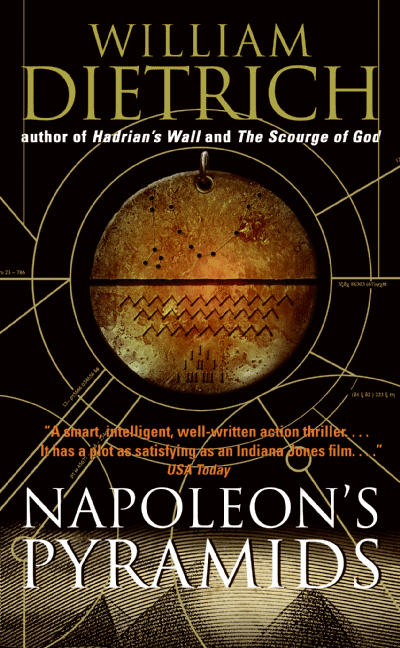
Napoleon's Pyramids-smallOver on his blog Of Swords and Plumes, Lawrence Schick takes a look at the Ethan Gage Adventures, a promising new historical action series from William Dietrich.

The series is set in the Napoleonic era, and is clearly modeled, at least in part, on George MacDonald Fraser’s Flashman novels. Like Flashman, the hero is a self-described amoral rogue who gets drawn into every major fracas of his time. But Dietrich’s books are no mere homage to Fraser, as they have their own distinctive tone; Dietrich is pulpier than Fraser, and has fewer qualms about embroidering on history in the pursuit of outlandish action scenes or occult overtones.

Dietrich’s hero, Ethan Gage, is an American frontiersman, a gambler and opportunist who finds himself in Europe after attaching himself to Ben Franklin during his term as Ambassador to France. After Franklin’s return to the States Gage hangs on in Paris, playing the “Franklin’s man” card in the salons of the Revolutionary elite, charming the ladies with his tales of the American savages and doing parlor tricks with that new scientific toy, electricity.

In classic pulp fashion, Gage wins a mysterious Egyptian amulet in a game of cards, refuses to sell it to an ominous foreigner, and is soon being pursued through the Parisian night by mysterious robed figures led by a man with a snake-headed staff. That pretty much roped me in right there: equip your villain with a snake-headed staff, and I’m sold.

Lawrence’s most recent article for us was Compiling The Big Book of Swashbuckling Adventure, on his upcoming anthology from Pegasus Books. Read his complete review of Napoleon’s Pyramids here.

Napoleon’s Pyramids was published in paperback by Harper on April 24, 2012. It is 400 pages, priced at $14.99 in trade paperback, and just $1.99 for the digital version. The sequel is The Rosetta Key and the most recent volume, The Three Emperors, brings the series to seven volumes.

Future Treasures: Stories of the Raksura by Martha Wells

Future Treasures: Stories of the Raksura by Martha Wells

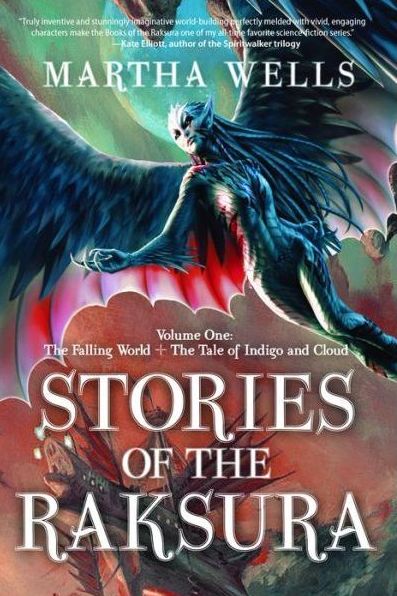
Stories of the Raksura-smallMartha Wells’s Books of the Raksura trilogy — The Cloud Roads, The Serpent Sea, and The Siren Depths — have captivated readers around the world. In Stories of the Raksura: Volume One: The Falling World & The Tale of Indigo and Cloud, she returns to the world of Raksura with a pair of exciting novellas.

In “The Falling World,” Jade, sister queen of the Indigo Cloud Court, has traveled with Chime and Balm to another Raksuran court. When she fails to return, her consort, Moon, along with Stone and a party of warriors and hunters, must track them down. Finding them turns out to be the easy part; freeing them from an ancient trap hidden in the depths of the Reaches is much more difficult.

“The Tale of Indigo and Cloud” explores the history of the Indigo Cloud Court, long before Moon was born. In the distant past, Indigo stole Cloud from Emerald Twilight. But in doing so, the reigning Queen Cerise and Indigo are now poised for a conflict that could spark war throughout all the courts of the Reaches.

Stories of Moon and the shape changers of Raksura have delighted readers for years. This world is a dangerous place full of strange mysteries, where the future can never be taken for granted and must always be fought for with wits and ingenuity, and often tooth and claw. With two brand-new novellas, Martha Wells shows that the world of the Raksura has many more stories to tell…

Read Martha’s complete Nebula-Award nominated novel The Death of the Necromancer right here at Black Gate, and her article on the Raksura series, How Well Does The Cloud Roads Fit as Sword and Sorcery?  Stories of the Raksura: Volume Two will contain two more novellas; it is not yet scheduled.

Stories of the Raksura will be published by Night Shade Books on September 2, 2014. It is 240 pages, priced at $15.99 in trade paperback and digital format.

How I Lost My Soul and Learned to Love Hell

How I Lost My Soul and Learned to Love Hell

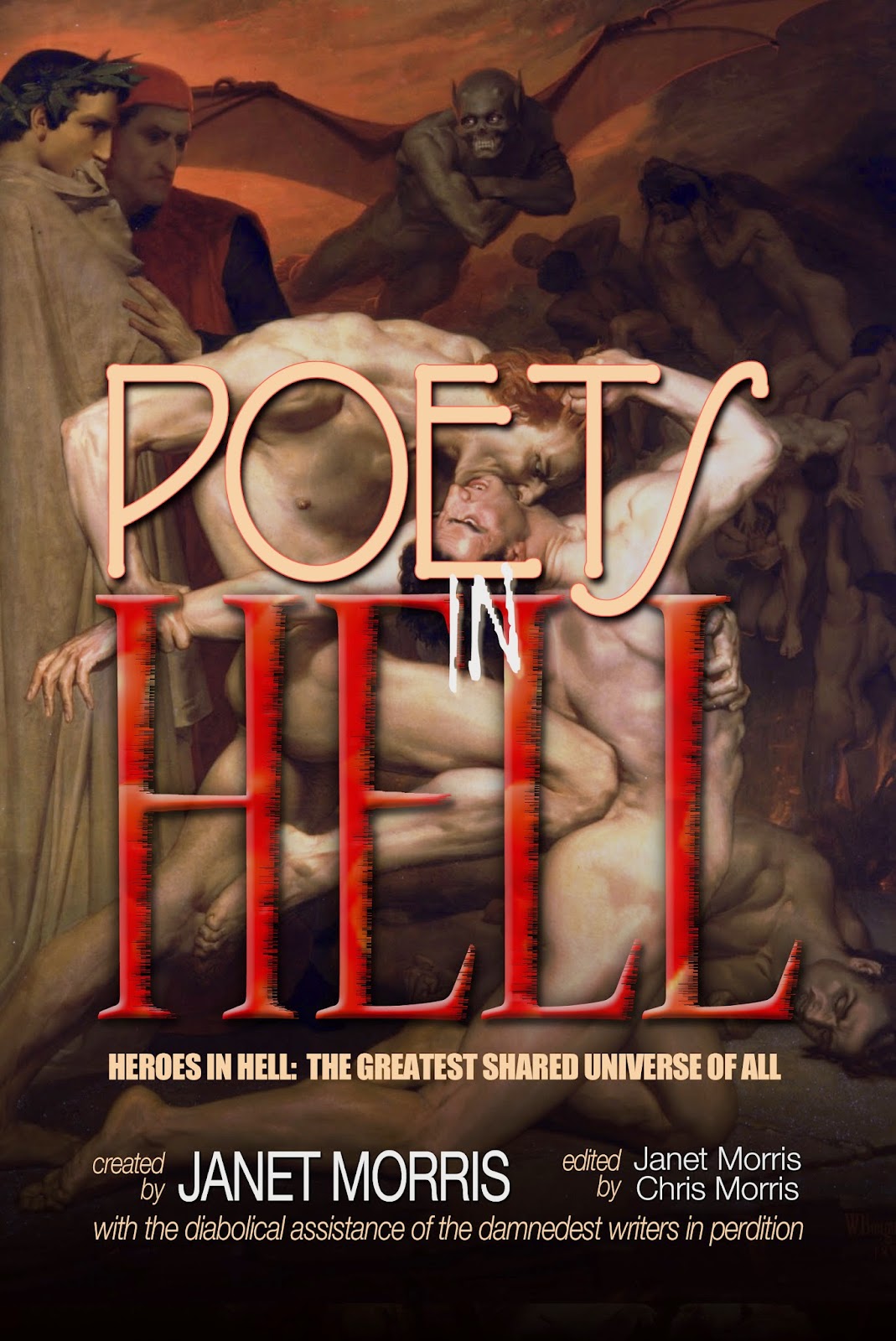
Poets in Hell-smallAs many readers of Black Gate no doubt know by now, I have previously reviewed the shared-universe anthologies Lawyers in HellRogues in Hell, and Dreamers in Hell, all edited by Janet Morris and Chris Morris.

Well, this time out, with Janet’s help, I am going to do something a little different for Poets in Hell, the 17th volume in the highly-acclaimed, award-winning, and very successful Heroes in Hell (HIH) series, what I like to call The Eternal Infernal Saga. Let me first give you a little back story, a little history as to how I, unplanned and undreamed, found myself wandering through the circles and levels of Hell.

A couple years ago, I was asked by my friend and fellow author, Bruce Durham, if I would write a review for the then-newest volume in the Heroes in Hell series, Rogues in Hell. I said sure, I’d be happy to, even though I was in the middle of writing my second novel.

I remembered the original Baen Books Heroes in Hell series, having enjoyed a number of those, and I was familiar with Janet Morris from her work in Thieves World™ and many of her own novels. But it had been years since I read those; and I’d been so long away from the fantasy genre that I had no idea that Heroes in Hell had continued on past the 4 or 5 volumes I had read in the 1980s and early 90s.

So I read Rogues in Hell, loved every word of it, wrote my review, and then bought the previous and first volume in the new 21st century series now published by Perseid Press, Lawyers in Hell. Now, while lost somewhere deep in the nether regions, I get contacted one fine day by none other than Janet Morris herself, who read my review, was very pleased with it, and liked the way I wrote it.

Read More Read More

Vintage Treasures: Master of Hawks by Linda E. Bushyager

Vintage Treasures: Master of Hawks by Linda E. Bushyager

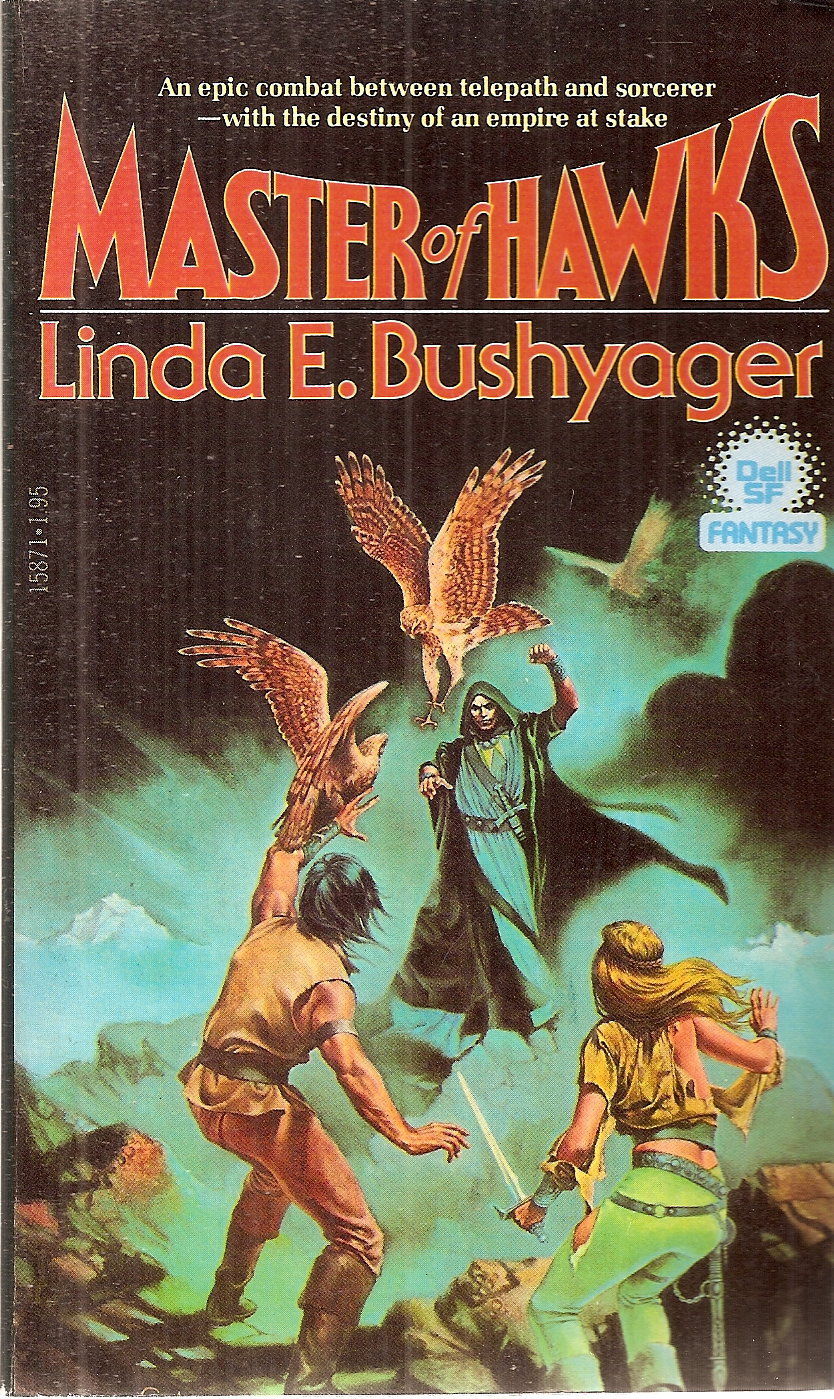
Master of Hawks Linda Bushyager-smallThursday’s article on Theodore Sturgeon’s The Stars Are the Styx reminded me of other Dell paperbacks we used to read, collect, and pass around enthusiastically in 1979. Perhaps the most popular was Linda E. Bushyager’s Master of Hawks.

Linda Bushyager is forgotten today. She wrote only two novels, Master of Hawks and its loose sequel, The Spellstone of Shaltus (May 1980), before vanishing, like J.D. Salinger. But she was far from forgotten among fantasy fans in the early 80s, who found her pair of novels set in the magical Eastern Kingdoms original and a lot of fun. Here’s the back cover blurb for Master of Hawks.

War of the Wizards

Backed by the power of the world’s mightiest sorcerers, the forces of the Empire marched on the Kingdom of York. But York had its own wizardry… including the telepathic gift of young Hawk, who could control every kind of bird — and more, see through their eyes.

The key to York’s survival was an alliance with the Sylvan — mysterious forest dwellers who mistrusted all humans — and to win their friendship, Hawk embarked on a quest deep into Empire territory, where only his mastery of his winged comrades could bring him through alive.

Linda E. Bushyager reappeared briefly in 2002, co-authoring the SF novel Pacifica with John Gregory Betancourt. She’s published nothing since.

Master of Hawks was published in July 1979 by Dell Publishing Co. It is 256 pages, originally priced at $1.95. The cover is by Maelo Cintron. It remained out of print for nearly 30 years, before being reprinted by Fantastic Books in trade paperback in April 2010. There is no digital edition.

The Series Series: Traitor’s Blade by Sebastien de Castell

The Series Series: Traitor’s Blade by Sebastien de Castell

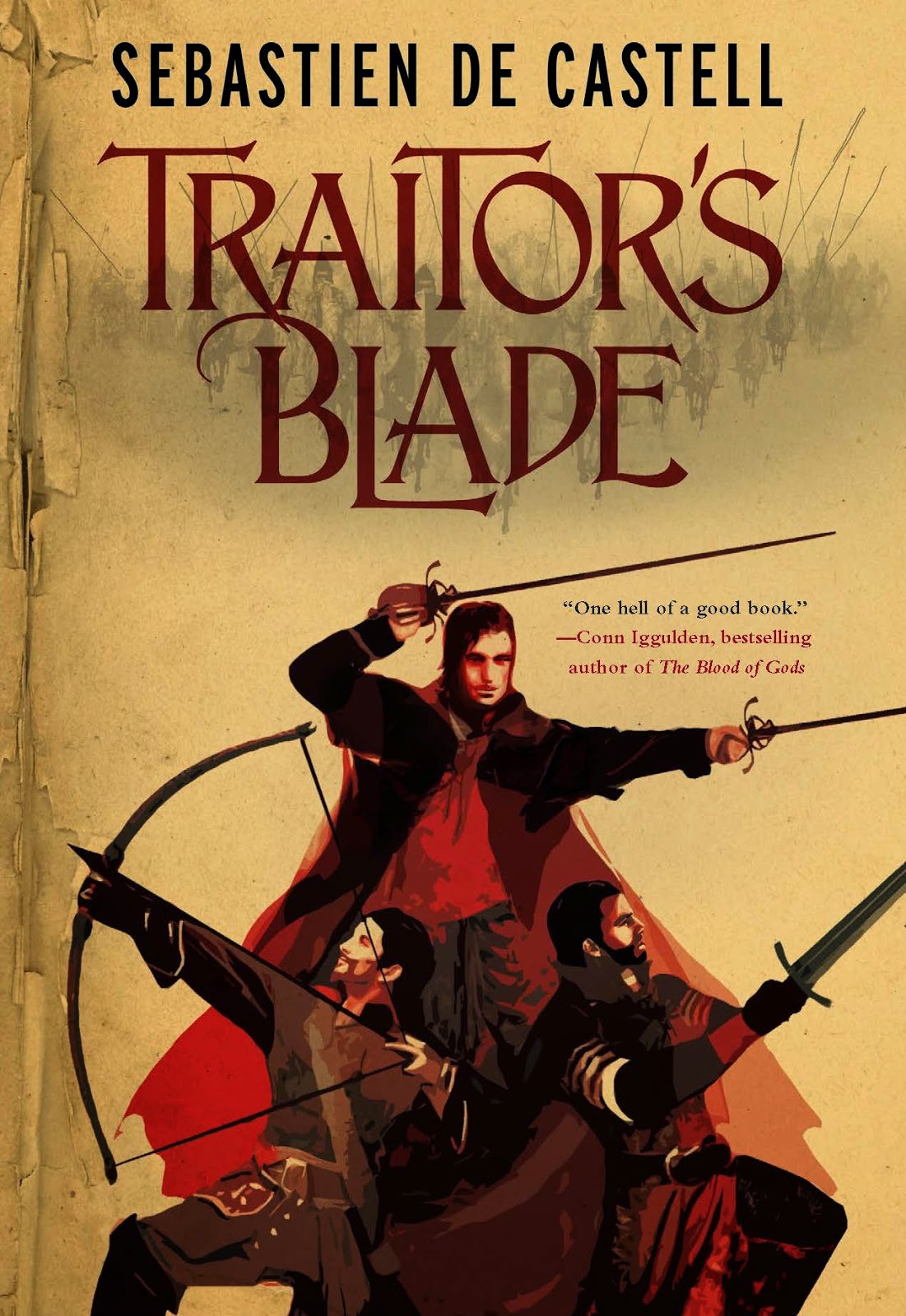
Traitor's Blade cover-smallWell, this breaks the streak.

After months of reviews that boiled down to not-my-book-but-maybe-yours or notably-flawed-but-with-some virtues or promising-but-published-a-draft-too-early, I looked at my box of review copies and saw months more of the same ahead of me. So I wrote John O’Neill and asked if any new books had come in that I might be able to love without reservation.

Not only did I love this book, I trusted it. Somehow, de Castell managed in his debut novel to win my trust so completely and quickly that he could tell nearly half of his story in flashback, often for a chapter at a stretch, and never once did he throw me out of the waking dream of fiction to wonder whether he could pull it off. As much as I like watching authorial tightrope-walking acts in general, I like best of all to watch one without worrying that the author might fall.

Falcio Val Mond’s coat is in tatters, along with his reputation, his soul, his country, and the order of warrior-magistrates he led to bring the king’s justice to the people of Tristia. He’s still First Cantor of the Greatcoats — for all the good that does him, with his king long since dead and the dukes of Tristia’s provinces plotting to exterminate or co-opt the surviving Greatcoats and install a new puppet monarch.

What Falcio has left to work with is formidable, though. He is still chief badass of an elite band of badasses, with two of his lifelong companions still by his side. Kest and Brasti are different enough from Falcio and from each other for the three of them to thread their misadventures with a high-stakes debate about how to survive and be of service as bringers of law in a lawless time when they are constantly outnumbered, defamed, despised, and impoverished. How do you help people who hate you, and is it ever conscionable to give up?

Read More Read More

Why Pure Historical Fantasies Never Seem to be Bestsellers

Why Pure Historical Fantasies Never Seem to be Bestsellers

the-desert-of-souls-tp
Robert E Howard does Clark Ashton Smith with a setting by Harold Lamb

One of the best modern Heroic Fantasy books I’ve read — one of few modern ones I’ll reread — is Howard Andrew Jones’s The Desert of Souls. I’d describe it as “Robert E Howard does Clark Ashton Smith with a setting by Harold Lamb.” It’s an awesome Heroic Fantasy adventure set in the authentic Near East of Harun Al Raschid. I note, however that Howard only got two novels into the series before being forced to move on.

Another book I loved was Matthew Woodring Stover’s Iron Dawn and its sequel Jericho Moon. This time we’re following a party of Trojan-war veterans as they battle necromancers and killer deities. These yarns should have kicked off a series and perhaps a movie or two, but they didn’t and Stover seems best known now for Star Wars novels.

Other otherwise successful writers have tried their hand at Fantasy in a straight historical setting, for example Barbara Hambly has romped around Early Renaissance Italy. Nobody, however, seems to have made a fortune writing “pure” Historical Fantasy, that is Fantasy tales set in an accurately depicted historical setting.

I find this depressing.

Partly it’s selfish reasons; I’m a historian by academic background and have an interest in historical magic. This is a tune I would love to play. Mostly though, I’d love to read more about Dabir and Asim, and about Princess Bara and her misfits.

Why is an authentic historical setting a kiss of death?

Read More Read More