Browsed by
Category: Magazines

The Original Bug-Eyed Monster: Astounding Stories, May 1931
The Original Bug-Eyed Monster: Astounding Stories, May 1931

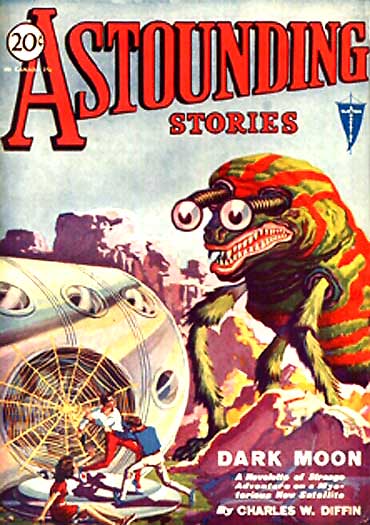
Astounding Stories May 1931-smallPulps are my weakness. I discovered them when I was just 12 years old, in Jacques Sadoul’s marvelous art book 2000 A.D. Illustrations From the Golden Age of Science Fiction Pulps (which I discussed back in May). That book sparked a lifetime interest in pulp magazines, where American science fiction was born.

Of course, I was too young to have purchased or read any pulp magazines myself in 1976. Pulps died out in the 1950s, killed off by wartime paper shortages and changing economics. So I’ve relied on the collector’s market to supply me with magazines — an expensive proposition, especially if you’re a completist.

Over the years, I’ve gotten more discriminating in my collecting. I dearly love Planet Stories, Weird Tales, Amazing Stories, Thrilling Wonder, Unknown, Air Wonder Stories, and many other pulps. But my favorite is Astounding Stories (later Astounding Science Fiction), the magazine which — under legendary editor John W. Campbell — ushered in the so-called Golden Age of Science Fiction, discovering Robert A. Heinlein, A.E. van Vogt, Isaac Asimov, Theodore Sturgeon, and many, many others. Campbell became editor with the October 1937 issue and he quickly transformed the entire field. 

Curiously, the most expensive and in-demand issues of Astounding aren’t from Campbell’s reign, however. They’re from its first three years, 1930-1933, the period known as the Clayton Astounding, when it was owned by Clayton Magazines. That’s their symbol, the little blue pennant, in the top right of the cover at left.

Very little fiction from the Clayton period is remembered today — and if you’ve never heard of the Clayton Astounding, you’re not missing much. The magazine’s early editors, like most of the American public, didn’t really understand science fiction and mostly filled the magazine with thinly disguised westerns in space and early space operas. But the covers… ah. They’re a very different story.
Read More Read More

Reading the Entrails

Reading the Entrails

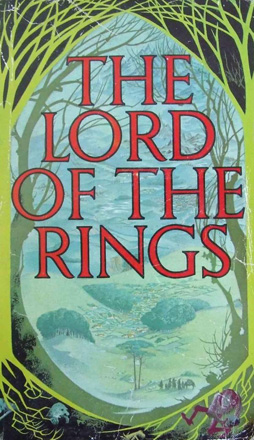
The Lord of the RingsBrowsing about the Internet recently, I stumbled on something that interested me. Several things, actually. Specifically, the results at the Internet Speculative Fiction Database of various Locus audience polls; more specifically, the results of the all-time polls in the fantasy field. I was struck by how some things stayed constant across the years, and how some other things have changed.

Now, it’s important to be wary of making overly-sweeping statements about the fantasy field based on these polls. These are things that can be compared with one another; I don’t know if they can be said to have weight beyond that. But, given that, what can one take away from them?

Let me be precise about what I’m looking at. The polls that interest me are the 1987 poll for best all-time fantasy novel, the 1987 poll for best all-time fantasy novelist, the 1998 poll for best fantasy novel before 1990, the 1998 poll for best all-time fantasy novelist, the 1999 poll for best all-time fantasy author, and the 2012 poll for best fantasy novel of the 20th century (John O’Neill wrote about that last poll for Black Gate). There are also all-time polls for science fiction, and some older polls that just asked the Locus readership for best all-time author or novel without specifying genre; I’m interested in fantasy, though, so that’s what I’m focusing on.

You can see some constants in the rankings of the books, but also movement. Some books and authors fell out of favour, some maintained their positions, and a few new titles emerged over time. So together the lists are potentially a glimpse of how attitudes to the genre developed over the course of twenty-five years among fans.

But even assuming that the poll respondents represent a group relatively knowledgeable about fantasy, do the polls say more about fantasy or more about the Locus readership?

Read More Read More

July/August Magazine of Fantasy & Science Fiction now on Sale

July/August Magazine of Fantasy & Science Fiction now on Sale

Fantasy and Science Fiction Magazine July-August 2014-smallHoly cats! C.C. (Charles) Finlay is the guest editor of the July/August issue of F&SF.

How did this happen? Did Charles win some kind of contest? Did he travel back in time and convince regular editor Gordon van Gelder that the previously-planned July/August issue would lead to an apocalyptic future timeline? Was he selected in a process of elimination from a group of a dozen contestants in a grueling and deadly contest of wills?

Nah. Gordon asked him to do it, and Charles said, “Sure.”

Here’s how Charles says it went down on his blog:

About 13 years ago, I made my first short story sale… it was to Fantasy and Science Fiction – the magazine that published writers I grew up with, like Ray Bradbury, Ursula K. Le Guin, and Stephen King. That was a rush. Nothing since – not award nominations, not other short story sales, not book sales – has been quite as exciting as that first sale.

Until now.

I’ve wanted to try editing for a while. Maybe it’s all the workshopping I’ve done, the excitement of seeing a great story for the first time before anyone else gets to read it. Maybe it’s the time I’ve spent as resident editor at the Online Writing Workshops… So when F&SF publisher Gordon Van Gelder asked me if I was interested in guest editing an issue of his magazine, I immediately said “Yes.”

Actually, I think I said “HELL YES.”

Read More Read More

A New Literary Fantasy Magazine: A Review of Lackington’s #1

A New Literary Fantasy Magazine: A Review of Lackington’s #1

Issue 1 CoverI live in Ottawa, Canada and despite being up to my eyeballs in the sci-fi and fantasy and geek scenes, I’m still caught flat-footed by the talent this city seems to pack in the woodwork.

I’ve blogged previously about our science fiction publisher Bundoran Press, our indie comic publisher Mirror Comics, and a couple of our writers like Geoff Gander, module-writer extraordinaire, and novelist Robin Riopelle.

This week, I was surprised by editor Ranylt Richildis, who, apparently not content with co-editing an amazing dark fantasy and horror anthology series called Post-Scripts to Darkness, decided to launch a new online magazine.

Richildis details Lackington’s very clear editorial vision in the foreword to the debut issue, where she quickly establishes how important storytelling rules are before eviscerating that concept and planting her flag on the goal that Lackington’s provides something different to the world. The territory she’s staking out is overtly literary, poetry in prose.

Read More Read More

Galaxy Science Fiction, December 1951: A Retro-Review

Galaxy Science Fiction, December 1951: A Retro-Review

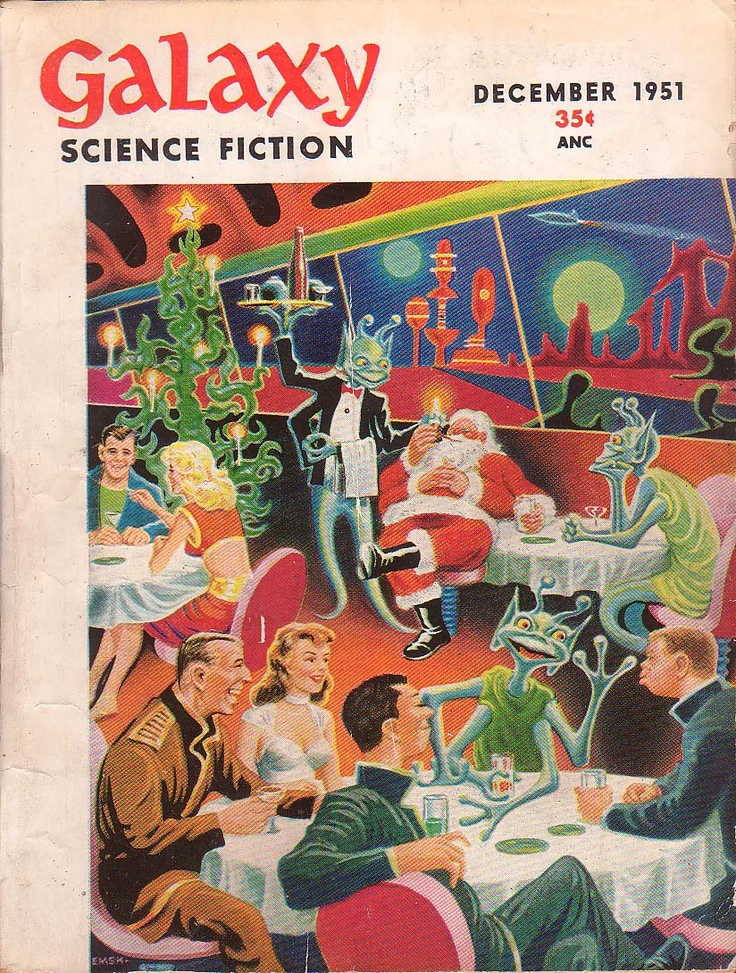
Galaxy Science Fiction December 1951-smallGalaxy’s December issue hit newsstands with a holiday cover: Santa Claus smoking a pipe on an alien world in a restaurant patronized by humans and aliens. This was a very strong issue and I loved it.

There are other Galaxy stories I would place above those in this issue, such as Bradbury’s “The Fireman” or anything by Poul Anderson, but the contents of December 1951 are amazing. I couldn’t even pick a favorite story. Authors include Damon Knight, Fritz Leiber, and Jack Vance, so that might be part of the reason for its greatness.

“World Without Children” by Damon Knight — George is the last recorded birth for humanity, and even though that was 200 years ago, people still refer to him as The Child. The birth prohibition is firmly in place to prevent overpopulation — a reasonable precaution since scientists have figured out a way to extend a human lifespan by fifty times.

But even if it were repealed, very few of the populace would have the ability to procreate. George is part of a small group of individuals who realize that the trade-off for longevity was sterility, and since they cannot convince the government to take action, they plan to start an underground birthing organization.

The story seemed to start out a bit slow, but it soon moved into a cloak-and-dagger, resist-the-all-powerful-government thriller. I’m not sure if I liked the ending, though. It seemed too upbeat after everything else that took place.

“A Pail of Air” by Fritz Leiber — The earth has been ripped free from its orbit around the sun by the gravitational pull of a dark star. One family works together to survive in the frozen world.

Read More Read More

May Short Story Roundup

May Short Story Roundup

oie_1662641OEwJwWbpMay’s come and gone by several weeks, but I’m only just getting to the short fiction review now because, well, I was busy with stuff. I’m glad I’m finally getting around to it, though, because there were some really ace stories last month and I hope I can convince you to check them out for yourselves.

Swords and Sorcery Magazine #28 starts off with “The Witch of Anûn” by Raphael Ordoñez. It’s the third story of his I’ve read in the past year (both reviewed here at BG previously), all set on the world Antellus, a “paleozoic counter-earth at the cosmic antipodes.”

Cuneaxe has brought his daughter, Una, to a thaumaturge to cure her of an “infestation.” When this fails, he is sent to a temple in the swamps. The clerics there send him in search of the titular witch. Willing to do whatever’s necessary to save his daughter, Cuneaxe journeys to the witch’s home. There he will meet danger he is willing to face and a deal he’d rather not.

Read More Read More

Gygax Magazine #4 Now Available

Gygax Magazine #4 Now Available

Gygax Magazine 4-smallIt’s been terrific to see Gygax Magazine maintain a regular quarterly schedule, especially after an occasionally bumpy start last year. 2014 has been much better — two issues so far, and we’re not even halfway through the year.

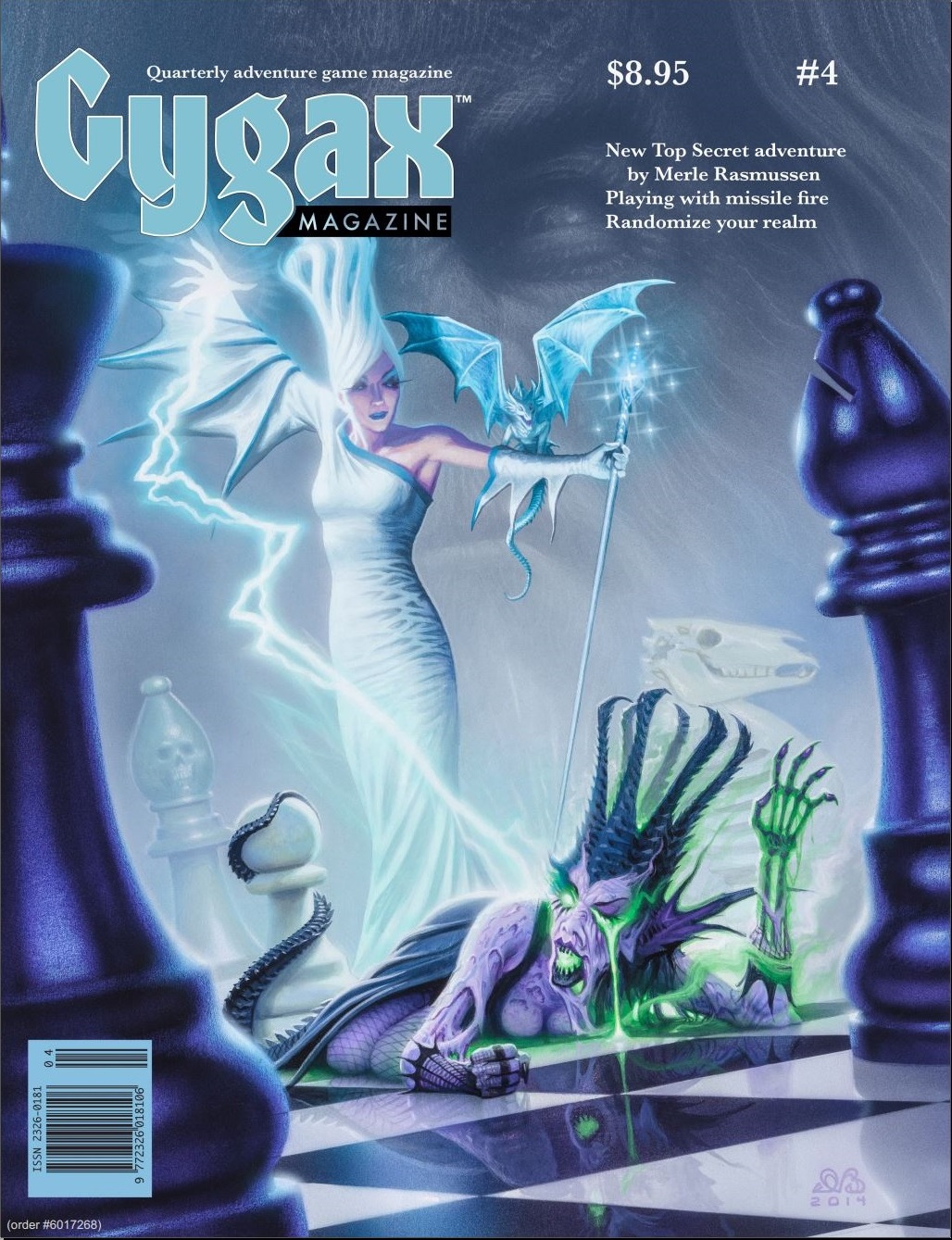
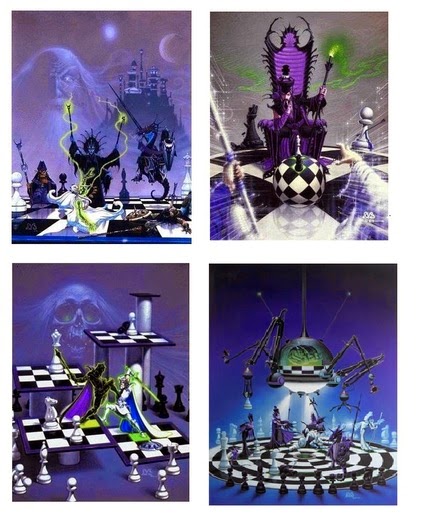
That’s not all that’s terrific about Gygax. Under Art Director R. Scott Taylor (author, editor, and BG blogger extraordinaire), the art in the magazine has really blossomed. The cover for issue 4 is by none other than my fellow Ottawa native Denis Beauvais, another entry in the famous chess series he did for Dragon magazine in the early 80s. And a fabulous piece it is, too (click on the image at left for a mega-sized version).

The interior art is just as lush, and it’s produced by folks who should be familiar to Black Gate readers, including the talented Chuck Lukacs, who illustrated every one of James Enge’s Morlock the Maker stories for us (including his now iconic portrait for “Turn up This Crooked Way.”) Other artists you may recognize include Russ Nicholson (Fiend Folio, Fighting Fantasy), Chris White, Michael Wilson, and many others.

The non-fiction is just as captivating as the art. It includes a new Top Secret adventure by the game’s creator, Merle Rasmussen, an intriguing article on Vancian verbalizations for 13th Age by Ed Greenwood, Leomund’s Secure Shelter by Lenard Lakofka, The Necromancer’s Cookbook by Dave Olson, an article on Djinn by RuneQuest 6 Lawrence Whitaker & Pete Nash, and much more. There’s also comics from Aaron Williams (Full Frontal Nerdity) and Rich Burlew (The Order of the Stick.)

Gygax Magazine #4 is edited by Jayson Elliot and published by TSR.  It is 70 pages (including a gatefold map), priced at $8.95. It’s currently available in PDF format, and in print format before the end of the month. Order directly from the website. We last covered Gygax Magazine with Issue #3.

New Treasures: Adventure Tales #7

New Treasures: Adventure Tales #7

Adventure Tales 7-smallHurrah! Hurrah! The latest issue of Adventure Tales has arrived! And a spectacular issue it is.

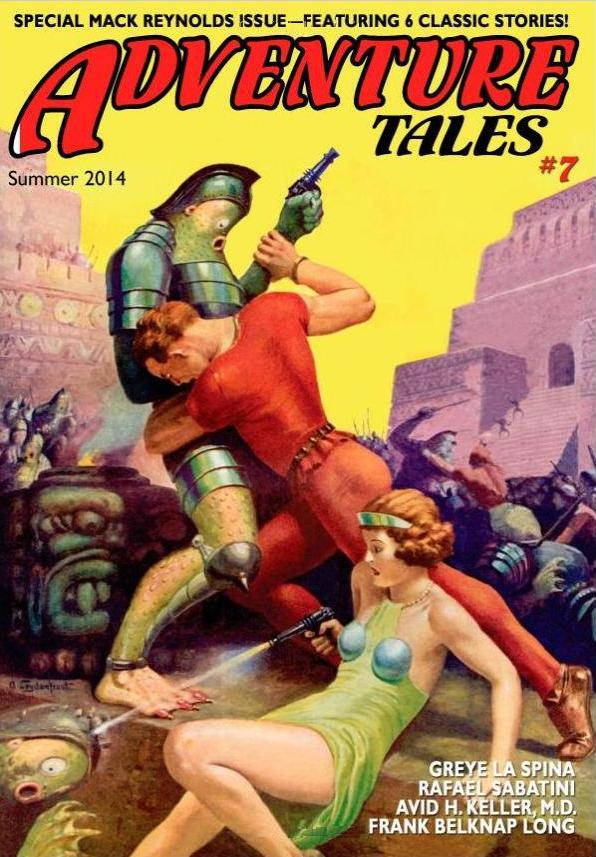
It starts with the cover, a reprint of my all-time favorite Planet Stories cover. I’ve always wanted to know who painted it — and I still don’t know, as the cover artist remains uncredited. (Maybe nobody knows? Sadly, that’s entirely possible.)

It’s been a long, long time since we’ve seen an issue of Adventure Tales, Wildside Press’s flagship magazine of pulp reprints. And speaking as a magazine publisher who thought he was doing well putting out one issue a year, that means something. Here’s an explanatory snippet from John Betancourt’s (anonymous) editorial:

We are, as usual, managing to keep to our “irregular” schedule with an issue that’s “only” 4 years in following the last one. Hopefully that won’t happen again. (Blame the economy… we’ve had to focus on things that actually make money, rather than the publisher’s time-consuming pulp-magazine hobby!)

I’m hugely appreciative of Wildside’s tireless efforts to keep countless genre authors — many of whom have no other outlet — constantly in print. But having said that. I still vote for more issues of Adventure Tales. Let’s hear it for time-consuming pulp-magazine hobbies! They make the world go round.

Read More Read More

Doug Draa on Weird Tales and Keeping the Brand Alive: The Paperback Years

Doug Draa on Weird Tales and Keeping the Brand Alive: The Paperback Years

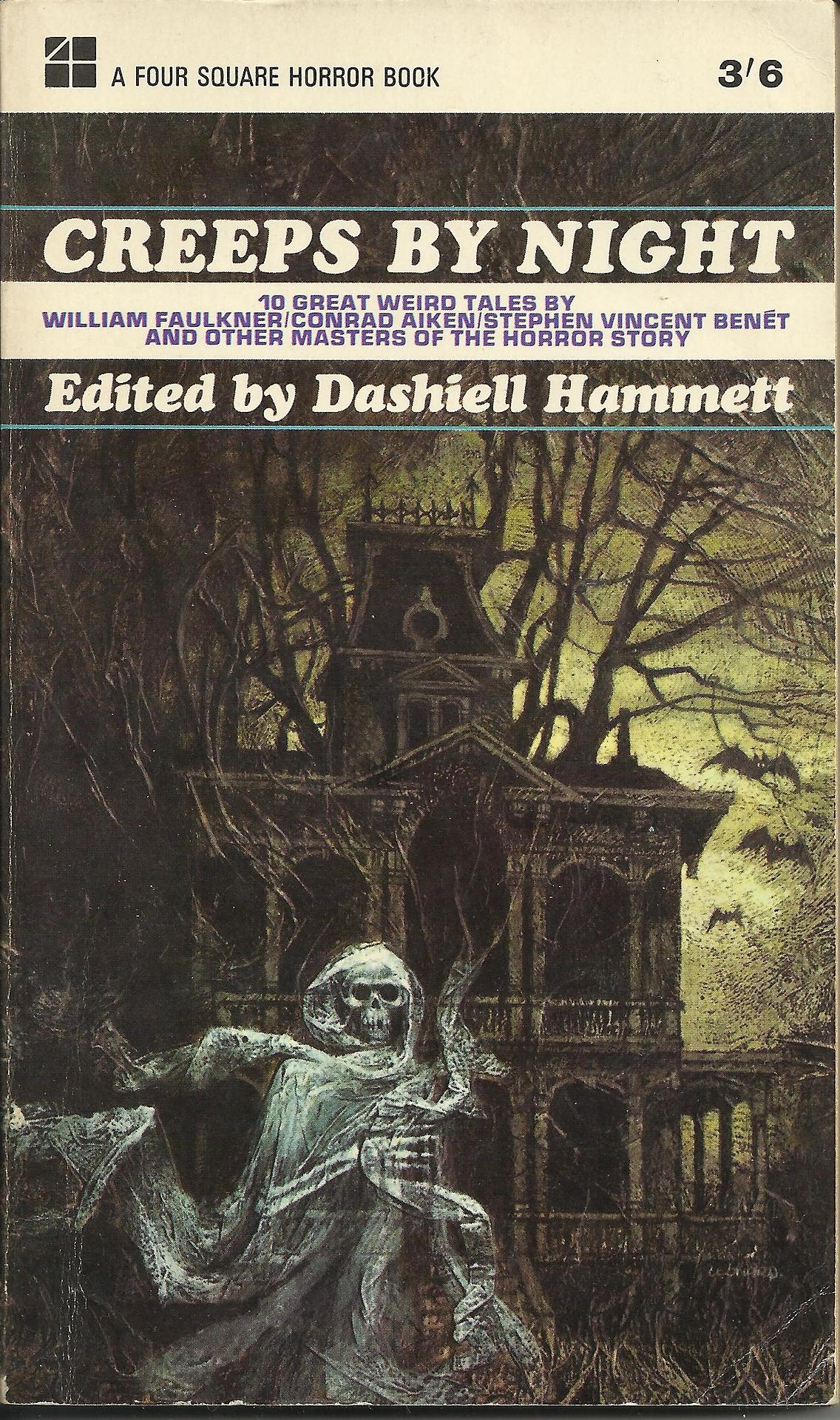
Creeps by Night-smallLong before Doug Draa became an occasional blogger for Black Gate, I was a reader of his blog, Uncle Doug’s Bunker of Horror, which we’ve celebrated before. I especially enjoyed his habit of using any excuse whatsoever — and I do mean any excuse — to post luscious high-res images of countless beautiful old paperbacks. Reading Uncle Doug’s Bunker was like browsing a superb used bookstore (without any money).

As Doug has become busier with other projects, including becoming an Online Editor for Weird Tales, he’s been less and less able to keep up his blog. So I was delighted to see that he’s now started to post at the Weird Tales site. His recent articles include “The 15 most entertaining Horror Films from the 1980s,” “Four Decades of the Lovecraftian Aesthetic in Paperback,” “Lin Carter’s Weird Tales” and more fun stuff like that (see a complete archive here.)

On May 25, Doug posted one of his best recent articles, continuing his series on 90 Years of Weird: Keeping the Brand Alive: The Paperback Years. Doug surveys three decades of paperback anthologies reprinting WT fiction, from the death of the pulp magazine in September 1954 through its rebirth in 1988, generously illustrated with nearly three-dozen high-res scans. Here’s a quick snippet:

Lin Carter has a special place among the ranks of Weird Tales preservationists and revivalists. During the late 1960s and early 70s he edited and reprinted many H. P. Lovecraft and Clark Ashton Smith collections as part of his Adult Fantasy Series published by Ballantine. Mr. Carter never failed to sing praises to Weird Tales from the roof tops in his numerous introductions to the collections in this series. At the beginning of the 1980s Mr. Carter even went as far as to revive Weird Tales in paperback format for four issues. This incarnation wasn’t a darling of the critics, but I found it to be enjoyable and true to the original vision of the magazine… Thank you Mr. Carter, I drink to your Shade!

See the complete article here.

Vintage Treasures: Weird Tales #290

Vintage Treasures: Weird Tales #290

Weird Tales 290-smallI’m still unpacking all the treasures I brought home from the 2014 Windy City Pulp & Paper show in April. Although, as my wife Alice points out, things would go a little faster if I didn’t fondle everything for 20 minutes.

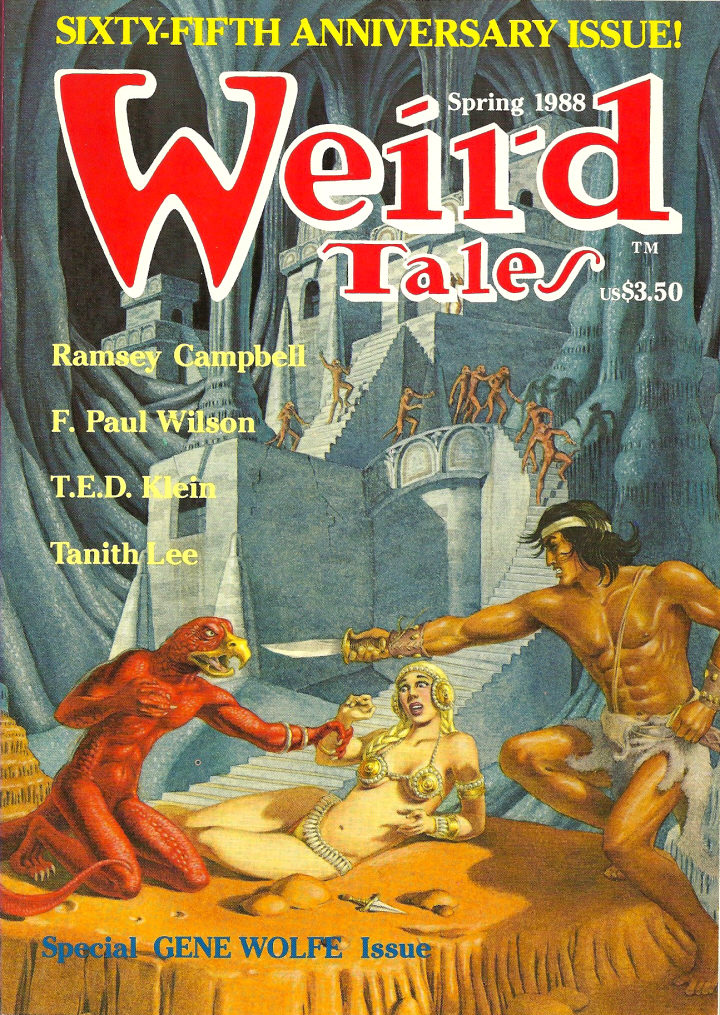
I found the artifact at right buried in a box of magazines and fanzines from the 70s and 80s I acquired at the show. It’s the 290th issue of Weird Tales, covered dated Spring 1988 — the Sixty-Fifth Anniversary issue, a landmark, and one of my favorite issues of perhaps the most famous fantasy magazine of all time.

Issue 290 was the first issue of Weird Tales from Terminus Publishing, under editors George H. Scithers, John Gregory Betancourt, and Darrell Schweitzer. It’s special to me because the Terminus era was my favorite incarnation of Weird Tales.

I suppose some folks will find that odd. Certainly the early pulp era of the Grand Old Lady of fantasy was its most fertile and famous period — the late 20s to mid-thirties, when it routinely published groundbreaking work by Robert E, Howard, H.P. Lovecraft, Clark Ashton Smith, Edmond Hamilton, and many, many others. Those issue are highly prized by collectors and key copies in good condition from that era routinely command hundreds of dollars.

But the Terminus years, which began in my mid-20s, marked the resurgence of Weird Tales as a vibrant, important and thoroughly modern fantasy magazine, publishing short fiction by the top fantasy writers of the time. It was also the first time I was able to enjoy it as a contemporary publication, rather than a highly collectible relic of a distant era, and I appreciated that very much. I had a subscription, and looked forward to each issue eagerly.

Read More Read More