Browsed by
Category: Magazines

Tom Reamy, the Iron Throne, and George R.R. Martin’s Plan to Stay Ahead of HBO: The Game of Thrones Issue of Vanity Fair

Tom Reamy, the Iron Throne, and George R.R. Martin’s Plan to Stay Ahead of HBO: The Game of Thrones Issue of Vanity Fair

Vanity Fair Game of Tthrones-smallYou know your HBO fantasy series has hit it big when it makes the cover of culture and fashion magazine Vanity Fair.

The April issue, on sale now, features a cast photoshoot by star photographer Annie Leibovitz and a feature on the making of the show written by Jim Windolf. But more interesting is a wide-ranging interview with author George R.R. Martin which covers, among other things, the true scale of the Iron Throne and Martin’s plan to stay ahead of the rapidly-progressing show.

The season that’s about to debut covers the second half of the third book… But there are two more books beyond that… A Dance with Dragons is itself a book that’s as big as A Storm of Swords. So there’s potentially three more seasons there, between [A Feast for Crows] and Dance, if they split into two the way they did [with Storms]. Now, Feast and Dance take place simultaneously… You can combine them and do it chronologically. And it’s my hope that they’ll do it that way and then, long before they catch up with me, I’ll have published The Winds of Winter, which’ll give me another couple years. It might be tight on the last book, A Dream of Spring, as they juggernaut forward.

I was also fascinated by his comments on the death of the brilliant Tom Reamy, whom we profiled in Black Gate 15:

Tom died of a heart attack just a few months after winning the award for best new writer in his field. He was found slumped over his typewriter, seven pages into a new story. Instant. Boom. Killed him… Tom’s death had a profound effect on me, because I was in my early thirties then. I’d been thinking, as I taught, well, I have all these stories that I want to write… and I have all the time in the world… and then Tom’s death happened, and I said, Boy. Maybe I don’t…

After Tom’s death, I said, “You know, I gotta try this. I don’t know if I can make a living as a full-time writer or not, but who knows how much time I have left?…” So I decided I would sell my house in Iowa and move to New Mexico. And I’ve never looked back.

Read the complete interview here.

March/April Magazine of Fantasy & Science Fiction now on Sale

March/April Magazine of Fantasy & Science Fiction now on Sale

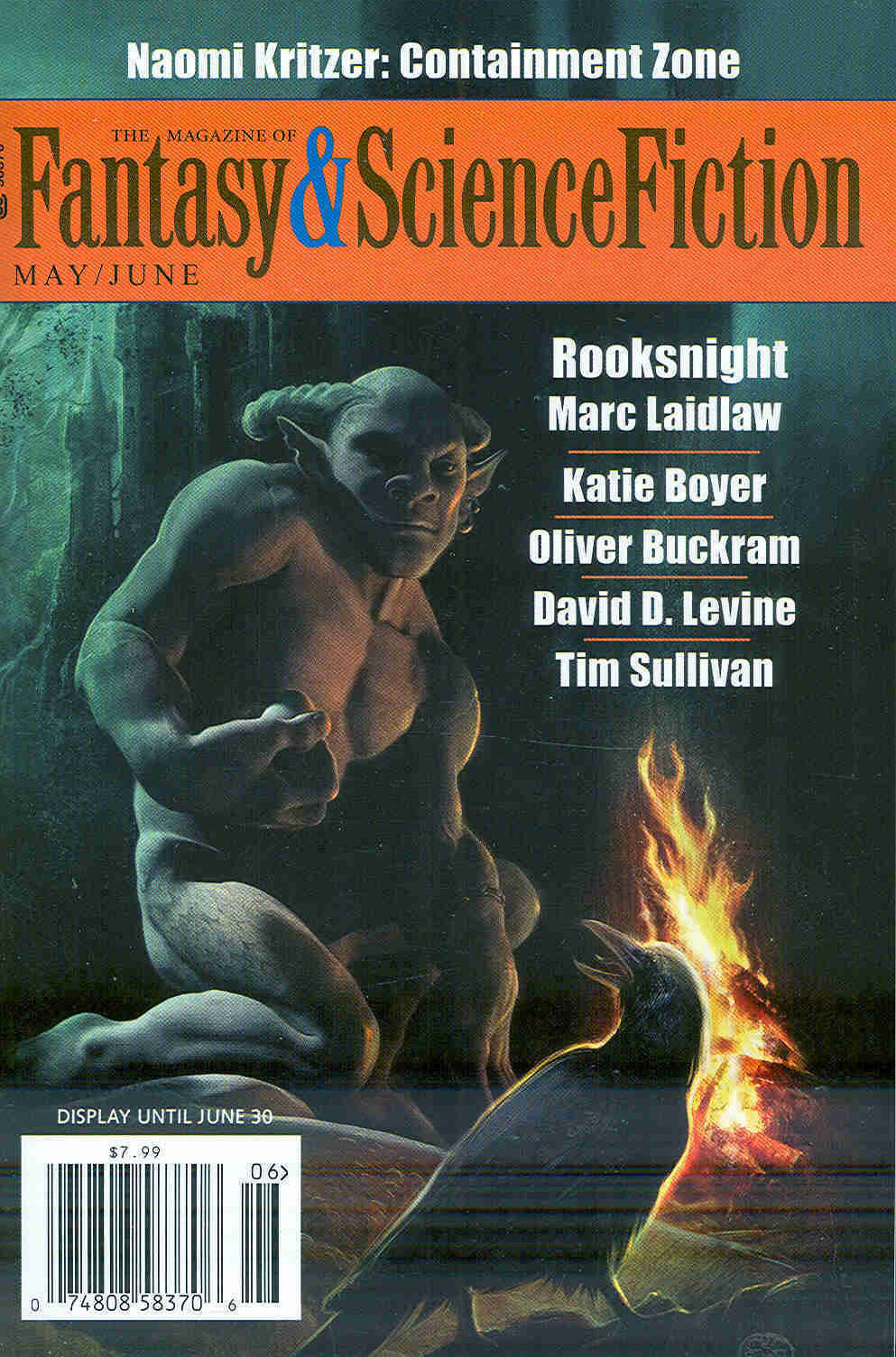
F&SF March April 2014-smallI’m so far behind reading Fantasy & Science Fiction. Seriously. I need to take a long vacation just so I can catch up.

Now, I know reading F&SF is ultimately a time-saver. When I did have time to keep up, it always pointed me towards the hottest new fantasy writers on the market. Believe me, considering all the bad fantasy novels I’ve read (or tried to read) in the last few years, if I’d just spent half that time reading F&SF, I would have known which writers to try instead.

Well, I suppose I’ll have a nice stack of magazines to read when I’m retired.

Jamie Lackey at Tangent Online is more disciplined than I am… not only has she read the latest issue, she had time to write a lengthy review. Here’s her thoughts on Sarah Pinsker’s contribution:

“A Stretch of Highway Two Lanes Wide” by Sarah Pinsker opens when Andy wakes after a farming accident to find that his arm has been replaced by a prosthetic. As he works at getting used to his new appendage, he realizes that the arm thinks that it’s a stretch of road in Colorado. It’s a unique concept, and the prose is beautiful. As Andy deals with his new arm’s sense of self, he also gains more understanding and acceptance of his own place in the world.

This issue contains stories by Gordon Eklund, Ron Goulart, Albert E. Cowdrey, Ted White, and many others.

Read More Read More

Monthly Short Story Roundup – February

Monthly Short Story Roundup – February

So February’s come and gone, a bunch of new stories have been published, and some were very good. With five stories from five different authors, it’d be an exciting month if I loved all of them, but at least there were more hits than misses.

oie_1122436ENJGqRjjLet’s start with the February issue of Curtis Ellett’s Swords and Sorcery Magazine. It’s Issue #25 and first of the magazine’s third year of publication. That’s over fifty stories published — fifty new works of heroic fiction out there for free! Lots of writers are getting to see their first published stories — some good, some fair, some poor — out in front of eyeballs and in position to get feedback.

Even if I sound like a broken record every month (Dad, what’s a record?), I can’t urge everybody enough to check this and the other web ‘zines out and let the editors and writers know what you think. This is how the genre will continue to grow and evolve. As readers, we can do our part by supporting these magazines and these writers.

Issue #25, is equal bits weak and and strong. First, the weak: “The Wedding Gift” by Neil W. Howell. It’s a story of the moments around the arrivals at the church of a royal bride and a royal groom, told from the perspectives of several different observers. There are the war veterans now serving as guards outside the church. Then there’s the embittered mother of the bride, a disappointed and defeated queen.

They and others weigh in on the events that have led to the wedding, which is really only a plan to end a generation-long war and unite two kingdoms in peace. Into this hopeful moment comes a terror that may or may not be an accident and leads to unforeseen conclusions.

Read More Read More

Galaxy Science Fiction, September 1951: A Retro-Review

Galaxy Science Fiction, September 1951: A Retro-Review

Galaxy Science Fiction September 1951-smallGalaxy concluded its first year of publication with this issue. Horace (H. L.) Gold notes some interesting stats in his opening remarks. He mentions that about 60 stories were selected from submissions of about 3,000. That’s a 2% acceptance rate, which is better than Duotrope reports for some professional magazines today.

Still, if you’re an author planning to travel back to 1951 to try your chances on getting into Galaxy, bear in mind that you’re up against some of the founders of science fiction. It’s you vs. Heinlein; you vs. Damon Knight. That might prove more difficult than inventing a time machine.

The Puppet Masters (Part 1 of 3) by Robert Heinlein — Slug-like aliens attach themselves to human hosts and take control of their minds. They begin an invasion by controlling key individuals, city by city, steadily working their way toward the President of the United States.

A government agency, led by the Old Man (as he’s called), works alongside two of his best agents, code-named Sam and Mary. The three of them try to capture a live specimen in order to learn more about the threat and to convince the President to quarantine vast areas of the country. But with so many controlled government leaders assuring the President that there is no danger, it seems impossible to defeat the puppet masters.

I’m familiar with this story from one of its movie adaptations. This story set a standard for parasite-controlling creatures. It’s a frightening concept, not too far from the notion of zombies; in both cases the individual is lost, reduced to involuntary responses.

Read More Read More

The Return of The SFWA Bulletin

The Return of The SFWA Bulletin

SFWA Bulletin 203-smallIt’s been a rough twelve months for The Science Fiction Writers of America Bulletin.

Early last year, issue #200 drew complaints for some generally tasteless remarks on female editors from columnists Mike Resnick and Barry Malzberg (and a cover that did nothing to allay concerns that SFWA was still presided over by an Old Guard unwelcoming to women). The problems compounded in later issues as Resnick and Malzberg mocked and trivialized those who raised the issue, and C.J. Henderson praised Barbie for maintaining “quiet dignity the way a woman should.” In June, editor Jean Rabe stepped down and the Bulletin went on hiatus.

Compounding the problem, the recent petition to protect the magazine from perceived censorship and the evils of political correctness put the spotlight back on the missing Bulletin. (And, naturally, in the midst of a fierce debate on whether sexism inside SFWA was a real issue, a member used the SFWA boards at SFF.Net to launch a sexist attack on ex-SWFA officer Mary Robinette Kowal.)

Now SFWA reports that the long-delayed issue 203 has gone to the printer. Guest-edited by Tansy Rayner Roberts, who was ably assisted by Production Editor Jaym Gates, this issue is described as “an outreach tool for conventions and other events.”

While Resnick and Malzberg are noticeably absent, the issue does contain interviews with Eileen Gunn, Adam Rakunas and 2013′s Norton winner E.C. Myers, and contributions from Sheila Finch, Richard Dansky, James Patrick Kelly, Cat Rambo, Ari Asercion, Michael Capobianco, Russell Davis, M.C.A. Hogarth, Nancy Holder, and Erin Underwood, and many others.

Read More Read More

Ares Magazine Kickstarter Succeeds!

Ares Magazine Kickstarter Succeeds!

Ares Magazine Issue 1-smallRecently, I wrote about the Rebirth of Ares Magazine. Earlier this month, they wrapped up a successful Kickstarter campaign, raising $26,185, or 105% of their goal.

Now, they’re moving forward to deliver their premiere issue in May.  The issue will contain the complete two-player game War of the Worlds, designed by Bill Banks, and a nice mix of intriguing articles, including:

  • Asimov’s Last Gasp – A discussion on Robotics and Ethics
  • The Queen’s Guard – High Fantasy in the land of Hadera
  • BattleChrome – Mechs, Techs, and Wrecks
  • Sarita’s Gambit – Star Fury Fiction

along with three short stories, interviews, ads, and other content.

Ares is inspired by the classic Ares Magazine, published by SPI between 1980 and 1984. It included a complete SF or fantasy game in every issue, including Greg Costikyan’s classic Barbarian Kings and Citadel of Blood; The High Crusade, based on Poul Anderson’s 1960 novel of interstellar conquest on horseback; The Wreck of the B.S.M. Pandora; Nightmare House; The Omega War; and nearly a dozen others.

The issue will be 80 pages in full-size (8.5″ x 11″) format; future bi-monthly issues are already in the works. Keep up on the latest news on their website.

Congratulations, Ares!

Monthly Short Story Roundup – January

Monthly Short Story Roundup – January

oie_113212RNKI9Hm5Well, it’s that time again, and here I am with another batch of new heroic fantasy and S&S short fiction reviews.

Nothing outside of Swords and Sorcery Magazine and Heroic Fantasy Quarterly caught my eye this past month and the stories they offered are the usual mixed bag, varying in quality from mid-range to very good. In a perfect world, some of these writers could make a living just writing short stories.

I love short stories. Growing up, a large part of my genre reading was made up of anthologies from brilliant editors like Lin Carter and Terry Carr. Their short (by contemporary standards) volumes introduced me to dozens of great authors, established and new.

oie_114255fABYaSsMIn Lin Carter’s The Year’s Best Fantasy Stories: 2, for example, the authors ranged from Tanith Lee and Fritz Leiber to Caradoc Cador and Paul Spenser. If one story stunk, there was a very good chance the next one wouldn’t. It was a rare anthology that had nothing to offer.

I’m not saying anything new when I say a ten- or fifteen-page story can be as powerful as a novel. I’d recommend Harlan Ellison’s “I Have No Mouth and I Must Scream” to anyone doubting that. As for excitement, how many five pound books can match the urgency and ferocity of Robert E. Howard’s “Beyond the Black River”? Sure, there are times I enjoy being swept up in a six- or seven-hundred page book, but I’d mostly rather read twenty or thirty good individual tales. When the rare new heroic fiction story collection comes along, like Strahan and Anders’ Swords & Dark Magic or Davis and Saunders’ Griots, I don’t hesitate to toss it in my Amazon cart.

And that’s why I love the various magazines (and the work their editors do each issue). Just counting Beneath Ceaseless Skies and Swords and Sorcery Magazine, I’m guaranteed at least six new stories a month. In the months Heroic Fantasy Quarterly is published, that’s an additional four or more.

Over the course of a year, that’s a lot more stories than even Lin Carter edited together in the same amount of time. Which makes me a very happy fan.

Read More Read More

Voices in Fantasy Literature, Part III

Voices in Fantasy Literature, Part III

Sir_Hereward_and_Mister_Fitz_by_Garth_Nix_200_294This is the third installment in a series of posts highlighting fantasy short fiction (here are Part I and Part II).

Over the course of the last eight years, I’ve read or listened to a lot of short fiction and the variety out there is astonishing. And I love to try to introduce new readers to some of the stuff that impressed me. This week, the three stories I picked were by Garth Nix, Nancy Hightower, and Daniel Abraham.

“Hereward and Mr Fitz Go To War Again,” by Garth Nix, appeared originally in Jim Baen’s Universe,  then in Podcastle (where I heard it), and then in a collection by Subterranean Press (ebook available here). This is one of three Sir Hereward and Mister Fitz stories I heard and I absolutely fell in love with the weird swashbuckling world Nix created.

Hereward is a knight, artillerist, and swordsman, as able with gunpowder as with the blade. Fitz is an animated wooden puppet and dangerous sorcerer, whose sorcery is structured around sewing and knitting, with his accouterments being needles, thread, and sometimes a portable sewing desk. Their job is to enforce a treaty against rogue gods that is so old that some of the nations to the treaty no longer exist.

This is pure buddy picture story, a grand adventures against old gods. Loads of fun and the Sir Hereward and Mister Fitz stories are now available as an ebook, so no reason not to check it out.

Read More Read More

Gygax Magazine #3 Now Available

Gygax Magazine #3 Now Available

Gygax Magazine 3-smallWhen the last game shop in town went out of business six years ago, I lost the ability to easily browse the latest new releases, and keep up with what’s going on in the industry. Sure, Games Plus in Mount Prospect– one of the finest game shops on the planet — is still in business and thriving, but it’s a good hour away, and I don’t get there more than two or three times a year (although I never miss their semi-annual auction).

One of the things I miss the most is the magazine section. Nothing makes you feel your hobby is vibrant and alive quite like a healthy ecosystem of periodicals. I really enjoyed standing in front of the magazine rack and pulling out the latest issue of Knights of the Dinner Table, Kobold Quarterly, the excellent KnockSpell, Games Workshop’s  White Dwarf, or Troll Lord’s The Crusader.

The loss of so many local game shops has really hurt gaming magazines — we lost Kobold Quarterly in 2012 and Mythmere has announced the future of Knockspell is in doubt. That’s one of the reasons I was so delighted to hear about the launch of the very promising Gygax Magazine last year.

I reviewed the first issue last March and I was very impressed. Issue #2 was released in time for Gen Con, and I’ve been anxiously awaiting the third issue for some time… and wondering how I was going to find a copy.

My wait finally ended last week, compliments of a Priority Mail package from our San Diego correspondent and ace blogger Scott Taylor — who late last year was hired as the new Art Director for the magazine. Inside was a beautiful copy of Gygax Magazine #3, the first issue with his name on the masthead.

Read More Read More

Galaxy Science Fiction, August 1951: A Retro-Review

Galaxy Science Fiction, August 1951: A Retro-Review

Galaxy Science Fiction August 1951-smallSometimes when I look at the table of contents for Galaxy, I can almost hear Horace Gold chuckling. In the August, 1951 issue, for example, there are stories from both Lester del Rey and Ray Bradbury. But every issue is full of talented authors, though some became more famous with the passage of time. I think it would be a struggle to compete against such a formidable magazine.

“Beyond Bedlam” by Wyman Guin — Everyone in society has Multiple Personality Disorder with two strong personalities. The treatment is to allow each personality to live on its own for five days at a time, and the rules of society forbid interacting with the worlds of one’s own alternate personality. Each personality has its own name, its own job, its own spouse. Yet in the case of Bill and Conrad, who share a single body, their wives are within the same physical body. Bill’s curiosity leads him into an interaction with Conrad’s wife, and over time, it develops into an affair — something that the Medicorps would deal with severely if they found out.

Guin mistakenly uses the term schizophrenia throughout the piece, but there has been confusion between that and Multiple Personality Disorder for decades, so it’s easily ignored. This is really an amazing story — highly imaginative and suspenseful. It pulled me along quickly and I couldn’t tell where it would go; I just knew I wanted to find out. This was my favorite piece in the issue.

“Operation Distress” by Lester del Rey — During his return trip from Mars, Bill Adams notices a rash on his hands. It quickly spreads, and he’s denied clearance to land on Earth. Instead, he’s ordered to land on the moon, where a dedicated, risk-taking physician will assess his health. If Bill’s carrying a new disease, it will likely kill both men.

One curiosity beyond the story: the byline had a typo of Lester del Ray. Oops. The logistics within the story felt very realistic. It’s well-written with a nice pace. And it’s interesting that a story with such a dire plot can have a genuine, light-hearted ending.

Read More Read More