Browsed by
Category: Series Fantasy

Peter Watts’ Rifters Trilogy

Peter Watts’ Rifters Trilogy

StarfishUsually I write here about books I’ve read and enjoyed. It’s really quite selfish: thinking about a good book extends the pleasure I get from reading it. This post, though, is a little different. I’m going to write about a science fiction trilogy in order to work out why I don’t like it more than I do. These are good books, even excellent books. But something about them didn’t grip me the way I would have thought they might.

The books are Peter Watts’ Rifters trilogy: Starfish, Maelstrom, and ßehemoth (that’s a Greek beta at the start of the last; for ease of typing, I’ll stick with the English B from here out). Starfish was Watts’ first novel, published in 1999, and Maelstrom followed two years later. Behemoth was split into two volumes for print publication; B-Max (Betamax, I suppose) was published in 2004, Seppuku in 2005. All these books are available for free on Watts’ web site.

They’re extremely well-written. The plot’s tight and fast-moving, the characters are multilayered, and the prose is both concise and, when it needs to be, beautiful. And they’ve got some potent themes, about power and science and the nature of humanity. I came away from them very impressed. And also somehow dissatisfied, for no reason I could put a finger on. So I will write about them here, and see if I can articulate for my own satisfaction what it was that I missed, and whether it was something in the books or something in myself in as a reader.

Read More Read More

Drizzt Do’Urden Simply Won’t Stop Adventuring: Myke Cole on Learning to Love Serial Fantasy

Drizzt Do’Urden Simply Won’t Stop Adventuring: Myke Cole on Learning to Love Serial Fantasy

Gemini Cell-smallMy name is Myke Cole, and I have a hard time with serial fantasy.

Yes, that’s right, I’m admitting it right up front. I’m wading into the hornet’s nest and making my confession.

More than three books in a series and I start to nod off. At five, you’ve pretty much lost me. It’s happened to me again and again and again. In A Song of Ice and Fire, I honestly don’t really care what happens after Dance. I followed Bernard Cornwell’s Richard Sharp through twelve books before I finally decided that, no matter how awesome his further adventures might be, I couldn’t get excited about them. Daniel Abraham’s The Widow’s House is the fourth book in his absolutely stunning Dagger and Coin series, and I know I’ll get to it… eventually.

It’s happened to me time and again with comic book series. Fables, Hundred Bullets, Sandman and on and on and on. I reach a point 5 or 6 or 10 trades in where I just sort of throw up my hands.

And all of the above examples are for good books. The kind of books that resonate and transport, the kind of books that make you want to give up writing because you’ll never be in the same league as that author.

For years, I’ve hid my head in the company of other fans, bit my tongue and kept my opinions to myself. Because Brandon Sanderson wound up rounding out The Wheel of Time series at fourteen books. Because Drizzt Do’Urden simply won’t stop adventuring, because fans LOVE long serials.

Read More Read More

Dave Duncan’s The Great Game

Dave Duncan’s The Great Game

duncan past Connor Gormley wrote a post not long ago in which he discussed the seeming sameness of the current state of Fantasy. That the genre which should be most imaginative showed a singular lack of imagination, or flexibility might be a better word, in its choice of settings and characters. The comments give you a pretty good idea of how people agreed or disagreed with his thesis, and the whole post is well worth looking at. I think what it did for a lot of people, however, is remind them of books they’ve read that aren’t cloyed down with the sameness of things.

In my case, I was reminded specifically of Dave Duncan’s work. I’ve mentioned his Alchemist Novels in discussing fantasy mysteries, and one day I’d like discuss the brilliant West of January in more detail, but at the moment I want to introduce you to the trilogy The Great Game, made up of Past Imperative, Present Tense, and Future Indefinite.

At first glance it seems we’re being dealt a typical stranger-in-a-strange land trope, but as is so often the case with Duncan, the first glance is all you get for free. I think it’s safe to say that whatever you think Duncan’s up to, it’s very seldom what’s going on.

Part Imperative begin with two apparently unconnected storylines, or rather, we assume they are connected – not being entirely new to this game ourselves – but we aren’t shown how until much farther into the narrative than we’d expect. An epigraph does give us a broad hint, but honestly, it’s very easy to overlook. I have a theory that fewer than half of all readers actually read epigraphs, even the ones at the beginning of chapters, but that’s neither here nor there – which, come to think of it, pretty much describes the position of Duncan’s characters.

Read More Read More

New Treasures: The Dark Defiles by Richard K. Morgan

New Treasures: The Dark Defiles by Richard K. Morgan

The Dark Defiles-smallI can’t read all the fantasy books out there. I can’t even read all the really great stuff. Fortunately, I’m surrounded by a superb team of reviewers who keep me on top of things.

When Richard K. Morgan published his highly acclaimed first fantasy novel back in 2009, I totally missed it. But John C. Hocking didn’t, and in his review in Black Gate 13 he called it:

One of the most unusual, powerful, and daring sword & sorcery novels to see print for decades… The Steel Remains follows a trio of characters, each of whom played a dramatic part in humanity’s grim battle with the Scaled Folk — reptilian invaders from the sea, defeated several years past… As the three heroes are slowly drawn back together, a threat older and even more alien than the Scaled Folk moves into the world. Ringil and his friends will meet it with steel.

A sequel, The Cold Commands, followed in 2011, introducing the dark prophecy of the Illwrack Changeling, a boy raised to manhood in a ghostly between-world realm, whose return would be catastrophic for the fragile land. And late last year the final novel in what’s now being called a trilogy finally arrived. As the world teeters towards another war with the dragon folk, Ringil and his companions find the prophecy of a dark lord may be coming true very close to home.

Here’s the publisher’s description for The Dark Defiles, the closing volume of Land Fit for Heroes.

Read More Read More

It’s Good to be Minding the Stars with The Early Jack Vance, Volume Four, edited by Terry Dowling and Jonathan Strahan

It’s Good to be Minding the Stars with The Early Jack Vance, Volume Four, edited by Terry Dowling and Jonathan Strahan

Minding the Stars The Early Jack Vance Volume 4-smallI’ve been heartily enjoying The Early Jack Vance volumes from Subterranean Press, which collect the hard-to-find early pulp SF and fantasy from one of the greatest writers of the genre, Jack Vance.

The first two, Hard Luck Diggings (2010) and Dream Castles (2012), are now sold out and out of print — and rapidly raising in price. They collected fiction from the very start of Vance’s career, the late 40s through the late 60s.

Two more volumes are now in print, with one more due in March. Minding the Stars, the fourth volume, spans the years from 1952 to 1967, collecting four long novellas and four short stories, originally published in Astounding Science Fiction, Future Science Fiction, Fantastic Universe, Amazing Stories, and other fine publications. Here’s the complete table of contents:

Introduction by Terry Dowling and Jonathan Strahan
“Nopalgarth” (Originally published as The Brains of Earth, Ace Double, 1966)
“Telek” (Astounding Science Fiction, January 1952)
“Four Hundred Blackbirds” (Future Science Fiction, July 1953)
“Alfred’s Ark” (New Worlds SF, May 1965)
“Meet Miss Universe” (Fantastic Universe, March 1955)
“The World Between” (Future Science Fiction, May 1953)
“Milton Hack from Zodiac” (Amazing Stories, August 1967)
“Parapsyche” (Amazing Science Fiction Stories, August 1958)

The opening story, “Nopalgarth,” was originally published as half of an Ace Double in 1966, under the title The Brains of Earth. Vance collectors may recognize it as one of three novellas published in a slender collection from DAW in September 1980, under the title Nopalgarth (see below).

Read More Read More

My Overly Conscious Love for Pathfinder

My Overly Conscious Love for Pathfinder

Pathfinder Tales Stalking the BeastLately I’ve been reading a fair amount of Pathfinder novels. Partly this is because I want to play Pathfinder and have no one with whom to play it, because all of my adult friends who are so inclined live too far away, and my children and I just aren’t in the same frame of mind. (Roleplaying with a fourteen-year-old and a twelve-year-old is challenging, simply because logic, for all involved, works a little differently. For this audience, a straightforward dungeon crawl, like Fantasy Flight’s Descent, is a more viable option, but, with that, you don’t get enough freedom for story creation and character generation.)

Another reason I have been reading Pathfinder novels is because my oldest son has started reading them. If I read them as well, we can inhabit a shared text (and perhaps, in time, a satisfying Pathfinder gaming session).

And yet another reason why I have been reading Pathfinder novels is because they’re good.

This was announced not too long ago, at least in reference to Howard Andrew Jones’s Stalking the Beast, when Nick Ozment realized that that novel was “better than it needed to be.” I’ve read some Pathfinder novels by other writers as well, and I will say that most of them are quite good.

Nick made clear why he found Jones’s second novel for the franchise so good, but what do I mean when I say that, in general, I like the series? I will say that they are highly satisfying Sword and Sorcery novels. They are entertaining. They are escapist. They have cool things in them. And, above all, they are quite familiar. They are based on the 3.5 (or 3.75) edition of Dungeons & Dragons, after all.

Read More Read More

New Treasures: For a Few Souls More by Guy Adams

New Treasures: For a Few Souls More by Guy Adams

For a Few Souls More-smallI’ve been waiting for the conclusion of Guy Adams’s Heaven’s Gate trilogy since the first installment, The Good The Bad and the Infernal, appeared in March 2013. The second volume, Once Upon a Time in Hell, was published almost exactly a year ago. It’s a gonzo Weird Western with demons, supernatural cowboys, and steampunk Indians.

In the third and final volume, For a Few Souls More, Heaven has fallen to Earth, joining the Union as the 43rd state… and the President sets out for the legendary town of Wormwood, the traveling community which appears once every hundred years for a single day.

The uprising in Heaven is at an end and Paradise has fallen, becoming the forty-third state of America. Now angels and demons must learn to get along with humans.

The rest of the world is in uproar. How can America claim the afterlife as its own? It’s certainly going to try as the President sets out for the town of Wormwood for talks with its governor, the man they call Lucifer.

Hell has problems of its own. There’s a new evangelist walking its roads, trying to bring the penitent to paradise, and a new power is rising. Can anyone stand up to the Godkiller?

For a Few Souls More was published on December 30, 2014 by Solaris. It is 316 pages, priced at $7.99 in paperback and $6.99 for the digital edition. The cover is by Jake Murray.

The Public Life of Sherlock Holmes: Pratchett’s Cohen the Barbarian

The Public Life of Sherlock Holmes: Pratchett’s Cohen the Barbarian

Cohen_CohenI am an unabashed fan of Terry Pratchett’s Discworld books. Along with a lot of Carl Hiassen’s work, they are the only reads that cause me to laugh out loud. Unseen Academicals was the first Discworld book that I wasn’t really happy with when I finished it; which isn’t too bad considering it was the thirty-third in the series for me.

Though I have a very fundamental difference with Pratchett’s basic worldview, I think he is an absolutely brilliant satirist. Discworld isn’t nearly as well known generally as The Hitchhiker’s Guides to the Galaxy books, but I tell folks that if you like Douglas Adams, you should like Terry Pratchett.

Genghiz Cohen, better known as Cohen the Barbarian, appears in a few novels. He is Discworld’s greatest warrior, though now he is an old man in his late eighties or nineties, and he leads a band of senior citizen barbarians known as the Silver Horde.

Cohen/Conan. The Silver Horde/The Golden Horde. See? Get it? Discworld is full of this stuff.

Cohen is a skinny old man with a long white beard, a patch over one eye and a dirty loincloth. He has a set of dentures made from Troll teeth, which are pretty much the only things he has left from a wild life.

Read More Read More

The Series Series: The Wide World’s End by James Enge

The Series Series: The Wide World’s End by James Enge

The Wide World's End-smallYou have something wonderful to look forward to in February, and it’s sort of the opposite of Valentine’s Day.  The third volume of James Enge’s Tournament of Shadows trilogy, The Wide World’s End, is coming out, and it’s every bit as strange and glorious as Enge’s novels have all been so far, with an extra dimension of heartbreak.

Because it’s a tragedy. Not the schoolroom mountain-diagram tragedy plot here, not the victim-blaming hubris explanation, but a fresher, more original kind of tragedy. (Fortunately, the tragedy is leavened by Enge’s usual black humor, numerous inventively disturbing monsters, clever magical technologies, and crackling dialogue.)

What’s tragic about Morlock is that the very things that make him so genuinely excellent, so uniquely able to save his world, are the very things that make it impossible for him to go home again. And that includes the great love between him and his wife.

The author and publisher have been completely forthright about that. The cover copy tells us even the happiest available ending on the cosmic scale will be a disaster on the personal scale.

Read More Read More

Vintage Treasures: Strange Cargo by Jeffrey E. Barlough

Vintage Treasures: Strange Cargo by Jeffrey E. Barlough

Strange Cargo Jeffrey E. Barlough-smallI didn’t know quite what to make of Strange Cargo when I received a review copy over a decade ago. The cover grabbed my attention immediately, as did the synopsis, but I didn’t immediately realize it was part of Jeffrey E. Barlough’s ongoing Western Lights series, set in a world where the Ice Age never ended and only a narrow sliver of civilization survives along the Pacific American coastline.

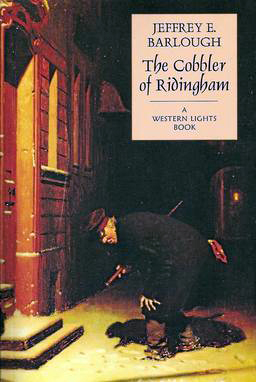
The vast majority of review copies I received a decade ago are already long forgotten. But Barlough’s fame has steadily grown as Western Lights, a delightful series in which Victorian society exists alongside saber-toothed cats and woolly mammoths, continues to attract new readers. Strange Cargo was the third volume, following Dark Sleeper and The House in the High Wood; the most recent are What I Found at Hoole and The Cobbler of Ridingham.

Something wicked this way comes…

Nantle is the destination for the wealthy Cargo family. A mysterious heir has been named in their grandfather’s will — and they have traveled a long way by sea to find him.

Mr. Tim Christmas journeys as part of his apprenticeship, seeking the mechanism behind a strange set of seemingly magical stones. On her twenty-first birthday, Miss Wastefield is given an odd gift, which she keeps locked up in a giant chest at all times — a keeping place from which she receives dire threats. In Nantle, she hopes to find the one man who can rid her of this evil.

It is in this old cathedral city that their paths will converge. And where they will find themselves at the mercy of a mighty and vengeful power.

Strange Cargo was published by Ace Books on August 3, 2004. It is 481 pages, priced at $14.95 in trade paperback. It has never been reprinted and it currently out of print; there is no digital edition. The cover is by Gregory Bridges.