Browsed by
Category: Books

Deepest, Darkest Eden: Return to Hyperborea
Deepest, Darkest Eden: Return to Hyperborea

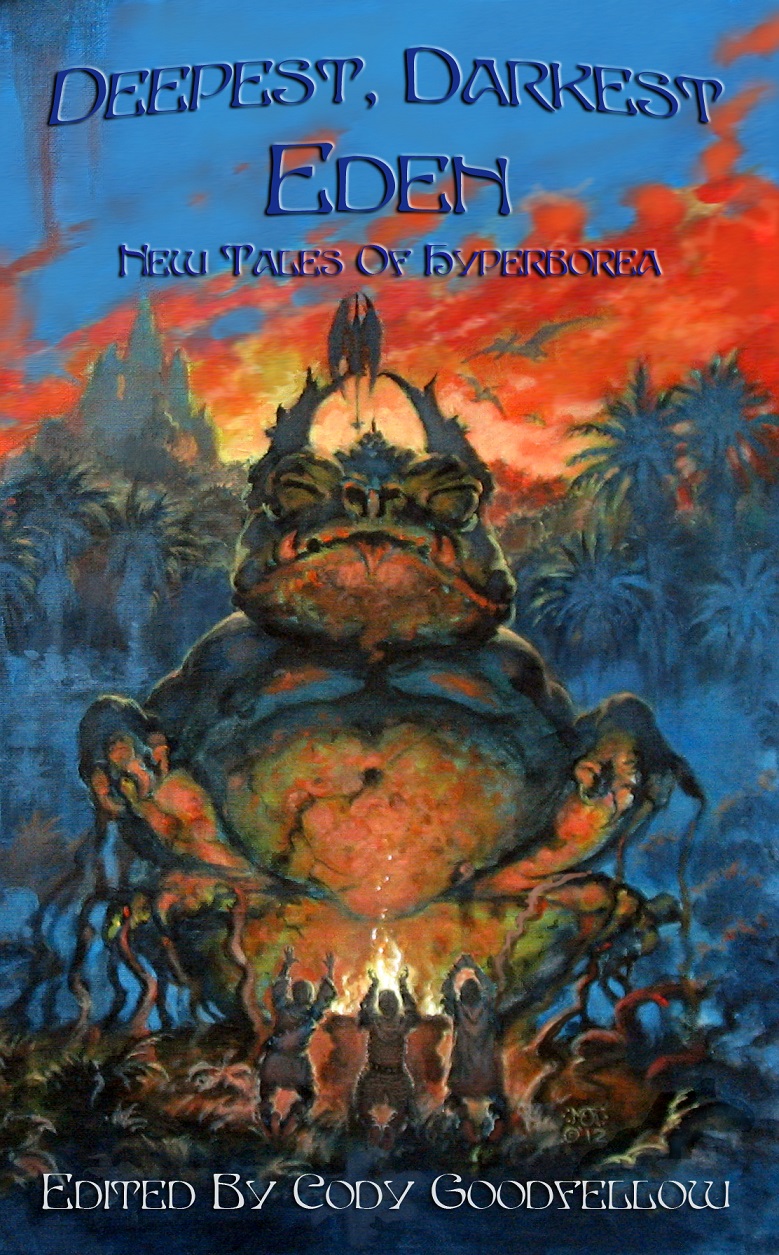
HyperboreaCoverDEEPEST, DARKEST EDEN: New Tales of Hyperborea is a new fantasy anthology from Miskatonic River Press. Editor Cody Goodfellow has assembled 17 stories (and two poems) set in the primordial world of Clark Ashton Smith‘s Hyperborea.

Although it officially launches this month at the Rhode Island NecronomiCon, the book is available right now through Amazon. Here is the Table of Contents:

Nick Mamatas – “Hostage”
Joe Pulver – “To Walk Night…Alone”
Darrell Schweitzer – “In Old Commoriom”
Ann K. Schwader – “Yhoundeh Fades” (poem)
Cody Goodfellow – “Coil Of The Ouroboros”
John R. Fultz – “Daughter Of The Elk Goddess”
Brian R. Sammons – “The Darkness Below”
Dieter Meier – “The Conquest Of Rhizopium”
Lisa Morton – “Zolamin And The Mad God”
Brian Stableford – “The Lost Archetype”
Ran Cartwright – “One Last Task For Athammaus”
Don Webb – “The Beauties Of Polarion”
Robert M. Price – “The Debt Owed Abhoth”
Marc Laidlaw – “The Frigid Ilk Of Sarn Kathool”
Charles Schneider – “The Return Of The Crystal”
John Shirley – “Rodney LaSalle Has A Job Waiting in Commoriom”
Zak Jarvis – “The Winter Of Atiradarinsept ”
Jesse Bullington – “The Door From Earth”
Ann K. Schwader – “Weird Of The White Sybil” (poem)

Most of Smith’s original Hyperborean tales ran in WEIRD TALES in the 1930s. They featured lost cities, haunted jungles, strange sorcery, and terrible demon-gods such as Tsathoggua and Abhoth. His entire cycle of these tales was gathered into a single volume first in 1971’s HYPERBOREA from Ballantine Books, then again in 1996 for THE BOOK OF HYPERBOREA from Necronomicon Press.

(See the entire wrap-around cover after the jump…)
Read More Read More

Vintage Treasures: The Best of Edmond Hamilton

Vintage Treasures: The Best of Edmond Hamilton

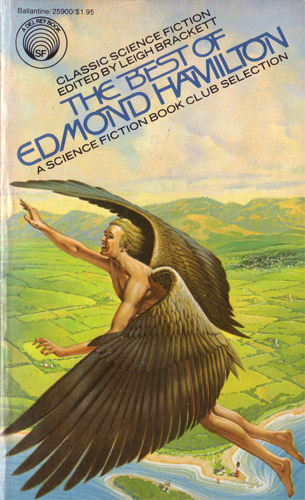
The Best Of Edmond Hamilton-smallEdmond Hamilton is my favorite pulp writer and he has been since I read the chilling short story “The Man Who Evolved” in Before the Golden Age. (Read the complete story online at The Nostalgia League.)

That’s a long time, especially considering how many pulp tales I’ve read in the intervening years. But Hamilton had a lengthy and productive career — he was one of the few writers to survive both the coming of Campbell, who ushered in the Golden Age of Science Fiction, and the death of pulps more than a decade later.

Hamilton’s first published story, “The Monster-God of Mamurth,” appeared in the August 1926 issue of Weird Tales. It was a fully realized tale of eldritch horror, following the exploits of a group of explorers who discover a legendary lost city in the desert and the sinister spider-things who inhabit it still.

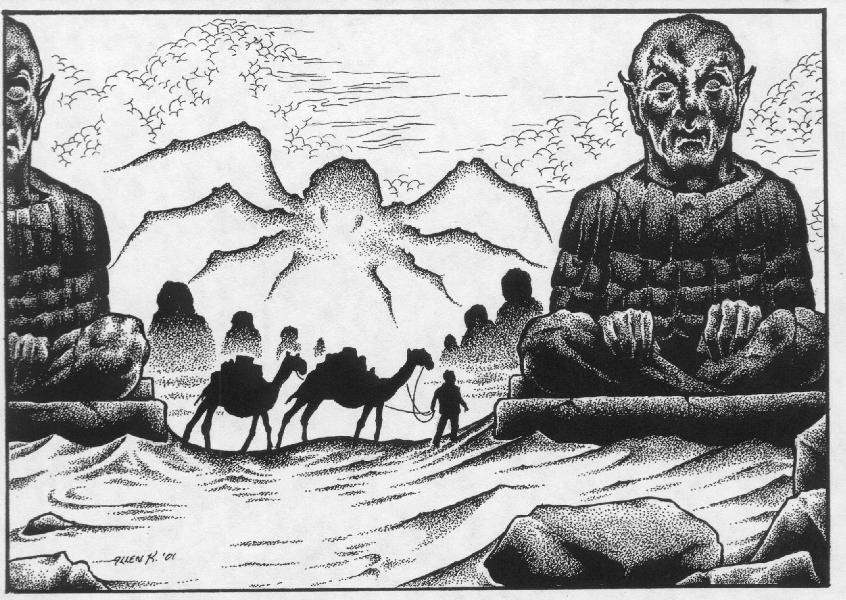
When we began including reprints in the print version of Black Gate, “The Monster-God of Mamurth” was the second one we chose, and it appeared in BG 2, with all-original art by Allen Koszowski (see one of the magnificently creepy illos he did for us here).

Hamilton quickly became one of Weird Tales‘ most popular and prolific writers, appearing alongside H. P. Lovecraft and Robert E. Howard. All told he sold 79 stories to Farnsworth Wright and the magazine’s later editors between 1926 and 1948; only Seabury Quinn and August Derleth appeared more often in the magazine’s pages.

According to his ISFDB page, Hamilton wrote exactly 200 short stories for the magazines between 1926 and his death in 1977. He appeared in virtually all the science fiction and fantasy pulps, including Air Wonder Stories, Wonder Stories, Thrilling WonderSuper Science Stories, Amazing Stories, Fantastic Science Fiction, and many others.

Read More Read More

Animal Stories: Johanna Sinisalo’s Troll: A Love Story

Animal Stories: Johanna Sinisalo’s Troll: A Love Story

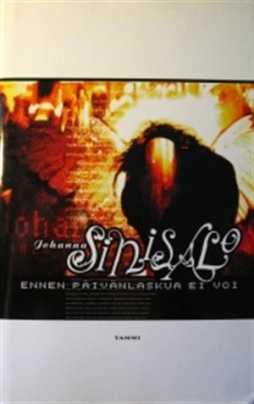
Ennen päivänlaskua ei voiA few years ago, a cat came to live with me under unexpected circumstances. (This is getting around to a look at a fantasy novel, and no the novel has nothing to do with cats as such, and yes I have a point.) I’d never had a pet when I was young, so I suddenly found myself dealing with a new range of experiences and emotions; and found also that the depictions in most media of relationships between pets and their humans were notably lacking. There’s a complexity of living with, and to an extent being responsible for, a non-human animal. You have to learn about (and sometimes worry about) diet and medical needs and what certain behaviour patterns mean. You have to learn how to communicate with a creature that does not use words — but which may be surprisingly good at understanding emotions in a voice. These sort of things are rarely shown in most stories about humans and animals, but they’re a crucial part of the experience of dealing with a pet.
Which brings me around to Johanna Sinisalo’s book Ennen päivänlaskua ei voi, a Finnish book translated into English in 2003 by Peter Owen as Not Before Sundown and then again the same year by Herbert Lomas as Troll: A Love Story. The book won the 2000 Finlandia Prize for best novel written by a Finnish citizen and was one of the winners of the 2004 Tiptree Award, apparently in the Owen translation. I read the Lomas version, and was impressed by the prose and structure, by the book’s conceptual flexibility and symbolic heft, and by Sinisalo’s depiction of a man coming to learn to live with an inhuman creature — specifically, a troll. It’s not quite a ‘pet’ in the sense of a domesticated animal, and the relationship between man and troll is certainly different than that of the usual human and pet. But some of what the main human character feels and does is recognisable to me as somebody who lives with a cat.

And I think that kind of relationship informs the basic theme of the book: otherness and the things one person projects on another. Sinisalo’s book acknowledges that the most profoundly ‘other’ creatures around us are the animals we call ‘pets.’ They are adopted members of our families; but do not share the biology that makes us what we are, and that shapes how a human thinks. Their thought processes are alien to us. We try to understand them, we think we come to know them, but for all our good intentions probably still can’t help but project ourselves onto them. That tendency to project fears, hopes, and narratives onto others is I think what drives Sinisalo’s book.

Read More Read More

New Treasures: Walking in the Midst of Fire

New Treasures: Walking in the Midst of Fire

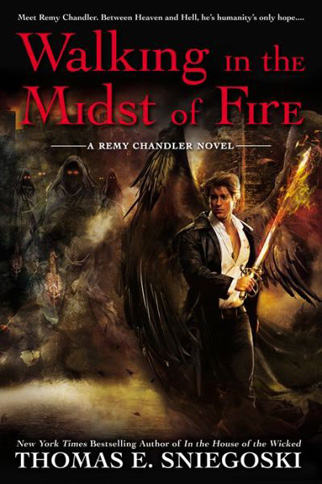
Walking in the Midst of Fire-smallWalking In the Midst of Fire is the sixth installment in the Remy Chandler series, which began with A Kiss Before the Apocalypse. These books are a mix of urban fantasy, paranormal romance, and noir detective fiction, following the exploits of an angel private investigator trying to lead a normal life. (Not gonna happen, Remy.)

Author Thomas E Sniegoski wrote the YA series The Fallen before switching to adult fiction with the Remy Chandler books. I first came across his name in the world of comics, however, when he wrote the prequel to Jeff Smith’s brilliant fantasy Bone, the mini-series Stupid, Stupid Rat Tails: The Adventures of Big Johnson Bone.

Remy Chandler, angel private investigator, is trying his damnedest to lead a normal life in a world on the verge of supernatural change. He’s found a new love — a woman his dog, Marlowe, approves of — and his best human friend is reluctantly coming to grips with how… unusual… Remy’s actions can be. And he’s finally reached a kind of peace between his true angelic nature and the human persona he created for himself so very long ago.

But that peace can’t last — Heaven and the Legions of the Fallen still stand on the brink of war. Then one of Heaven’s greatest generals is murdered, and it falls to Remy to discover who — or what — might be responsible for the death, which could trigger the final conflict… a conflict in which Earth will most certainly be the beachhead.

The deeper he digs, the further he goes into a dark world of demonic assassins, secret brothels, and things that are unsettling even to a being who has lived since time began. But it is not in his nature — angelic or human — to stop until he has found the killer, no matter the personal price…

Walking in the Midst of Fire was published August 6th, 2013 by Roc Books. It is 340 pages, priced at $15 for the trade paperback and $9.99 for the digital edition.

Vintage Treasures: The Best of Stanley G. Weinbaum

Vintage Treasures: The Best of Stanley G. Weinbaum

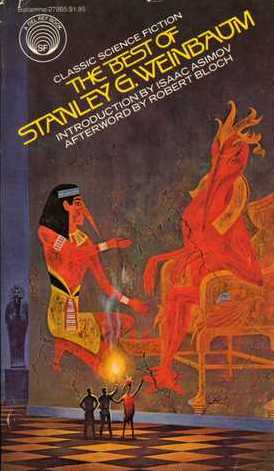
The Best of Stanley G WeinbaumThis is the fifth volume in Lester Del Rey’s Classics of Science Fiction line I’ve discussed here (starting with The Best of Murray Leinster, The Best of Robert Bloch, The Best of Henry Kuttner, and The Best of C M Kornbluth.) I believe it may also have been the first, since it has the earliest publication date of the titles we’ve examined so far — April 1974 — and also because the cover design for the first printing (see below) was slightly different and a little rougher.

And also because, if you’re going to launch a series dedicated to the very best science fiction and fantasy writers of the century, it makes sense to start with Stanley G. Weinbaum.

This isn’t the first time we’ve covered Weinbaum’s career. The distinguished Ryan Harvey wrote a terrific retrospective three years ago, where he said, in part:

In a way, Weinbaum was science fiction’s equivalent of Robert E. Howard: a hugely talented author who died too young. But Weinbaum’s run was even shorter than Howard’s — a mere year and a half, with twelve stories published during that time. Posthumous work followed, but considering the immense talent that Weinbaum shows in his fiction — starting with his first story! — it is frustrating how little of this gold strike ever got to the surface for readers to mine.

We’re hardly the first fans to champion Weinbaum’s pulp science fiction. H.P. Lovecraft praised him highly, calling him ingenious, and stating that he stood miles above the other pulp SF writers in his ability to create genuinely alien worlds, especially in comparison to Edgar Rice Burroughs and his “inane” stories of “egg-laying Princesses.” And series editor Lester del Rey, in the June 1974 issue of IF magazine, said:

Weinbaum, more than any other writer, helped to take our field out of the doldrums of the early thirties and into the beginnings of modern science fiction.

Pretty heavy claims. So exactly who was this writer who won such adoration and devotion, even decades after his death?

Read More Read More

Explanations – I Got a Million of ‘Em

Explanations – I Got a Million of ‘Em

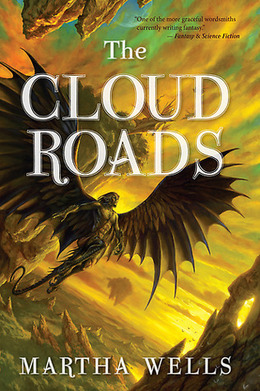
RaksuraI was reading Martha Wells’ excellent The Cloud Roads the other day and I was struck, as I often am when reading something very well written, by how few explanations there were. One of the most difficult things writers of Fantasy or SF face in creating a new world, and alien beings, is to find a way to give their readers necessary information seamlessly, and Wells has done a great job here. There are plenty of things about the world of the Raksura I still don’t know and plenty that I had to figure out for myself. I know there are some readers who don’t want to do any work when they’re reading, but it’s a fact that you value and remember the information you had to work out for yourself a lot more than stuff that was just handed to you.

Yes, I’m talking about that old writing class cliché, “show, don’t tell.” And as important as that advice is when we’re creating sequences involving action and emotion, it’s doubly important when we’re handing out explanations.

Explanations have a bad rep, and justifiably. There’s the ever unpopular info-dump where all forward motion grinds to a halt and the author tells you everything you need to know – ever – about anything – or so it feels like. There’s the equally unpleasant and not-as-rare-as-you-might-hope “As you know Bob,” a dialogue oopsy, more cleverly disguised on TV than on the page. Don’t tell me you’ve never wondered why all those CSI guys tell each other what they’re doing all the time when they must already know. I know you have. But that’s the classic “As you know, Bob.”

There are situations (crime shows being one of them) where readers and audiences are becoming more knowledgeable about certain basics, to the point that explanations are no longer needed. But the unfortunate truth is that some of these back-handed ways of doing things still turn up from time to time, usually in the hands of amateurs in the field. The problem is that there are certain things the readers simply have to know and our jobs as writers is to find a way to tell them, without stopping the forward flow of the narrative and without having characters explain things to each other that they already know perfectly well.

Read More Read More

New Treasures: Unfettered, edited by Shawn Speakman

New Treasures: Unfettered, edited by Shawn Speakman

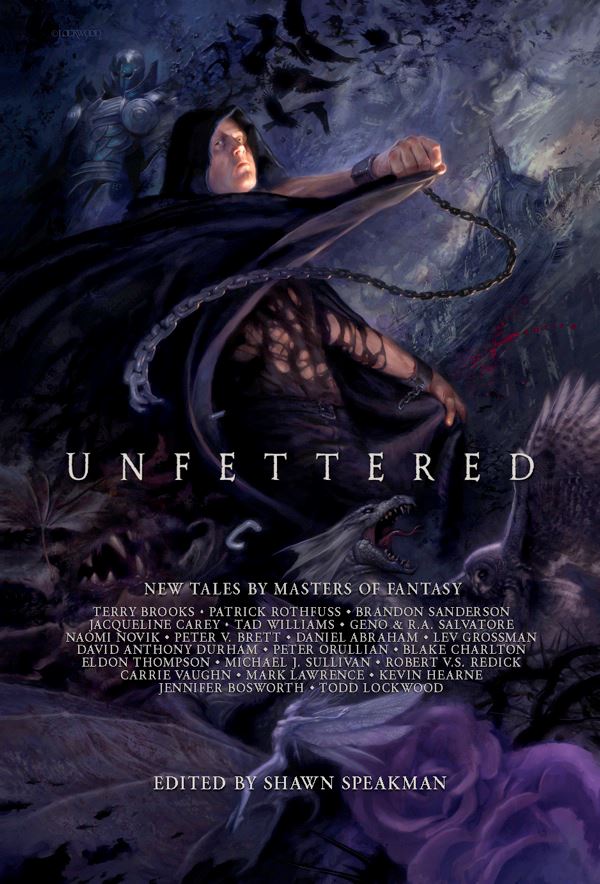
Unfettered-smallUnfettered is a monster anthology with an unusual genesis.

It started with editor Shawn Speakman, who became friends with Terry Brooks a few years back and wrote his own fantasy novel, The Dark Thorn. When Shawn was diagnosed with Hodgkin’s lymphoma in 2011, Brooks donated an original short story to help Shawn pay his mounting medical bills — and suggested that Shawn ask some of his writer friends to do the same.

The result is a massive 518-page tome containing original stories in some of the most popular fantasy series on the market, from some of today’s hottest writers — including Tad Williams, Patrick Rothfuss, R.A. Salvatore, Robert Jordan & Brandon Sanderson, Peter V. Brett, Lev Grossman, Carrie Vaughn, Jacqueline Carey, Mark Lawrence, and many others.

The tales included are set in the worlds of Shannara, the Wheel of Time, the Demon Cyle, Temeraire, Kushiel, Vault of Heaven, the Broken Empire, and many other top-selling series.

As the title suggests, authors were free to contribute whatever they desired.

This book really is a once-in-a-lifetime event and, as the marketing copy states, a testament to the generosity of the science fiction and fantasy community.

Here’s the impressive Table of Contents.

Read More Read More

When Ideas Collide

When Ideas Collide

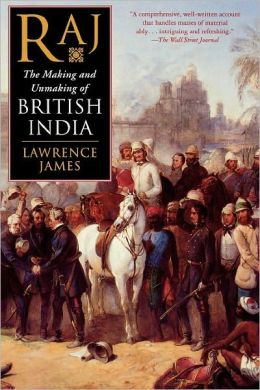
Raj The Making and Unmaking of British IndiaOne of the most common questions I hear from readers and non-writers is Where do you get your ideas? A lot of writers I know have a glib answer like: my cat, my muse (often the same critter), my subconscious (but in other words, we don’t know), or my favorite: a P.O. Box in Spokane.

But sometimes, authors — and I think especially SFF authors — will say a book idea came from two or three separate things considered at once. When they’re brought together, sparks fly and an idea flames up. This happened to me with my latest novel.

It began with serendipity: the discovery of two endlessly fascinating nonfiction books I found on my husband’s book shelf. One was about the British Natural History Museum and the other was a history of the British Raj in India.

I started one, which was a little slow, and while I tried to decide whether to plod on, I began the other book. Then the first book picked up speed and sank its hooks.

I jumped from one to the other so I could keep reading them both. In one, I was reading about the part of natural history museums you don’t realize are there (the research offices and store rooms). There were these eccentric scientists with nicknames like “trilobite man” and “beetle man.” If women had been more welcome in those rarified offices, I might have read about bird woman, or more likely, gopher girl.

In the other book, I found out how the British established an empire in that unlikely place, India, and the stunning arrogance of the Raj. Although colonialism’s stain spread widely on the continent, I was surprised to learn that even as late as the early 20th century, there were people in villages in India who had never heard of the Raj or Queen Victoria. India is a big place.

Read More Read More

An Interview with Lonesome Wyatt of Those Poor Bastards

An Interview with Lonesome Wyatt of Those Poor Bastards

Lonesome WyattI came across Lonesome Wyatt as I nosed about a funnel cake shack in an abandoned amusement park built on a prairie settler boneyard. He had a rotted sack of popcorn in one hand and he dragged a crowbar in the other. Twilight filtered in through a roof hole. Something skittered across his hat. He hummed an old-time dirge.

This being Lonesome Wyatt of Those Poor Bastards. This being the man behind Lonesome Wyatt and the Holy Spooks. This being the author of the pulp horror novel The Terrible Tale of Edgar Switchblade and the composer of its companion album, Behold the Abyss. Which, really, if you’re in the mood for a cloven-hoofed, knife-wielding bounty hunter with step-daddy issues chasing an albino werewolf with supplementary gothic country tunes, there is no better pairing than that which Lonesome Wyatt has provided.

Under normal circumstances…well, you try to avoid talking to mad-eyed men on decrepit fair grounds; but I – being the steadfast and fearsome Black Gate minion I am – AHEMed. Stood my ground. Waited for him to turn around. I am not one to be intimidated. A man can’t hex you by humming. Usually. And this was a man I wanted to talk to.

Lonesome Wyatt turned and sneered, or possibly he smiled; these things are hard to tell. He agreed to do an interview before I had the words out of my mouth to ask. He is a mysterious revelator of mayhem and wonder, and quite possibly he is psychic.*

For your perusal, here lies the exchange Black Gate had with Lonesome Wyatt in that shadowy funnel cake shack…

Read More Read More

Roger Zelazny, August Derleth and Appendix N: Advanced Readings in D&D

Roger Zelazny, August Derleth and Appendix N: Advanced Readings in D&D

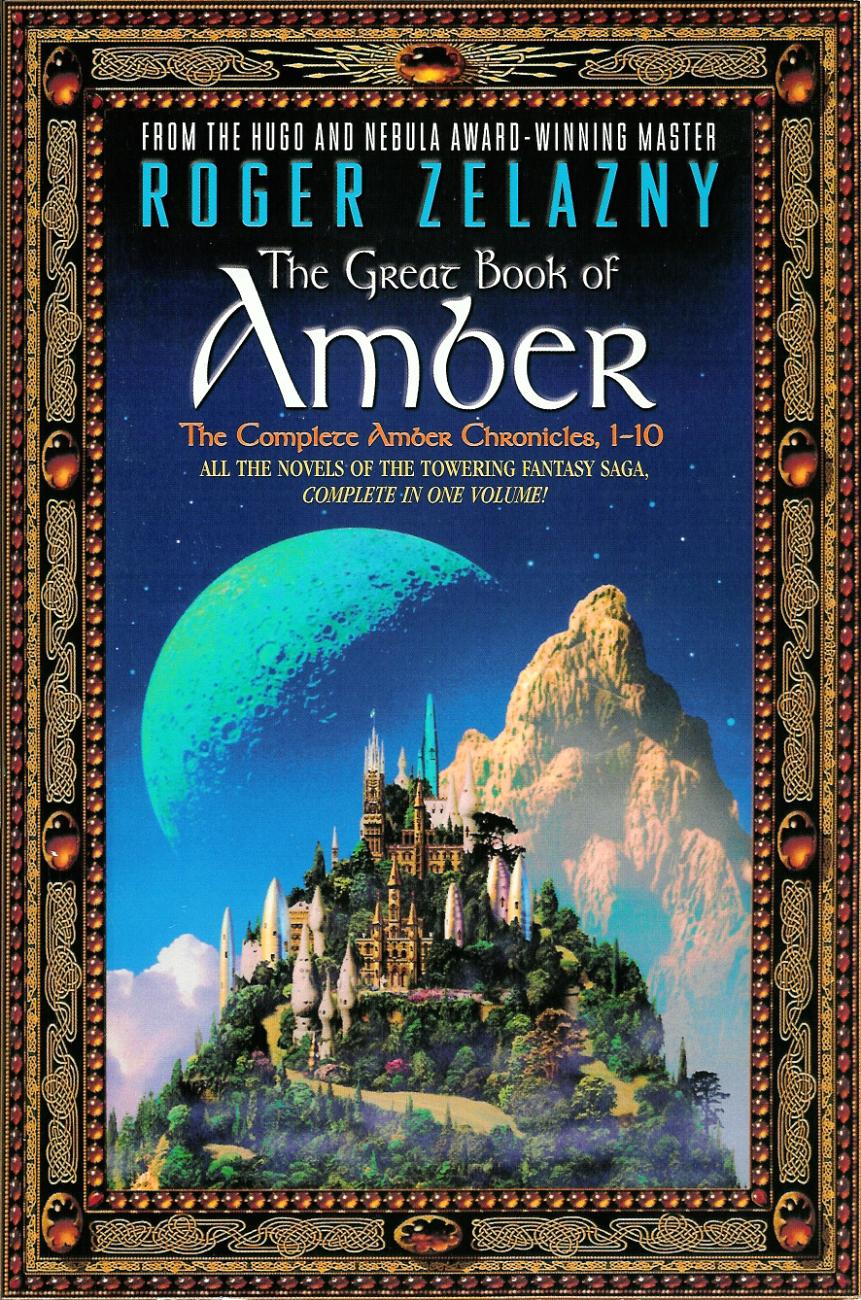
The Great Book of Amber-smallI’ve been spending a lot of time with Gary Gygax’s Dungeon Masters Guide recently, as I guide my young players through a wilderness campaign using Outdoor Survival. The DMG is a treasure trove of handy tables, excellent advice, and fascinating tangents — atrociously organized, of course, but that’s part of its charm. Like the most useful book in all fantasy, the Junior Woodchucks Guidebook (seriously — I’d kill for a copy of that book), you can flip pages at random and never know what indispensable tidbit you’ll find.

Appendix N, which lists the great fantasy writers whose collective contributions laid the groundwork for Dungeons and Dragons, is just one of those finds; but it’s one which has received a great deal of attention. Mordicai Knode and Tim Callahan at Tor.com are sampling the work of every author in Appendix N; so far they’ve covered Robert E. Howard, Poul Anderson, Sterling E. Lanier, Fritz Leiber, Edgar Rice Burroughs, and Jack Vance.

Last week, Tim turned his attention to Roger Zelazny and The Chronicles of Amber. He wasn’t impressed:

I merely sampled the first book in the series, Nine Princes in Amber, originally published in 1970, and that was more than enough… if the first book in Roger Zelazny’s Amber series is considered any kind of classic, then it must be because the novel is graded on a curve. A curve called “pretty good for an opening novel in a series that gets a whole lot better,” or maybe a curve called, “better than a lot of other, trashier fantasy novels released in 1970, when there was nothing on television but episodes of Marcus Welby and the Flip Wilson Show…”

It’s not that I found Nine Princes in Amber uninteresting; it’s just that I found the novel shockingly discordant and unsatisfying to actually read all the way through. It’s a novel that slams together jokey Hamlet references in the narration with pop psychoanalysis and superhuman beings and shadow realms and dungeons and swords and pistols and Mercedes-Benzes.

Actually, that last sentence is almost exactly how I remember Nine Princes in Amber. Shadow realms and dungeons and swords and pistols and Mercedes-Benzes. Yeah, that pretty much covers it.

Read More Read More