Browsed by
Category: Books

Vintage Treasures: Galactic Derelict by Andre Norton
Vintage Treasures: Galactic Derelict by Andre Norton

Galactic Derelict-smallI came too late to science fiction and fantasy to catch Andre Norton’s true heyday in the 50s and 60s, when she published over two dozen novels — including early classics like Star Man’s Son (1952), Star Rangers (1953), Star Gate (1958), The Time Traders (1958), The Beast Master (1959), Witch World (1963), Three Against the Witch World (1965), and Year of the Unicorn (1965).

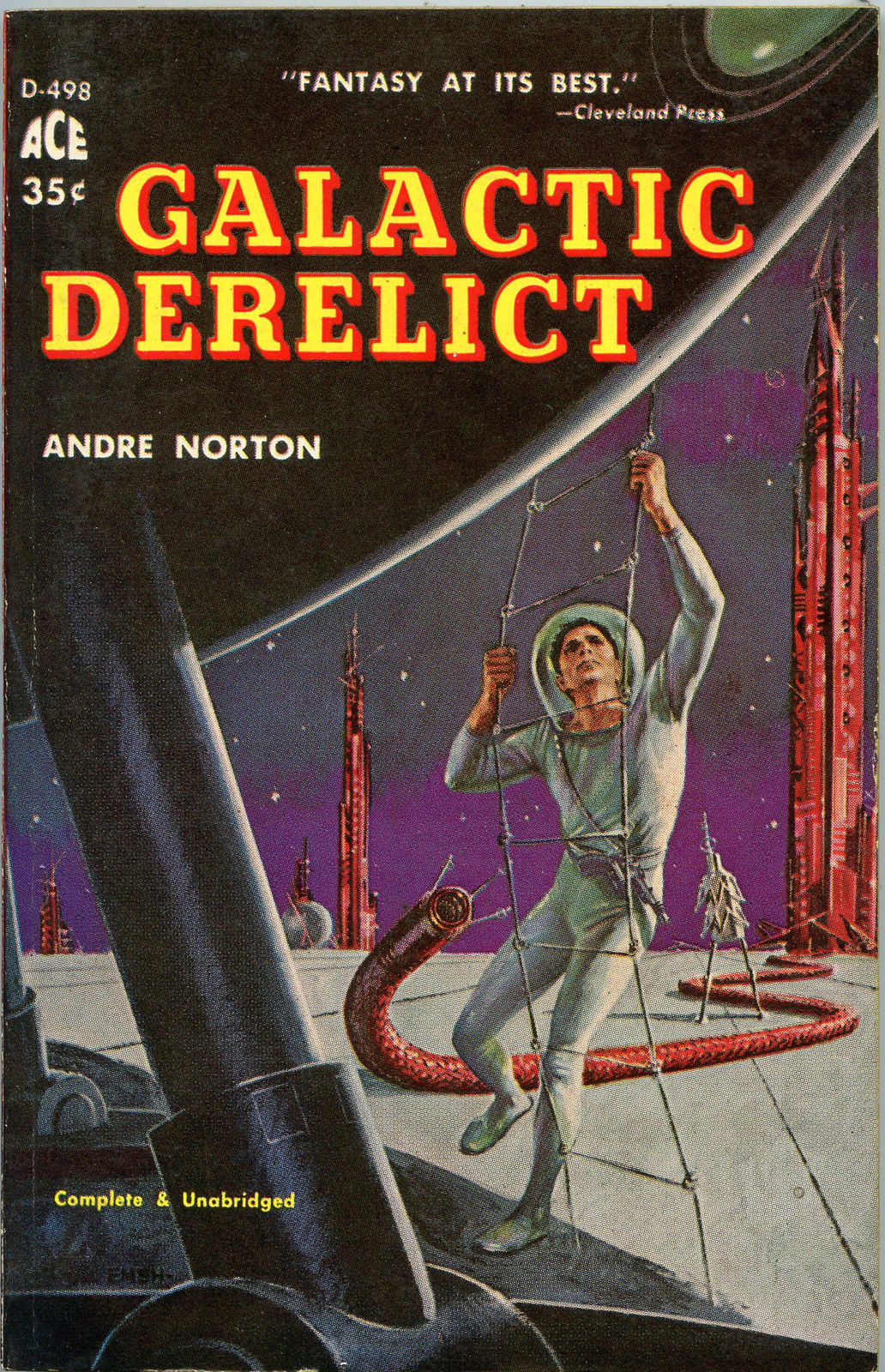
True, she continued to publish books steadily throughout the 70s, 80s, and even the 90s — though by the last decade of her life (she died in 2005), she was writing almost solely in collaboration with other authors. But it was her early Ace paperbacks that really stirred my collector’s soul. Perhaps it was the splendid covers. Here’s the back cover copy from the 1961 Ace paperback Galactic Derelict — with one of those splendid covers — reprinting a review from Galaxy:

“All the classic elements are present in full measure in Galactic Derelict. It suffers not at all in being a sequel to Andre Norton’s excellent Time Traders.

“The U.S. Army’s race with the Russians through and against Time remains Norton’s background. Both search for abandoned wrecks of a race that had interstellar travel back in man’s infancy.

“Travis Fox, Apache, joins Ross Murdock and Dr. Gordon Ashe, time agents, in attempting the transfer, intact, of an alien ship through 20,000 years to present. Inadvertently, controls are activated and the group is launched on an involuntary galactic tour. Their efforts to return to Here and Now constitute a top-notch science-adventure yarn.” – Galaxy Magazine

Galactic Derelict is part of Norton’s Forerunner universe. The other books in the series include The Time Traders (1958), The Defiant Agents (1962), Key Out of Time (1963), and others.

Galactic Derelict was published in 1959 by the World Publishing Company and has been reprinted in eight different editions over the last half-century. It first appeared in paperback from Ace Books in 1961. It is 192 pages in paperback, priced at 35 cents. The cover is by Ed Emshwiller. If I have a few moments this weekend, I may assemble some of the other covers to display them here.

Mary Stewart, September 17, 1916 – May 10, 2014

Mary Stewart, September 17, 1916 – May 10, 2014

The Hollow Hills-smallMary Stewart, my wife’s favorite author, died last week.

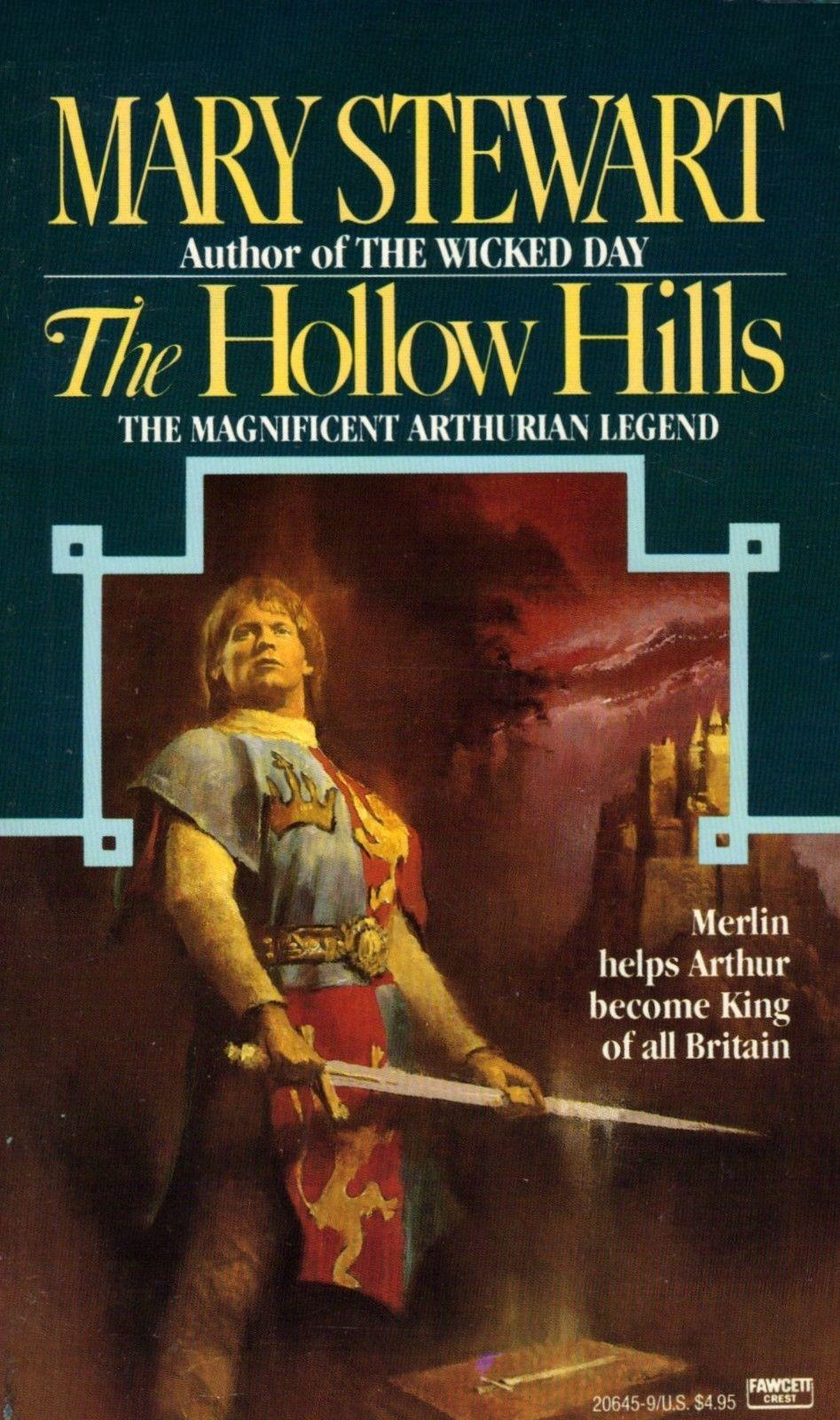
I’ve read only a handful of Stewart’s novels. Her Merlin TrilogyThe Crystal Cave (1970), The Hollow Hills (1973), and The Last Enchantment (1979) — is one of the top-selling Arthurian sagas of all time, hitting bestseller lists around the world. It was her only fantasy series, but it instantly made her one of the most popular fantasy authors of the 70s.

But I got used to seeing the covers of her romantic mystery novels. My wife re-read them constantly. Alice is a voracious reader and she’s read widely in both mystery and contemporary fiction, but at least once a year she pulls out one of her tattered Mary Stewart paperbacks.

“Why are you constantly re-reading those, when you have so many others to choose from?” I asked her once, shortly after we were married.

“Because these are the best,” she said simply.

Mary Stewart’s Merlin Trilogy eventually extended to five novels, including The Wicked Day (1983) and The Prince and the Pilgrim (1995), but her gothic romance included Madam, Will You Talk? (1954), Thunder on the Right (1957), Nine Coaches Waiting (1958), My Brother Michael (1959), The Moon-Spinners (1962) — made into a 1964 Walt Disney film starring Hayley Mills, This Rough Magic (1964), The Gabriel Hounds (1967), Touch Not the Cat (1976), Thornyhold (1988), Stormy Petrel (1991), and her final novel, Rose Cottage (1997).

Mary Stewart lived in Edinburgh, Scotland. She died on May 10th at the age of 97.

Goth Chick News: 2013 Bram Stoker Award Winners

Goth Chick News: 2013 Bram Stoker Award Winners

Doctor SleepBack in March, we gave you the list of nominees for the The Horror Writers Association’s 2013 Stoker Awards for superior literary achievement in horror, in a variety of categories. The Bram Stoker Awards were instituted in 1987 and the eleven award categories are: Novel, First Novel, Short Fiction, Long Fiction, Young Adult, Fiction Collection, Poetry Collection, Anthology, Screenplay, Graphic Novel, and Non-Fiction.

The 2013 awards were distributed at the Association’s annual award banquet on May 10, 2014, at the World Horror Convention in Portland. Black Gate and Goth Chick News would like to congratulate the following authors and editors for their superior achievements and suggest you start loading up your Amazon wish list immediately.

Lifetime Achievement Awards

  • R.L. Stine
  • Stephen Jones

For Superior Achievement in a Novel

  • Stephen King – Doctor Sleep (Scribner)

Read More Read More

New Treasures: End of the Road edited by Jonathan Oliver

New Treasures: End of the Road edited by Jonathan Oliver

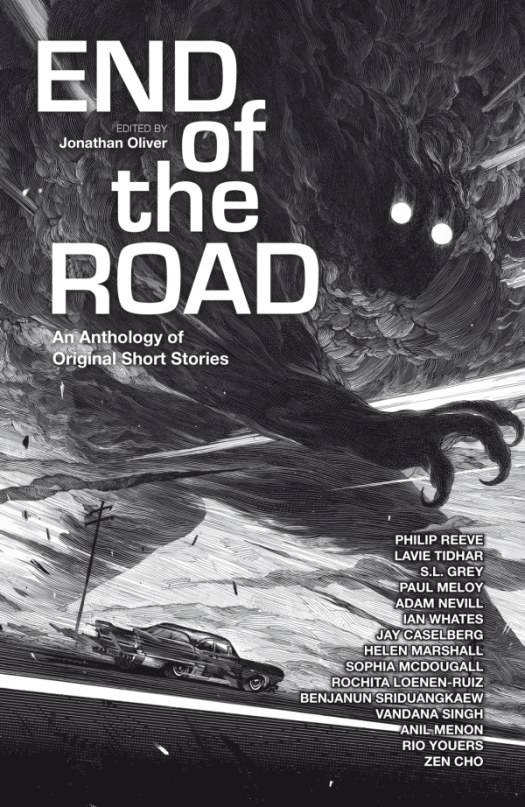
End of the Road Jonathan Oliver-smallBack in March, we saluted Solaris and their rapidly expanding line of anthologies — a rare thing in today’s market — in a post titled “Is the Original SF and Fantasy Paperback Anthology Series Dead?

In researching that article, I discovered Solaris had released a standalone anthology of original fantasy fiction in December: End of the Road. I ordered a copy, it arrived last week, and I’m very happy to say that I’m not disappointed.

Each step leads you closer to your destination, but who, or what, can you expect to meet along the way?

Here are stories of misfits, spectral hitch-hikers, nightmare travel tales and the rogues, freaks and monsters to be found on the road. The critically acclaimed editor of Magic, The End of The Line and House of Fear has brought together the contemporary masters and mistresses of the weird from around the globe in an anthology of travel tales like no other. Strap on your seatbelt, or shoulder your backpack, and wait for that next ride… into darkness.

An incredible anthology of original short stories from an exciting list of writers including the bestselling Philip Reeve, the World Fantasy Award-winning Lavie Tidhar and the incredible talents of S. L. Grey, Ian Whates, Jay Caselberg, Banjanun Sriduangkaew, Zen Cho, Sophia McDougall, Rochita Loenen-Ruiz, Anil Menon, Rio Youers, Vandana Singh, Paul Meloy, Adam Nevill and Helen Marshall.

Jonathan Oliver is the editor-in-chief of Solaris and Abaddon. He has two novels out with Abaddon Books, The Call of Kerberos and The Wrath of Kerberos, and three other anthologies: House of Fear, The End of the Line, and the World Fantasy award nominee Magic: An Anthology of the Esoteric and Arcane.

End of the Road was published by Solaris Books on December 15, 2013. It is 304 pages, priced at $7.99 in paperback and $6.99 for the digital edition. The moody and effective cover is by Nicolas Delort.

Vintage Treasures: Marianne, The Magus, and the Manticore by Sheri S. Tepper

Vintage Treasures: Marianne, The Magus, and the Manticore by Sheri S. Tepper

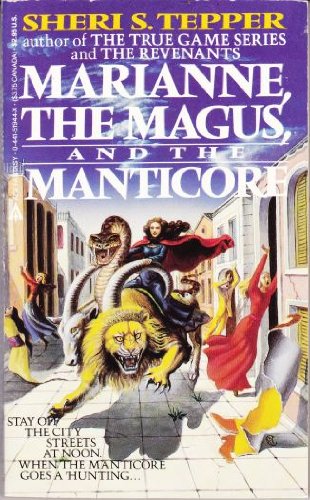
Marianne The Magus and the Manticore-smallI’ve written a lot of Vintage Treasures articles (over 400 now, believe it or not.) Most of them feature collectible paperbacks and virtually all of them — even the old Ace Doubles from the 1950s — are inexpensive to acquire for the patient collector. It’s very, very rare that I discuss one that costs as much as a new paperback, for example.

Sheri S. Tepper’s Marianne, The Magus, and the Manticore is an exception. Used copies start at $10 – 15 on both Amazon and eBay and copies in good shape will run you closer to $40. It’s not particularly old — published in 1985 — and it’s not even all that rare. So why is it so expensive? Because it was published just before her groundbreaking novel The Gate to Women’s Country (1988) and the Hugo-nominated Grass (1989). In other words, before Tepper became a Big Name in the industry. The book was reprinted once, in 1988, but has now been out of print for nearly 30 years. Tepper has a great many fans, and the law of supply and demand dictates that the volumes in this trilogy are likely to be hot properties for some time.

Legacy Of Magic

Marianne was born to luxury in the tiny nation of Alphenlicht, nestled in the mountains between Turkey and Iraq. The her parents died, leaving control of their fortune to the older brother she fears. Struggling to make her way as a student in America, Alphenlicht seems as unreal as a fairy tale, her childhood there as distant as a dream…

… Until the Magus comes to claim her, and the Black Madame to destroy her, and the Manticore to hunt her down through the streets of another world. For there is magic in the land of Alphenlicht. Magic in Marianne’s blood, and magic in her soul…

Marianne, The Magus, and the Manticore was followed by two sequels in what’s now known as the Marianne series: Marianne, The Madame, and the Momentary Gods (1988), and Marianne, the Matchbox, and the Malachite Mouse (1989). A 592-page omnibus volume, The Marianne Trilogy, was offered briefly in paperback by Corgi in 1990 — it’s a great value, if you can find it.

Read More Read More

New Treasures: Nebula Awards Showcase 2014, edited by Kij Johnson

New Treasures: Nebula Awards Showcase 2014, edited by Kij Johnson

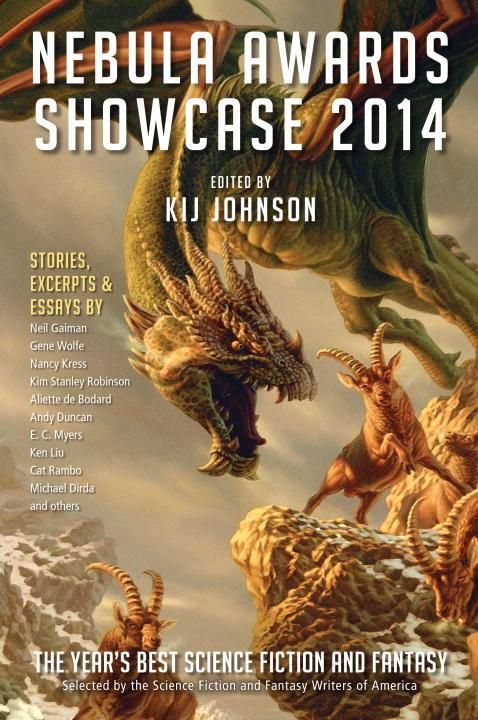
Nebula Awards Showcase 2014-smallThe first volume of the revered Nebula Awards anthologies was released nearly half a century ago, in 1966, and it’s been an annual event ever since. I really can’t think of a single anthology series that’s lasted even half as long.

It’s no accident, either. Year after year these books, which gather Nebula Award-winning short fiction from the previous year — alongside additional nominees, excerpts from winning novels, author retrospectives and appreciations, and survey pieces — collectively form a record of the most acclaimed SF and fantasy our industry has produced for the last 49 years.

Want an example? Have a look at the Tables of Contents for the first three volumes, which contained such stories as “Repent, Harlequin!” Said the Ticktockman” by Harlan Ellison, “The Doors of His Face, the Lamps of His Mouth” by Roger Zelazny, “Light of Other Days” by Bob Shaw, “The Last Castle” by Jack Vance, “We Can Remember It for You Wholesale” by Philip K. Dick, “Aye, and Gomorrah…” by Samuel R. Delany, “Behold the Man” by Michael Moorcock, and “Gonna Roll the Bones” by Fritz Leiber.

It’s not just that those are some of the most famous SF tales ever written. It’s that the Nebula Awards — and these volumes — helped preserve and promote them and they’re likely the reason you know about these stories today.

All that begs the question: who’s in the latest volume? Who are the writers who will be remembered and acclaimed half a century from today?

Read More Read More

“All Folk Cherished Their Legends”: Phyllis Ann Karr’s Wildraith’s Last Battle

“All Folk Cherished Their Legends”: Phyllis Ann Karr’s Wildraith’s Last Battle

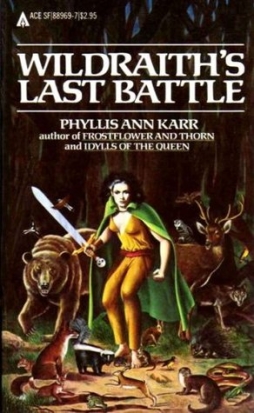
Wildraith's Last BattleA little while ago, I wrote here about Phyllis Ann Karr’s 1986 novel At Amberleaf Fair. I thought it was well-written and inventive, quietly doing highly distinctive things with the fantasy genre without drawing attention to its own originality. I recently read another book by Karr, 1982’s Wildwraith’s Last Battle, and found it was different from Amberleaf Fair while also sharing many of its virtues: tight prose, clever plotting, a strong sense of character, and a tremendously well-constructed setting. It’s not a perfect book, but it’s well worth discussing here.

Set in the southern hemisphere of an unknown world, a group of iron-age nations have begun a complex three-sided war. Meanwhile, for reasons unrelated to the war, one woman loses everything and curses the god, Wildrava, that she believes is responsible. The result is that the god incarnates as a (more-or-less) human female named Wildraith and tries to seek out the woman who cursed her — but the woman, Ylsa, is finding her own way among the shifting sides of the ongoing war. Despite herself, Wildraith finds herself becoming a key player in the war as she strives to find Ylsa and break the curse.

The book is, to use recently-developed terminology, both grim and dark. Violence, including sexual violence and torture, is an element of the story’s reality and occasionally described in detail. There’s nothing ostentatious in the novel’s depiction of violence, though, nothing exploitative or false. It’s a part of the tone and world and feels earned without forcing the whole book into depressive bleakness. Ultimately, what makes the novel remarkable is its ability to fuse matter-of-fact description of day-to-day activities with the experience of war and also a distinctively fantastic sense of wonder: a feeling of the numinous that comes from gods involving themselves in the affairs of mortals.

Read More Read More

The Fantasy of Lucius Shepard: A Handbook of American Prayer

The Fantasy of Lucius Shepard: A Handbook of American Prayer

A Handbook of American Prayer-smallLucius Shepard died on March 18 and, to commemorate his profound contributions to fantasy, we are surveying his books here. Today, we continue with a short novel with a fascinating premise: A Handbook of American Prayer.

Wardlin Stuart is in prison for manslaughter when he begins to write letters to God. He soon finds that his prayers are answered — all of them. Wardlin seems to have accidently stumbled on the correct way to supplicate God… or, at least, a god. But when he publishes his prayers, he sets himself up for a confrontation with a powerful fundamentalist minister. And in the meantime, God appears to have arrived on Earth…

A man walks into a bar. A dispute ensues, and the bartender kills him. He’s sentenced to ten years for manslaughter. In prison, the convict, Wardlin Stuart, writes prayers addressed to no god in particular. Inexplicably, his prayers — whether it’s a request for a girlfriend or a special favor for a fellow inmate — are answered, be it in days or weeks. When his collection of supplications, A Handbook of American Prayer, is published by a New York press, Stuart emerges a celebrity author. Settling into a new life in Arizona, he encounters a fundamentalist minister. The two are destined for a confrontation. In the interim, it seems that the god to whom Stuart has been praying has manifested himself on the earth. In this short novel about America’s conflicting love triangle — celebrity, spirituality, and money — Shepard negotiates the thin line between the real and the surreal, expounding upon violence and redemption along the way. This story of an unlikely American messiah shows why The Wall Street Journal has compared Shepard, an award-winning author, to Graham Greene, Robert Stone, and Ward Just.

We previously discussed Shepard’s acclaimed collection The Dragon Griaule and his vampire novel, The Golden.

A Handbook of American Prayer was published by Thunder’s Mouth Press on September 14, 2004. It is 272 pages in hardcover. A trade paperback edition was published simultaneously. Both are out of print; there is no digital edition.

Future Treasures: Prince of Fools by Mark Lawrence

Future Treasures: Prince of Fools by Mark Lawrence

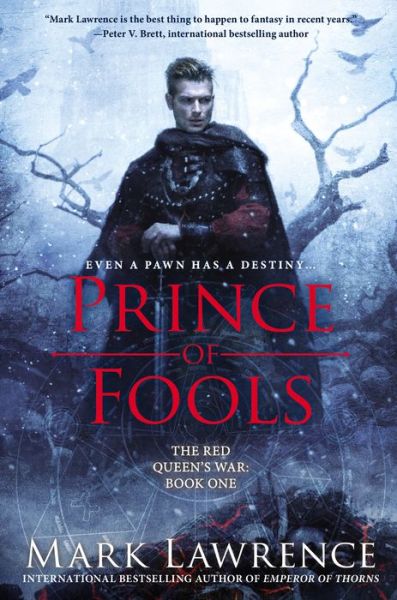
Prince of Fools Mark Lawrence-smallIn The Broken Empire trilogy (Prince of Thorns, King of Thorns, and Emperor of Thorns), Mark Lawrence told the tale of Jorg Ancrath’s devastating rise to power. In a blog post for us shortly before Prince of Thorns was released, Mark Lawrence explained some of the genesis of the series:

The book I’ve written, Prince of Thorns, has layers, rather like an onion (or an ogre). I hope it can be enjoyed as a violent swords and sorcery romp. Get your teeth into it though and there’s more there – it’s as much about our prince as it is about what he does. This is a damaged person and although the story is told in his words without a hint of excuse, there are lessons to be learned between the lines. It wasn’t until tonight though, desperately scratching at the subject in the effort to come up with something to say in this blog post I was invited to supply, that I discovered another layer, deeper still…

In Prince of Thorns the main character has suffered a personal disaster. It’s not the ‘evil threatens the village’ of classic fantasy. It’s not injured pride or a looming darkness in the east. He’s been screwed over, a tsunami has rolled through his life and left devastation. And the book is in large part his reaction to that… It’s only through the lens of half a decade and more that I see I was writing out… not a version of my own experience, but a mapping of the emotions.

We published the first chapter of Prince of Thorns, with a brand new introduction by Mark, online here.

The numerous fans of The Broken Empire trilogy will be thrilled to hear that Mark Lawrence returns to the Broken Empire with his next book, coming June 3. Prince of Fools tells the tale of The Red Queen’s grandson, Prince Jalan Kendeth, a man tenth in line for the throne, who nonetheless finds life quickly becoming very complicated indeed…

Read More Read More

Vintage Treasures: Six Worlds Yonder / The Space Willies by Eric Frank Russell

Vintage Treasures: Six Worlds Yonder / The Space Willies by Eric Frank Russell

Six Worlds Yonder-smallWe’re back with our continued look at some of the most interesting Ace Doubles.

Last time we discussed Eric Frank Russell’s first Ace release, his 1954 novel Sentinels of Space (with a brief aside to look at his 1958 paperback collection from Berkley, Men, Martians, and Machines.) So I thought it apropos to examine his first Ace Double pair: Six Worlds Yonder / The Space Willies, published in 1958.

Six Worlds Yonder is a rather uniquely themed collection: stories of first landings on far planets, all published in Astounding between 1955 and 1957. Here’s the book description:

THE PLANET MAPPERS

One thing’s certain about the exploration of outer space — there’s not going to be two worlds alike! In this new collection of interstellar explorers, the fertile and original mind of Eric Frank Russell presents a half-dozen of the more extraordinary possibilities.

There’s the world where everything moves at a pace so different from ours that it would take a couple of lifetimes to establish communication. There’s the planet of immortals, with all that that really signifies. There’s the puzzling problem of keeping important messages secret when surrounded by truculent aliens. And there’s more…

Every story is different, every world is unique, and every adventure is science-fiction at its best.

Russell’s stories were frequently more whimsical than most others depicting the grim business of interstellar exploration in 1950s SF digests. I think perhaps Bud Webster described Russell’s style best in his book Past Masters, in his appreciation of the stories in Men, Martians and Machines.

Read More Read More