Browsed by
Category: Books

Four Books on Historical European Martial Arts (HEMA)

Four Books on Historical European Martial Arts (HEMA)

Miles Cameron
Historical European Martial Arts (HEMA) have already filtered through into Fantasy as authors get sucked into their research — reference Miles Cameron who fights about as much as he writes.

So there are people among us that know how to use historical weapons, that can wield a real sabre, not the bendy car aerial sports variety, have fought in plate armour, jousted, even.

Historical European Martial Arts (HEMA) have already filtered through into Fantasy as authors get sucked into their research — reference Miles Cameron, who fights about as much as he writes. HEMA is also going to pervade Urban Fantasy since… well swords in the city.

And reader expectations are going to raise the barrier.

So, here are some books to help you make sense of it all…

Read More Read More

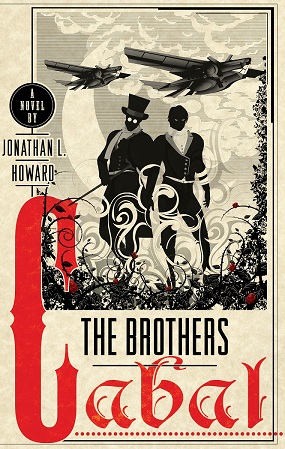
New Treasures: The Brothers Cabal by Jonathan L. Howard

New Treasures: The Brothers Cabal by Jonathan L. Howard

The Brothers Cabal-smalllI’ve been following Jonathan L. Howard’s career since we published his light-hearted sword & sorcery tale “The Beautiful Corridor,” about a young thief named Kyth hired to penetrate a deadly tomb, in Black Gate 13 — and its sequel, “The Shuttered Temple,” in BG 15.

His first novel was the highly regarded Johannes Cabal the Necromancer (2009), followed by Johannes Cabal the Detective (2010) and last year’s Johannes Cabal: The Fear Institute. In the latest installment, he teams up with his brother, an affable vampire, to take on an occult conspiracy with a monstrous army.

Horst Cabal has risen from the dead. Again. Horst, the most affable vampire one is ever likely to meet, is resurrected by an occult conspiracy that wants him as a general in a monstrous army. Their plan: to create a country of horrors, a supernatural homeland. As Horst sees the lengths to which they are prepared to go and the evil they cultivate, he realizes that he cannot fight them alone. What he really needs on his side is a sarcastic, amoral, heavily armed necromancer.

As luck would have it, this exactly describes his brother.

Join the brothers Cabal as they fearlessly lie quietly in bed, fight dreadful monsters from beyond reality, make soup, feel slightly sorry for zombies, banter lightly with secret societies that wish to destroy them, and — in passing — set out to save the world.*

*The author wishes to point out that there are no zebras this time, so don’t get your hopes up on that count. There is, however, a werebadger, if that’s something that’s been missing from your life.

Jonathan’s most recent novels are Katya’s World, and Katya’s War, the first books of The Russalka Chronicles. Read Jonathan’s article on writing the Johannes Cabel series and his interview with John Joseph Adams. Johannes Cabal: The Fear Institute was published by Thomas Dunne Books on September 30. It is 338 pages, priced at $25.99 in hardcover and $11.99 in digital format.

Vintage Treasures: Silverglass by J.F. Rivkin

Vintage Treasures: Silverglass by J.F. Rivkin

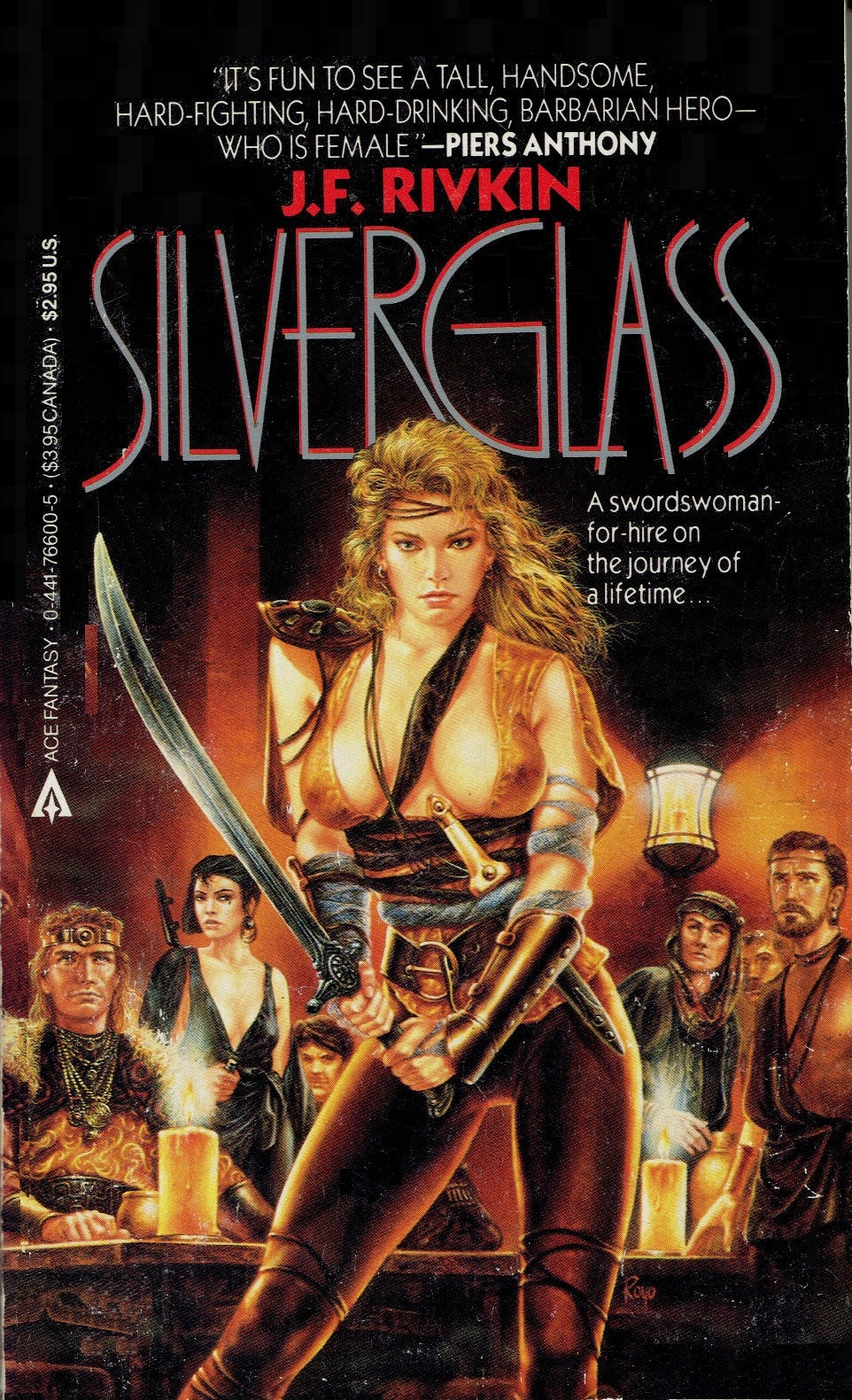
Silverglass-smallThere’s no shortage of fantasy fiction with strong women heroines these days — in fact, if you’re standing in front of the urban fantasy section of your local bookstore, I wouldn’t be surprised if you assume that that’s all there is.

I do hear the occasional observation that this is entirely a modern development however, and obviously that’s not true. Yeah, adventure fantasy was largely dominated by male writers in the 20th Century (and male editors, and male art directors, but that’s a different topic.) But it wasn’t just trailblazers like C.L. Moore, Anne McCaffrey, and Joanna Russ creating popular female heroes. Even in midlist fantasy, there were popular sword-wielding women characters, many of whom are forgotten today.

Are they worth remembering? That’s a different question.

I’ve always wanted to find out. Recently I’ve been curious about the Silverglass books by J.F. Rivkin, four novels published between 1986 and 1991: Silverglass, Web of Wind, Witch of Rhostshyl, and Mistress of Ambiguities. The first one crossed my desk again last night, part of a small paperback collection I recently acquired, and I dipped into it long enough to be intrigued.

Probably the reason I’ve remembered these books so long is the colorful wraparound covers by Royo. For Silverglass, he surrounded our heroine with an interesting cast of characters in what looks like an underground tavern — a setting that immediately spoke to me of adventure in 1986. The main selling point is summarized in the Piers Anthony blurb at the top:

It’s fun to see a tall, handsome, hard-fighting, hard-drinking barbarian hero — who is female.

Here’s the book blurb, and high-res scans of the front and back covers.

Read More Read More

The Color Out of Time: Michael Shea Takes a Dip Into Lovecraftian Horror

The Color Out of Time: Michael Shea Takes a Dip Into Lovecraftian Horror

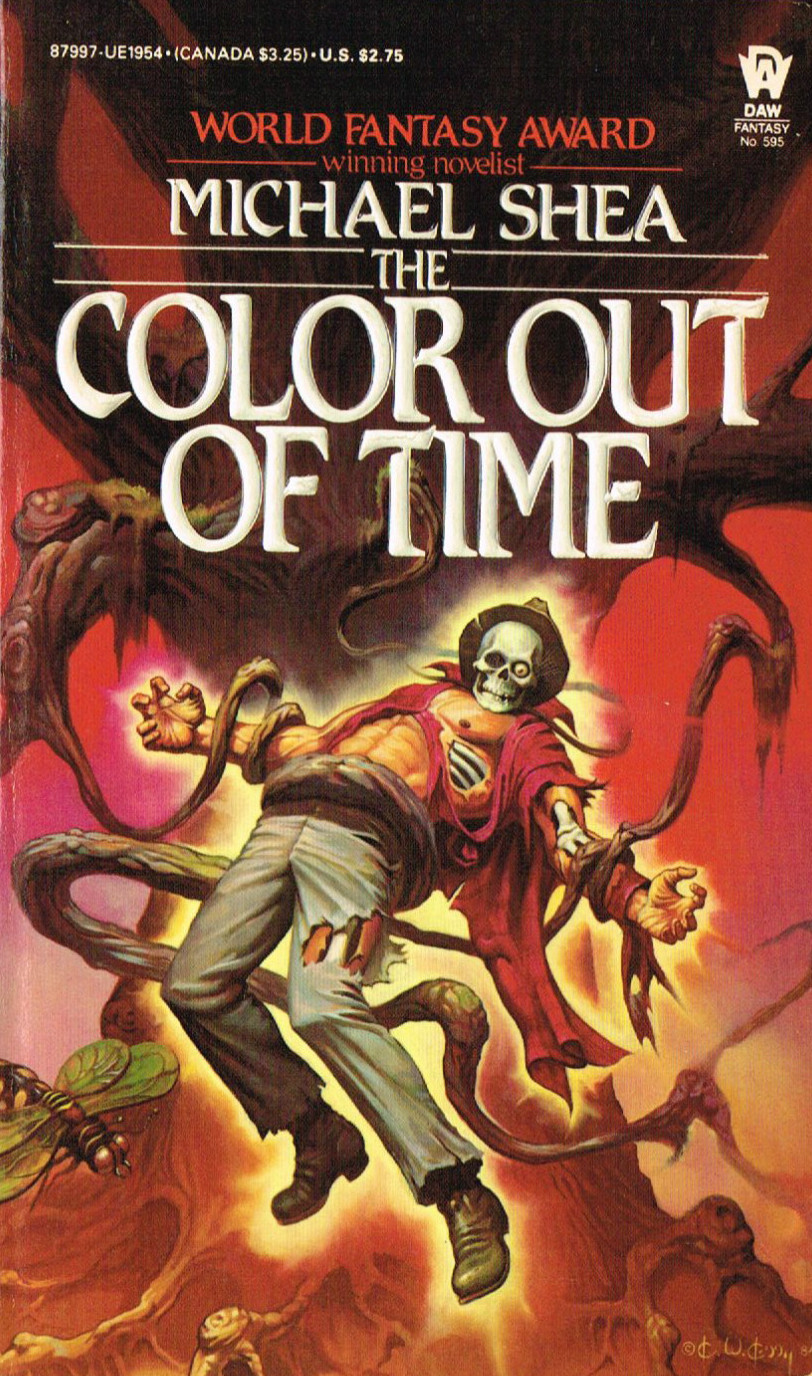
The Color out of TimeI’ll mention this first about Michael Shea’s 1984 novel The Color Out of Time: the protagonists consume copious amounts of Wild Turkey. They fortify their coffee with it; they carry hip flasks full of it. This is a fact the narrator always notes casually in passing. Never are the potentially debilitating effects of alcohol mentioned; it simply occurs to the reader that these people might well be past the point of tipsy into “whiskey-river-take-my-mind” territory through much of the central action of the adventure. Perhaps that’s how they maintain their sanity. And make no mistake: sanity is but one of the possessions at stake for our heroes, because they have waded head-deep into Lovecraft territory. If they do manage to survive with their sanity intact, though, they might want to consider rehab.

The second thing I’ll mention is that because some of my own fictional excursions overlap with Shea’s foray into Lovecraftian horror — we tread similar unhallowed ground, digging up the bones of past masters of weird horror and coating them with fresh slime, if you will — I find myself contemplating the book not just as a critic, but as a writer: appreciating moves he makes while noting missteps and potential pitfalls. Ultimately, Shea’s sequel to H.P. Lovecraft’s 1927 short story “The Colour Out of Space” is entertaining, but slightly off, a tad unsatisfying, and I’ll try to pinpoint why — to isolate the juncture at which it diverges from Lovecraft’s vision and to articulate how this impacts the effectiveness of the tale. (For a different take on the book, check out Douglas Draa’s review for Black Gate last year HERE.)

The premise is straightforward enough. Take the story that is generally regarded as Lovecraft’s first successful amalgam of science fiction and horror, a blend that became his unique trademark (“The Colour Out of Space” is one of Lovecraft’s most highly regarded and was always, according to Wikipedia, the author’s personal favorite. For the sake of full disclosure, it ranks high on my list of best horror stories and is one of my top two or three favorite works by Lovecraft). Start from the central event of that tale and then project its aftermath some sixty odd — very odd — years later.

Read More Read More

Tor.com Salutes Solaris Books

Tor.com Salutes Solaris Books

Solaris Rising 3-smallA while back, I praised Solaris Books for their impressive line of top-notch original anthologies, including Ian Whates’s Solaris Rising, and Jonathan Strahan’s Reach for Infinity. And just a few hours ago (see below), I reported on their upcoming fantasy volume, Fearsome Magics.

Looks like I wasn’t the only one to notice. Last week at Tor.com, Niall Alexander called out the publisher for their splendid recent record on original anthologies:

In recent years, no one publisher has done as much for the short form of speculative fiction in Britain as Solaris. Since the summer, they’ve released Reach for Infinity… the latest volume of Jonathan Strahan’s continuing chronicle of the future history of humanity — reviewed right here by yours truly— alongside the eighth edition of The Best Science Fiction and Fantasy of the Year and the third in the superb Solaris Rising series.

And there’s much more to come in the coming months. Fearsome Magics, the follow-up to The New Solaris Book of Fantasy, is out in early October — on the same day, indeed, as Two Hundred and Twenty-One Baker Streets from Solaris’ sister imprint Abaddon, which proposes to showcase the great detective through a decidedly unlikely lens.

Just this week, readers of When Gravity Falls were treated to an early look at another of the plentiful collections Solaris has on the cards. Dangerous Games is due in December, and it looks to meet, or even exceed, the high standards set by Jonathan Oliver’s previous projects.

Solaris 3 was edited by Ian Whates and released on August 26, 2014. I bought a copy last week and it looks like the same great bargain as the other volumes — a thick 448 pages for just $7.99 in paperback — with stories from  Aliette de Bodard, Ken Liu, Julie E. Czerneda, Tony Ballantyne, Sean Williams, Ian Watson, Adam Roberts, George Zebrowski, Benjamin Rosenbaum, Rachel Swirsky, and many others. The cover is by Pye Parr (click the image at right for a high res version of the front and back cover.)

Read More Read More

Future Treasures: Fearsome Magics, edited by Jonathan Strahan

Future Treasures: Fearsome Magics, edited by Jonathan Strahan

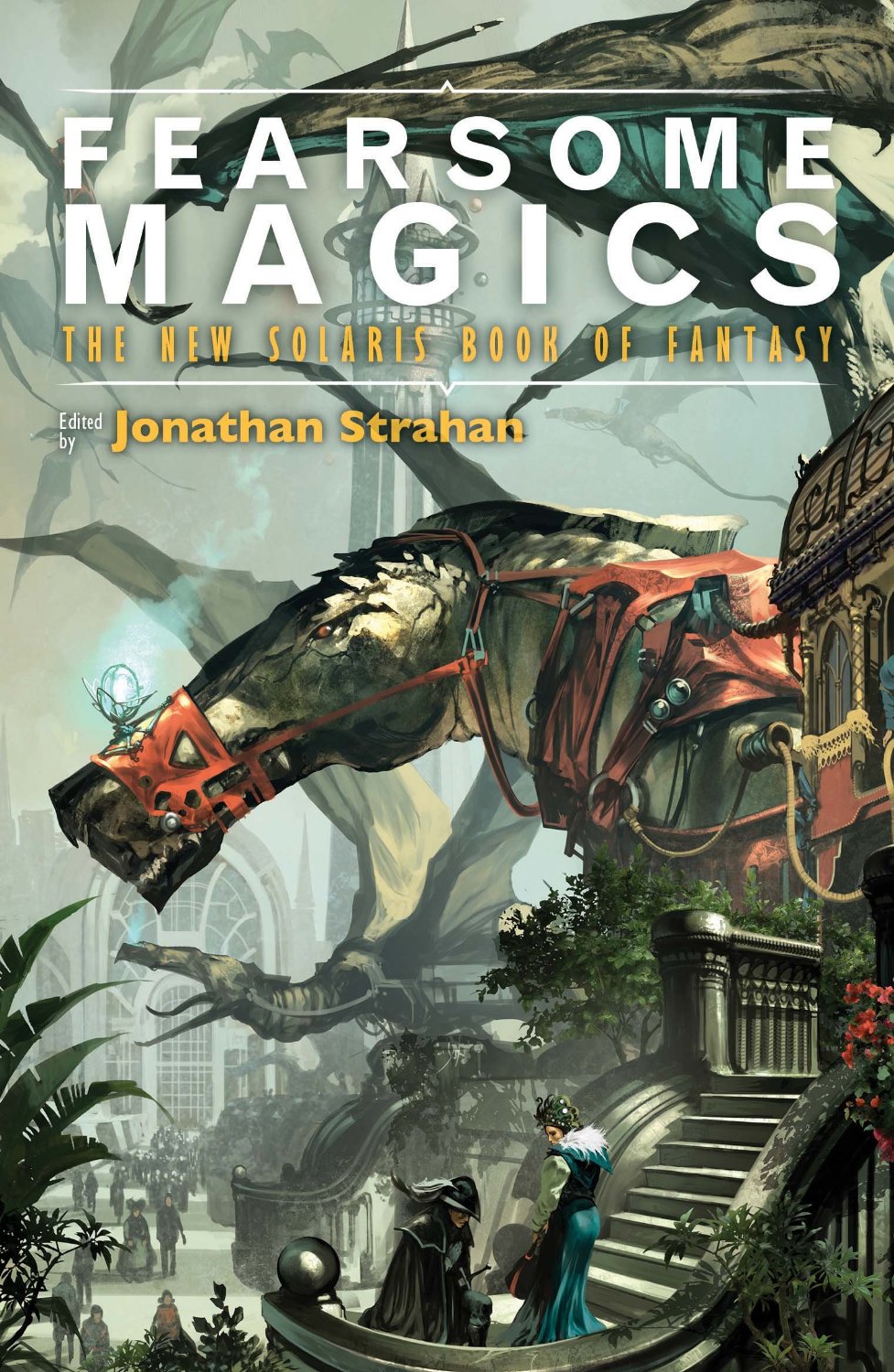
Fearsome Magics-smallSolaris Books continues to single-handedly fuel a renaissance in paperback anthologies, including two top notch science fiction anthology series: Ian Whates’s Solaris Rising, and  Jonathan Strahan’s  Reach for Infinity.

Next week sees the arrival of Jonathan Strahan’s Fearsome Magics, his second volume of original fantasy fiction from Solaris. Here’s what James McGlothlin said about the first, Fearsome Journeys:

Many of Fearsome Journeys’ stories fit squarely within the tradition of fantasy — which I love! For instance, many contain typical tropes such as magic, dragons, wizards, fighters, thieves, etc., as well as familiar plot angles like quests to recover treasure or kill some monster or dragon. However, as one would expect from this lineup, many are fairly experimental attempts to push the boundaries of what is, or should be, considered fantasy. Let me give a few highlights.

Glenn Cook provides another great tale of the Black Company, his popular fantasy military troop, with his story “Shaggy Dog Bridge.” Similar to Cook’s Black Company, Scott Lynch’s “The Effigy Engine” centers upon a group of (wizard) warriors called the Red Hats, who are battled-hardened cynics often attempting to just get by. This was a very interesting tale describing war contraptions that reminded me of medieval versions of the AT-AT Walkers from The Empire Strikes Back. Very cool!…

I can say — without any reservation — all of stories contained within Fearsome Journeys are extremely well-crafted… There’s no doubt that these are some of the best writers in the field today.

Here’s the book description.

Read More Read More

“Shardik, Shardik the Power Of God!”

“Shardik, Shardik the Power Of God!”

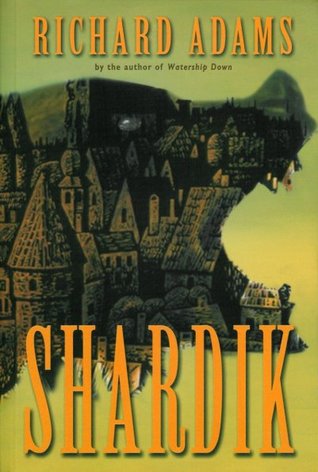
Shardik-smallMidway through Richard Adams’s doorstop of a book, Shardik (1974), I decided I had stumbled into the world’s longest parable.

Biblical parables are typically quite brief, but Adams pulls toward the opposite shore, reasoning that in thoroughness lies salvation. And why shouldn’t he? That tactic worked like gangbusters in his astounding debut, Watership Down (1972).

Shardik could indeed function as a serviceable doorstop, but to dismiss it out of hand would be a disservice to literature in general, and to fantasy novels in particular. Shardik is a brave, uncompromising examination of how “mere” mortals encounter and deify the exceptional, thus giving rise to portents, omens, prophecies, and ultimately continent-conquering religions.

In the case of Shardik, the talismanic inciting event takes the form of a gigantic bear, a bear of monstrous, prehistoric proportions, and this bear first flees a forest fire and then crashes, half-burned and exhausted, into a far-flung outpost of human civilization, Ortelga. Unfortunately – or not, depending on one’s point of view – the Ortelgans entertain a fervid belief that God’s manifestation on Earth will come in the form of a massive bear.

While Watership Down stayed locked within the heads of its rabbit characters, Shardik spends only a few pages at the outset inside the eponymous bear’s mind, just long enough to convince any alert reader that while Shardik may be a divine instrument, he is very much a bear, no more, no less, and will behave accordingly. After that, the story turns to Kelderek-Plays-With-Children, a hunter of simple tastes who first stumbles upon the injured, recovering bear-god.

Read More Read More

New Treasures: Die and Stay Dead by Nicholas Kaufmann

New Treasures: Die and Stay Dead by Nicholas Kaufmann

Die And Stay Dead Nicholas Kaufmann-smallLast October, I talked about Nicholas Kaufmann’s dark fantasy novel Dying is My Business, which I called “the tale of a badass hero facing down the forces of darkness in modern-day Brooklyn.” I’m very pleased to see the sequel arrive this week — this looks like a gritty and appealing dark fantasy series I can really sink my teeth into.

In this pulse­pounding sequel to Dying Is My Business, Trent, a man who can’t stay dead or retain his memories, tries to uncover his connection to a deadly doomsday cult bent on destroying NYC.

A brutal murder in Greenwich Village puts Trent and the Five-Pointed Star on the trail of Erickson Arkwright, the last surviving member of a doomsday cult. Back in the day, the Aeternis Tenebris cult thought the world would end on New Year’s Eve of 2000. When it didn’t, they decided to end it themselves by summoning Nahash-Dred, a powerful, terrifying demon known as the Destroyer of Worlds. But something went wrong. The demon massacred the cult, leaving Arkwright the sole survivor.

Now, hiding somewhere in New York City with a new identity, Arkwright plans to summon the demon again and finish the job he started over a decade ago. As Trent rushes to locate a long-lost magical artifact that may be the only way to stop him, the clues begin to mount… Trent’s past and Arkwright’s might be linked somehow. And if they are, it means the truth of who Trent really is may lie buried in the twisted mind of a madman.

Die and Stay Dead will be published on Tuesday, September 30 by St. Martin’s Griffin. It is 388 pages, priced at $15.99 in trade paperback and $10.99 for the digital edition. The cover is by Chris McGrath.

See all of our recent New Treasures here.

The Public Life of Sherlock Holmes: An Index (So Far)

The Public Life of Sherlock Holmes: An Index (So Far)

Index_Holmes
An awesome print by Tom Richmond of Holmes on screen over the years. I own print #7 of 450

Surprisingly, The Public Life of Sherlock Holmes has now made it to thirty posts. While I’m sure the dedicated reader types ‘Public Life of Sherlock Holmes’ in the search field to call up all the posts in the series, I said to myself (I talk to myself a lot),  “Bob, there’s got to be an easier way for someone to bask in the entirety of your writings so far.”

And there is! Below is an index with links to all the posts, followed by some topics likely to come.


Sherlock Holmes/Sir Arthur Conan Doyle

The Public Life of Sherlock Holmes – Introduction to the column (rather unoriginal title, eh?)

Lord of Misrule – Christopher Lee as the great detective

The Case of the Short Lived Sherlock – One of my favorite Holmes’, Ian Richardson

Creation to Death and Back – A good intro to Holmes, focusing on Doyle’s love-hate (minus the love) relationship with his most famous creation

Read More Read More

Vintage Treasures: The Dance of Death by Algernon Blackwood

Vintage Treasures: The Dance of Death by Algernon Blackwood

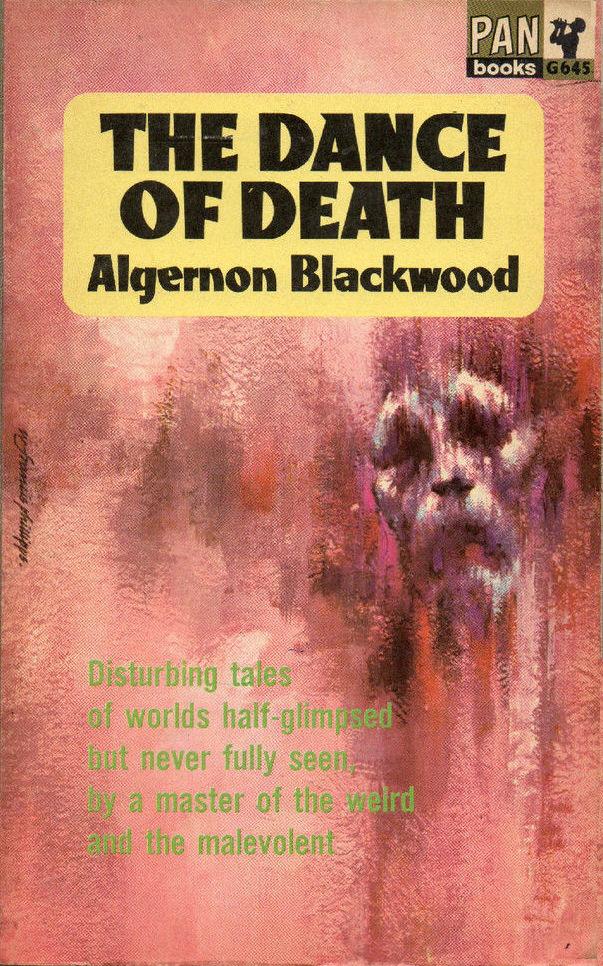
The Dance of Death Blackwood-smallAlgernon Blackwood is one of the acknowledged masters of the ghost story — and also one of its most prolific practitioners. He wrote a dozen novels and published some 34 short story collections, including John Silence (1908), Incredible Adventures (1914), Ancient Sorceries and Other Tales (1927); and Tales of the Uncanny and Supernatural (1949). He died in 1951.

In his review of Incredible Adventures, Ryan Harvey saluted Blackwood thusly:

Of all the practitioners of the classic “weird tale,” which flourished in the early twentieth century before morphing into the more easily discerned genres of fantasy and horror, none entrances me more than Algernon Blackwood. Looking at the stable of the foundational authors of horror — luminaries like Poe, James, le Fanu, Machen, Lovecraft — it is Blackwood who has the strongest effect on me. Of all his lofty company, he is the one who seems to achieve the most numinous “weird” of all…

In my view, Blackwood achieved his finest work in his earlier collections The Listener and Other Stories (1907), John Silence — Physician Extraordinary (1908), and The Lost Valley and Other Stories (1910), where he combined his weird adventures with aspects of horror and fear. These earlier classics are supernatural horror, but are also superb works of mood.

Much of Blackwood’s impressive catalog is now out of print, but not all of it. S. T. Joshi, who called his work “more consistently meritorious than any weird writer’s except Dunsany’s,” and said Incredible Adventures “may be the premier weird collection of this or any other century,” has edited two contemporary short story collections: The Complete John Silence Stories (1997), and Ancient Sorceries and Other Weird Stories (2002).

Of course, I’m most interested in the vintage paperback editions of Algernon Blackwood, and especially his 1963 Pan paperback The Dance of Death, which I recently acquired on eBay.

Read More Read More