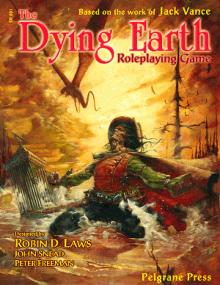
 Pelgrane Press has announced that one of my favorite role playing games, The Dying Earth, is available again after several years in limbo.
The Dying Earth is, of course, based on the famed fantasy books by Jack Vance, including The Dying Earth, The Eyes of the Overworld, Cugel’s Saga, and Rhialto the Marvellous. The RPG was written by Robin Laws, John Snead, and Peter Freeman, and originally published by Pelgrane Press in 2001.
I’ve never actually played The Dying Earth role playing game. It appeared after I moved from Ottawa to Chicago and left my gaming group behind, and before my three children stopped throwing the dice at each other and got old enough to game with. So why is one of my favorites?
Because there’s plenty to enjoy about The Dying Earth RPG, even if you never use the rules to guide your dice arm. The support materials were superb, especially the accompanying magazine, The Excellent Prismatic Spray — whose contributors numbered Gary Gygax, Robin D Laws, Jonathan Tweet, Monte Cook, Keith Baker, and many others — and which published seven fat issues before following the game into limbo.
 Much of the content of the magazine and the additional support material were written in studied imitation of Vance’s witty and erudite style, and made terrific reading.
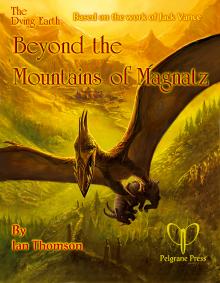
Who knows why the game was out of print for so long? A licensing issue, most likely. But it’s finally back, and Pelgrane has wasted no time gearing up the presses again, releasing the first new supplement in several years: Beyond The Mountains of Magnatz by Ian Thomson, a picaresque series of adventures for Cugel-level characters:
You may have thought your adventurous rogues trapped in the barren north until the sun went dark. But no, the former Lords of Cil are on the move again. The adventurers must evade becoming victim to the ancient menace of Magnatz in the sinister town of Vull, progress through greater and lesser challenges, both natural & magical, as they struggle across the savage mountains, explore strange hospitality in the valley of the mighty Pharesm, and survive lands populated by an army of basilisks, before winning free to the civilized lands of the east.
Our recent coverage of Pelgrane Press includes:
When the End of the World is a Mercy Killing: Cthulhu Apocalypse for Trail of Cthulhu
Mythos Expeditions for Trail of Cthulhu
Experience the Epic Madness of Eternal Lies for Trail of Cthulhu
June Page XX Available — get the latest Pelgrane Press News
Accretion Disk for Ashen Stars
The Justice Trade for Ashen Stars
Some Mysteries You Don’t Want to Solve: Exploring Dead Rock Seven for Ashen Stars
Out of Space for Trail of Cthulhu
Ashen Stars by Robin D. Laws
The Dying Earth Role Playing Game
The Dying Earth RPG is a 192-page hardcover priced at $29.95. Beyond The Mountains of Magnatz is a 96 page PDF, and sells for $9.95. Both are available at the Pelgrane Press website.
See all of our recent Games coverage here.
 Every so often I come across a product so insanely cool that I not only have to own it immediately, but I must also tell you about it so we can share the joy together.
 I’m pleased to interview my great friend and writer buddy, Brad Beaulieu. We’ll be discussing his new novel, The Winds of Khalakovo, Book One of The Lays of Anuskaya, which comes out the first of April 2011 from Nightshade Books as a trade paperback and as an eBook. Winds is a sweeping epic fantasy with a Czarist Russian and Persian feel, a unique combination to be sure. I’m so proud of Brad’s accomplishment with the world building and the story. I’ve been involved with this novel for several years now, and have had a part in the revisions, so I’ve seen it go from an awesome book with an amazing concept to a truly exceptional one with a fully fleshed-out world.

 Every time I think I’ve moved on from the fantasy/realism debate, someone drops the gauntlet and I find myself back in the thick of the fray, giving and receiving hard blows in turn. The latest exchange stems from this preview of the upcoming HBO miniseries A Game of Thrones,
 Howard Andrew Jones’ four-part story “The Walkers from the Crypt” has now been posted in its entirety at The Pathfinder Tales site at Paizo.com: