There are those who will maintain that in order to call yourself a “fan” of something, you must be a complete expert on that topic.
I, however, would not be one of those people.
Those bits of trivia I retain about my favorite subject matters is sheer coincidence born of seeing, hearing or reading it multiple times until it stuck. Because of this there has been more than one incident where I inadvertently insulted a “real fan” of said topics by not being immediately aware of some “critical” bit of information related to them.
I am about to commit this exact sin, so if you’re one of those “real fans” of Alfred Hitchcock, then you may want to avert your gaze before you are forced to slam your keyboard down in disgust.
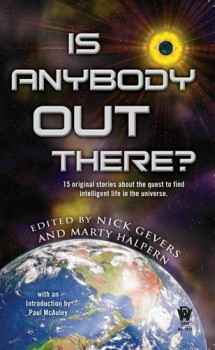
Is Anybody Out There?
Nick Gevers and Marty Halpern, eds.
DAW (312 pp, $7.99, June 2010)
Reviewed by David Soyka
The $64 question of the modern era is not whether God exists. How you answer that depends on intangibles and inferences based more on faith than the scientific method. What is nearly as imponderable is the empirical evidence of a vast universe (and possibly co-existent multi-verses) within which conditions exist (or once existed) that may give rise to life as we know it (putting aside consideration of life as we don’t know it and are incapable of comprehending). Moreover, given the age of the universe, it is further conceivable that there is, somewhere in some galaxy, more advanced civilizations capable of interstellar travel that, by now, should be aware of our existence. Even if we are in an Einsteinean universe in which speed of light travel cannot be exceeded, seeing as how that we are already capable of mapping distant universes, presumably a more advanced civilization would have the technology to find us and make radio contact, just as we have been launching Elvis recordings out beyond the solar system in hopes of doing the same. With no results.
So, where are they? This is the crux of the famous Fermi Paradox, posed by the Nobel physicist who reasoned that given the mathematical probabilities of the existence of alien civilizations, why hasn’t anyone phoned home? Is it truly possible that we are the only intelligent beings in the universe? Or, more depressing, are “intelligent” beings fated to self-destruct, allowing technology to harness their fate instead of the other way around, before becoming capable of interstellar travel?
Lin Carter’s Anton Zarnak is a man of mystery. With a jagged streak of silver running through his black hair from his temple to the base of his skull and his exotic features and peculiar mannerisms, Zarnak is almost as outré as the enemies he fights. With a startling knowledge and a somewhat sinister history, Zarnak battled evil in three stories penned by Carter — “Curse of the Black Pharaoh”, “Dead of Night”, and “Perchance to Dream” — as well as in a half dozen or so more contributed by the likes of Robert M. Price, CJ Henderson, Joseph S. Pulver Sr. And James Chambers. All of these stories, for those interested, are collected in Lin Carter’s Anton Zarnak: Supernatural Sleuth from Marietta Publishing.
Like the pulp characters Carter based him on, Zarnak is something of a Renaissance man. Educated at a number of prestigious universities, including the Heidelberg (where he studied theology with a certain Anton Phibes, according to “The Case of the Curiously Competent Conjurer” by James Ambuehl and Simon Bucher-Jones), the Sorbonne and Miskatonic University, he is an accredited physician, musician, theologian and metaphysicist. He speaks eleven languages and has one of the finest and most complete collections of occult literature in existence. His home drifts like a soap bubble between Half-Moon Street in London, No. 13 China Alley in San Francisco and a cursed apartment building in New York; always decorated in oriental splendour, it is filled to bursting with esoteric paraphernalia, including a hideously decorated mask of Yama which always hangs in a place of honour above Zarnak’s desk.
And, as the saying goes, ‘so a man’s home, his mind’ — Zarnak is the proverbial odd duck. By turns consoling and caustic, arrogant and affectionate, and almost inhumanly ruthless, Zarnak is no comforting Judge Pursuivant or soothing John Silence. He is singularly and irrepressibly Zarnak.
Nowadays, most anyone who’s into science fiction and fantasy will know Dave Kirtley, half of the team that hosts The Geek’s Guide to the Galaxy. What I bet a lot of people don’t know is that he has copied GAME OF THRONES, word for word, by hand, to learn about style and sentence structure, or that he’s also a talented artist who wants to help other up and coming artists get exposure. When I first met him, he was still a newly minted Asimov Award winner (the award has since been renamed the Dell Award), soft spoken, and curious about how I’d fallen in with such a motley crew of critique groupmates. I think we spent most of that first conversation talking about George R.R. Martin, because back then I was the cool person who knew George and Dave hadn’t even met him. I even introduced Dave to George at TorCon during a wild party thrown by the Brotherhood Without Banners. And when I say wild, I mean really full of people in odd costumes (okay, fine, by con standards, not wild). George was sitting in the back of the room by himself because none of his fans were brave enough to try to talk to him.
And now, how times have changed. Dave’s the one with all the cool friends and contacts, but he agreed to let me interview him, either because he’s really nice (he seems that way, at least, though soft spoken people can be sneaky about that) or because he thinks I set up that first meeting with George R.R. Martin that led to us having his full attention for most of the rest of the party. I didn’t hesitate to wonder, just sent him interview questions before he could change his mind.
Oaths, vows, geasa, bindings–you love reading about that kind of thing, or you wouldn’t be here at Black Gate. A vow is powerful magic. A vow written or witnessed is more powerful still.
You would think, then, that the New Year’s resolutions that saturate our culture this time of year would work better than they do. There’s lots of help out there for people who make resolutions about physical fitness, but not so much for people who make resolutions about their writing. How do you come up with a writing resolution that you’ll be glad to fulfill, not just when it’s all over, but while you’re actually doing the work? If you’ve already made a resolution, how do you follow through on it? Maybe last year you tried the crazy ordeal that is Nanowrimo, and you’re looking for a way to tap into its productivity that is actually sustainable. Maybe Nanowrimo’s cheery cultishness turned you off, and you’re sure there must be another way.
There’s an abundance of other ways, thank goodness. Although I have fond memories of frenzied November write-ins, and my novella that’s slated to appear in a forthcoming issue of Black Gate got its start as the first chapter of a Nanowrimo project, my Nanowrimo survival skills are some of the least sustainable writing behaviors in my repertoire. I have some very different ones that have helped me stay in the game for years and finish some long, daunting projects. I want to tell you about some books on process that have been of enduring use to me in broadening that repertoire.
Is it me, or do you think this dragon might be cold?
Do any of you have a gaming shelf? How about a gaming wall? Or even in the case of our fearless leader John O’Neill a ‘Cave of Wonders’ filled with literally thousands of RPGs and games?
Well if you do, then you’ll fully understand the feeling you get when you look at those shelves and feel a mix of nostalgia for times lost, and regret for games never played. With all those books, from so many companies and editions of each title, I couldn’t help wonder at what I missed, especially after the news that WotC is now in production of a 5th Edition of D&D.
Still, I always want to give folks an update on some older material, in this case 2E, even if I’m three and a half editions behind the curve. Today’s topic, the 2E AD&D‘monster’ that is the Dragon Mountain Boxed Set. This thing is huge, and from what I can see epic, but I’ve always found it so daunting that I’ve yet to actually play it. I think I’ve used pieces in other campaigns over the years, but never as a whole.
I have to wonder if anyone else out there ever had this issue, or ever played the full box. It seems like a pretty well thought out campaign, and I have to admit that the concept of a full 2Edungeon crawl where the main obstacle to the characters are Kobolds always kept me pleasantly intrigued.
In all I counted out 12 Kobold clans in the three volumes inside the box, and you almost need a road map to understand the relationships between them. There are also sixteen player handouts, eight of the old monstrous compendium sheets, 12 full color reference cards, a full set of counters for miniature play, and six, count them SIX full-color fold out maps!
Nihilism got you down? Can’t stomach yet another scene of rape and torture? Need a break from learning your eleventeenth language and living abroad? If so, then io9 has the prescription for your burning fever:
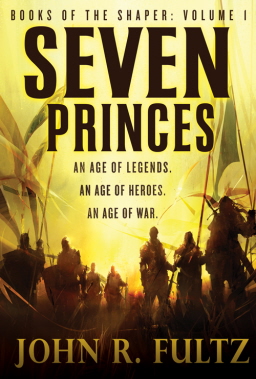
These days, fantasy novels seem to be all about realism. Or at least, semi-realism. … So it’s a pleasure to read an unabashed over-the-top fantasy epic like John R. Fultz’s Seven Princes, in which totally batshit stuff happens every few pages and the wonders aren’t rationed at all. Fultz writes at a frenetic pace, as if worried he’ll run out of pages before he throws in all the cool stuff he’s thought up. It’s kind of amazing.
…
What Seven Princes does have to offer, though, is breakneck pacing and nonstop insanity. Every few pages, foxes are turning into naked ladies or giants are going off to talk to the mermaid queen, or a long-lost race of blue giants is randomly discovered, or evil dark spirits are destroying entire kingdoms. It’s epic with a capital EPIC.
And judging by the majority of comments, vitamin Fultz is the tonic lots of folks are craving.
Edgar Rice Burroughs’s Mars, Part 2: The Gods of Mars
I played a bit rough with A Princess of Mars last week in my first installment of this eleven part mega-series on the Martian novels of Edgar Rice Burroughs. That book knocked me out when I first read it as a junior high school kid, but it was also the first ERB book I ever picked up. Now that I’ve read most of Burroughs’s canon, the flaws of his first book seem more obvious. For all that is wonderful about A Princess of Mars, it looks like a runt compared to the book I knew was snapping at its heels: The Gods of Mars. Also known as: “Edgar Rice Burroughs gets the knack.”
Our Saga: The adventures of Earthman John Carter, his progeny, and sundry other visitors and natives, on the planet Mars. A dry and slowly dying world, the planet known to its inhabitants as “Barsoom” contains four different human civilizations, one non-human one, a scattering of science among swashbuckling, and a plethora of religions, mystery cities, and strange beasts. The series spans 1912 to 1964 with eleven books: nine novels, a book of linked novellas, and a volume collecting two unrelated novellas.
In his original proposal to editor Thomas Newell Metcalf at Munsey’s Magazines regarding a novel of Martian adventure, Edgar Rice Burroughs suggested he could write three books from the concept. But he apparently wasn’t certain about the content of the second and third volumes to follow A Princess of Mars, since it was Metcalf who gave him the idea of where to start the next book. After Metcalf rejected Burroughs’s second novel, The Outlaw of Torn, he urged the author to return to Mars and send John Carter into the Valley of Dor, the mysterious paradise mentioned a number of times in the first book. Burroughs ran with the concept, and finished the novel in the beginning of October 1912.
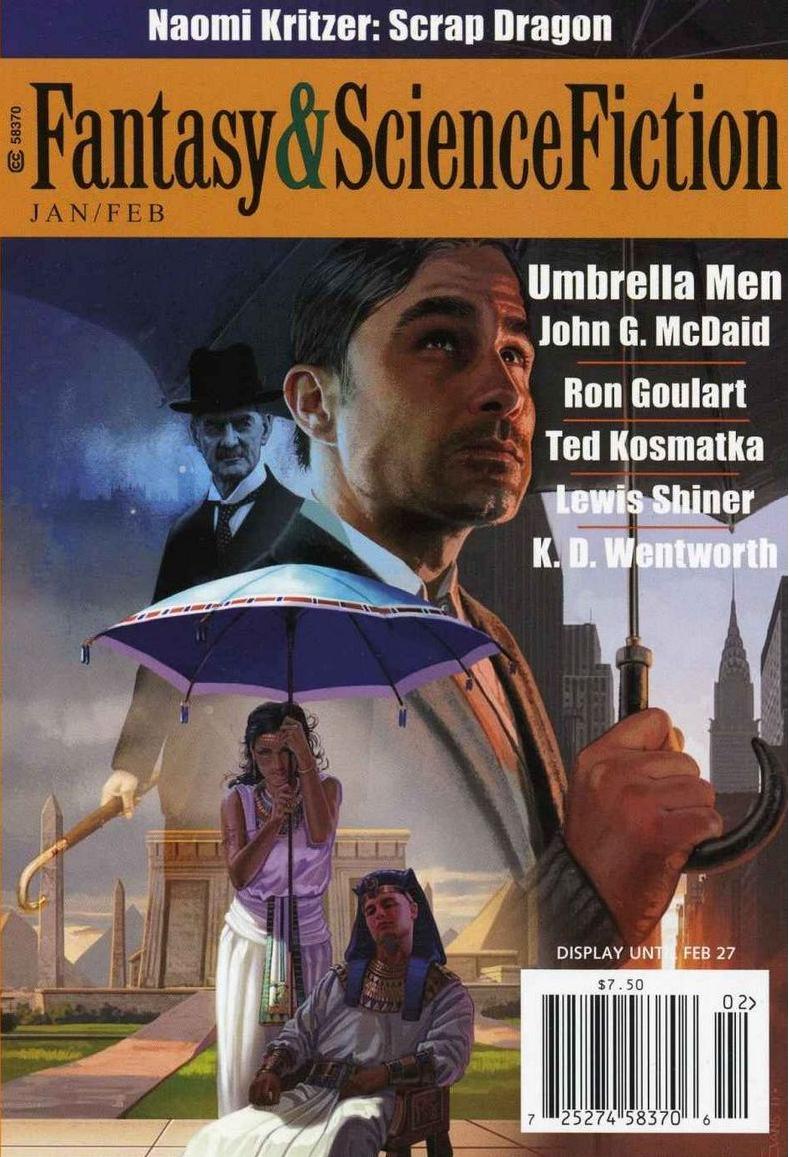
I was very pleased to see Mark Evans, who’s published artwork in every issue of Black Gate since 2005, get another cover assignment for Fantasy & Science Fiction. That’s his contribution at right, gracing the cover of the Jan/Feb issue. Mark’s one of the most talented artists in the field, and it’s great to see him get the exposure he deserves. The rest of the issue is pretty impressive as well. Contents include:
NOVELETS
Small Towns – Felicity Shoulders
The Secret of the City of Gold – Ron Goulart
Umbrella Men – John G. McDaid
Alien Land – K.D. Wentworth
Mindbender – Albert E. Cowdrey
The Color Least Used by Nature – Ted Kosmatka
SHORT STORIES
The Comfort of Strangers – Alexander Jablokov
Maxwell’s Demon – Ken Liu
Scrap Dragon – Naomi Kritzer
In the Trenches – Michael Alexander
Canto MCML – Lewis Shiner
Lois Tilton at Locus Onlinereviews the entire issue, including “In the Trenches” by Michael Alexander:
WWI. Hans is a soldier on the German side, near the starving end of the action, when Gamlin the kobold emerges from the trench. He thinks the humans are crazy and Hans doesn’t disagree. The kobold takes him far underground where he finds a French soldier, and they immediately make a truce…
An unusual viewpoint on the horrors of war and on being human. The tone is light, but the horrors are genuinely dark. The combination works.
Cover price is $7.50. You can find more details on the issue at the F&SFwebsite. We last covered F&SF here with the November/December issue.
Mike Mearls, senior manager of D&D research and development at Wizards of the Coast, today announced the project that will become the fifth edition of the world’s most popular role playing game.
Confused by the plethora of editions? Wondering if this is really a big deal? You’re not alone.
Gary Gygax and Dave Arneson published the first Dungeons and Dragons rules in a hand-assembled boxed set in 1974; in 1977 Gygax completely revamped the game into Advanced Dungeons & Dragons, the version that catapulted it into a household name. In 1989 David “Zeb” Cook and a new team at TSR rewrote the game, releasing a Second Edition of AD&D aimed primarily at younger players. D&D 3rd Edition arrived in 2000 from new owners Wizards of the Coast; it is widely credited with saving the game — and revitalizing the entire RPG industry with the streamlined d20 System, released at the same time. Version 3.5 came along in 2003, tweaking numerous rules, and the most recent incarnation is the Fourth Edition, published in 2008.
And yes, it’s a big deal.
Wizards is putting out the call to players around the world to assist in development, with an ambitious open playtesting program starting this spring. You can help shape the future of the game by signing up for the playtest here. According to Mearls,
The ultimate goal of this next iteration of D&D a game that rises above differences of play styles, campaign settings, and editions, one that takes the fundamental essence of D&D and brings it to the forefront of the game.
You can read the complete announcement here, and read more about the genesis of the new edition in today’s New York Times.
 There are those who will maintain that in order to call yourself a “fan” of something, you must be a complete expert on that topic.
 Is Anybody Out There?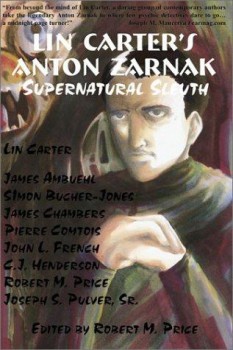
 Nowadays, most anyone who’s into science fiction and fantasy will know
  Oaths, vows, geasa, bindings–you love reading about that kind of thing, or you wouldn’t be here at Black Gate. A vow is powerful magic. A vow written or witnessed is more powerful still.
 Nihilism got you down? Can’t stomach yet another scene of rape and torture? Need a break from learning your eleventeenth language and living abroad? If so,
  I played a bit rough with A Princess of Mars last week in my