Browsed by
Category: Vintage Treasures

Vintage Treasures: The Song of Mavin Manyshaped by Sheri S. Tepper

Vintage Treasures: The Song of Mavin Manyshaped by Sheri S. Tepper

The song of Mavin Manyshaped-smallI think I’m finally starting to figure out Sheri Tepper’s 9-volume magnum opus The True Game (believe me, it took some work.)

I accidentally started (as usual) in the middle, with Dervish Daughter, which I didn’t even realize was part of a series, much less the eighth frickin’ volume. However, I overcame this as, after many decades of reading fantasy, I have mad reader skillz. Dervish Daughter isn’t really the eighth volume anyway, it’s actually the middle volume of the last trilogy, known as The Books of the True Game: Jinian.

The first trilogy, The Books of the True Game: Mavin Manyshaped, was written second, after the middle trilogy, which was composed of King’s Blood Four, Necromancer Nine, and Wizard’s Eleven, which were collectively gathered in a one-volume edition as The True Game. Which isn’t at all confusing. Still with me?

Forget it, I’m lost again. Let’s start over. The Song of Mavin Manyshaped is the first book in the first trilogy of The True Game. Mavin is a shapeshifter, and this opening trilogy tells the story from her point of view.

It is never easy growing up as a shape-shifter, learning to control the wild Talent for changing into any shape at all — a winged dragon, a pillar of stone, another human being, a creature from a nightmare. But for Mavin Manyshaped — one of only two she-shifters in her tribe, and recklessly headstrong by nature — coming of age is both exhilarating and terrifying. Little does she know she is destined to become the most notorious shape-shifter in all the lands of the True Game.

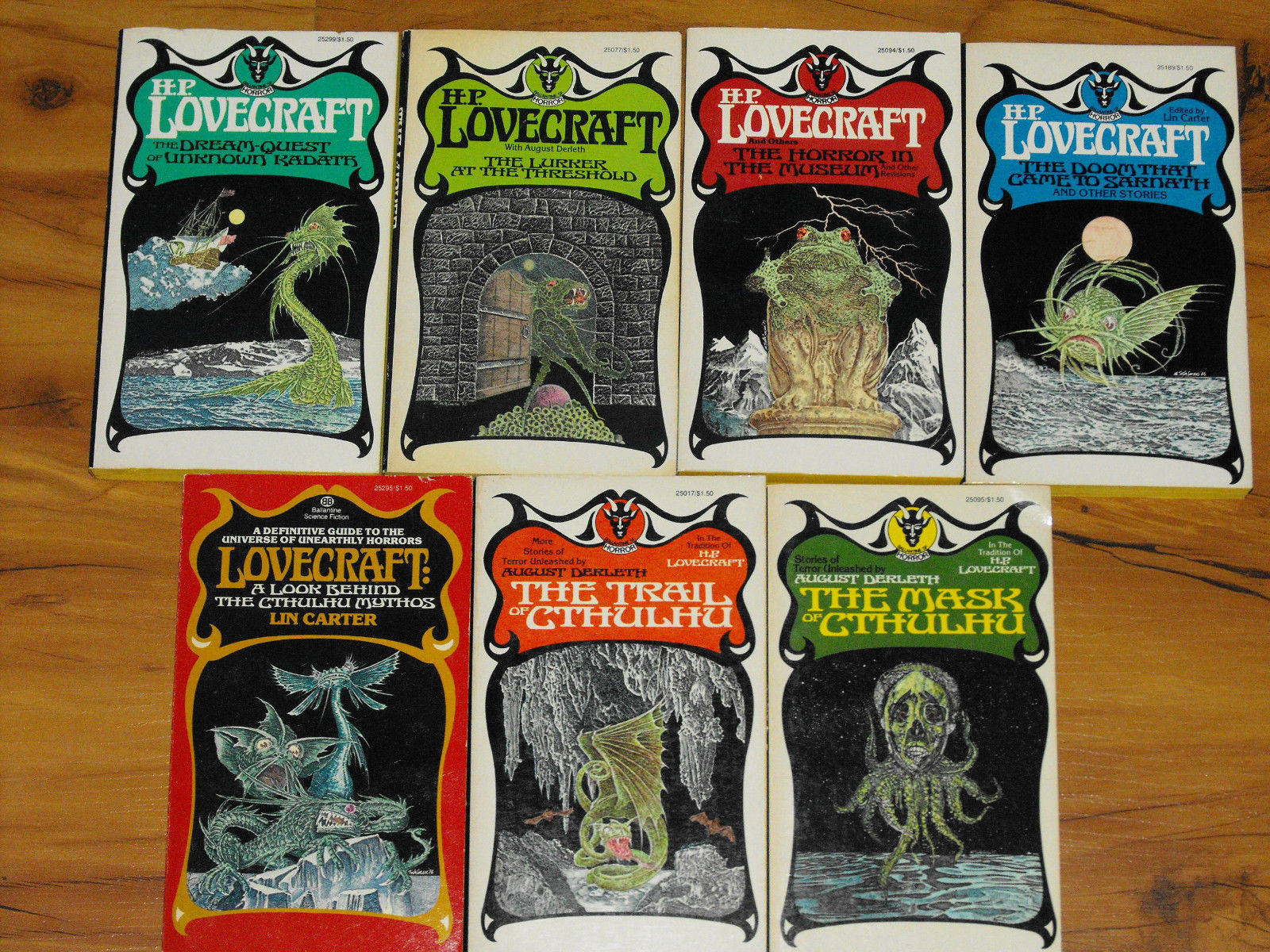
I bought The Song of Mavin Manyshaped as part of a jaunty collection of seven Sheri S. Tepper paperbacks on eBay for $10.50. They’re not all part of The True Game… I think. Anything is possible.

Read More Read More

The Original Bug-Eyed Monster: Astounding Stories, May 1931

The Original Bug-Eyed Monster: Astounding Stories, May 1931

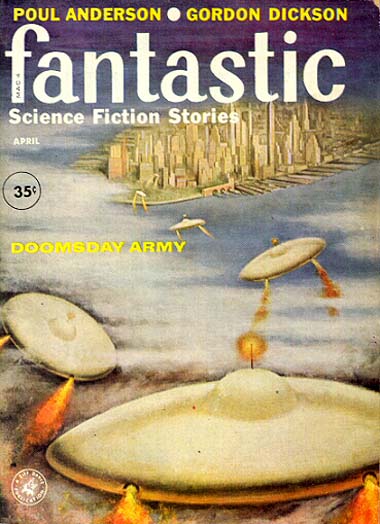
Astounding Stories May 1931-smallPulps are my weakness. I discovered them when I was just 12 years old, in Jacques Sadoul’s marvelous art book 2000 A.D. Illustrations From the Golden Age of Science Fiction Pulps (which I discussed back in May). That book sparked a lifetime interest in pulp magazines, where American science fiction was born.

Of course, I was too young to have purchased or read any pulp magazines myself in 1976. Pulps died out in the 1950s, killed off by wartime paper shortages and changing economics. So I’ve relied on the collector’s market to supply me with magazines — an expensive proposition, especially if you’re a completist.

Over the years, I’ve gotten more discriminating in my collecting. I dearly love Planet Stories, Weird Tales, Amazing Stories, Thrilling Wonder, Unknown, Air Wonder Stories, and many other pulps. But my favorite is Astounding Stories (later Astounding Science Fiction), the magazine which — under legendary editor John W. Campbell — ushered in the so-called Golden Age of Science Fiction, discovering Robert A. Heinlein, A.E. van Vogt, Isaac Asimov, Theodore Sturgeon, and many, many others. Campbell became editor with the October 1937 issue and he quickly transformed the entire field. 

Curiously, the most expensive and in-demand issues of Astounding aren’t from Campbell’s reign, however. They’re from its first three years, 1930-1933, the period known as the Clayton Astounding, when it was owned by Clayton Magazines. That’s their symbol, the little blue pennant, in the top right of the cover at left.

Very little fiction from the Clayton period is remembered today — and if you’ve never heard of the Clayton Astounding, you’re not missing much. The magazine’s early editors, like most of the American public, didn’t really understand science fiction and mostly filled the magazine with thinly disguised westerns in space and early space operas. But the covers… ah. They’re a very different story.

Read More Read More

Old Favorites: Katherine Kurtz’s Deryni

Old Favorites: Katherine Kurtz’s Deryni

Deryni rising I don’t usually fan or geek out about stuff – my credentials in geekdom are rarely questioned, but I was thinking the other day about my influences and in what direction I might want them to go.

I’ve been reading a lot of space opera and really hard sci-fi lately, mostly Alastair Reynolds with a side of Stephen Baxter, as I get ready to start a new novel. But hard sci-fi and fantasy are just setting. Any plot structure can fit inside them. Baxter is a lot of adventure. Reynolds is very noir.

dragon 78That got me to thinking about what stories I enjoyed and why. One of the appeals of Game of Thrones is how it’s a giant soap opera. Claremont’s run on Uncanny X-Men was similarly soapy, as was the reimagined Battlestar Galactica.

And that reminded me of how much I loved Katherine Kurtz’s Deryni series as a teen. The Kingdom of Gwynedd, a human world of the Middle Ages with a scattering of persecuted psionic families, has always seemed to me to be one of those surprisingly under-appreciated corners of fantasy.

The only reason I’d ever heard of it was because of issue #78 of Dragon magazine, which was an issue devoted to psionics in AD&Dand one of the articles featured the characters of Kurtz’s Gwynedd in role-playing terms. I looked for her books at my local second-hand store as soon as I could.

Right away, I found two of Kurtz’s core trilogies, the Deryni series (Deryni Rising, Deryni, and High Deryni) and the Camber series (Camber of Culdi, Saint Camber, and Camber the Heretic), and even after only the first one, I was hooked.

Read More Read More

Vintage Treasures: Martians, Go Home by Fredric Brown

Vintage Treasures: Martians, Go Home by Fredric Brown

Martians-Go-Home-smallThe last time I talked about Fredric Brown, I called The Best of Fredric Brown one of the best short story collections I’ve read in years. Brown is best remembered today for his short stories — including  “Arena,” “Puppet Show,” and “The Geezenstacks” — but his novels are also fondly remembered.

Martians, Go Home is probably his most famous. A shorter version originally appeared in the September 1954 issue of Astounding; it was expanded a year later for publication in hardcover by E. P. Dutton. Set in the distant future of 1964, it begins as SF writer Luke Deveraux opens the door of his desert cabin in a drunken stupor to find a little green Martian, a one-creature invasion who proceeds to make Deveraux’s life hell. Richard A. Lupoff called it “one of the most charming bits of SF-whimsy ever written.” Here’s the description from the back of the 1976 Ballantine paperback.

THEY WERE GREEN, THEY WERE LITTLE, THEY WERE BALD AS BILLIARD BALLS AND THEY WERE EVERYWHERE!

Luke Devereaux was a science fiction writer, holed up in a desert shack waiting for inspiration. He was the first to see a Martian… but he wasn’t the last!

It was estimated that one billion of them had arrived — one to every three human beings on Earth — obnoxious green creatures who could be seen and heard, but not harmed, and who probed private sex lives as shamelessly as they probed government secrets.

No one knew why they had come. No one knew how to make them go away — except perhaps, Luke Devereaux. Unfortunately he was going slightly bananas, so it wouldn’t be easy. But for a science fiction writer nothing was impossible…

The cover painting by Frank Kelly Freas became one of his signature works, used as the cover of Astounding, two paperback editions, a calendar, and Freas’s art book (see the various versions here.)

Martians, Go Home was published by Ballantine Books in September 1976. It is 163 pages, originally priced at $1.50. It is currently out of print, but available in digital format from Hachette and audio book from Skyboat Media.

Welcome To The Commonwealth: John Myers Myers’ Silverlock

Welcome To The Commonwealth: John Myers Myers’ Silverlock

Silverlock Ace paperbackLast week, I was talking about L. Sprague de Camp and Fletcher Pratt’s Compleat Enchanter and it occurred to me that one of the great pleasures of that work is encountering familiar myths, persons, and fictional events in a new guise and from a new perspective. It’s also a bit intimidating, from the point of view of a writer, to realize just how thoroughly de Camp and Pratt had to know their source materials.

It doesn’t take very long to go from these thoughts to the great masterwork of this type, John Myers Myers’s Silverlock. On the surface, the book tells the story of  A. Clarence Shandon – re-christened Silverlock due to a white streak in his hair —  on his journey of self-discovery after being shipwrecked on the shores of the Commonwealth.

It doesn’t take long, in fact he’s still in the water,  for the well-read person to begin to find a certain quality of familiarity in the narrative, to figure out that Shandon has made landfall in the Commonwealth of Letters. From the very first, every  person he meets, every place he goes, everything that happens to him, alludes to some piece of literature. Every single person, place, or thing. What adds to the pleasure is that Shandon himself has no idea of what’s happened to him. His degree is in business administration.

Now this might strike you as a bit overwhelming, or even a bit tedious, but it isn’t. Shandon himself, without being aware of it,  provides the key to enjoying the book:

At times the mind works on two levels at once, and it was so with mine on this occasion. Half of it was giving itself gleefully to the moment, while the other half was revolving a new idea. What had impressed me was that this friar was well-informed and had a lot of fun out of that fact alone…  I glimpsed the concept that to know a thing for itself could be a source of joy. Take the song we were bellowing. It was easy to appreciate, but I would have had more chuckles out of if I had known, as the others did, about the personages involved.

Read More Read More

Blogging Sapper’s Bulldog Drummond, Part Four – “The Third Round”

Blogging Sapper’s Bulldog Drummond, Part Four – “The Third Round”

510+vaEqotL._SY344_BO1,204,203,200_20974339Sapper’s The Third Round (1926) marked a return to the more humorous tone of the first book in the series. Not only the humor, but the premise of that initial book is invoked with the decision to again build the plot around a spunky female whose doddering old father has fallen prey to heinous villains. All trace of The Black Gang (1924) and its doom-laden paranoia over England likewise falling prey to a communist revolution has been removed. In its place we have Hugh Drummond once again eager to escape the boredom of everyday life and engaging in comical banter with friends and foes alike.

The starting point for the adventure this time is the impending nuptials of Algy Longworth, Hugh’s old friend who has finally been reduced to the silly ass familiar from the stage play and film adaptations. The catalyst for Algy’s descent into idiocy is his having fallen head over heels in love to the extent that he now horrifies his friends by reciting poetry. So serious is his obsession with the girl of his dreams that he has become a literal walking disaster shunned by all who know him.

Read More Read More

A Bomb on the Highway: The Adventures of Captain Marvel, Chapter Eight: Boomerang

A Bomb on the Highway: The Adventures of Captain Marvel, Chapter Eight: Boomerang

Tom Tyler as Captain Marvel-smallEase back in your seat and take a deep breath. That’s the way. Now a handful of buttered popcorn… wash it down with a swallow of soda pop. Your week of unbearable suspense is almost over, and now you can finally find out how Billy and Betty got out of last week’s impossible situation; the answer will be revealed in today’s chapter of The Adventures of Captain Marvel, “Boomerang.” (Notice I didn’t say “if they got out.” I respect your intelligence too much for that.)

This week’s catch-up title cards on last week’s episode are brief and to the point: “The Scorpion: Plans an elaborate trap to catch Captain Marvel.” “Barnett — Holds Betty and Billy Batson in a shack at the bombing range.” Now, as the magic name of Shazam passes your lips, prepare yourself for ten cents’ worth of suspense and superheroic thrills! (No refunds.)

Last week, we left Billy and Betty tied up in the shack at the bombing range, waiting for the other shoe… er, bomb, to drop. (What? Your town doesn’t have a bombing range? Mine either. The decline in social services these days is just shameful — libraries closed every other weekend, public parks run down and neglected, no bombing ranges… ) Betty calls for Captain Marvel on the radio, but is knocked out by a falling beam when the first bomb hits. Billy, meanwhile, struggles with his bonds — and his gag.

At the last moment, using the powerful jaw muscles he’s built up over years of broadcasting, Billy works the gag loose and shouts “Shazam!” Billy Batson vanishes, to be replaced by Captain Marvel, who quickly scoops up Betty (and the chair she’s tied to — Tom Tyler’s line readings are only fair, but he’s better at heavy lifting than any actor I’ve ever seen) and exits the shack, just an instant before it’s blown to pieces by a bomb.

Read More Read More

The Drawing of the Dark by Tim Powers

The Drawing of the Dark by Tim Powers

oie_843719JA9UJcX8I have loved the work of two-time World Fantasy Award-winning and two-time Philip K. Dick Award-winning author Tim Powers ever since I read The Anubis Gates (one of the foundational works of steampunk) back in 1984. Since then, I’ve been equally thrilled by a number of his other books, including The Stress of Her Regard, his tale of artists and vampiric monsters; Last Call, about the search for the Fisher King in Las Vegas; and Three Days to Never, involving time-travel, Albert Einstein, and Charlie Chaplin.

Every few years I feel the pull to revisit his third novel, The Drawing of the Dark (1979). It’s a swords & sorcery adventure set in 1529 and climaxing during Suleiman the Magnificent’s siege of Vienna.

Briefly, The Drawing of the Dark is about the adventures of Brian Duffy, an aging soldier of fortune who encounters a stranger with an offer of employment at just the time circumstances require him to flee Venice.

The old man who’d hailed Duffy stood by the window, smiling nervously. He was dressed in a heavy black gown with red and gold embroidery at the neck, and wore a slim stiletto at his belt, but no sword.

“Sit down, please,” he said, waving at the chair.

“I don’t mind standing,” Duffy told him.

“Whatever you prefer.” He opened a box and took from it a narrow black cylinder. “My name is Aurelianus.” Duffy peered closely at the cylinder, and was surprised to see that it was a tiny snake, straightened and dried, with the little jaws open wide and the end of the tail clipped off. “And what is yours?”

Duffy blinked. “What?”

“Oh! I’m Brian Duffy.”

Aurelianus nodded and put the tail end of the snake into his mouth, then leaned forward so that the head was in the long flame of one of the candles. It began popping and smoldering, and Aurelianus puffed smoke from the tail end.

Read More Read More

Kirkus Looks at The Science Fiction Hall of Fame, Volumes I – IV

Kirkus Looks at The Science Fiction Hall of Fame, Volumes I – IV

The Science Fiction Hall of Fame Volume 4-smallOver at Kirkus Reviews, Andrew Liptak continues his thorough and excellent survey of vintage science fiction with a look at one of the most important anthology series in the history of the genre: the four-volume Science Fiction Hall of Fame. Here he is on the first volume:

The book appeared as a hardcover in 1970 under the title The Science Fiction Hall of Fame, Volume One: The Greatest Science Fiction Stories of All Times, chosen by the members of the science fiction writers of America. Silverberg, in the introduction, described the anthology as “nearly definitive an anthology of modern science fiction stories as it likely to be compiled for quite some time.” The book sold well, and sold out within a year. Doubleday sold the rights to Avon Books, which published a paperback edition in July 1971; it would go through dozens of printings in the coming decades. In 1971, it placed first in Locus’ annual poll for best Anthology/Collection…

The Science Fiction Hall of Fame, Volumes 1 & 2, are perhaps the finest SF anthologies of the 20th Century and even today they serve as a superb introduction to the genre for modern readers. (The only comparable books I can think of are The Hugo Winners, Volumes I and II, edited by Isaac Asimov.) I dearly love my Avon paperback editions, which are sturdy and well-read.

Read the entire article here. Or have a look at some of Andrew’s previous articles, including:

Kirkus Looks at Astounding Science Fiction
Kirkus Looks at Galaxy Science Fiction
Kirkus Looks at Donald A. Wollheim and the Ace Double
Kirkus Looks at The Meteoric Rise and Fall of Gnome Press
Kirkus Looks at Andre Norton’s Young Adult Novels

Vintage Treasures: The Bumper Book of Ghost Stories, edited by Aidan Chambers

Vintage Treasures: The Bumper Book of Ghost Stories, edited by Aidan Chambers

The Bumper Book of Ghost Stories-smallBelieve it or not, I’m still looking through the last of the loot from the 2014 Windy City Pulp & Paper show here in Chicago from April.

Now, I’m pretty good at tracking down hard-to-find paperbacks and vintage curiosities — as long as I know about them. It’s a little harder to locate fabulous objects of desire if you’ve unaware of them. And that’s one of the great pleasures of Windy City: even a casual walk through the great Dealer’s Room is a marvelous exercise in serendipity. I found gorgeous art books, rare fanzines, beautiful pulps, and much more.

And I also stumbled across a copy of a delightful vintage paperback: The Bumper Book of Ghost Stories, edited by Aidan Chambers, a Pan paperback published in the UK in 1976. It’s an omnibus collection of The Tenth Ghost Book and The Eleventh Ghost Book, with an original cover price of £0.75. I paid $4 for a copy in very good condition. A quick Internet search reveals that there were at least three more, also from Pan: The Second Bumper Book of Ghost Stories, edited by Polly Parkin and James Hale (1978, cover here), the Third, and the Fourth, both edited by Hale. More treasures for me to track down!

Read More Read More