Browsed by
Category: Vintage Treasures

The Public Life of Sherlock Holmes: The Best I’ve Ever Read…

The Public Life of Sherlock Holmes: The Best I’ve Ever Read…

BoysLife_Cover

See, this is my opinion: we all start out knowing magic. We are born with whirlwinds, forest fires, and comets inside us. We are born able to sing to birds and read the clouds and see our destiny in grains of sand. But then we get the magic educated right out of our souls. We get it churched out, spanked out, washed out, and combed out.

And so begins the best piece of writing I’ve come across.

In the seventies and the eighties, Robert R. McCammon was a successful horror author. Usher’s Passing (a sequel to Poe’s classic), Wolf’s Hour (World War II werewolf yarn) and Swan Song (post-apocalyptic epic) were among his excellent works. 1990’s Mine was a different kind of terror tale, as was 1992’s Gone South.

To oversimplify, McCammon wanted to move out of horror and into new genres. And he was told to forget it: to not mess with the formula (shades of Brian Wilson and Pet Sounds). So he wrote two historical novels that weren’t published, and he quit.

A decade later, that first historical book, Speaks the Nightbird finally saw the light of day in 2002 and has spawned seven sequels and one short story collection. The next book is under way. I read the first two and enjoyed them. But they grow continually darker and I quit after book three. Too much for me.

McCammon has written a few other novels and novellas, back in the horror genre. But he returned on his own terms, and not with a major publishing house.

Two thousand is a low estimate of how many books I’ve read, and the single finest piece of writing I’ve ever come across is in the introduction to his 1991’s Boy’s Life. Which isn’t really too surprising, because that is the finest book I’ve ever read; in any genre. It’s not a horror book: it’s a coming-of age tale. It’s a book about the magic of our youth. And what happens to that magic.

One of my favorite authors, Tony Hillerman, said that Fly on the Wall, was his attempt at writing The Great American Novel. He feels he came up short. He would know, though it’s in my Top Five Novels list. But I’m gonna say that Boy’s Life is McCammon’s Great American Novel. And it’s in the running for THE Great American novel You ask me for only one book to read (beyond the Bible), and I’m telling you Boy’s Life.

Here’s the rest of that snippet from the opening that has stayed with me for going on three decades:

Read More Read More

Galaxy Science Fiction, June 1951: A Retro-Review

Galaxy Science Fiction, June 1951: A Retro-Review

Galaxy June 1951-smallHere’s a review of a magazine issue that Matthew Wuertz has already covered here in his excellent ongoing traversal of Galaxy from its beginning … but I happened to read it and John O’Neill assures me that another (not necessarily dissenting) view is always welcome.

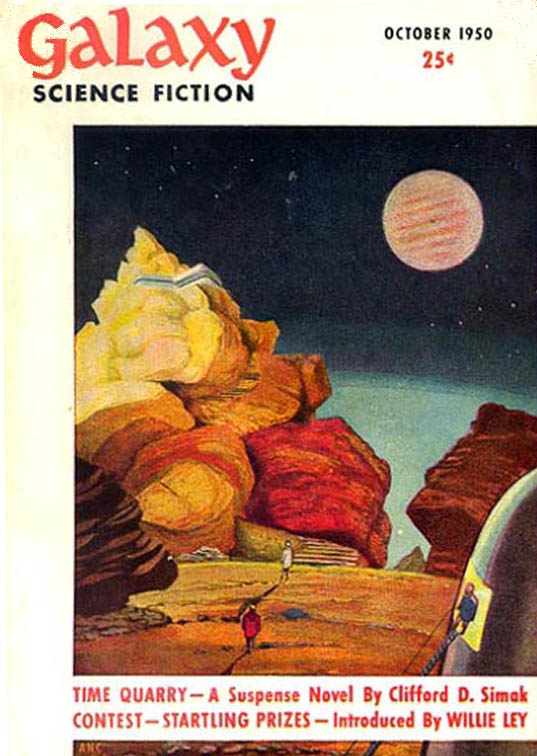
This is from the first year of Galaxy‘s existence. To me it reflects an magazine increasingly confident of its place. The cover doesn’t illustrate any story: it’s by Ed Emshwiller, titled “Relics of an Extinct Race”, and it depicts lizard-like aliens investigating rock strata containing remnants of human civilization.

The back cover advertises a book called The Education of a French Model, which was the memoirs of “Kiki de Montparnasse” (real name Alice Prin), who was somewhat famous as a nude model, and mistress of, among others, Man Ray, in the early part of the 20th Century. Her memoirs featured an introduction by Ernest Hemingway, which the ad happily trumpets. Other ads were for Saran Plastic Seat Covers, and for weight reducing chewing gum (called Kelpidine!), and other than that for books.

Interior illustrations were by Elizabeth MacIntyre, David Stone, David Maus, and “Willer” — this last a somewhat transparent (and, I would have thought, unnecessary) pseudonym for Ed Emshwiller (who usually signed his word Emsh). I note that except for Emshwiller the names are all unfamiliar, suggesting that H. L. Gold may have been looking for “new blood.” (For that matter, Emshwiller was “new blood” himself, a Gold discovery who had only begun illustrating for the SF magazines that year. It’s just that he’s the one of these illustrators who became a legend.)

Elizabeth MacIntyre is interesting as one of very few women SF illustrators in that era (the only other one I can think of offhand is the great Weird Tales artist Margaret Brundage). Todd Mason suggests, I think sensibly, that both the different set of illustrators and the unexpected advertisements can be attributed to Galaxy‘s publisher, World Editions, which had wider ambitions than just publishing SF.

Read More Read More

The “Known World” D&D Setting: A Secret History

The “Known World” D&D Setting: A Secret History

TSR's Known World
TSR’s Known World

Recently some old friends in Akron, Ohio, turned up a few pages of the pre-TSR homebrew Dungeons & Dragons rules created by Tom Moldvay and me in the mid-1970s. I was delighted to see them, as I thought all of our early collaborative work had been lost to history.

I first encountered Tom Moldvay in late 1973 at a meeting of the Kent State University Science Fiction Club. We hit it off right away, and quickly decided we ought to collaborate on something — we just weren’t sure what.

In early ’74 Tom came back from an SF convention with Dungeons & Dragons in its original white box edition. He DMed a session, I DMed a session, and suddenly we knew what we were going to create together: a fantasy world setting for D&D.

We had both read widely in world history and mythology, and enjoyed a lot of the same fantasy fiction; we traded Lin Carter’s Ballantine Adult Fantasy books back and forth until we’d read them all, as well as everything we could find by Howard, Lovecraft, Tolkien, Merritt, Haggard, Harold Lamb, Dunsany, Hodgson, Machen, and Zelazny.

We were both nuts about Clark Ashton Smith, Tom was a Michael Moorcock and Philip José Farmer fanatic, while I could quote chapter and verse from the works of Jack Vance and Fritz Leiber. So we knew what we wanted to create: a single world setting that would enable us to simulate the fictional realities of these, our favorite authors.

It was going to have to be a big world.

Read More Read More

Seven Lessons I Learned from RPG Games of Yore

Seven Lessons I Learned from RPG Games of Yore

Final Fantasy 2 Super Nintendo-smallGrowing up, my brother was a huge gamer, and I loved watching him play. He used to rent a Nintendo at the library every weekend, as well as the Final Fantasy cartridge. He would practically turn blue holding his breath all week, hoping no one else would rent it and save over that one precious on-cartridge spot.

Then, when the Super Nintendo was announced, he saved allll of his monies and my dad drove us to the States (it was coming out only months later in Canada!) He bought it, and we stared at those “high-res” graphics on the box all the way back home.

I bought him Final Fantasy 2 (I know, I know, it’s IV, but back in the day, Google didn’t alert us of all these things. Wait, am I old?  I’m going to ignore that.) I had to get Dad to drive me to the States to get it again, and it ate up all of my hard earned paper route proceeds. Totally worth it to see him jump up and down.

BUT, on top of the games teaching me things through their acquisitions (saving, planning, emotional manipulation/whining), I think it’s safe to say that we’ve all learned many other fine lessons from playing pixelated heroes.

Here are a few of mine.

Read More Read More

The New York Times on Andrew J. Offutt

The New York Times on Andrew J. Offutt

My Lord Barbarian-smallAndrew J. Offutt had a lengthy and successful career as a fantasy writer before his death on April 30, 2013 (which we reported on here.) He was one of the most popular writers in the Thieves World collective, with a trio of novels (Shadowspawn, Deathknight, and The Shadow of Sorcery), and his Conan pastiches, including Conan and the Sorcerer (1978) and Conan: The Sword of Skelos (1979), were highly regarded.

He also had an excellent reputation as an editor, in part due to his sword and sorcery anthology series Swords Against Darkness.

Offutt published fantasy under his own name, but the greater part of his output — chiefly early pornography — was written under a variety of pseudonyms. When he died he left his papers to his son Chris Offutt, who reports on his father’s unusual career in the Feb 5 issue of The New York Times Magazine, in an article titled “My Dad, the Pornographer.”

At 12, Dad wrote a novel of the Old West. He taught himself to type with the Columbus method — find it and land on it — using one finger on his left hand and two fingers on his right. Dad typed swiftly and with great passion. In this fashion, he eventually wrote and published more than 400 books. Two were science fiction and 24 were fantasy, written under his own name; the rest were pornography, using 17 pseudonyms… His primary pseudonym [was] John Cleve…

In the 1980s, John Cleve’s career culminated with a 19-book series for Playboy Press, the magazine’s foray into book publishing. The Spaceways series allowed him to blend porn with old-time “space opera,” reminiscent of the 1930s pulps, his favorite kind of science fiction. Dad’s modern twist included aliens who possessed the genitalia of both genders. Galactic crafts welcomed the species as part of their crews, because they were unencumbered with the sexual repression of humans and could service men and women alike. The books were popular, in part, because of their campiness, repeating characters and entwined stories — narrative tropes that later became standard on television.

Read the complete article here.

Vintage Treasures: Starshine by Theodore Sturgeon

Vintage Treasures: Starshine by Theodore Sturgeon

Theodore Sturgeon Starshine Pyramid-small Theodore Sturgeon Starshine Pyramid 2-small Theodore Sturgeon Starshine Pyramid 3-small

For this installment of Vintage Treasures, we’re going to set the Wayback Machine for that far distant era of American publishing, when it wasn’t at all unusual for a midlist science fiction writer to publish a paperback collection clocking in at a slender 174 pages… and have it go through nearly a dozen printings in as many years. Ah, for the days when the American public had a greater appetite for short stories!

Starshine was Sturgeon’s thirteenth collection (thirteen short story collections! It boggles the mind). It included three novelettes and three short stories, spanning just over two decades of his career: 1940 to 1961. I’ve captured the covers of all the paperback editions in this article — if you’re an old-timer like me, maybe one of them will jog your memory.

The first edition of Starshine was the December 1966 Pyramid paperback (above left, cover by Jack Gaughan.) It was back in print less than two years later, in March 1969, with a new cover by Gaughan again (above middle). Why it needed a new cover, I dunno – I much prefer the original one.

Read More Read More

What Price Immortality? In Yana, the Touch of Undying by Michael Shea

What Price Immortality? In Yana, the Touch of Undying by Michael Shea

oie_34161QIl911YLAs I was rushing to get out of the house the other morning I remembered that I had to pick a book to read and review for this week. Nothing in the front row of my swords & sorcery shelves caught my eye so I started going through the books stacked in the back and still, nothing called out to me (that was short enough to read in just a couple of days). Finally I snagged the late Michael Shea’s In Yana, the Touch of Undying (1985). I saw the print was big, so even though it’s just over three hundred pages I knew it would be a quick read. I can’t believe that such lame criteria led me to this dynamite book.

Last year John O’Neill wrote that a friend had told him this book would change his life, though I didn’t remember that when I took up In Yana last Thursday. What I knew, from the back cover, was that the book featured a student named Bramt Hex searching for the secret of immortality in a world filled with ogres, ghosts, vampires, and lots of magic. From reading Shea’s very good Nifft the Lean, I expected a similar work of Vancian fantasy — dark, bizarre imagery laced with humor.

For the first chapter or two, In Yana appears to be just that. At 28, Bramt Hex has been a student for much of his life. He’s fat, worried about failing his final examination, and coming to dread what he assumes will be a life of day-in day-out dreariness in academia. When a wealthy dowager, the Widow Poon, enters the inn where he’s dining, Bramt allows a wave of romantic dreaming to sweep over him.

Read More Read More

The Ballantine Adult Fantasy Series: Figures of Earth by James Branch Cabell

The Ballantine Adult Fantasy Series: Figures of Earth by James Branch Cabell

Figures of Earth-smallFigures of Earth
James Branch Cabell
Ballantine Books (290 p, November 1969. $0.95)
Cover art by Robert Pepper

Okay, this one is probably going to be the last Cabell I read for a while. It turned out to be more of a slog than I expected. I’ll elaborate below.

Figures of Earth was the second volume of James Branch Cabell’s Chronicles of Fabled Poictesme, published as part of the Ballantine Adult Fantasy series. It is the story of how the swineherd Dom Manuel came to be the Count of Poictesme.

Poictesme is of course a fictional province in France. Cabell freely mixes real and imaginary locations in his work.

The story begins with Dom Manuel leaving his pigs to rescue the kidnapped daughter of a count from the sorcerer Miramon Lluagor. He hasn’t really been paying much attention to the pigs. Instead he’s been making human figures from clay because his mother told him from her deathbed that he should make a figure in the world. I suspect he misunderstood what she meant.

Anyway, Manuel sets off on his quest. Along the way, he meets the young woman Niafer, who is the one who actually gets them through the various magical traps along the way. Once they reach the sorcerer’s castle, they learn that things aren’t quite what they seem. The quest to rescue the princess is actually Miramon’s idea. She’s his wife, and he’s tired of her. Manuel and Niafer manage to reconcile the couple and start back down the mountain.

At the bottom of the hill, they are met by Grandfather Death. He is riding a black horse and has a white horse with him. Grandfather Death says that one of them must ride his white horse. Dom Manuel promptly volunteers Niafer to be the rider. She goes to her death without protest.

Read More Read More

Hitchhiker’s Guide to Edmond Hamilton: Who did Douglas Adams Really Read?

Hitchhiker’s Guide to Edmond Hamilton: Who did Douglas Adams Really Read?

Last-of-the-Star-Kings2-Copy
…how is it that Hitchhiker’s Guide to the Galaxy reads like a rip-roaring Silver Age Space Opera with added humour and satire?

Douglas Adams famously wasn’t an SF fan — apparently he “only got to about page 10” of most SF books (source) .

How odd, then, that Hitchhiker’s Guide to the Galaxy reads like a rip-roaring Silver Age Space Opera with added humour and satire.

Douglas Adams always told the same story about the birth of his magnum opus:

One night in 1971 a 19-year-old English hitchhiker named Douglas Adams lay drunk in a field in Innsbruck, Austria. He had with him a borrowed copy of Hitchhiker’s Guide to Europe by Ken Welsh.

No mention of reading widely in the genre.

Really?

Read More Read More

Vintage Treasures: Vulcan’s Hammer by Philip K. Dick/ The Skynappers by John Brunner

Vintage Treasures: Vulcan’s Hammer by Philip K. Dick/ The Skynappers by John Brunner

Vulcan's Hammer-small The Skynappers-small

One of the things I love about the early Ace Doubles is that they frequently paired young writers who later became superstars. It’s like finding a movie starring Scarlett Johansson and Elijah Wood when they were both 10 years old (that move exists, by the way. It’s called North. Don’t see it.)

The 1960 Ace Double Vulcan’s Hammer/The Skynappers is a fine example. It paired the 32-year old Philip K. Dick — well established by that point, with seven novels under his belt — with an up-and coming British author, the 26-year old John Brunner, whose first novel Threshold of Eternity had appeared as an Ace Double the previous year. Both went on to stellar careers. Indeed, they’re two of the most highly regarded SF writers of the 20th Century.

Neither of these two books is particularly well remembered, however. In fact, if you’re a Brunner fan and interested in reading The Skynappers, this 55-year old paperback is pretty much the only way to get it.

Read More Read More