Browsed by
Category: Vintage Treasures

The Omnibus Volumes of Jack Vance, Part I: Planet of Adventure

The Omnibus Volumes of Jack Vance, Part I: Planet of Adventure

Vance Planet of Adventure-smallI’ve been exploring the work of Jack Vance recently, inspired by the beautiful volumes from Subterranean Press collecting his earliest short stories, The Early Jack Vance. Four have been released so far, and we covered the upcoming fifth volume, Grand Crusade, here.

I don’t think I really understood just how prolific Jack Vance was until I set out to collect his paperbacks. I began that undertaking decades ago, and it’s still underway. At last count, I had well over 50. He published over 20 through DAW alone (Amazon has listed many of them here).

Still, one of the great things about Vance is that you don’t have to work hard to find his most popular fiction. Over the years much of it — including his Dying Earth, Demon Princes, Durdane, Alastor, and Ports of Call books — has been collected in handsome and affordable omnibus editions from Orb/Tor, Gollancz, and the Science Fiction Book Club. And most of them are still in print.

Earlier this week I published the third and final installment of my survey of The Omnibus Volumes of C.J. Cherryh. That started out as a modest attempt to catalog the omnibus editions of Cherryh’s early paperback SF and fantasy from DAW Books, and eventually became an excuse to showcase the covers of all 22 of her original novels. It was a lot of fun, especially if you have an obsessive interest in vintage paperbacks like I do.

Coincidentally, I ordered a set of Jack Vance omnibus editions earlier this month, and when they arrived I realized I could do the same thing with Vance. I’ve never really explored Vance’s back catalog with any thoroughness here at Black Gate, and it seemed like the right time.

So here we are. We’re kicking things off today with Planet of Adventure, an omnibus collection of four linked space opera novels: City of the Chasch (1968), Servants of the Wankh (1969), The Dirdir (1969), and The Pnume (1970). Next to The Dying Earth this is perhaps Vance’s most popular series, so it’s as  good a place to start as any.

Read More Read More

From Poul Anderson’s Vault of the Ages to the End of All Things

From Poul Anderson’s Vault of the Ages to the End of All Things

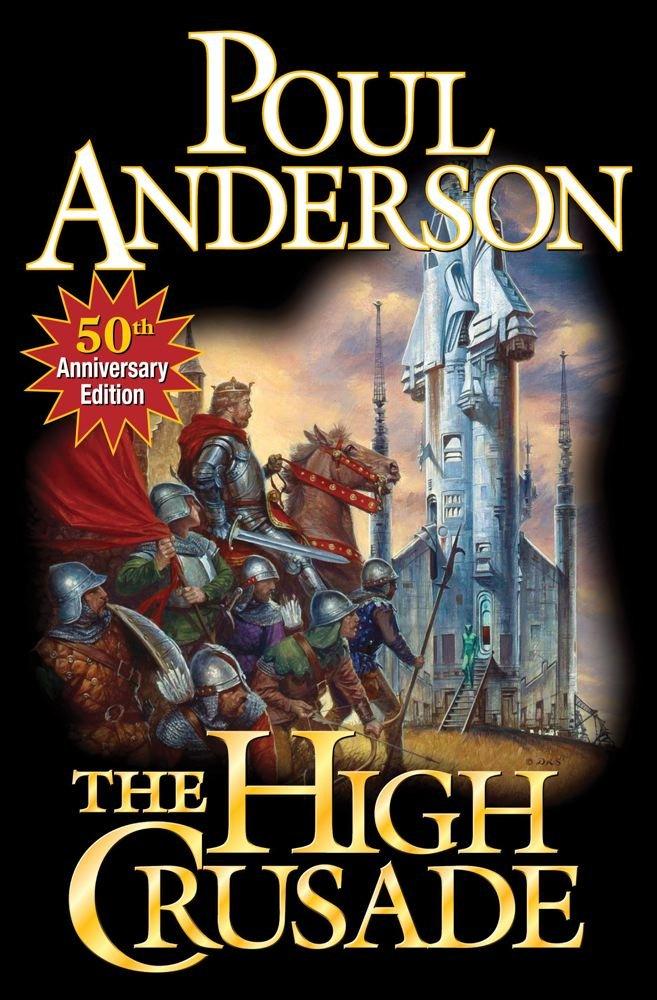
VaultoftheAgesEven though this survey seeks to showcase, specifically, Anderson’s fantasy works, I want to begin with what may be argued to be his first novel: Vault of the Ages.  It moreover wouldn’t be all that hard to argue that this work is fantasy, anyway. Perhaps it’s historical fantasy – a kind that anachronistically depicts a medieval northern tribal culture in the future. It’s undeniably post-apocalyptic, and many of these works are not only fantasy but escapist fantasy at that. Who hasn’t been locked into a frustrating, mind-numbing job – a stereotypical office job, for instance – and thought, “If only I had some real problems with which to deal with right now, like zombies, or road warriors, or radioactive mutants”? Who hasn’t secretly yearned for the chance to see what they truly are capable of, to pit their meager store of talents against all that the dangerous world might offer, and who hasn’t secretly concluded that they would do just fine – they would just have to get a gun, of course, and stockpile some food – and take out that weirdo next door, first thing!

Not only would I classify Anderson’s first novel as belonging to the species of post-apocalyptic literature, but I’d also call it mundane science fiction, because none of the science in here is extrapolative. In fact, it can be argued that there is no “science” here at all, because the gist of the science is the salvage of iron, to be hammered into common swords and shields, out of radioactive cities. And gunpowder which is hidden in the – you guessed it – Vault of the Ages.

I also might classify this as a boy’s novel, because it begins with an overly informational account of actual time capsules in Atlanta, Georgia and in New York City. It’s hard to see what purpose this introduction might serve other than didacticism, and this consequently suggests an audience that often is perceived to be in need of didacticism. Moreover, the main characters are routinely called “boys,” which, intentionally or not, because of the way in which these characters gleefully and energetically hurl themselves into very scary, very potentially fatal situations, lends this work the character of an adventure novel aimed at Boy Scouts. In other words, for me, this book is short in emotional realism. We shall have to talk about Viking age perspectives in time, but even taking this into account, the boys’ worldviews and actions seem wantonly cavalier.

Read More Read More

A Neglected Classic from the Golden Age of Sword & Sorcery: H. Warner Munn’s Merlin Cycle

A Neglected Classic from the Golden Age of Sword & Sorcery: H. Warner Munn’s Merlin Cycle

Merlins Godson H Warner Munn-smallI first encountered H. Warner Munn by chance. Or maybe he encountered me, and it was more than pure chance.

I started reading fantasy and science fiction in high school, when a friend recommended Anne McCaffrey’s Dragonflight books. I dutifully took the first one out of the public library and soldiered through it. I was impressed enough to decide to start broadening my narrow literary horizons. The problem was that, in South Africa in the 1980’s, the big book sellers stocked a pretty limited selection of genre titles, and the more specialized sellers were few and far between.

The solution was for my friend Graham and I to take a bus to the city center after school, and explore some of the independent and more specialized shops. One in particular has a vast array of genre books, and to this day I lament its eventual closure.

I encountered a myriad of unknown authors and works on that shop’s shelves. One that particularly intrigued me – although not enough to part with my pitifully small amount of cash – was The Misplaced Legion, by Harry Turtledove. I never saw that book on the shelves again.

Fast forward a decade and a bit and, lo and behold, the internet was here and much exploring was done. I dredged my memory — while whittling away at my employer’s internet bandwidth — looking for bits and pieces to fill out my book and RPG collections. Memory failed me somewhat, however, and when I attempted to recall that vague, impressive book from the ‘80s, I remembered it as… The Lost Legion. I no longer had a clue to the author’s name, either.

Read More Read More

Fantastic Universe, September 1959: A Retro-Review

Fantastic Universe, September 1959: A Retro-Review

Fantastic Universe September 1959-smallHere is probably one of the less-remembered digest SF magazines of the 1950s. Fantastic Universe was founded in 1953 and lasted until 1960, publishing 71 issues overall… it was a bimonthly briefly then a monthly until its demise (with a missed issue or two along the way). Thus it survived the collapse of the pulps in about 1955, and the American News Company disaster in 1957 or so, and even Sputnik. That’s not a bad run, all things considered.

But what does historian of the field Mike Ashley say of it (in Tymn/Ashley, Science Fiction, Fantasy, and Weird Fiction Magazines):

Fantastic Universe was born at the height of the SF magazine boom in 1953, and perhaps the most surprising fact about it was that it survived the boom and appeared regularly throughout the rest of the 1950s.  Because if FU had any distinguishing feature it was its remarkable lack of memorable or meritorious fiction.

Ouch!

Alas, a skim through the TOCs of its run supports that notion: the most memorable stories were perhaps “Short in the Chest,” by “Idris Seabright” (Margaret St. Clair); “The Large Ant,” by Howard Fast; “Be My Guest,” by Damon Knight; and Robert Silverberg’s “Road to Nightfall.”

Add a couple of stories more famous for either their novel expansion, or the movie version: Algis Budrys’ “Who?” and Philip K. Dick’s “Minority Report,” and a couple decent but minor stories each by Poul Anderson and Jack Vance, oh, and say Walter Miller’s “The Hoofer” and Avram Davidson’s “The Bounty Hunter.” There was a short Borges story in translation as well (before Borges was all that well known in the US). Not all that much to show for 71 issues: even these stories I mention are solid works but not their authors at their very best.

Read More Read More

Second-hand Magic, Part I

Second-hand Magic, Part I

Magic For SaleAt a science fiction book sale not too long ago, I picked up an anthology from 1983 called Magic For Sale. There was something irresistibly appropriate in buying the book second-hand: edited by Avram Davidson, it’s a collection of stories for the most part precisely about the magic that lies within the second-hand. About purchasable goods with something in them beyond cost and explanation. About shoppers who find more than they expected. About supernatural bargains, each with its own twist.

Mostly. It’s actually difficult to find a plot description that fits all the stories in the book. Many involve strange old shops (that may or may not be present when a shopper returns), but many don’t. Most involve somebody buying something, but several are about decisions not to buy, or even simply about a customer escaping a shop more-or-less intact. Virtually all involve magic, except one or two that are, at least superficially, science fiction. So in some ways it’s quite a mixed bag.

And then again, in other ways it isn’t. Tonally, the stories feel quite similar, which might be a function of Davidson’s tastes as editor. But it’s interesting to wonder how much the similarity has to do with the nature of the book’s theme: the moment of transaction, the buying (or not) of the odd and dangerous. The way that the unnatural enters everyday life. Often, in horror and dark fantasy, critics like to talk about the “irruption” of the supernatural into the real; but the relevant definitions of irrupt have to do with something breaking in by force, and that’s exactly what doesn’t happen here, in most cases. Mostly, these stories are about making deals, and whether a character chooses to accept the deal they’re given, and what happens as a result. Mostly. One way or another, certain themes tend to emerge.

Read More Read More

The Omnibus Volumes of C.J. Cherryh, Part III

The Omnibus Volumes of C.J. Cherryh, Part III

The Dreaming Tree-small At the Edge of Space-small The Deep Beyond-small

We’ve come to the end of our three-part series on DAW’s omnibus reprint volumes of C.J. Cherryh’s early fantasy and space opera novels. Part I examined The Faded Sun Trilogy, The Morgaine Saga, and The Chanur Saga, all published in the year 2000, and Part II continued with Chanur’s Endgame, Alternate Realities, and Alliance Space. In Part III, we’ll take a look at The Dreaming Tree, At the Edge of Space, and The Deep Beyond., each of which collects a pair of novels.

With The Dreaming Tree, we’re back to fantasy again. Cherryh dabbles in fantasy only occasionally — she’s had the greatest success with space opera over her long career, especially her long-running Foreigner and Chanur series, which together encompass some 20 novels. But The Dreaming Tree, which collects the two Ealdwood novels, The Dreamstone and The Tree of Swords and Jewels, has proved to be one of her most enduring works. The omnibus volume was published in 1997 and is still in print, eighteen years later.

Read More Read More

Vintage Treasures: Somewhere a Voice by Eric Frank Russell

Vintage Treasures: Somewhere a Voice by Eric Frank Russell

Somewhere a Voice Eric Frank Russell-smallI cover a lot of different writers with these Vintage Treasures posts. Some are authors I’ve long cherished, and some are folks I’ve never read. Frequently they’re books I’ve been curious about for a long time, and sometimes they’re simply odd discoveries from recent collections I’ve acquired.

But I think the most rewarding are those where I take a look at writers I’ve long overlooked. That’s the case with Eric Frank Russell, whom I really knew for a single story, “Dear Devil,” which I read in Terry Carr’s great anthology Creatures From Beyond many years ago — a great story, true, but a single story nonetheless. So I’m discovering him for the first time now by reading collections of his pulp science fiction, such as Men, Martians, and Machines and Six Worlds Yonder, and they are delightful.

I went searching for more in my library and found Somewhere a Voice, a 1966 Ace paperback that has now been out of print for nearly five decades. A great pity, I think, since Russell’s stories still speak to a modern audience and I’m convinced he would easily find readers today.

In the meantime, I can do my part to fight against the cruel modern neglect of Eric Frank Russell by spending a few moments talking about him here, and that’s what I’m going to do. Plus, I’m going to throw in a few pulp magazine covers, because it’s Saturday morning and I have nothing better to do.

Let’s start with the text from the back of the book, because that saves me the effort of describing it myself.

Read More Read More

Vintage Treasures: Pamela Dean’s Secret Country Trilogy

Vintage Treasures: Pamela Dean’s Secret Country Trilogy

The Secret Country-small Pamela Dean Hidden Land-small Pamela Dean The Whim of the Dragon-small

We’ve been talking a lot about the early days of Dungeons and Dragons recently, and that put me in mind of the early novels directly inspired by fantasy role playing. The most famous examples are probably Andre Norton’s Quag Keep (1979) and Joel Rosenberg’s long-running Guardians of the Flame series, starting with The Sleeping Dragon (1983).

Pamela Dean’s Secret Country Trilogy is another early example, although it’s not as well remembered today. It began with The Secret Country (1985), featuring a group of friends who become stranded in the fantasy realm they thought they had created.

Read More Read More

Poul Anderson and the Northern Mythic Tradition: An Introduction

Poul Anderson and the Northern Mythic Tradition: An Introduction

WaroftheGodsI first met Poul Anderson in the little, northern-Iowa town of Decorah, which is fitting, because Decorah has a very large Scandinavian population and takes evident pride in its Scandinavian heritage.

Only in a figurative sense, alas, do I say that I met Poul Anderson. Though, in the time in which I first read War of the Gods, there had been the slightest possibility that I might have met him, for Wikipedia reports that Anderson passed away on July 31, 2001, and the time in which I first became aware of his work was in 2001.

I read War of the Gods because of Dag Rossman (a professor at Luther College and a fellow fantasist likewise inspired by the Nordic mythic tradition) and a fantasy book club that he hosted. I didn’t stay with the club long, because I had to drive across the Minnesota-Iowa border from Lanesboro on back roads that were cold, desolate, and perilous during the winter months, and I had young children at the time, and sitters were always difficult to find – particularly because I was spending most of my money on publishing, with Nick Ozment, Mooreeffoc Magazine. Getting introduced to War of the Gods was the chief experience I took away from that book club – that and a copy of Tim Powers’s Expiration Date, which I always meant to return to the lender. Sorry, guy, if you happen to find me here.

War of the Gods struck me like a hammer-bolt out of the sky. How did I not know, I asked myself, that this book existed? Such is the way of many discoveries. Because, as I cast my memory back over the years, I realize that I should have known. I remembered a too-tall-for-his-age, very blonde, and (to my eyes, at least) somewhat ungainly kid whom I often had regarded with curiosity from afar. This was because I had noted, as so many in our tribe are astute at noting – particularly in those days when geek culture had not yet gone mainstream – that this guy read comic books and fantasy novels and science fiction novels. But I realized that I had no means with which to start a conversation with him, because he wasn’t reading what I was reading. Moreover, this kid’s first name was Poul. Perhaps because of his unusual name, perhaps because of his size, this kid, when I spied him from afar, was always solitary, and perhaps he preferred it that way. But he certainly seemed reasonable and social enough when I finally spoke to him, having come across him in the wilds of Eden Prairie (the parking lot of Lund’s grocery store may very well be “wild,” in the suburbs). Poul told me that Poul Anderson’s novels were awesome, that I should read them, that they were about Vikings and Norse mythology. He also said that I should be reading Walter Simonson’s Thor comics for Marvel, incidentally.

And then I never spoke to him again. And, unfortunately, I never took his recommendations.

Until much later, of course. Now, obviously, both of these oversights have been remedied.

Read More Read More

The Long Reach of Night: The Voidal Vol. 2 by Adrian Cole

The Long Reach of Night: The Voidal Vol. 2 by Adrian Cole

oie_862634UE7X7d5eLast year I reviewed (quite favorably, after an initial aversion to it) The Oblivion Hand (2001), the first collection of Adrian Cole’s stories about the Voidal. To say they’re excessive, over the top, and incredibly phatasmagorical barely does them justice. They are all those things and much more. These traits are carried over into the second volume, The Long Reach of Night (2011), an even better book than the first.

The Voidal is a man, cast out by the Dark Gods onto the currents of the Omniverse as punishment for some unknown sin. He has been stripped not only of his memory but also of his right hand, which has been replaced with the Oblivion Hand — a sentient-seeming thing that carries out the will of his tormentors. The Voidal is endlessly tossed about parallel dimensions and planets of the Omniverse, wholly against his will, a scourge in servitude to some celestial tribunal.

By the end of The Oblivion Hand the Voidal had acquired an associate, the froggy familiar, Elfloq. Together they set out on a search, from one hellish locale to another, for how to restore the Voidal’s lost memories and free him from the control of the Dark Gods.

Like its predecessor, The Long Reach of Night is a fix-up. Two of the stories appeared in magazines previously, but the rest appear here for the first time.

It is Elfloq who is the real protagonist of this book. For much of the time, the Voidal is lost somewhere in the aether. In each story the familiar is forced to hunt for clues to where his master is, ever formulating a plan to get one step closer to their goals.

Sometimes Elfloq is forced to undertake some dangerous task in exchange for information. In the first story, “The Preposterous Library,” he must travel through the pages of a book entitled The Skullworks to a pocket world of the same name.

Read More Read More