Browsed by
Category: Vintage Treasures

Join Howard Andrew Jones and Bill Ward in a Swords Against Death Re-Read

Join Howard Andrew Jones and Bill Ward in a Swords Against Death Re-Read

Swords Against Death-smallI’ve been enjoying the re-read of Fritz Leiber’s famous Lankhmar stories over at Howard Andrew Jones’ website. Howard and Bill Ward have taken a break from their entertaining examination of Lord Dunsany, and have turned their keen eye towards one of the most famous sword and sorcery series of all time, Fritz Leiber’s Fafhrd and the Gray Mouser books. They open the series with an overview of the second volume, Swords Against Death, a collection of short stories. Here’s Howard.

Once I got past the short, storyless opening (“The Circle Curse”) I was engrossed. Every short story was approximately the same length, and a few were tangentially connected. It was a little like episodic television.

More importantly, it was exciting, fast-paced, brimming with magic and sword-play and horror and mystery — and beautiful women, a subject that was becoming increasingly interesting to teenaged Howard. I loved Swords Against Death so much that I read it at least six times in the next few years (oh, to have so much spare time and energy).

Swords Against Death was not only one of the first fantasy books I read, it was my introduction to true sword-and-sorcery. These days the line between sword-and-sorcery is a lot more blurred than it was in the mid ’70s. Back then you pretty much had high fantasy, or sword-and-sorcery, and I definitely preferred the latter for the grit and the kind of protagonists, not to mention the pacing.

Swords Against Death was published in July 1970 by Ace Books. It is 251 pages, originally priced at $0.75. The gorgeous cover is by the one-and-only Jeff Jones.

Read the complete overview here, and part one (a look at “The Circle Curse”) here.

Vintage Treasures: Science Fiction: The Great Years edited by Carol & Frederik Pohl

Vintage Treasures: Science Fiction: The Great Years edited by Carol & Frederik Pohl

Science Fiction The Great Years Pohl-small Science Fiction The Great Years Sphere-small

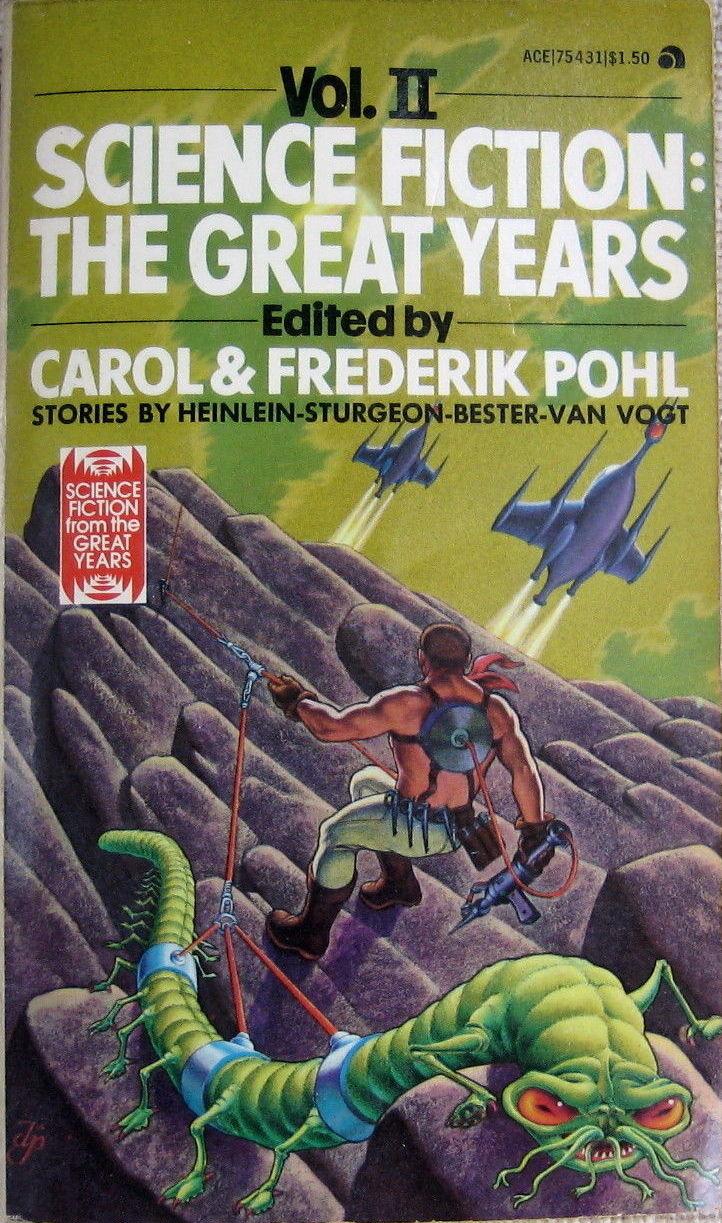
Science Fiction From the Great YearsOne of my favorite pulp reprint anthologies is Science Fiction: The Great Years, edited by Carol & Frederik Pohl and released by Ace Books in 1973 (cover artist unknown), and by Sphere in the UK in 1977 (cover by Peter Jones).

Part of the reason I like it is because it’s part of a series I remember very fondly. The second volume, Science Fiction: The Great Years, Volume II, was released in 1976. It was also part of an Ace imprint, Science Fiction From the Great Years, a line of 17 pulp classics edited and selected by Fred Pohl and published in paperback between 1972 and 1976. All bore the colophon at left. I first discovered pulps in the mid-70s, in Jacques Sadoul’s marvelous art book 2000 A.D: Illustrations From the Golden Age of Science Fiction Pulps, and finding these paperbacks on the shelves proudly proclaiming their pulp roots at around the same time was an exciting discovery.

Read More Read More

The Public Life of Sherlock Holmes: Asimov’s The Caves of Steel

The Public Life of Sherlock Holmes: Asimov’s The Caves of Steel

caves of steelIn 1953, Isaac Asimov combined the science fiction and mystery genres with a three-part serial. In The Caves of Steel, Asimov painted a bleak future for humanity that served as more than just the background of a murder investigation.

Earth became overpopulated and civilization had to adapt to the massive resource needs. Cities became densely populated collectives. Efficiency drove everything. Section units (one, two and three room apartments) rather than houses. Group eating areas, rather than individual kitchens. Common shower and bath units instead of one (or more) per family. Hundreds of miles of high-speed conveyer belts, rather than roads and cars. The ancient, underground roadways were used by official forces to fight fires, to move about to quell riots and such.

Towns and cities were absorbed by ever-growing CITIES. The huge Cities were roofed in by domes until “Outside” became a terrible place that city dwellers never went to: they stayed in their caves of steel, eating mass produced yeast and hydroponics. Direct sunlight was not experienced. As Asimov says, “There was no doubt about it: The City was the culmination of man’s mastery over the environment.”

Then the Spacers came. Man had colonized other planets but those inhabitants eventually rebelled and broke free. They then returned and easily defeated Earth’s defenses.

The Spacers lived on other planets in wide-open spaces, with many robot servants. Asimov essentially paints a picture of the rich, upper class, living indolently, and the poor, lower class, packed together like sardines.

Read More Read More

Vampiric Legions Versus Noble Knights: Avalon Hill’s Dark Emperor

Vampiric Legions Versus Noble Knights: Avalon Hill’s Dark Emperor

Dark Emperor Avalon Hill-smallBy 1985 it was pretty clear that J.R.R. Tolkien’s The Lord of the Rings was the defining fantasy of the 20th Century — and that the license was a gaming gold mine. SPI had turned it into the classic board game War of the Ring in 1977, which had gone through multiple printings and was still selling well nearly a decade later. SPI had built on the success of WotR with a small line of Tolkien-inspired games, the most ambitious of which was Greg Costikyan’s sumptuous Swords & Sorcery, in 1978.

It took a while for Avalon Hill, the undisputed king of American board games, to get into the act, but by the mid-80s they decided to enter the epic fantasy market. They’d already tried their hand with Magic Realm in 1979, and later Elric, neither of which drew on the epic good-versus-evil model of The Lord of the Rings, and neither of which had been very successful. For their next attempt they lured Greg Costikyan from West End Games, where he’d been gainfully employed since SPI had been shut down by TSR in 1982.

Costikyan, who was only 25 at the time, already had an impressive resume. He entered the industry at 14, assembling games in the shipping department at SPI. He designed his first game for SPI, Supercharge (1976), based on the First and Second Battles of Alamein during World War II, when he was 17. By 1985 his published games included Barbarian Kings (1980), Paranoia (1984), and Toon (1984), not to mention the popular microgames The Creature That Ate Sheboygan (1979), Vector 3 (1979) DeathMaze (1979), and Trailblazer (1981). Perhaps his greatest success, West End’s Star Wars RPG, was just two years in his future.

Dark Emperor, the game Costikyan designed for Avalon Hill, is a two-player boardgame that mimics Swords & Sorcery‘s dual warfare-and-quest approach. Although it lacks both the deep world-building of that game, and its numerous rich scenarios, it’s clear that Costikyan learned from the overly-ambitious design of S&S, producing a more tightly focused game. The Tolkien influence is also clear… if you want to play Sauron, striding across a fantasy land as a nigh-unstoppable Dark Lord invading from another dimension, Dark Emperor is definitely for you.

Read More Read More

Vintage Treasures: Not Without Sorcery by Theodore Sturgeon

Vintage Treasures: Not Without Sorcery by Theodore Sturgeon

Not Without Sorcery 1961-small Not Without Sorcery-small

Theodore Sturgeon’s first short story collection was Without Sorcery, a handsome hardcover published in 1948 with an introduction by Ray Bradbury. As you can imagine, it’s a tough book to find these days, even for collectors.

The paperback edition, released 13 long years later, dropped five stories and the introduction, and was re-titled Not Without Sorcery. It became Sturgeon’s tenth collection and was released in two editions, from Ballantine (in 1961, with a rather drab cover by an unknown artist) and Del Rey (in 1975, with a far more interesting cover from artist Darrell K. Sweet.) 1975 was the last time the book saw a mass market edition; it remained out of print for 35 years, until Kessinger Publishing did a facsimile reprint edition in 2010.

Sturgeon was a Campbell writer through and through, and all eight stories in Not Without Sorcery appeared in the two pulp magazines John W. Campbell edited: Astounding Science Fiction, and its sister magazine Unknown Worlds. The stories were published over a two-year period, 1939-1941. I’ve assembled some of the original covers below, because I can never resist an excuse to showcase pulp magazines.

Read More Read More

The History Manifesto and Sweeping Histories

The History Manifesto and Sweeping Histories

foundation
“History is the science of Science of Science Fiction”

If History is the science of Science of Science Fiction — who said that? — then History is the bedrock  of Fantasy.

In High Fantasy the characters make new history by engaging with the old; Frodo disposes of the ring and secures Middle Earth’s future, but the Ring Wraiths are ancient kings and the politics is grounded in the past. In Low Fantasy — what we mostly call Sword and Sorcery — the characters forage like ants in the debris of history; Conan loots ancient tombs, and loses his sweetheart to an antique monster.

In between, the heroes of Heroic Fantasy delve in the past in order to remake the present; the heroes in Michael J. Sullivan’s Riyria Chronicles actually resolve the geopolitical plot with an extended stint of dungeoneering.

And if Science Fiction is about future history, then it’s also often about future ancient history. We love our alien artefacts and lost forerunner civilisations. What is Aliens if not a Dungeons and Dragons story, but with more face huggers?

So we readers of Speculative Fiction also have an appetite for history, not just the down in the dirt tales of derring-do with William Marshal or Harald Hardrada, or the Rifle Brigade, carving out their personal histories with blade or bullet, but longer thrilling stories of the rise and fall of civilisations, or the evolution of a particular strand of human experience, whether it be war or sexuallity, or gender, or commerce.

Oddly, as noted by a pair of top historians, not a lot of these books are written by card carrying academic historians anymore…

Read More Read More

Amazing Stories, August 1967: A Retro-Review

Amazing Stories, August 1967: A Retro-Review

Amazing Stories August 1967-smallI have recently covered a lot of issues of Amazing (and Fantastic) from the Cele Goldsmith/Lalli era, which extended (officially) from December 1958 through June 1965. The two magazines were then sold to Ultimate Publishing, owned by Sol Cohen. Cohen (and managing editor Joseph Ross) immediately instituted a policy of publishing mostly reprints of stories previously published in Amazing/Fantastic, which lasted until Ted White took over in 1969. (White’s issues still featured reprints for a while, but by the time I was buying the magazine (in 1974) the cover would proclaim “All Stories New – No Reprints.”)

Joseph Ross (and Cohen) were briefly succeeded as editor by Harry Harrison and then by Barry Malzberg, both of whom (as I understand) resisted Cohen’s reprint policy. To make things worse, Cohen refused to pay the authors for reprinted stories (technically legal under the terms Amazing had originally bought the stories under). The then new organization SFWA took exception, and threatened a boycott, after which, I believe, Cohen agree to pay at least a nominal fee.

After Amazing and Fantastic stopped publishing reprints (and even before), Ultimate published a variety of dreadful magazines with different titles like Great Science Fiction Stories, and Thrilling Science Fiction, that were all reprint. (Again, all from inventory owned by Ultimate.)

I remember buying one early in my reading career – I thought I had found a brand new SF magazine, and was crushed to realize it was all mostly shoddy reprints. (There was a decent John Campbell story, probably “Uncertainty,” which appeared in the July 1974 Science Fiction Adventure Classics.)

Anyway, I happened to buy one of the Cohen/Ross era Amazings, mainly because it has a rather obscure Jack Vance story that I had not read. And I figured it would be interesting to compare it to Lalli’s Amazing. What is interesting is that, viewed objectively and ignoring the fact that most of the stories are reprints, this is quite a good issue, with at least one very fine story that has been largely forgotten.

Read More Read More

Vintage Treasures: The Boats of the Glen Carrig by William Hope Hodgson

Vintage Treasures: The Boats of the Glen Carrig by William Hope Hodgson

Famous Fantastic Mysteries June 1945-small The Boats of the Glen Carrig-small The Boats of the Glen Carrig Grafton-small

The Boats of the Glen Carrig was first published in 1907, and it has been reprinted countless times over the last hundred years. It is currently in print in no less than five separate editions, including multiple digital formats. In virtually every sense it is a classic horror novel, by one of the great 20th Century horror writers.

It wasn’t always recognized as such. In fact, after its first appearance, it languished for decades, before it was showcased in Famous Fantastic Mysteries in June 1945, with a terrific cover by Lawrence. It was reprinted in the seminal omnibus volume The House on the Borderland and Other Novels the following year, one of the most important and collectible volumes Arkham House ever published.

Read More Read More

Barry N. Malzberg and Bill Pronzini on Astounding Science Fiction in the 1950s

Barry N. Malzberg and Bill Pronzini on Astounding Science Fiction in the 1950s

The End Of Summer Science Fiction of the Fifties-smallWe’ve had some discussion here in the last week on the relative merits of the top science fiction digests of the 1950s.

Bob Silverberg offered his opinion that Galaxy magazine took the lead in the field virtually with its very first issue in October 1950, saying “That first year of Galaxy left us all gasping.” And in his Astounding Science Fiction Testimonial, John Boston generally concurs, saying that 1958 was the last good year under editor John W. Campbell.

Over the weekend, I was surprised to run across an interesting and impassioned defense of Astounding magazine in, of all places, the introduction to The End of Summer: Science Fiction of the Fifties, a 1979 paperback edited by Barry N. Malzberg and Bill Pronzini, which collects ten short stories from Isaac Asimov, Poul Anderson, Alfred Bester, Fritz Leiber, C.M. Kornbluth, and others.

Here’s the complete text of the editors’ Prefatory Note:

Six of the ten stories in this anthology are from John W. Campbell’s Astounding. This preponderance was not a publishing decision — Conde Nast gave us complete editorial decision — but our own.

No 70,000-word anthology devoted to the 1950s can give more than a sketchy representation of that tumultuous and fertile decade in science fiction. Accordingly it was felt that a deliberate bias toward Astounding had purpose and would give this book particular value. Concordance on the decade (which will come under increasing challenge as academia’s tanks roll on and on into our little backwater) overrates the not inconsiderable role of Gold’s Galaxy and the Boucher/McComas Fantasy & Science Fiction while somewhat minimizing Astounding, which is felt to have peaked in the forties.

Not quite so. This book is entered in evidence.

Read More Read More

The Public Life of Sherlock Holmes: REH Goes Hard Boiled

The Public Life of Sherlock Holmes: REH Goes Hard Boiled

Steve Harrison's CasebookYou know how people say “No offense intended,” and then offend like it’s an Olympic sport? I’m a major Robert E. Howard fan. In fact, I think his writing in the Conan stories is the best you’ll find in the entire genre.

However, he was not much of a hardboiled writer. The pulpster did (half-heartedly) give it a try, with nine completed Steve Harrison stories, as well as one unfinished tale and a synopsis.

In February of 1934, Strange Detective Stories introduced Steve Harrison in “Fangs of Gold.” It also included another Harrison story, “Teeth of Doom:” except that it didn’t. Not wanting to include two stories from the same author in one issue, the magazine renamed the hero Brock Rollins, changed the title to “The Tomb’s Secret” and used a Howard pseudonym, Patrick Ervin!

The next month, “Lords of the Dead” (retitled “Dead Man’s Doom”) was going to appear in Strange Detective, but alas, the publication folded. That story remained unprinted until 1978. Though, oddly enough, its sequel, “Names in the Black Book,” was included in the May, 1934 issue of Super Detective Stories. Those readers were probably looking for some history on Erlik Khan, the villain in both stories.

The fourth and final story to see publication during Howard’s lifetime was “Graveyard Rats,” appearing only four months before the writer committed suicide in 1936.

“The House of Suspicion” was printed in 1976. In that one, Fred Blosser completed Howard’s “The Mystery of Tannernoe Lodge” and added Khan in to make it a trilogy with Harrison’s antagonist. “The Black Moon,” “The Silver Heel” and the untitled synopsis all saw first printings in the nineteen eighties.

Read More Read More