Browsed by
Category: Vintage Treasures

An Astounding Science Fiction Testimonial

An Astounding Science Fiction Testimonial

Astounding Science Fiction February 1958-smallI started reading Astounding with the February 1958 issue. 1958 was the last good year under editor John W. Campbell.

Consider the short fiction:

L. Sprague de Camp’s “Aristotle and the Gun”
Charles V. de Vet and Katherine MacLean’s “Second Game”
Fritz Leiber’s “Try and Change the Past”
Jack Vance’s “The Miracle Workers”
Clifford D. Simak’s “The Big Front Yard”
Rog Phillips’s “The Yellow Pill”
Katherine MacLean’s “Unhuman Sacrifice”
J.F. Bone’s “Triggerman”

(Also Randall Garrett’s “The Queen Bee,” but we won’t think about that right now.)

The serials: two substantial ones by Poul Anderson, “The Man Who Counts” (a/k/a War of the Wing Men) and “We Have Fed Our Sea” (a/k/a The Enemy Stars), Hal Clement’s admirable if clumsy Close to Critical, and another Anderson, very lightweight but appealing to a 10-year-old, “A Bicycle Built for Brew” (The Makeshift Rocket).

Then the bottom dropped out. The only short fiction in 1959 on a level with the 1958 items cited were Ralph Williams’ “Cat and Mouse,” Chad Oliver’s “Transfusion,” A. Bertram Chandler’s “Familiar Pattern” (undeservedly obscure), and Theodore L. Thomas’s “Day of Succession” — and that’s being generous.

Read More Read More

Vintage Treasures: Sheila Gilluly’s Greenbriar Trilogy

Vintage Treasures: Sheila Gilluly’s Greenbriar Trilogy

Greenbriar Queen-small The Crystal Keep-small Ritnym's Daughter-small

Sheila Gilluly had a brief career as a fantasy writer. She published two trilogies in the late 80s and early 90s, and has produced nothing else for the last 20 years. But I’ve always been curious about her Greenbriar Trilogy — composed of Greenbriar Queen (1988), The Crystal Keep (1988), and Ritnym’s Daughter (1989) — mostly because of the beautiful covers (click the images above for bigger versions). I’ve tried to identify the artist, but the art is uncredited in my copies, and so far an internet search has been fruitless.

Greenbriar Queen opens in a pretty dark place, with the Dark Lord’s reign about to begin, the heroes scattered, the king dead, and a traitor on the throne. If you like high stakes and desperate battles, The Greenbriar Trilogy might be for you.

Read More Read More

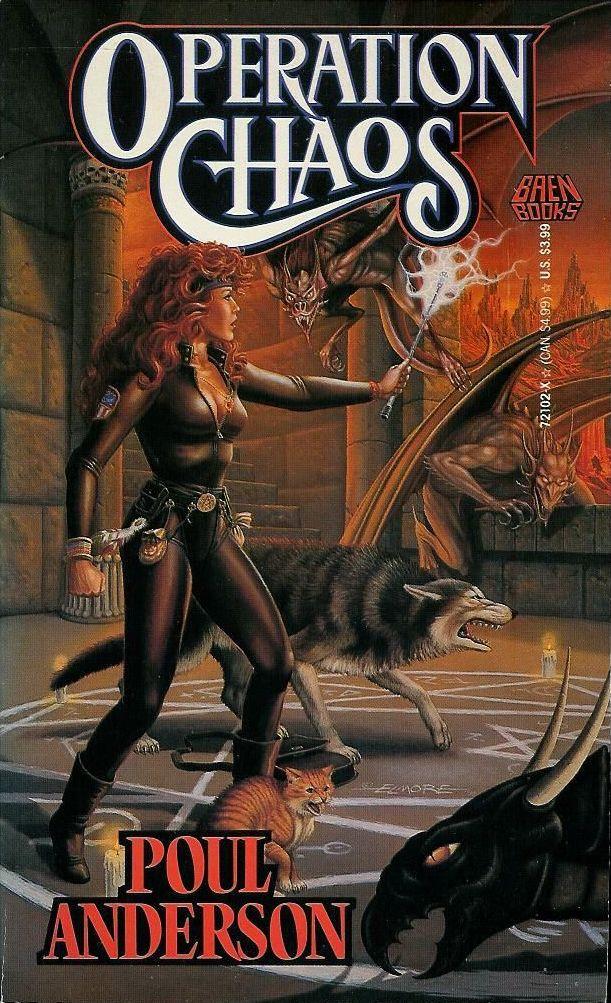
Representations of the Amazon in Poul Anderson’s Virgin Planet and in DC’s Wonder Woman

Representations of the Amazon in Poul Anderson’s Virgin Planet and in DC’s Wonder Woman

Legolas_portrait_-_EmpireMagBut first, I’d like to ask readers a very important question:

Do Tolkien’s Elves have pointy ears?

This came up after my last post, in which I wondered why Anderson and Tolkien (and many other fantasy writers) agree that elves are tall and have pointy ears. After reading this, Frederic S. Durbin contacted me to say,

Does Tolkien ever say that the elves have pointed ears? To my knowledge, he never does. Please correct me if I’m wrong! This is a bone I had to pick a few years back, when some writer somewhere described hobbits as having “hairy toes and pointed ears.” I think this misconception about Tolkien’s elves and hobbits has come from artwork. Artists need to have a way of making magical races look different from humans, so they go for the ears. We need Spock to look different from humans in a cheap and easily-reproducible way from day to day in the studio, so we give him pointed ears. People have been seeing illustrations of pointy-eared elves and hobbits for so long that they’ve begun to believe Tolkien described them that way. I don’t think it’s true. (Again, I’m willing to stand corrected if someone shows me a passage!)

So there you have it, folks! Please help! Is there a passage anywhere in Tolkien’s writings that suggest that Elves (or even Hobbits) have pointy ears?

And now let’s turn our attention to Poul Anderson’s Virgin Planet.

Read More Read More

Robert Silverberg on the First Year of Galaxy Science Fiction

Robert Silverberg on the First Year of Galaxy Science Fiction

The First Issue of Galazy Magazine-smallGalaxy magazine was founded in 1950; its legendary first editor was H.L. Gold. At the time Astounding Science Fiction, under John W. Campbell, was the leading SF magazine, publishing such writers as Isaac Asimov, Robert A. Heinlein, Clifford D. Simak, and H. Beam Piper. Within a single year, Gold wrestled the mantle of leadership away from Campbell, making Galaxy the top magazine in the industry. In his first two years Gold published some of the most memorable SF of the century, including Ray Bradbury’s “The Fireman” (later expanded as Fahrenheit 451), Robert A. Heinlein’s The Puppet Masters, and Alfred Bester’s The Demolished Man.

Author Robert Silverberg (who credits the first issue of Galaxy with saving him from becoming a smoker) offers his own comments on the effect Galaxy had on the field, saying:

It is impossible to overestimate the impact that Galaxy had on us in its first twelve or fifteen issues. There had never been such a succession of brilliant stories in an s-f magazine, not even in the Campbell Astounding of 1941, which had plenty of future classics but also a high percentage of pulp filler.

That first year of Galaxy left us all gasping, and I still look at those early issues with reverence and awe. It was as if Campbell’s whole stable had been holding in its best work, which Gold now was able to set free. Alas, by 1954 much of the magic was gone, and from 1955 on Galaxy was a good magazine indeed but no longer, well, astounding.

Rich Horton has been reviewing individual issues of Galaxy (and other vintage science fiction digest magazines) for us for the past few years. And Matthew Wuertz has taken on the ambitious project of reading and reviewing the Gold issues of Galaxy for Black Gate, starting with issue 1, dated October, 1950. His most recent review was the July 1952 issue, containing stories by John Wyndham and Richard Matheson, and the second installment of Frederik Pohl and C. M. Kornbluth’s serial novel The Space Merchants.

Legion from the Shadows by Karl Edward Wagner

Legion from the Shadows by Karl Edward Wagner

oie_9192021nLnODdJxFor those raised in this day of pure unadulterated Robert E. Howard texts, it may interest you to learn that once upon a time a flourishing industry of pastiche publication existed. There were only so many Howard stories to satisfy hordes of swords & sorcery fans, so the powers that were created more. Sprague de Camp and Lin Carter, the masterminds as it were, behind the pastiche industry were either greedy exploiters of Howard’s legacy or passionate fans who saw the need for further Howardian adventures. As a fan myself at the time, I was quite happy to buy and read a lot of them. Most weren’t better than alright but they scratched an itch.

De Camp (who fiddled mercilessly with Howard’s own short stories) and Carter wrote some of the weakest pastiches. For all his involvement with Howard’s fiction, de Camp never seemed to understand its nuance and why it worked. By education he was an engineer, and the need for things to be logical and systematic undermines his fiction. Carter, sadly, just didn’t have the talent to mimic the writer whose work he loved so dearly.

Unknown Swedish author, Bjorn Nyberg wrote The Return of Conan (1957). Decades later famous authors such as Poul Anderson and Andrew Offut tried their hands at the game. Howard Andrew Jones wrote a good piece on the pasticheurs a while back. Eventually a critical mass of fans and academics rose up, rightly so, to decry the inferior copies — and really, most were — of Howard’s creations.

There’s one Conan pastiche novel I remember truly liking: The Road of Kings (1979) by Karl Edward Wagner. It was good; equal parts dark and exciting. You can read Charles Rutledge’s review from a few years back here.

Read More Read More

Adventures In History: George MacDonald Fraser’s Flashman

Adventures In History: George MacDonald Fraser’s Flashman

First FlashmanA few months back, I was (ever so gently) castigated for not giving proper credit to the screenwriter of the Michael York / Oliver Reed rendition of The Three Musketeers. That man was George MacDonald Fraser, he who wrote the Flashman books, a series into which I had never delved.

That has now been corrected, and just in time, too: no lesser a light than Ridley Scott (Alien; Blade Runner) is developing a reboot of Flashman with 20th Century Fox. As the fool on the hill once opined, everything old is new.

So let’s set aside fantasy for just a moment and allow for historical action-adventure as a sideline of the vast cultural behemoth that is now Black Gate. Swords, after all, form a big part of heroic fantasy, and in Flashman (first published in 1969, never out of print), swords of many types are on display and put to use. Lances, too. Plus primitive rifles, dueling pistols, and cannons.

The only thing missing? The heroism of our anti-hero, Harry Paget Flashman. He’s a survivor, and an accurate judge of other people’s character and abilities, but beyond that, he’s the very definition of reprehensible. He’s a cad, a coward, and an unrepentant racist; he’s treacherous, larcenous, and vindictive besides. Let’s leave off his appalling treatment of women, at least for now, and accept him for what he’s best at: looking sharp in military regalia. Ah, if only looks could kill…

Read More Read More

Vintage Treasures: The Chronicles of Corum by Michael Moorcock

Vintage Treasures: The Chronicles of Corum by Michael Moorcock

The Chronicles of Corum-smallI need to read more Michael Moorcock.

I discovered Moorcock in the late 70s with An Alien Heat, the first novel in a trilogy featuring Jherek Carnelian and the Dancers at the End of Time. I discovered Elric shortly thereafter. But the other incarnations of his famous Eternal Champion — including Jerry Cornelius, Dorian Hawkmoon, and Corum — managed to escape me. Lately, however, I’ve been growing increasingly intrigued by The Chronicles of Corum, partly triggered by Fletcher Vredenburgh’s comments in his review of the entire series, “The Shout of a Young Man Who Finds the World a Complicated Place: The Eternal Champion by Michael Moorcock.”

Most preferred the morose albino, Elric, of doomed Melniboné. Dressed in black armor, wielding the evil soul-drinking sword Stormbringer, and riding a dragon — I totally get it. A few liked Dorian Hawkmoon von Koln and his adventures across post-apocalyptic Europe and America better. Personally, I did and still do enjoy the two trilogies about Corum Jhaelen Irsei, last of the Vadhagh. Steeped in Irish myth and a gloomy Celtic miasma, I think they’re the most intense and beautiful books in the series.

The two trilogies Fletcher’s talking about are The Swords Trilogy, which gathered the first three Corum novels, and The Chronicles of Corum, which collects the last three. I frequently find these books referred to as perhaps Moorock’s most enduring works. Here’s Tor.com writer Tim Callahan, quoted from as part of our Appendix N series, in “Andre Norton, Michael Moorcock and Appendix N: Advanced Readings in D&D“:

I read The Swords Trilogy and The Chronicles of Corum early, and they made an impact. They exploded inside my mind in a way I have never forgotten… I didn’t really feel like I tuned into Elric until halfway through the first reprint volume, when we get the four novellas of Stormbringer…

Read More Read More

Lawrence Schick Expands on the Origins of TSR’s The Known World

Lawrence Schick Expands on the Origins of TSR’s The Known World

Gods Demi-Gods & Heroes-smallThe “Known World” D&D Setting: A Secret History,” Lawrence Schick’s fascinating look behind the scenes at the home-grown adventure world that eventually became TSR’s famed Known World campaign setting, one of the earliest published settings for Dungeons and Dragons, was our most popular article last month, read by thousands of old school gamers.

Interest in the piece continues to be high and last week James Mishler, who painstakingly produced color versions of Lawrence’s original hand-drawn maps, conducted a detailed Q&A with Lawrence on his blog, Adventures in Gaming V2. The questions range from how much inspiration Tom Moldvay and Lawrence drew from the original D&D supplement Gods, Demigods & Heroes for their pantheon, to the influence of Lin Carter and Michael Moorcock. Here’s a snippet.

You mentioned an “ancient, pre-human civilization.” Do you recall any details about this? Related, do you recall if Tom Moldvay’s creation, the Carnifex of M3: Twilight Calling, were based on the Dragon Kings from Lin Carter’s Thongor series?

The pre-human civilizations were misty, with contradictory legends about them. Tom’s Carnifex were not based on Carter’s Dragon Kings, IIRC. (Neither of us thought very highly of the Thongor novels, though we admired Carter’s work as an editor.)

The influences from Howard, Lovecraft, and Smith are fairly obvious. But what, if any influence of Moorcock can be found in the Original Known World? Were the alignments of the OKW strongly in the Moorcock tradition?

We weren’t all that big on alignment, actually — it seemed to us, even then, to be an oversimplification that was more restrictive than it was useful. Moorcock’s real influence on us was the example of his anti-heroes, which freed us up to put moral choices in the hands of the players, rather than hard-wiring the world into good vs. evil.

Read the complete Q&A here.

Vintage Treasures: Horrors in Hiding edited by Sam Moskowitz with Alden H. Norton

Vintage Treasures: Horrors in Hiding edited by Sam Moskowitz with Alden H. Norton

Horrors in Hiding-smallHorrors in Hiding is the second in the trilogy of anthologies Sam Moskowitz edited for Berkely in the early 70s, and the only one we haven’t covered. The first was Horrors Unknown (1971), and the last (and the final anthology Moskowitz ever produced) was Horrors Unseen (1974).

It’s also the only one co-edited with Alden H. Norton, a noted anthologist in his own right, who co-edited four books with Moskowitz, including The Space Magicians and Ghostly By Gaslight (both in 1971).

I like Vincent Di Fate’s cover, which is moody and very striking. Although it’s awfully purple, and a little puzzling if you stare at it too long. (Is that dude eating a rock?)

The blurb on the back is short and to the point:

WARNING: Lock your doors before unleashing Horrors In Hiding. Ten grim and gruesome tales of the macabre guaranteed to chill your blood and shatter your nerves.

I count only nine stories, but let’s not be picky. They are grim and gruesome, and that’s what matters.

Moskowitz was a die-hard pulp fan, and half the stories within — those by Seabury Quinn, Robert Bloch, Henry Kuttner, August Derleth and Ray Bradbury — are culled from pulp magazines like Weird Tales and Strange Stories. The rest — by Arthur Conan Doyle, O. Henry, John Kendrick Bangs and Nathaniel P. Babcock — are much older.

As usual, Sam wrote fascinating and detailed introductions — author appreciations, really — for each story, and his love and knowledge of the field shine through. Sometimes I think Moskowitz produced these anthologies just so he’d have an excuse to talk about his favorite writers.

Read More Read More

Galaxy Science Fiction, July 1952: A Retro-Review

Galaxy Science Fiction, July 1952: A Retro-Review

Galaxy Science Fiction July 1952-smallSporting a robot miner on the cover (art by Jack Coggins), Galaxy’s July, 1952 issue invites readers inside. And it doesn’t disappoint!

“Star, Bright” by Mark Clifton — A single father observes that his four-year-old daughter, Star, has an impressive intelligence level. He doesn’t understand exactly how high it is until she begins to use telepathy.

The story has an interesting premise, but I’m not sure I liked where the story went. It seemed a bit too far-fetched at points.

“Wailing Wall” by Roger Dee — The crew of the Marco Four interacts with the colony on Sadr III. The Sadrians had been under the control of an alien race known as the Hymenops, which could explain their odd behavior. Since the crew’s landing, over a hundred people in the world’s only village have died as a result of murder or suicide.

I think the story would have been better without the initial flash-forward. Otherwise, it was a good read. Roger Dee is a pseudonym for Roger D. Aycock. The crew of the Marco Four return in “Pet Farm” (published in the February, 1954 issue of Galaxy) and “Control Group” (in the January, 1960 issue of Amazing Science Fiction Stories).

“Origin of Galactic Slang” by Edward Wellen (illustrated by David Stone) — This is a compilation of fictional anecdotes around “galactic” terms and phrases.

I’m not sure if this qualifies as a story, but I found it amusing. It’s listed in the table of contents as a “Non-Fact Article”. Wellen wrote eight such “Origins of Galactic X” articles.

Read More Read More