Browsed by
Category: Vintage Treasures

Galaxy Science Fiction, June 1952: A Retro-Review

Galaxy Science Fiction, June 1952: A Retro-Review

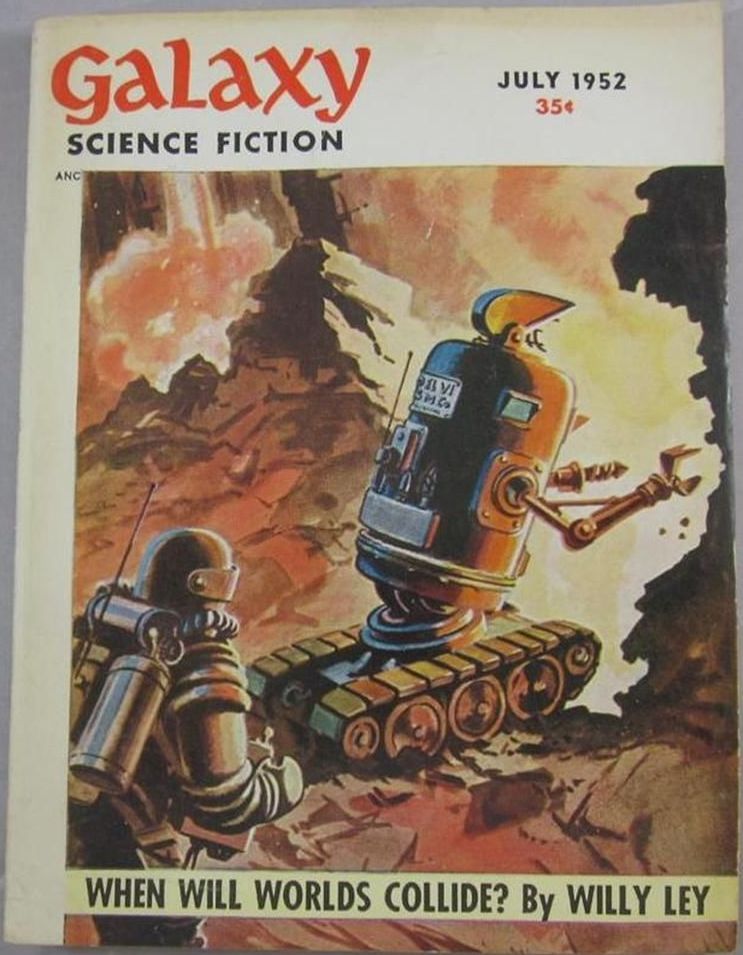
Galaxy Science Fiction June 1952-smallThe June, 1952 issue of Galaxy is another good one. It included six pieces of fiction and a science article by Willy Ley.

“Gravy Planet” (Part 1) by Frederik Pohl and C.M. Kornbluth — Mitch Courtenay works at Fowler Shocken, the top ad agency in the world. And now, the agency has its eyes on the possibility of colonizing Venus with governmental approval to exclusively profit from the venture. Fowler Shocken chooses Mitch as chairman of the Venus Section, leaving Mitch to all the details around drawing public interest to going to Venus and actually making it hospitable.

Besides his work duties, Mitch tries to revive his failing marriage. His wife is a talented surgeon, but she’s seen Mitch try to pull her away from her career to become a housewife. With the news of his advancement, she’s willing to date him again, albeit with boundaries.

As if the stress of the campaign and a sinking love life isn’t enough, Mitch becomes a target. He narrowly survives two attempts on his life, and the private sector detectives aren’t much help. He pursues the man likely responsible for the attempts (along with sabotages to the Venus campaign), tracking him to Antarctica. Unfortunately for Mitch, he’s heading straight into an ambush.

“Gravy Planet” was published as a novel under the title The Space Merchants in 1953. It moves very well, and the futuristic world the authors seems close to modern in 2015. It doesn’t try to turn Venus into an Earth-like planet, but it’s not quite as inhospitable to life as we know it presently. (The Mariner 2 probe sent to Venus in 1962 measured surface temperature among other data, so the authors didn’t have access to all of that information.) Letting the details about Venus go, this novel (so far) is a great ride.

Read More Read More

Vintage Treasures: The Ship That Sailed the Time Stream by G.C. Edmondson

Vintage Treasures: The Ship That Sailed the Time Stream by G.C. Edmondson

The Ship That Sailed the Time Stream 1965-small The Ship That Sailed the Time Stream 1970-small The Ship That Sailed the Time Stream-small

G.C. Edmondson was not a prolific fantasy author. He wrote barely half a dozen novels between 1965 and 1981. But at least one, The Ship That Sailed the Time Stream, became an acknowledged classic, kept in print by Ace Books for nearly two decades after it first appeared in 1965.

Edmondson wrote Westerns under at least three pseudonyms. The Ship That Sailed the Time Stream was his first fantasy novel; it first appeared as part of an Ace Double (cover by Jack Gaughan, above left), paired with Stranger Than You Think, a collection of Edmondson’s short stories.

The book, the tale of a military research ship cast back in time to the Bronze Age while testing experimental submarine detection gear, was an immediate critical success. It was nominated for the Nebula Award (it lost to Frank Herbert’s Dune), and Jerry Pournelle, co-author of The Mote in God’s Eye and Lucifer’s Hammer, called it “One of the best time travel novels I have ever read.”

Read More Read More

It’s Good to be Minding the Stars with The Early Jack Vance, Volume Four, edited by Terry Dowling and Jonathan Strahan

It’s Good to be Minding the Stars with The Early Jack Vance, Volume Four, edited by Terry Dowling and Jonathan Strahan

Minding the Stars The Early Jack Vance Volume 4-smallI’ve been heartily enjoying The Early Jack Vance volumes from Subterranean Press, which collect the hard-to-find early pulp SF and fantasy from one of the greatest writers of the genre, Jack Vance.

The first two, Hard Luck Diggings (2010) and Dream Castles (2012), are now sold out and out of print — and rapidly raising in price. They collected fiction from the very start of Vance’s career, the late 40s through the late 60s.

Two more volumes are now in print, with one more due in March. Minding the Stars, the fourth volume, spans the years from 1952 to 1967, collecting four long novellas and four short stories, originally published in Astounding Science Fiction, Future Science Fiction, Fantastic Universe, Amazing Stories, and other fine publications. Here’s the complete table of contents:

Introduction by Terry Dowling and Jonathan Strahan
“Nopalgarth” (Originally published as The Brains of Earth, Ace Double, 1966)
“Telek” (Astounding Science Fiction, January 1952)
“Four Hundred Blackbirds” (Future Science Fiction, July 1953)
“Alfred’s Ark” (New Worlds SF, May 1965)
“Meet Miss Universe” (Fantastic Universe, March 1955)
“The World Between” (Future Science Fiction, May 1953)
“Milton Hack from Zodiac” (Amazing Stories, August 1967)
“Parapsyche” (Amazing Science Fiction Stories, August 1958)

The opening story, “Nopalgarth,” was originally published as half of an Ace Double in 1966, under the title The Brains of Earth. Vance collectors may recognize it as one of three novellas published in a slender collection from DAW in September 1980, under the title Nopalgarth (see below).

Read More Read More

Swords & Sorcery edited by L. Sprague De Camp

Swords & Sorcery edited by L. Sprague De Camp

oie_2763211ShPWYPH2The swords & sorcery that works best for me, the tales that get my heart pounding, come in short story form. It was Robert E. Howard’s “Beyond the Black River”, Fritz Leiber’s “Ill Met in Lankhmar”, and Karl Edward Wagner’s “Reflections for the Winter of My Soul” that made me love this genre. In those stories, the authors distilled everything down to forty or fifty pages of concentrated action, mayhem, and bloodshed. There are no wasted words, no longuers. While all three authors wrote decent enough S&S novels, it’s their short stories that roar down the tracks like a train, pulling me along. S&S is a fiction of action and plot. I want speed; economy of story-telling.

Even in 2015, thirty years after the end of swords & sorcery’s glory days, there are new short stories being written all the time. Each year, several anthologies’-worth of short fiction, once the lifeblood of S&S, still appear in various print and electronic magazines (read my most recent review here).

But you rarely see actual S&S anthologies published anymore. The only recent collections of original stories that spring to mind are the excellent Swords and Dark Magic, edited by Jonathan Strahan and Lou Anders, and Jason M. Waltz’s equally cool Return of the Sword. David Hartwell and Jacob Weisman’s The Sword and Sorcery Anthology is a decent enough collection, though of mostly reprints reaching all the way back to S&S’s earliest days.

But once upon a time anthologies seemed to be coming out of the woodwork. Probably the most well known are Lin Carter’s Flashing Swords! series and Andrew J. Offut’s Swords Against Darkness series. Amanda Salmonson edited two collections about women warriors, called succinctly, Amazons and Amazons II. Robot-like, Marion Zimmer Bradley’s Swords and Sorceress series continued for four years after she died in 1999.

Read More Read More

Vintage Treasures: Strange Cargo by Jeffrey E. Barlough

Vintage Treasures: Strange Cargo by Jeffrey E. Barlough

Strange Cargo Jeffrey E. Barlough-smallI didn’t know quite what to make of Strange Cargo when I received a review copy over a decade ago. The cover grabbed my attention immediately, as did the synopsis, but I didn’t immediately realize it was part of Jeffrey E. Barlough’s ongoing Western Lights series, set in a world where the Ice Age never ended and only a narrow sliver of civilization survives along the Pacific American coastline.

The vast majority of review copies I received a decade ago are already long forgotten. But Barlough’s fame has steadily grown as Western Lights, a delightful series in which Victorian society exists alongside saber-toothed cats and woolly mammoths, continues to attract new readers. Strange Cargo was the third volume, following Dark Sleeper and The House in the High Wood; the most recent are What I Found at Hoole and The Cobbler of Ridingham.

Something wicked this way comes…

Nantle is the destination for the wealthy Cargo family. A mysterious heir has been named in their grandfather’s will — and they have traveled a long way by sea to find him.

Mr. Tim Christmas journeys as part of his apprenticeship, seeking the mechanism behind a strange set of seemingly magical stones. On her twenty-first birthday, Miss Wastefield is given an odd gift, which she keeps locked up in a giant chest at all times — a keeping place from which she receives dire threats. In Nantle, she hopes to find the one man who can rid her of this evil.

It is in this old cathedral city that their paths will converge. And where they will find themselves at the mercy of a mighty and vengeful power.

Strange Cargo was published by Ace Books on August 3, 2004. It is 481 pages, priced at $14.95 in trade paperback. It has never been reprinted and it currently out of print; there is no digital edition. The cover is by Gregory Bridges.

Vintage Treasures: Fevre Dream by George R.R. Martin

Vintage Treasures: Fevre Dream by George R.R. Martin

Fevre Dream hardcover-small Fevre Dream Fantasy Masterworks-small Fevre Dream-small

George R.R. Martin’s A Song of Ice and Fire is the biggest series in fantasy right now — indeed, the biggest literary series of any kind — but I’ve never read it. I prefer not diving into a series until it’s complete (or at least very close to complete), and based on the news that it probably won’t wrap up until after 2020, I’m likely years away from working up enough motivation to pick up the first volume in the series, A Game of Thrones.

But there are other Martin books I’m very interested in. For instance, I just bought a copy of his steamboat vampire novel Fevre Dream, originally released in 1982. It’s one of the most acclaimed horror novels of the last 30 years and, even better, it’s a standalone novel. I don’t have to wait for the sequel, which is kind of refreshing.

Read More Read More

Murray Leinster and the Moon

Murray Leinster and the Moon

I first encountered Murray Leinster’s work when Black Gate published his classic pulp story “The Fifth-Dimension Catapult” in BG 9.

While the story was enjoyable, it didn’t resonate much with me at the time. The key I suppose was that his name stuck in my mind, and as time went by, and as I followed the Black Gate blog, I began to appreciate the many treasures I had been missing out on — purely through consuming mostly contemporary fiction.

Resolving to remedy this oversight, I decided to pay more attention when scanning flea market stands and the shelves of book exchanges. My Ace Double collection (something else I owe to Black Gate) started to grow exponentially, and eventually I came across a Murray Leinster novel: Four from Planet 5.

Four from Planet 5Amazing Murray Leinster

It’s a thin volume, which seems to have been par for the course back in the days before the fat-fantasy trend. It was published by Fawcett in 1959 under their Gold Medal imprint and runs to 160 pages, with cover art by the prolific Paul Lehr. Some research indicates that the story was published a few months earlier in Amazing Science Fiction Stories, September 1959, under the title “Long Ago, Far Away.”

Read More Read More

Vintage Treasures: Echoes of Valor II, edited by Karl Edward Wagner

Vintage Treasures: Echoes of Valor II, edited by Karl Edward Wagner

Echoes of Valor II-smallKarl Edward Wagner continued his sword-and-sorcery anthology series with Echoes of Valor II, published in hardcover by Tor Books in August 1989, two years after the release of Echoes of Valor.

Wagner settled into an established pattern with this volume. The first one had been unusual for a couple of reasons. For one thing, it contained only novellas — three big stories by Robert E. Howard, Fritz Leiber, and Henry Kuttner. Not that you can go wrong with Howard, Leiber, and Kuttner, but the next two books in the series offered a more varied table of contents.

Echoes of Valor had also been bare bones from an editorial standpoint. Not even an introduction, let alone commentary on the stories. Wagner rectified that with Echoes of Valor II, which included new and reprinted story intros and author retrospectives by C. L. Moore, Sam Moskowitz, Forrest J. Ackerman, and Wagner himself. This seems more what Wagner had in mind for EoV, which he clearly intended to be a definitive S&S anthology series.

In fact, it’s probable that the first volume was put together much more hurriedly than the last two. Not only was it missing the editorial content that would be the hallmark of the series, but it went straight to paperback. Echoes of Valor II appeared first in a handsome hardcover edition, and was reprinted in paperback in February 1991.

This one contains a rich assortment of classic S&S and heroic fantasy, including a Conan tale by Robert E. Howard, a Jirel of Joiry story and two Northwest Smith tales from C. L. Moore, a Venus novella by Leigh Brackett and Ray Bradbury, and a Hok the Mighty novella by Manly Wade Wellman… along with fascinating articles on how some of the stories came together.

Read More Read More

The Shock of the Old: The Professor Jameson Space Adventures by Neil R. Jones

The Shock of the Old: The Professor Jameson Space Adventures by Neil R. Jones

Amazing_Stories,_April_1937-smallFew things are more exciting than finding an unheralded new author or reading an impressive new book fresh off the press. It is exhilarating to be present at the advent of a significant new work, to witness the beginning of an important writer’s career, or to feel yourself at the cutting edge of a genre. That sense of exploration and discovery is at the very heart of science fiction and fantasy.

These genres we love have roots that reach deep into the past, though, some of those roots extending into the cheap pulp magazines of the 20’s and 30’s, venues that at the time — and for long after — were utterly disreputable; anything that had even a whiff of such seamy origins was utterly damned in the eyes of critics.

Today’s top writers have moved far beyond those simple beginnings, and their finest works exhibit a thematic sophistication and literary polish that their progenitors can’t match, even as the best of those pioneers have finally achieved a hard-won respectability (penny-a-word pulpsters like Leigh Brackett and H.P. Lovecraft escaping the lurid confines of Planet Stories and Weird Tales to appear between the staid covers of the Library of America?! It’s about time.)

Writers like Neil Gaiman, China Meiville, and Susanna Clarke are expanding the boundaries of what can be accomplished with what is decreasingly called genre fiction, and for that we should all be grateful. Sometimes though, I must confess that I am compelled to put aside the careful work of the current generation for a while, because I just need a jolt of unadulterated pulp, and nothing else will do. (I don’t know about you, but I wasn’t around for the pulps, much as I wish I had been, so I have to rely on paperbacks, most of which are themselves now as old as I am, or older.)

Read More Read More

Vintage Treasures: Horrors Unseen, edited by Sam Moskowitz

Vintage Treasures: Horrors Unseen, edited by Sam Moskowitz

Horrors Unseen-smallAbout six months ago I bought a small collection of vintage horror paperbacks on eBay (see the whole set here). It was a delightful batch of books, mostly anthologies and short story collections from the 60s-70s, and I’ve been gradually working my way through it.

I previously covered Night Fear by Frank Belknap Long, Carl Jacobi’s Revelations in Black, and Anthony Boucher’s The Compleat Werewolf, from the same set.

Horror anthologies are still published today, of course, and we’ve covered several recent examples right here. But over the years the market has shrunk enough that they are nowadays exclusively published in hardcover, or (at best) trade paperback. The days of the cheap paperback horror anthology, when a wide range of titles crowded the shelves, are long over. I miss them.

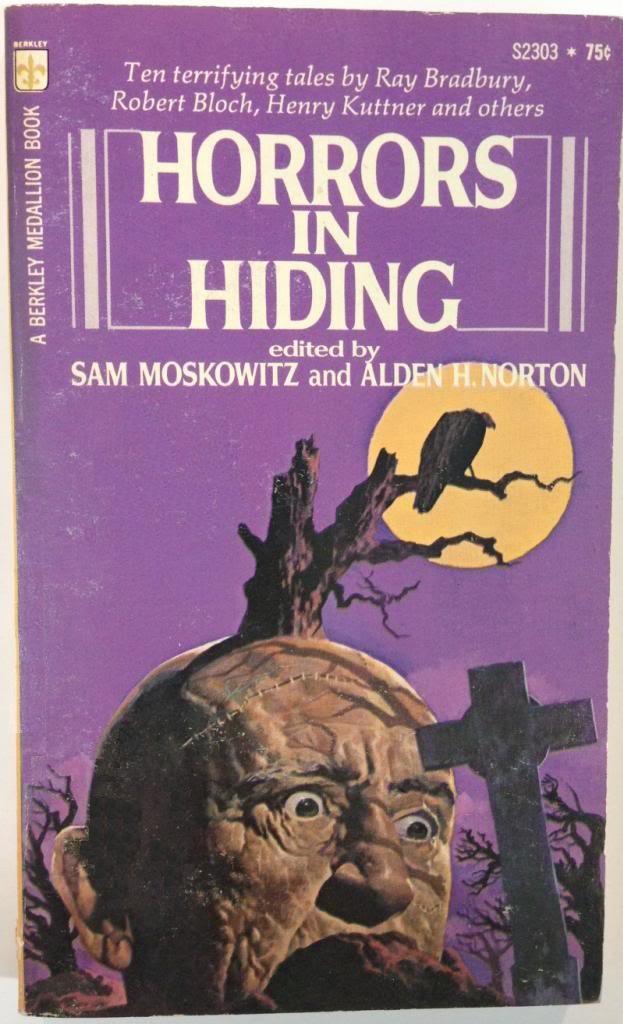
Sam Moskowitz was a well-known editor with some 25 anthologies to his name, and Horrors Unseen was the last. It was the third in a loose series which started with Horrors Unknown (1971) and Horrors in Hiding (1973; edited with Alden H. Norton). Sam was a pulp enthusiast, and these books are crammed full of classic horror tales from the pulps — this one includes the first reprint of C. L. Moore’s “Daemon” from Famous Fantastic Mysteries, and other reprints from Imagination!, Colliers, and other places.

Horrors Unseen was edited by Sam Moskowitz and published in June 1974 by Berkley Medallion. It is 208 pages, originally priced at 75 cents. It has never been reprinted, and there is no digital edition, but it’s not a rare book and copies are available online for $2-3. The cover artist is not credited, but it sure looks like Vincent di Fate.

Read More Read More