Browsed by
Category: Vintage Treasures

A Blast From the Past: John Christopher’s The Tripods Trilogy

A Blast From the Past: John Christopher’s The Tripods Trilogy

white1Long before YA fiction conquered the universe and millennia before the trilogy became the gold standard by which the world judges any given author, there lived Sam Youd, a British writer who worked under the pseudonym of John Christopher. Youd published The White Mountains in 1967, at a time when the United Kingdom was lurching away from the tight-laced, survivalist mode inherited from and necessitated by back-to-back world wars. Cue mods and rockers, Pink Floyd, the Swinging Sixties. Twiggy. Bowie. Cue a mind-set ready to dismiss the bleak past in favor of (in Christopher’s eye) an equally bleak future.

I first encountered The Tripods trilogy in the late seventies, and both my sister and I devoured the series more than once. In the first book, Will Parker, his loutish cousin Henry, and a whipsmart French lad, Beanpole, embark on a post-apocalyptic journey to the only haven they’ve ever heard of where humankind isn’t ruled by the fearsome Tripods, massive metal beings reminiscent of The War Of the Worlds. But in The White Mountains, the tripods have won: humanity has been enslaved through the use of “caps,” metal headgear installed without fail on a child’s fourteenth birthday. Will, Henry, and Beanpole are about to turn fourteen, and they are all too aware that after capping, their peers are never the same.

So book one is the journey. Book two, The City Of Gold and Lead, pits the boys, along with a stoic German, Fritz, against the creatures that operate the tripods, the Masters. Will and Fritz pose as slaves and infiltrate one of the three cities inhabited by the Masters.

Read More Read More

Vintage Treasures: The Second Ghost Book, edited by Lady Cynthia Asquith

Vintage Treasures: The Second Ghost Book, edited by Lady Cynthia Asquith

Great Pan Second Ghost Book-smallI’ve done a fair job of collecting American horror and dark fantasy paperback anthologies over the years. I have by no means a complete collection (or anything close to a complete collection), but after nearly four decades of collecting I’ve seen almost all the really desirable stuff, and I’m intimately familiar with the market.

That’s not remotely true of British paperbacks. Take for example the highly regarded Pan Ghost Books. They were published between 1952 and 1980, and there are a lot of them. How many? I have no idea. A lot.

The first, originally titled The Ghost Book, was published in hardcover from Hutchinson in 1926, and didn’t appear in paperback until 1945. The Second Ghost Book had a hardcover edition in 1952 from James Barrie, and was reprinted in paperback by Pan (under the imprint Great Pan) in 1956. If things had continued at that pace, we wouldn’t have much of a series to talk about, but fortunately they picked up a bit, with the third appearing in hardcover in 1955.

The books were a mix of original fiction and reprints. All three of the first Pan Book of Ghost Stories were edited by Lady Cynthia Asquith, who was also a contributor (under the name Cynthia Asquith.) The fourth volume was edited by James Turner; altogether the series had half a dozen editors by the time it petered out in 1980.

My first encounter with the series was with The Bumper Book of Ghost Stories, a fat omnibus of two later volumes, which I found at the Windy City Pulp & Paper show last year. That was enough to set me on the trail of the earlier volumes. I recently stumbled across a copy of the The Second Ghost Book, and it’s got a stellar list of contributors, including V. S. Pritchett, Lord Dunsany, Elizabeth Bowen, L. P. Hartley, and many others. It’s also got a fabulous cover.

Read More Read More

The Omnibus Volumes of C.J. Cherryh, Part II

The Omnibus Volumes of C.J. Cherryh, Part II

Chanur’s Endgame-small Alternate Realities Cherryh Alliance Space-small

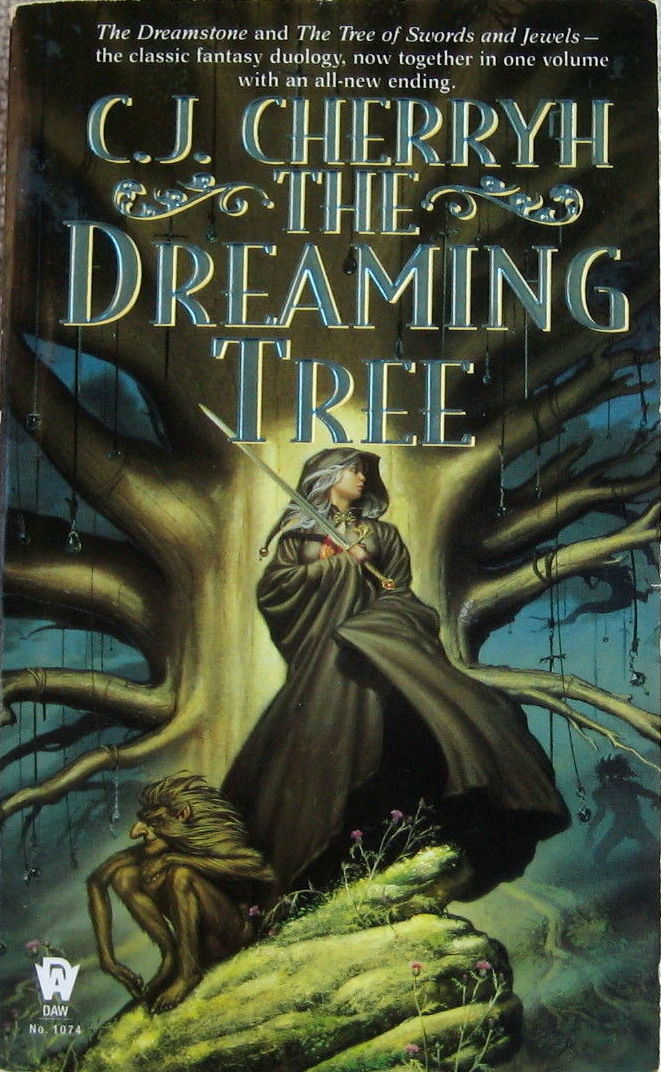
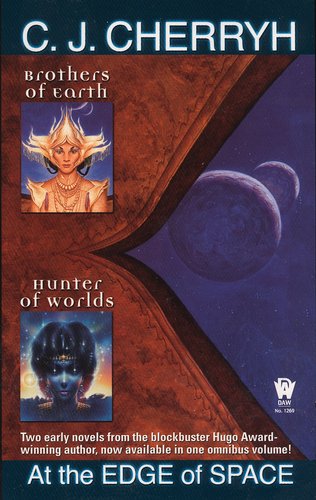
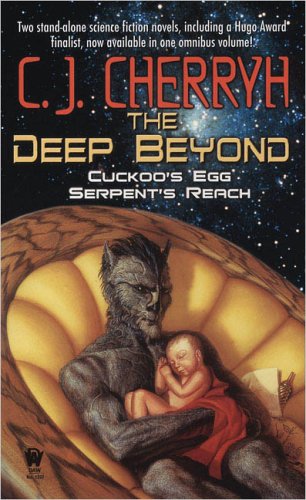
Last week I wrote the first installment of a three-part series looking at DAW’s ambitious program to bring some two dozen of C.J. Cherryh’s early fantasy and space opera novels back into print, The Omnibus Volumes of C.J. Cherryh, Part I. I looked at The Faded Sun Trilogy, The Morgaine Saga, and The Chanur Saga, published in January, March, and May of 2000, respectively.

In the Comments section of that article, Joe H. observed,

That first Chanur omnibus always confused me because it was functionally equivalent to putting The Hobbit, Fellowship and Two Towers into a single volume. And then you had that seven-year gap before the second Chanur omnibus was published…

Joe is quite correct. Chanur’s Homecoming, the fourth novel in the series, was in effect the conclusion of a trilogy which began in Chanur’s Venture and The Kif Strike Back. Readers coming to the novels for the first time with the first omnibus had to track down a copy of the final volume, or wait until it was collected with Chanur’s Legacy in the omnibus Chanur’s Endgame in 2007.

Read More Read More

Amazing Stories, May 1964: A Retro-Review

Amazing Stories, May 1964: A Retro-Review

Amazing Stories May 1964-smallHere we are fairly late in Cele Lalli’s tenure, an issue with an impressive set of names on the TOC, but mildly disappointing overall content. The cover is by Ed Emshwiller, illustrating Lester Del Rey’s “Boiling Point”. The interiors are by George Schelling and Virgil Finlay.

The editorial, from Norman Lobsenz as usual, discusses with some concern the possibility of manipulation of people’s genetic material… then adds two silly Benedict Breadfruitian puns on the subject of the proper pronunciation of Lobsenz (Lobe-sense, it seems).

Ben Bova contributes a science article called “Planetary Engineering”, about prospects for building a base on the Moon. (Future articles in the series will cover more extensive “planetary engineering”, including terraforming other planets in the Solar System.)

Robert Silverberg’s book review column, The Spectroscope, covers Philip K. Dick’s The Game Players of Titan (which he judges as decent, but a disappointment relative to the best of Dick’s work), Doc Smith’s Skylark 3 (regarded by Silverberg as rather bad, though Doc is praised on personal grounds), and John Campbell’s anthology Analog 2 (he considers it very uneven, with one excellent story, a couple decent ones, and some weaker stuff). I will add that I agree with Mr. Silverberg on all points.

The stories, then.

Read More Read More

Vintage Treasures: The Year’s Best Fantasy, First Annual Collection, edited by Ellen Datlow and Terri Windling

Vintage Treasures: The Year’s Best Fantasy, First Annual Collection, edited by Ellen Datlow and Terri Windling

The Year's Best Fantasy First Annual Collection-smallSome 27 years ago, the first volume of Ellen Datlow and Terri Windling’s long-running Year’s Best Fantasy series appeared.

Created in conscious imitation of Gardner Dozois’s even longer-running Year’s Best Science Fiction (also published by St. Martin’s), Datlow and Windling’s Year’s Best Fantasy became the most prestigious and long-lived fantasy annual the genre has yet seen. Renamed The Year’s Best Fantasy and Horror beginning with the third book in 1990, it lasted an impressive 21 years, publishing its final volume in 2009.

The series accumulated numerous accolades and award nominations over the decades, and became the acknowledged yearbook for the field. Just as Dozois did with his sprawling summations, Datlow and Windling summarized the year’s news, events, and gossip in lengthy and highly readable intros. If you were a new writer, publication, or small press, it was a major career milestone just to be name-checked.

I remember how excited I was to finally get my hands on a copy in the fall of 1988. I took it to the common room of my graduate dorm in Urbana, Illinois, and curled up in a comfy chair, where I read for hours while the first winter snow accumulated outside. I read this first volume cover to cover, in the process getting introduced to dozens of writers like Delia Sherman, Michael McDowell, David J. Schow, Susan Palwick, and many others. The book was the equivalent of a graduate course in modern fantasy.

In fact, there was just one problem. I didn’t like most of the stories.

Read More Read More

The Public Life of Sherlock Holmes: The Crime Doctor

The Public Life of Sherlock Holmes: The Crime Doctor

Solitary_Bruce
What Holmes would have you think of Watson’s abilities.

There are a few instances in the Canon when Sherlock Holmes assigns Watson to investigate matters on his behalf. There can be no questioning that Watson does his earnest best each time; his character would allow nothing less. Lack of effort or intent cannot be assigned to Watson’s endeavors. Any shortcomings must be blamed on his actual performance or the circumstances.  So, how does Watson fare as a detective, and how does Holmes assess his only friend’s performance? Below are three cases where Watson was assigned by Holmes to detect in his stead for a time.

“The Solitary Cyclist”

Holmes refers to Violet Smith’s situation as possibly being “some trifling intrigue” and declines to personally look into the matter, refusing to neglect his “other important research.” Instead, he sends the good doctor. His instructions to Watson are to “observe the facts for yourself and act as your own judgment advises. Then, having inquired as to the occupants of the Hall,” to come back and report to him.

So off goes Watson, arriving early so that he can conceal himself in a spot giving him a view of the road in both directions and also of the gate to Hampstead Hall. Watson becomes the spectator to a scene in which Violet Hunter is followed by a bearded stranger. Both of them are on bicycles. She turns the tables and chases after her pursuer, but he escapes. She continues her ride to Chiltern Grange, with the stranger once again following her. He then disappears up the drive to Hampstead Hall and Watson does not see him again.

Read More Read More

The Omnibus Volumes of C.J. Cherryh, Part I

The Omnibus Volumes of C.J. Cherryh, Part I

The Faded Sun Trilogy-small The Morgaine Saga The Chanur Saga-small

It’s probably not a surprise to most to you that I love vintage paperbacks. I write a regular series on some of the more interesting old paperbacks in my collection, Vintage Treasures, which over the years has gradually become one of the more popular links on the BG blog.

I cherish old paperbacks both as books and as unique cultural artifacts. Over the decades, our industry has been blessed with some truly gifted artists, designers, and editors, and many of these old books are quite beautiful. So I especially appreciate those rare instances when publishers bring vintage paperbacks back into print after a quarter century or more, complete with the original cover art. That’s rare enough, but when the publisher also bundles popular trilogies into a single handsome book, and releases it at the same price as a regular paperback, that’s cause for celebration.

That’s the case with the DAW omnibus collections of C.J. Cherryh’s science fiction and fantasy novels from the 1970s and 80s. DAW has published a grand total of nine, re-packing virtually her entire early catalog in compact and affordable volumes, and I’ve gradually been collecting them. They’re a fabulous value and a great way to introduce yourself to one of the most popular and important genre writers of the late 20th Century.

Read More Read More

Vintage Treasures: Bow Down to Nul by Brian W. Aldiss / The Dark Destroyers by Manly Wade Wellman

Vintage Treasures: Bow Down to Nul by Brian W. Aldiss / The Dark Destroyers by Manly Wade Wellman

Bow Down to Nul-small The Dark Destroyers-small

We’re back to our survey of Ace Doubles, this time with a volume from 1960 containing lesser-known novels from two of science fiction’s brightest stars: Bow Down to Nul by Brian W. Aldiss and The Dark Destroyers by Manly Wade Wellman. Ace Doubles didn’t always have a clear connecting theme, but they did in this case, as both novels feature the struggle against brutal aliens who have conquered Earth.

Bow Down to Nul is a Galactic Empire novel, a fairly common theme in early pulp SF, made popular by writers like Asimov and Van Vogt. The empire in this case is a huge stellar realm controlled by the Nuls, an ancient race of giant three-limbed creatures. Earth is a backwater colony world, ruled by a Nul tyrant. The human resistance is disorganized, but aided by a Nul signatory attempting to bring to light abuses on Earth.

As Aldiss noted in his Note From The Author, the set-up strongly parallels the complex colonial relationships he witnessed first hand while serving in India and Indonesia in the forties.

Read More Read More

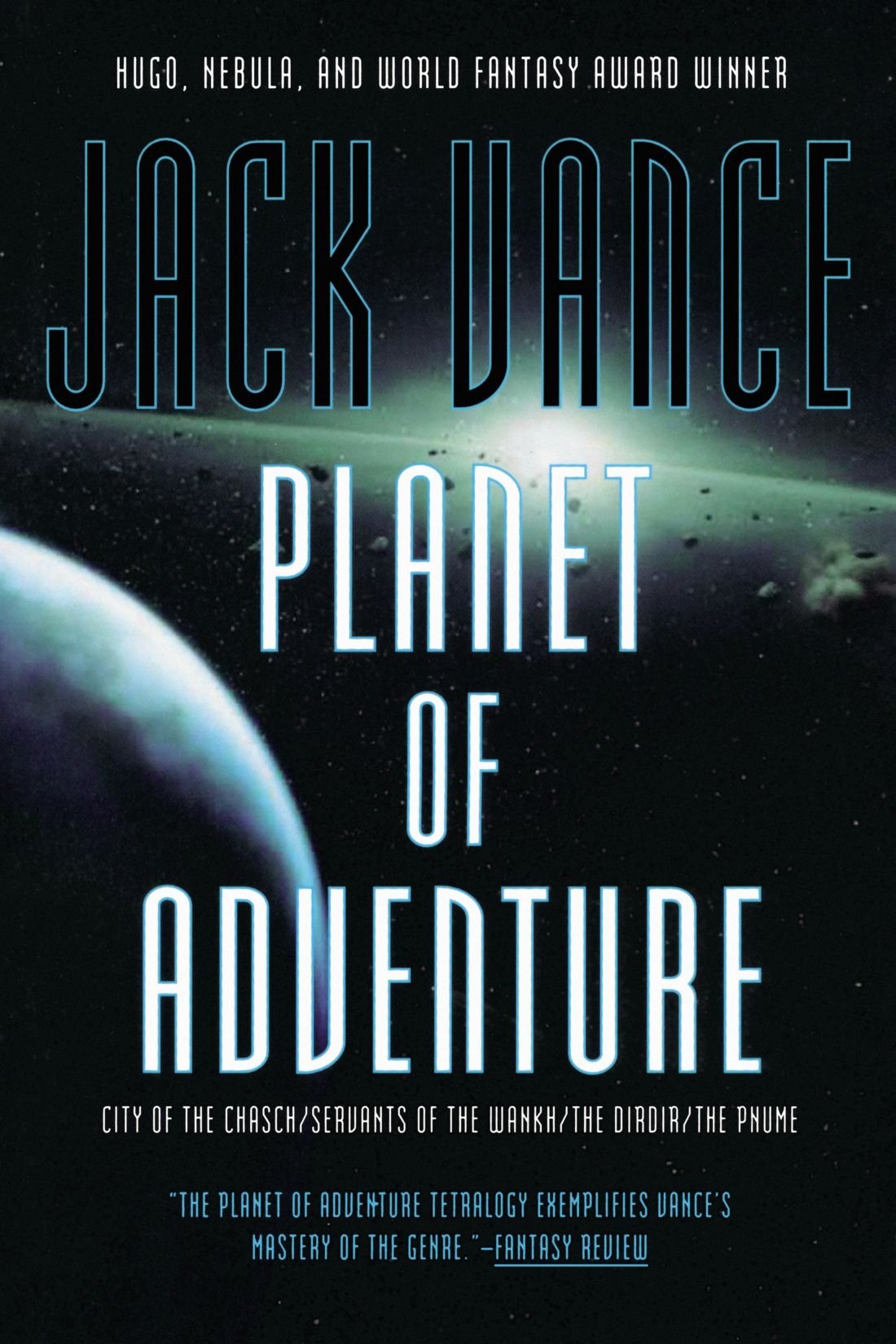
The Early Novels of Jack Vance: Grand Crusades: The Early Jack Vance, Volume Five, edited by Terry Dowling and Jonathan Strahan

The Early Novels of Jack Vance: Grand Crusades: The Early Jack Vance, Volume Five, edited by Terry Dowling and Jonathan Strahan

Grand Crusades The Early Jack Vance Volume Five-smallSubterranean Press is now accepting pre-orders on the fifth volume of their landmark series The Early Jack Vance.

New titles in the series are released every March. I covered Volume Two, Dream Castles, after I unexpectedly found a copy in the Dealer’s Room at Capricon 33 in 2013, and I reported on Volume Three, Magic Highways, last March.

Volume Five is by far the largest so far (at 472 pages); I was also surprised to see that it contains only five stories, all short novels, most published in pulp magazines between 1950 and 1954.

The Rapparee (Startling Stories, November 1950)
Crusade to Maxus (Thrilling Wonder Stories, February 1951)
Gold and Iron (Space Stories, December 1952)
The Houses of Iszm (Startling Stories, Spring 1954)
Space Opera (Pyramid Books, 1965)

This volume also contains a new introduction by the editors.

The first four books in The Early Jack Vance were a treasure trove for collectors, as they contained Vance stories that have been out of print for decades — and many that have never been reprinted. In contrast, this volume contains four short novels that have appeared in a handful of paperback editions over the decades (and under multiple titles), and one that has never been reprinted. This is first time they’ve been collected under one cover and the first time any have been in print for at least 30 years. I’ve selected a dozen covers from earlier printings below.

Read More Read More

Vintage Treasures: The House in the High Wood by Jeffrey E. Barlough

Vintage Treasures: The House in the High Wood by Jeffrey E. Barlough

The House in the High Wood-smallJeffrey E. Barlough’s first three Western Lights novels were published in trade paperback by Ace over a decade ago, beginning with Dark Sleeper (2000), and followed by The House in the High Wood (2001) and Strange Cargo (2004). All three are highly prized today. Barlough began to publish them though his own Gresham & Doyle press beginning with the fourth volume, Bertram of Butter Cross (2007). I recently acquired the second book. Back when I was running SF Site, I recruited the author Victoria Strauss to write for us; here’s what she said about it the year it was published:

Framed in good Gothic style by ante and post scriptums in which a nameless narrator encounters the teller of the main tale (a somber, haunted Oliver Langley, 11 years later), The House in the High Wood is a homage to such classics of the Gothic genre as The Monk and Woman in White, replete with mystery, madness, illegitimacy, ghostly visitations, ancient ruins, brooding forests, sinister dwellings, and supernatural terror. Like the first in the series, Dark Sleeper, it’s a neo-Victorian pastiche, with an agreeably verbose 19th-century prose style and a large cast of eccentric characters. But where the previous book was as much digression as story, devoting entire chapters to character study and whole pages to the description of the contents of a single room, this novel is much more a straight-ahead narrative of suspense, proceeding grippingly from plot turn to plot turn, with moments that are genuinely bone-chilling.

The Western Lights novels have steadily been gathering acclaim (and readers) over the last few years. Jackson Kuhl reviewed the fifth volume Anchorwick for us in 2011, calling it “A Victorian Dying Earth —- gothic and claustrophobic yet confronted by its inhabitants with upper lips held stiff… It’s P.G. Wodehouse with woolly mammoths.” More recently, we covered What I Found at Hoole (2012) and the eighth volume, The Cobbler of Ridingham. We published an interview with him in 2013.

The House in the High Wood was published by Ace Books on August 1, 2001. It is 336 pages, originally priced at $14.95. The digital version is $17.99. The cover art is by Aleta Jenks.