Browsed by
Category: Vintage Treasures

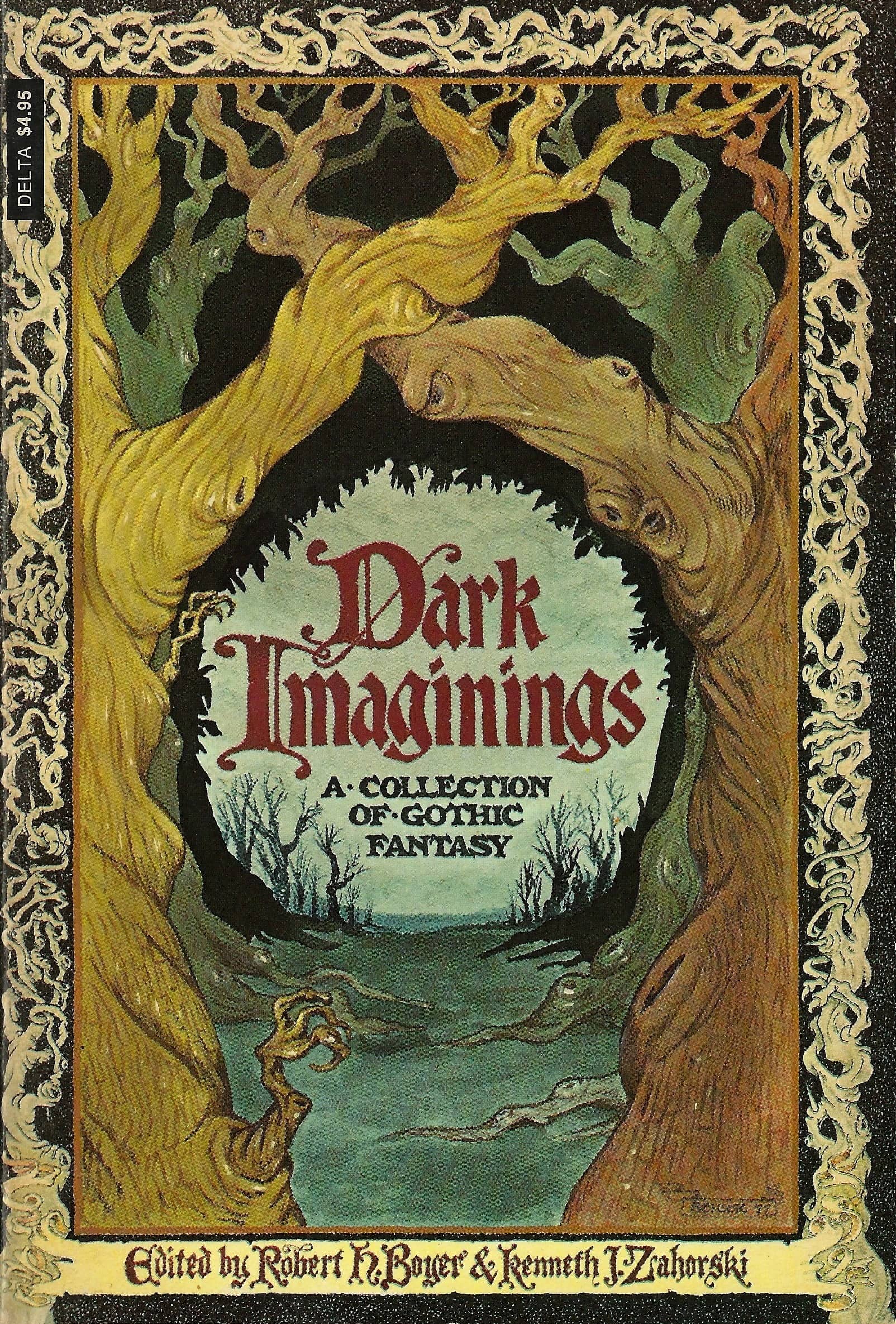
Vintage Treasures: Dark Imaginings: A Collection of Gothic Fantasy edited by Robert H. Boyer and Kenneth J. Zahorski

Vintage Treasures: Dark Imaginings: A Collection of Gothic Fantasy edited by Robert H. Boyer and Kenneth J. Zahorski

Dark Imaginings 1978-small Dark Imaginings 1978-back-small


Dark Imaginings
, edited by Robert H. Boyer and Kenneth J. Zahorski (Delta, July 1978). Cover by Joel Schick

Dark Imaginings is the first dark fantasy anthology I can remember lusting after in a bookstore. It was published in 1978, when I was 14 years old, at the lordly price of $4.95 — pretty steep in an era when a typical paperback was a buck fifty, even for a big oversized trade paperback.

In those days I would make weekly sojourns to downtown Ottawa every Saturday afternoon to hunt through the used bookstores on Bank Street for science fiction paperbacks, and I would gaze at it longingly on the bookshelf at WHSmith, or take it down and thumb through it. Joel Schick’s beautiful cover, featuring a canopy of dead, grasping trees in a twisted wood, spoke to me of dark tales whispered by strangers on Halloween. Man, I wanted this book.

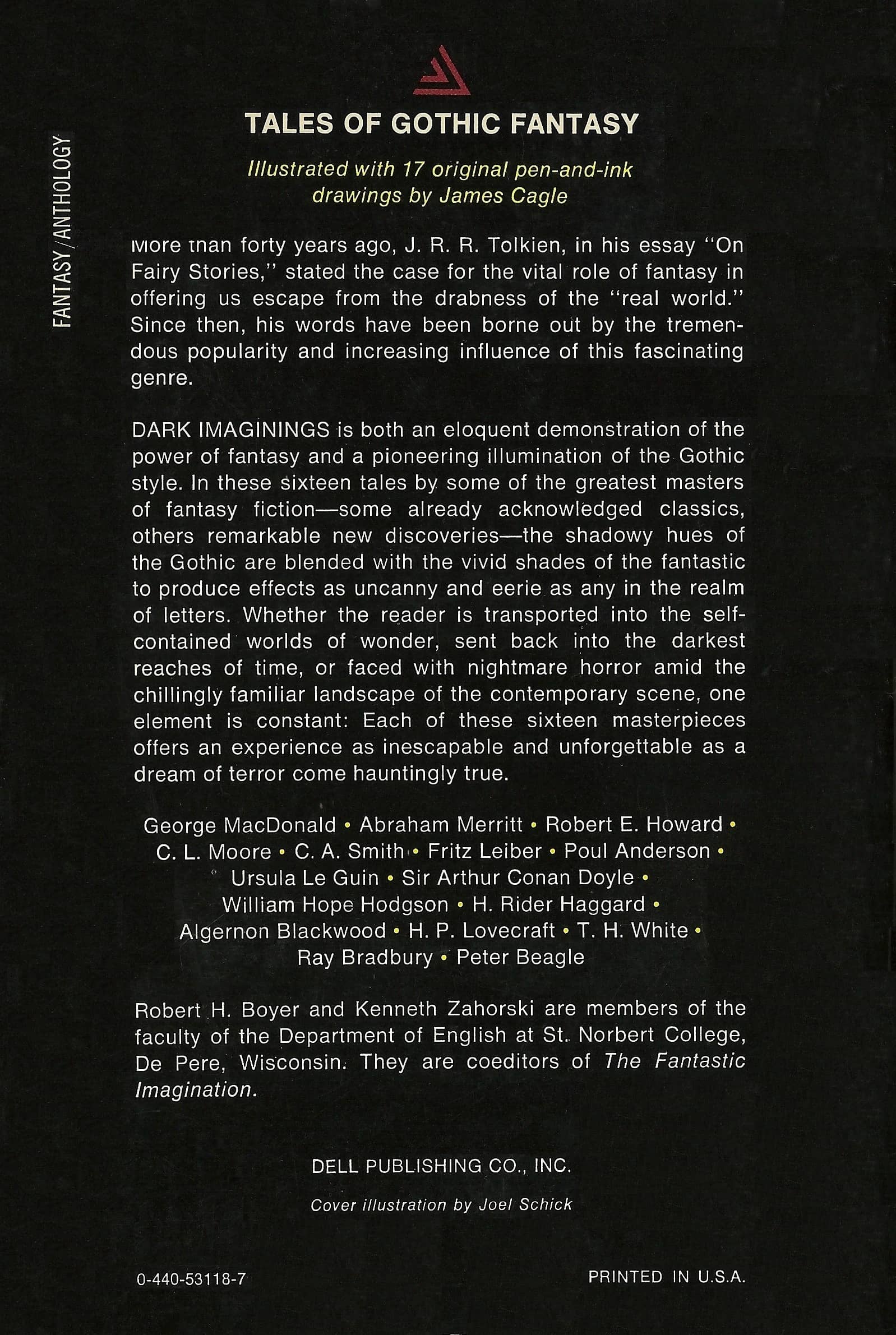
And who wouldn’t? Dark Imaginings is packed with classic tales of gothic fantasy, including a Kull tale by Robert E. Howard, a Northwest Smith novelette by C. L. Moore, an Averoigne story by Clark Ashton Smith, a Fafhrd and the Gray Mouser tale by Fritz Leiber, a Cthulhu Mythos story by H. P. Lovecraft, a novel excerpt from Poul Anderson, and ten more stories. Each is illustrated with a sparse b&w pencil sketch by James Cagle. It’s a fine volume to curl up by the window with on a blustery winter evening, as I learned when I finally bought a copy, over a decade later.

Read More Read More

War Eternal: Beyond the Farthest Star by Edgar Rice Burroughs

War Eternal: Beyond the Farthest Star by Edgar Rice Burroughs

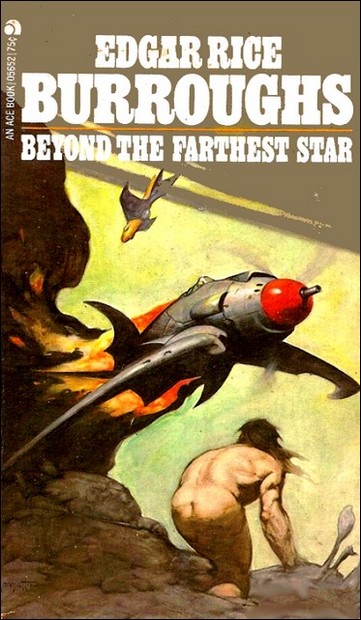
beyond-farthest-star-ace-frazetta-coverIn 1940, Edgar Rice Burroughs created his final new adventure setting, the extrasolar planet Poloda. For the first time in a career that had ignited pulp science fiction back in 1912, Burroughs pushed beyond the solar system to the region of pure speculation. But what he discovered four hundred and fifty thousand light-years from Earth wasn’t an E. E. Smith space opera, or even an old-fashioned romp on a weird planet of monsters and savage humanoid tribes. Against the grain of its romanticized title, the incomplete short novel Beyond the Farthest Star isn’t an escapist tale, but a bleak meditation on a world mired in unending warfare. The title makes you anticipate Star Wars. Instead you find just Wars.

This is a stark work. It offers no illusions. There’s a dash of humor and some winking satire, but the overwhelming sensation of Beyond the Farthest Star is resignation to carnage. There are no valiant heroes on Poloda who become beacons for others to follow. There are only stalwart soldiers who fall in line to fight the fight, whatever it may be, and die in numbers tabulated by the hundreds of thousands.

We’re used to Edgar Rice Burroughs as a master of sweeping adventure in worlds where fighting means hope. It’s a shock to see him sitting glumly among the ruins of hope, waiting for the next wave of barbarians. Looking at Poloda from the perspective of the twenty-first century is to see a prophetic futurist emerging in Old Man Burroughs. The story the Old Man tells is not much fun. But it’s enthralling — and there’s nothing else like it in the ERB canon, even among the strange evolutions his work took during his last decade.

As with Savage Pellucidar and its sister books set on Mars and Venus, the Poloda novellas were planned to form a connected sequence for later hardcover publication. Part I, “Beyond the Farthest Star,” was written in October 1940 over twelve days, and Part II, “Tangor Returns,” was finished in December in five days. “Beyond the Farthest Star” appeared in the January 1942 issue of Blue Book, but Burroughs never submitted Part II for publication, probably because he scrapped the series after starting work as a war correspondent. “Tangor Returns” wasn’t discovered until thirteen years after Burroughs’s death. It was published along with “Beyond the Farthest Star” in the 1964 Canaveral Press omnibus Tales from Three Planets. Ace Books later released a paperback of the unfinished Poloda saga as Beyond the Farthest Star, with the first novella retitled “Adventure on Poloda.”

Read More Read More

Birthday Reviews: Clark Ashton Smith’s “The Maze of Maal Dweb”

Birthday Reviews: Clark Ashton Smith’s “The Maze of Maal Dweb”

Cover of Double Shadow, artist unknown.

Clark Ashton Smith was born on January 13, 1893 and died on August 14, 1961. Along with H.P. Lovecraft, he was one of the major authors at Weird Tales, writing stories which were similar to the dark fantasies Lovecraft wrote.

Smith maintained a correspondence with Lovecraft for the last 15 years of Lovecraft’s life. While Lovecraft wrote about Cthulhu, Smith wrote about the far future Zothique. Smith was named the Cordwainer Smith Rediscovery Award winner in 2015.

“The Maze of Maal Dweb” first appeared in a limited edition chapbook, The Double Shadow and Other Fantasies, published by Smith in 1933. A the time the story was called “The Maze of the Enchanter.” It received its first general publication, and under its better known title, in the October 1938 issue of Weird Tales, edited by Farnsworth Wright.

Smith included it in his 1944 collection Lost Worlds and it has frequently been reprinted since, including translations into Dutch, German, French, and Italian. Maal Dweb also appeared in Smith’s story “The Flower-Women.”

“The Maze of Maal Dweb” has Tiglari working his way through a swamp to retrieve his beloved, Athlé, from the titular lord of the solar system. Despite Maal Dweb’s palace being impregnable, Tiglari has somehow managed to acquire knowledge of the dangers that lie within, so he can arm himself appropriately for his quest.

Similarly unexamined is how Maal Dweb, a recluse who is never seen by anyone except the women he orders sent to him, can successfully rule his vast domains. Similarly, the palace is seemingly unpopulated except by the petrified forms of Maal Dweb’s previous victims. Rather than a living home in which to live, Maal Dweb sits like bait in his trap, waiting for doomed adventurers to come to him.

Read More Read More

Vintage Treasures: The World Fantasy Awards, Volume One and Two

Vintage Treasures: The World Fantasy Awards, Volume One and Two

First World Fantasy Awards-small The World Fantasy Awards Volume Two-small

The World Fantasy Convention is my favorite convention by a pretty fair margin, and the highlight of the con every year is the presentation of the World Fantasy Awards. They were first given out at the very first World Fantasy Convention in Providence, Rhode Island in 1975, and they’ve been awarded every year since. The list of recipients is like a Who’s Who of the major authors in the genre, and the award has come to be the most significant honor in American fantasy, alongside the Nebula and Hugo Awards (both more generally given to works of science fiction).

The Nebula Award winners are collected annually in the Nebula Awards Showcase, which has been continuously published for 51 years (we covered the latest volume, edited by Julie E. Czerneda, here), and the Hugo Winners were famously collected in some of the most popular SF anthologies of all time, Isaac Asimov’s The Hugo Winners, which ran to multiple volumes (we looked at that series here). But even most SF collectors are unaware that there are two volumes collecting World Fantasy Award winners, originally published in hardcover by Doubleday in 1977 and 1980.

Read More Read More

Birthday Reviews: George Alec Effinger’s “Albert Schweitzer & the Treasures of Atlantis”

Birthday Reviews: George Alec Effinger’s “Albert Schweitzer & the Treasures of Atlantis”

Alternate Warriors-small Alternate Warriors-back-small

Cover by Barclay Shaw

Most days in 2018, I’ll be selecting an author whose birthday is celebrated on that date and reviewing a speculative fiction story written by that author.

George Alec Effinger was born on January 10, 1947 and died on April 27, 2002. He was married three times, the second time to artist Beverly Effinger and the third time to science fiction author Barbara Hambly. He was a John W. Campbell, Jr. finalist in the award’s inaugural year and the Southern Fandom Confederation presented him with the Phoenix Award in 1974. His story “Schrödinger’s Kitten” received the Hugo, Nebula, and Sturgeon Award in 1989. Effinger wrote the popular Budayeen series, comprised of several short stories and the novels When Gravity Fails, A Fire in the Sun, and The Exile Kiss. He also wrote pastiches of several types of pulp adventure stories featuring his character Maureen Birnbaum, Barbarian Swordsperson.

His short story “Albert Schweitzer and the Treasures of Atlantis” was written for Mike Resnick’s alternate history anthology Alternate Warriors, in which each story takes an unlikely historical figure and turns them into a fighter. The story has never been reprinted.

Read More Read More

The High House by James Stoddard

The High House by James Stoddard

51nkGCbEv1LI need to find some new superlatives for the books I read. Too often I fall back on “terrific” or “awesome” or just plain “great.” Those are all stalwart words, but after I’ve described two or three books with them, it just seems lazy to describe the next two or three with the same exact words. I do it to make clear I liked a particular book and that I think it’s worth Black Gate readers’ attention, but it’s really lazy of me to just keep using the same superlatives again and again. That said, James Stoddard’s The High House (1998) is exceptional, superb, and top-notch.

The High House of Evenmere is

a truly beautiful pile of building, all masonry, oak, and deep golden brick, a unique blend of styles — Elizabethan and Jacobean fused with Baroque — an irregular jumble balancing the heavy spired tower and main living quarters on the western side with the long span flowing to the graceful L of the servants’ block to the east. Innumerable windows, parapets, and protrusions clustered like happy children, showing in their diversity the mark of countless renovations. Upon the balustrades and turrets stood carved lions, knights, gnomes, and pinecones; iron crows faced outward at the four corners. The Elizabethan entrance, the centerpiece of the manor, was framed by gargantuan gate piers and pavilions, combining Baroque outlines with Jacobean ornamentation.

The building “is the mechanism that propels the universe, (. . .) If the Towers’ clocks are not wound their portion of Creation will fall to Entropy.”

Lord Ashton Anderson is responsible for protecting the High House. The foremost enemy of the house is the Society of Anarchists, led in the field by the Bobby, a man dressed in the uniform of a police constable and with a face from which the features sometimes vanish, leaving him looking like a “faceless doll.”

The story, though, is not Lord Anderson’s, but his son Carter’s. When Carter is nearly killed and the Bobby steals the Master Keys, Lord Anderson sends his son away for safety. Carter doesn’t return for fourteen years, during which time his father vanished while on expedition in the land of the Tigers of Naleewuath.

Read More Read More

Birthday Reviews: Jack Womack’s “Audience”

Birthday Reviews: Jack Womack’s “Audience”

The Horns of ElflandJack Womack was born on January 8, 1956. His novel Elvissey, the fifth book in his six-book Dryco series, received the Philip K. Dick Award in 1994, tying with John M. Ford’s Growing Up Weightless. Womack has also worked in New York as a publicist in the publishing industry.

“Audience” was written for the anthology The Horns of Elfland, edited by Ellen Kushner, Delia Sherman, and Donald G. Keller. It was reprinted in Ellen Datlow & Terri Windling’s The Year’s Best Fantasy and Horror: Eleventh Annual Edition the next year and again in 2001 by Mike Ashley in The Mammoth Book of Fantasy. The story was nominated for the World Fantasy Award.

“Audience” was originally written for an anthology about music and Womack took that idea and decided to explore the importance and ephemeral nature of sound. His character tries to seek out smaller museums when traveling, avoiding the large, well-known places like the Louvre in favor of out of the way places which offer unknown exhibits. One of these museums is the Hall of Lost Sounds, which contains small rooms which allow visitors to hear collected sounds which no longer can be heard in their natural place.

Just as Proust noted how smells can trigger memories, Womack uses sounds to do the same thing. His curator gives a tour of the museum, commenting on where in his own life each of the lost sounds come from. The story also points out that sounds can change over time. A person’s voice as a teenager sounds different from their voice as an adult, and without recordings, completely vanishes. Even with recordings, the way a person hears their own voice can never be recaptured.

“Audience” is less a story and more a slice of life rumination which teaches the reader to examine their senses and memories in new ways.

Read More Read More

The Fellowship of the Ring and the Palantir

The Fellowship of the Ring and the Palantir

I Palantir 1-small I Palantir 2-small I Palantir 3-small

Last week, I posted a few fanzines that I’d picked up in a SF collection a few weekends ago. These originated from the estate of a Chicago area fan who appears to have been pretty active in the 1960’s and 1970’s, even publishing his own fanzine. He apparently attended a number of SF conventions, including many Worldcons, during that period. Among the material are several program books and other ephemera from cons during that time, including the 1960 Worldcon, known as Pittcon. One of the more interesting items I picked up which has a convention tie-in is a copy of the Fantasy Press edition of E.E. “Doc” Smith’s The Vortex Blaster, which is inscribed by Doc to him, reading, “At the Pittcon 1960. Ain’t we having fun? With very best regards, Edward E. Smith, PhD.”

Among the events at that Pittcon was the organizational meeting of the first organized group of J.R.R. Tolkien fans, The Fellowship of the Ring. The FotR went on to publish the first Tolkien fanzine, I Palantir (the first issue of which contained the first piece of Tolkien fan fiction), edited by Ted Johnstone and Bruce Pelz. Among other contributors was Marion Zimmer Bradley, who had pieces in issues 2 and 3 (the latter under the name Elfride Rivers). I Palantir lasted four issues, from 1960 through 1966, before folding.

Read More Read More

London Wins Great Game

London Wins Great Game

1905-01-01 Pittsburgh Press 24 The Balky Pitcher

The Pittsburgh Pirates owned the National League at the start of the 20th century. They won the pennants in 1901, 1902, and 1903 by a total of 41½ games. Then came the disastrous, injury-filled season of 1904 when the club fell to fourth behind the Giants, Cubs, and Reds. John McGraw’s New York team ran away from the rest of  the league and refused to play the upstart American League after the season. Pittsburghers undoubtedly took that personally,  since the Boston Americans — the same Boston club that upset the Pirates in the one and only 1903 World Series — again won the AL pennant. “Wait until next year” was already the slogan of frustrated fans everywhere.

Baseball fans in Pittsburgh saw good reason to hope that better baseball lay in the offing. So did the press. On January 1, 1905 they looked ahead. Way ahead. The headline in the Pittsburg Press read “London Wins Great Game.”

Read More Read More

Christmas for the Paperback Collector

Christmas for the Paperback Collector

$18 eBay lot 65 novels Nov 14-small

Back in October I was doing an innocent eBay search on R.A. Lafferty, and I stumbled on the lot of vintage science fiction paperbacks above. 65 titles from the 60s, 70s, and 80s, in what looked like pretty good shape, for the Buy-It-Now price of $18.

Well, this was a pickle. The way the books were laid out I couldn’t even see them all, which was annoying. And the vast majority of the ones I could see, I had already.

On the other hand, 65 books, 18 bucks, that’s…. what, like a quarter per book? At that price, it’d be well worth it just to upgrade my existing copies with ones in better shape. And there were a handful of tantalizing titles I didn’t have, like The Rainbow Cadenza by J. Neil Schulman, The Crystal Memory by Stephen Leigh, Conscience Place by Joyce Thompson, and The Steps of the Sun by Walter Tevis. Plus that Lafferty paperback, The Devil is Dead. And y’know, it was true that I couldn’t see all the covers, so who knew what treasures were lurking in all that jumble?

In the end, it was just too tempting. I pulled the trigger on the auction, shelled out the $18 (plus shipping), and waited impatiently to find out exactly what I’d bought.

Read More Read More