Browsed by
Category: Vintage Treasures

Vintage Treasures: Thirteen Tales of Terror by Jack London

Vintage Treasures: Thirteen Tales of Terror by Jack London

Thirteen Tales of Terror Jack London-small Thirteen Tales of Terror Jack London-back-small

I haven’t read much Jack London. He’s most famous of course for his novels of the Klondike Gold Rush, The Call of the Wild and White Fang, which are outside my field of speciality. But he also dabbled a bit in the genre, both at novel length (with his dystopian science fiction novel The Iron Heel) and especially with his short stories, which were routinely reprinted in places like Famous Fantastic Mysteries and The Magazine of Fantasy & Science Fiction. He had one posthumous SF collection, The Science Fiction Stories of Jack London (1993), a 211-page volume from Citadel Twilight.

But I’m more interested in his tales of terror, which include stories of death ships, spectres, the mysterious arctic, enormous wolves, and stranger things. Most of London’s tales of adventure were gathered in collections like Son of the Wolf (1900) and Children of the Frost (1902), but his supernatural fiction remained largely uncollected until it was gathered in Curious Fragments: Jack London’s Tales of Fantasy Fiction, a small press hardcover from Kennikat Press in 1975.

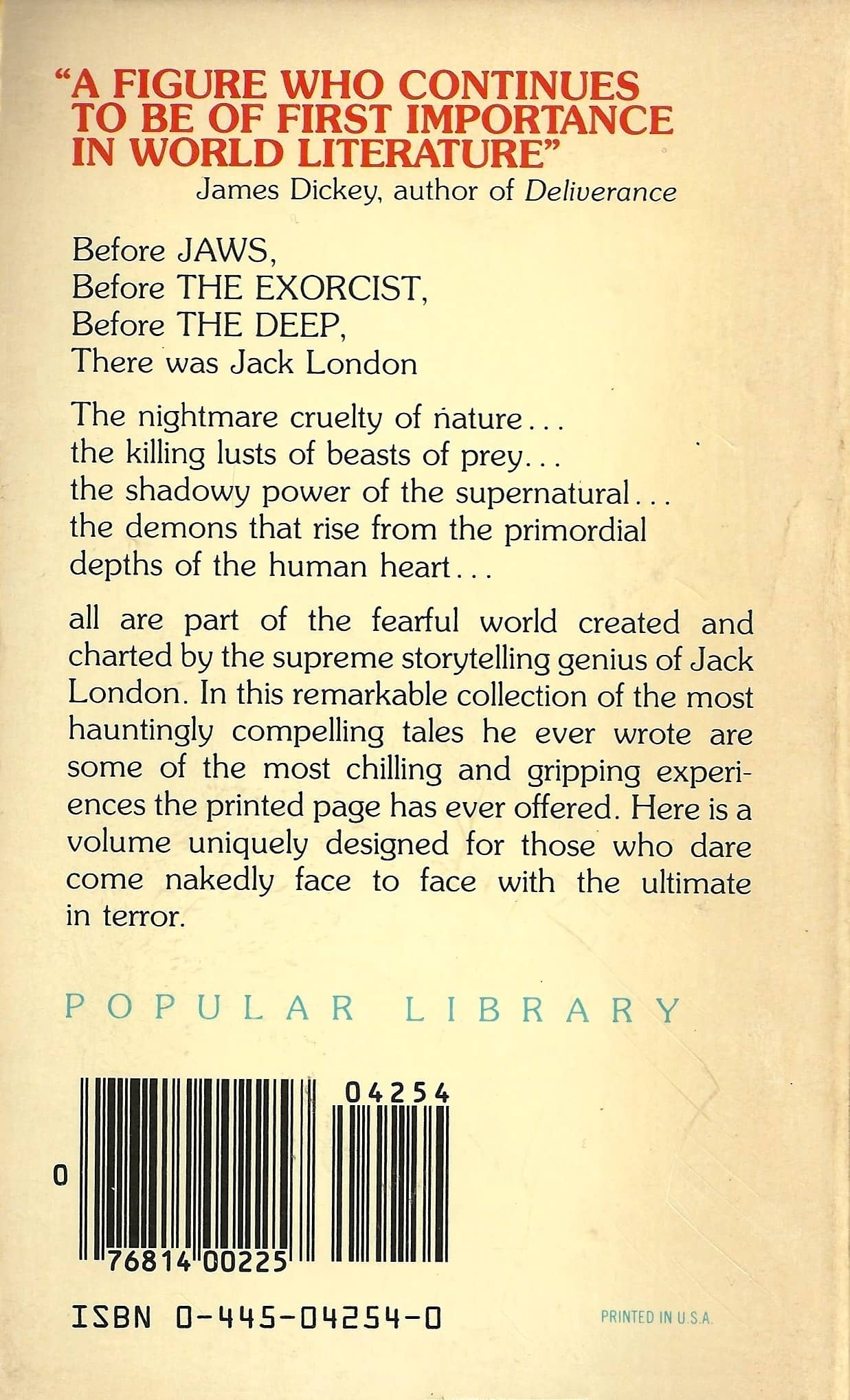
Three years later some of his most popular supernatural stories, like “A Thousand Deaths” (from The Black Cat, May 1899), and “Even Unto Death” (San Francisco Evening Post Magazine, 1900) were published in paperback for the first time, with several of London’s tales of suspense, in Thirteen Tales of Terror (Popular Library), edited and with an introduction by John Perry. Here’s a photo of the intriguing story teasers from the inside front cover.

Read More Read More

From Ancient Opar to the Moon: An Interview with Author Christopher Paul Carey

From Ancient Opar to the Moon: An Interview with Author Christopher Paul Carey

Swords Against the Moon Men-full jacket-small

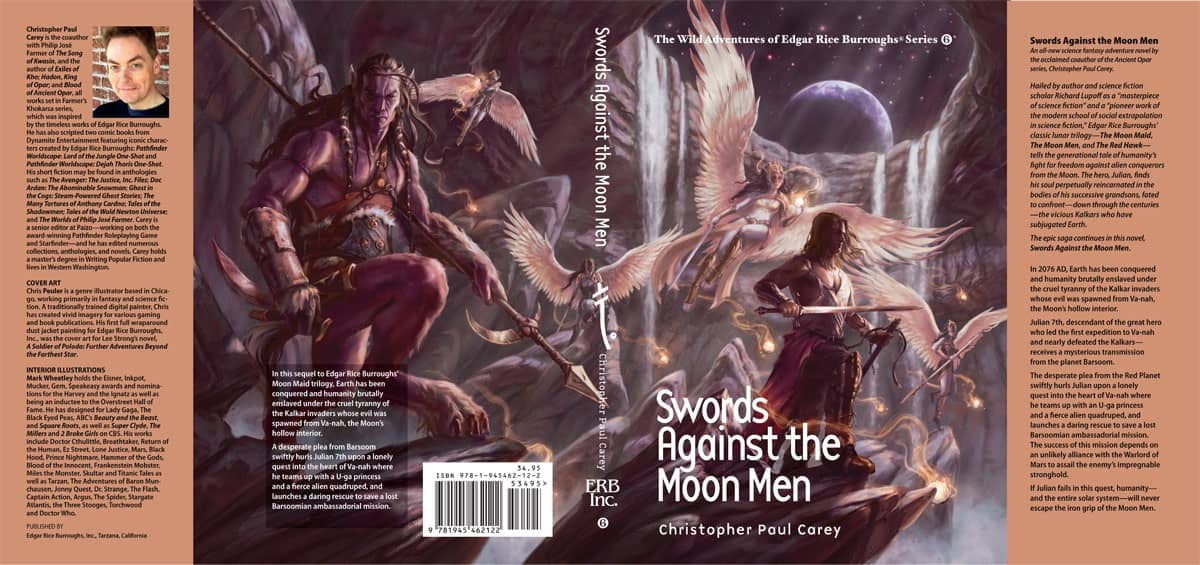
Christopher Paul Carey is a name well known to the readers of Philip José Farmer. In 2012, his collaboration with Farmer, The Song of Kwasin, was published by Subterranean Press in the omnibus Gods of Opar: Tales of Lost Khokarsa. Other installments in the Khokarsa series (also known as the Ancient Opar series) by Carey followed, including Exiles of Kho, Hadon, King of Opar, and Blood of Ancient Opar. As Farmer’s Khokarsa series was inspired by the lost city of Opar from Edgar Rice Burroughs’ Tarzan novels, it is fitting that Christopher Paul Carey now tries his hand at Swords Against the Moon Men, a new novel set in the world of Burroughs’ Moon trilogy (The Moon Maid, The Moon Men, and The Red Hawk). I took some time to ask Chris about Swords Against the Moon Men as well as other aspects of his writing career.

Your latest novel, Swords Against the Moon Men, is the sixth volume in the Wild Adventures of Edgar Rice Burroughs series. Could you tell us a little bit about the series, for the benefit of readers who are unfamiliar with it, and how your novel fits in?

The Wild Adventures of Edgar Rice Burroughs is a new line of books authorized and published by Edgar Rice Burroughs, Inc. The books are all set in Burroughs’ fantastical worlds but written by today’s authors. So far, the series includes four new Tarzan books (Tarzan: Return to Pal-ul-don by Will Murray, Tarzan on the Precipice by Michael A. Sanford, Tarzan Trilogy by Thomas Zachek, and Tarzan: The Greystoke Legacy Under Siege by Ralph N. Laughlin and Ann E. Johnson), a sequel to Burroughs’ Beyond the Farthest Star (A Soldier of Poloda by Lee Strong), and now my novel, Swords Against the Moon Men, which takes place in the world of Burroughs’ lunar trilogy.

Read More Read More

Modular: Resurrecting RuneQuest: An Investigation by the Tales of the Reaching Moon Editorial Staff

Modular: Resurrecting RuneQuest: An Investigation by the Tales of the Reaching Moon Editorial Staff

Runequest Deluxe Third Edition boxed set-small Runequest Deluxe Third Edition boxed set 2-back-small

[This article was originally published in Tales of the Reaching Moon #5 in Spring, 1991, after the RuneQuest trademark had been sold to Avalon Hill and the game re-released in Deluxe and Standard boxed sets. Its publication was a catalyst for Avalon Hill bringing Ken Rolston on board and kicking off what became known as the (short-lived) “RuneQuest Renaissance.”

This article was actually based on a report commissioned by Avalon Hill itself in 1990 (prior to the decision to publish Eldarad). The original report was written by an award-winning game designer.]

Introduction

RuneQuest is a great game. We all know that. Unfortunately, things haven’t been going so good for the game for some time. We all know that too. We, the Tales of the Reaching Moon staff present here our thoughts about the history of the game, the hole RuneQuest is currently in, and what action we think Avalon Hill should take to dig its way out again.

Read More Read More

Vintage Treasures: Blind Voices by Tom Reamy

Vintage Treasures: Blind Voices by Tom Reamy

Tom Reamy Blind Voices-back-small Tom Reamy Blind Voices-small

In a 2014 Vanity Fair interview, George R.R. Martin shared just how profoundly he was affected by the death of Tom Reamy in 1977.

Tom died of a heart attack just a few months after winning the award for best new writer in his field. He was found slumped over his typewriter, seven pages into a new story. Instant. Boom. Killed him… Tom’s death had a profound effect on me, because I was in my early thirties then. I’d been thinking, as I taught, well, I have all these stories that I want to write… and I have all the time in the world… and then Tom’s death happened, and I said, Boy. Maybe I don’t…

After Tom’s death, I said, “You know, I gotta try this. I don’t know if I can make a living as a full-time writer or not, but who knows how much time I have left?…” So I decided I would sell my house in Iowa and move to New Mexico. And I’ve never looked back.

In the same article George also commented on the relentless pace of production on Game of Thrones, saying “Long before they catch up with me, I’ll have published The Winds of Winter, which’ll give me another couple years. It might be tight on the last book, A Dream of Spring, as they juggernaut forward.” Might be tight indeed. Almost four years later The Winds of Winter remains unpublished, and GoT has long since passed the novels.

Who the heck was Tom Reamy? That’s a question the late Bud Webster attempted to answer in his inaugural column in Black Gate 15.

Read More Read More

Lost and Found Treasure

Lost and Found Treasure

Sword and Sorceress VII-small Sword and Sorceress VII-back-small

A few weeks ago, I was cruising Facebook when I stopped up short at a familiar image.

It was on our esteemed editor John O’Neill’s wall. And as is often the case with such things, I was struck by a wealth of memories. I received Sword and Sorceress VII as a gift for my 12th birthday. It was probably bought at the B. Dalton in College Mall in Bloomington, IN, one of two easily accessible bookstores on that side of town back in 1990. (Before anyone does the math too fast, yes, I’m celebrating a big birthday next year. It’s in May, if you want to send gift cards for more books.)

I couldn’t tell you exactly which stories were in this volume. I know it had one of Mercedes Lackey’s “Tarma and Kethry” tales in it, but beyond that none of them stand out alone. But as a whole, that volume changed my life as a reader. While I’d feasted on the The Chronicles of Narnia, Robin McKinley, and Susan Cooper, this book was my first exposure to fantasy for grown-ups. And it was full of women.

When I think casually, 1990 doesn’t feel that far away. But in terms of the way women were portrayed in fiction it was another era entirely, and in ways I can’t even begin to explain unless you were there.

Read More Read More

Vintage Treasures: Red Dust by Paul J. McAuley

Vintage Treasures: Red Dust by Paul J. McAuley

Red Dust Paul McAulley-small Red Dust Paul McAulley-back-small

Paul J. McAuley was the first book reviewer for Black Gate, way back in 2000-01. His first novel, the far-future space opera Four Hundred Billion Stars (Del Rey, 1988) won the Philip K. Dick Award, the sequels Of the Fall and Eternal Light appeared in 1989 and 1991.

His first standalone novel Red Dust, set on a far-future Mars colonized by the Chinese, was published by Gollancz in the UK in 1993 and AvoNova in the US in 1995. It was packed with big ideas and technologies that are still being explored in SF today, including personality downloads, biotech, virtual reality, nanotech, A.I, and a lot more. Kirkus Reviews raved, saying:

An extraordinary saga.. Seven hundred years hence, a depopulated Earth is ruled by the Consensus eco-fanatics who allow nothing to change; on Jupiter, a self-aware probe calling itself the King of the Cats broadcasts rock music and propaganda; various dwindling groups of dissenters inhabit the asteroid belt; and Mars, habitable but slowly reverting to dust and drought and populated mostly by Chinese, is ruled by a committee of ruthless old men called the Ten Thousand Years, who, in a secret pact with the Consensus, have agreed to let Mars die in return for personal immortality. Young technician Wei Lee, who believes himself beholden to his great-grandfather, one of the Ten Thousand Years, stumbles upon a spaceship crashed in the dust… McAuley’s Mars is at once satisfyingly familiar and disquietingly alien: cultural contrasts, persuasive inventions, and constant surprises are set forth with a weird yet compelling logic. Superb.

The novel has never been reprinted in the US, but copies are still fairly easy to find online. I bought the brand new copy above on eBay for $4 two months ago. It was published by AvoNova in November 1995; it is 392 pages, priced at $4.99 in paperback. The cover is by Tim Jacobus. A digital edition was published by Gollancz/Orion in 2010. Our previous coverage of Paul J. McAuley includes his recent Choice Series and his Confluence novels.

Don’t Mess with Mary: P.L Travers’ Mary Poppins

Don’t Mess with Mary: P.L Travers’ Mary Poppins

Saving Mr. Banks poster-small

Saving Mr. Banks (2013)

I don’t know what this year’s big Christmas movie will be, but a few years ago, the unavoidable holiday hit that was in every theater was Disney’s Saving Mr. Banks, which told the heartwarming story of how Walt Disney (Tom Hanks) pulled out all the stops in persuading Patricia L. Travers (Emma Thompson) to permit him to make a movie featuring her creation, Mary Poppins. I didn’t see the movie, though from everything I heard it was both a thoroughly professional entertainment and a disgraceful whitewash of the events it purports to dramatize. (If you haven’t seen Harlan Ellison’s hilarious takedown of the film, it’s ready and waiting on YouTube, anytime you can make sure that the children are safely out of the house.)

Travers always regretted the necessity of giving in to Disney, but necessity it was; she badly needed the money, and Walt knew it. Considering the circumstances, she drove as hard a bargain as she could, fighting tirelessly to preserve the essence of her creation, even as she knew that she was doomed to fail, as fail she did.

Nevertheless, the movie that resulted from Walt’s blandishments, 1964’s Mary Poppins, is reckoned one of Disney’s greatest accomplishments, both artistically and commercially, winning five Oscars (including a best actress statuette for Julie Andrews’ portrayal of Mary) and grossing close to one hundred million dollars on a six million dollar budget. When Walt was right, he was right.

Read More Read More

Vintage Treasures: Soldier Boy by Michael Shaara

Vintage Treasures: Soldier Boy by Michael Shaara

The Killer Angels Michael Shaara-small Soldier Boy Michael Shaara-small Soldier Boy Michael Shaara-back-small

Michael Shaara won the Pulitzer Prize for his 1974 Civil War novel The Killer Angels. It was a huge bestseller, selling more than 2 million copies worldwide, and became the basis for the 1993 film Gettysburg.

Most of Shaara’s legion of fans don’t know that he began his career as as a science fiction writer. His first publication was “Orphans of the Void” in the June 1952 issue of Galaxy Science Fiction. Matthew Wuertz has been reviewing the entire back catalog of Galaxy since its first issue; he described the story thusly.

Captain Steffens and his crew explore the Tyban solar system. They find the third planet populated by millions of robots. The robots are telepathic, in the likeness of their makers, who are nowhere to be found. Yet the robots continue to await the return of their makers, for their longing to serve is their primary function. This was a marvelous tale of first encounters. It plays out well, with a touch of sadness that leads to great hope.

Over the next 30 years Shaara’s short fiction appeared in genre magazines like F&SF, Astounding, Fantastic Universe, and Galaxy. In 1982 he issued a single collection gathering most of his finest short fiction, Soldier Boy, published through David Hartwell’s legendary Timescape imprint at Pocket Books.

Read More Read More

Wings, Wind, and World-Wreckers: The Best of Edmond Hamilton

Wings, Wind, and World-Wreckers: The Best of Edmond Hamilton

Best-of-Edmond-Hamilton-SFBCJames McGlothin has been providing excellent continuing coverage on Black Gate of Del Rey’s famous “The Best Of…” anthologies that shaped many SF readers in the 1970s. He was kind enough to allow me to take a pile of notes I’d assembled for Del Rey’s The Best of Edmond Hamilton (1976) and do an entry in the series. I also sought the blessing of our editor John O’Neill because Edmond Hamilton is his favorite pulp author and I wanted to feel sure I wasn’t intruding too far into another’s territory. Both James and John are welcome to trash Edgar Rice Burroughs and Godzilla as much as they want after this.

I’ll admit to having absorbed less Edmond Hamilton than I should. I’ve read some of his short fiction, but only one of his novels, The Star Kings (1947), a science-fiction variant on The Prisoner of Zenda that’s about as thrilling as Golden Age space opera gets. (Because John O’Neill will ask, I read the original magazine version of The Star Kings, not the later book revision with the sequel-friendly ending.) I’m more familiar with the work of Hamilton’s wife, Leigh Brackett, one of the great science-fiction writers and one of my favorite authors of all time. Their marriage didn’t lead to frequent collaborations, as the marriage of C. L. Moore and Henry Kuttner did. I’m glad Hamilton and Brackett maintained separate writer identities, and the feeling became sharper after reading this selection of what Brackett thought was her husband’s finest short fiction.

I’ve read many of the Del Rey “Best Of…” volumes, but few that I’ve enjoyed as consistently as this one. It’s not only because Hamilton was a superb writer — all the authors in the series were first-rank SF masters — but because of two specific factors.

Read More Read More

Vintage Treasures: Farewell Fantastic Venus! edited by Brian W. Aldiss with Harry Harrison

Vintage Treasures: Farewell Fantastic Venus! edited by Brian W. Aldiss with Harry Harrison

Farewell Fantastic Venus!-small Farewell Fantastic Venus!-back-small

One of the things I love about pulp SF is its romanticized view of our solar system. The ancient canals and lost cities of Mars, the steaming dinosaur-ridden swamps of Venus. I can still remember the bitter disappointment I felt when I first learned that science had proven Venus completely inhospitable to life. It felt like the solar system had been robbed of its greatest potential for extra-planetary adventure.

Many SF writers felt very much the same way. Two recent anthologies from Gardner Dozois and George R.R. Martin, Old Mars and Old Venus, have done a splendid job re-capturing some of that old pulp magic with a generous sampling of modern tales set in retro-versions of both planets.

But they weren’t the first books to celebrate a cherished (and now obsolete) vision of our solar system. That honor probably goes to Farewell Fantastic Venus!, a 1968 anthology released shortly after the first probes reached Venus, and the hard truth was revealed. The book contains classic Venusian fiction by Arthur C. Clarke and John & Dorothy de Courcy, and two novellas by Poul Anderson, including a Psychotechnic League tale. There’s also a rich sampling of novel excerpts by Olaf Stapledon, Edgar Rice Burroughs, C. S. Lewis, and others. All that plus science articles by Frank R. Paul, Carl Sagan, Sir Bernard Lovell, Willy Ley, and others.

Read More Read More