Browsed by
Category: Vintage Treasures

A Return to Terry Carr’s Best Science Fiction of the Year

A Return to Terry Carr’s Best Science Fiction of the Year

Terry Carr Best Science Fiction of the Year-small

My taste in science fiction — like my taste in music and film — was shaped early. What I learned to love as a teen I largely still enjoy… with some exceptions. One of those exceptions is Terry Carr’s Best Science Fiction of the Year. I picked up my first one in 1977, at the age of 13, and I discovered pretty quickly that they weren’t for me. I went back to reading pulp SF in books like Before the Golden Age, and was blissfully happy to do so for many years.

I’ve returned to Carr’s Best Science Fiction of the Year recently, and discovered why I didn’t connect with them four decades ago: unlike many of his contemporaries, Carr brought an adult eye to SF, and the fiction he selected spoke to adults. It still speaks to adults today, clearly and with no loss of voice, and I now consider Carr’s Best volumes — especially the ones he did in the mid-70s — to be some some of the best SF anthologies ever printed. Here’s what I said last year about #3, published in 1973.

How incredible was The Best Science Fiction of the Year #3? It contains some of the finest science fiction stories of all time, packed into one slender volume. Like “The Women Men Don’t See” by James Tiptree, Jr… perhaps her most famous story, and that’s saying something. And Vonda N. McIntyre’s Nebula Award-winning “Of Mist, and Grass, and Sand,” which became the basis of her 1978 novel Dreamsnake (which swept the Hugo, Nebula, and Locus Awards the following year.) And Harlan Ellison’s classic “The Deathbird,” the Hugo and Locus Award-winning title story of his celebrated 1975 collection Deathbird Stories. Plus Gene Wolfe’s famous “The Death of Dr. Island,” winner of the Locus and Nebula awards for Best Novella.

And an unassuming little story by a young writer named Ursula K. Le Guin, “The Ones Who Walk Away from Omelas,” which won the Hugo Award for Best Short Story, and is considered by many (me included) to be one of the finest short stories ever written. And lots more — including a Jack Vance novella, plus stories by Philip José Farmer, Alfred Bester, R. A. Lafferty, Robert Silverberg, and F. M. Busby. All for $1.50!

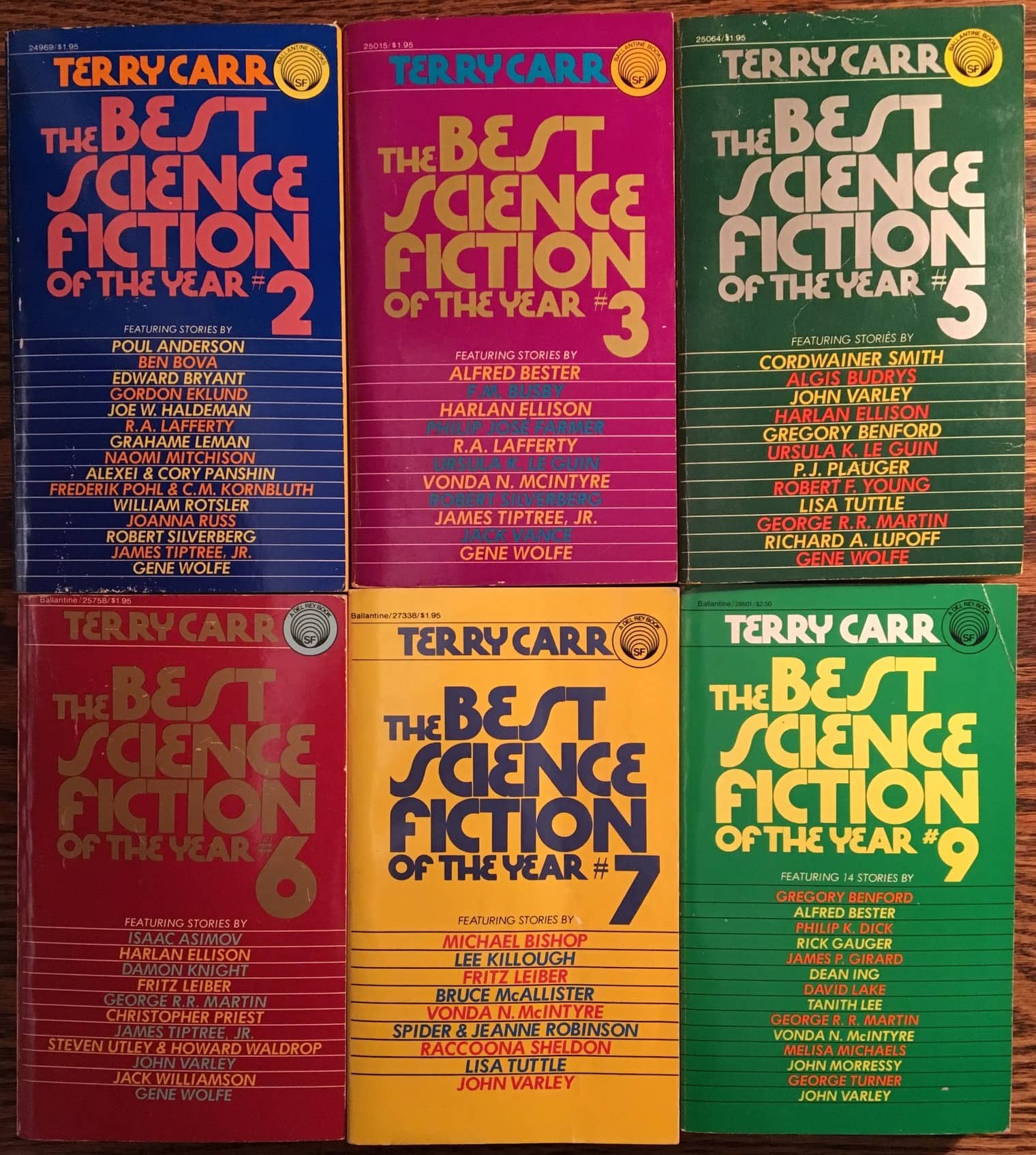
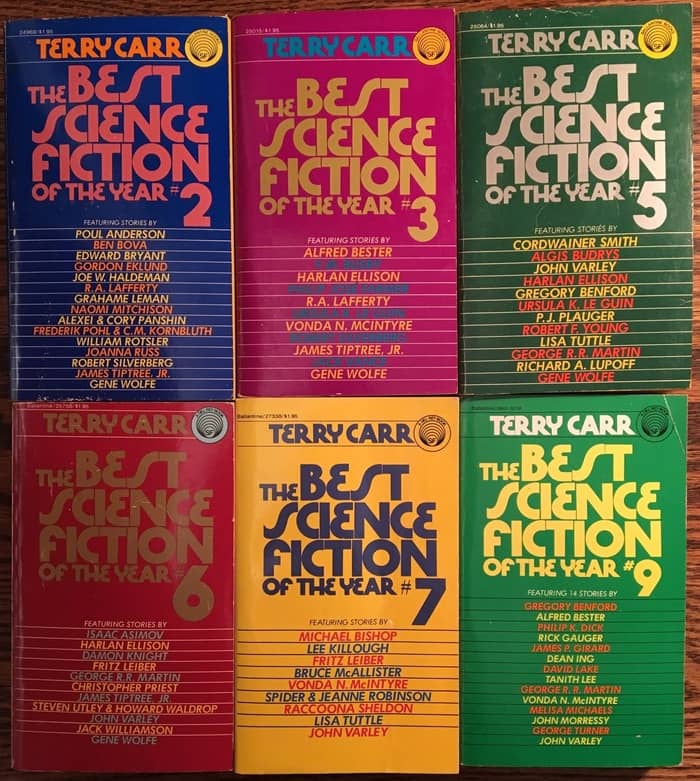
Last month I purchased a fine collection of six Best Science Fiction of the Year volumes (pictured above) on eBay for the criminally low price of $7. They arrived a few weeks ago, and I’ve stolen a few minutes here and there to dip into them. It’s been an enormously rewarding experience.

Read More Read More

Old Empires and Armored Planets: Rich Horton on The Sun Smasher by Edmond Hamilton and Starhaven by Ivar Jorgenson

Old Empires and Armored Planets: Rich Horton on The Sun Smasher by Edmond Hamilton and Starhaven by Ivar Jorgenson

The Sun Smasher Edmond Hamilton-small Starhaven Ivar Jorgenson-small

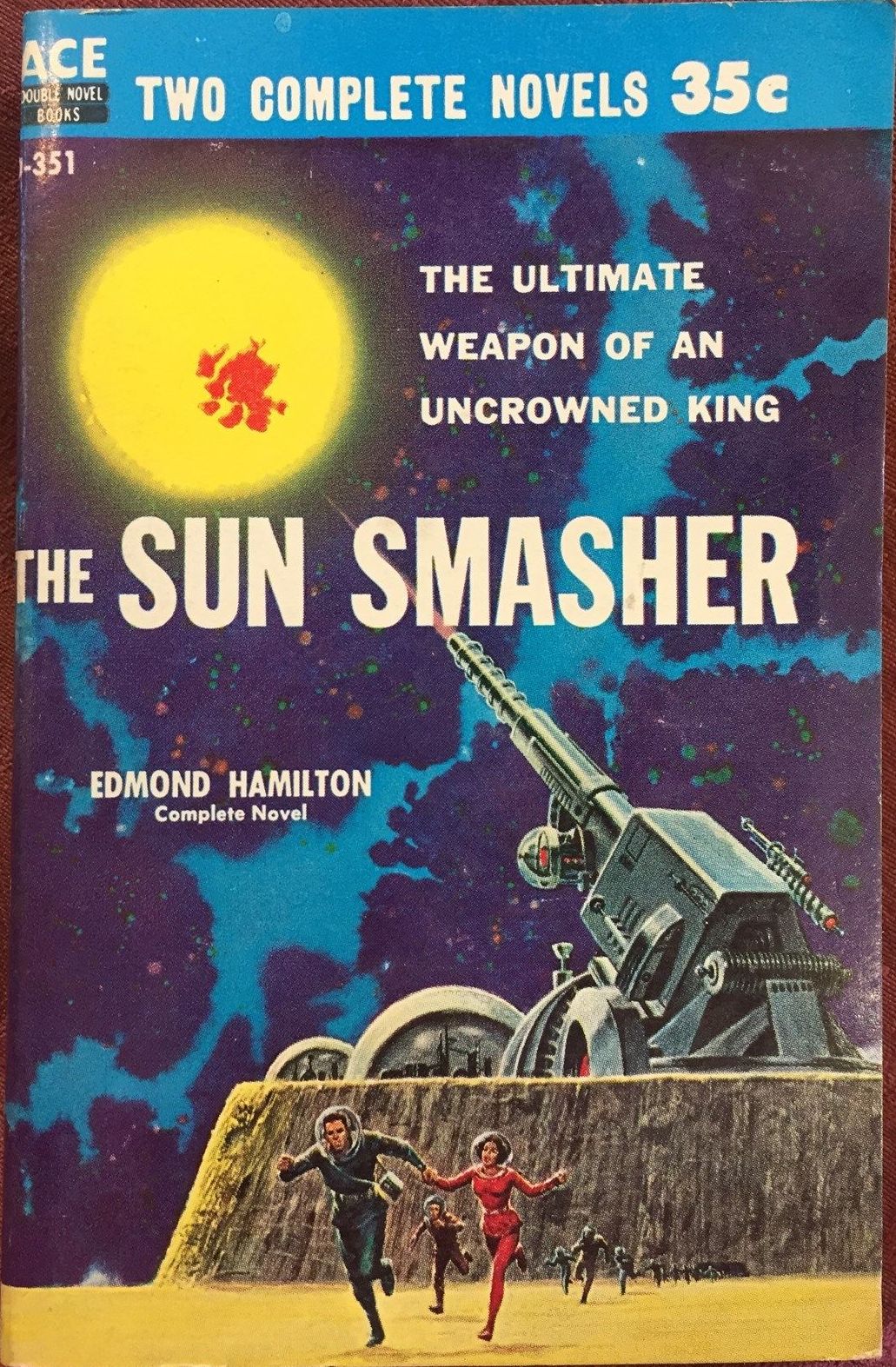
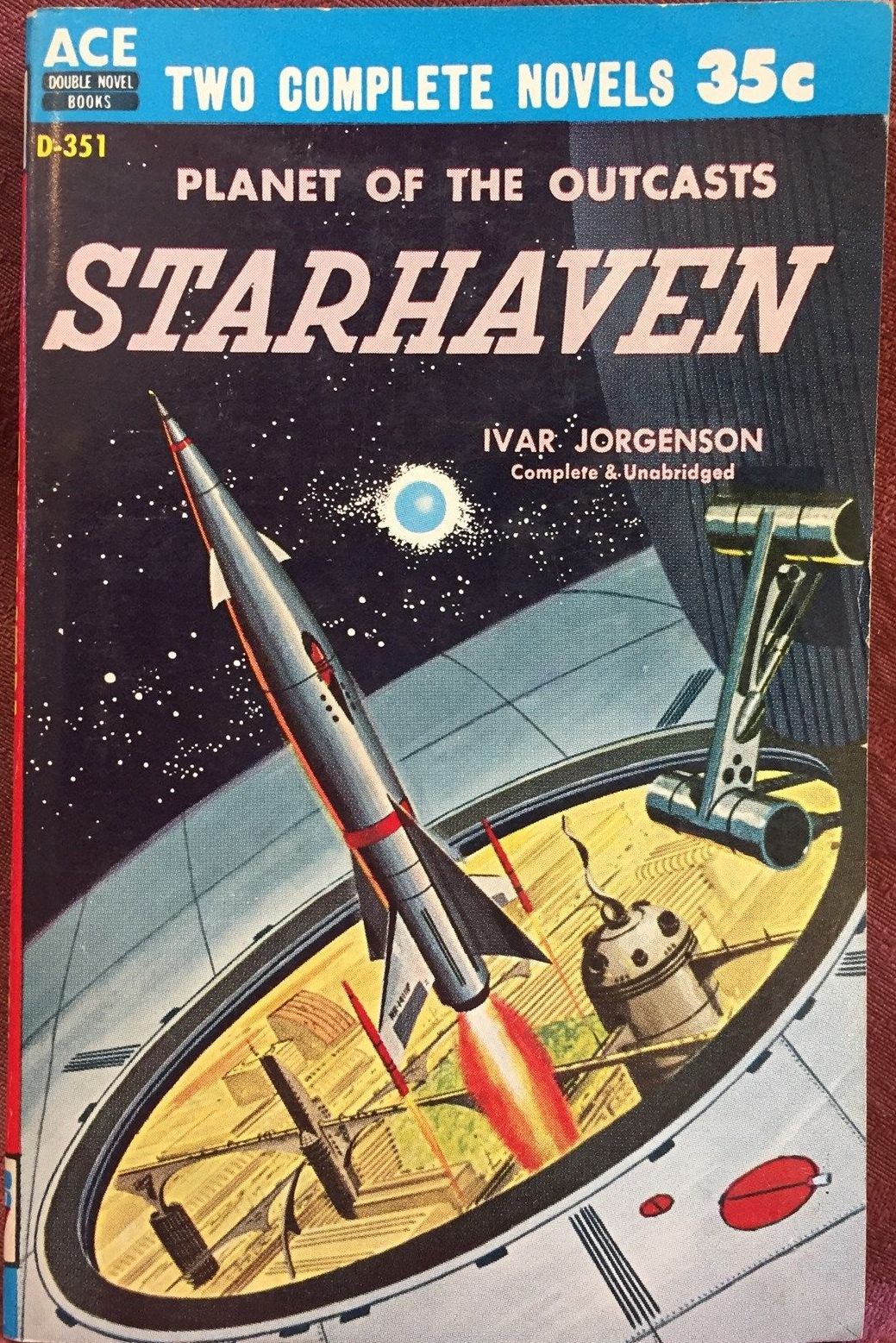
Rich Horton has been reading through the Ace Double library over at his blog Strange at Ecbatan. His last few selections have been duds, but I’m optimistic about Edmond Hamilton’s The Sun Smasher and Ivar Jorgenson’s Starhaven, Double #D351, published in 1959. Edmond Hamilton was my favorite pulp SF writer, and “Ivar Jorgenson” was a pen name for none other than Robert Silverberg.  Here’s Rich.

Each of these novels was published earlier in a single issue of a magazine, possibly (especially in the case of the Jorgenson novel) in shorter versions. The Sun Smasher appeared as “Starman Come Home” in the September 1954 Universe Science Fiction, while Starhaven appeared as “Thunder Over Starhaven” in Science Fiction Adventures for October 1957. (I suspect the Hamilton novel, which is the shorter of the two at about 30,000 words, probably is the same version as appeared in the magazine, but the “Jorgenson” story, some 40,000 words long or more, is expanded, as Silverberg discusses below.)

The covers of the magazine editions of these stories are something of a real delight, so I’ve reproduced them here.

I always enjoy Rich’s reviews of classic SF. But when he starts throwing in vintage magazine covers, you know he’s really speaking my language.

Read More Read More

Vintage Treasures: Changing Fate by Elisabeth Waters

Vintage Treasures: Changing Fate by Elisabeth Waters

Elisabeth Waters Changing Fate-back-small Elisabeth Waters Changing Fate-small

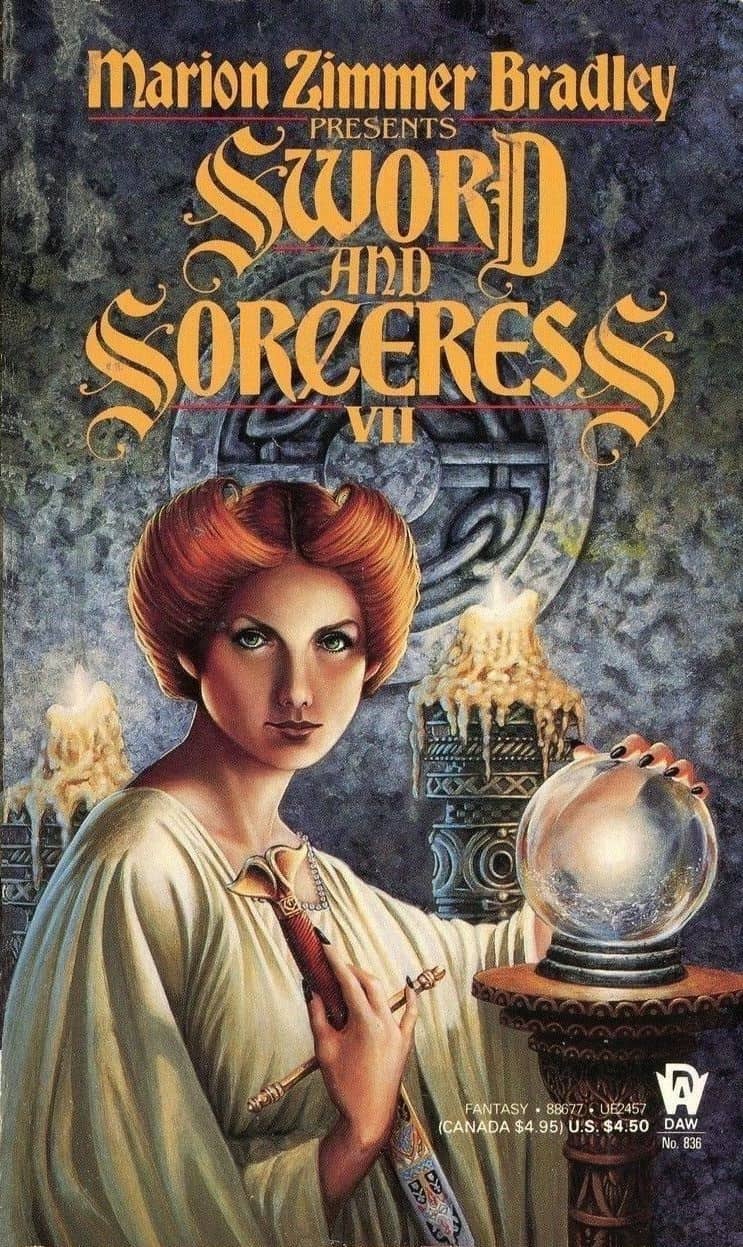
Elisabeth Waters’ first publication, “The Keeper’s Price,” was co-authored with Marion Zimmer Bradley and appeared in Bradley’s 1980 Darkover anthology The Keeper’s Price and Other Stories. That launched a lengthy writing career that includes over 40 short stories and a novel in the Trillium series, also co-authored with Bradley. Since 2007 Waters has been the driving force behind the Sword and Sorceress anthology series, taking over with Volume XXII at Norilana Books. The most recent,  Volume 32, was released last month by the Marion Zimmer Bradley Literary Works Trust.

Waters published a single standalone novel, Changing Fate, in 1994, with a striking wraparound cover by Lord of the Rings artist John Howe. It grew out of the short story “A Woman’s Privilege” in Sword and Sorceress 3, published in 1986; it was nominated for the Locus Award for Best First Novel, and won Andre Norton’s Gryphon Award. A sequel, Mending Fate, finally appeared last year, 22 years after the first volume, from the Marion Zimmer Bradley Literary Works Trust.

Changing Fate was published by DAW Books in April 1994. It is 240 pages, priced at $4.99 in paperback. The cover is by John Howe. It was reprinted in trade paperback and digital formats in 2015. Read more at Elisabeth Waters’ website.

Little Miss Martian

Little Miss Martian

Other Worlds May 1951-small Other Worlds May 1951-back-small

Other Worlds, May 1951. Cover by Hannes Bok

Other Worlds Science Fiction launched in November 1949, part of the boom in f&sf magazines in a postwar world that retroactively realized their worth after real life rockets and atomic bombs made headlines. It was frankly third-tier, half written by Rog Phillips under pseudonyms and half by younger writers striving to make their mark. After a year or two, though, some bigger names like Ray Bradbury, A. E. van Vogt, and Robert Bloch were lured in and a few of the newcomers would develop into stars of equal rank. Even so, fans read it for fun and excitement, not literary quality. Issue after issue sated with a plenitude of humor stories, starting with the Hoka series by young Poul Anderson and Gordon R. Dickson, and robot stories, including ones by Bradbury, van Vogt, and Bloch, and humorous robot stories, many by authors nobody remembers (such as Hodge Winsell, whose two atrocities comprise his entire f&sf oeuvre).

One reason for the increase in quality was hidden from readers. The editor for the first issue was listed as Robert N. Webster, another pseudonym. Knowledgeable fans would have been tipped off by the presence of “The Fall of Lemuria” by Richard S. Shaver, a true screwball who might have believed in his stories about an alien civilization hidden within the Earth. Ray Palmer had pushed circulation at Amazing Stories to the  f&sf magazine peak with Shaver until his bosses grew tired of the slime on their fingers. Sure enough, Robert N. Webster was Ray Palmer and Other Worlds was headed down that same path.

And then the horribly unlucky Palmer, who grew up hunched and dwarfed after a car accident when he was seven, slipped, fell, and became temporarily paralyzed from the waist down. A 21-year-old fan, Bea Mahaffey, who was already on the payroll as Managing Editor, i.e. editor of scutwork, quietly took over, adding Marge Budwig Saunder to replace her hands-on jobs. Today it’s given that the sudden veer away from Shaver and toward solid second-tier status is attributable to Mahaffey.

Read More Read More

My All-Story Story, or, A Tale of Tarzan (Not Triumphant)

My All-Story Story, or, A Tale of Tarzan (Not Triumphant)

all story 1912 10 uk edition modified-small

Those who know me well are aware that I’m not a morning person (to put it mildly). Accordingly, they’d be shocked to learn that not only did I get up on Saturday, November 25th morning at 5:00 a.m., I did so voluntarily and eagerly! As collectors will attest, however, no price – even missing hours of delightful sleep! – is too great to pay in the pursuit of one of your collecting grails. Of course, it’s much more gratifying when the pursuit pays off. Unfortunately for me, it did not. Even so, I’m glad I got up to give it a shot.

About a week ago, I learned that an auction house in England would be auctioning off a copy of the October 1912 issue of The All-Story, which features Edgar Rice Burroughs’ complete novel, Tarzan of the Apes. All other things being equal in terms of condition, that issue is the most valuable of all the pulp magazines (the nicest copy I’m aware of having sold at auction, in fine condition, sold over a decade ago for nearly $60,000). This auction house clearly had no idea of its value, as their pre-sale estimate was between 20 and 40 pounds! A decent copy of this pulp has been my number one pulp grail for decades, and I hoped that this one would slip through the collecting cracks on its way to me. The auction house only had one photo of it online, and I couldn’t obtain any other photos of it, so condition was a bit of a guess, which complicated bidding. The front cover had some overall wear, but generally looked decent, but I had no clue on the condition of the spine, back cover or paper. See the photo above.

What made this particularly interesting was that it was the British edition of The All-Story, rather than the American edition. For a period of time in the teens (and I think going back a little earlier than that), The All-Story was also published in Britain, with the same cover date as the American edition. The covers noted that the price was Six Pence, rather than Ten Cents, and I believe the ads were different, but the fiction content was the same. I assume that the British edition was published at least a few days later than the American edition (the October 1912 American edition actually went on sale on September 10, 1912), but I don’t know how much of a delay there was. My guess is that it was later than the American edition, so technically this was not the first printing of the story, unlike the American.

Read More Read More

Vintage Treasures: Neverness by David Zindell

Vintage Treasures: Neverness by David Zindell

Neverness David Zindell-back-small Neverness David Zindell-small

David Zindell was nominated for the John W. Campbell Award for Best New Writer in 1986. His space opera trilogy A Requiem for Homo Sapiens (The Broken God, The Wild, and War in Heaven) received plenty of attention in the mid-90s, including a Clarke Award nomination for the opening novel. He also produced a six-book fantasy series, the EA Cycle, but it was not as well received, and only three volumes were ever released in the US.

Much of his reputation today, in fact, comes from his debut novel Neverness, which won instant and wide acclaim. Edward Bryant called it a “Feat of universe crafting [that] propels him instantly into the big leagues with the likes of Frank Herbert and Ursula K. Le Guin.” Kirkus Reviews said “Zindell succeeds brilliantly… in his convincing portrayal of what a super-intelligent being might be like…. Vastly promising work.” And on the basis of this single novel, Gene Wolfe proclaimed Zindell “One of the finest talents to appear since Kim Stanley Robinson and William Gibson — perhaps the finest.”

Zindell has not published a book in the US since The Silver Sword in 2007. His literary career has prospered far better in the UK, however, and his most recent novel, The Idiot Gods, was released across the pond by HarperVoyager in July 2017. It does not yet have a US release date.

Neverness was published by Bantam Spectra in July 1989. It is 552 pages, priced at $4.95. It was reprinted multiple times in the UK by Grafton and HarperCollins, but only once in the US, in a self-published edition in 2015. The wraparound cover of the Spectra version is by Don Dixon.

Vintage Treasures: The American Fantasy Tradition edited by Brian M. Thomsen

Vintage Treasures: The American Fantasy Tradition edited by Brian M. Thomsen

The American Fantasy Tradition Brian M Thomsen-small

Brian Thomsen’s first anthology was Halflings, Hobbits, Warrows & Weefolk: A Collection of Tales of Heroes Short in Stature, a 1991 Questar paperback co-edited with Baird Searles. He followed that with more than a dozen more over the next 20 years — including The Reel Stuff (1998), Oceans of Magic (2001), and Masters of Fantasy (2004) — most co-edited with Martin H. Greenberg. He was the Senior Editor of SF and Fantasy at Warner Books and then Director of Books and Periodicals at TSR, where he wrote several Forgotten Realms novels, including Once Around the Realms (1995) and The Mage in the Iron Mask (1996).

He eventually became a Consulting Editor at Tor, where he produced in my opinion the most significant book of his career, and indeed one of the most important fantasy anthologies of the 90s: The American Fantasy Tradition, a massive 600-page hardcover surveying two centuries of American fantasy, containing stories by Washington Irving, Nathaniel Hawthorne, Mark Twain, Louisa May Alcott, Henry James, Ambrose Bierce, Kate Chopin, Stephen Vincent Benét, Edith Wharton, Robert W. Chambers, H. P. Lovecraft, Manly Wade Wellman, Charles Beaumont, Henry Kuttner, Theodore Sturgeon, Richard Matheson, Fredric Brown, Ray Bradbury, R. A. Lafferty, Alan Dean Foster, Shirley Jackson, Avram Davidson, Harlan Ellison, Stephen King, Gene Wolfe, Karl Edward Wagner, Ursula K. Le Guin, Michael Bishop, and many others.

The American Fantasy Tradition is one of the finest survey anthologies of Western fantasy ever assembled, and it would serve as a splendid textbook for any introductory course to modern fantasy. It stands with David Hartwell’s The Dark Descent, Gardner Dozois’s Modern Classics of Fantasy, and Jeff and Ann VanderMeer’s The Weird as one of the essential texts of the fantasy canon.

Read More Read More

Remembering Frank M. Robinson’s Legendary Pulp Collection

Remembering Frank M. Robinson’s Legendary Pulp Collection

William F Nolan and Franks Pulps300-small

William F. Nolan pointing at the Hammett Black Mask

Frank M. Robinson lived an incredible life. He was drafted into the navy in World War II, wrote his first novel The Power in 1956, and saw three of his books transformed into major motion pictures, including The Power (1968),  The Towering Inferno (1974), and The Fifth Missile (1986). His other novels include Blow-Out! (1987, with Thomas N. Scortia) and The Dark Beyond the Stars (1991). He wrote the Playboy Advisor column from 1969 to 1973, and played himself in the 2008 film Milk, as one of Harvey Milk’s political inner circle.

But for science fiction and fantasy collectors, Frank is chiefly known for an entirely different reason: he had one of the most valuable and complete pulp collections ever assembled. His collection was legendary for the incredible condition of most of the magazines, including some of the rarest pulps in existence. Last week Jason V. Brock posted several unseen photos of Frank’s collection on Facebook, and was kind enough to offer us high-resolution versions we could share with Black Gate readers.

Read More Read More

Amazing Science Fiction Stories, February 1960: A Retro-Review

Amazing Science Fiction Stories, February 1960: A Retro-Review

Amazing Science Fiction Stories February 1960-smallHere’s a pretty early Cele Goldsmith issue. The names on the TOC reflect that — a lot different than in the 1963-1965 era — only Ben Bova would be familiar from latter days, and he mostly did nonfiction.

The cover is by Edward Valigursky, another contributor who didn’t appear as much later on. (His last cover was for the May 1960 issue.) Interiors are by Leo Summers, Varga, and Virgil Finlay. The editorial, extremely brief, is as ever by Norman Lobsenz, and concerns suspended animation. S. E. Cotts’ book reviews cover Manly Wade Wellman’s The Dark Destroyers, which she enjoyed a great deal more than I did; The Outward Urge, by John Wyndham and Lucas Parkes, a fixup of four stories from Fantastic, which she didn’t like much at all; and John Brunner’s The World Swappers, which she thought quite good.

The lettercol has contributions from Chester F. Milburn, Mike Deckinger, Ronald Felty, Philip A. Harrell, Arthur B. Prag, and Tobey Reed.

The stories are:

Complete Novel

“Transient,” by Ward Moore (35,000 words)

Short Stories

“A Long Way Back,” by Ben Bova (6,000 words)
“Divvy Up,” by Milt Lesser (4,700 words)
“It’s a Good Trick If …,” by Kate Wilhelm (1,900 words)
“A Jar of Jelly Beans,” by Franklin Gregory (4,900 words)

To begin with the short novel. Ward Moore (1903-1978) published five novels, beginning with Greener Than You Think (1947). His most famous novel by far is Bring the Jubilee (1953), a very well-regarded alternate history in which the South wins the Civil War. He is also remembered for his last novel, Joyleg (1962), a collaboration with Avram Davidson, about a Revolutionary War veteran discovered to be still alive in the present time; and for a stunning post-Apocalyptic (or “during the Apocalypse”) story, “Lot,” along with its sequel, “Lot’s Daughter.” As a writer he started late and finished early, with the great bulk of his fiction appearing between 1947 and 1962 (though a few more stories appeared in the ’70s).

Read More Read More

Vintage Treasures: The Best Science Fiction Novellas of the Year 1, edited by Terry Carr

Vintage Treasures: The Best Science Fiction Novellas of the Year 1, edited by Terry Carr

The Best Science Fiction Novellas of the Year 1 Terry Carr-small The Best Science Fiction Novellas of the Year 1 Terry Carr-back-small

Some of the most rewarding books I’ve read in the past few years have been anthologies edited by Terry Carr. Even though he died 30 years ago, in April 1987, his books remain splendid reading for modern audiences, and I think it’s very possible Carr may have been the most gifted editor our field has ever seen. The sixteen volumes of The Best Science Fiction of the Year (1972-1987) he edited may well be the high water mark for Year’s Best anthologies.

In 1979 and 1980, Carr convinced Lester del Del at Del Rey Books to allow him to try an experiment. In effect, to see if the market would bear an additional Terry Carr Best SF, this one showcasing the best SF novellas of the year. It was a noble ambition, and a great idea, but that didn’t mean the market was ready for it. The Best Science Fiction Novellas of the Year died after two volumes, and Carr went back to the frustrating task of trying to fit as many novellas as he could into his slender Best SF paperbacks every year.

I’ve never read either of his Best Novellas books before. But, like his regular Best SF series, both volumes are packed with classic fiction that has stood the test of time, as well as genuine finds. I recently came across the first one in a collection I bought on eBay. I was expecting greatness, and I was not disappointed.

Read More Read More